REVIEW 3 major objections 6 minor 67 references
Generative AI Toolkit -- a framework for increasing the quality of LLM-based applications over their whole life cycle
T0 review · 3 major / 6 minor · reviewed 2026-08-11 · deepseek-v4-flash
Pith's one-line read The Generative AI Toolkit is an open-source framework that automates the build, test, and monitoring phases of LLM-based applications to improve quality and shorten release cycles.
desk verdict This is a useful engineering report on an LLM DevOps toolkit whose central quality claim is asserted rather than measured, and whose one genuinely new idea is explicitly deferred to a later paper. read the letter →
The pith
A machine-rendered reading of the paper's core claim, the machinery that carries it, and where it could break.
The reading
What carries the argument
The central machinery is a trace-and-metric evaluation loop around every agent interaction. The toolkit wraps the agent so that model calls, tool invocations, and conversation turns are recorded as structured traces; developer-defined metrics then reduce those traces to scalar measurements. Around this loop, a permutation mechanism runs the same evaluation cases against many agent configurations in parallel and returns a tabular summary of all measurements grouped by configuration, making model and prompt selection a measurable comparison rather than a guess. The paper also adapts the software-engineering test pyramid to LLM-based agents, proposing to test components in isolation, then interactions, then the whole system, with traces used to verify the intermediate levels. The same cases, metrics, and assertions run in development, in CI/CD, and after deployment, which is what lets the framework serve both quality control and continuous improvement.
What would settle it
Seed a fixed set of known defects (for example, hallucinated menu items, wrong tool invocations, overly long responses, and prompt-sensitivity regressions) into the same agent codebase, run it through the toolkit's layered test pipeline and through an acceptance-only evaluation on identical cases and metrics, and count defects caught per engineering hour; if the layered pipeline does not catch more per hour, the central quality claim fails.
Extended reading notes
Core claim
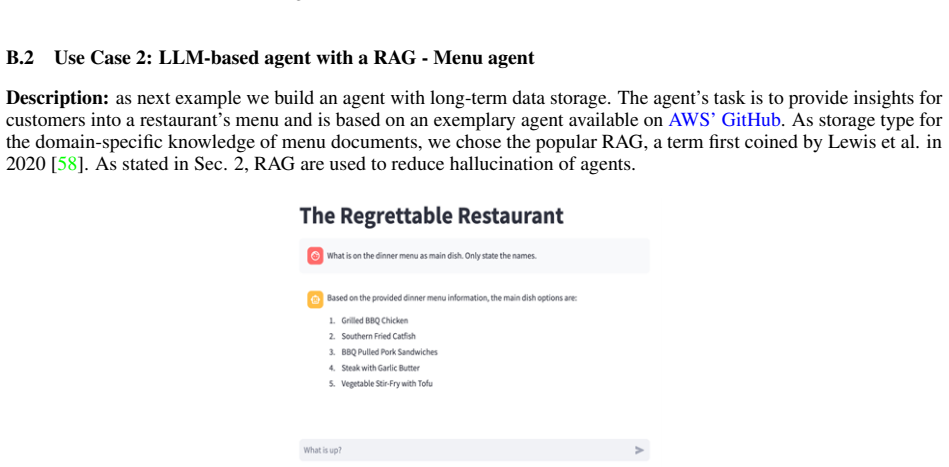
The core claim is that the Generative AI Toolkit constitutes a whole-lifecycle DevOps framework for LLM-based applications and agents, covering the phases code, build, test, and monitoring. The paper spells out concrete mechanisms for each phase: a bootstrapping template that creates a working 'vanilla agent'; a user-defined metric system that can measure response content, tool usage, conversation turns, token counts, per-turn cost, latency, and LLM-as-a-judge quality scores; repeatable evaluation cases; and parallel permutation of agent parameters so that different models, system prompts, temperatures, and tool sets are scored with identical cases and metrics. It also describes integration of these evaluations into CI/CD pipelines, where commit measurements can be compared against thresholds or against the target branch, and a trace-capturing wrapper that records every internal step of the agent for both pre-deployment debugging and post-deployment monitoring. The authors state that these capabilities together reduce manual work and cycle time while improving quality, and they illustrate the claim with four use cases of increasing complexity: a text-to-SQL agent, a retrieval-augmented menu agent, an in-vehicle personal assistant, and a model-comparison run.
Load-bearing premise
The quality benefit rests on the assumption that testing an agent's components in isolation and then their interactions catches more real defects than end-to-end acceptance testing alone and is cheap enough to run in practice, a premise the paper defers supporting to a later publication.
Editorial extensions
If this is right
- Development teams can move from scattered acceptance-testing scripts to a single suite of reusable cases and metrics that runs identically during development and in CI/CD.
- Model and prompt choices become data-driven: permutation runs score every configuration with the same benchmarks, so the best combination is identified by measurement.
- Production monitoring gains a feedback loop: trace logs and custom metrics (including indicators such as 'unfortunately' responses) expose feature gaps and drift and can trigger alarms.
- Pull requests can be checked automatically by comparing evaluation measurements against thresholds or against the latest target-branch measurements, reducing manual review effort.
- Because the framework is open source, the proposed workflow is reproducible and adaptable by other teams rather than locked to a single vendor.
Reading between the lines
- If the deferred validation of the layered test pyramid shows it catches more defects than acceptance-only testing, the same pattern could generalize to other non-deterministic software with hard-to-isolate components, not just LLM agents.
- The trace-and-metric loop points toward a closed, automated feedback cycle in which monitoring alarms do not just page engineers but trigger fallbacks such as prompt retries, model swaps, or rollbacks.
- The paper's admission that generic quantitative benefits are hard to state suggests that a community benchmark with seeded, known agent defects would let future frameworks compete on comparable numbers.
- The toolkit's design as a lightweight library with test-case generation and permutation logic makes it a plausible integration point for standard testing frameworks, which the paper itself lists as future work.
Editorial analysis
A structured set of objections, weighed in public.
Referee Report
Summary. The paper introduces the Generative AI Toolkit, an open-source framework (per the authors) intended to cover the complete DevOps life cycle of LLM-based applications, with emphasis on the phases code, build, test, and monitoring. The described features include agent scaffolding via Cookiecutter templates, user-defined and built-in metrics, repeatable evaluation cases, permutation-based model/prompt comparisons, CI/CD integration, a debugging GUI, and trace-based logging and monitoring. The authors claim that the toolkit 'significantly improve[s] quality while shortening release cycles,' and they support this with four qualitative use cases: a text-to-SQL agent, a RAG-based menu agent, an in-vehicle personal assistant, and a model-comparison study. The paper also discusses related LLMOps tools and positions the toolkit as one of the few free-of-charge and open-source whole-life-cycle frameworks.
Significance. If the toolkit delivers what the paper describes, it is a potentially useful practical contribution to the emerging LLMOps space, where end-to-end, open-source tooling is still scarce. The concrete code listings for metrics and evaluation cases, the explicit discussion of trace-based monitoring, and the comparison with existing frameworks such as Opik and MLFlow are valuable for practitioners. The paper does not provide machine-checked proofs or a quantitative evaluation; its contributions are architectural and experiential. As a result, its significance depends entirely on whether the claimed quality and cycle-time benefits can be substantiated with evidence, which the paper currently does not provide.
major comments (3)
- [Abstract and Section 4] The central claim that the toolkit leads to 'significantly improving quality while shortening release cycles' is not supported by the evaluation. Section 4 states that 'generic statements on the quantitative benefits of the Generative AI toolkit are difficult to make,' and the use cases in Appendix B report only qualitative benefits (e.g., 'reduces manual validation efforts,' 'enables us to compare models'). There are no measured baselines, no controlled comparisons against existing acceptance-level testing frameworks, and no quantification of cycle-time reduction. This is load-bearing because the abstract's headline claim rests on this evidence. The authors should either provide quantitative data (e.g., test coverage, defect detection rates, release-cycle durations, or model-selection improvements) or explicitly re-scope the paper's claim to describe qualitative workflow benefits.
- [Section 3.2, 'Tests'] The test automation pyramid is introduced as the key mechanism for improving quality, but the paragraph says 'more details will be provided in a subsequent publication,' and no evaluation of the pyramid appears in Section 4 or Appendix B. Since the paper's claimed quality advantage over acceptance-only frameworks such as DeepEval or Ragas depends on this layered approach, the omission is substantial. The authors should at least describe the pyramid's concrete implementation within the toolkit (which components are tested, how isolation is achieved, what assertions are used) and provide some evidence, even pilot data, that the layered tests catch defects that acceptance-only tests miss.
- [Abstract and Appendix A] The abstract promises that the toolkit is 'open sourcing it on GitHub,' but the full text never provides a repository URL or a project identifier. Appendix A refers to 'the README.MD in the Github repository' without giving the address. For a paper whose contribution is an open-source toolkit, the missing link prevents readers from accessing the code and undermines reproducibility. Please include the exact repository URL, and ensure it is present in the camera-ready version.
minor comments (6)
- [Section 2] The reference for the test pyramid is attributed to 'Kohn in 2010' in the text, but the bibliography entry [11] is by M. Cohn; the surname is inconsistent and should be corrected.
- [Section 2] Reference [39] is listed as 'Wandi (2022)' but the author name is Wang; this typo should be fixed.
- [Section 2] In the paragraph on Transformers, 'Transfomer' is misspelled; please correct it.
- [Section 3.2, 'Deploy'] The phrase 'GitHub workflow Y AML file' contains a stray space in 'YAML' and should be 'GitHub workflow YAML file'.
- [Appendix B, Listings 5, 8, and 9] Several code listings appear corrupted by formatting artifacts, e.g., Listing 5's class name 'A gen tD oesn tIn voke Any Too lMe tri c' in Listing 8, and the line 'number_matches =+ len(matches)' in Listing 5 should be 'number_matches += len(matches)'. While these may be rendering issues, they should be fixed because the listings are central to the tool's usability.
- [Appendix B, Listing 3] The early return in the 'NoRealDishMetric.evaluate_conversation' method returns 'None' when the trace is not an LlmTrace, which would likely cause downstream errors when a Measurement is expected; this should be corrected or explicitly documented.
Circularity Check
No circular derivation: the paper describes a toolkit and demonstrates it on use cases; benefits are asserted qualitatively, not derived from the toolkit's own outputs.
full rationale
The paper contains no mathematical derivation, fitted parameters, or first-principles result that could reduce to its own inputs. The toolkit's features (custom metrics, test cases, traces, permutation runs) are described and showcased on use cases, but the claimed quality and cycle-time benefits are stated as qualitative observations, with Section 4 explicitly disclaiming generic quantitative claims: 'generic statements on the quantitative benefits of the Generative AI toolkit are difficult to make.' The deferred test-pyramid details are a missing-support issue, not a circular step, and the test pyramid concept is attributed to standard software engineering literature (Cohn) rather than to the authors' own prior work. There is no load-bearing self-citation chain, and no prediction is fitted or renamed as an output. The absence of external baselines is a correctness/evidence risk, but it does not constitute circularity.
Assumptions & free parameters
assumptions (3)
- domain assumption LLM outputs are sensitive to variations of the prompt.
- domain assumption Retrieval Augmented Generation (RAG) reduces hallucination in LLM-based applications.
- domain assumption Hallucination is inevitable in LLMs and must be mitigated operationally.
Cite this review
Pith. "Pith review of Generative AI Toolkit -- a framework for increasing the quality of LLM-based applications over their whole life cycle." pith.science (2026). https://pith.science/paper/2SH5APBS
@misc{pith2026241214215,
  author       = {Pith},
  title        = {Pith review of: Generative AI Toolkit -- a framework for increasing the quality of LLM-based applications over their whole life cycle},
  year         = {2026},
  howpublished = {\url{https://pith.science/paper/2SH5APBS}},
  note         = {Machine review of arXiv:2412.14215}
}
read the original abstract
As LLM-based applications reach millions of customers, ensuring their scalability and continuous quality improvement is critical for success. However, the current workflows for developing, maintaining, and operating (DevOps) these applications are predominantly manual, slow, and based on trial-and-error. With this paper we introduce the Generative AI Toolkit, which automates essential workflows over the whole life cycle of LLM-based applications. The toolkit helps to configure, test, continuously monitor and optimize Generative AI applications such as agents, thus significantly improving quality while shortening release cycles. We showcase the effectiveness of our toolkit on representative use cases, share best practices, and outline future enhancements. Since we are convinced that our Generative AI Toolkit is helpful for other teams, we are open sourcing it on and hope that others will use, forward, adapt and improve
Figures


Figures from the paper (3 more)


Reference graph
Works this paper leans on
-
[1]
Can large language models truly understand prompts? A case study with negated prompts,
J. Jang, S. Ye, and M. Seo, “Can large language models truly understand prompts? A case study with negated prompts,” in Transfer learning for natural language processing workshop, pp. 52–62, Proceedings of Machine Learning Research (PMLR), 2023
work page 2023
-
[2]
A Prompt Pattern Catalog to Enhance Prompt Engineering with ChatGPT,
J. White, Q. Fu, S. Hays, M. Sandborn, C. Olea, H. Gilbert, A. Elnashar, J. Spencer-Smith, and D. C. Schmidt, “A Prompt Pattern Catalog to Enhance Prompt Engineering with ChatGPT,” 2023
2023
-
[3]
The prompt report: A systematic survey of prompting techniques,
S. Schulhoff, M. Ilie, N. Balepur, K. Kahadze, A. Liu, C. Si, Y . Li, A. Gupta, H. Han, S. Schulhoff, P. S. Dulepet, S. Vidyadhara, D. Ki, S. Agrawal, C. Pham, G. Kroiz, F. Li, H. Tao, A. Srivastava, H. D. Costa, S. Gupta, M. L. Rogers, I. Goncearenco, G. Sarli, I. Galynker, D. Peskoff, M. Carpuat, J. White, S. Anadkat, A. Hoyle, and P. Resnik, “The promp...
work page 2024
-
[4]
A survey of DevOps concepts and challenges,
L. Leite, C. Rocha, F. Kon, D. Milojicic, and P. Meirelles, “A survey of DevOps concepts and challenges,”ACM Computing Surveys (CSUR), vol. 52, no. 6, pp. 1–35, 2019
work page 2019
-
[5]
M. Fowler, “Continuous integration.” https://martinfowler.com/articles/continuousIntegration. html, 2006
work page 2006
-
[6]
K. Beck, M. Beedle, A. Van Bennekum, A. Cockburn, W. Cunningham, M. Fowler, J. Grenning, J. Highsmith, A. Hunt, R. Jeffries, et al., “The agile manifesto,” 2001
work page 2001
-
[7]
J. Humble and D. Farley, Continuous Delivery: reliable software releases through build, test, and deployment automation. Pearson Education, 2010
work page 2010
-
[8]
Continuous delivery: Huge benefits, but challenges too,
L. Chen, “Continuous delivery: Huge benefits, but challenges too,” IEEE software, vol. 32, no. 2, pp. 50–54, 2015
work page 2015
Show all 67 references
-
[9]
Dustin, J
E. Dustin, J. Rashka, and J. Paul, Automated software testing: introduction, management, and performance . Addison-Wesley Professional, 1999
1999
-
[10]
Gregory and L
J. Gregory and L. Crispin, More agile testing: learning journeys for the whole team. Addison-Wesley Professional, 2014
2014
-
[11]
Cohn, Succeeding with agile: software development using Scrum
M. Cohn, Succeeding with agile: software development using Scrum. Pearson Education, 2010
2010
-
[12]
A Survey of Large Language Models,
W. X. Zhao, K. Zhou, J. Li, T. Tang, X. Wang, Y . Hou, Y . Min, B. Zhang, J. Zhang, Z. Dong, Y . Du, C. Yang, Y . Chen, Z. Chen, J. Jiang, R. Ren, Y . Li, X. Tang, Z. Liu, P. Liu, J.-Y . Nie, and J.-R. Wen, “A Survey of Large Language Models,” 2023
2023
-
[13]
Learning to control fast-weight memories: An alternative to dynamic recurrent networks,
J. Schmidhuber, “Learning to control fast-weight memories: An alternative to dynamic recurrent networks,” Neural Computation, vol. 4, no. 1, pp. 131–139, 1992
1992
-
[14]
Neural machine translation by jointly learning to align and translate,
D. Bahdanau, K. Cho, and Y . Bengio, “Neural machine translation by jointly learning to align and translate,” in International Conference on Learning Representations (ICLR), 2015
2015
-
[15]
Attention is all you need,
A. Vaswani, N. Shazeer, N. Parmar, J. Uszkoreit, L. Jones, A. N. Gomez, Ł. Kaiser, and I. Polosukhin, “Attention is all you need,” Advances in neural information processing systems, vol. 30, 2017
2017
-
[16]
Long short-term memory,
S. Hochreiter and J. Schmidhuber, “Long short-term memory,”Neural computation, vol. 9, no. 8, pp. 1735–1780, 1997
1997
-
[17]
Improving language understanding by generative pre-training,
A. Radford, K. Narasimhan, T. Salimans, I. Sutskever,et al., “Improving language understanding by generative pre-training,” 2018
2018
-
[18]
Language models are unsupervised multitask learners,
A. Radford, J. Wu, R. Child, D. Luan, D. Amodei, I. Sutskever, et al., “Language models are unsupervised multitask learners,” OpenAI blog, vol. 1, no. 8, p. 9, 2019
2019
-
[19]
Language models are few-shot learners,
T. Brown, B. Mann, N. Ryder, M. Subbiah, J. D. Kaplan, P. Dhariwal, A. Neelakantan, P. Shyam, G. Sastry, A. Askell, et al., “Language models are few-shot learners,” Advances in neural information processing systems, vol. 33, pp. 1877–1901, 2020
1901
-
[20]
Training language models to follow instructions with human feedback,
L. Ouyang, J. Wu, X. Jiang, D. Almeida, C. Wainwright, P. Mishkin, C. Zhang, S. Agarwal, K. Slama, A. Ray, et al., “Training language models to follow instructions with human feedback,”Advances in neural information processing systems, vol. 35, pp. 27730–27744, 2022
2022
-
[21]
Llama: Open and efficient foundation language models,
H. Touvron, T. Lavril, G. Izacard, X. Martinet, M.-A. Lachaux, T. Lacroix, B. Rozière, N. Goyal, E. Hambro, F. Azhar, et al., “Llama: Open and efficient foundation language models,” arXiv preprint arXiv:2302.13971, 2023
2023 arXiv
-
[22]
Llama 2: Open foundation and fine-tuned chat models,
H. Touvron, L. Martin, K. Stone, P. Albert, A. Almahairi, Y . Babaei, N. Bashlykov, S. Batra, P. Bhargava, S. Bhosale, et al., “Llama 2: Open foundation and fine-tuned chat models,” arXiv preprint arXiv:2307.09288, 2023. 8
2023 arXiv
-
[23]
Training compute-optimal large language models,
J. Hoffmann, S. Borgeaud, A. Mensch, E. Buchatskaya, T. Cai, E. Rutherford, D. d. L. Casas, L. A. Hendricks, J. Welbl, A. Clark, et al., “Training compute-optimal large language models,”arXiv preprint arXiv:2203.15556, 2022
2022 arXiv
-
[24]
Textbooks are all you need,
S. Gunasekar, Y . Zhang, J. Aneja, C. C. T. Mendes, A. Del Giorno, S. Gopi, M. Javaheripi, P. Kauffmann, G. de Rosa, O. Saarikivi, et al., “Textbooks are all you need,”arXiv preprint arXiv:2306.11644, 2023
2023 arXiv
-
[25]
The RefinedWeb dataset for Falcon LLM: outperforming curated corpora with web data, and web data only,
G. Penedo, Q. Malartic, D. Hesslow, R. Cojocaru, A. Cappelli, H. Alobeidli, B. Pannier, E. Almazrouei, and J. Launay, “The RefinedWeb dataset for Falcon LLM: outperforming curated corpora with web data, and web data only,” arXiv preprint arXiv:2306.01116, 2023
2023 arXiv
-
[26]
Russell and P
S. Russell and P. Norvig, Artificial intelligence: a modern approach, vol. 4th. Pearson, 2021
2021
-
[27]
The rise and potential of large language model based agents: A survey,
Z. Xi, W. Chen, X. Guo, W. He, Y . Ding, B. Hong, M. Zhang, J. Wang, S. Jin, E. Zhou, et al., “The rise and potential of large language model based agents: A survey,” arXiv preprint arXiv:2309.07864, 2023
2023 arXiv
-
[28]
A survey on large language model based autonomous agents,
L. Wang, C. Ma, X. Feng, Z. Zhang, H. Yang, J. Zhang, Z. Chen, J. Tang, X. Chen, Y . Lin,et al., “A survey on large language model based autonomous agents,” Frontiers of Computer Science, vol. 18, no. 6, p. 186345, 2024
2024
-
[29]
LLM Powered Autonomous Agents
L. Weng, “LLM Powered Autonomous Agents.” https://lilianweng.github.io/posts/ 2023-06-23-agent/ , 2023
2023
-
[30]
A comprehensive overview of large language models,
H. Naveed, A. U. Khan, S. Qiu, M. Saqib, S. Anwar, M. Usman, N. Akhtar, N. Barnes, and A. Mian, “A comprehensive overview of large language models,”arXiv preprint arXiv:2307.06435, 2023
2023 arXiv
-
[31]
Describe, explain, plan and select: Interactive planning with large language models enables open-world multi-task agents,
Z. Wang, S. Cai, G. Chen, A. Liu, X. Ma, and Y . Liang, “Describe, explain, plan and select: Interactive planning with large language models enables open-world multi-task agents,” arXiv preprint arXiv:2302.01560, 2023
2023 arXiv
-
[32]
React: Synergizing reasoning and acting in language models,
S. Yao, J. Zhao, D. Yu, N. Du, I. Shafran, K. Narasimhan, and Y . Cao, “React: Synergizing reasoning and acting in language models,” 2023
2023
-
[33]
Autogen: Enabling next-gen LLM applications via multi-agent conversation framework,
Q. Wu, G. Bansal, J. Zhang, Y . Wu, S. Zhang, E. Zhu, B. Li, L. Jiang, X. Zhang, and C. Wang, “Autogen: Enabling next-gen LLM applications via multi-agent conversation framework,”arXiv preprint arXiv:2308.08155, 2023
2023 arXiv
-
[34]
Bleu: a method for automatic evaluation of machine translation,
K. Papineni, S. Roukos, T. Ward, and W.-J. Zhu, “Bleu: a method for automatic evaluation of machine translation,” in Proceedings of the 40th annual meeting of the Association for Computational Linguistics, pp. 311–318, 2002
2002
-
[35]
Recall oriented understudy of gisting evaluation,
C.-Y . Lin, “Recall oriented understudy of gisting evaluation,” 2005
2005
-
[36]
Glue: A multi-task benchmark and analysis platform for natural language understanding,
A. Wang, “Glue: A multi-task benchmark and analysis platform for natural language understanding,” arXiv preprint arXiv:1804.07461, 2018
2018 arXiv
-
[37]
Benchmarking LLM powered chatbots: methods and metrics,
D. Banerjee, P. Singh, A. Avadhanam, and S. Srivastava, “Benchmarking LLM powered chatbots: methods and metrics,” arXiv preprint arXiv:2308.04624, 2023
2023 arXiv
-
[38]
The power of Generative AI: A review of requirements, models, input–output formats, evaluation metrics, and challenges,
A. Bandi, P. V . S. R. Adapa, and Y . E. V . P. K. Kuchi, “The power of Generative AI: A review of requirements, models, input–output formats, evaluation metrics, and challenges,” Future Internet, vol. 15, no. 8, p. 260, 2023
2023
-
[39]
Modern question answering datasets and benchmarks: A survey,
Z. Wang, “Modern question answering datasets and benchmarks: A survey,”arXiv preprint arXiv:2206.15030, 2022
2022 arXiv
-
[40]
Survey of hallucination in natural language generation,
Z. Ji, N. Lee, R. Frieske, T. Yu, D. Su, Y . Xu, E. Ishii, Y . J. Bang, A. Madotto, and P. Fung, “Survey of hallucination in natural language generation,” ACM Computing Surveys, vol. 55, no. 12, pp. 1–38, 2023
2023
-
[41]
Retrieval augmentation reduces hallucination in conversa- tion,
K. Shuster, S. Poff, M. Chen, D. Kiela, and J. Weston, “Retrieval augmentation reduces hallucination in conversa- tion,” arXiv preprint arXiv:2104.07567, 2021
2021 arXiv
-
[42]
Hallucination is inevitable: An innate limitation of large language models,
Z. Xu, S. Jain, and M. Kankanhalli, “Hallucination is inevitable: An innate limitation of large language models,” 2024
2024
-
[43]
LLMs Will Always Hallucinate, and We Need to Live With This,
S. Banerjee, A. Agarwal, and S. Singla, “LLMs Will Always Hallucinate, and We Need to Live With This,” 2024
2024
-
[44]
Universal and transferable adversarial attacks on aligned language models,
A. Zou, Z. Wang, N. Carlini, M. Nasr, J. Z. Kolter, and M. Fredrikson, “Universal and transferable adversarial attacks on aligned language models,” arXiv preprint arXiv:2307.15043, 2023
2023 arXiv
-
[45]
A comprehensive study of jailbreak attack versus defense for large language models,
Z. Xu, Y . Liu, G. Deng, Y . Li, and S. Picek, “A comprehensive study of jailbreak attack versus defense for large language models,” 2024
2024
-
[46]
Pandora: Jailbreak GPTs by Retrieval Augmented Generation Poisoning,
G. Deng, Y . Liu, K. Wang, Y . Li, T. Zhang, and Y . Liu, “Pandora: Jailbreak GPTs by Retrieval Augmented Generation Poisoning,” 2024
2024
-
[47]
A survey on evaluation of large language models,
Y . Chang, X. Wang, J. Wang, Y . Wu, L. Yang, K. Zhu, H. Chen, X. Yi, C. Wang, Y . Wang, W. Ye, Y . Zhang, Y . Chang, P. S. Yu, Q. Yang, and X. Xie, “A survey on evaluation of large language models,” 2023
2023
-
[48]
Software Testing of Generative AI Systems: Challenges and Opportunities,
A. Aleti, “Software Testing of Generative AI Systems: Challenges and Opportunities,” 2023. 9
2023
-
[49]
Continuous integration of machine learning models with ease.ml/ci: Towards a rigorous yet practical treatment,
C. Renggli, B. Karlaš, B. Ding, F. Liu, K. Schawinski, W. Wu, and C. Zhang, “Continuous integration of machine learning models with ease.ml/ci: Towards a rigorous yet practical treatment,” 2019
2019
-
[50]
Machine learning operations (MLOps): Overview, definition, and architecture,
D. Kreuzberger, N. Kühl, and S. Hirschl, “Machine learning operations (MLOps): Overview, definition, and architecture,” IEEE access, vol. 11, pp. 31866–31879, 2023
2023
-
[51]
Hidden technical debt in machine learning systems,
D. Sculley, G. Holt, D. Golovin, E. Davydov, T. Phillips, D. Ebner, V . Chaudhary, M. Young, J.-F. Crespo, and D. Dennison, “Hidden technical debt in machine learning systems,” Advances in neural information processing systems, vol. 28, 2015
2015
-
[52]
Large Language Model Operations (LLMOps): Definition, Challenges, and Lifecycle Management,
J. Diaz-De-Arcaya, J. López-De-Armentia, R. Miñón, I. L. Ojanguren, and A. I. Torre-Bastida, “Large Language Model Operations (LLMOps): Definition, Challenges, and Lifecycle Management,” in 2024 9th International Conference on Smart and Sustainable Technologies (SpliTech), pp....
2024
-
[53]
On the opportunities and risks of foundation models,
R. Bommasani, D. A. Hudson, E. Adeli, R. Altman, S. Arora, S. von Arx, M. S. Bernstein, J. Bohg, A. Bosselut, E. Brunskill, et al., “On the opportunities and risks of foundation models,” arXiv preprint arXiv:2108.07258, 2021
2021 arXiv
-
[54]
Pre-train, prompt, and predict: A systematic survey of prompting methods in natural language processing,
P. Liu, W. Yuan, J. Fu, Z. Jiang, H. Hayashi, and G. Neubig, “Pre-train, prompt, and predict: A systematic survey of prompting methods in natural language processing,” ACM Computing Surveys, vol. 55, no. 9, pp. 1–35, 2023
2023
-
[55]
DSPy: Compiling declarative language model calls into self-improving pipelines,
O. Khattab, A. Singhvi, P. Maheshwari, Z. Zhang, K. Santhanam, S. Vardhamanan, S. Haq, A. Sharma, T. T. Joshi, H. Moazam, et al., “DSPy: Compiling declarative language model calls into self-improving pipelines,” arXiv preprint arXiv:2310.03714, 2023
-
[56]
Judging LLM-as-a-judge with mt-bench and chatbot arena,
L. Zheng, W.-L. Chiang, Y . Sheng, S. Zhuang, Z. Wu, Y . Zhuang, Z. Lin, Z. Li, D. Li, E. Xing,et al., “Judging LLM-as-a-judge with mt-bench and chatbot arena,” Advances in Neural Information Processing Systems, vol. 36, pp. 46595–46623, 2023
2023
-
[57]
Sequel: A structured english query language,
D. D. Chamberlin and R. F. Boyce, “Sequel: A structured english query language,” inProceedings of the 1974 ACM SIGFIDET workshop on Data description, access and control, pp. 249–264, 1974
1974
-
[58]
Retrieval-augmented generation for knowledge-intensive NLP tasks,
P. Lewis, E. Perez, A. Piktus, F. Petroni, V . Karpukhin, N. Goyal, H. Küttler, M. Lewis, W.-t. Yih, T. Rocktäschel, et al., “Retrieval-augmented generation for knowledge-intensive NLP tasks,”Advances in Neural Information Processing Systems, vol. 33, pp. 9459–9474, 2020
2020
-
[59]
Billion-scale similarity search with GPUs,
J. Johnson, M. Douze, and H. Jégou, “Billion-scale similarity search with GPUs,” 2017
2017
-
[60]
A comprehensive survey of small language models in the era of large language models: Techniques, enhancements, applications, collaboration with llms, and trustworthiness,
F. Wang, Z. Zhang, X. Zhang, Z. Wu, T. Mo, Q. Lu, W. Wang, R. Li, J. Xu, X. Tang,et al., “A comprehensive survey of small language models in the era of large language models: Techniques, enhancements, applications, collaboration with llms, and trustworthiness,” arXiv preprint ...
2024 arXiv
-
[61]
Apple intelligence foundation language models,
T. Gunter, Z. Wang, C. Wang, R. Pang, A. Narayanan, A. Zhang, B. Zhang, C. Chen, C.-C. Chiu, D. Qiu,et al., “Apple intelligence foundation language models,”arXiv preprint arXiv:2407.21075, 2024. A Getting started The Generative AI Toolkit is a lightweight library covering the ...
2024
-
[62]
What are the names and salaries of employees in the Marketing department?
"What are the names and salaries of employees in the Marketing department?" Expected SQL: SELECT name, salary FROM EMPLOYEES WHERE department = ’Marketing’; Expected Output: A table with columns name and salary, containing the row ["David Lee", 55000]
-
[63]
List all employees in the Engineering department
"List all employees in the Engineering department." Expected SQL: SELECT * FROM EMPLOYEES WHERE department = ’Engineering’; Expected Output: a table with columns id, name, department, and salary, including rows for employees in Engineering. Results/ Benefits of Generative AI toolkit:
-
[64]
Automated Evaluation: The Generative AI Toolkit automates the process of evaluating generated SQL queries against predefined correctness metrics, reducing manual validation efforts
-
[65]
Scalable Testing: The ability to generate multiple test cases and run evaluations across model configurations provides robust validation, ensuring quality at scale
-
[66]
Cost Analysis: Using the Cost Metric, developers can compare model usage costs and select configurations that balance performance with operational expenses
-
[67]
" " You a r e a h e l p f u l r e s t a u r a n t a g e n t f o r t h e r e s t a u r a n t
Comprehensive Traces: The toolkit captures detailed interaction traces, enabling in-depth debugging and iterative improvements. As Fig. 5 shows, the Generative AI toolkit provides an interactive visualization of results of the automated evaluation, of metrics such as costs and...
2020
Reviewed August 11, 2026 · model on record in the stance chip above.
Discussion (0). Continue with ORCID to comment.