REVIEW 3 major objections 4 minor 57 references
Stealing That Free Lunch: Exposing the Limits of Dyna-Style Reinforcement Learning
T0 review · 3 major / 4 minor · reviewed 2026-08-11 · deepseek-v4-flash
Pith's one-line read This paper reports that adding synthetic rollouts—the defining step of Dyna-style model-based reinforcement learning—significantly degrades performance in most DeepMind Control Suite tasks, even though the same algorithms gain sample…
desk verdict Useful negative result, but the MBPO-specific conclusion overreaches: the DMC experiments run a 1-step variant, and the equivalence to original n-step MBPO is only shown in Gym. read the letter →
The pith
A machine-rendered reading of the paper's core claim, the machinery that carries it, and where it could break.
The reading
What carries the argument
The central object is the synthetic rollout: a transition sampled from a learned dynamics model, branched from a real state in the replay buffer, and mixed into the off-policy training batch at a synthetic-to-real ratio of 0.95 (MBPO's default). The diagnostic machinery includes percent model error (normalized prediction error measured on the training distribution), sweeping the synthetic-to-real ratio, measuring average critic Q-values to expose divergence, and testing replay ratio and plasticity via periodic parameter resets. The argument runs through this machinery: synthetic transitions dominate the batch, their inaccuracy (and, in the perfect-model experiment, even their accuracy) interacts with MBPO's twenty updates per environment interaction to push the critic's Q-values out of line, and the resulting divergence blocks policy improvement.
What would settle it
Run the original MBPO implementation with its original multi-step rollouts and hyperparameters on the six DMC tasks where the paper's 1-step MBPO shows no improvement, and compare final returns to SAC. If the original MBPO matches or beats SAC on those tasks, the paper's claim that synthetic rollouts degrade performance in DMC would not hold for MBPO as published.
Extended reading notes
Core claim
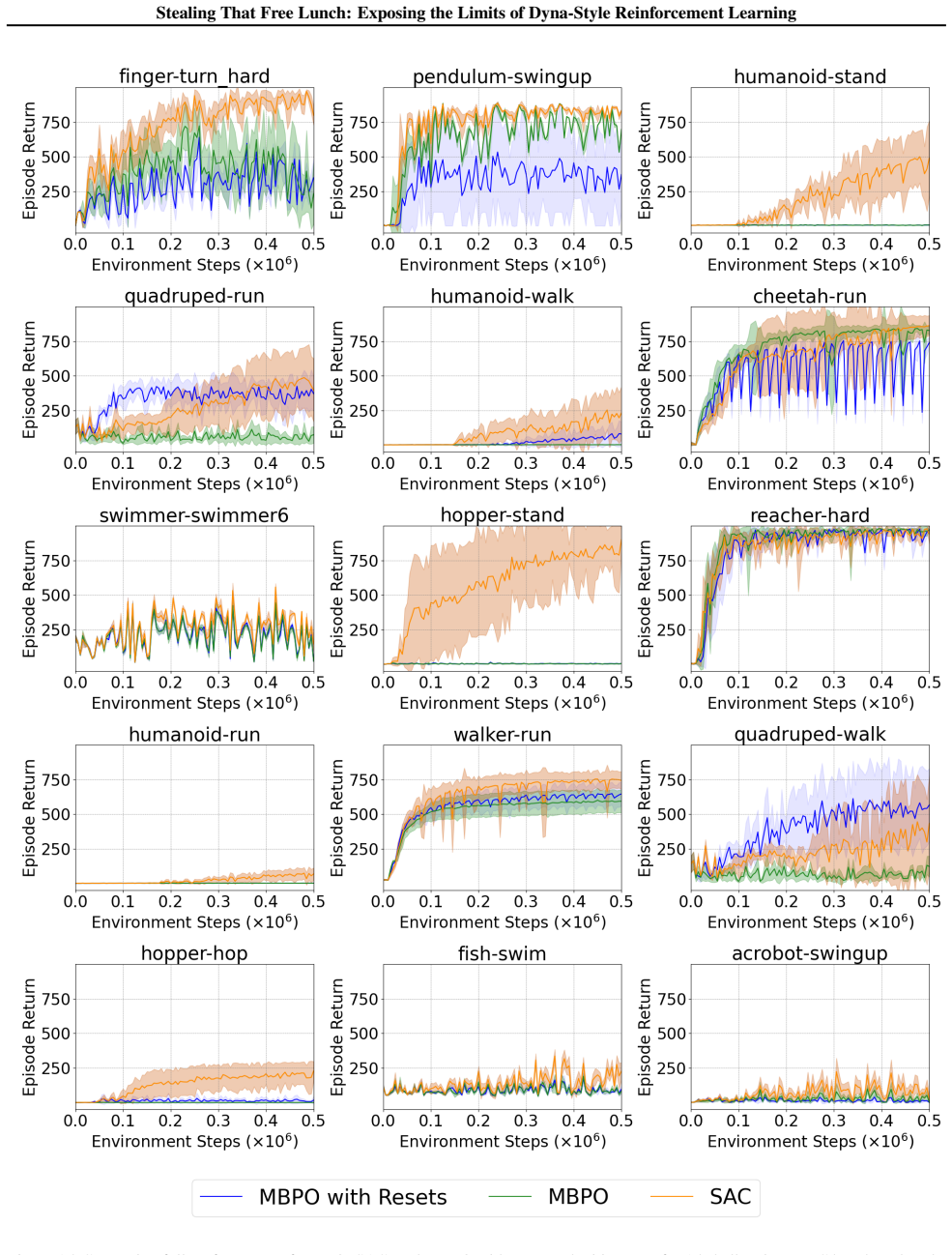
The paper's core discovery is that the value of synthetic rollouts is environment-dependent in a way that breaks the standard sample-efficiency narrative. The authors implement MBPO with single-step rollouts and reproduce its Gym advantage over SAC, then show the same algorithm with the same hyperparameters fails to improve in six of fifteen DMC tasks and lags SAC across most of the remaining ones. ALM, a latent-space Dyna-style method built on a deterministic DDPG base, shows the same pattern, which rules out an artifact of SAC or of MBPO's specific design. Using an augmented simulator that supplies perfect one-step transitions, they find that even a perfect model does not allow MBPO to consistently match SAC in DMC. The paper concludes that the Dyna-style augmentation loop itself—imagined data generated from a learned model and replayed at high frequency—can arrest policy improvement, and that this limitation applies to a subclass of Dyna-style algorithms rather than to model-based RL as a whole.
Load-bearing premise
The dividing assumption is that the paper's version of MBPO, which generates one imagined step per rollout, is equivalent to the original MBPO, which generates several; that match is established only in OpenAI Gym, so if longer imagined rollouts behave differently in the DeepMind Control Suite, the reported failure may belong to this particular variant.
Editorial extensions
If this is right
- Published sample-efficiency claims for MBPO and related Dyna-style methods should be treated as benchmark-specific until re-run in DMC or similar suites.
- Because removing synthetic rollouts restores strong performance, the failure is in the Dyna-style augmentation loop, not in the underlying off-policy learner.
- The standard remedies examined—better or tuned model, perfect model, layer normalization, periodic resets—do not consistently recover Gym-level gains, so the gap is not a simple tuning artifact.
- The results distinguish a subclass of Dyna-style algorithms that struggle in DMC from model-based RL as a whole; DreamerV3's DMC success is consistent with this subclass-level conclusion.
- The large wall-clock speedup of the paper's implementation makes broad re-evaluation of other Dyna-style algorithms practical on a single GPU.
Reading between the lines
- Editorial: If a direct n-step MBPO run in DMC fails to reproduce the gap, the paper's characterization of MBPO as such would need to be narrowed to 1-step rollouts; this is the sharpest test the paper leaves open.
- Editorial: The dose-response pattern in the paper's synthetic-to-real ratio sweeps suggests a testable prediction: other Dyna-style methods will show monotone performance collapse as the fraction of imagined data in each batch increases in DMC.
- Editorial: The results push toward reporting per-environment results rather than averaged returns, since averaged curves can hide environments where an algorithm never leaves random-policy level.
- Editorial: A broader implication is that sample-efficiency gains in model-based RL may be less a property of the algorithm than of the benchmark's reward, termination, and integration structure; the paper documents these differences but does not isolate a cause.
Signed reviews
Editorial analysis
A structured set of objections, weighed in public.
Referee Report
Summary. The paper reports an empirical study of Dyna-style model-based reinforcement learning (DMBRL), centered on MBPO and ALM, across OpenAI Gym and DeepMind Control Suite (DMC) tasks with proprioceptive observations. The main observation is that MBPO and ALM, which perform well in Gym, largely fail to improve over their model-free base algorithms in DMC, despite similar task structure and the same physics engine. The authors then investigate possible causes—predictive model error, critic divergence, and plasticity loss—and show that standard remedies (better model utilization, layer norm, periodic resets) do not restore competitive performance. They also introduce a JAX-based MBPO implementation with reported speedups and release code. The paper concludes that synthetic rollouts, the backbone of Dyna-style methods, can degrade performance and that the community's benchmark reliance has inflated confidence in these methods.
Significance. If the core claims hold, the paper is a useful and timely cautionary result: it documents a concrete generalization failure of two influential DMBRL algorithms, reproduces across 15 DMC tasks with 6 seeds, includes full training curves in the appendix, and provides an oracle-model experiment that separates model error from other failure sources. The released JAX implementation is a practical contribution that lowers the computational barrier for follow-up work. However, the strength of the central attribution to 'MBPO' and the broad 'Dyna-style methods' conclusion depends on an equivalence claim between the implemented 1-step variant and the original n-step MBPO, which is only established on Gym final returns. That gap, plus a conclusion that overstates the body's own results, currently tempers the significance of the headline message.
major comments (3)
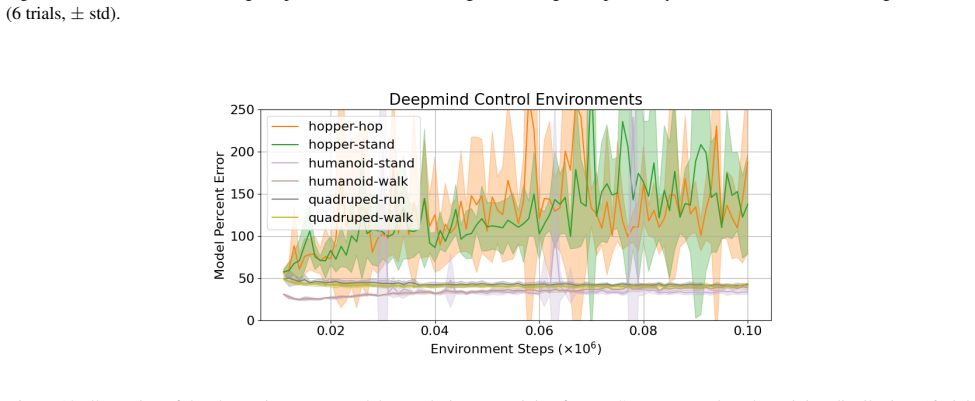
- [Section 3.1] The paper's core attribution to MBPO rests on the statement, 'Combining the results in Figure 2 and Figure 3 we can conclude that our JAX-based implementation of 1-step MBPO matches the original implementation's n-step MBPO's performance... and as such we will henceforth refer to 1-step MBPO as simply MBPO.' This equivalence is established only on six OpenAI Gym final returns. Since the DMC results in Sections 3.2 through 5 are the load-bearing evidence for the paper's central claim, the 1-step to n-step bridge needs to be validated in DMC, where the paper itself reports model errors above 100% on hopper tasks and above 25% on other failure tasks. A hardcoded rollout length of 1 removes exactly the adaptive horizon mechanism that n-step MBPO uses to balance model bias and compounding error. As written, the paper characterizes 'MBPO' as known in the literature, but the evidence supports a claim about a 1-step MBPO configuration. Please either run the original n-step MBPO on the DMC tasks or explicitly re-scope the claims to the 1-step variant and adjust the title, abstract, and conclusion accordingly.
- [Section 6] The conclusion states that 'for all 15 DMC tasks we examined, adding model-generated samples consistently undermined both sample efficiency and wall-clock performance relative to simpler, model-free off-policy algorithms with identical hyperparameters.' This is inconsistent with the body. Section 3.2 says MBPO fails to improve the policy in 'six out of fifteen' environments, and the full results in Figure 11 and Figure 17 explicitly include scenarios where MBPO 'matches SAC's sample efficiency' or solves tasks more slowly. 'Consistently undermined' is therefore too strong for the presented evidence. The conclusion should be reworded to reflect the actual distribution: a subset of tasks shows complete failure, a larger set shows underperformance, and a few show matching or slower improvement. This is not merely a wording issue because the abstract and conclusion are what readers will cite.
- [Section 4.2] The perfect-model experiment is well designed as a diagnostic, but it is a perfect-model version of the 1-step algorithm, not of the original n-step MBPO. With a perfect model, longer rollouts are no longer penalized by compounding error, so the natural comparison would include an n-step perfect-model condition. The current experiment therefore cannot rule out the possibility that the original n-step MBPO, even with a learned model, would behave differently in DMC. Please either report an n-step perfect-model condition or explicitly state that this experiment only tests the 1-step variant.
minor comments (4)
- [Abstract and Section 3.2] The abstract says the gap 'significantly degrades performance across most DMC environments,' while Section 3.2 says MBPO fails in 'six out of fifteen' environments. The paper should harmonize these counts and use a consistent classification of failure, underperformance, and matching behavior.
- [Section 4.1] The percent model error formula is presented without an equation number; numbering it would make the later references in Sections 4.2 and Appendix G easier to follow.
- [Figure 10 caption] The caption says 'the hopper-stand and humanoid-stand environment' (singular); it should say 'environments.' In addition, the two panels (a) and (b) should be labeled clearly so readers know which panel corresponds to which environment.
- [References] The reference to Voelcker et al. appears with an extra space ('V oelcker') in several places; please fix the formatting.
Circularity Check
No circularity: the central claim is an empirical ablation, not a derivation; the 1-step/n-step attribution gap is an external-validity concern, not a self-referential reduction.
full rationale
This paper makes no formal derivation whose output is equivalent to its input by construction. The central comparison is a controlled ablation: MBPO versus its own 'no Dyna' base (SAC) with identical hyperparameters, so the difference isolates the synthetic-rollout component. The perfect-model experiment in Section 4.2 is an independent benchmark that does not reuse fitted values from the learned-model experiments. No parameter is fitted to a subset of data and then reported as a prediction of a closely related quantity. The cited prior work (Janner et al., 2019; Ghugare et al., 2022; Voelcker et al., 2024) is external to the present authors and is used as evidence or as a baseline, not as a self-citation chain that forces the conclusion. The one substantive validity concern is the paper's Section 3.1 decision to equate its 1-step MBPO implementation with the original n-step MBPO based on Gym results and 'henceforth refer to 1-step MBPO as simply MBPO.' That is an attribution or generalization question: if n-step rollouts behave differently in DMC, the conclusions may not transfer to MBPO as published. But this is not circularity under the enumerated patterns, because the equivalence is asserted from empirical evidence, not defined into existence, and the DMC results are generated by the 1-step algorithm itself rather than being derived from that equivalence. The claim that Dyna-style enhancements degrade performance is therefore self-contained as an experimental finding about the tested configurations; its scope, not its logical structure, is what is contested.
Assumptions & free parameters
assumptions (3)
- domain assumption OpenAI Gym and DMC are sufficiently comparable that a robust algorithm should transfer.
- ad hoc to paper The 1-step MBPO variant is equivalent to the original n-step MBPO for DMC conclusions.
- domain assumption Six random seeds are sufficient to establish relative sample efficiency and final return comparisons.
Cite this review
Pith. "Pith review of Stealing That Free Lunch: Exposing the Limits of Dyna-Style Reinforcement Learning." pith.science (2026). https://pith.science/paper/EVN5LVHA
@misc{pith2026241214312,
  author       = {Pith},
  title        = {Pith review of: Stealing That Free Lunch: Exposing the Limits of Dyna-Style Reinforcement Learning},
  year         = {2026},
  howpublished = {\url{https://pith.science/paper/EVN5LVHA}},
  note         = {Machine review of arXiv:2412.14312}
}
read the original abstract
Dyna-style off-policy model-based reinforcement learning (DMBRL) algorithms are a family of techniques for generating synthetic state transition data and thereby enhancing the sample efficiency of off-policy RL algorithms. This paper identifies and investigates a surprising performance gap observed when applying DMBRL algorithms across different benchmark environments with proprioceptive observations. We show that, while DMBRL algorithms perform well in OpenAI Gym, their performance can drop significantly in DeepMind Control Suite (DMC), even though these settings offer similar tasks and identical physics backends. Modern techniques designed to address several key issues that arise in these settings do not provide a consistent improvement across all environments, and overall our results show that adding synthetic rollouts to the training process -- the backbone of Dyna-style algorithms -- significantly degrades performance across most DMC environments. Our findings contribute to a deeper understanding of several fundamental challenges in model-based RL and show that, like many optimization fields, there is no free lunch when evaluating performance across diverse benchmarks in RL.
Figures


Figures from the paper (16 more)





Reference graph
Works this paper leans on
-
[1]
write newline
" write newline "" before.all 'output.state := FUNCTION n.dashify 't := "" t empty not t #1 #1 substring "-" = t #1 #2 substring "--" = not "--" * t #2 global.max substring 't := t #1 #1 substring "-" = "-" * t #2 global.max substring 't := while if t #1 #1 substring * t #2 global.max substring 't := if while FUNCTION format.date year duplicate empty "emp...
-
[2]
S., Courville, A., and Bellemare, M
Agarwal, R., Schwarzer, M., Castro, P. S., Courville, A., and Bellemare, M. G. Deep reinforcement learning at the edge of the statistical precipice. Advances in Neural Information Processing Systems, 34: 0 29304--29320, 2021
work page 2021
-
[3]
Ahmed, N., Wahed, M., and Thompson, N. C. The growing influence of industry in ai research. Science, 379 0 (6635): 0 884--886, 2023. doi:10.1126/science.ade2420. URL https://www.science.org/doi/abs/10.1126/science.ade2420
-
[4]
Amos, B., Stanton, S., Yarats, D., and Wilson, A. G. On the model-based stochastic value gradient for continuous reinforcement learning. In Proceedings of the 3rd Conference on Learning for Dynamics and Control, volume 144 of Proceedings of Machine Learning Research, pages 6--20. PMLR, 2021
work page 2021
-
[5]
Atkeson, C. and Schaal, S. Learning tasks from a single demonstration. In Proceedings of International Conference on Robotics and Automation, volume 2, pp.\ 1706--1712 vol.2, 1997. doi:10.1109/ROBOT.1997.614389
-
[6]
Ba, J. L., Kiros, J. R., and Hinton, G. E. Layer normalization, 2016 a . URL https://arxiv.org/abs/1607.06450
arXiv 2016
-
[7]
J., Smith, L., Kostrikov, I., and Levine, S
Ball, P. J., Smith, L., Kostrikov, I., and Levine, S. Efficient online reinforcement learning with offline data. In Proceedings of the International Conference on Machine Learning, pages 1577--1594. PMLR, 2023
work page 2023
-
[8]
M., Gebru, T., McMillan-Major, A., and Shmitchell, S
Bender, E. M., Gebru, T., McMillan-Major, A., and Shmitchell, S. On the dangers of stochastic parrots: Can language models be too big? In Proceedings of the 2021 ACM Conference on Fairness, Accountability, and Transparency, FAccT '21, pp.\ 610–623, New York, NY, USA, 2021. Association for Computing Machinery. ISBN 9781450383097. doi:10.1145/3442188.344592...
arXiv 2021
Show all 57 references
-
[9]
J., Leary, C., Maclaurin, D., Necula, G., Paszke, A., Vander P las, J., Wanderman- M ilne, S., and Zhang, Q
Bradbury, J., Frostig, R., Hawkins, P., Johnson, M. J., Leary, C., Maclaurin, D., Necula, G., Paszke, A., Vander P las, J., Wanderman- M ilne, S., and Zhang, Q. JAX : composable transformations of P ython+ N um P y programs, 2018. URL http://github.com/jax-ml/jax
2018
-
[10]
Openai gym, 2016
Brockman, G., Cheung, V., Pettersson, L., Schneider, J., Schulman, J., Tang, J., and Zaremba, W. Openai gym, 2016. URL https://arxiv.org/abs/1606.01540
2016 arXiv
-
[11]
Sample-efficient reinforcement learning with stochastic ensemble value expansion
Buckman, J., Hafner, D., Tucker, G., Brevdo, E., and Lee, H. Sample-efficient reinforcement learning with stochastic ensemble value expansion. Advances in Neural Information Processing Systems, 31, 2018
2018
-
[12]
G., and Silver, D
Dabney, W., Barreto, A., Rowland, M., Dadashi, R., Quan, J., Bellemare, M. G., and Silver, D. The value-improvement path: Towards better representations for reinforcement learning. In Proceedings of the AAAI Conference on Artificial Intelligence, volume 35, number 8, pages 716...
2021
-
[13]
Deisenroth, M. P. and Rasmussen, C. E. Pilco: a model-based and data-efficient approach to policy search. In Proceedings of the 28th International Conference on International Conference on Machine Learning, ICML'11, pp.\ 465–472, Madison, WI, USA, 2011. Omnipress. ISBN 9781450306195
2011
-
[14]
Dyna-style model-based reinforcement learning with model-free policy optimization
Dong, K., Luo, Y., Wang, Y., Liu, Y., Qu, C., Zhang, Q., Cheng, E., Sun, Z., and Song, B. Dyna-style model-based reinforcement learning with model-free policy optimization. Knowledge-Based Systems, 287: 0 111428, 2024. ISSN 0950-7051. doi:https://doi.org/10.1016/j.knosys.2024....
2024
-
[15]
G., and Courville, A
D’Oro, P., Schwarzer, M., Nikishin, E., Bacon, P.-L., Bellemare, M. G., and Courville, A. Sample-efficient reinforcement learning by breaking the replay ratio barrier. In Proceedings of the Eleventh International Conference on Learning Representations, 2023
2023
-
[16]
Addressing function approximation error in actor-critic methods
Fujimoto, S., Hoof, H., and Meger, D. Addressing function approximation error in actor-critic methods. In Proceedings of the International Conference on Machine Learning, pages 1587--1596. PMLR, 2018
2018
-
[17]
Simplifying model-based rl: learning representations, latent-space models, and policies with one objective
Ghugare, R., Bharadhwaj, H., Eysenbach, B., Levine, S., and Salakhutdinov, R. Simplifying model-based rl: learning representations, latent-space models, and policies with one objective. In International Conference on Learning Representations, 2022
2022
-
[18]
Continuous deep q-learning with model-based acceleration
Gu, S., Lillicrap, T., Sutskever, I., and Levine, S. Continuous deep q-learning with model-based acceleration. In Proceedings of the International Conference on Machine Learning, pages 2829--2838. PMLR, 2016
2016
-
[19]
Soft actor-critic algorithms and applications, 2019 a
Haarnoja, T., Zhou, A., Hartikainen, K., Tucker, G., Ha, S., Tan, J., Kumar, V., Zhu, H., Gupta, A., Abbeel, P., and Levine, S. Soft actor-critic algorithms and applications, 2019 a . URL https://arxiv.org/abs/1812.05905
2019 arXiv
-
[20]
Dream to control: learning behaviors by latent imagination
Hafner, D., Lillicrap, T., Ba, J., and Norouzi, M. Dream to control: learning behaviors by latent imagination. In Proceedings of the International Conference on Learning Representations, 2020
2020
-
[21]
Mastering diverse control tasks through world models
Hafner, D., Pasukonis, J., Ba, J., et al. Mastering diverse control tasks through world models. Nature, 640: 0 647--653, 2025. doi:10.1038/s41586-025-08744-2
2025 doi
-
[22]
A., Hosny, A., Khodakarami, F., Waldron, L., Wang, B., McIntosh, C., Goldenberg, A., Kundaje, A., Greene, C
Haibe-Kains, B., Adam, G. A., Hosny, A., Khodakarami, F., Waldron, L., Wang, B., McIntosh, C., Goldenberg, A., Kundaje, A., Greene, C. S., et al. Transparency and reproducibility in artificial intelligence. Nature, 586 0 (7829): 0 E14--E16, 2020. doi:10.1038/s41586-020-2766-y
2020 doi
-
[23]
A., Su, H., and Wang, X
Hansen, N. A., Su, H., and Wang, X. Temporal difference learning for model predictive control. In Chaudhuri, K., Jegelka, S., Song, L., Szepesvari, C., Niu, G., and Sabato, S. (eds.), Proceedings of the 39th International Conference on Machine Learning, volume 162 of Proceedin...
2022
-
[24]
Z., Talvitie, E
Holland, G. Z., Talvitie, E. J., and Bowling, M. The effect of planning shape on dyna-style planning in high-dimensional state spaces, 2019. URL https://arxiv.org/abs/1806.01825
2019 arXiv
-
[25]
A., Gilitschenski, I., Farahmand, A.-m., and Eaton, E
Hussing, M., Voelcker, C. A., Gilitschenski, I., Farahmand, A.-m., and Eaton, E. Dissecting deep RL with high update ratios: Combatting value divergence. In Proceedings of the Reinforcement Learning Conference, 2024
2024
-
[26]
Mbpo: Model-based policy optimization, 2019
Janner, M. Mbpo: Model-based policy optimization, 2019. URL https://github.com/jannerm/mbpo. Accessed: 2024-12-11
2019
-
[27]
When to trust your model: Model-based policy optimization
Janner, M., Fu, J., Zhang, M., and Levine, S. When to trust your model: Model-based policy optimization. In Proceedings of the 33rd International Conference on Neural Information Processing Systems, pp.\ 1122--1133, Red Hook, NY, USA, 2019. Curran Associates Inc
2019
-
[28]
M., White, A., da Silva, B
Jordan, S. M., White, A., da Silva, B. C., White, M., and Thomas, P. S. Position: Benchmarking is limited in reinforcement learning research, 2024. URL https://arxiv.org/abs/2406.16241
2024 arXiv
-
[29]
and Boedecker, J
Kalweit, G. and Boedecker, J. Uncertainty-driven imagination for continuous deep reinforcement learning. In Levine, S., Vanhoucke, V., and Goldberg, K. (eds.), Proceedings of the 1st Annual Conference on Robot Learning, volume 78 of Proceedings of Machine Learning Research, pp...
2017
-
[30]
Bidirectional model-based policy optimization
Lai, H., Shen, J., Zhang, W., and Yu, Y. Bidirectional model-based policy optimization. In Proceedings of the International Conference on Machine Learning, pages 5618--5627. PMLR, 2020
2020
-
[31]
On effective scheduling ofmModel-based reinforcement Learning
Lai, H., Shen, J., Zhang, W., Huang, Y., Zhang, X., Tang, R., Yu, Y., and Li, Z. On effective scheduling ofmModel-based reinforcement Learning. Advances in Neural Information Processing Systems, 34: 0 3694--3705, 2021
2021
-
[32]
Reinforcement learning with augmented data
Laskin, M., Lee, K., Stooke, A., Pinto, L., Abbeel, P., and Srinivas, A. Reinforcement learning with augmented data. Advances in Neural Information Processing Systems, 33: 0 19884--19895, 2020
2020
-
[33]
When to trust your data: Enhancing dyna-style model-based reinforcement learning with data filter, 2024
Li, Y., Dong, Z., Luo, E., Wu, Y., Wu, S., and Han, S. When to trust your data: Enhancing dyna-style model-based reinforcement learning with data filter, 2024. URL https://arxiv.org/abs/2410.12160
2024 arXiv
-
[34]
P., Hunt, J
Lillicrap, T. P., Hunt, J. J., Pritzel, A., Heess, N., Erez, T., Tassa, Y., Silver, D., and Wierstra, D. Continuous control with deep reinforcement learning, 2019. URL https://arxiv.org/abs/1509.02971
2019 arXiv
-
[35]
[Re] When to trust your model: model-based policy optimization
Liu, Y., Xu, J., and Pan, Y. [Re] When to trust your model: model-based policy optimization. ReScience C, 6 0 (2), 2020. URL https://openreview.net/forum?id=rkezvT9f6r. Accepted at NeurIPS 2019 Reproducibility Challenge
2020
-
[36]
A survey on model-based reinforcement learning
Luo, F.-M., Xu, T., Lai, H., Chen, X.-H., Zhang, W., and Yu, Y. A survey on model-based reinforcement learning. Science China Information Sciences, 67(2):121101, 2024
2024
-
[37]
Understanding and preventing capacity loss in reinforcement learning
Lyle, C., Rowland, M., and Dabney, W. Understanding and preventing capacity loss in reinforcement learning. In Proceedings of the International Conference on Learning Representations, 2022
2022
-
[38]
Overestimation, overfitting, and plasticity in actor-critic: the Bitter lesson of Reinforcement learning
Nauman, M., Bortkiewicz, M., Miłoś, P., Trzcinski, T., Ostaszewski, M., and Cygan, M. Overestimation, overfitting, and plasticity in actor-critic: the Bitter lesson of Reinforcement learning. In Proceedings of the 41st International Conference on Machine Learning , pp.\ 37342-...
2024
-
[39]
The primacy bias in deep reinforcement learning
Nikishin, E., Schwarzer, M., D’Oro, P., Bacon, P.-L., and Courville, A. The primacy bias in deep reinforcement learning. In Proceedings of the International Conference on Machine Learning, pages 16828--16847. PMLR, 2022
2022
-
[40]
Pytorch: An imperative style, high-performance deep learning library, 2019
Paszke, A., Gross, S., Massa, F., Lerer, A., Bradbury, J., Chanan, G., Killeen, T., Lin, Z., Gimelshein, N., Antiga, L., Desmaison, A., Köpf, A., Yang, E., DeVito, Z., Raison, M., Tejani, A., Chilamkurthy, S., Steiner, B., Fang, L., Bai, J., and Chintala, S. Pytorch: An impera...
2019 arXiv
-
[41]
Mind the model, not the agent: the primacy bias in model-based RL
Qiao, Z., Lyu, J., and Li, X. Mind the model, not the agent: the primacy bias in model-based RL . In Proceedings of the European Conference on Artificial Intelligence, 2023
2023
-
[42]
EPOpt : learning robust neural network policies using model ensembles
Rajeswaran, A., Ghotra, S., Levine, S., and Ravindran, B. EPOpt : learning robust neural network policies using model ensembles. In Proceedings of the International Conference on Learning Representations, 2017
2017
-
[43]
High-dimensional continuous control using generalized advantage estimation, 2015
Schulman, J., Moritz, P., Levine, S., Jordan, M., and Abbeel, P. High-dimensional continuous control using generalized advantage estimation, 2015. URL https://arxiv.org/abs/1506.02438
2015 arXiv
-
[44]
Learning off-policy with online planning
Sikchi, H., Zhou, W., and Held, D. Learning off-policy with online planning. In Proceedings of the Conference on Robot Learning, pages 1622--1633. PMLR, 2022
2022
-
[45]
CURL : contrastive unsupervised representations for reinforcement learning
Laskin, M., Srinivas, A., and Abbeel, P. CURL : contrastive unsupervised representations for reinforcement learning. In Proceedings of the International Conference on Machine Learning, pages 5639--5650. PMLR, 2020
2020
-
[46]
Sutton, R. S. Dyna, an integrated architecture for learning, planning, and reacting. SIGART Bull., 2 0 (4): 0 160–163, July 1991. ISSN 0163-5719. doi:10.1145/122344.122377. URL https://doi.org/10.1145/122344.122377
1991
-
[47]
Model regularization for stable sample rollouts
Talvitie, E. Model regularization for stable sample rollouts. In Proceedings of the Thirtieth Conference on Uncertainty in Artificial Intelligence, UAI'14, pp.\ 780–789, Arlington, Virginia, USA, 2014. AUAI Press. ISBN 9780974903910
2014
-
[48]
dm\_control: Software and Tasks for Continuous Control
Tassa, Y., Tunyasuvunakool, S., Muldal, A., Doron, Y., Trochim, P., Liu, S., Bohez, S., Merel, J., Erez, T., Lillicrap, T., and Heess, N. dm\_control: Software and Tasks for Continuous Control . Software Impacts, 6: 0 100022, November 2020. ISSN 26659638. doi:10.1016/j.simpa.2...
2020
-
[49]
and Schwartz, A
Thrun, S. and Schwartz, A. Issues in using function approximation for reinforcement learning. In Proceedings of 4th Connectionist Models Summer School. Erlbaum Associates, June 1993
1993
-
[50]
Mujoco: A physics engine for model-based control
Todorov, E., Erez, T., and Tassa, Y. Mujoco: A physics engine for model-based control. 2012 IEEE/RSJ International Conference on Intelligent Robots and Systems, pp.\ 5026--5033, 2012. URL https://api.semanticscholar.org/CorpusID:5230692
2012
-
[51]
A., Hussing, M., and Eaton, E
Voelcker, C. A., Hussing, M., and Eaton, E. Can we hop in general? A discussion of benchmark selection and design using the Hopper environment. In Finding the Frame: An RLC Workshop for Examining Conceptual Frameworks, 2024
2024
-
[52]
Model-based policy optimization under approximate Bayesian inference
Wang, C., Chen, Y., and Murphy, K. Model-based policy optimization under approximate Bayesian inference. In Proceedings of the 27th International Conference on Artificial Intelligence and Statistics (AISTATS), volume 238. PMLR, 2024
2024
-
[53]
Benchmarking model-based reinforcement learning, 2019
Wang, T., Bao, X., Clavera, I., Hoang, J., Wen, Y., Langlois, E., Zhang, S., Zhang, G., Abbeel, P., and Ba, J. Benchmarking model-based reinforcement learning, 2019. URL https://arxiv.org/abs/1907.02057
2019 arXiv
-
[54]
Live in the moment: learning dynamics model adapted to evolving policy
Wang, X., Wongkamjan, W., Jia, R., and Huang, F. Live in the moment: learning dynamics model adapted to evolving policy. In Proceedings of the International Conference on Machine Learning, pages 36470--36493. PMLR, 2023
2023
-
[55]
Accelerated policy learning with parallel differentiable simulation
Xu, J., Makoviychuk, V., Narang, Y., Ramos, F., Matusik, W., Garg, A., and Macklin, M. Accelerated policy learning with parallel differentiable simulation. In Proceedings of the International Conference on Learning Representations, 2022
2022
-
[56]
Mastering visual continuous control: improved data-augmented reinforcement learning
Yarats, D., Fergus, R., Lazaric, A., and Pinto, L. Mastering visual continuous control: improved data-augmented reinforcement learning. In Proceedings of the Tenth International Conference on Learning Representations, 2022
2022
-
[57]
Is model ensemble necessary? Model-based RL via a single model with Lipschitz regularized value function
Zheng, R., Wang, X., Xu, H., and Huang, F. Is model ensemble necessary? Model-based RL via a single model with Lipschitz regularized value function. In Proceedings of the International Conference on Learning Representations, 2023
2023
Reviewed August 11, 2026 · model on record in the stance chip above.
Discussion (0). Continue with ORCID to comment.