REVIEW 4 major objections 4 minor 5 cited by
ResQ: Mixed-Precision Quantization of Large Language Models with Low-Rank Residuals
T0 review · 4 major / 4 minor · reviewed 2026-08-11 · deepseek-v4-flash
Pith's one-line read ResQ keeps a PCA-chosen 8-bit subspace and quantizes the rest of an LLM to 4-bit, claiming near-16-bit accuracy without any training.
desk verdict Solid empirical PTQ paper; the 'provably optimal' proof in Appendix A is wrong, and the paper needs a major revision before acceptance. read the letter →
The pith
A machine-rendered reading of the paper's core claim, the machinery that carries it, and where it could break.
The reading
What carries the argument
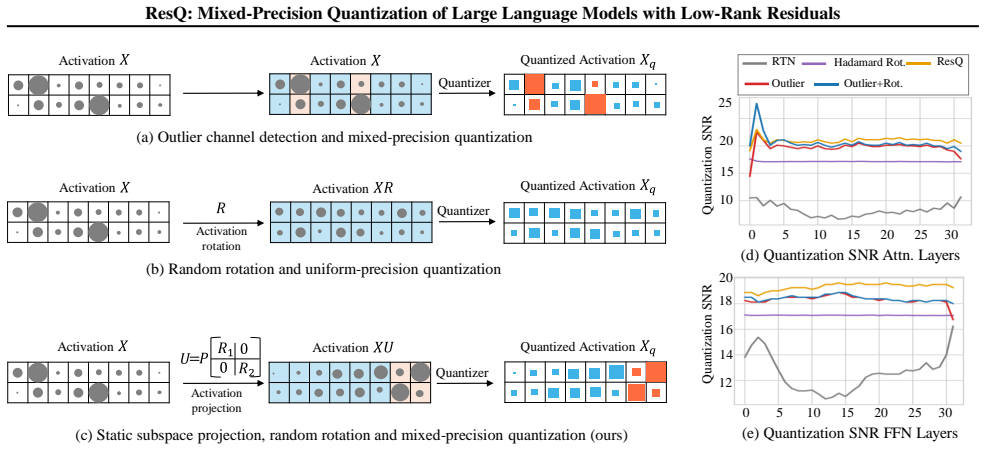
The central object is the orthogonal projection $U = PR$, where $P$ is the eigenbasis of the activation covariance $XX^{\top}$ sorted by increasing eigenvalue and $R$ is a block-diagonal random orthogonal rotation. The last $r$ columns of $P$, corresponding to the highest-variance directions, form the high-precision subspace kept at 8-bit, while the first $d-r$ columns, rotated and quantized at 4-bit, form the low-precision residual. The machinery also includes four projection placements, $U_A$, $U_B$, $U_C$, and $U_D$, that push the projections into neighboring weights or, where necessary, apply fast Hadamard transforms at runtime so that the mixed-precision GEMMs dominate the cost.
What would settle it
Recompute the bound in Theorem 4.2 using the exact relation $\|XP_l\|_F = \sqrt{\|X\|_F^2 - \|XP_h\|_F^2}$ and check whether the inequality still implies that choosing the PCA subspace maximizes $\|XP_h\|_F$; alternatively, run ResQ with a random orthogonal $P_h$ of the same rank on the same models and compare Wikitext perplexity, since a random projection matching or beating PCA would contradict the claimed optimality.
Extended reading notes
Core claim
The central claim is that the right way to allocate mixed precision is to decompose the activation tensor along principal components of its empirical covariance, quantize the top-r high-variance directions at high precision, quantize the remaining low-variance directions at low precision, and then rotate each block by a random orthogonal matrix before quantization. The paper's Theorem 4.2 bounds the expected Frobenius quantization error in terms of the norm of the high-precision projection, showing that the bound is minimized when the high-precision subspace is spanned by the eigenvectors of $XX^{\top}$ with the largest eigenvalues, i.e. the PCA subspace. Because the projection matrices can be fused into adjacent weights except where rotary embeddings or activation functions intervene, the scheme adds little runtime overhead, and the authors demonstrate consistent gains over SpinQuant and other baselines across Llama 2, Llama 3, Llama 3.2, Qwen2.5, and Qwen2-VL models at W/A/KV = 4/4/4 bits.
Load-bearing premise
The optimality proof depends on treating rotated activation coefficients as Gaussian enough for the SVDQuant error bound in Lemma A.1 to apply, and on the identity $\|XP_l\|_F = \|X\|_F - \|XP_h\|_F$, which is not exact; the correct Pythagorean relation for orthogonal complements is $\|XP_l\|_F = \sqrt{\|X\|_F^2 - \|XP_h\|_F^2}$, so as written the derived bound and the optimality conclusion are not established.
Editorial extensions
If this is right
- ResQ can quantize weights, activations, and KV cache all to 4-bit while keeping one eighth of the hidden-dimension channels at 8-bit, closing much of the gap to 16-bit baselines on language modeling and reasoning tasks.
- Because the projection matrices fuse into adjacent weights, the mixed-precision 4-bit/8-bit GEMMs run close to uniform INT4 speed, giving measured speedups of roughly 1.61x to 3.03x over 16-bit inference on a single decoder block.
- The rank $r$ of the high-precision subspace provides a direct accuracy-efficiency trade-off, so practitioners can choose a Pareto-optimal operating point for a given hardware budget.
- The method extends beyond language modeling to KV cache compression and to vision-language models, preserving a large fraction of MMMU accuracy when only the language model is quantized.
- Combining ResQ with GPTQ for weight quantization maintains its advantage across model families from 0.5B to 72B parameters, suggesting the approach scales with model size.
Reading between the lines
- If the PCA-optimality argument can be repaired, the same spectral recipe would likely apply to any linear layer with heavy-tailed activation distributions, suggesting a general principle: choose quantization bases by the covariance of calibration activations rather than by per-channel outlier statistics.
- The strong results on Qwen2.5, where Hadamard-rotation baselines degrade sharply, hint that architecture-specific activation geometry matters more than rotation alone; a testable extension is to apply ResQ to Mixture-of-Experts models or other architectures with different covariance structure.
- The 512-sample calibration requirement could probably be reduced by estimating the activation covariance online or with a lightweight proxy, making the method usable when only a small calibration set is available.
- Since rank tuning already traces a Pareto frontier, a natural extension is per-layer rank allocation driven by layerwise sensitivity, which the paper does not explore but its own ablation data would support.
Editorial analysis
A structured set of objections, weighed in public.
Referee Report
Summary. ResQ is a post-training quantization method for LLMs that targets W/A/KV = 4/4/4-bit inference. It projects activations, weights, and KV cache into an orthogonal basis, keeps the low-rank subspace (1/8 of hidden dimension) with highest activation variance at 8-bit precision, and quantizes the complementary subspace at 4-bit, applying random orthogonal rotations within each subspace to suppress outliers. The paper claims that PCA is a provably optimal choice for the high-precision subspace (Theorem 4.2), and supports this with an extended empirical evaluation on Llama 2/3/3.2, Qwen2.5, and Qwen2-VL models across language modeling, commonsense reasoning, MMLU, GSM8K, LongBench, and MMMU, reporting gains over SpinQuant and other baselines as well as CUDA-kernel speedups.
Significance. If the method and its theoretical justification were both sound, this would be a practically valuable contribution: it addresses a hard setting (4-bit weights, activations, and KV cache), it is training-free, and the experimental coverage is unusually broad, including several model families and both language-only and multimodal benchmarks. The paper also ships code and reports kernel-level speedups, which strengthens reproducibility. The central advertised claim, however, is the 'provably optimal' PCA choice for mixed precision; as written, the proof of Theorem 4.2 contains an algebraic error that invalidates the stated bound and the optimality conclusion. The empirical results may still stand on their own, but the paper's headline theoretical guarantee is not currently supported.
major comments (4)
- [Appendix A, Eq. (12)] The proof of Theorem 4.2 uses the identity ||XP_l||_F = ||X||_F - ||XP_h||_F. This is false: since P_lP_l^T + P_hP_h^T = I and the columns of P_l and P_h are orthonormal, the correct relation is ||XP_l||_F^2 = ||X||_F^2 - ||XP_h||_F^2. The preceding line (Eq. 11) also conflates ||XP_l||_F with ||tr(XP_lP_l^T X^T)||_F, where the trace is the squared norm, not the norm itself. With the correct Pythagorean relation, the bound becomes a*E(sqrt(||X||^2 - ||XP_h||^2)) + b*E||XP_h||, which is not monotone in ||XP_h||_F; it has an interior maximum and decreases only on part of its domain. Consequently, the inference 'to lower the upper bound, maximize ||XP_h||_F' does not follow from the displayed equations, and the PCA optimality of Theorem 4.2 is not established by this argument.
- [Appendix A, Eq. (11) and Eq. (10)] There are two additional issues in the chain of inequalities leading to Theorem 4.2. First, Eq. (10) states an equality between E||X - Xq||_F and the sum of the two component errors; in general only an inequality (triangle inequality) holds, and the equality requires the squared norms and orthogonality of the subspaces. Second, the text says 'We know size(XP_l) = d - r and size(XP_h) = r', but X is an n by d matrix, so the number of elements in XP_l is n(d-r) and in XP_h is nr. The logarithmic factors in Eq. (7) should be log(n(d-r)) and log(nr), not log(d-r) and log(r). This changes the constants and the conditions under which the coefficient multiplying E||XP_h||_F is positive, so the theorem as stated needs correction beyond the Frobenius-norm identity.
- [Section 4.1, Eq. (2)] Equation (2), Xq = Q_L(XU_l) + Q_H(XU_h), is dimensionally inconsistent as written. XU_l is n by (d-r) and XU_h is n by r, so the two matrices cannot be added. To reconstruct an n by d activation, the formula should include the right-multiplication by U_l^T and U_h^T, e.g., Xq = Q_L(XU_l)U_l^T + Q_H(XU_h)U_h^T. The same issue affects the interpretation of Eq. (4) and the discussion following it; although the shapes in Eq. (4) can be read consistently if U_l^T W is (d-r) by d, the presentation should state the reconstruction explicitly.
- [Section 4.2, Lemma 4.1 and Theorem 4.2] The proof of Theorem 4.2 depends on Lemma 4.1, which is stated as a direct consequence of the Central Limit Theorem and a citation to prior work, and on Lemma A.1, which is imported from another paper. For the argument to apply, the entries of XU_l and XU_h must be approximately Gaussian. But P_l and P_h are data-dependent PCA projections estimated from calibration data, and R_l, R_h are random orthogonal matrices applied after those projections; it is not immediate that XU_l = XP_l R_l has Gaussian marginals for realistic n and d, especially with the heavy-tailed activation distributions observed in LLMs. The paper does not provide empirical diagnostics for this assumption on the actual calibration data. This is a correctness-risk issue for the key theorem, and a concrete test (e.g., measuring the Gaussianity of projected coefficients after the PCA step) would help assess whether the assumption holds in practice.
minor comments (4)
- [Abstract and Introduction] There are typographical errors: 'upto' in the abstract and 'mlowers' in the Introduction should be corrected to 'up to' and 'lowers'.
- [Appendix A, Lemma A.1] The notation size(R) is used without defining it for a matrix; it should be stated explicitly as the number of elements in R, since the logarithmic factor in the bound is what makes the size dependence clear.
- [Appendix A, Eq. (11)] There is a missing closing parenthesis in the second term of Eq. (11): 'sqrt(log(size(XP_h)π)' should read 'sqrt(log(size(XP_h))π)'.
- [Section 4.3] The text states that UA and UB projections are fused into weights with no additional inference cost, but UC and UD are computed at runtime; this contrast should be stated more explicitly so the reader does not infer that all projections are overhead-free.
Circularity Check
No significant circularity: ResQ's theoretical and empirical claims are not equivalent to their inputs; the proof's false Frobenius-norm identity is a correctness defect, not a circular reduction.
full rationale
The paper's central claim is that PCA selection of the high-precision subspace minimizes quantization error. The derivation uses two imported external results: Lemma A.1 from SVDQuant (Li et al., 2024) bounding the quantization error of Gaussian tensors, and Lemma 4.1 from QuIP# (Tseng et al., 2024) on Gaussianization by random orthogonal multiplication. Neither is authored by the present paper, and neither presupposes the PCA conclusion. The step 'to lower this upper bound ... maximize ||XP_h||_F' is a mathematical consequence of the bound's form; the identification of the maximizer with eigenvectors of XX^T is the standard variational characterization of PCA, not a restatement of the conclusion. The projection matrices are fit to 512 Wikitext samples to minimize reconstruction error, and the headline perplexity is reported on Wikitext; this is an in-distribution calibration/evaluation convention typical of PTQ, and the paper additionally reports results on MMLU, GSM8K, LongBench, and MMMU, which are outside the calibration distribution. The self-citations (Eigen Attention, Saxena et al. 2024; Sharify et al. 2024) appear only in related-work and baseline construction, not in the optimality proof. The proof of Theorem 4.2 does contain a serious mathematical error: Appendix A Eq. (12) substitutes ||XP_l||_F = ||X||_F - ||XP_h||_F, whereas by orthogonality the correct relation is ||XP_l||_F^2 = ||X||_F^2 - ||XP_h||_F^2. This invalidates the stated bound and the derived optimality guarantee, but it is an error in a proof step, not a reduction of the conclusion to the premise, so it does not constitute circularity under the criteria; it is a correctness risk.
Assumptions & free parameters
free parameters (3)
- Rank r of high-precision subspace =
d/8 (e.g., 512 for hidden dimension 4096)
- Calibration set size =
512 Wikitext samples for projections, 128 for GPTQ
- Bit-width assignment (H=8, L=4) and down_proj uniform 4-bit =
8-bit for top-r subspace, 4-bit for complement; down_proj uniformly 4-bit
assumptions (4)
- domain assumption Lemma A.1 from SVDQuant (Li et al., 2024): quantization error of a Gaussian tensor is bounded by sqrt(pi log(size))/(2^{n-1}-1) times its Frobenius norm.
- domain assumption Lemma 4.1, cited to Tseng et al. 2024: multiplication with a random orthogonal matrix makes the distribution approximately Gaussian by the Central Limit Theorem.
- domain assumption PCA eigenvectors estimated from 512 Wikitext calibration samples are representative of the activation covariance for all evaluated inputs.
- domain assumption Hadamard matrices exist for the FFN hidden dimension, or a fallback random orthogonal matrix is used.
Cite this review
Pith. "Pith review of ResQ: Mixed-Precision Quantization of Large Language Models with Low-Rank Residuals." pith.science (2026). https://pith.science/paper/24BZEVUL
@misc{pith2026241214363,
  author       = {Pith},
  title        = {Pith review of: ResQ: Mixed-Precision Quantization of Large Language Models with Low-Rank Residuals},
  year         = {2026},
  howpublished = {\url{https://pith.science/paper/24BZEVUL}},
  note         = {Machine review of arXiv:2412.14363}
}
read the original abstract
Post-training quantization (PTQ) of large language models (LLMs) holds the promise in reducing the prohibitive computational cost at inference time. Quantization of all weight, activation and key-value (KV) cache tensors to 4-bit without significantly degrading generalizability is challenging, due to the high quantization error caused by extreme outliers in activations. To tackle this problem, we propose ResQ, a PTQ method that pushes further the state-of-the-art. By means of principal component analysis (PCA), it identifies a low-rank subspace (in practice 1/8 of the hidden dimension) in which activation variances are highest, and keep the coefficients within this subspace in high precision, e.g. 8-bit, while quantizing the rest to 4-bit. Within each subspace, invariant random rotation is applied to further suppress outliers. We show that this is a provably optimal mixed precision quantization scheme that minimizes error. With the Llama and Qwen2.5 families of models, we demonstrate that ResQ outperforms recent uniform and mixed precision PTQ methods on a variety of benchmarks, achieving up to 33\% lower perplexity on Wikitext than the next best method SpinQuant, and upto 3\times speedup over 16-bit baseline. Code is available at https://github.com/utkarsh-dmx/project-resq.
Figures


Figures from the paper (3 more)


Forward citations
Cited by 5 Pith papers
-
dMX: Differentiable Mixed-Precision Assignment for Low-Precision Floating-Point Formats
dMX learns continuous per-layer MXFP bit-width offsets with temperature annealing and target-aware regularization, yielding Pareto-better mixed-precision LLMs than uniform or KL-heuristic baselines.
-
GyRot: Leveraging Hidden Synergy between Rotation and Fine-grained Group Quantization for Low-bit LLM Inference
Rotation and fine-grained group quantization can work together if rotation spans several quantization groups and outlier channels are permuted onto harmonic Hadamard rows, enabling 4-bit LLM inference with integer-onl...
-
ARCQuant: Boosting NVFP4 Quantization with Augmented Residual Channels for LLMs
By appending quantized residual channels to NVFP4 activations and duplicating the matching weights, ARCQuant reaches W4A8-level accuracy while keeping a single unified 4-bit GEMM.
-
RotateKV: Accurate and Robust 2-Bit KV Cache Quantization for LLMs via Outlier-Aware Adaptive Rotations
RotateKV combines outlier-aware, pre-RoPE grouped-head Hadamard rotation with attention-sink-aware retention to make 2-bit KV cache quantization accurate on LLaMA-2, LLaMA-3, and Mistral models.
-
A Survey on Large Language Model Acceleration based on KV Cache Management
A survey that classifies KV cache management techniques for faster LLM inference into token-level, model-level, and system-level categories, with benchmark resources.
Reference graph
Works this paper leans on
-
[1]
Ashkboos, S., Croci, M. L., Nascimento, M. G. d., Hoefler, T., and Hensman, J. SliceGPT : Compress large language models by deleting rows and columns. arXiv:2401.15024, 2024 a
arXiv 2024
-
[2]
QUIK : Towards end-to-end 4-bit inference on generative large language models
Ashkboos, S., Markov, I., Frantar, E., Zhong, T., Wang, X., Ren, J., Hoefler, T., and Alistarh, D. QUIK : Towards end-to-end 4-bit inference on generative large language models. In Proceedings of the 2024 Conference on Empirical Methods in Natural Language Processing, pp.\ 3355--3371. Association for Computational Linguistics, 2024 b . doi:10.18653/v1/202...
-
[3]
L., Li, B., Cameron, P., Jaggi, M., Alistarh, D., Hoefler, T., and Hensman, J
Ashkboos, S., Mohtashami, A., Croci, M. L., Li, B., Cameron, P., Jaggi, M., Alistarh, D., Hoefler, T., and Hensman, J. QuaRot : Outlier-free 4-bit inference in rotated llms. arXiv:2404.00456, 2024 c
arXiv 2024
-
[4]
L ong B ench: A bilingual, multitask benchmark for long context understanding
Bai, Y., Lv, X., Zhang, J., Lyu, H., Tang, J., Huang, Z., Du, Z., Liu, X., Zeng, A., Hou, L., Dong, Y., Tang, J., and Li, J. L ong B ench: A bilingual, multitask benchmark for long context understanding. In Proceedings of the 62nd Annual Meeting of the Association for Computational Linguistics (Volume 1: Long Papers), pp.\ 3119--3137. Association for Comp...
-
[5]
PIQA : Reasoning about physical commonsense in natural language
Bisk, Y., Zellers, R., Gao, J., Choi, Y., et al. PIQA : Reasoning about physical commonsense in natural language. In Proceedings of the AAAI conference on artificial intelligence, volume 34, pp.\ 7432--7439, 2020
work page 2020
-
[6]
Chang, C.-C., Lin, W.-C., Lin, C.-Y., Chen, C.-Y., Hu, Y.-F., Wang, P.-S., Huang, N.-C., Ceze, L., Abdelfattah, M. S., and Wu, K.-C. Palu: Compressing kv-cache with low-rank projection. arXiv:2407.21118, 2024
arXiv 2024
-
[7]
Chee, J., Cai, Y., Kuleshov, V., and De Sa, C. M. QuIP : 2-bit quantization of large language models with guarantees. Advances in Neural Information Processing Systems, 36, 2024
work page 2024
-
[8]
I.-J., Srinivasan, V., and Gopalakrishnan, K
Choi, J., Wang, Z., Venkataramani, S., Chuang, P. I.-J., Srinivasan, V., and Gopalakrishnan, K. PACT : Parameterized clipping activation for quantized neural networks. arXiv:1805.06085, 2018
arXiv 2018
Show all 68 references
-
[9]
Boolq: Exploring the surprising difficulty of natural yes/no questions
Clark, C., Lee, K., Chang, M.-W., Kwiatkowski, T., Collins, M., and Toutanova, K. Boolq: Exploring the surprising difficulty of natural yes/no questions. arXiv:1905.10044, 2019. URL https://arxiv.org/abs/1905.10044
1905 arXiv
-
[10]
Think you have solved question answering? try arc, the ai2 reasoning challenge
Clark, P., Cowhey, I., Etzioni, O., Khot, T., Sabharwal, A., Schoenick, C., and Tafjord, O. Think you have solved question answering? try arc, the ai2 reasoning challenge. arXiv:1803.05457, 2018
2018 arXiv
-
[11]
Training verifiers to solve math word problems
Cobbe, K., Kosaraju, V., Bavarian, M., Hilton, J., Nakano, R., Hesse, C., and Schulman, J. Training verifiers to solve math word problems. arXiv:2110.14168, 2021
2021 arXiv
-
[12]
Dettmers, T., Lewis, M., Belkada, Y., and Zettlemoyer, L. Gpt3. int8 (): 8-bit matrix multiplication for transformers at scale. Advances in Neural Information Processing Systems, 35: 0 30318--30332, 2022
2022
-
[13]
SpQR : A sparse-quantized representation for near-lossless llm weight compression
Dettmers, T., Svirschevski, R., Egiazarian, V., Kuznedelev, D., Frantar, E., Ashkboos, S., Borzunov, A., Hoefler, T., and Alistarh, D. SpQR : A sparse-quantized representation for near-lossless llm weight compression. arXiv:2306.03078, 2023
2023 arXiv
-
[14]
QAQ : Quality adaptive quantization for llm kv cache
Dong, S., Cheng, W., Qin, J., and Wang, W. QAQ : Quality adaptive quantization for llm kv cache. arXiv:2403.04643, 2024
2024 arXiv
-
[15]
Extreme compression of large language models via additive quantization
Egiazarian, V., Panferov, A., Kuznedelev, D., Frantar, E., Babenko, A., and Alistarh, D. Extreme compression of large language models via additive quantization. arXiv:2401.06118, 2024
2024 arXiv
-
[16]
GPTQ : Accurate post-training quantization for generative pre-trained transformers
Frantar, E., Ashkboos, S., Hoefler, T., and Alistarh, D. GPTQ : Accurate post-training quantization for generative pre-trained transformers. arXiv:2210.17323, 2022
2022 arXiv
-
[17]
A framework for few-shot language model evaluation, 07 2024
Gao, L., Tow, J., Abbasi, B., Biderman, S., Black, S., DiPofi, A., Foster, C., Golding, L., Hsu, J., Le Noac'h, A., Li, H., McDonell, K., Muennighoff, N., Ociepa, C., Phang, J., Reynolds, L., Schoelkopf, H., Skowron, A., Sutawika, L., Tang, E., Thite, A., Wang, B., Wang, K., a...
2024
-
[18]
W., and Keutzer, K
Gholami, A., Kim, S., Dong, Z., Yao, Z., Mahoney, M. W., and Keutzer, K. A survey of quantization methods for efficient neural network inference. In Low-Power Computer Vision, pp.\ 291--326. Chapman and Hall/CRC, 2022
2022
-
[19]
SAMSum corpus: A human-annotated dialogue dataset for abstractive summarization
Gliwa, B., Mochol, I., Biesek, M., and Wawer, A. SAMSum corpus: A human-annotated dialogue dataset for abstractive summarization. arXiv:1911.12237, 2019
1911 arXiv
-
[20]
APTQ : Attention-aware post-training mixed-precision quantization for large language models
Guan, Z., Huang, H., Su, Y., Huang, H., Wong, N., and Yu, H. APTQ : Attention-aware post-training mixed-precision quantization for large language models. In Proceedings of the 61st ACM/IEEE Design Automation Conference, pp.\ 1--6, 2024
2024
-
[21]
ZipCache : Accurate and efficient kv cache quantization with salient token identification
He, Y., Zhang, L., Wu, W., Liu, J., Zhou, H., and Zhuang, B. ZipCache : Accurate and efficient kv cache quantization with salient token identification. arXiv:2405.14256, 2024
2024 arXiv
-
[22]
Measuring massive multitask language understanding
Hendrycks, D., Burns, C., Basart, S., Zou, A., Mazeika, M., Song, D., and Steinhardt, J. Measuring massive multitask language understanding. Proceedings of the International Conference on Learning Representations (ICLR), 2021
2021
-
[23]
W., Shao, Y
Hooper, C., Kim, S., Mohammadzadeh, H., Mahoney, M. W., Shao, Y. S., Keutzer, K., and Gholami, A. KVQuant : Towards 10 million context length llm inference with kv cache quantization. arXiv:2401.18079, 2024
2024 arXiv
-
[24]
SliM-LLM : Salience-driven mixed-precision quantization for large language models
Huang, W., Qin, H., Liu, Y., Li, Y., Liu, X., Benini, L., Magno, M., and Qi, X. SliM-LLM : Salience-driven mixed-precision quantization for large language models. arXiv:2405.14917, 2024
2024 arXiv
-
[25]
Accurate post training quantization with small calibration sets
Hubara, I., Nahshan, Y., Hanani, Y., Banner, R., and Soudry, D. Accurate post training quantization with small calibration sets. In International Conference on Machine Learning, pp.\ 4466--4475, 2021
2021
-
[26]
Gear: An efficient kv cache compression recipefor near-lossless generative inference of llm
Kang, H., Zhang, Q., Kundu, S., Jeong, G., Liu, Z., Krishna, T., and Zhao, T. Gear: An efficient kv cache compression recipefor near-lossless generative inference of llm. arXiv:2403.05527, 2024
2024 arXiv
-
[27]
W., and Keutzer, K
Kim, S., Hooper, C., Gholami, A., Dong, Z., Li, X., Shen, S., Mahoney, M. W., and Keutzer, K. SqueezeLLM : Dense-and-sparse quantization. arXiv:2306.07629, 2023
2023 arXiv
-
[28]
OWQ : Outlier-aware weight quantization for efficient fine-tuning and inference of large language models
Lee, C., Jin, J., Kim, T., Kim, H., and Park, E. OWQ : Outlier-aware weight quantization for efficient fine-tuning and inference of large language models. In Proceedings of the AAAI Conference on Artificial Intelligence, volume 38, pp.\ 13355--13364, 2024
2024
-
[29]
SVDQuant : Absorbing outliers by low-rank components for 4-bit diffusion models
Li, M., Lin, Y., Zhang, Z., Cai, T., Li, X., Guo, J., Xie, E., Meng, C., Zhu, J.-Y., and Han, S. SVDQuant : Absorbing outliers by low-rank components for 4-bit diffusion models. arXiv:2411.05007, 2024. URL https://arxiv.org/abs/2411.05007
2024
-
[30]
MatryoshkaKV : Adaptive kv compression via trainable orthogonal projection
Lin, B., Zeng, Z., Xiao, Z., Kou, S., Hou, T., Gao, X., Zhang, H., and Deng, Z. MatryoshkaKV : Adaptive kv compression via trainable orthogonal projection. arXiv:2410.14731, 2024 a
2024 arXiv
-
[31]
Duquant: Distributing outliers via dual transformation makes stronger quantized llms
Lin, H., Xu, H., Wu, Y., Cui, J., Zhang, Y., Mou, L., Song, L., Sun, Z., and Wei, Y. Duquant: Distributing outliers via dual transformation makes stronger quantized llms. In The Thirty-eighth Annual Conference on Neural Information Processing Systems, 2024 b
2024
-
[32]
AWQ : Activation-aware weight quantization for on-device llm compression and acceleration
Lin, J., Tang, J., Tang, H., Yang, S., Chen, W.-M., Wang, W.-C., Xiao, G., Dang, X., Gan, C., and Han, S. AWQ : Activation-aware weight quantization for on-device llm compression and acceleration. Proceedings of Machine Learning and Systems, 6: 0 87--100, 2024 c
2024
-
[33]
QServe : W4a8kv4 quantization and system co-design for efficient llm serving
Lin, Y., Tang, H., Yang, S., Zhang, Z., Xiao, G., Gan, C., and Han, S. QServe : W4a8kv4 quantization and system co-design for efficient llm serving. arXiv:2405.04532, 2024 d
2024 arXiv
-
[34]
QLLM : Accurate and efficient low-bitwidth quantization for large language models
Liu, J., Gong, R., Wei, X., Dong, Z., Cai, J., and Zhuang, B. QLLM : Accurate and efficient low-bitwidth quantization for large language models. arXiv:2310.08041, 2023 a
2023 arXiv
-
[35]
RepoBench : Benchmarking repository-level code auto-completion systems
Liu, T., Xu, C., and McAuley, J. RepoBench : Benchmarking repository-level code auto-completion systems. arXiv:2306.03091, 2023 b . URL https://arxiv.org/abs/2306.03091
2023 arXiv
-
[36]
KIVI : A tuning-free asymmetric 2bit quantization for kv cache
Liu, Z., Yuan, J., Jin, H., Zhong, S., Xu, Z., Braverman, V., Chen, B., and Hu, X. KIVI : A tuning-free asymmetric 2bit quantization for kv cache. arXiv:2402.02750, 2024 a
2024 arXiv
-
[37]
SpinQuant : Llm quantization with learned rotations
Liu, Z., Zhao, C., Fedorov, I., Soran, B., Choudhary, D., Krishnamoorthi, R., Chandra, V., Tian, Y., and Blankevoort, T. SpinQuant : Llm quantization with learned rotations. arXiv:2405.16406, 2024 b
2024 arXiv
-
[38]
Pointer sentinel mixture models
Merity, S., Xiong, C., Bradbury, J., and Socher, R. Pointer sentinel mixture models. arXiv:1609.07843, 2016
2016 arXiv
-
[39]
Llama 3.2: Revolutionizing edge AI and vision with open, customizable models , 2024 a
Meta. Llama 3.2: Revolutionizing edge AI and vision with open, customizable models , 2024 a . URL https://ai.meta.com/blog/llama-3-2-connect-2024-vision-edge-mobile-devices/
2024
-
[40]
Introducing Meta Llama 3: The most capable openly available LLM to date
Meta. Introducing Meta Llama 3: The most capable openly available LLM to date. , 2024 b . URL https://ai.meta.com/blog/meta-llama-3/
2024
-
[41]
Can a suit of armor conduct electricity? a new dataset for open book question answering
Mihaylov, T., Clark, P., Khot, T., and Sabharwal, A. Can a suit of armor conduct electricity? a new dataset for open book question answering. In EMNLP, 2018
2018
-
[42]
J., Kim, B., Lee, Y., and Lee, D
Park, G., Park, B., Kwon, S. J., Kim, B., Lee, Y., and Lee, D. nuQmm : Quantized matmul for efficient inference of large-scale generative language models. arXiv:2206.09557, 2022
2022 arXiv
-
[43]
Pytorch: An imperative style, high-performance deep learning library
Paszke, A., Gross, S., Massa, F., Lerer, A., Bradbury, J., Chanan, G., Killeen, T., Lin, Z., Gimelshein, N., Antiga, L., et al. Pytorch: An imperative style, high-performance deep learning library. Advances in neural information processing systems, 32, 2019
2019
-
[44]
L., Bhagavatula, C., and Choi, Y
Sakaguchi, K., Bras, R. L., Bhagavatula, C., and Choi, Y. WinoGrande : An adversarial winograd schema challenge at scale. Communications of the ACM, 64 0 (9): 0 99--106, 2021
2021
-
[45]
and Khailany, B
Sakr, C. and Khailany, B. ESPACE : Dimensionality reduction of activations for model compression. arXiv:2410.05437, 2024
2024 arXiv
-
[46]
Social iqa: Commonsense reasoning about social interactions
Sap, M., Rashkin, H., Chen, D., Le Bras, R., and Choi, Y. Social iqa: Commonsense reasoning about social interactions. In Proceedings of the 2019 Conference on Empirical Methods in Natural Language Processing and the 9th International Joint Conference on Natural Language Proce...
2019
-
[47]
Eigen attention: Attention in low-rank space for KV cache compression
Saxena, U., Saha, G., Choudhary, S., and Roy, K. Eigen attention: Attention in low-rank space for KV cache compression. In Findings of the Association for Computational Linguistics: EMNLP 2024, pp.\ 15332--15344. Association for Computational Linguistics, 2024. doi:10.18653/v1...
2024 doi
-
[48]
OmniQuant : Omnidirectionally calibrated quantization for large language models
Shao, W., Chen, M., Zhang, Z., Xu, P., Zhao, L., Li, Z., Zhang, K., Gao, P., Qiao, Y., and Luo, P. OmniQuant : Omnidirectionally calibrated quantization for large language models. arXiv:2308.13137, 2023
2023 arXiv
-
[49]
Post training quantization of large language models with microscaling formats
Sharify, S., Saxena, U., Xu, Z., Yazar, W., Soloveychik, I., and Wang, X. Post training quantization of large language models with microscaling formats. In NeurIPS Efficient Natural Language and Speech Processing Workshop, pp.\ 241--258. PMLR, 2024
2024
-
[50]
FlexGen : High-throughput generative inference of large language models with a single gpu
Sheng, Y., Zheng, L., Yuan, B., Li, Z., Ryabinin, M., Chen, B., Liang, P., R \'e , C., Stoica, I., and Zhang, C. FlexGen : High-throughput generative inference of large language models with a single gpu. In International Conference on Machine Learning, pp.\ 31094--31116. PMLR, 2023
2023
-
[51]
CUTLASS , January 2023
Thakkar, V., Ramani, P., Cecka, C., Shivam, A., Lu, H., Yan, E., Kosaian, J., Hoemmen, M., Wu, H., Kerr, A., Nicely, M., Merrill, D., Blasig, D., Qiao, F., Majcher, P., Springer, P., Hohnerbach, M., Wang, J., and Gupta, M. CUTLASS , January 2023. URL https://github.com/NVIDIA/cutlass
2023
-
[52]
Touvron, H., Martin, L., Stone, K., Albert, P., Almahairi, A., Babaei, Y., Bashlykov, N., Batra, S., Bhargava, P., Bhosale, S., Bikel, D., Blecher, L., Ferrer, C. C., Chen, M., Cucurull, G., Esiobu, D., Fernandes, J., Fu, J., Fu, W., Fuller, B., Gao, C., Goswami, V., Goyal, N....
2023 arXiv
-
[53]
Tseng, A., Chee, J., Sun, Q., Kuleshov, V., and Sa, C. D. Quip\#: Even better llm quantization with hadamard incoherence and lattice codebooks. arXiv:2402.04396, 2024. URL https://arxiv.org/abs/2402.04396
2024 arXiv
-
[54]
Qwen2-VL : Enhancing vision-language model's perception of the world at any resolution
Wang, P., Bai, S., Tan, S., Wang, S., Fan, Z., Bai, J., Chen, K., Liu, X., Wang, J., Ge, W., Fan, Y., Dang, K., Du, M., Ren, X., Men, R., Liu, D., Zhou, C., Zhou, J., and Lin, J. Qwen2-VL : Enhancing vision-language model's perception of the world at any resolution. arXiv:2409...
2024 arXiv
-
[55]
L., Gugger, S., Drame, M., Lhoest, Q., and Rush, A
Wolf, T., Debut, L., Sanh, V., Chaumond, J., Delangue, C., Moi, A., Cistac, P., Rault, T., Louf, R., Funtowicz, M., Davison, J., Shleifer, S., von Platen, P., Ma, C., Jernite, Y., Plu, J., Xu, C., Scao, T. L., Gugger, S., Drame, M., Lhoest, Q., and Rush, A. M. Huggingface's tr...
1910 arXiv
-
[56]
Training transformers with 4-bit integers
Xi, H., Li, C., Chen, J., and Zhu, J. Training transformers with 4-bit integers. Advances in Neural Information Processing Systems, 36: 0 49146--49168, 2023
2023
-
[57]
Smoothquant: Accurate and efficient post-training quantization for large language models
Xiao, G., Lin, J., Seznec, M., Wu, H., Demouth, J., and Han, S. Smoothquant: Accurate and efficient post-training quantization for large language models. In International Conference on Machine Learning, pp.\ 38087--38099. PMLR, 2023
2023
-
[58]
Qwen2.5 technical report
Yang, A., Yang, B., Zhang, B., Hui, B., Zheng, B., Yu, B., Li, C., Liu, D., Huang, F., Wei, H., et al. Qwen2.5 technical report. arXiv:2412.15115, 2024 a
2024 arXiv
-
[59]
Y., Kim, B., Bae, J., Kwon, B., Park, G., Yang, E., Kwon, S
Yang, J. Y., Kim, B., Bae, J., Kwon, B., Park, G., Yang, E., Kwon, S. J., and Lee, D. No Token Left Behind : Reliable kv cache compression via importance-aware mixed precision quantization. arXiv:2402.18096, 2024 b
2024 arXiv
-
[60]
ZeroQuant : Efficient and affordable post-training quantization for large-scale transformers
Yao, Z., Yazdani Aminabadi, R., Zhang, M., Wu, X., Li, C., and He, Y. ZeroQuant : Efficient and affordable post-training quantization for large-scale transformers. Advances in Neural Information Processing Systems, 35: 0 27168--27183, 2022
2022
-
[61]
RPTQ : Reorder-based post-training quantization for large language models
Yuan, Z., Niu, L., Liu, J., Liu, W., Wang, X., Shang, Y., Sun, G., Wu, Q., Wu, J., and Wu, B. RPTQ : Reorder-based post-training quantization for large language models. arXiv:2304.01089, 2023 a
2023 arXiv
-
[62]
ASVD : Activation-aware singular value decomposition for compressing large language models
Yuan, Z., Shang, Y., Song, Y., Wu, Q., Yan, Y., and Sun, G. ASVD : Activation-aware singular value decomposition for compressing large language models. arXiv:2312.05821, 2023 b
2023 arXiv
-
[63]
MMMU : A massive multi-discipline multimodal understanding and reasoning benchmark for expert agi
Yue, X., Ni, Y., Zhang, K., Zheng, T., Liu, R., Zhang, G., Stevens, S., Jiang, D., Ren, W., Sun, Y., Wei, C., Yu, B., Yuan, R., Sun, R., Yin, M., Zheng, B., Yang, Z., Liu, Y., Huang, W., Sun, H., Su, Y., and Chen, W. MMMU : A massive multi-discipline multimodal understanding a...
2024 arXiv
-
[64]
HellaSwag : Can a machine really finish your sentence? arXiv:1905.07830, 2019
Zellers, R., Holtzman, A., Bisk, Y., Farhadi, A., and Choi, Y. HellaSwag : Can a machine really finish your sentence? arXiv:1905.07830, 2019
1905 arXiv
-
[65]
ABQ-LLM : Arbitrary-bit quantized inference acceleration for large language models
Zeng, C., Liu, S., Xie, Y., Liu, H., Wang, X., Wei, M., Yang, S., Chen, F., and Mei, X. ABQ-LLM : Arbitrary-bit quantized inference acceleration for large language models. arXiv:2408.08554, 2024
2024 arXiv
-
[66]
Atom: Low-bit quantization for efficient and accurate llm serving
Zhao, Y., Lin, C.-Y., Zhu, K., Ye, Z., Chen, L., Zheng, S., Ceze, L., Krishnamurthy, A., Chen, T., and Kasikci, B. Atom: Low-bit quantization for efficient and accurate llm serving. Proceedings of Machine Learning and Systems, 6: 0 196--209, 2024
2024
-
[67]
QMSum : A new benchmark for query-based multi-domain meeting summarization
Zhong, M., Yin, D., Yu, T., Zaidi, A., Mutuma, M., Jha, R., Hassan, A., Celikyilmaz, A., Liu, Y., Qiu, X., et al. QMSum : A new benchmark for query-based multi-domain meeting summarization. In Proceedings of the 2021 Conference of the North American Chapter of the Association ...
2021
-
[68]
write newline
" write newline "" before.all 'output.state := FUNCTION n.dashify 't := "" t empty not t #1 #1 substring "-" = t #1 #2 substring "--" = not "--" * t #2 global.max substring 't := t #1 #1 substring "-" = "-" * t #2 global.max substring 't := while if t #1 #1 substring * t #2 gl...
Reviewed August 11, 2026 · model on record in the stance chip above.
Discussion (0). Continue with ORCID to comment.