REVIEW 4 major objections 6 minor 63 references
Pressure-Induced Enhancement of Superfluid Density in Transition Metal Dichalcogenides with and without Charge Density Wave
T0 review · 4 major / 6 minor · reviewed 2026-08-11 · deepseek-v4-flash
Pith's one-line read Hydrostatic pressure raises the superfluid density of the layered superconductor 4H-NbSe2 by 75%, while leaving its superconducting gaps nearly unchanged.
desk verdict Solid pressure-muSR data on two TMDs, with a real caveat about the clean-limit conversion that inflates the headline 75% number; worth peer review. read the letter →
The pith
A machine-rendered reading of the paper's core claim, the machinery that carries it, and where it could break.
The reading
What carries the argument
The measurement engine is transverse-field muon spin rotation (TF-µSR): implanted muons precess in the vortex lattice of the superconductor, and the Gaussian relaxation rate $\sigma_{sc}$ is converted to an effective magnetic penetration depth $\lambda_{\rm eff}$ through the vortex-lattice relation $\sigma_{sc}/\gamma_\mu = 0.06091\,\Phi_0\, \lambda_{\rm eff}^{-2}$ (Brandt's result). Under the clean-limit assumption (coherence length $\xi$ much larger than mean free path $l$, so the factor $1/(1+\xi/l)\approx 1$), $\lambda_{\rm eff}^{-2}$ is proportional to the superfluid density $n_s/m^*$. The temperature dependence is analyzed with an $(s+s)$-wave two-gap model with pressure-independent weight factors, so the zero-temperature superfluid density can be tracked versus pressure. Magnetotransport (resistivity, Hall, magnetoresistance) independently locates $T_c$ and the CDW onset.
What would settle it
Measure the residual resistivity or use de Haas–van Alphen oscillations on the same crystals under pressure to estimate the mean free path $l$. If $l$ decreases by roughly a factor of two over 2 GPa, the $1/(1+\xi/l)$ correction would grow enough that the apparent 75% rise in $\lambda_{\rm eff}^{-2}$ could be largely a mean-free-path artifact rather than a true increase in $n_s/m^*$.
Extended reading notes
Core claim
The central claim is that hydrostatic pressure strongly enhances the zero-temperature superfluid density $n_s/m^*$ in niobium-based transition metal dichalcogenides, with the largest effect in 4H-NbSe$_2$: a 75% increase relative to ambient pressure at 2.05 GPa. In 2H-NbS$_2$, which has no charge-density-wave order, the enhancement is 20% at 1.8 GPa, and in 2H-NbSe$_2$ it is 32% at 2.2 GPa (from prior work). In all cases the superconducting gaps remain essentially pressure-independent, and $T_c$ changes only by about 0.2–0.9 K. Because the CDW onset temperature falls by only about 20% over the same pressure range in the selenides, the authors conclude that the superfluid-density enhancement is not a simple consequence of CDW suppression, and they highlight a pressure-independent slope in the $T_c$ versus $n_s/m^*$ scaling that resembles cuprate and iron-based superconductors.
Load-bearing premise
The reported superfluid-density increase assumes the clean limit, where the mean free path is long enough that the $\xi/l$ correction in the penetration-depth relation is negligible; the paper does not measure the mean free path.
Editorial extensions
If this is right
- A 75% increase in superfluid density at only 2 GPa means pressure can nearly double the supercurrent-carrying capacity of 4H-NbSe$_2$ without a corresponding rise in $T_c$, a response that standard BCS theory does not predict.
- The same slope in the $T_c$ vs $n_s/m^*$ scaling across 2H-NbSe$_2$, 4H-NbSe$_2$, and 2H-NbS$_2$ indicates a common microscopic mechanism for the pressure effect in the NbX$_2$ family.
- Because 2H-NbS$_2$ shows a 20% enhancement with no CDW, a quantitative theory of these compounds must explain superfluid-density growth through a channel other than CDW suppression—such as pressure-driven changes in electron-phonon coupling, $p$-$d$ hybridization, or Fermi-surface topology.
- The pressure independence of the two superconducting gaps constrains the pairing: pressure changes the condensate fraction without changing the gap magnitudes, which is consistent with phase-fluctuation or stiffness-driven pictures.
- The addition of these TMDs to the Uemura-type scaling plot (with cuprates, iron-based, and kagome superconductors) suggests that a common mechanism may link superfluid density and $T_c$ across very different materials.
Reading between the lines
- A testable extension not pursued here is to measure the mean free path (from residual resistivity or quantum oscillations) under the same pressures; this would test whether the clean-limit assumption holds and whether the 75% is entirely a superfluid-density effect.
- The authors' explanation invokes pressure-driven changes in electron-phonon coupling, $p$-$d$ hybridization, and a saddle point near the Fermi level; first-principles band-structure calculations under pressure could verify which of these dominates.
- The scaling plot places these TMDs on a Uemura-type correlation, which in cuprates has been read as BEC-like pairing; confirming that would require an independent measure of the effective mass $m^*$ to separate changes in $n_s$ from changes in $m^*$.
- If the effect is a stiffness enhancement decoupled from $T_c$, uniaxial strain or chemical pressure in related TMDs might achieve similar or larger superfluid-density gains without raising $T_c$.
Signed reviews
Editorial analysis
A structured set of objections, weighed in public.
Referee Report
Summary. This manuscript reports transverse-field muon spin rotation (TF-muSR) and magnetotransport experiments on 4H-NbSe2 and 2H-NbS2 under hydrostatic pressure. The authors extract the superconducting transition temperature, the vortex-lattice relaxation rate, and the effective penetration depth, converting the latter into superfluid density ns/m*. They report a 75% increase in superfluid density for 4H-NbSe2 at 2.05 GPa, a 20% increase for 2H-NbS2 at 1.8 GPa, and compare these with a 32% increase previously reported for 2H-NbSe2. Magnetotransport is used to map the CDW onset and a Hall sign-reversal temperature in 4H-NbSe2, showing only modest CDW suppression under pressure. The temperature dependence of the relaxation rate is analyzed with a two-gap (s+s)-wave model, yielding nearly pressure-independent gaps. The paper argues for an unconventional correlation between Tc and superfluid density across TMDs and draws analogies with cuprates, kagome, and iron-based superconductors.
Significance. If the clean-limit conversion is valid, the reported 75% enhancement of superfluid density in 4H-NbSe2 is a striking and quantitatively important result. The study is valuable because it uses a direct bulk probe (TF-muSR), covers both a CDW-bearing and a CDW-free compound, and provides a systematic pressure comparison with 2H-NbSe2. The finding that the superconducting gaps are essentially pressure-independent while the superfluid density changes substantially would impose strong constraints on models of superconductivity in TMDs. However, the headline numbers depend on an unmeasured mean free path through Eq. (1), and the cross-material slope claim in Fig. 5 is not quantified. These issues need to be resolved before the quantitative claims are fully supported.
major comments (4)
- [Eq. (1) and the following paragraph] The central quantitative claim, the 75% enhancement of ns/m* in 4H-NbSe2 reported in Fig. 4(c), is obtained from Eq. (1) by setting the clean-limit factor 1/(1+xi/l) to unity. The text correctly states that no accurate estimate of l is available and justifies this by the small coherence length xi ~ 3.5-3.8 nm. This justification is not sufficient: for a finite mean free path of order 10 nm, the factor is about 0.74, and if l grows from 10 nm to 25 nm under pressure, the conversion factor alone changes by about 18%, a substantial fraction of the reported 75% enhancement. Since the Hall and magnetoresistance data in Fig. 2 indicate Fermi-surface reconstruction and changing scattering under pressure, a pressure-dependent l is plausible. The authors should either provide a bound on l(p) from independent measurements or supply a sensitivity analysis showing how the reported relative changes of sigma_sc translate into ns/m* for a range of xi/l values. Without this, the 75% and 20% figures cannot be attributed purely to changes in superfluid density.
- [Fig. 5 and the discussion of it] The statement that "the slopes for 2H-NbSe2, 4H-NbSe2 and 2H-NbS2 are the same" is not supported by any quantitative fit or uncertainty estimate. Figure 5 shows only a few points without visible error bars, and the three TMD data sets cover different pressure ranges and different numbers of points. To claim a universal Tc-ns/m* correlation, the authors should report slopes with confidence intervals and goodness-of-fit measures; otherwise the comparison with cuprates and iron-based superconductors remains qualitative.
- [Methods, Eq. (6) and the following text] The pressure-cell background subtraction below Tc introduces a model-dependent linear coupling between sigma_pc and DeltaB_dia, with an unspecified function C(T). The value sigma_pc(T>Tc)=0.25 micros^-1 is given, but C(T) is not defined or constrained. Because roughly 60% of muons stop in the pressure cell rather than in the sample, the authors should demonstrate that the extracted sigma_sc(p) is robust to this modeling choice, or provide the form of C(T) and its uncertainty.
- [Fig. 4 and the paragraph citing extracted parameters] The 75% value is quoted from zero-temperature values obtained through the (s+s)-wave fits, which include two gaps and a weight factor, rather than directly from the low-temperature plateau of sigma_sc. Since the abstract and main text emphasize relative changes, the authors should show explicitly that the pressure-induced enhancement persists when the low-T data (for example, sigma_sc at 0.3 K) are ratioed directly, separated from the model-dependent two-gap extrapolation.
minor comments (6)
- [Methods, Eq. (3)] The functional form in Eq. (3) is described as a two-component fit, but the sum runs from i=0 to 2, while the moment formulas in Eqs. (4) and (5) use As,1+As,2 as the denominator. Please fix the index convention.
- [Reference [26]] Reference [26] is a placeholder with a 'LINK' for Supplemental Material; the actual link and the content of the Supplemental Material should be resolved before publication.
- [Discussion of the Hall effect] The phrase 'emergence of a secondary CDW order appears to induce Fermi-surface reconstruction' is speculative: the transport data show a Hall sign reversal but do not directly identify a secondary CDW order. Please soften this statement or provide supporting evidence.
- [Methods, pressure data analysis] In the pressure-cell analysis, the text introduces sigma_ns and sigma_pc but does not repeat the separation sigma_sc = sqrt(sigma^2 - sigma_ns^2) for the pressure runs. Clarify how the sample and cell relaxation rates are separated at pressure, especially given the temperature-dependent cell term below Tc.
- [Fig. 2 caption] Figure 2 uses many line colors and symbols without a panel-specific legend in the caption; a consistent legend or a table of Tc, TCDW, and T* values would improve readability.
- [Final discussion] The sentence 'the ratio Tc/TF is reduced by approximately 20 times compared to cuprates' lacks a definition of TF and a reference for the cuprate value; please specify both.
Circularity Check
No significant circularity: the 75% superfluid-density enhancement is read from the zero-temperature muon relaxation-rate plateau, and Tc comes from independent transport and muSR data; the clean-limit factor is a stated assumption, not a derived input.
full rationale
The central claim (75% increase of ns/m* in 4H-NbSe2 at 2 GPa) is obtained from the pressure dependence of sigma_sc(0) in TF-muSR, which is an experimental observable read from the low-T plateau of the relaxation rate. Eq. (1) is the standard London penetration-depth relation; setting 1/(1+xi/l)=1 is an explicitly stated clean-limit assumption (the paper says 'reasonable to assume a very little effect from xi/l'), not an equation that encodes the claimed pressure enhancement. The (s+s)-wave alpha-model in Eq. (2) is only used to characterize the temperature dependence and to extract the gap values and weights; the relative superfluid-density change is carried by the measured sigma_sc(0,p)/sigma_sc(0,0) ratios. Tc is measured independently by resistivity and muSR. The comparison with 2H-NbSe2 uses previously published muSR data from the same group (Ref. [1]), but that is experimental data external to this paper's fitting, not a self-referential derivation. No fitted parameter is renamed as a prediction, and no uniqueness or ansatz is smuggled in via self-citation. The unmeasured mean free path is a genuine limitation (a pressure-dependent l could affect the size of the effect), but it is a caveat about an assumption, not circularity.
Assumptions & free parameters
free parameters (6)
- Delta1 (small gap) for 4H-NbSe2
- Delta2 (large gap) for 4H-NbSe2
- Delta1 (small gap) for 2H-NbS2
- Delta2 (large gap) for 2H-NbS2
- omega (weight factor) for 4H-NbSe2 =
0.54
- omega (weight factor) for 2H-NbS2 =
0.52
assumptions (6)
- domain assumption Brandt vortex-lattice relation sigma_sc/gamma_mu = 0.06091 Phi0 lambda_eff^-2
- domain assumption Local (London) approximation lambda >> xi
- domain assumption Clean-limit condition xi/l << 1
- domain assumption Two-gap (s+s)-wave alpha-model
- domain assumption Polycrystalline powder-average relation for lambda_eff
- ad hoc to paper Linear coupling model for pressure-cell background below Tc
Cite this review
Pith. "Pith review of Pressure-Induced Enhancement of Superfluid Density in Transition Metal Dichalcogenides with and without Charge Density Wave." pith.science (2026). https://pith.science/paper/OEF6R2VB
@misc{pith2026241214381,
  author       = {Pith},
  title        = {Pith review of: Pressure-Induced Enhancement of Superfluid Density in Transition Metal Dichalcogenides with and without Charge Density Wave},
  year         = {2026},
  howpublished = {\url{https://pith.science/paper/OEF6R2VB}},
  note         = {Machine review of arXiv:2412.14381}
}
abstract
Gaining a deeper understanding of the interplay between charge density wave (CDW) order and superconductivity in transition metal dichalcogenides (TMDs), particularly within the (4H/2H)-NbX$_{2}$ (X=Se,S) family, remains an open and intriguing challenge. A systematic microscopic study across various compounds in this family is therefore required to unravel this complex interplay. Here, we report on muon spin rotation and magnetotransport experiments investigating the effects of hydrostatic pressure on the superconducting transition temperature ($T_{\rm c}$), the temperature-dependent magnetic penetration depth ($\lambda_\mathrm{eff}$), and the charge density wave order (CDW) in two layered chalcogenide superconductors: 4H-NbSe$_{2}$, which exhibits CDW order, and 2H-NbS$_{2}$, which lacks such order. Our observations reveal a substantial 75$\%$ enhancement of the superfluid density ($n_{s}/m^{*}$) in 4H-NbSe$_{2}$ upon maximum applied pressure of 2 GPa, surpassing that of 2H-NbSe$_{2}$. Despite the absence of CDW order, a sizeable 20$\%$ growth in superfluid density is also observed for 2H-NbS$_{2}$ under an applied pressure of 1.8 GPa. Notably, the evaluated superconducting gaps in all these TMDs remain largely unaffected by changes in applied pressure, irrespective of pressure-induced partial suppression of CDW order in (4H/2H)-NbSe$_{2}$ or its general absence in 2H-NbS$_{2}$. These results underscore the complex nature of pressure-induced behaviors in these TMDs, challenging a simplistic view of competition solely between CDW order and superconductivity. Remarkably, the relationship between $n_{s}/m^{*}$ and $T_{\rm c}$ exhibits an unconventional correlation, indicating a noteworthy similarity with the behavior observed in cuprate, kagome, and iron-based superconductors.
Figures


Figures from the paper (5 more)




Reference graph
Works this paper leans on
-
[1]
F. O. von Rohr, J.-C. Orain, R. Khasanov, C. Witteveen, Z. Shermadini, A. Nikitin, J. Chang, A. R. Wieteska, A. N. Pasupathy, M. Z. Hasan, A. Amato, H. Luetkens, Y. J. Uemura, and Z. Guguchia, Unconventional scaling of the superfluid density with the critical temperature in transition metal dichalcogenides, Sci. Adv.5, eaav8465 (2019)
work page 2019
-
[2]
SC gap atT = 0 K, whilstω and (1 − ω) are the weight factors quantifying their relative contributions toσsc. The results of our analysis are shown in Fig. 3(a), in which a single s-wave (red dashed line) and a (s + s)-wave (black solid line) models are considered. It is clearly evident that a two gap (s + s)-wave model describes our data much better than ...
-
[3]
Z. Guguchia, F. von Rohr, Z. Shermadini, A. T. Lee, S. Banerjee, A. R. Wieteska, C. A. Marianetti, B. A. Frandsen, H. Luetkens, Z. Gong, S. C. Cheung, C. Baines, A. Shengelaya, G. Taniashvili, A. N. Pasupathy, E. Moren- zoni, S. J. L. Billinge, A. Amato, R. J. Cava, R. Khasanov, and Y. J. Uemura, Signatures of the topological s+− super- conducting order p...
work page 2017
-
[4]
Q. H. Wang, A. Bedoya-Pinto, M. Blei, A. H. Dismukes, A. Hamo, S. Jenkins, M. Koperski, Y. Liu, Q.-C. Sun, E. J. Telford, H. H. Kim, M. Augustin, U. Vool, J.- X. Yin, L. H. Li, A. Falin, C. R. Dean, F. Casanova, R. F. L. Evans, M. Chshiev, A. Mishchenko, C. Petrovic, R. He, L. Zhao, A. W. Tsen, B. D. Gerardot, M. Brotons- Gisbert, Z. Guguchia, X. Roy, S. ...
work page 2022
-
[5]
Z.Guguchia, A.Kerelsky, D.Edelberg, S.Banerjee, F.von Rohr, D. Scullion, M. Augustin, M. Scully, D. A. Rhodes, Z. Shermadini, H. Luetkens, A. Shengelaya, C. Baines, 9 E. Morenzoni, A. Amato, J. C. Hone, R. Khasanov, S. J. L. Billinge, E. Santos, A. N. Pasupathy, and Y. J. Uemura, Magnetism in semiconducting molybdenum dichalcogenides, Sci. Adv.4, eaat3672 (2018)
work page 2018
- [6]
- [7]
-
[8]
X. Xi, Z. Wang, W. Zhao, J.-H. Park, K. T. Law, H. Berger, L. Forró, J. Shan, and K. F. Mak, Ising pairing in superconducting NbSe2 atomic layers, Nat. Phys.12, 139 (2016)
work page 2016
Show all 63 references
-
[9]
Zhang, A
H. Zhang, A. Rousuli, K. Zhang, L. Luo, C. Guo, X. Cong, Z.Lin, C.Bao, H.Zhang, S.Xu, R.Feng, S.Shen, K.Zhao, W. Yao, Y. Wu, S. Ji, X. Chen, P. Tan, Q.-K. Xue, Y. Xu, W. Duan, P. Yu, and S. Zhou, Tailored ising superconductivity in intercalated bulkNbSe2, Nat. Phys. 18, 1425 (2022)
2022
-
[10]
M. Zhou, Y. Gu, S. Ni, B. Ruan, Q. Liu, Q. Yang, L. Chen, J. Yi, Y. Shi, G. Chen, and Z. Ren, Structures, charge den- sity wave, and superconductivity of noncentrosymmetric 4Ha-NbSe2, Phys. Rev. B108, 224518 (2023)
2023
-
[11]
C.-w. Cho, J. Lyu, C. Y. Ng, J. J. He, K. T. Lo, D. Cha- reev, T. A. Abdel-Baset, M. Abdel-Hafiez, and R. Lortz, Evidence for the fulde–ferrell–larkin–ovchinnikov state in bulk NbS2, Nat. Commun.12, 3676 (2021)
2021
-
[12]
P. Wan, O. Zheliuk, N. F. Q. Yuan, X. Peng, L. Zhang, M. Liang, U. Zeitler, S. Wiedmann, N. E. Hussey, T. T. M. Palstra, and J. Ye, Orbital fulde–ferrell–larkin– ovchinnikov state in an ising superconductor, Nature619, 46 (2023)
2023
-
[13]
Yoshizawa, K
S. Yoshizawa, K. Sagisaka, and H. Sakata, Visualization of alternating triangular domains of charge density waves in 2H-NbSe2 by scanning tunneling microscopy, Phys. Rev. Lett. 132, 056401 (2024)
2024
-
[14]
Berthier, P
C. Berthier, P. Molinié, and D. Jérome, Evidence for a connection between charge density waves and the pressure enhancement of superconductivity in 2H-NbSe2, Solid State Commun.18, 1393 (1976)
1976
-
[15]
Suderow, V
H. Suderow, V. G. Tissen, J. P. Brison, J. L. Martínez, and S. Vieira, Pressure induced effects on the fermi surface of superconducting 2H-NbSe2, Phys. Rev. Lett.95, 117006 (2005)
2005
-
[16]
Y. Feng, J. Wang, R. Jaramillo, J. van Wezel, S. Har- avifard, G. Srajer, Y. Liu, Z.-A. Xu, P. B. Littlewood, and T. F. Rosenbaum, Order parameter fluctuations at a buried quantum critical point, Proc. Natl. Acad. Sci.109, 7224 (2012)
2012
-
[17]
Moulding, I
O. Moulding, I. Osmond, F. Flicker, T. Muramatsu, and S. Friedemann, Absence of superconducting dome at the charge-density-wave quantum phase transition in 2H-NbSe2, Phys. Rev. Res.2, 043392 (2020)
2020
-
[18]
Z.-Y. Cao, K. Zhang, A. F. Goncharov, X.-J. Yang, Z.-A. Xu, and X.-J. Chen, Pressure effect of the charge density wave transition on raman spectra and transport properties of 2H-NbSe2, Phys. Rev. B107, 245125 (2023)
2023
-
[19]
Momma and F
K. Momma and F. Izumi,VESTA3 for three-dimensional visualization of crystal, volumetric and morphology data, J. Appl. Crystallogr.44, 1272 (2011)
2011
-
[20]
Giraldo-Gallo, J
P. Giraldo-Gallo, J. A. Galvis, Z. Stegen, K. A. Modic, F. F. Balakirev, J. B. Betts, X. Lian, C. Moir, S. C. Riggs, J. Wu, A. T. Bollinger, X. He, I. Božović, B. J. Ramshaw, R. D. McDonald, G. S. Boebinger, and A. Shekhter, Scale- invariant magnetoresistance in a cuprate supe...
2018
-
[21]
Novak, S
M. Novak, S. Sasaki, K. Segawa, and Y. Ando, Large linear magnetoresistance in the dirac semimetalTlBiSSe, Phys. Rev. B91, 041203 (2015)
2015
-
[22]
X. Wei, C. Tian, H. Cui, Y. Li, S. Liu, Y. Feng, J. Cui, Y. Song, Z. Wang, and J.-H. Chen, Linear nonsaturating magnetoresistance in kagome superconductorCsV3Sb5 thin flakes, 2D Mater.10, 015010 (2022)
2022
-
[23]
L. Das, Y. Xu, T. Shang, A. Steppke, M. Horio, J. Choi, S. Jöhr, K. von Arx, J. Mueller, D. Biscette, X. Zhang, A. Schilling, V. Granata, R. Fittipaldi, A. Vecchione, and J. Chang, Two-carrier magnetoresistance: Applications to Ca3Ru2O7, J. Phys. Soc. Jpn.90, 054702 (2021)
2021
-
[24]
L. Li, J. Shen, Z. Xu, and H. Wang, Magnetoresistance and hall effect of two-dimensional 2H-NbSe2, J. Mod. Phys. B19, 275 (2005)
2005
-
[25]
LeBoeuf, N
D. LeBoeuf, N. Doiron-Leyraud, J. Levallois, R. Daou, J.- B. Bonnemaison, N. E. Hussey, L. Balicas, B. J. Ramshaw, R. Liang, D. A. Bonn, W. N. Hardy, S. Adachi, C. Proust, and L. Taillefer, Electron pockets in the fermi surface of hole-doped high-Tc superconductors, Nature450,...
2007
-
[26]
LeBoeuf, N
D. LeBoeuf, N. Doiron-Leyraud, B. Vignolle, M. Suther- land, B. J. Ramshaw, J. Levallois, R. Daou, F. Lalib- erté, O. Cyr-Choinière, J. Chang, Y. J. Jo, L. Balicas, R. Liang, D. A. Bonn, W. N. Hardy, C. Proust, and L. Taillefer, Lifshitz critical point in the cuprate supercon-...
2011
-
[27]
[34, 56–62]
See Supplemental Material at http: LINK for additional information, which includes Refs. [34, 56–62]
-
[28]
E. H. Brandt, Properties of the ideal ginzburg-landau vortex lattice, Phys. Rev. B68, 054506 (2003)
2003
-
[29]
Diener, M
P. Diener, M. Leroux, L. Cario, T. Klein, and P. Rodière, In-plane magnetic penetration depth inNbS2, Phys. Rev. B 84, 054531 (2011)
2011
-
[30]
Rossnagel, O
K. Rossnagel, O. Seifarth, L. Kipp, M. Skibowski, D. Voß, P. Krüger, A. Mazur, and J. Pollmann, Fermi surface of 2H-NbSe2 and its implications on the charge-density-wave mechanism, Phys. Rev. B64, 235119 (2001)
2001
-
[31]
M. D. Johannes, I. I. Mazin, and C. A. Howells, Fermi- surface nesting and the origin of the charge-density wave in NbSe2, Phys. Rev. B73, 205102 (2006)
2006
-
[32]
V. G. Tissen, M. R. Osorio, J. P. Brison, N. M. Nemes, M. García-Hernández, L. Cario, P. Rodière, S. Vieira, and H. Suderow, Pressure dependence of superconducting critical temperature and upper critical field of2H-NbS2, Phys. Rev. B87, 134502 (2013)
2013
-
[33]
C. Heil, S. Poncé, H. Lambert, M. Schlipf, E. R. Margine, and F. Giustino, Origin of superconductivity and latent charge density wave inNbS2, Phys. Rev. Lett.119, 087003 (2017)
2017
-
[34]
El Youbi, S
Z. El Youbi, S. W. Jung, C. Richter, K. Hricovini, C. Ca- cho, and M. D. Watson, Fermiology and electron-phonon coupling in the2H and 3R polytypes of NbS2, Phys. Rev. B 103, 155105 (2021)
2021
-
[35]
Guguchia, A
Z. Guguchia, A. Amato, J. Kang, H. Luetkens, P. K. Biswas, G. Prando, F. von Rohr, Z. Bukowski, A. Shen- gelaya, H. Keller, E. Morenzoni, R. M. Fernandes, and R. Khasanov, Direct evidence for a pressure-induced nodal superconducting gap in theBa0.65Rb0.35Fe2As2 supercon- 10 du...
2015
-
[36]
Guguchia, R
Z. Guguchia, R. Khasanov, A. Shengelaya, E. Pom- jakushina, S. J. L. Billinge, A. Amato, E. Morenzoni, and H. Keller, Cooperative coupling of static mag- netism and bulk superconductivity in the stripe phase of La2−xBaxCuO4: Pressure- and doping-dependent studies, Phys. Rev. B...
2016
-
[37]
Yokoya, T
T. Yokoya, T. Kiss, A. Chainani, S. Shin, M. Nohara, and H. Takagi, Fermi surface sheet-dependent superconduc- tivity in 2H-NbSe2, Science294, 2518 (2001)
2001
-
[38]
S. V. Borisenko, A. A. Kordyuk, V. B. Zabolotnyy, D. S. Inosov, D. Evtushinsky, B. Büchner, A. N. Yaresko, A. Varykhalov, R. Follath, W. Eberhardt, L. Patthey, and H. Berger, Two energy gaps and fermi-surface “arcs” in NbSe2, Phys. Rev. Lett.102, 166402 (2009)
2009
-
[39]
D. J. Rahn, S. Hellmann, M. Kalläne, C. Sohrt, T. K. Kim, L. Kipp, and K. Rossnagel, Gaps and kinks in the electronic structure of the superconductor2H-NbSe2 from angle-resolved photoemission at 1 k, Phys. Rev. B85, 224532 (2012)
2012
-
[40]
M. D. Johannes and I. I. Mazin, Fermi surface nesting and the origin of charge density waves in metals, Phys. Rev. B77, 165135 (2008)
2008
-
[41]
Weber, S
F. Weber, S. Rosenkranz, J.-P. Castellan, R. Osborn, R. Hott, R. Heid, K.-P. Bohnen, T. Egami, A. H. Said, and D. Reznik, Extended phonon collapse and the origin of the charge-density wave in2H-NbSe2, Phys. Rev. Lett. 107, 107403 (2011)
2011
-
[42]
Valla, A
T. Valla, A. V. Fedorov, P. D. Johnson, P.-A. Glans, C. McGuinness, K. E. Smith, E. Y. Andrei, and H. Berger, Quasiparticle spectra, charge-density waves, superconduc- tivity, and electron-phonon coupling in2H-NbSe2, Phys. Rev. Lett.92, 086401 (2004)
2004
-
[43]
Leroux, I
M. Leroux, I. Errea, M. Le Tacon, S.-M. Souliou, G. Gar- barino, L. Cario, A. Bosak, F. Mauri, M. Calandra, and P. Rodière, Strong anharmonicity induces quantum melt- ing of charge density wave in2H-NbSe2 under pressure, Phys. Rev. B92, 140303 (2015)
2015
-
[44]
D. Das, R. Gupta, C. Baines, H. Luetkens, D. Kac- zorowski, Z. Guguchia, and R. Khasanov, Unconventional pressure dependence of the superfluid density in the node- less topological superconductorα-PdBi2, Phys. Rev. Lett. 127, 217002 (2021)
2021
-
[45]
Y. Qi, P. G. Naumov, M. N. Ali, C. R. Rajamathi, W. Schnelle, O. Barkalov, M. Hanfland, S.-C. Wu, C. Shekhar, Y. Sun, V. Süß, M. Schmidt, U. Schwarz, E. Pippel, P. Werner, R. Hillebrand, T. Förster, E. Kam- pert, S. Parkin, R. J. Cava, C. Felser, B. Yan, and S. A. Medvedev, Su...
2016
-
[46]
Majumdar, D
A. Majumdar, D. VanGennep, J. Brisbois, D. Chareev, A. V. Sadakov, A. S. Usoltsev, M. Mito, A. V. Silhanek, T. Sarkar, A. Hassan, O. Karis, R. Ahuja, and M. Abdel- Hafiez, Interplay of charge density wave and multiband superconductivity in layered quasi-two-dimensional ma- ter...
2020
-
[47]
Y. J. Uemura, G. M. Luke, B. J. Sternlieb, J. H. Brewer, J. F. Carolan, W. N. Hardy, R. Kadono, J. R. Kempton, R. F. Kiefl, S. R. Kreitzman, P. Mulhern, T. M. Rise- man, D. L. Williams, B. X. Yang, S. Uchida, H. Takagi, J. Gopalakrishnan, A. W. Sleight, M. A. Subramanian, C. L...
1989
-
[48]
Luetkens, H.-H
H. Luetkens, H.-H. Klauss, M. Kraken, F. J. Litterst, T. Dellmann, R. Klingeler, C. Hess, R. Khasanov, A. Am- ato, C. Baines, M. Kosmala, O. J. Schumann, M. Braden, J. Hamann-Borrero, N. Leps, A. Kondrat, G. Behr, J. Werner, and B. Büchner, The electronic phase dia- gram of th...
2009
-
[49]
Khasanov, H
R. Khasanov, H. Luetkens, A. Amato, H.-H. Klauss, Z.-A. Ren, J. Yang, W. Lu, and Z.-X. Zhao, Muon spin rotation studies of SmFeAsO0.85 and NdFeAsO0.85 superconduc- tors, Phys. Rev. B78, 092506 (2008)
2008
-
[50]
Luetkens, H.-H
H. Luetkens, H.-H. Klauss, R. Khasanov, A. Amato, R. Klingeler, I. Hellmann, N. Leps, A. Kondrat, C. Hess, A. Köhler, G. Behr, J. Werner, and B. Büchner, Field and temperature dependence of the superfluid density in LaFeAsO1−xFx superconductors: A muon spin relaxation study, P...
2008
-
[51]
Guguchia, R
Z. Guguchia, R. Khasanov, and H. Luetkens, Unconven- tional charge order and superconductivity in kagome- lattice systems as seen by muon-spin rotation, npj Quan- tum Mater.8, 41 (2023)
2023
-
[52]
Y. J. Uemura, L. P. Le, G. M. Luke, B. J. Sternlieb, W. D. Wu, J. H. Brewer, T. M. Riseman, C. L. Sea- man, M. B. Maple, M. Ishikawa, D. G. Hinks, J. D. Jorgensen, G. Saito, and H. Yamochi, Basic similarities among cuprate, bismuthate, organic, chevrel-phase, and heavy-fermion...
1991
-
[53]
Y. J. Uemura, A. Keren, L. P. Le, G. M. Luke, B. J. Sternlieb, W. D. Wu, J. H. Brewer, R. L. Whetten, S. M. Huang, S. Lin, R. B. Kaner, F. Diederich, S. Donovan, G. Grüner, and K. Holczer, Magnetic-field penetration depth inK3C60 measured by muon spin relaxation, Nature 352, 6...
1991
-
[54]
Y. J. Uemura, Condensation, excitation, pairing, and su- perfluid density in high-Tc superconductors: the magnetic resonance mode as a roton analogue and a possible spin- mediated pairing, J. Phys. Condens. Matter16, S4515 (2004)
2004
-
[55]
Khasanov, Z
R. Khasanov, Z. Guguchia, A. Maisuradze, D. Andreica, M. Elender, A. Raselli, Z. Shermadini, T. Goko, F. Knecht, E. Morenzoni, and A. Amato, High pressure research using muons at the paul scherrer institute, High Press. Res.36, 140 (2016)
2016
-
[56]
Khasanov, Perspective on muon-spin rota- tion/relaxation under hydrostatic pressure, J
R. Khasanov, Perspective on muon-spin rota- tion/relaxation under hydrostatic pressure, J. Appl. Phys. 132, 190903 (2022)
2022
-
[57]
Khasanov, D
R. Khasanov, D. G. Eshchenko, D. Di Castro, A. Shen- gelaya, F. La Mattina, A. Maisuradze, C. Baines, H. Luetkens, J. Karpinski, S. M. Kazakov, and H. Keller, Magnetic penetration depth inRbOs2O6 studied by muon spin rotation, Phys. Rev. B72, 104504 (2005)
2005
-
[58]
Maisuradze, A
A. Maisuradze, A. Shengelaya, A. Amato, E. Pom- jakushina, and H. Keller, Muon spin rotation investigation of the pressure effect on the magnetic penetration depth in YBa2Cu3Ox, Phys. Rev. B84, 184523 (2011)
2011
-
[59]
Suter and B
A. Suter and B. Wojek, Musrfit: A free platform- independent framework forµSR data analysis, Phys. Pro- cedia 30, 69 (2012)
2012
-
[60]
Tinkham, Introduction to superconductivity, 2nd ed
M. Tinkham, Introduction to superconductivity, 2nd ed. (Dover Publications Mineola, N.Y, Mineola, N.Y, 2004). 11
2004
-
[61]
Carrington and F
A. Carrington and F. Manzano, Magnetic penetration depth of MgB2, Physica C: Superconductivity385, 205 (2003)
2003
-
[62]
Jellinek, G
F. Jellinek, G. Brauer, and H. MÜller, Molybdenum and niobium sulphides, Nature185, 376 (1960)
1960
-
[63]
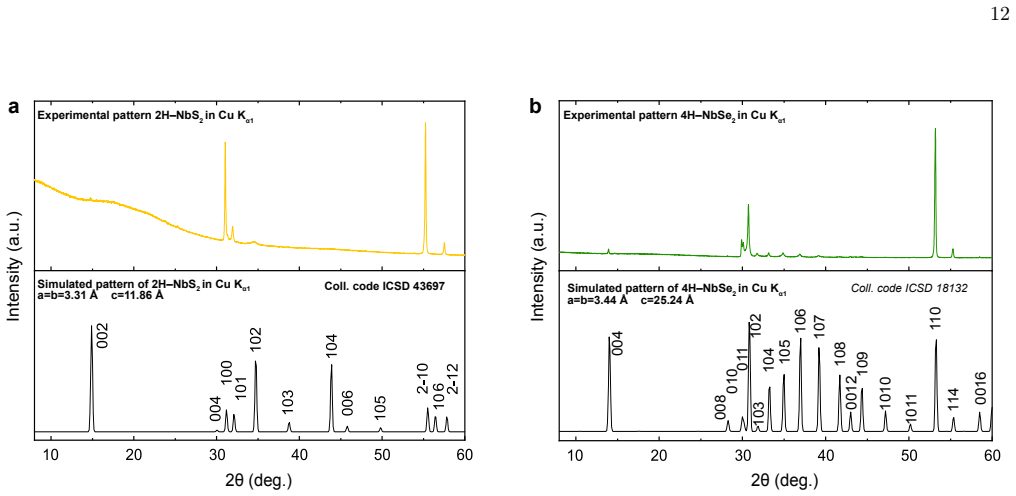
B. E. Brown and D. J. Beerntsen, Layer structure polytyp- ism among niobium and tantalum selenides, Acta Cryst. 18, 31 (1965). 12 Intensity (a.u.) 2θ (deg.) Coll. code ICSD 43697 Coll. code ICSD 18132Simulated pattern of 2H–NbS2in Cu Kα1 a=b=3.31 Å c=11.86 Å Experimental patte...
1965
Reviewed August 11, 2026 · model on record in the stance chip above.
Discussion (0). Continue with ORCID to comment.