REVIEW 4 major objections 5 minor 2 cited by
The boson number hypothesis and the boson number odd-even effect in $^{196-204}$Hg
T0 review · 4 major / 5 minor · reviewed 2026-08-11 · deepseek-v4-flash
Pith's one-line read Mercury isotope data confirm that low-lying nuclear states alternate with the parity of the boson number N.
desk verdict The Hg odd-even pattern is real, but N is locked to A here, so the boson-number verification claim overshoots. read the letter →
The pith
A machine-rendered reading of the paper's core claim, the machinery that carries it, and where it could break.
The reading
What carries the argument
The load-bearing object is the SU(3) third-order Casimir operator $\hat C_3[\mathrm{SU}(3)]$ inside the Hamiltonian (1), together with the other SU(3) higher-order terms. For finite boson number $N$, this operator's ground representation alternates between $(0,N)$ for even $N$ and $(2,N-1)$ for odd $N$, forcing the first excited bandhead angular momentum to alternate between $0$ and $2$. A single parameter set ($\eta=0.4$, $\alpha=1.65$, $\beta=0.05$, $\gamma=-1.9$, $\delta=-12.0$) with only the global scale $c$ adjusted per nucleus carries the whole calculation, so the $N$-parity alternation is the mechanism that explains the data.
What would settle it
Measure, or reanalyse with higher resolution, the ordering of the $0_2^+$ and $2_2^+$ bandheads in $^{200}$Hg and $^{202}$Hg: if $^{200}$Hg showed a $2_2^+$ state below its $0_2^+$ state, or $^{202}$Hg showed a $0_2^+$ state below its $2_2^+$ state, the predicted $N$-parity alternation would be directly contradicted.
Extended reading notes
Core claim
The central claim is that the boson number odd-even effect predicted by the SU3-IBM really exists in $^{196-204}$Hg. For the third-order Casimir interaction, the ground-state SU(3) representation is $(0,N)$ for even $N$ and $(2,N-1)$ for odd $N$, so the bandhead of the first excited band has angular momentum $0$ for even $N$ and $2$ for odd $N$. The paper shows that a fixed five-parameter Hamiltonian, Eq. (1), with only the boson number $N$ changed from isotope to isotope, reproduces the measured evolution of the $0_1^+$, $2_1^+$, $4_1^+$, $0_2^+$, $2_2^+$, and $0_3^+$ states, including the anomalous low $0_2^+$ energy in $^{200}$Hg. This is presented as the first verification of the boson number hypothesis and as direct evidence for the validity of the SU3-IBM.
Load-bearing premise
The argument assumes that one fixed five-parameter Hamiltonian, with only the boson number changing between isotopes, fully accounts for the odd-even pattern; the paper itself says that effects it left out, such as distinguishing protons from neutrons, adding higher-spin bosons, and including individual-particle motion, are also needed near the heavier mercury isotopes.
Editorial extensions
If this is right
- The low-lying $0_2^+$ and $2_2^+$ bandheads in $^{196-204}$Hg become a direct readout of the boson number $N$: even $N$ favors a $0_2^+$ bandhead, odd $N$ a $2_2^+$ bandhead.
- A single Hamiltonian with fixed parameters, only the scale $c$ changed, reproduces the measured level evolution for five isotopes, implying the spectra are sensitive to the exact value of $N$.
- The SU(3) third-order Casimir operator is identified as the correct finite-$N$ description of oblate shapes, and the O(6) limit is judged inadequate for the $\gamma$-softness of these nuclei.
- The calculation predicts a $4_2^+$ state in $^{200}$Hg that future experiment should be able to find.
- The odd-even effect is absent in the large-$N$ limit and in earlier IBM treatments, so the finite-$N$ representation structure of SU3-IBM is the essential ingredient.
Reading between the lines
- Beyond the paper: if the $N$-parity interpretation is right, the alternation should weaken as $N$ grows toward the large-$N$ limit, so heavier mercury isotopes or neighbouring platinum isotopes should show a fading of the effect; this is a testable extension the authors do not state.
- Beyond the paper: the fit is worst exactly where the paper invokes missing degrees of freedom (single-particle excitations, g bosons, proton-neutron distinguishability), so a cleaner test is to measure the $2_2^+ \to 2_1^+$ transition rate in $^{198}$Hg, where the calculation overshoots experiment by a large factor; a small measured value would implicate non-collective mixing rather than $N$ parit
- Beyond the paper: the same logic predicts an $N$-parity ordering in the neighbouring $^{192-200}$Pt nuclei mentioned as a future platform, turning the five-isotope coincidence into a region-wide prediction.
- Beyond the paper: the evidence that $N$ alone controls the effect could be sharpened by perturbing the five parameters within their uncertainties; if the $N$-parity ordering survives only for the one tuned set, the case that $N$ is the controlling variable becomes much weaker.
Signed reviews
Editorial analysis
A structured set of objections, weighed in public.
Referee Report
Summary. The paper claims to identify a boson number odd-even effect in the low-lying 0+2 and 2+2 bandheads of 196-204Hg and interprets it as a verification of the IBM boson number hypothesis and of the SU3-IBM. The authors use a Hamiltonian (Eq. 1) with five fixed structural parameters (eta=0.4, alpha=1.65, beta=0.05, gamma=-1.9, delta=-12.0), per-isotope energy scales c, and per-isotope effective charges e, and show that the calculated bandhead energies reproduce the observed alternating pattern of 0+2 and 2+2 states. They also compare selected B(E2) values and quadrupole moments.
Significance. If the central claim were established, the paper would provide a rare empirical test of the finite-N predictions of an algebraic model, and the odd-even pattern predicted from the SU(3) third-order Casimir operator (Ref. [34]) predates the present data fit, which is a genuine strength. The authors are also transparent about the deficiencies of the B(E2) description and about the need for extensions such as proton-neutron distinction and g bosons. However, the evidence presented is not sufficient to support the strong conclusions in the abstract and conclusion, and the manuscript needs substantial additional analysis before the claim of verification can be accepted.
major comments (4)
- [Eq. (1) and 'Now we explain this effect'] The statement that 'for this specific Hamiltonian, the only variable is the boson number N' is not supported, because the energy scale c is adjusted per isotope (733.5, 743.1, 602.0, 548.6, 613.2 keV) and the effective charge e also takes five different values in Table I. The five structural parameters are fixed, but the model still contains ten isotope-dependent scaling parameters, so the comparison is not parameter-free. The paper should report the sensitivity of the odd-even pattern to the per-isotope scales and demonstrate that the pattern is not an artifact of tuning c_N and e_N.
- [Paragraph 'The boson number for 196−204Hg are 6,5,4,3,2'] For these Hg isotopes the boson number is N=(208-A)/2, so N is an exact linear function of the mass number A; every step A to A+2 changes N by exactly one. Consequently, any odd-even staggering in A automatically appears as an odd-even staggering in N, and the Hg chain alone cannot discriminate the boson number hypothesis from any other mechanism that produces an A-parity effect. The authors do not fit an alternative model to the same data, do not provide a statistical significance test, and dismiss the O(6)-U(5) descriptions in Refs. [41,43] without a quantitative comparison. The conclusion that the effect 'verifies the boson number hypothesis' therefore goes beyond what a single isotope chain can establish.
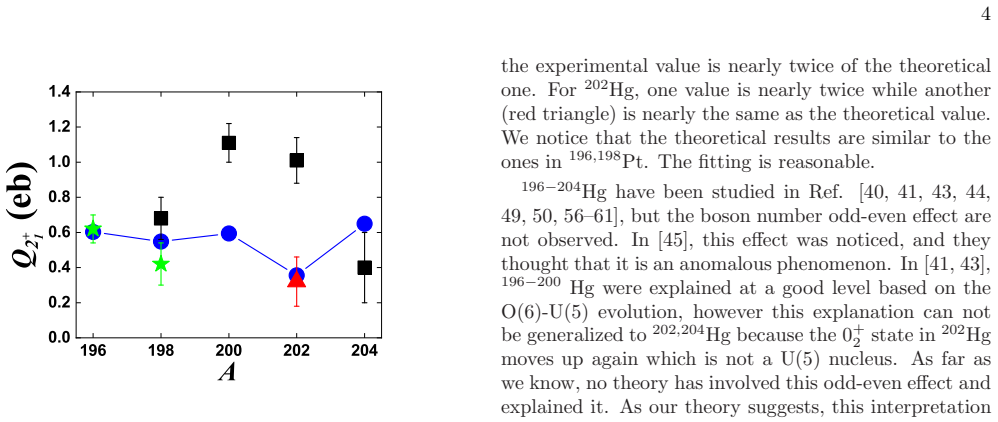
- [Table I and discussion near Fig. 2] The B(E2) comparison contains order-of-magnitude failures for the 2+2 states: in 198Hg the calculated 2+2→2+1 value is 32.7 W.u. versus 0.63(8) W.u. experimentally, and 2+2→0+1 is 3.44 versus 0.0216(4); in 200Hg the 2+2→2+1 value is 19.1 versus 2.2(5). The authors themselves state that the collective nature of the 2+2 state is greatly reduced. If the calculated 2+2 states are not the same as the experimental states, the agreement of the bandhead energies in Fig. 2 cannot be used as evidence for the predicted odd-even effect of the 2+2 bandhead.
- [Paragraph 'For only this third-order interaction...'] The pure SU(3) third-order Casimir term predicts a 0+2 first-excited bandhead for 196Hg (N=6), but the experimental bandhead is 2+2. The authors state that other higher-order interactions change 196Hg from 0 to 2 while keeping the heavier nuclei unchanged. Thus the full five-parameter Hamiltonian, not the C3 term alone, reproduces the observed pattern, and the assertion that 'the main interaction is the C3 operator' is not established by the fit. A decomposition showing the separate effect of each term in Eq. (1) is needed to support the attribution.
minor comments (5)
- [Abstract and Conclusion] There are typos: 'hgiher-order' in the conclusion and 'pevious' in the penultimate section; these should be corrected.
- [Fig. 4 caption] The caption should read 'Black squares' and 'blue spheres' rather than 'Black square' and 'blue sphericity'.
- [Eq. (1)] The operators Omega and Lambda are described only verbally; explicit expressions or precise equations from Refs. [47,48] should be provided.
- [References] Reference [58] is missing the journal name, and the volume number in Ref. [20] appears inconsistent; please check all entries for completeness.
- [Discussion of Fig. 2] The sentence 'the theoretical results of the 2+2 states in Fig. 2 also suffer from deficiencies' should be quantified, since those deficiencies are relevant to the identification of the states.
Circularity Check
The model's structural odd-even prediction is independently grounded in Ref. [34], but the 'verification' is weakened by fitting c to the 0+2 bandheads and by the definitional identity N_boson=(208-A)/2 in this mass region.
-
fitted input called prediction
[Section 'Now we explain this effect with the SU3-IBM' (p.3), after Eq. (1); Fig. 2 and Table I]
"To make the energy of the 0+2 state be equal to the experimental data, the parameter c are 733.5 keV, 743.1 keV, 602.0 keV, 548.6 keV, 613.2 keV for 196−204Hg, respectively. Thus for this specific Hamiltonian, the only variable is the boson number N."
The 0+2 bandhead is one of the two quantities whose odd-even alternation is presented as evidence (Fig. 1). Setting c_n so that E_th(0+2)=E_exp(0+2) for every isotope makes the staggered 0+2 curve in Fig. 2 an input, not an output; the subsequent statement that 'theoretical calculations reproduce the evolutional behaviors at a high level' is therefore partly true by construction. The independent part, the 2+2 bandhead, is admitted to be 'somewhat quantitatively worse', and the B(E2) rates for 2+2→2+1 disagree by factors of 10-50 (Table I), so the data do not independently confirm the fitted 0+2 pattern. This is a fitted input presented as a verified prediction.
-
other
[Section 'The boson number for 196−204Hg are 6,5,4,3,2' (p.3) and Conclusion (p.5)]
"The boson number for 196−204Hg are 6,5,4,3,2. ... Because these results are very sensitive to the boson number N, they also verify the basic boson number hypothesis of the IBM, which was considered impossible in the past 50 years."
N_boson is not an independent variable in this chain: with Z=80 and neutrons counted as holes to N=126, N_boson=(208−A)/2, so the listed values 6,5,4,3,2 are exactly linear in A. Consequently every odd-even staggering in A is automatically an odd-even staggering in N under the very hypothesis ('N is half the number of valence nucleons') that the paper claims to verify. The test therefore cannot distinguish N-sensitivity from ordinary mass-number or valence-neutron-number sensitivity; no alternative model (e.g., keeping N fixed while changing other degrees of freedom) is compared. The claimed verification is partly a restatement of the definitional link between A and N, not an independent confirmation of the boson number hypothesis.
full rationale
The paper's internal derivation is not overtly circular at the level of the SU(3) representation: the alternating bandhead angular momenta (0,2,0,2,0) for N=6..2 are a structural property of the third-order Casimir operator reported in Ref. [34], which is independent of the present data fit and not authored by the current paper's authors. That gives the central model prediction real, independently published content. However, the empirical validation is substantially weakened by two construction-related issues. First, the per-isotope energy scale c is chosen to force each 0+2 bandhead to exactly equal experiment, so the 0+2 component of the odd-even effect is fitted, not predicted; the remaining 2+2 comparison is admitted to be quantitatively worse and its B(E2) values fail by large factors. Second, the boson number hypothesis itself defines N from the valence-nucleon count, and in 196-204Hg this gives N_boson=(208-A)/2, so an A-parity staggering is automatically an N-parity staggering; the paper's 'only variable is N' statement is thus a re-labeling of the mass-number dependence rather than an independent experimental control. The manuscript also concedes the need for proton-neutron distinction, g bosons, single-particle excitations, and reduced collectivity of the 2+2 states, further weakening the directness of the claimed verification. There is no load-bearing self-citation chain that forces the result, and the structural prediction is not equivalent to its inputs by definition. The appropriate finding is therefore partial circularity: score 4.
Assumptions & free parameters
free parameters (7)
- eta =
0.4
- alpha =
1.65
- beta =
0.05
- gamma =
-1.9
- delta =
-12.0
- c_N (energy scale per isotope) =
733.5, 743.1, 602.0, 548.6, 613.2 keV for 196-204Hg
- e_N (effective boson charge per isotope) =
2.395, 2.542, 2.829, 2.801, 3.471 (W.u.)^1/2 for 196-204Hg
assumptions (5)
- domain assumption Standard IBM valence boson count for 196-204Hg gives N=6,5,4,3,2.
- domain assumption The SU3-IBM Hamiltonian with only the U(5) and SU(3) limits is an adequate low-energy model space for these nuclei.
- standard math The SU(3) cubic Casimir yields (0,N) ground states for even N and (2,N-1) for odd N, giving bandhead angular momenta 0 and 2 respectively.
- domain assumption The Omega and Lambda terms are the SU(3) images of the rigid triaxial rotor.
- domain assumption The experimental 0+2 and 2+2 assignments in 196-204Hg are correct.
Cite this review
Pith. "Pith review of The boson number hypothesis and the boson number odd-even effect in $^{196-204}$Hg." pith.science (2026). https://pith.science/paper/RWD6KFYW
@misc{pith2026241214881,
  author       = {Pith},
  title        = {Pith review of: The boson number hypothesis and the boson number odd-even effect in $^196-204$Hg},
  year         = {2026},
  howpublished = {\url{https://pith.science/paper/RWD6KFYW}},
  note         = {Machine review of arXiv:2412.14881}
}
abstract
In the SU3-IBM the oblate shape is described by the \textrm{SU(3)} third-order Casimir operator in the large-$N$ limit. However for finite $N$, this interaction can produce a boson number odd-even effect. In this Letter, we find that, the unique odd-even effect really exists in the nuclei $^{196-204}$Hg. This finding implies that realistic low-lying excitations are sensitive to certain boson number $N$. The boson number hypothesis is verified for the first time since the advent of the interacting boson model. This also proves the accuracy and validity of the SU3-IBM directly. The SU(3) symmetry and the higher-order interactions are both indispensable for understanding the nuclear quadrupole deformations.
Figures


Figures from the paper (1 more)
Forward citations
Cited by 2 Pith papers
-
Typical new spherical-like $\gamma$-soft spectra in $^{104,106,108}$Pd
The author fits an interacting boson model with many parameters to low-lying data for 106Pd and concludes it confirms a new gamma-soft mode, but the evidence is mostly fitting, not prediction.
-
SU(3) rigid triaxiality in $^{154}$Sm
Applying the SU3-IBM with ground-state irrep (18,2) to 154Sm reproduces many energy levels, B(E2) values, and quadrupole moments, but with significant deviations in key transitions and a γ angle outside the experiment...
Reference graph
Works this paper leans on
-
[34]
F. Pan, T. Wang, Y. S. Huo, and J. P. Draayer, J. Phys. G: Nucl. Part. Phys. 35, 125105 (2008)
2008
-
[1]
Iachello and A
F. Iachello and A. Arima, The Interacting Boson Model , (Cambridge University Press, Cambridge, 1987)
1987
-
[2]
Arima and F
A. Arima and F. Iachello, Phys. Rev. Lett. 35, 1069 (1975)
1975
-
[3]
Wang, EPL 129, 52001 (2020)
T. Wang, EPL 129, 52001 (2020)
2020
-
[4]
Wang, Chin
T. Wang, Chin. Phys. C 46, 074101 (2022)
2022
-
[5]
The large- N limit of this new model was first discussed by one of the authors (L
and the higher-order interactions [6, 7]. The large- N limit of this new model was first discussed by one of the authors (L. Fortunato) and his collaborators [8]. In the SU3-IBM, the SU(3) symmetry is suggested to domi- nate over the onset of quadrupole deformations, and only the U(5) limit and the SU(3) limit are included. So, in a sense, the SU3-IBM is b...
-
[6]
V. K. B. Kota, SU(3) Symmetry in Atomic Nuclei , (Springer Nature, Singapore,2020)
2020
- [7]
Show all 62 references
-
[8]
Vanden Berghe, H
G. Vanden Berghe, H. E. De Meyer and P. Van Isacker, Phys. Rev. C 32, 1049 (1985)
1985
-
[9]
Fortunato, C
L. Fortunato, C. E. Alonso, J. M. Arias, J. E. Garc ´ ıa- Ramos and A. Vitturi, Phys. Rev. C 84, 014326 (2011)
2011
-
[10]
T. Wang, B. C. He, C. X. Zhou, D. K. Li and L. Fortu- nato, Chin. Phys. C 48, 094102 (2024)
2024
-
[11]
Arima and F
A. Arima and F. Iachello, Phys. Rev. Lett. 40, 385 (1978)
1978
-
[12]
J. A. Cizewski, R. F. Casten, G. J. Smith, M. L. Stelts, W. R. Kane, H. G. B¨ orner et al., Phys. Rev. Lett. 40, 167 (1978)
1978
-
[13]
Zhang, Y
Y. Zhang, Y. W. He, D. Karlsson, C. Qi, F. Pan and J. P. Draayer, Phys. Lett. B 834, 137443 (2022)
2022
-
[14]
Wang, Phys
T. Wang, Phys. Rev. C 107, 064303 (2023)
2023
-
[15]
Zhang, S
Y. Zhang, S. N. Wang, F. Pan, C. Qi and J. P. Draayer, Phys. Rev. C 110, 024303 (2024)
2024
-
[16]
F. Pan, Y. Zhang, Y. X. Wu, L. R. Dai and J. P. Draayer, Phys. Rev. C 110, 054324 (2024)
2024
-
[17]
W. Teng, Y. Zhang and C. Qi, Chin. Phys. C 49, 014102 (2025)
2025
-
[18]
Zhang and W
Y. Zhang and W. Teng, Phys. Rev. C 111, 014324 (2025)
2025
-
[19]
Y. X. Cheng, D. H. Zhao, Y. Y. Shao, T. Wang and X. S. Kang, in preparation
-
[20]
T. Wang, X. Chen and Y. Zhang, Chin. Phys. C 49, 014107 (2025)
2025
-
[21]
T. Wang, B. C. He, D. K. Li and C. X. Zhou, Phys. Rev. C 78, 064322 (2023)
2023
-
[22]
C. X. Zhou and T. Wang, Phys. Rev. C 108, 024309 (2023)
2023
-
[23]
C. X. Zhou, T. Wang, D. K. Li, B. C. He and L. Fortu- nato, in preparation
- [24]
-
[25]
Heyde and J
K. Heyde and J. L. Wood, Rev. Mod. Phys. 83, 1467 (2011)
2011
-
[26]
Heyde and J
K. Heyde and J. L. Wood, Phys. Scr. 91, 083008 (2016)
2016
-
[27]
P. E. Garrett, J. L. Wood and S. W. Yates, Phys. Scr. 93, 063001 (2018)
2018
-
[28]
C. X. Zhou and T. Wang, in preparation
-
[29]
Otsuka, Y
T. Otsuka, Y. Tsunoda, T. Abe, N. Shimizu and P. Van Duppen, Phys. Rev. Lett. 123, 222502 (2019)
2019
-
[30]
Tsunoda and T
Y. Tsunoda and T. Otsuka, Phys. Rev. C 103, L021303 (2021)
2021
-
[31]
Otsuka, Y
T. Otsuka, Y. Tsunoda, Y. Utsuno, N. Shimizu, T. Abe and H. Ueno, arXiv:2303.11299v5
-
[32]
A. M. Shirokov, N. A. Smirnova and Y. F. Smirnov, Phys. Lett. B 434, 237 (1998)
1998
-
[33]
Cejnar, S
P. Cejnar, S. Heinze, and J. Jolie, Phys. Rev. C 68, 034326 (2003)
2003
-
[35]
Zhang, F
Y. Zhang, F. Pan, Y. X. Liu, Y. A. Luo and J. P. Draayer, Phys. Rev. C 85, 064312 (2012)
2012
-
[36]
Jolie, R
J. Jolie, R. F. Casten, P. von Brentano and V. Werner, Phys. Rev. Lett. 87, 162501 (2001)
2001
-
[37]
Jolie, P
J. Jolie, P. Cejnar, R. F. Casten, S. Heinze, A. Linne- mann and V. Werner, Phys. Rev. Lett. 89, 182502 (2002)
2002
-
[38]
Warner, Nature 420, 614 (2002)
D. Warner, Nature 420, 614 (2002)
2002
-
[39]
Jolie and A
J. Jolie and A. Linnemann, Phys. Rev. C 68, 031301(R) (2003)
2003
-
[40]
Bonatsos, A
D. Bonatsos, A. Martinou, S. K. Peroulis, T. J. Mertz- imekis and N. Minkov, Phys. Scr. 99, 062003 (2024)
2024
-
[41]
Nomura, R
K. Nomura, R. Rodr ´ ıguez-Guzm´ an and L. M. Robledo, Phys. Rev. C 87, 064313 (2013)
2013
-
[42]
J. E. Garc ´ ıa-Ramos and K. Heyde, Phys. Rev. C 89, 014306 (2014)
2014
-
[43]
X. Q. Yang, L. J. Wang, J. Xiang, X. Y. Wu and Z. P. Li, Phys. Rev. C 103, 054321 (2021)
2021
-
[44]
Sahoo, P
S. Sahoo, P. C. Srivastava, N. Shimizu and Y. Utsuno, Phys. Rev. C 110, 024306 (2024)
2024
-
[45]
Bernards, R
C. Bernards, R. F. Casten, V. Werner, P. von Brentano, D. Bucurescu, G. Graw et al. , Phys. Rev. C 87, 024318 (2013)
2013
-
[46]
Bernards, R
C. Bernards, R. F. Casten, V. Werner, P. von Brentano, D. Bucurescu, G. Graw et al. , Phys. Rev. C 87, 064321 (2013)
2013
-
[47]
ENSDF: https://www.nndc.bnl.gov/ensdf/
-
[48]
Y. F. Smirnov, N. A. Smirnova and P. Van Isacker, Phys. Rev. C 61, 041302(R) (2000)
2000
-
[49]
Zhang, F
Y. Zhang, F. Pan, L. R. Dai and J. P. Draayer, Phys. Rev. C 90, 044310 (2014)
2014
-
[50]
Chakraborty, H
S. Chakraborty, H. P. Sharma, S. S. Tiwary, C. Ma- jumder, P. Banerjee, S. Ganguly et al. , Eur. Phys. J. A 55, 46 (2019)
2019
-
[51]
Olaizola, A
B. Olaizola, A. B. Garnsworthy, F. A. Ali, C. Andreoiu, G. C. Ball, N. Bernier et al. , Phys. Rev. C 100, 024301 (2019)
2019
-
[52]
Bonatsos, I
D. Bonatsos, I. E. Assimakis, N. Minkov, A. Martinou, S. Sarantopoulou, R. B. Cakirli et al. , Phys. Rev. C 95, 064326 (2017)
2017
-
[53]
Bonatsos, A
D. Bonatsos, A. Martinou, S. K. Peroulis, T. J. Mertz- imekis, N. Minkov, Symmetry 15, 169 (2023)
2023
-
[54]
Martinou1, D
A. Martinou1, D. Bonatsos, N. Minkov, I. E. Assimakis, S. K. Peroulis, S. Sarantopoulou et al. , Eur. Phys. J. A 56, 239 (2020)
2020
-
[55]
Bonatsos and A
D. Bonatsos and A. Klein, Ann. Phys. 169, 61 (1986)
1986
-
[56]
J. P. Elliott and J. A. Evans, J. Phys. G: Nucl. Part. Phys. 25, 2071 (1999)
1999
-
[57]
Bernards, S
C. Bernards, S. Heinze, J. Jolie, C. Fransen, A. Linne- mann and D. Radeck, Phys. Rev. C 79, 054307 (2009)
2009
-
[58]
Bernards, S
C. Bernards, S. Heinze, J. Jolie, M. Albers, C. Fransen and D. Radeck, Phys. Rev. C 81, 024312 (2010)
2010
-
[59]
Bernards, W
C. Bernards, W. Urban, M. Jentschel, B. M¨ arkisch, J. Jolie, C. Fransen et al. , 84, 047304 (2011)
2011
-
[60]
Esmaylzadeh, L
A. Esmaylzadeh, L. M. Gerhard, V. Karayonchev, J.-M. R´ egis, J. Jolie, M. Bast et al. , Phys. Rev. C 98, 014313 (2018)
2018
-
[61]
Alimohammadi L
M. Alimohammadi L. Fortunato and A. Vitturi, Eur. Phys. J. Plus 134, 570(2019)
2019
-
[62]
R. Kern, R. Stegmann, N. Pietralla, G. Rainovski, M. P. Carpenter, R. V. F. Janssens et al. , Phys. Rev. C 99, 011303(R) (2019)
2019
Reviewed August 11, 2026 · model on record in the stance chip above.
Discussion (0). Continue with ORCID to comment.