REVIEW 4 major objections 5 minor 1 cited by
Typical new spherical-like $\gamma$-soft spectra in $^{104,106,108}$Pd
T0 review · 4 major / 5 minor · reviewed 2026-08-10 · deepseek-v4-flash
Pith's one-line read The paper claims that 106Pd is a typical spherical-like γ-soft nucleus, with low-lying states up to the 10+ state under 4000 keV reproduced by an extended interacting-boson model with SU(3) higher-order interactions.
desk verdict A systematic fit with some real hits, but the central claim rests on an unsupported assumption about negligible normal–intruder coupling; the abstract overstates what the evidence shows. read the letter →
The pith
A machine-rendered reading of the paper's core claim, the machinery that carries it, and where it could break.
The reading
What carries the argument
The machinery is an extended interacting boson model Hamiltonian $\hat H = c\{(1-\eta)\hat n_d + \eta[-\hat C_2[SU(3)]/(2N) + \alpha \hat C_3[SU(3)]/(2N^2) + \beta \hat C_2^2[SU(3)]/(2N^3) + \gamma \Omega/(2N^2) + \delta \Lambda/(2N^3)]\}$, plus an $\hat L^2$ term, diagonalized in a $U(6)\supset SU(3)\supset SO(3)$ basis. SU(3) symmetry dominates: the second- and third-order Casimir operators describe prolate and oblate deformation, and their combination produces a low-lying spectrum that mimics phonon triplets but with a characteristic missing 0+3 near the second group and a 0+3 near the third group at roughly twice the 0+2 energy. The SU(3) decomposition of the 0+ states in the new model is shown to differ from both the U(5) and O(6) limits, which is how the paper distinguishes the new mode from both spherical vibration and standard γ-soft rotation.
What would settle it
Precision measurement of the B(E2) values for the 0+5 and 2+3 states in 106Pd would settle the claim: the new model predicts B(E2;0+5→2+3)=60.5 W.u. and B(E2;2+3→0+2)=37.8 W.u., while the IBM-2 fits give 23.2 and 12.3 W.u., respectively. Resolving these branches with a Coulomb-excitation or gamma-spectroscopy experiment would distinguish the two pictures.
Extended reading notes
Core claim
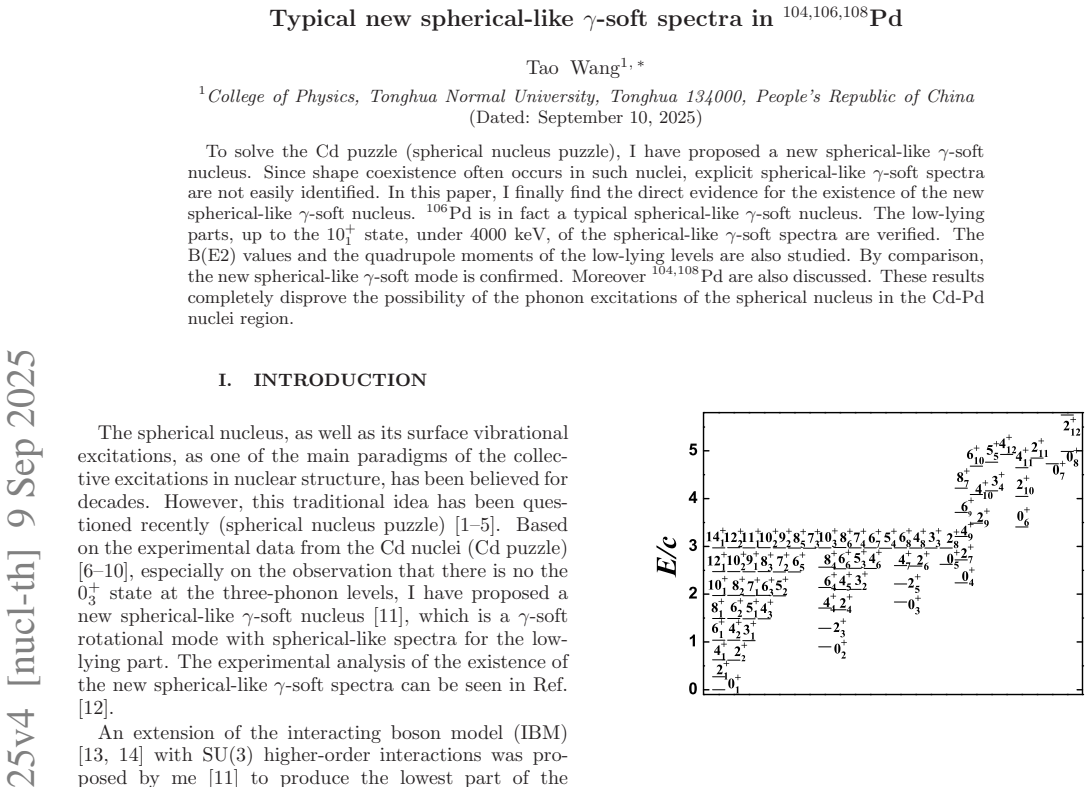
The central claim is that direct experimental evidence for the proposed spherical-like γ-soft nucleus exists in 106Pd. The author shows that the complete low-lying normal-state spectrum up to the 10+1 state under 4000 keV, including the third and fourth group levels 8+1, 6+2, 5+1, 4+3, 4+4, 2+4, 0+3 and 10+1, 8+1, 7+1, 6+3, 5+2, 6+4, 4+5, 3+2, 2+5, 0+4, is reproduced by the new model with a single set of fitted parameters. The theoretical B(E2) values and quadrupole moments agree with experiment at a good level, and the paper claims the agreement is better than that of the IBM-2 calculations. The neighboring nuclei 104Pd and 108Pd are also discussed, with 108Pd behaving as a softer, near-critical nucleus between the new γ-soft mode and the prolate shape, and 104Pd requiring intruder configuration mixing. The author concludes that these results completely disprove the possibility that the Cd-Pd nuclei are spherical phonon vibrators.
Load-bearing premise
The load-bearing premise is that the coupling between the normal states and the intruder states in 106Pd can be ignored, based on the small B(E2;0+3→2+1) value near 2.41 W.u.; if that coupling were significant, the fitted normal levels would be shifted and the comparison to the pure normal-state model would collapse.
Editorial extensions
If this is right
- The two-times relationship between the 0+3 and 0+2 energies becomes a testable fingerprint: nuclei showing a 0+ state near twice the 0+2 energy, with no 0+3 near the second group, can be classified as spherical-like γ-soft candidates.
- The Cd-Pd region would be reinterpreted: the traditional spherical phonon-vibrational description should be replaced by γ-soft rotation with spherical-like low-lying spectra, and the Cd puzzle dissolves.
- For 104Pd, the model requires explicit normal-intruder configuration mixing; future calculations including intruder states should reduce B(E2;0+2→2+1) toward experiment.
- 108Pd emerges as the critical nucleus for a shape phase transition between the new γ-soft phase and prolate shapes, which explains its softer quadrupole moments and larger odd-even staggering.
- The success of higher-order SU(3) terms suggests that quadrupole deformation, not spherical vibration, is the organizing principle of low-lying collective spectra in medium-mass nuclei.
Reading between the lines
- A decisive cross-check would be to search for the predicted 0+5 and 2+3 branching pattern in 108Pd or in a cadmium isotope whose intruder states are pushed high enough to expose the normal spectrum, since one nucleus alone may not rule out all phonon-based alternatives.
- Because the emergent fingerprint is energy-based, it can be searched for in large nuclear data sets: nuclei whose 0+ spectra show a gap followed by a 0+ state at twice the first excited 0+ energy.
- The proposed proton-neutron extension of the model is likely to resolve the odd-even γ-band staggering discrepancy and could be tested on 104Pd and 108Pd by comparing neutron and proton boson numbers.
- If the two-times 0+ relationship holds in other nuclei with N=7 bosons, such as 110Cd and 118Cd, the new mode is not an isolated case but a systematic family.
Signed reviews
Editorial analysis
A structured set of objections, weighed in public.
Referee Report
Summary. The manuscript argues that 106Pd is a "typical spherical-like γ-soft nucleus" described by an extended interacting-boson-model Hamiltonian with SU(3) higher-order terms. After fitting parameters (η, γ, δ, c, f, e) to the low-lying energies and selected B(E2) values, the paper reports agreement of the calculated level scheme with experimental data up to the 10+1 state, interprets the 0+5 state via a two-times energy relationship, and extends the analysis to 104Pd and 108Pd. It concludes that the existence of the new spherical-like γ-soft mode is confirmed and that phonon excitations in the Cd–Pd region are "completely disproved."
Significance. The proposed mode is an alternative to the traditional spherical-vibrator picture in the Cd–Pd nuclei, and if the claim were established it would be of considerable interest. The paper provides a broad set of comparisons (level energies, B(E2) values, quadrupole moments) and makes concrete predictions for unobserved states, which is a useful feature. However, the verification is weakened by the use of fitted parameters, the unjustified neglect of normal–intruder mixing, and the inclusion of unobserved levels as confirmed states; the comparison with the phonon picture is not quantitative. The paper does not provide reproducible code or machine-checked proofs, but the tabulated comparisons are a service to the community.
major comments (4)
- [Section II] The conclusion that normal–intruder coupling "can be also ignored" in 106Pd rests solely on the small value B(E2;0+3→2+1)≈2.41 W.u. This inference is not quantitatively supported: in a two-state mixing picture with B(E2;0+2→2+1)≈35 W.u., the observed interband strength can be produced by a mixing amplitude |β|≈sqrt(2.41/35)≈0.26, which is not negligible, and the small interband B(E2) can also arise from destructive interference even for large mixing. Section V admits that B(E2;0+3→2+1)>25 W.u. in 104Pd calls for configuration mixing, but no threshold is given for when mixing is negligible; therefore the unmixed comparison in Fig. 3 is not an established verification of the normal-state spectrum.
- [Table I and Section IV] The theoretical B(E2;0+2→2+2)=84.6 W.u. disagrees with the adopted experimental value 19(+7,-3) W.u. by more than a factor of four, a deviation far outside the uncertainty quoted for the data. The subsequent comparison with larger values in 108Pd and Cd nuclei does not explain this specific discrepancy in 106Pd; as presented, this undercuts the statement that there is "no complete inconsistency" and limits the strength of the B(E2) verification claim.
- [Section IV and Fig. 3] Three of the levels used in the comparison (the blue 8+, 7+, and 6+ states) are not experimentally observed and are placed "according to the features of the level bands", and the 0+5 state is identified at least in part because the model requires a two-times relationship with the 0+2 state. The claimed confirmation of the third and fourth group states therefore relies on assignments that are not independent of the model. Independent experimental identification of these states is needed before the spectrum can be said to be verified.
- [Abstract and Section VII] The statement that these results "completely disprove the possibility of the phonon excitations of the spherical nucleus in the Cd-Pd nuclei region" is not supported by any quantitative comparison with a phonon (e.g., U(5)-type) description of the same data. A model with several fitted parameters that reproduces part of a level scheme cannot by itself exclude an alternative model; the conclusion should be severely softened or the phonon model should be tested directly.
minor comments (5)
- [Throughout] There are typographical errors, for example "pro posed" in the abstract, "Nucl. Phya." in Ref. [20], and "quadruple moments" in Section VI; these should be corrected.
- [Fig. 3] The experimental status of the blue levels (observed vs. predicted) should be stated unambiguously in the caption, since the text says these levels have not been found yet.
- [Table I] The table would be more informative if the theoretical uncertainties and the references for each experimental column were reported consistently; currently the source labels a–d are not all mapped in every row.
- [Section III] The value α=3N/(2N+3) appears to be fixed, but the paper does not explain why this choice is made for the fits; the sensitivity of the results to this choice should be commented on.
- [References] Several references are to "submitted" or "in preparation" items (Refs. [38], [39], [49], [50]); these should be replaced by published versions or clearly identified as preprints.
Circularity Check
Central 106Pd 'spherical-like γ-soft' claim is built from fitted parameters and a self-definitional 0+ assignment, so its confirmation partly reduces to the model's own assumptions.
-
fitted input called prediction
[Section III (Hamiltonian) and Section IV (Results for 106Pd), after Eq. (1) / around Fig. 3]
"The η is determined to allow the energies of the 0+ states to agree with the experimental data. The γ and δ are to match the value of B(E2; 0+2 → 2+1). ... The theoretical five lowest 0+ states all have experimental correspondences."
These parameters are adjusted to the 0+ spectrum and one B(E2) of 106Pd itself; the same 0+ states and B(E2) are then offered as 'verification' and 'confirmation' of the new mode. In particular, the paper's 'fit below will show that this is not a coincidence' cannot do that for the 0+5 two-times state, because η was chosen to make the 0+ energies agree and the two-times feature is a property of the author's model. Thus the central 0+ comparison in Fig. 3 is, for the pattern being claimed, a report of the fit rather than an independent prediction.
-
self definitional
[Section II, paragraph following Fig. 2(b)]
"Importantly, compared with 118Cd, the 0+4 state does not belong to the normal states too, which is not mentioned in previous studies. ... If the normal states of 106Pd show the new spherical-like γ-soft spectra, there must be a 0+ state with energy that is twice the one of the 0+2 state (two-times relationship). I indeed find this 0+5 state of 106Pd in Fig. 2(b). The fit below will show that this is not a coincidence."
The paper removes observed 0+3 and 0+4 from the normal set partly because 0+4 'does not belong to the normal states'—an assignment not previously established and not derived from independent data in this paper. It then selects 0+5 as the state required by the model's two-times relationship. Because the model is used both to define the expected pattern and to sort the experimental states, the later agreement is self-consistent by construction. This is the decisive step that turns the fit into 'direct evidence' for the new spherical-like γ-soft nucleus.
full rationale
The paper is not wholly without independent content: it uses external ENSDF and published B(E2) data, fixes one parameter set and applies it to 104Pd and 108Pd, and reports quadrupole moments and several B(E2) values not directly used in the fit. Those comparisons could in principle falsify the model, and the normal–intruder decoupling question (small B(E2;0+3→2+1)=2.41 W.u. versus mixing) is a physics/correctness concern rather than a circularity. However, the central 106Pd identification depends on (i) fitting η to the 0+ energies and γ, δ to a B(E2) of the same nucleus, and (ii) declaring the experimental 0+4 to be an intruder and choosing 0+5 as the model's two-times state. These steps make the main 'verification' partly circular: the model's pattern is used to select the normal-state spectrum, and the selected spectrum is then used to confirm the model. Hence score 8 rather than 6.
Assumptions & free parameters
free parameters (6)
- eta =
0.47 for 106,104,108Pd
- gamma =
1.728
- delta =
1.34
- c =
1177.42 keV (106Pd), 1317.46 keV (104Pd), 1152.21 keV (108Pd)
- f =
37.04 keV (106Pd), 45.12 keV (104Pd), 27.40 keV (108Pd)
- e =
2.027, 2.082, 1.950 (W.u.)^(1/2) for 106Pd, 104Pd, 108Pd
assumptions (4)
- ad hoc to paper The IBM with the Hamiltonian in Eq. (1) is an adequate description of low-lying collective states.
- standard math The SU(3) basis diagonalization code (Refs. 17, 56) is correct.
- domain assumption The coupling between normal and intruder states is negligible in 106Pd.
- domain assumption The assignment of unobserved levels (blue levels in Fig. 3) is correct.
invented entities (1)
-
New spherical-like gamma-soft nuclear mode
Cite this review
Pith. "Pith review of Typical new spherical-like $\gamma$-soft spectra in $^{104,106,108}$Pd." pith.science (2026). https://pith.science/paper/MCFA6FKR
@misc{pith2026250110925,
  author       = {Pith},
  title        = {Pith review of: Typical new spherical-like $\gamma$-soft spectra in $^104,106,108$Pd},
  year         = {2026},
  howpublished = {\url{https://pith.science/paper/MCFA6FKR}},
  note         = {Machine review of arXiv:2501.10925}
}
abstract
To solve the Cd puzzle (spherical nucleus puzzle), I have proposed a new spherical-like $\gamma$-soft nucleus. Since shape coexistence often occurs in such nuclei, explicit spherical-like $\gamma$-soft spectra are not easily identified. In this paper, I finally find the direct evidence for the existence of the new spherical-like $\gamma$-soft nucleus. $^{106}$Pd is in fact a typical spherical-like $\gamma$-soft nucleus. The low-lying parts, up to the $10_{1}^{+}$ state, under 4000 keV, of the spherical-like $\gamma$-soft spectra are verified. The B(E2) values and the quadrupole moments of the low-lying levels are also studied. By comparison, the new spherical-like $\gamma$-soft mode is confirmed. Moreover $^{104,108}$Pd are also discussed. These results completely disprove the possibility of the phonon excitations of the spherical nucleus in the Cd-Pd nuclei region.
Figures


Figures from the paper (2 more)


Forward citations
Cited by 1 Pith paper
-
The boson number hypothesis and the boson number odd-even effect in $^{196-204}$Hg
Measured 0+2 and 2+2 energy levels in 196-204Hg show the odd-even, boson-number dependent alternation predicted by the SU3-IBM.
Reference graph
Works this paper leans on
-
[1]
P. E. Garrett and J. L. Wood, J. Phys. G: Nucl. Part. Phys. 37, 064028 (2010)
work page 2010
-
[2]
Heyde and J
K. Heyde and J. L. Wood, Rev. Mod. Phys. 83, 1467 (2011)
2011
-
[3]
P. E. Garrett, J. Phys. G: Nucl. Part. Phys. 43, 084002 (2016)
work page 2016
- [4]
-
[5]
P. E. Garrett, J. L. Wood and S. W. Yates, Phys. Scr. 93, 063001 (2018)
work page 2018
-
[6]
P. E. Garrett, K. L. Green and J. L. Wood, Phys. Rev. C 78, 044307 (2008)
work page 2008
-
[7]
P. E. Garrett, J. Bangay, A. Diaz Varela, G. C. Ball, D. S. Cross, G. A. Demand, et al. , Phys. Rev. C 86, 044304 (2012)
work page 2012
-
[8]
J. C. Batchelder, N. T. Brewer, R. E. Goans, R. Grzywacz, B. O. Griffith, C. Jost, et al. , Phys. Rev. C. 86, 064311 (2012)
work page 2012
Show all 63 references
-
[9]
P. E. Garrett, T. R. Rodr ´ ıguez, A. Diaz Varela, K. L. Green, J. Bangay, A. Finlay, et al. , Phys. Rev. Lett. 123, 8 142502 (2019)
2019
-
[10]
P. E. Garrett, T. R. Rodr ´ ıguez, A. Diaz Varela, K. L. Green, J. Bangay, A. Finlay, et al. , Phys. Rev. C 101, 044302 (2020)
2020
-
[11]
Wang, Chin
T. Wang, Chin. Phys. C 46, 074101 (2022)
2022
-
[12]
T. Wang, X. Chen and Y. Zhang, Chin. Phys. C 49, 014107 (2025)
2025
-
[13]
Iachello and A
F. Iachello and A. Arima, The Interacting Boson Model , (Cambridge University Press, Cambridge, 1987)
1987
-
[14]
Arima and F
A. Arima and F. Iachello, Phys. Rev. Lett. 35, 1069 (1975)
1975
-
[15]
Jolie, R
J. Jolie, R. F. Casten, P. von Brentano, and V. Werner, Phys. Rev. Lett. 87, 162501 (2001)
2001
-
[16]
Cejnar, J
P. Cejnar, J. Jolie and R. F. Casten, Rev. Mod. Phys. 82, 2155 (2010)
2010
-
[17]
F. Pan, T. Wang, Y. S. Huo, and J. P. Draayer, J. Phys. G: Nucl. Part. Phys. 35, 125105 (2008)
2008
-
[18]
J. P. Elliott, Proc. Roy. Soc. Ser. A 245, 128 (1958)
1958
-
[19]
Arima, M
A. Arima, M. Harvey and K. Shimizu. Phys. Lett. B 30, 517 (1969)
1969
-
[20]
K. T. Hecht and A. Adler, Nucl. Phya. A 137, 129 (1969)
1969
-
[21]
J. P. Draayer and K. J. Weeks, Phys. Rev. Lett. 51, 1422 (1983)
1983
-
[22]
Leschber and J
Y. Leschber and J. P. Draayer, Phys. Lett. B 190, 1 (1987)
1987
-
[23]
Vanden Berghe, H
G. Vanden Berghe, H. E. De Meyer and P. Van Isacker, Phys. Rev. C 32, 1049 (1985)
1985
-
[24]
Y. F. Smirnov, N. A. Smirnova and P. Van Isacker, Phys. Rev. C 61, 041302(R) (2000)
2000
-
[25]
Zhang, F
Y. Zhang, F. Pan, L. R. Dai and J. P. Draayer, Phys. Rev. C 90, 044310 (2014)
2014
-
[26]
Bonatsos, I
D. Bonatsos, I. E. Assimakis, N. Minkov, A. Martinou, R. B. Cakirli, R. F. Casten, et al. , Phys. Rev. C 95, 064325 (2017)
2017
-
[27]
V. K. B. Kota, SU(3) Symmetry in Atomic Nuclei , (Springer Nature, Singapore,2020)
2020
-
[28]
Wang, EPL 129, 52001 (2020)
T. Wang, EPL 129, 52001 (2020)
2020
-
[29]
Zhang, Y
Y. Zhang, Y. W. He, D. Karlsson, C. Qi, F. Pan and J. P. Draayer, Phys. Lett. B 834, 137443 (2022)
2022
-
[30]
Wang, Phys
T. Wang, Phys. Rev. C 107, 064303 (2023)
2023
-
[31]
Zhang, S
Y. Zhang, S. N. Wang, F. Pan, C. Qi and J. P. Draayer, Phys. Rev. C 110, 024303 (2024)
2024
-
[32]
F. Pan, Y. Zhang, Y. X. Wu, L. R. Dai and J. P. Draayer, Phys. Rev. C 110, 054324 (2024)
2024
-
[33]
W. Teng, Y. Zhang and C. Qi, Chin. Phys. C 49, 014102 (2025)
2025
-
[34]
Zhang and W
Y. Zhang and W. Teng, Phys. Rev. C 111, 014324 (2025)
2025
-
[35]
W. Teng, Y. Zhang, S. N. Wang, F. Pan, C. Qi and J. P. Draayer, Phys. Lett. B 865, 139487 (2025)
2025
-
[36]
W. Teng, S. N. Wang, Y. Zhang, X. Z. Zhao, X. Deng and X. T. Li, Chin. Phys. C 49, 084106 (2025)
2025
-
[37]
Y. X. Cheng, D. H. Zhao, Y. Y. Shao, L. Gong, T. Wang and X. S. Kang, Chin. Phys. C 49, 104105 (2025)
2025
-
[38]
T. Wang, Y. X. Cheng, D. K. Li, X. S. Kang, S. C. Jin, T. Wang, et al. , arXiv:2503.22100v2, submitted
-
[39]
C. G. Zhang, S. C. Jin, T. Wang and T. Wang, submitted
-
[40]
Fortunato, C
L. Fortunato, C. E. Alonso, J. M. Arias, J. E. Garc ´ ıa- Ramos and A. Vitturi, Phys. Rev. C 84, 014326 (2011)
2011
-
[41]
Zhang, F
Y. Zhang, F. Pan, Y. X. Liu, Y. A. Luo and J. P. Draayer, Phys. Rev. C 85, 064312 (2012)
2012
-
[42]
T. Wang, B. C. He, D. K. Li and C. X. Zhou, Phys. Rev. C 78, 064322 (2023)
2023
-
[43]
T. Wang, B. C. He, C. X. Zhou, D. K. Li and L. Fortu- nato, Chin. Phys. C 48, 094102 (2024)
2024
-
[44]
C. X. Zhou and T. Wang, Phys. Rev. C 108, 024309 (2023)
2023
-
[45]
T. Wang, C. X. Zhou and L. Fortunato, arXiv: 2412.14881
-
[46]
Otsuka, Y
T. Otsuka, Y. Tsunoda, T. Abe, N. Shimizu and P. Van Duppen, Phys. Rev. Lett. 123, 222502 (2019)
2019
-
[47]
Tsunoda and T
Y. Tsunoda and T. Otsuka, Phys. Rev. C 103, L021303 (2021)
2021
-
[48]
Otsuka, Y
T. Otsuka, Y. Tsunoda, Y. Utsuno, N. Shimizu, T. Abe and H. Ueno, Eur. Phys. J. A 61, 126 (2025)
2025
-
[49]
C. X. Zhou and T. Wang, in preparation
-
[50]
De-hao Zhao, Xiao-shen Kang, Li Gong, Ze-yu Yin and Tao Wang, arXiv: 2504.06571v2, submitted
-
[51]
P. E. Garrett, M. Zieli´ nska and E. Cl´ ement, Prog. Part. Nucl. Phys. 124, 103931 (2022)
2022
-
[52]
Bonatsos, A
D. Bonatsos, A. Martinou, S. K. Peroulis, T. J. Mertz- imekis and N. Minkov, Atoms 11, 117 (2023)
2023
-
[53]
Leoni, B
S. Leoni, B. Fornal, A. Bracco, Y. Tsunoda and T. Ot- suka, Prog. Part. Nucl. Phys. 139, 104119 (2024)
2024
-
[54]
E. E. Peters, F. M. Prados-Est´ evez, A. Chakraborty, M. G. Mynk, D. Bandyopadhyay, S. N. Choudry, et al. , Eur. Phys. J. A 52, 96 (2016)
2016
-
[55]
Marchini, A
N. Marchini, A. Nannini, M. Ottanelli, A. Saltarelli, G. Benzoni, E. R. Gamba, et al. , Phys. Rev. C 105, 054304 (2022)
2022
-
[56]
Rosensteel, Phys
G. Rosensteel, Phys. Rev. C 41, 730 (1990)
1990
-
[57]
ENSDF: https://www.nndc.bnl.gov/ensdf/
-
[58]
L. E. Svensson, C. Fahlander, L. Hasselgren, A. B¨ acklin, L. Westerberg, D. Cline, et al. , Nucl. Phys. A 584, 547 (1995)
1995
-
[59]
F. M. Prados-Est´ evez, E. E. Peters, A. Chakraborty, M. G. Mynk, D. Bandyopadhyay, N. Boukharouba, et al. , Phys. Rev. C 95, 034328 (2017)
2017
-
[60]
Giannatiempo, A
A. Giannatiempo, A. Nannini and P. Sona, Phys. Rev. C 58, 3316 (1998)
1998
-
[61]
Giannatiempo, Phys
A. Giannatiempo, Phys. Rev. C 98, 034305 (2018)
2018
-
[62]
Grahn, S
T. Grahn, S. Stolze, D. T. Joss, R. D. Page, B. Saˇ gı, D. O’ Donnell, et al. , Phys. Rev. C 94, 044327 (2016)
2016
-
[63]
Droste, A
M. Droste, A. Blazhev, P. Reiter, K. Arnswald, M. Beck- ers, C. Fransen, et al. , Phys. Rev. C 106, 024329 (2022)
2022
Reviewed August 10, 2026 · model on record in the stance chip above.
Discussion (0). Continue with ORCID to comment.