REVIEW 3 major objections 4 minor 128 references
Gravitational Waves From Dark Binaries With Finite-Range Dark Forces
T0 review · 3 major / 4 minor · reviewed 2026-08-11 · deepseek-v4-flash
Pith's one-line read This paper argues that a finite-range dark force between macroscopic dark matter objects reshapes binary formation and inspiral, producing a stochastic gravitational-wave background with knee and ankle features tied to the dark force…
desk verdict A serious, internally consistent calculation of SGWB from dark binaries with finite-range dark forces; the qualitative knee features are robust, but the amplitude/detectability claims inherit O(1) uncertainty from gravity-only N-body calibration constants. read the letter →
The pith
A machine-rendered reading of the paper's core claim, the machinery that carries it, and where it could break.
The reading
What carries the argument
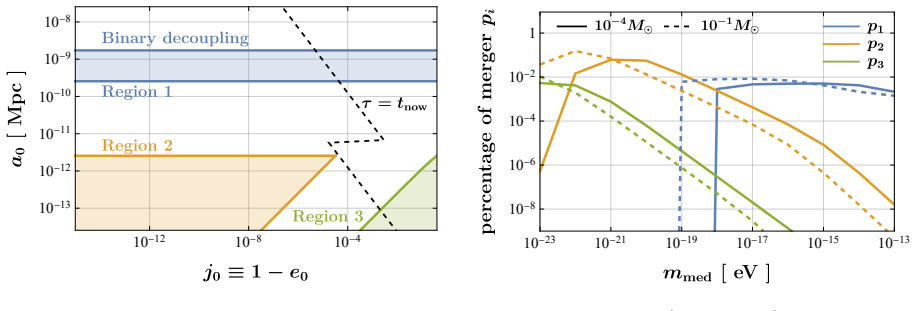
The central object is the effective potential of the binary, which combines the usual gravitational and centrifugal terms with a Yukawa attractive term of range set by the inverse mediator mass. When the dark-force enhancement exceeds a threshold, this potential has an inner dark-force-dominated minimum, an outer gravity-like minimum, and a barrier between them, so a binary can live in several distinct orbital configurations as its angular momentum is radiated away. The paper's main calculational tool is an approximate piecewise gravitational-wave emission spectrum for a single binary, together with a three-region probability distribution for initial semimajor axis and eccentricity that follows from two chances for a pair to decouple from the Hubble flow, once inside and once outside the dark-force range. The threshold at which the binary's orbital frequency reaches the mediator mass is what turns on mediator radiation and produces the most common knee in the background spectrum.
What would settle it
A cosmological N-body simulation that includes the Yukawa dark force and measures the mapping from initial comoving separation to initial semimajor axis and eccentricity would settle the weakest link: if the calibration constants depart from 0.4 and 0.8 by more than an order-one factor, the predicted merger rates, region boundaries, and background amplitude change. Observationally, a detected stochastic gravitational-wave background with the predicted overall shape that lacks the knee at the redshifted mediator frequency would refute the spectral-feature claim.
Extended reading notes
Core claim
The paper's central claim is that replacing the massless mediator of an attractive dark force with a massive one changes the predicted stochastic gravitational-wave background qualitatively, not just in detail. A massive mediator means the force acts only inside a range set by the inverse mediator mass, so a binary can first inspiral under gravity alone, then feel an enhanced attractive force before it starts radiating the mediator, and finally radiate mediator plus enhanced gravitational waves. The authors show that the individual binary emission spectrum is piecewise, following the gravity-only form at low frequencies, a dark-force-enhanced form between two characteristic frequencies, and the massless-dark-force form at high frequencies, with a suppressed gap between the first two stages. The initial binary separation distribution splits into three disconnected regions, with binaries that decouple under the dark force but feel only gravitational tides being the most eccentric. Superposed into a cosmological background, these pieces produce plunging knees at frequencies tied to the mediator mass and to the dark-force enhancement, plus a pile-up ankle when merger times are dominated by the cosmic decoupling time, and the spectrum returns to the gravity-only and massless-mediator limits for very heavy and very light mediators.
Load-bearing premise
The prediction leans on two calibration constants, 0.4 and 0.8, taken from simulations of gravity-only binary formation, being unchanged when the finite-range dark force is present.
Editorial extensions
If this is right
- If the calculation is right, the stochastic gravitational-wave background from sub-solar-mass dark binaries with a finite-range dark force is enhanced at intermediate frequencies relative to the gravity-only case and could be detectable by next-generation space- and ground-based observatories when dark matter objects make up one percent of the dark matter.
- A knee or ankle in a measured background at a frequency near the redshifted mediator mass would observationally indicate a dark force with that mediator mass.
- The predicted spectrum interpolates between the gravity-only and massless-mediator limits as the mediator becomes very heavy or very light, so finite-range dark forces connect and extend the two previously studied cases.
- Binaries that decouple under the dark force but are tidally perturbed only by gravity are the most eccentric and shortest lived, raising the merger rate and shifting the frequencies at which the background peaks.
- For sufficiently heavy mediators, binaries merge too early and their gravitational waves are redshifted away, so the high-frequency part of the background can be suppressed or cut off entirely.
- A measured knee that does not move with redshift the way a mediator-mass feature should would challenge the mediator-radiation interpretation and point to a different origin for the spectral break.
Reading between the lines
- Editorial extension: because the knee frequency is set by the redshifted mediator mass, a multi-band detection of multiple knees from the same binary population could break the degeneracy between mediator mass and merger redshift.
- Editorial extension: the calculation drops higher harmonics of the orbital frequency; for the highly eccentric, non-closed orbits in the mixed and dark-force-dominated stages, harmonics could fill the predicted emission gap and smooth the sharpest knees, changing detectability at those frequencies.
- Editorial extension: the same piecewise inspiral logic applies to any compact binary with an additional finite-range force, so a search for such knees could also be run on catalogs of ordinary black-hole and neutron-star mergers.
Editorial analysis
A structured set of objections, weighed in public.
Referee Report
Summary. This paper computes the stochastic gravitational-wave background (SGWB) from binaries of macroscopic dark matter (MDM) interacting through a finite-range attractive dark force with mediator mass m_med. After classifying binary evolution into four configurations determined by a Yukawa barrier in the effective potential, the authors construct a semi-analytic piecewise emission spectrum dEGW/df (Eq. 41) and combine it with an initial binary distribution derived from nearest-neighbor decoupling and tidal-torque arguments (Eqs. 43-58). The resulting SGWB (Eq. 59) is evaluated for a range of mediator masses and MDM masses, yielding knee and ankle features associated with m_med and the force-activation frequency f_beta, an enhancement relative to gravity-only at intermediate frequencies, and convergence to the gravity-only and massless-DF limits in the appropriate limits. Detectability is assessed against SKA, LISA, BBO, LIGO-Virgo, and Cosmic Explorer sensitivity curves.
Significance. The work is a timely and largely self-contained extension of the massless-DF analysis in Ref. [62] to the more realistic finite-range case. Its main strengths are the analytical transparency of the orbital-evolution results, the explicit comparison between numerical and semi-analytic per-binary spectra in Fig. 2, and the clear limit checks in Fig. 9, which give confidence that the qualitative knee and ankle phenomenology is physically meaningful. The predicted correlation of spectral features with m_med is a falsifiable target for future detectors. However, the quantitative amplitude and detectability claims rest on O(1) calibration constants and on approximations whose numerical impact is not fully quantified; the paper is appropriately cautious in Sec. 5.3, but the abstract and figures inherit those uncertainties. With those caveats the result is a useful advance, although the absolute normalization is not yet on as firm a footing as the spectral-shape predictions.
major comments (3)
- [§4, Eqs. (48)-(51)] The initial-condition distribution P(a0,e0) that drives the SGWB integral (59) is fixed by c1=0.4 and c2=0.8, which the text states are taken from gravity-only simulations because "No numerical simulation has been performed including a DF". These constants propagate nonlinearly into the result: a0 is proportional to c1, b0/a0 is proportional to c2, and the merger lifetimes in Eqs. (15), (20), and (27) scale as high powers of a0, so O(1) shifts in c1 or c2 can change the predicted SGWB amplitude and the detectability boundaries in Figs. 6-7 by more than an order of magnitude. Since the finite-range DF changes both the decoupling condition and the tidal torque, the x-, y-, beta-, and m_med-dependence of c1 and c2 is plausibly non-negligible. I request either a dedicated robustness scan over c1 and c2 or an explicit reframing of all amplitude and detectability claims as order-of-magnitude estimates.
- [§3.3 and §5, Eq. (41)] The piecewise emission spectrum uses the transition frequency ftrans, which Sec. 3.3 says is "obtained numerically from the binary evolution", but the paper does not provide a formula, algorithm, or code for ftrans(a0,e0) over the full initial-condition space of the SGWB integral (59). The spectral position of the GR branch and the width of the zero-emission gap therefore cannot be checked from the text, and the SGWB curves in Figs. 6-9 are not reproducible from the material given. Please supply the functional form or numerical procedure for ftrans, or release the code used for the convolution.
- [§3.2.3 and §3.3, Eq. (41) and footnote 5] The approximation that the emission vanishes for ftrans < fGW,s < f_beta is acknowledged to be partly an artifact of neglecting harmonics with fGW,s = 2/T, and footnote 5 notes that the gap disappears if the barrier is not crossed. Since the SGWB in Fig. 9 exhibits a visible deficit near the cutoff for m_med = 10^-10 eV caused by this gap, and since the knee and ankle phenomenology is a central claim, the robustness of the spectral features to harmonic filling should be quantified rather than assumed. An estimate of the first-harmonic contribution inside the gap, or a demonstration that the gap integrates to a negligible fraction of the SGWB, would settle this concern.
minor comments (4)
- [Abstract] The abstract states that the SGWB is "detectable by both space- and ground-based gravitational wave observatories", which is stronger than the conclusion in Sec. 5.3 that only a few parameter choices are detectable at SKA or LISA and that next-generation observatories are generally required once gravitational-lensing constraints on fDM are imposed. Please qualify the abstract accordingly.
- [§4, Eq. (46)] The step-function decoupling approximation in Eq. (46) is used without a quantitative error estimate. Figure 4 demonstrates that it captures the multi-valued decoupling structure qualitatively, but a brief estimate of the resulting uncertainty in a0 and in the region boundaries (53)-(58) would help the reader judge the robustness of the three-region decomposition.
- [§3.3, Eq. (41)] The conditions under which the beta-enhanced branch f_beta < fGW,s < m_med exists are not stated; if f_beta is larger than or equal to m_med, that branch should be absent, and this case appears to be implicit in the parameter scan but is never spelled out in the text.
- [§4, after Eq. (42)] The factor ccharge = 1 (1/2) for a scalar (vector) DF mediator affects the overall SGWB normalization, so a one-sentence derivation or a reference explaining this counting factor would improve the presentation.
Circularity Check
No significant circularity: the SGWB calculation is self-contained, with only external calibration constants c1 and c2 and standard formulas from prior work, none of which encode the claimed finite-range-DF spectral features.
full rationale
The paper's central derivation—the SGWB with knee/ankle features—is not constructed from its own output. The input force law (1), the piecewise emission spectrum (41), and the binary initial distribution from (48) and (51) are independent ingredients. The knee at fGW = mmed follows from the physical threshold fGW,s > mmed for mediator emission (Sec. 3.2.4) and the redshift integration (59); it is not fitted to the SGWB. The fbeta knee follows from Kepler's law at the DF range. The calibration constants c1 = 0.4 and c2 = 0.8 are taken from gravity-only simulations [56], as the paper explicitly states, and are not derived from the SGWB being predicted; this is an external input whose O(1) uncertainty affects amplitude but does not make the prediction equal to the fit. Formulas imported from the authors' previous work [62] (dipole emission rates, massless-DF spectrum) are standard derivations with stated assumptions that do not include the finite-range result, so the self-citation is not load-bearing in a circular way.
Assumptions & free parameters
free parameters (7)
- beta (dark force enhancement factor) =
100 (benchmark, scanned)
- m_med (dark force mediator mass) =
10^-23 to 10^-12 eV (scanned)
- M_MDM (macroscopic dark matter mass) =
10^-4 to 1 solar mass (scanned)
- rho_MDM (internal density) =
(0.1 GeV)^4 (benchmark)
- f_DM (dark matter fraction in MDMs) =
10^-2 and 10^-3
- c1 (semimajor axis calibration) =
0.4
- c2 (semiminor axis calibration) =
0.8
assumptions (7)
- domain assumption Poisson nearest-neighbor initial distribution, Eq. (43)
- domain assumption Decoupling condition (acceleration)*H^-1 ~ H d, Eq. (45)
- ad hoc to paper Step-function decoupling approximation, Eq. (46)
- domain assumption Mediator emission only when f_GW,s > m_med
- domain assumption Period-averaged emission at fundamental frequency f_GW,s = 2/T, no higher harmonics
- domain assumption All MDMs have equal mass and equal dark charge
- domain assumption MDMs form before matter-radiation equality
invented entities (1)
-
Massive dark force mediator (vector boson with mass m_med)
independent evidence
Cite this review
Pith. "Pith review of Gravitational Waves From Dark Binaries With Finite-Range Dark Forces." pith.science (2026). https://pith.science/paper/AXKW2AC5
@misc{pith2026241215158,
  author       = {Pith},
  title        = {Pith review of: Gravitational Waves From Dark Binaries With Finite-Range Dark Forces},
  year         = {2026},
  howpublished = {\url{https://pith.science/paper/AXKW2AC5}},
  note         = {Machine review of arXiv:2412.15158}
}
read the original abstract
This paper calculates the stochastic gravitational wave background from dark binaries with finite-range attractive dark forces, complementing previous works which consider long-range dark forces. The finiteness of the dark force range can dramatically modify both the initial distributions and evolution histories of the binaries. The generated gravitational wave spectrum is enhanced in the intermediate frequency regime and exhibits interesting "knee" and "ankle" features, the most common of which is related to the turn on of the dark force mediator radiation. Other such spectral features are related to changes in the binary merger lifetime and the probability distribution for the initial binary separation. The stochastic gravitational wave background from sub-solar-mass dark binaries is detectable by both space- and ground-based gravitational wave observatories.
Figures


Figures from the paper (7 more)



Reference graph
Works this paper leans on
-
[62]
Y. Bai, S. Lu, and N. Orlofsky, Gravitational waves from more attractive dark binaries , JCAP 08 (2024) 057, [ arXiv:2312.13378]
work page Pith review arXiv 2024
-
[1]
Aasi et al., Advanced LIGO, Class
LIGO Scientific Collaboration, J. Aasi et al., Advanced LIGO, Class. Quant. Grav. 32 (2015) 074001, [ arXiv:1411.4547]
arXiv 2015
-
[2]
LIGO Scientific, Virgo Collaboration, B. P. Abbott et al., Observation of Gravitational Waves from a Binary Black Hole Merger , Phys. Rev. Lett. 116 (2016), no. 6 061102, [ arXiv:1602.03837]
arXiv 2016
-
[3]
Agazie et al., The NANOGrav 15 yr Data Set: Evidence for a Gravitational-wave Background , Astrophys
NANOGrav Collaboration, G. Agazie et al., The NANOGrav 15 yr Data Set: Evidence for a Gravitational-wave Background , Astrophys. J. Lett. 951 (2023), no. 1 L8, [arXiv:2306.16213]
arXiv 2023
-
[4]
NANOGrav Collaboration, G. Agazie et al., The NANOGrav 15 yr Data Set: Observations and Timing of 68 Millisecond Pulsars , Astrophys. J. Lett. 951 (2023), no. 1 L9, [arXiv:2306.16217]
arXiv 2023
-
[5]
Afzal et al., The NANOGrav 15 yr Data Set: Search for Signals from New Physics , Astrophys
NANOGrav Collaboration, A. Afzal et al., The NANOGrav 15 yr Data Set: Search for Signals from New Physics , Astrophys. J. Lett. 951 (2023), no. 1 L11, [arXiv:2306.16219]
arXiv 2023
-
[6]
NANOGrav Collaboration, G. Agazie et al., The NANOGrav 15 yr Data Set: Constraints on Supermassive Black Hole Binaries from the Gravitational-wave Background, Astrophys. J. Lett. 952 (2023), no. 2 L37, [ arXiv:2306.16220]
arXiv 2023
-
[7]
Antoniadis et al., The second data release from the European Pulsar Timing Array - I
EPTA Collaboration, J. Antoniadis et al., The second data release from the European Pulsar Timing Array - I. The dataset and timing analysis , Astron. Astrophys. 678 (2023) A48, [ arXiv:2306.16224]
arXiv 2023
Show all 128 references
-
[8]
Antoniadis et al., The second data release from the European Pulsar Timing Array - III
EPTA, InPTA: Collaboration, J. Antoniadis et al., The second data release from the European Pulsar Timing Array - III. Search for gravitational wave signals , Astron. Astrophys. 678 (2023) A50, [ arXiv:2306.16214]
2023 arXiv
-
[9]
Antoniadis et al., The second data release from the European Pulsar Timing Array IV
EPTA Collaboration, J. Antoniadis et al., The second data release from the European Pulsar Timing Array IV. Search for continuous gravitational wave signals , arXiv:2306.16226
-
[10]
Antoniadis et al., The second data release from the European Pulsar Timing Array: V
EPTA Collaboration, J. Antoniadis et al., The second data release from the European Pulsar Timing Array: V. Implications for massive black holes, dark matter and the early Universe, arXiv:2306.16227
-
[11]
D. J. Reardon et al., Search for an Isotropic Gravitational-wave Background with the Parkes Pulsar Timing Array , Astrophys. J. Lett. 951 (2023), no. 1 L6, [arXiv:2306.16215]
2023 arXiv
-
[12]
D. J. Reardon et al., The Gravitational-wave Background Null Hypothesis: Characterizing Noise in Millisecond Pulsar Arrival Times with the Parkes Pulsar Timing Array, Astrophys. J. Lett. 951 (2023), no. 1 L7, [ arXiv:2306.16229]
2023 arXiv
-
[13]
Zic et al., The Parkes Pulsar Timing Array Third Data Release , arXiv:2306.16230
A. Zic et al., The Parkes Pulsar Timing Array Third Data Release , arXiv:2306.16230
-
[14]
Xu et al., Searching for the Nano-Hertz Stochastic Gravitational Wave Background with the Chinese Pulsar Timing Array Data Release I , Res
H. Xu et al., Searching for the Nano-Hertz Stochastic Gravitational Wave Background with the Chinese Pulsar Timing Array Data Release I , Res. Astron. Astrophys. 23 (2023), no. 7 075024, [ arXiv:2306.16216]
2023 arXiv
-
[15]
Ellis, M
J. Ellis, M. Fairbairn, G. Franciolini, G. H¨ utsi, A. Iovino, M. Lewicki, M. Raidal, 33 J. Urrutia, V. Vaskonen, and H. Veerm¨ ae,What is the source of the PTA GW signal? , Phys. Rev. D 109 (2024), no. 2 023522, [ arXiv:2308.08546]
2024 arXiv
-
[16]
Mandic, S
V. Mandic, S. Bird, and I. Cholis, Stochastic Gravitational-Wave Background due to Primordial Binary Black Hole Mergers , Phys. Rev. Lett. 117 (2016), no. 20 201102, [arXiv:1608.06699]
2016 arXiv
-
[17]
Wang, Y.-F
S. Wang, Y.-F. Wang, Q.-G. Huang, and T. G. F. Li, Constraints on the Primordial Black Hole Abundance from the First Advanced LIGO Observation Run Using the Stochastic Gravitational-Wave Background, Phys. Rev. Lett. 120 (2018), no. 19 191102, [arXiv:1610.08725]
2018 arXiv
-
[18]
Raidal, V
M. Raidal, V. Vaskonen, and H. Veerm¨ ae,Gravitational Waves from Primordial Black Hole Mergers, JCAP 09 (2017) 037, [ arXiv:1707.01480]
2017 arXiv
-
[19]
Sasaki, T
M. Sasaki, T. Suyama, T. Tanaka, and S. Yokoyama, Primordial black holes—perspectives in gravitational wave astronomy , Class. Quant. Grav. 35 (2018), no. 6 063001, [ arXiv:1801.05235]
2018 arXiv
-
[20]
Pujolas, V
O. Pujolas, V. Vaskonen, and H. Veerm¨ ae,Prospects for probing gravitational waves from primordial black hole binaries , Phys. Rev. D 104 (2021), no. 8 083521, [arXiv:2107.03379]
2021 arXiv
-
[21]
Garc ´ ıa-Bellido, S
J. Garc ´ ıa-Bellido, S. Jaraba, and S. Kuroyanagi,The stochastic gravitational wave background from close hyperbolic encounters of primordial black holes in dense clusters , Phys. Dark Univ. 36 (2022) 101009, [ arXiv:2109.11376]
2022 arXiv
-
[22]
V. Atal, J. J. Blanco-Pillado, A. Sanglas, and N. Triantafyllou, Constraining changes in the merger history of BH and PBH binaries with the stochastic gravitational wave background, Phys. Rev. D 105 (2022), no. 12 123522, [ arXiv:2201.12218]
2022 arXiv
-
[23]
Braglia, J
M. Braglia, J. Garcia-Bellido, and S. Kuroyanagi, Tracking the origin of black holes with the stochastic gravitational wave background popcorn signal , Mon. Not. Roy. Astron. Soc. 519 (2023), no. 4 6008–6019, [ arXiv:2201.13414]
2023 arXiv
-
[24]
I. K. Banerjee and U. K. Dey, Probing the origin of primordial black holes through novel gravitational wave spectrum, JCAP 07 (2023) 024, [ arXiv:2305.07569]
2023 arXiv
-
[25]
T. D. Lee and Y. Pang, Fermion Soliton Stars and Black Holes , Phys. Rev. D 35 (1987) 3678
1987
-
[26]
Del Grosso, G
L. Del Grosso, G. Franciolini, P. Pani, and A. Urbano, Fermion soliton stars , Phys. Rev. D 108 (2023), no. 4 044024, [ arXiv:2301.08709]
2023 arXiv
-
[27]
Xie, Revisiting the fermion-field nontopological solitons , JHEP 09 (2024) 077, [arXiv:2405.01227]
K.-P. Xie, Revisiting the fermion-field nontopological solitons , JHEP 09 (2024) 077, [arXiv:2405.01227]
2024 arXiv
-
[28]
Friedberg, T
R. Friedberg, T. D. Lee, and A. Sirlin, A Class of Scalar-Field Soliton Solutions in Three Space Dimensions, Phys. Rev. D 13 (1976) 2739–2761
1976
-
[29]
S. R. Coleman, Q-balls, Nucl. Phys. B 262 (1985), no. 2 263. [Addendum: Nucl.Phys.B 269, 744 (1986)]
1985
-
[30]
T. D. Lee and Y. Pang, Nontopological solitons, Phys. Rept. 221 (1992) 251–350
1992
-
[31]
Pont´ on, Y
E. Pont´ on, Y. Bai, and B. Jain,Electroweak Symmetric Dark Matter Balls , JHEP 09 (2019) 011, [ arXiv:1906.10739]. 34
2019 arXiv
-
[32]
E. Y. Nugaev and A. V. Shkerin, Review of Nontopological Solitons in Theories with U (1)-Symmetry, J. Exp. Theor. Phys. 130 (2020), no. 2 301–320, [ arXiv:1905.05146]
2020 arXiv
-
[33]
Heeck, A
J. Heeck, A. Rajaraman, R. Riley, and C. B. Verhaaren, Understanding Q-Balls Beyond the Thin-Wall Limit , Phys. Rev. D 103 (2021), no. 4 045008, [ arXiv:2009.08462]
2021 arXiv
-
[34]
Y. Bai, S. Lu, and N. Orlofsky, Q-monopole-ball: a topological and nontopological soliton , JHEP 01 (2022) 109, [ arXiv:2111.10360]
2022 arXiv
-
[35]
Y. Bai, S. Lu, and N. Orlofsky, Origin of nontopological soliton dark matter: solitosynthesis or phase transition , JHEP 10 (2022) 181, [ arXiv:2208.12290]
2022 arXiv
-
[36]
Krnjaic and K
G. Krnjaic and K. Sigurdson, Big Bang Darkleosynthesis , Phys. Lett. B 751 (2015) 464–468, [arXiv:1406.1171]
2015 arXiv
-
[37]
Bai and A
Y. Bai and A. J. Long, Six Flavor Quark Matter , JHEP 06 (2018) 072, [arXiv:1804.10249]
2018 arXiv
-
[38]
Y. Bai, A. J. Long, and S. Lu, Dark Quark Nuggets , Phys. Rev. D 99 (2019), no. 5 055047, [arXiv:1810.04360]
2019 arXiv
-
[39]
Liang and A
X. Liang and A. Zhitnitsky, Axion field and the quark nugget’s formation at the QCD phase transition, Phys. Rev. D 94 (2016), no. 8 083502, [ arXiv:1606.00435]
2016 arXiv
-
[40]
M. B. Wise and Y. Zhang, Stable Bound States of Asymmetric Dark Matter , Phys. Rev. D 90 (2014), no. 5 055030, [ arXiv:1407.4121]. [Erratum: Phys.Rev.D 91, 039907 (2015)]
2014 arXiv
-
[41]
M. B. Wise and Y. Zhang, Yukawa Bound States of a Large Number of Fermions , JHEP 02 (2015) 023, [ arXiv:1411.1772]. [Erratum: JHEP 10, 165 (2015)]
2015 arXiv
-
[42]
Hardy, R
E. Hardy, R. Lasenby, J. March-Russell, and S. M. West, Big Bang Synthesis of Nuclear Dark Matter , JHEP 06 (2015) 011, [ arXiv:1411.3739]
2015 arXiv
-
[43]
M. I. Gresham, H. K. Lou, and K. M. Zurek, Nuclear Structure of Bound States of Asymmetric Dark Matter , Phys. Rev. D 96 (2017), no. 9 096012, [ arXiv:1707.02313]
2017 arXiv
-
[44]
M. I. Gresham, H. K. Lou, and K. M. Zurek, Early Universe synthesis of asymmetric dark matter nuggets , Phys. Rev. D 97 (2018), no. 3 036003, [ arXiv:1707.02316]
2018 arXiv
-
[45]
Curtin and J
D. Curtin and J. Setford, How To Discover Mirror Stars , Phys. Lett. B 804 (2020) 135391, [arXiv:1909.04071]
2020 arXiv
-
[46]
Curtin and J
D. Curtin and J. Setford, Signatures of Mirror Stars , JHEP 03 (2020) 041, [arXiv:1909.04072]
2020 arXiv
-
[47]
Kouvaris and N
C. Kouvaris and N. G. Nielsen, Asymmetric Dark Matter Stars , Phys. Rev. D 92 (2015), no. 6 063526, [ arXiv:1507.00959]
2015 arXiv
-
[48]
G. F. Giudice, M. McCullough, and A. Urbano, Hunting for Dark Particles with Gravitational Waves, JCAP 10 (2016) 001, [ arXiv:1605.01209]
2016 arXiv
-
[49]
Maselli, P
A. Maselli, P. Pnigouras, N. G. Nielsen, C. Kouvaris, and K. D. Kokkotas, Dark stars: gravitational and electromagnetic observables , Phys. Rev. D 96 (2017), no. 2 023005, [arXiv:1704.07286]
2017 arXiv
-
[50]
Hippert, J
M. Hippert, J. Setford, H. Tan, D. Curtin, J. Noronha-Hostler, and N. Yunes, Mirror neutron stars, Phys. Rev. D 106 (2022), no. 3 035025, [ arXiv:2103.01965]
2022 arXiv
-
[51]
Gross, G
C. Gross, G. Landini, A. Strumia, and D. Teresi, Dark Matter as dark dwarfs and other 35 macroscopic objects: multiverse relics? , JHEP 09 (2021) 033, [ arXiv:2105.02840]
2021 arXiv
-
[52]
Ryan and D
M. Ryan and D. Radice, Exotic compact objects: The dark white dwarf , Phys. Rev. D 105 (2022), no. 11 115034, [ arXiv:2201.05626]
2022 arXiv
-
[53]
Banks, D
H. Banks, D. M. Grabowska, and M. McCullough, Gravitational wave backgrounds from colliding exotic compact objects , Phys. Rev. D 108 (2023), no. 3 035017, [arXiv:2302.07887]
2023 arXiv
-
[54]
Y. Bai, S. Lu, and N. Orlofsky, Dark exoplanets , Phys. Rev. D 108 (2023), no. 10 103026, [arXiv:2303.12129]
2023 arXiv
-
[55]
Nakamura, M
T. Nakamura, M. Sasaki, T. Tanaka, and K. S. Thorne, Gravitational waves from coalescing black hole MACHO binaries , Astrophys. J. Lett. 487 (1997) L139–L142, [astro-ph/9708060]
1997 arXiv
-
[56]
K. Ioka, T. Chiba, T. Tanaka, and T. Nakamura, Black hole binary formation in the expanding universe: Three body problem approximation , Phys. Rev. D 58 (1998) 063003, [astro-ph/9807018]
1998 arXiv
-
[57]
Sasaki, T
M. Sasaki, T. Suyama, T. Tanaka, and S. Yokoyama, Primordial Black Hole Scenario for the Gravitational-Wave Event GW150914 , Phys. Rev. Lett. 117 (2016), no. 6 061101, [arXiv:1603.08338]. [Erratum: Phys.Rev.Lett. 121, 059901 (2018)]
2016 arXiv
-
[58]
Ali-Ha ¨ ımoud, E
Y. Ali-Ha ¨ ımoud, E. D. Kovetz, and M. Kamionkowski,Merger rate of primordial black-hole binaries , Phys. Rev. D 96 (2017), no. 12 123523, [ arXiv:1709.06576]
2017 arXiv
-
[59]
Raidal, C
M. Raidal, C. Spethmann, V. Vaskonen, and H. Veerm¨ ae,Formation and Evolution of Primordial Black Hole Binaries in the Early Universe , JCAP 02 (2019) 018, [arXiv:1812.01930]
2019 arXiv
-
[60]
Vaskonen and H
V. Vaskonen and H. Veerm¨ ae,Lower bound on the primordial black hole merger rate , Phys. Rev. D 101 (2020), no. 4 043015, [ arXiv:1908.09752]
2020 arXiv
-
[61]
H¨ utsi, M
G. H¨ utsi, M. Raidal, V. Vaskonen, and H. Veerm¨ ae,Two populations of LIGO-Virgo black holes , JCAP 03 (2021) 068, [ arXiv:2012.02786]
2021 arXiv
-
[63]
Krause, H
D. Krause, H. T. Kloor, and E. Fischbach, Multipole radiation from massive fields: Application to binary pulsar systems , Phys. Rev. D 49 (1994) 6892–6906
1994
-
[64]
Croon, A
D. Croon, A. E. Nelson, C. Sun, D. G. E. Walker, and Z.-Z. Xianyu, Hidden-Sector Spectroscopy with Gravitational Waves from Binary Neutron Stars , Astrophys. J. Lett. 858 (2018), no. 1 L2, [ arXiv:1711.02096]
2018 arXiv
-
[65]
Alexander, E
S. Alexander, E. McDonough, R. Sims, and N. Yunes, Hidden-Sector Modifications to Gravitational Waves From Binary Inspirals , Class. Quant. Grav. 35 (2018), no. 23 235012, [arXiv:1808.05286]
2018 arXiv
-
[66]
J. A. Dror, R. Laha, and T. Opferkuch, Probing muonic forces with neutron star binaries, Phys. Rev. D 102 (2020), no. 2 023005, [ arXiv:1909.12845]
2020 arXiv
-
[67]
Savastano, L
S. Savastano, L. Amendola, J. Rubio, and C. Wetterich, Primordial dark matter halos from fifth forces, Phys. Rev. D 100 (2019), no. 8 083518, [ arXiv:1906.05300]
2019 arXiv
-
[68]
Bogorad, P
Z. Bogorad, P. W. Graham, and H. Ramani, Coherent Self-Interactions of Dark Matter 36 in the Bullet Cluster , arXiv:2311.07648
-
[69]
Rosen, Particlelike Solutions to Nonlinear Complex Scalar Field Theories with Positive-Definite Energy Densities , J
G. Rosen, Particlelike Solutions to Nonlinear Complex Scalar Field Theories with Positive-Definite Energy Densities , J. Math. Phys. 9 (1968) 996
1968
-
[70]
K.-M. Lee, J. A. Stein-Schabes, R. Watkins, and L. M. Widrow, Gauged q Balls , Phys. Rev. D 39 (1989) 1665
1989
-
[71]
I. E. Gulamov, E. Y. Nugaev, A. G. Panin, and M. N. Smolyakov, Some properties of U(1) gauged Q-balls , Phys. Rev. D 92 (2015), no. 4 045011, [ arXiv:1506.05786]
2015 arXiv
-
[72]
Brihaye, A
Y. Brihaye, A. Cisterna, B. Hartmann, and G. Luchini, From topological to nontopological solitons: Kinks, domain walls, and Q-balls in a scalar field model with a nontrivial vacuum manifold , Phys. Rev. D 92 (2015), no. 12 124061, [ arXiv:1511.02757]
2015 arXiv
-
[73]
Heeck, A
J. Heeck, A. Rajaraman, R. Riley, and C. B. Verhaaren, Mapping Gauged Q-Balls , Phys. Rev. D 103 (2021), no. 11 116004, [ arXiv:2103.06905]
2021 arXiv
-
[74]
A. L. Macpherson and B. A. Campbell, Biased discrete symmetry breaking and Fermi balls, Phys. Lett. B 347 (1995) 205–210, [ hep-ph/9408387]
1995 arXiv
-
[75]
J.-P. Hong, S. Jung, and K.-P. Xie, Fermi-ball dark matter from a first-order phase transition, Phys. Rev. D 102 (2020), no. 7 075028, [ arXiv:2008.04430]
2020 arXiv
-
[76]
Bai and N
Y. Bai and N. Orlofsky, Primordial Extremal Black Holes as Dark Matter , Phys. Rev. D 101 (2020), no. 5 055006, [ arXiv:1906.04858]
2020 arXiv
-
[77]
P. Lu, K. Kawana, and K.-P. Xie, Old phase remnants in first-order phase transitions , Phys. Rev. D 105 (2022), no. 12 123503, [ arXiv:2202.03439]
2022 arXiv
-
[78]
Kawana, P
K. Kawana, P. Lu, and K.-P. Xie, First-order phase transition and fate of false vacuum remnants, JCAP 10 (2022) 030, [ arXiv:2206.09923]
2022 arXiv
-
[79]
Niikura et al., Microlensing constraints on primordial black holes with Subaru/HSC Andromeda observations, Nature Astron
H. Niikura et al., Microlensing constraints on primordial black holes with Subaru/HSC Andromeda observations, Nature Astron. 3 (2019), no. 6 524–534, [ arXiv:1701.02151]
2019 arXiv
-
[80]
Smyth, S
N. Smyth, S. Profumo, S. English, T. Jeltema, K. McKinnon, and P. Guhathakurta, Updated Constraints on Asteroid-Mass Primordial Black Holes as Dark Matter , Phys. Rev. D 101 (2020), no. 6 063005, [ arXiv:1910.01285]
2020 arXiv
-
[81]
Griest, A
K. Griest, A. M. Cieplak, and M. J. Lehner, Experimental Limits on Primordial Black Hole Dark Matter from the First 2 yr of Kepler Data , Astrophys. J. 786 (2014), no. 2 158, [arXiv:1307.5798]
2014 arXiv
-
[82]
Macho Collaboration, R. A. Allsman et al., MACHO project limits on black hole dark matter in the 1-30 solar mass range , Astrophys. J. Lett. 550 (2001) L169, [astro-ph/0011506]
2001 arXiv
-
[83]
Tisserand et al., Limits on the Macho Content of the Galactic Halo from the EROS-2 Survey of the Magellanic Clouds , Astron
EROS-2 Collaboration, P. Tisserand et al., Limits on the Macho Content of the Galactic Halo from the EROS-2 Survey of the Magellanic Clouds , Astron. Astrophys. 469 (2007) 387–404, [ astro-ph/0607207]
2007 arXiv
-
[84]
Wyrzykowski, J
L. Wyrzykowski, J. Skowron, S. Koz lowski, A. Udalski, M. K. Szyma´ nski, M. Kubiak, G. Pietrzy´ nski, I. Soszy´ nski, O. Szewczyk, K. Ulaczyk, R. Poleski, and P. Tisserand,The ogle view of microlensing towards the magellanic clouds - iv. ogle-iii smc data and final conclusion...
2011
-
[85]
Niikura, M
H. Niikura, M. Takada, S. Yokoyama, T. Sumi, and S. Masaki, Constraints on Earth-mass primordial black holes from OGLE 5-year microlensing events , Phys. Rev. D 99 (2019), no. 8 083503, [ arXiv:1901.07120]
2019 arXiv
-
[86]
Zumalacarregui and U
M. Zumalacarregui and U. Seljak, Limits on stellar-mass compact objects as dark matter from gravitational lensing of type Ia supernovae , Phys. Rev. Lett. 121 (2018), no. 14 141101, [arXiv:1712.02240]
2018 arXiv
-
[87]
Oguri, J
M. Oguri, J. M. Diego, N. Kaiser, P. L. Kelly, and T. Broadhurst, Understanding caustic crossings in giant arcs: characteristic scales, event rates, and constraints on compact dark matter , Phys. Rev. D 97 (2018), no. 2 023518, [ arXiv:1710.00148]
2018 arXiv
-
[88]
Mr´ oz et al.,Limits on planetary-mass primordial black holes from the OGLE high-cadence survey of the Magellanic Clouds , Astrophys
P. Mr´ oz et al.,Limits on planetary-mass primordial black holes from the OGLE high-cadence survey of the Magellanic Clouds , Astrophys. J. Lett. 976 (2024) 19, [arXiv:2410.06251]
2024 arXiv
-
[89]
Croon, D
D. Croon, D. McKeen, and N. Raj, Gravitational microlensing by dark matter in extended structures, Phys. Rev. D 101 (2020), no. 8 083013, [ arXiv:2002.08962]
2020 arXiv
-
[90]
Y. Bai, A. J. Long, and S. Lu, Tests of Dark MACHOs: Lensing, Accretion, and Glow , JCAP 09 (2020) 044, [ arXiv:2003.13182]
2020 arXiv
-
[91]
A. Katz, J. Kopp, S. Sibiryakov, and W. Xue, Femtolensing by Dark Matter Revisited , JCAP 12 (2018) 005, [ arXiv:1807.11495]
2018 arXiv
-
[92]
Bai and N
Y. Bai and N. Orlofsky, Microlensing of X-ray Pulsars: a Method to Detect Primordial Black Hole Dark Matter , Phys. Rev. D 99 (2019), no. 12 123019, [ arXiv:1812.01427]
2019 arXiv
-
[93]
Tamta, N
M. Tamta, N. Raj, and P. Sharma, Breaking into the window of primordial black hole dark matter with x-ray microlensing , arXiv:2405.20365
-
[94]
Jung and T
S. Jung and T. Kim, Gamma-ray burst lensing parallax: Closing the primordial black hole dark matter mass window , Phys. Rev. Res. 2 (2020), no. 1 013113, [ arXiv:1908.00078]
2020 arXiv
-
[95]
M. A. Fedderke and S. Sibiryakov, Kicking the Tires on Picolensing as a Probe of Primordial Black Hole Dark Matter , arXiv:2411.12947
-
[96]
Ricotti, J
M. Ricotti, J. P. Ostriker, and K. J. Mack, Effect of Primordial Black Holes on the Cosmic Microwave Background and Cosmological Parameter Estimates , Astrophys. J. 680 (2008) 829, [ arXiv:0709.0524]
2008 arXiv
-
[97]
Ali-Ha ¨ ımoud and M
Y. Ali-Ha ¨ ımoud and M. Kamionkowski,Cosmic microwave background limits on accreting primordial black holes , Phys. Rev. D 95 (2017), no. 4 043534, [arXiv:1612.05644]
2017 arXiv
-
[98]
Poulin, P
V. Poulin, P. D. Serpico, F. Calore, S. Clesse, and K. Kohri, CMB bounds on disk-accreting massive primordial black holes , Phys. Rev. D 96 (2017), no. 8 083524, [arXiv:1707.04206]
2017 arXiv
-
[99]
P. D. Serpico, V. Poulin, D. Inman, and K. Kohri, Cosmic microwave background bounds on primordial black holes including dark matter halo accretion , Phys. Rev. Res. 2 (2020), no. 2 023204, [ arXiv:2002.10771]
2020 arXiv
-
[100]
T. D. Brandt, Constraints on MACHO Dark Matter from Compact Stellar Systems in Ultra-Faint Dwarf Galaxies, Astrophys. J. Lett. 824 (2016), no. 2 L31, [arXiv:1605.03665]. 38
2016 arXiv
-
[101]
S. M. Koushiappas and A. Loeb, Dynamics of Dwarf Galaxies Disfavor Stellar-Mass Black Holes as Dark Matter , Phys. Rev. Lett. 119 (2017), no. 4 041102, [arXiv:1704.01668]
2017 arXiv
-
[102]
Afshordi, P
N. Afshordi, P. McDonald, and D. N. Spergel, Primordial black holes as dark matter: The Power spectrum and evaporation of early structures , Astrophys. J. Lett. 594 (2003) L71–L74, [astro-ph/0302035]
2003 arXiv
-
[103]
Murgia, G
R. Murgia, G. Scelfo, M. Viel, and A. Raccanelli, Lyman-α Forest Constraints on Primordial Black Holes as Dark Matter , Phys. Rev. Lett. 123 (2019), no. 7 071102, [arXiv:1903.10509]
2019 arXiv
-
[104]
Jancovici, On the relativistic degenerate electron gas , Il Nuovo Cimento 25 (1962) 428
B. Jancovici, On the relativistic degenerate electron gas , Il Nuovo Cimento 25 (1962) 428
1962
-
[105]
Cardoso and L
V. Cardoso and L. Gualtieri, Testing the black hole ‘no-hair’ hypothesis , Class. Quant. Grav. 33 (2016), no. 17 174001, [ arXiv:1607.03133]
2016 arXiv
-
[106]
Maggiore, Gravitational Waves: Volume 1: Theory and Experiments
M. Maggiore, Gravitational Waves: Volume 1: Theory and Experiments . Oxford University Press, 10, 2007
2007
-
[107]
F. W. Olver, NIST handbook of mathematical functions hardback and CD-ROM . Cambridge university press, 2010
2010
-
[108]
L´ oczi,Explicit and recursive estimates of the Lambert W function , arXiv e-prints (Aug., 2020) arXiv:2008.06122, [ arXiv:2008.06122]
L. L´ oczi,Explicit and recursive estimates of the Lambert W function , arXiv e-prints (Aug., 2020) arXiv:2008.06122, [ arXiv:2008.06122]
2020 arXiv
-
[109]
Chen, H.-Y
M.-C. Chen, H.-Y. Liu, Q.-Y. Zhang, and J. Zhang, Probing massive fields with multiband gravitational-wave observations , Phys. Rev. D 110 (2024), no. 6 064018, [arXiv:2405.11583]
2024 arXiv
-
[110]
van Die, I
F. van Die, I. Rapoport, Y. B. Ginat, and V. Desjacques, Detection prospects for the GW background of Galactic (sub)solar mass primordial black holes , arXiv:2410.04522
-
[111]
Aghanim et al., Planck 2018 results
Planck Collaboration, N. Aghanim et al., Planck 2018 results. VI. Cosmological parameters, Astron. Astrophys. 641 (2020) A6, [ arXiv:1807.06209]. [Erratum: Astron.Astrophys. 652, C4 (2021)]
2020 arXiv
-
[112]
C. L. Carilli and S. Rawlings, Science with the Square Kilometer Array: Motivation, key science projects, standards and assumptions , New Astron. Rev. 48 (2004) 979, [astro-ph/0409274]
2004 arXiv
-
[113]
Amaro-Seoane et al., Laser Interferometer Space Antenna, arXiv:1702.00786
LISA Collaboration, P. Amaro-Seoane et al., Laser Interferometer Space Antenna, arXiv:1702.00786
-
[114]
Corbin and N
V. Corbin and N. J. Cornish, Detecting the cosmic gravitational wave background with the big bang observer , Class. Quant. Grav. 23 (2006) 2435–2446, [ gr-qc/0512039]
2006 arXiv
-
[115]
Acernese et al., Advanced Virgo: a second-generation interferometric gravitational wave detector , Class
VIRGO Collaboration, F. Acernese et al., Advanced Virgo: a second-generation interferometric gravitational wave detector , Class. Quant. Grav. 32 (2015), no. 2 024001, [arXiv:1408.3978]
2015 arXiv
-
[116]
Reitze et al., Cosmic Explorer: The U.S
D. Reitze et al., Cosmic Explorer: The U.S. Contribution to Gravitational-Wave Astronomy beyond LIGO , Bull. Am. Astron. Soc. 51 (2019), no. 7 035, [arXiv:1907.04833]
2019 arXiv
-
[117]
Schmitz, New Sensitivity Curves for Gravitational-Wave Signals from Cosmological Phase Transitions, JHEP 01 (2021) 097, [ arXiv:2002.04615]
K. Schmitz, New Sensitivity Curves for Gravitational-Wave Signals from Cosmological Phase Transitions, JHEP 01 (2021) 097, [ arXiv:2002.04615]. 39
2021 arXiv
-
[118]
Li, M.-X
F.-Y. Li, M.-X. Tang, and D.-P. Shi, Electromagnetic response of a Gaussian beam to high frequency relic gravitational waves in quintessential inflationary models , Phys. Rev. D 67 (2003) 104008, [ gr-qc/0306092]
2003 arXiv
-
[119]
Aggarwal et al., Challenges and opportunities of gravitational-wave searches at MHz to GHz frequencies , Living Rev
N. Aggarwal et al., Challenges and opportunities of gravitational-wave searches at MHz to GHz frequencies , Living Rev. Rel. 24 (2021), no. 1 4, [ arXiv:2011.12414]
2021 arXiv
-
[120]
Ringwald, J
A. Ringwald, J. Sch¨ utte-Engel, and C. Tamarit,Gravitational Waves as a Big Bang Thermometer, JCAP 03 (2021) 054, [ arXiv:2011.04731]
2021 arXiv
-
[121]
Franciolini, A
G. Franciolini, A. Maharana, and F. Muia, Hunt for light primordial black hole dark matter with ultrahigh-frequency gravitational waves , Phys. Rev. D 106 (2022), no. 10 103520, [arXiv:2205.02153]
2022 arXiv
-
[122]
Domcke, S
V. Domcke, S. A. R. Ellis, and N. L. Rodd, Magnets are Weber Bar Gravitational Wave Detectors, arXiv:2408.01483
-
[123]
Abazajian et al., CMB-S4 Science Case, Reference Design, and Project Plan , arXiv:1907.04473
K. Abazajian et al., CMB-S4 Science Case, Reference Design, and Project Plan , arXiv:1907.04473
1907 arXiv
-
[124]
Caprini et al., Detecting gravitational waves from cosmological phase transitions with LISA: an update , JCAP 03 (2020) 024, [ arXiv:1910.13125]
C. Caprini et al., Detecting gravitational waves from cosmological phase transitions with LISA: an update , JCAP 03 (2020) 024, [ arXiv:1910.13125]
2020 arXiv
-
[125]
M. B. Hindmarsh and T. W. B. Kibble, Cosmic strings , Rept. Prog. Phys. 58 (1995) 477–562, [hep-ph/9411342]
1995 arXiv
-
[126]
Agazie et al., The NANOGrav 15 yr Data Set: Search for Anisotropy in the Gravitational-wave Background , Astrophys
NANOGrav Collaboration, G. Agazie et al., The NANOGrav 15 yr Data Set: Search for Anisotropy in the Gravitational-wave Background , Astrophys. J. Lett. 956 (2023), no. 1 L3, [ arXiv:2306.16221]
2023 arXiv
-
[127]
Enoki and M
M. Enoki and M. Nagashima, The Effect of Orbital Eccentricity on Gravitational Wave Background Radiation from Cosmological Binaries , Prog. Theor. Phys. 117 (2007) 241, [astro-ph/0609377]
2007 arXiv
-
[128]
Center for High Throughput Computing, Center for high throughput computing , 2006. 40
2006
Reviewed August 11, 2026 · model on record in the stance chip above.
Discussion (0). Continue with ORCID to comment.