REVIEW 3 major objections 4 minor 42 references
SimGRAG: Leveraging Similar Subgraphs for Knowledge Graphs Driven Retrieval-Augmented Generation
T0 review · 3 major / 4 minor · reviewed 2026-08-11 · deepseek-v4-flash
Pith's one-line read A training-free KG-driven RAG method that aligns an LLM-generated pattern graph to subgraphs via graph semantic distance outperforms prior KG-driven RAG methods on QA and fact verification.
desk verdict A well-executed KG-RAG method with a genuinely new two-stage alignment (LLM pattern graphs matched by embedding-based graph semantic distance), real gains over training-free baselines, and a known but untested structural ceiling on exact isomorphism. read the letter →
The pith
A machine-rendered reading of the paper's core claim, the machinery that carries it, and where it could break.
The reading
What carries the argument
The load-bearing object is the Graph Semantic Distance (GSD), defined over an isomorphic mapping $f$ from a pattern graph $P$ to a KG subgraph $S$: $\mathrm{GSD}(P,S)=\sum_{v\in P}\lVert z_v-z_{f(v)}\rVert_2+\sum_{\langle u,v\rangle\in P}\lVert z_{r_{\langle u,v\rangle}}-z_{r_{\langle f(u),f(v)\rangle}}\rVert_2$, with unknown nodes and relations excluded. GSD turns "which subgraph best matches this query-shaped pattern" into a numeric ranking. The retrieval algorithm's efficiency comes from a lower bound $B$ on any completion of a partial isomorphism; when $B$ exceeds the current k-th best GSD, the branch is pruned, and greedy expansion by smallest distances finds good subgraphs early.
What would settle it
Measure retrieval Hits@1 on queries where the LLM-generated pattern is semantically correct but not isomorphic to the ground-truth evidence subgraph; the paper's Section 6.5 indicates such cases exist (about 24% of FactKG errors, e.g., ground truth merging two relations into one). If that Hits@1 is near zero, the claim that GSD alignment recovers the best subgraph is falsified for exactly the cases that motivated the metric.
Extended reading notes
Core claim
The central claim is that the hard part of KG-driven RAG—aligning free-text queries with graph structure—can be split cleanly. First, an LLM converts the query into a pattern graph, possibly with UNKNOWN placeholders for entities and relations. Second, the pattern is matched against KG subgraphs by requiring graph isomorphism and then measuring Graph Semantic Distance, the sum of L2 embedding distances between corresponding nodes and edges; unknown elements are skipped. The retrieved top-k subgraphs are verbalized as triples and given to the LLM to answer. The paper argues this guarantees concise, noise-filtered evidence, removes the oracle-entity requirement, and—thanks to a lower-bound pruning and greedy expansion strategy—scales to tens of millions of edges.
Load-bearing premise
The method assumes that the LLM, prompted with a few examples, will produce a pattern graph that is topologically isomorphic to the ground-truth evidence subgraph, and that the KG's schema is human-understandable enough for that to be possible; when the LLM instead generates a semantically equivalent but differently shaped pattern, the paper's own error analysis shows retrieval fails.
Editorial extensions
If this is right
- On MetaQA 1/2/3-hop, PathQuestions 2/3-hop, and WC2014, SimGRAG reports Hits@1 of 98.0/98.4/97.8, 88.7/78.6, and 98.1, beating all training-free KG-driven RAG baselines.
- SimGRAG reaches 86.8% accuracy on FactKG, above the supervised GEAR baseline and above the training-free RAG baselines.
- The method works plug-and-play across Llama 3 70B, Phi-4 14B, and Qwen2.5-72B, with 4-shot prompts already competitive.
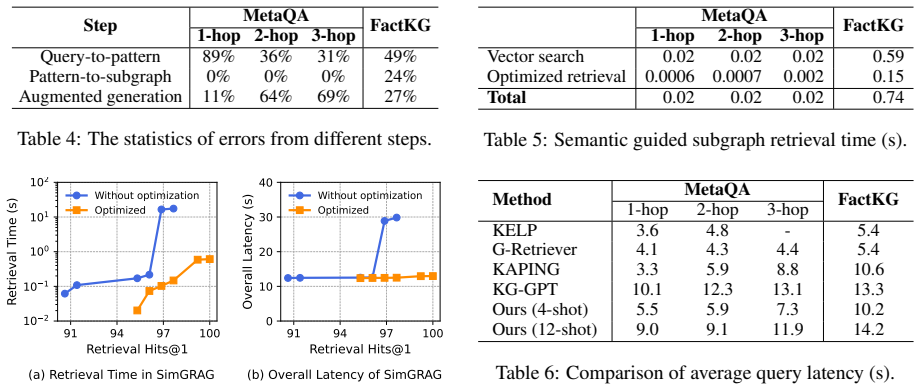
- Top-k subgraph retrieval is pruned by a lower bound on GSD, guaranteeing the same top-k as exhaustive search while averaging 0.74 seconds per query on DBpedia's 9.9 million nodes and 42.9 million edges.
- No oracle entities are needed because unknown nodes and relations in the pattern are skipped in GSD, and all KG nodes and relations become candidates with zero distance.
Reading between the lines
- Because the paper's error analysis attributes 24% of FactKG failures to pattern-to-subgraph mismatch, a natural extension is to relax exact isomorphism to approximate topology matching (for example, graph edit distance) so semantically equivalent but differently shaped evidence can still be retrieved; this is my inference, not a paper claim.
- The same query-to-pattern / pattern-to-subgraph decomposition could transfer to other structured corpora such as event logs, biological pathway databases, or code dependency graphs where a query is naturally a small graph; the paper only demonstrates human-cognate KGs.
- Given that vector search dominates runtime (0.59 seconds of the 0.74-second total on DBpedia), the paper's scalability claim is largely an ANN-index claim, so further speedups would come from better embedding indexes rather than subgraph matching.
- One could test whether pattern quality is the real bottleneck by feeding oracle patterns from the datasets directly into the retrieval stage and measuring the remaining gap; the paper does not isolate this component.
Signed reviews
Editorial analysis
A structured set of objections, weighed in public.
Referee Report
Summary. The paper proposes SimGRAG, a training-free KG-driven retrieval-augmented generation method. In the query-to-pattern stage, an LLM converts a natural-language query into a small graph pattern, using placeholders such as UNKNOWN entities when needed. In the pattern-to-subgraph stage, the method defines a Graph Semantic Distance (GSD) over subgraphs that are isomorphic to the pattern and retrieves the top-k subgraphs with the smallest GSD using an optimized DFS algorithm with semantic candidate filtering and branch-and-bound pruning. The retrieved subgraphs are verbalized as triples and fed to an LLM for final answer generation. Experiments on MetaQA, PathQuestions, WC2014, and FactKG report strong Hits@1 and accuracy numbers, with average retrieval times below one second on a 10-million-scale DBpedia graph; an additional WebQSP-WD experiment reports 87.7% Hits@1.
Significance. If the empirical claims hold, SimGRAG is a meaningful contribution to plug-and-play KG-driven RAG: it is training-free, avoids requiring oracle entities, and scales to graphs with tens of millions of entities. The paper gives clear formal definitions for graph isomorphism and GSD, provides a transparent lower-bound pruning argument for the optimized retrieval algorithm, and evaluates across four datasets with several baselines and three LLMs. The main risk is the exact-isomorphism requirement: the paper's own error analysis in Section 6.5 shows that 24% of FactKG errors occur in pattern-to-subgraph alignment, and the absence of an oracle-pattern ceiling or a relaxed structural matching baseline leaves this bottleneck unquantified. In addition, some retrieval hyperparameters for FactKG are selected via a grid search on sampled queries, and the WebQSP-WD test set is manually curated, so a few experimental choices need additional transparency before the broadest claims are fully established.
major comments (3)
- [§6.5 and §E, with Definition 1] The pattern-to-subgraph stage requires exact graph isomorphism, so GSD (Definition 2) is undefined for semantically correct evidence whose topology differs from the LLM-generated pattern. Section 6.5 reports that 24% of FactKG errors are pattern-to-subgraph mismatches, and Appendix E gives a concrete case where the ground truth uses one merged edge ("served warm (freshly baked) or cold") while the LLM pattern has two separate "served" edges. Such evidence is unreachable by construction. The paper neither reports an oracle-pattern ceiling (accuracy if the pattern were correct and isomorphic to the evidence) nor compares against a relaxed structural matching baseline (e.g., allowing edge contraction or splitting, or computing GSD over non-isomorphic alignments). Without one of these analyses, the 24% cannot be attributed to the isomorphism assumption versus the pattern-generation prompt. This is load-bearing for the fact-verification claim. Please add such an experiment or analysis and discuss the implications.
- [§C.1 and §G/Fig. 5] The default FactKG parameters (k(n)=16384, k(r)=512, k(t)=16) are selected after a grid search over 100 sampled queries, optimizing retrieval Hits@1 rather than end-to-end accuracy. Table 2 only varies the final top-k value, not these candidate widths. Because k(n)=16384 is very large relative to the 9.9M-entity DBpedia graph, it is possible that the reported 86.8% accuracy and 0.74s latency depend on an effectively exhaustive candidate set selected at least in part on the test distribution. Please provide an end-to-end sensitivity analysis over k(n), k(r), and k(t) on FactKG, and clarify whether the grid-search queries overlap the test set.
- [Appendix H] The WebQSP-WD experiment manually excludes unsupported questions after inspecting the 2-hop neighborhoods of topic and answer entities. The paper does not report how many questions were excluded, the criteria used to determine support, or the exact filtered test set. Without this information, the reported 87.7% Hits@1 is not reproducible and is not directly comparable to published WebQSP numbers. Please release the filtered test set and the exclusion counts, and, if any comparison is intended, run all baselines on the same filtered subset.
minor comments (4)
- [§4.1] The reported query-to-pattern alignment accuracy (98% for MetaQA, 93% for FactKG) is based on manual verification; please specify the annotation protocol or release the judgment data so that this metric is reproducible.
- [§6.4] In the first paragraph of the few-shot ablation, "pattern-to-graph alignment" should be "pattern-to-subgraph alignment" for consistency with the terminology used elsewhere in the paper.
- [Table 3] The column header row is ambiguous: the six structure types are listed as "Path Conjunction Star" with only numeric subcolumns, making it unclear which columns correspond to path-2hop, conjunction-2hop, star-3hop, etc. Please make the mapping explicit.
- [Limitations] The Limitations section does not mention the isomorphic-structure failures quantified in Section 6.5, which are a more immediate practical constraint than the general human-understandable-KG assumption; please add this limitation to the discussion.
Circularity Check
No circular derivation: GSD is a defined ranking metric, no parameter is fitted to answers, and the only author-overlap citation is non-load-bearing.
full rationale
SimGRAG's derivation is self-contained against external benchmarks. The query-to-pattern stage is an LLM prompt; pattern-to-subgraph uses the Graph Semantic Distance defined in Definition 2 (a sum of embedding L2 distances over an isomorphic matching); and the final answer is produced by an LLM from the retrieved subgraphs. GSD is a metric rather than a fitted quantity, and no parameter (k, k(n), k(r), k(t)) is optimized against the answer labels in a way that makes the reported Hits@1 or accuracy a forced consequence of the inputs. The manually constructed few-shot examples shape the LLM's pattern generation, but they do not enter the GSD computation or the retrieval ranking, so they are prompt design rather than fitted inputs renamed as predictions. The one author-overlap citation (Zhang et al. 2024, including corresponding author Weiguo Zheng) appears in Section 5.1 only to justify following a standard filtering-ordering-enumerating subgraph matching paradigm; it is not load-bearing and does not supply any correctness or uniqueness claim. Section 6.5 and Appendix E acknowledge that 24% of FactKG errors come from pattern-to-subgraph mismatch due to the strict isomorphism requirement (e.g., the LLM splits 'served warm'/'served cold' into two edges while the KG has one merged edge); this is an empirically quantified limitation, not a circular reduction, because the mismatch is reported as a failure of the method rather than redefined away. There is no self-definitional step, no fitted input called a prediction, and no uniqueness theorem imported from the authors' prior work.
Assumptions & free parameters
free parameters (7)
- k(n) for MetaQA =
16
- k(n) for FactKG =
16384
- k(r) for MetaQA =
16
- k(r) for FactKG =
512
- k(t) for FactKG =
16
- k =
3
- few-shot count =
12
assumptions (4)
- domain assumption The input KG aligns with human cognition and can be interpreted by LLMs.
- domain assumption Exact graph isomorphism is the appropriate structural constraint for evidence subgraphs.
- domain assumption Embedding distances (Nomic) reflect semantic alignment between pattern and KG nodes/relations.
- domain assumption The LLM can faithfully convert queries to pattern graphs.
Cite this review
Pith. "Pith review of SimGRAG: Leveraging Similar Subgraphs for Knowledge Graphs Driven Retrieval-Augmented Generation." pith.science (2026). https://pith.science/paper/EP4I2DVB
@misc{pith2026241215272,
  author       = {Pith},
  title        = {Pith review of: SimGRAG: Leveraging Similar Subgraphs for Knowledge Graphs Driven Retrieval-Augmented Generation},
  year         = {2026},
  howpublished = {\url{https://pith.science/paper/EP4I2DVB}},
  note         = {Machine review of arXiv:2412.15272}
}
read the original abstract
Recent advancements in large language models (LLMs) have shown impressive versatility across various tasks. To eliminate their hallucinations, retrieval-augmented generation (RAG) has emerged as a powerful approach, leveraging external knowledge sources like knowledge graphs (KGs). In this paper, we study the task of KG-driven RAG and propose a novel Similar Graph Enhanced Retrieval-Augmented Generation (SimGRAG) method. It effectively addresses the challenge of aligning query texts and KG structures through a two-stage process: (1) query-to-pattern, which uses an LLM to transform queries into a desired graph pattern, and (2) pattern-to-subgraph, which quantifies the alignment between the pattern and candidate subgraphs using a graph semantic distance (GSD) metric. We also develop an optimized retrieval algorithm that efficiently identifies the top-k subgraphs within 1-second on a 10-million-scale KG. Extensive experiments show that SimGRAG outperforms state-of-the-art KG-driven RAG methods in both question answering and fact verification. Our code is available at https://github.com/YZ-Cai/SimGRAG.
Figures


Figures from the paper (2 more)

Reference graph
Works this paper leans on
-
[1]
what films did Michelle Trachtenberg star in?
-
[2]
Gaole He, Yunshi Lan, Jing Jiang, Wayne Xin Zhao, and Ji-Rong Wen
Retrieval-augmented generation with graphs (graphrag).arXiv preprint arXiv:2501.00309. Gaole He, Yunshi Lan, Jing Jiang, Wayne Xin Zhao, and Ji-Rong Wen. 2021. Improving multi-hop knowledge base question answering by learning intermediate supervision signals. InProceedings of the 14th ACM international conference on web search and data mining, pages 553–5...
arXiv 2021
-
[3]
who is the director of The Well-Digger’s Daughter? MetaQA 2-hop
-
[5]
A comprehensive survey and experimental study of subgraph matching: Trends, unbiasedness, and interaction.Proc. ACM Manag. Data, 2(1). Zhiyuan Zhang, Xiaoqian Liu, Yi Zhang, Qi Su, Xu Sun, and Bin He. 2020. Pretrain-KGE: Learning knowl- edge representation from pretrained language models. InFindings of the Association for Computational Lin- guistics: EMNL...
arXiv 2020
-
[9]
what are some words that describe movie Lassie Come Home?
-
[11]
which movies have the same actor of Jack the Bear?
-
[12]
which movies share the same director of I Wanna Hold Your Hand?
-
[13]
what were the release dates of Eric Mandelbaum written films? MetaQA 3-hop
Show all 42 references
-
[14]
who wrote movies that share directors with the movie Unbeatable?
-
[15]
what genres do the movies that share directors with Fish Story fall under?
-
[16]
A Details of Tasks and Datasets Table 7 summarizes the statistics of the underlying knowledge graph used for each dataset
who acted in the films written by the screenwriter of The Man Who Laughs? Table 9: Example questions in the MetaQA dataset. A Details of Tasks and Datasets Table 7 summarizes the statistics of the underlying knowledge graph used for each dataset. A.1 Knowledge Graph Question A...
2018
-
[17]
john_b_kelly_sr’s son’s job?
-
[18]
what is the sex of spouse of mary_stuart_countess_of_bute?
-
[19]
where does virginia_heinlein’s spouse work for? PQ 3-hop
-
[20]
who is the mom of father of mary_of_teck’s heir?
-
[21]
what is the name of the gender of son of henry_i_of_england’s mother?
-
[22]
ferdinand_ii_of_aragon’s parent’s heir’s nation? Table 11: Example questions in the PQ dataset. Head Relation Tail Esseid_BELKALEM plays_in_club Watford_FC Frank_LAMPARD plays_for_country England JOAO_MOUTINHO plays_in_club AS_Monaco Agustin_ORION plays_position Goalkeeper Ric...
-
[23]
which football club does Alan_PULIDO play for?
-
[24]
what position does Alan_PULIDO play?
-
[25]
which country is the soccer team Atletico_Madrid based in? WC2014 2-hop
-
[26]
which professional foootball team has a player from Belgium?
-
[27]
where is the football club that Rafael_MARQUEZ plays for?
-
[28]
which country does Mathieu_DEBUCHY play professional in? WC2014 Conjunction
-
[29]
name a player who plays at Forward position at the club Tigres_UANL?
-
[30]
who are the Italy players at club US_Citta_di_Palermo?
-
[31]
which Portugal footballer plays at position Goalkeeper? Table 13: Example questions in the WC2014 dataset. A.2 Fact Verification For the task of fact verification, we use the FactKG dataset (Kim et al., 2023b) that contains 5 different types of fact verification: One-hop, Conj...
2015
-
[32]
It was Romano Prodi who was the prime minister
-
[33]
Are you familiar with Terrance Shaw? He also attended college
-
[34]
divided": [
Yes, Anastasio J. Ortiz was the Vice President. Table 15: Example statements from the FactKG dataset. You need to segment the given query then extract the potential knowledge graph structures. Notes) 1). Use the original description in the query with enough context, NEVER use ...
-
[35]
the actor in Flashpoint also appears in which films
query: "the actor in Flashpoint also appears in which films" output: { "divided": [ "the actor in Flashpoint", "this actor also appears in another films", ], "triples": [ ("UNKNOWN actor 1", "actor of", "Flashpoint"), ("UNKNOWN actor 1", "actor of", "UNKNOWN film 1"), ] }
-
[36]
divided": [
query: ... output: ... Your task) Please read and follow the above instructions and examples step by step query: {{QUERY}} Table 16: The query-to-pattern alignment prompt used for KGQA task. At each step for processing each dataset, our prompts utilize exactly the same guidanc...
2024
-
[37]
The College of William and Mary is the owner of the Alan B. Miller Hall, that is situated in Virginia
query: "The College of William and Mary is the owner of the Alan B. Miller Hall, that is situated in Virginia." output: { "divided": [ "The College of William and Mary is the owner of the Alan B. Miller Hall", "Alan B. Miller Hall is situated Virginia", ], "triples": [ ("The C...
-
[38]
person” or “organization
query: ... output: ... Your task) Please read and follow the above instructions and examples step by step query: {{QUERY}} Table 17: The query-to-pattern alignment prompt used in FactKG dataset. By default, we use k= 3 and 12-shot in-context learning throughout all experiments...
2024
-
[39]
who wrote films that share actors with the film Anastasia?
query: "who wrote films that share actors with the film Anastasia?" evidences: { "graph [1]": [ ("Anastasia", "starred_actors", "Ingrid Bergman"), ("Spellbound", "starred_actors", "Ingrid Bergman"), ("Spellbound", "written_by", "Ben Hecht"), ], "graph [2]":[ ("Anastasia", "sta...
-
[40]
evidences:
query: ... evidences: ... output: ... Your task) Please read and follow the above instructions and examples step by step query: {{QUERY}} evidences: {{RETRIEVED SUBGRAPHS}} Table 18: The verbalized subgraph-augemented generation prompt used for KGQA task. 1024-dimensional hidd...
2024
-
[41]
Mick Walker (footballer, born 1940) is the leader of 1993–94 Notts County F.C. season
query: "Mick Walker (footballer, born 1940) is the leader of 1993–94 Notts County F.C. season." evidences: { "graph [1]": [ (’Mick Walker (footballer, born 1940)’, ’manager’, ’1993–94 Notts County F.C. season’), (’Mick Walker (footballer, born 1940)’, ’birthDate’, ’"1940-11-27...
1940
-
[42]
The lady Anne Monson was born in the Darlington location of the ITL?
query: ... evidences: ... output: ... Your task) Please read and follow the above instructions and examples step by step query: {{QUERY}} evidences: {{RETRIEVED SUBGRAPHS}} Table 19: The verbalized subgraph-augemented generation prompt used in FactKG dataset. somewhat distant ...
2016
-
[2018]
12 Yun Zhu, Yaoke Wang, Haizhou Shi, and Siliang Tang
An interpretable reasoning network for multi-relation question answering.arXiv preprint arXiv:1801.04726. 12 Yun Zhu, Yaoke Wang, Haizhou Shi, and Siliang Tang. 2024a. Efficient tuning and inference for large lan- guage models on textual graphs. InProceedings of the Thirty-Thi...
2003 arXiv
-
[2020]
InProceedings of the 58th annual meeting of the as- sociation for computational linguistics, pages 4498– 4507
Improving multi-hop question answering over knowledge graphs using knowledge base embeddings. InProceedings of the 58th annual meeting of the as- sociation for computational linguistics, pages 4498– 4507. Jiaxin Shi, Shulin Cao, Lei Hou, Juanzi Li, and Hanwang Zhang. 2021. Tra...
2021 arXiv
-
[2022]
InCompanion Proceedings of the Web Conference 2022, WWW ’22, page 162–165
From discrimination to generation: Knowl- edge graph completion with generative transformer. InCompanion Proceedings of the Web Conference 2022, WWW ’22, page 162–165. Association for Computing Machinery. Linyao Yang, Hongyang Chen, Zhao Li, Xiao Ding, and Xindong Wu. 2024. Gi...
2022 arXiv
-
[2023]
Jie Zhou, Xu Han, Cheng Yang, Zhiyuan Liu, Lifeng Wang, Changcheng Li, and Maosong Sun
A survey of large language models.Preprint, arXiv:2303.18223. Jie Zhou, Xu Han, Cheng Yang, Zhiyuan Liu, Lifeng Wang, Changcheng Li, and Maosong Sun. 2019. GEAR: Graph-based evidence aggregating and reasoning for fact verification.arXiv preprint arXiv:1908.01843. Mantong Zhou,...
2019 arXiv
-
[2024]
Jinheon Baek, Alham Fikri Aji, and Amir Saffari
Many-shot in-context learning.arXiv preprint arXiv:2404.11018. Jinheon Baek, Alham Fikri Aji, and Amir Saffari. 2023. Knowledge-augmented language model prompting for zero-shot knowledge graph question answering. InProceedings of the 1st Workshop on Natural Language Reasoning ...
2023 arXiv
Reviewed August 11, 2026 · model on record in the stance chip above.
Discussion (0). Continue with ORCID to comment.