REVIEW 3 major objections 7 minor 1 cited by
MORTAR: Multi-turn Metamorphic Testing for LLM-based Dialogue Systems
T0 review · 3 major / 7 minor · reviewed 2026-08-11 · deepseek-v4-flash
Pith's one-line read MORTAR tests multi-turn LLM dialogues by perturbing context, finding over 150% more bugs per test case than single-turn metamorphic testing.
desk verdict MORTAR's multi-turn MR framework is a real contribution, but the EC check that powers it is unvalidated and the empirical claims need stronger support. read the letter →
The pith
A machine-rendered reading of the paper's core claim, the machinery that carries it, and where it could break.
The reading
What carries the argument
The equivalent-context check (EC), which decides whether a perturbed dialogue context supplies the same information as the original context for a given target question. EC combines three automated checks—semantic-based anaphora resolution, ontology-based knowledge-graph comparison, and a dataset-specific check—and its True/False output routes every question to the appropriate metamorphic relation (MR1/MR3 when equivalent, MR2/MR4 when not). The automated MR matching made possible by EC is what allows MORTAR to be fully automated and judge-free.
What would settle it
Manually annotate context equivalence on a sample of perturbed dialogues (e.g., 200 target questions where the target is a short anaphoric question like 'How?'), then compare EC's decisions to human labels. If EC labels a large share of inequivalent contexts as equivalent (say, above 25–30%), then MR1-violation detections on those cases are false positives and the claimed bug counts and precision would drop accordingly.
Extended reading notes
Core claim
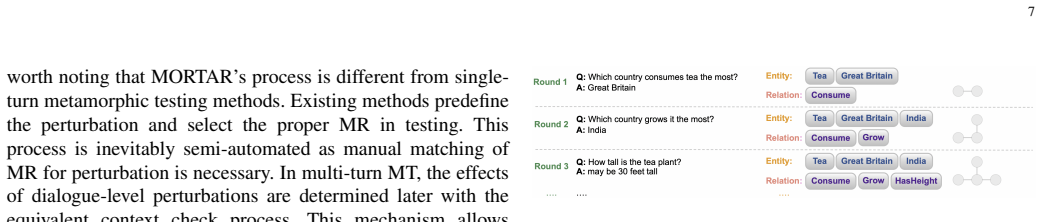
The central claim is that the test-oracle problem in multi-turn dialogue testing can be mitigated without human labels or LLM judges by exploiting the context-dependence of dialogue. MORTAR formalises a multi-turn dialogue as a sequence of question-answer pairs, introduces five dialogue-level perturbations (round shuffle, round reduction, round duplication, and two combined variants) that alter the context of target questions, and defines four metamorphic relations: MR1 expects semantically similar answers when the perturbed context is equivalent to the original, MR2 expects different answers when the context loses critical information, MR3 requires consistency among all context-preserving versions, and MR4 requires divergence between context-preserving and context-altering versions. The equivalence decision is automated by an equivalent-context check built from semantic anaphora resolution, an ontology/graph-based information extraction pipeline, and a dataset-specific check. On six open-source LLM-based dialogue systems using CoQA as test seeds, MORTAR reports 36,908 positive detections versus 14,665 for METAL, a BPTC of 11.36 versus 4.49, a manual-check precision of 70.5% versus 45.5%, and 35.6% unique bugs versus 25.9%.
Load-bearing premise
The load-bearing premise is that the automated equivalent-context check correctly decides whether a perturbed context preserves the information needed to answer the target question; if it mislabels inequivalent contexts as equivalent, many reported bugs are false positives (as the paper's 'How?' example shows).
Editorial extensions
If this is right
- Existing single-turn QA datasets can be reused as multi-turn test seeds, amplifying bug discovery without new annotated oracles.
- Adding new dialogue-level perturbations only requires an EC that can judge their effect; the four MRs and MR-matching mechanism remain intact.
- Bugs that reference-based testing misses (L2 and L3 bugs) become accessible from the same test seeds, so resource-constrained testing covers more failure modes.
- Because no LLM judge is involved, the reported bugs rest on formal metamorphic relations rather than on the opinions of another model.
- The method's smaller performance drop across six systems (51.8 vs 57.7 percentage points in positive rate) indicates more consistent effectiveness when dialogue systems vary in quality.
Reading between the lines
- Improving EC accuracy with a stronger context-equivalence model would likely raise MORTAR's effectiveness further, since the paper's own error analysis shows EC's main weakness is mislabelling inequivalent contexts as equivalent.
- The MR template could be lifted to other multi-turn properties, such as safety or factuality: context-preserving perturbations should not change a system's refusal, and context-altering perturbations should not cause it to keep asserting previously grounded facts.
- The ontology-based check's reliance on LLM-based information extraction makes MORTAR's seed yield (403/500 dialogues) and precision sensitive to the IE pipeline; domain-specific dialogues with complex entities would require adapted extraction prompts.
- The L3-bug category—failures found in dialogues that passed reference-based testing—is a reusable metric for any metamorphic testing of conversational systems and could become a standard reporting statistic.
Editorial analysis
A structured set of objections, weighed in public.
Referee Report
Summary. The paper proposes MORTAR, a metamorphic testing approach for multi-turn question-answer dialogue systems based on LLMs. It formalizes a multi-turn metamorphic testing framework, defines five dialogue-level perturbations (DRS, DRR, DRD, DSR, DSD), four metamorphic relations (MR1-MR4), and an automated equivalent-context check that combines semantic, ontology-based, and dataset-specific checks. Using CoQA as the test seed source, the authors compare MORTAR against the single-turn metamorphic testing baseline METAL on six open-source dialogue systems, reporting that MORTAR detects over 150% more bugs per test case and achieves higher precision, diversity, and uniqueness of bugs. An ablation study attributes contributions to individual perturbations and MRs.
Significance. If the equivalent-context check is reliable, MORTAR is a meaningful contribution: it is a fully automated, judge-free multi-turn metamorphic testing method with a formalized framework, novel dialogue-level perturbations, and automated MR matching. The paper ships a substantial empirical study with six dialogue systems and an ablation analysis, which strengthens the practical relevance of the proposal. The main significance, however, is conditional on the validity of EC, because MR1 and MR3, which together account for about 99.5% of reported detections (Table VIII), both rely on trusting EC labels of context equivalence. The authors' own discussion in Section V-D2 documents a concrete failure of EC in the direction that inflates MR1/MR3 detections, and no independent accuracy evaluation of EC is provided. Thus the empirical claims are plausible but not yet established to the standard required for the headline effectiveness conclusions.
major comments (3)
- [Section III-E and V-D2] The automated equivalent-context check is the load-bearing component of MORTAR, yet its accuracy is never measured against ground truth. Section III-E explicitly states that 'some inequivalent contexts will be mislabelled as equivalent' for MR1 and MR3, and Section V-D2 gives a concrete instance: in a perturbed test case, 'How?' is asked after 'Did the movie break any records?' while in the original test case 'How?' followed 'When did Kyle die?', and EC fails to flag the changed referent. This is exactly the error direction that inflates detections: MR1 and MR3 together account for 22,777 of the 22,893 mean detections in Table VIII (about 99.5%), and both require trusting EC=True classifications. The reported PPD of 70.5% is based on only 100 manually labelled detections and does not measure EC-specific precision or recall. The authors should validate EC against human equivalence judgments on a sample of perturbed contexts, report precision/recall for the EC=True and EC=False directions separately, and re-derive NBugs, RETC, BPTC, and PPD after filtering or correcting known EC failures.
- [Section IV-C and IV-D] The comparison between MORTAR and METAL is asymmetric with respect to unanswerable questions. Section IV-C states that MORTAR excludes unanswerable questions from MR violation detection, while Section IV-D states that METAL treats all originally unanswerable questions as answerable with the expectation 'Unknown'. This differential handling directly affects the counts that drive the headline comparison (NBugs, Rate+, BPTC). The authors should report the number of unanswerable questions in the test set, and either re-run the analysis with consistent treatment or provide a sensitivity analysis showing that the 150% effectiveness advantage is robust to this asymmetry.
- [Section V-A and V-D1] The effectiveness comparison is based on non-overlapping test seed sets: METAL uses all 500 test seeds while MORTAR uses only 403 successfully processed seeds (Table III). Section V-D1 reports that the failed extraction dialogues overlap 92.8% with effective original test cases of DS6, the best-performing system, which creates a systematic selection bias in favor of MORTAR. In addition, no statistical significance tests or confidence intervals are reported for any of the effectiveness metrics, despite the abstract claiming results are 'significantly better'. The authors should compare both methods on the common 403-seed subset, report the results for the excluded seeds separately, and provide significance tests or confidence intervals for the key metrics (NBugs, BPTC, Rate+, PPD).
minor comments (7)
- [Table IV] In Table IV, the DS1 row for METAL shows '01.023' for CV, which appears to be a typo for '1.023'; please verify and correct.
- [Section IV-E] The prompt description says the dialogue systems are required to answer 'Unknow' if they do not know the answer; this should be 'Unknown'.
- [Section III-E1c] The heading 'Dataset-specified check' is fine, but the phrase 'an additional semantic-based check will be added' is slightly confusing because this check is described as separate from the earlier semantic-based check; please clarify how it differs.
- [Section V-B2] The description of manual labelling says cases with a score below six are classified as true positive detections, but the treatment of exactly six is unspecified; please clarify the threshold rule.
- [Table VI] In Table VI, the MR3 row shows the same value (6,194) for all five perturbations, but MR3 is a group-level relation; the per-perturbation attribution is not obvious. Please explain how the counting is performed for MR3 and MR4.
- [Section III-D and III-E] Equation (27) defines EC on (Q^r_{i-1}, q^r_i), while Equation (30) uses EC(Q_{j-1}, q_j) = True; the two-argument notation for the original context should be defined explicitly for consistency.
- [Section V-D3] The sentence 'This contradicts the trend of increased reasoning capability as expectations' is grammatically unclear; please revise to 'as expected'.
Circularity Check
No significant circularity: MORTAR's bug counts are empirical and externally checked; EC oracle-leakage is a validity threat, not a definitional reduction.
full rationale
MORTAR's central effectiveness claims (NBugs, RETC, BPTC) are empirical counts obtained by running six dialogue systems on perturbed CoQA dialogues and comparing with the METAL baseline; no fitted constant is later renamed as a prediction. The four metamorphic relations are stated assumptions (Eqs. 30-39) linking perturbed contexts to expected answer similarity, and the equivalent-context check is an automated heuristic rather than a parameter fitted to the reported bug counts. The paper explicitly concedes EC limitations in Section III-E and gives a concrete misclassification example in Section V-D2, and the manual PPD assessment in Section V-B2 provides an external, human-labelled check on whether reported detections are true positives. The use of original answers in the ontology-based check is a possible oracle-leakage and validity threat, but it does not make the bug counts equivalent by construction: a bug is counted only when the dialogue system's actual output violates the MR, so the results remain empirically grounded. Self-citations, such as Chen et al.'s original metamorphic testing work [13] and Aleti [2], serve as background references and are not load-bearing uniqueness arguments. No step in the paper reduces to its own input by definition.
Assumptions & free parameters
free parameters (4)
- semantic similarity threshold epsilon =
0.6
- reduction ratio for DRR and DSR =
30%
- duplication ratio for DRD and DSD =
20%
- manual precision score threshold =
score below 6 is a true positive
assumptions (6)
- domain assumption Each multi-turn QA question has a unique correct answer given sufficient context
- domain assumption The answer a_i is implied by the question sequence Q_i alone (Eq. 11)
- ad hoc to paper Equivalent context can be decided by anaphora resolution, knowledge-graph coverage, and a dataset-specific story check
- ad hoc to paper Original answers from the seed dataset may be used inside the context check to clarify what information questions imply
- domain assumption Semantic similarity above 0.6 measured by all-MiniLM-L6-v2 means equivalent answers
- domain assumption Randomly chosen deletion, duplication, and shuffle operations produce representative test cases
Cite this review
Pith. "Pith review of MORTAR: Multi-turn Metamorphic Testing for LLM-based Dialogue Systems." pith.science (2026). https://pith.science/paper/AQFIRS6X
@misc{pith2026241215557,
  author       = {Pith},
  title        = {Pith review of: MORTAR: Multi-turn Metamorphic Testing for LLM-based Dialogue Systems},
  year         = {2026},
  howpublished = {\url{https://pith.science/paper/AQFIRS6X}},
  note         = {Machine review of arXiv:2412.15557}
}
read the original abstract
With the widespread application of LLM-based dialogue systems in daily life, quality assurance has become more important than ever. Recent research has successfully introduced methods to identify unexpected behaviour in single-turn testing scenarios. However, multi-turn interaction is the common real-world usage of dialogue systems, yet testing methods for such interactions remain underexplored. This is largely due to the oracle problem in multi-turn testing, which continues to pose a significant challenge for dialogue system developers and researchers. In this paper, we propose MORTAR, a metamorphic multi-turn dialogue testing approach, which mitigates the test oracle problem in testing LLM-based dialogue systems. MORTAR formalises the multi-turn testing for dialogue systems, and automates the generation of question-answer dialogue test cases with multiple dialogue-level perturbations and metamorphic relations (MRs). The automated MR matching mechanism allows MORTAR more flexibility and efficiency in metamorphic testing. The proposed approach is fully automated without reliance on LLM judges. In testing six popular LLM-based dialogue systems, MORTAR reaches significantly better effectiveness with over 150\% more bugs revealed per test case when compared to the single-turn metamorphic testing baseline. Regarding the quality of bugs, MORTAR reveals higher-quality bugs in terms of diversity, precision and uniqueness. MORTAR is expected to inspire more multi-turn testing approaches, and assist developers in evaluating the dialogue system performance more comprehensively with constrained test resources and budget.
Figures


Figures from the paper (2 more)

Forward citations
Cited by 1 Pith paper
-
Rethinking Testing for LLM Applications: Characteristics, Challenges, and a Lightweight Interaction Protocol
This position paper classifies testing methods for LLM applications into three layers and proposes AICL, a structured protocol for testable agent communication; neither the framework nor the protocol is empirically validated.
Reference graph
Works this paper leans on
-
[1]
A review of dialogue systems: current trends and future directions,
A. Algherairy and M. Ahmed, “A review of dialogue systems: current trends and future directions,”Neural Computing and Applications, vol. 36, no. 12, pp. 6325–6351, 2024
work page 2024
-
[2]
Software testing of generative ai systems: Challenges and opportunities,
A. Aleti, “Software testing of generative ai systems: Challenges and opportunities,” in2023 IEEE/ACM International Conference on Software Engineering: Future of Software Engineering (ICSE-FoSE), 2023, pp. 4–14
work page 2023
-
[3]
Hotpotqa: A dataset for diverse, explainable multi- hop question answering,
Z. Yang, P. Qi, S. Zhang, Y . Bengio, W. Cohen, R. Salakhutdinov, and C. D. Manning, “Hotpotqa: A dataset for diverse, explainable multi- hop question answering,” inProceedings of the 2018 Conference on Empirical Methods in Natural Language Processing, 2018, pp. 2369– 2380
work page 2018
-
[4]
Decodingtrust: A comprehensive assessment of trustworthiness in gpt models
B. Wang, W. Chen, H. Pei, C. Xie, M. Kang, C. Zhang, C. Xu, Z. Xiong, R. Dutta, R. Schaefferet al., “Decodingtrust: A comprehensive assessment of trustworthiness in gpt models.” inNeurIPS, 2023
work page 2023
-
[5]
Measuring massive multitask language understanding,
D. Hendrycks, C. Burns, S. Basart, A. Zou, M. Mazeika, D. Song, and J. Steinhardt, “Measuring massive multitask language understanding,” arXiv preprint arXiv:2009.03300, 2020
arXiv 2009
-
[6]
Gpqa: A graduate-level google-proof q&a benchmark,
D. Rein, B. L. Hou, A. C. Stickland, J. Petty, R. Y . Pang, J. Dirani, J. Michael, and S. R. Bowman, “Gpqa: A graduate-level google-proof q&a benchmark,”arXiv preprint arXiv:2311.12022, 2023
arXiv 2023
-
[7]
A survey on evaluation of large language models,
Y . Chang, X. Wang, J. Wang, Y . Wu, L. Yang, K. Zhu, H. Chen, X. Yi, C. Wang, Y . Wanget al., “A survey on evaluation of large language models,”ACM Transactions on Intelligent Systems and Technology, vol. 15, no. 3, pp. 1–45, 2024
2024
-
[8]
ShareGPT, “ShareGPT Data,” 2023, accessed: 2024-10-29. [Online]. Available: https://huggingface.co/datasets/anon8231489123/ShareGPT Vicuna unfiltered
work page 2023
Show all 56 references
-
[9]
Llm defenses are not robust to multi-turn human jailbreaks yet,
N. Li, Z. Han, I. Steneker, W. Primack, R. Goodside, H. Zhang, Z. Wang, C. Menghini, and S. Yue, “Llm defenses are not robust to multi-turn human jailbreaks yet,”arXiv preprint arXiv:2408.15221, 2024
2024 arXiv
-
[10]
MT-bench-101: A fine-grained benchmark for evaluating large language models in multi-turn dialogues,
G. Bai, J. Liu, X. Bu, Y . He, J. Liu, Z. Zhou, Z. Lin, W. Su, T. Ge, B. Zheng, and W. Ouyang, “MT-bench-101: A fine-grained benchmark for evaluating large language models in multi-turn dialogues,” in Proceedings of the 62nd Annual Meeting of the Association for Computational ...
2024
-
[11]
Judging llm-as-a-judge with mt-bench and chatbot arena,
L. Zheng, W.-L. Chiang, Y . Sheng, S. Zhuang, Z. Wu, Y . Zhuang, Z. Lin, Z. Li, D. Li, E. Xinget al., “Judging llm-as-a-judge with mt-bench and chatbot arena,”Advances in Neural Information Processing Systems, vol. 36, pp. 46 595–46 623, 2023
2023
-
[13]
Appli- cation of metamorphic testing in numerical analysis,
F. Chan, T. Y . Chen, S. C. Cheung, M. F. Lau, and S.-M. Yiu, “Appli- cation of metamorphic testing in numerical analysis,” inProceedings of the IASTED International Conference on Software Engineering (SE’98), 1998
1998
-
[14]
Testing your question answering software via asking recursively,
S. Chen, S. Jin, and X. Xie, “Testing your question answering software via asking recursively,” in2021 36th IEEE/ACM International Confer- ence on Automated Software Engineering (ASE). IEEE, 2021, pp. 104– 116
2021
-
[16]
Metal: Metamorphic testing framework for analyzing large-language model qualities,
S. Hyun, M. Guo, and M. A. Babar, “Metal: Metamorphic testing framework for analyzing large-language model qualities,” in2024 IEEE Conference on Software Testing, Verification and Validation (ICST). IEEE, 2024, pp. 117–128
2024
-
[17]
Neural approaches to conversational ai,
J. Gao, M. Galley, and L. Li, “Neural approaches to conversational ai,” inThe 41st international ACM SIGIR conference on research & development in information retrieval, 2018, pp. 1371–1374
2018
-
[18]
Coqa: A conversational question answering challenge,
S. Reddy, D. Chen, and C. D. Manning, “Coqa: A conversational question answering challenge,”Transactions of the Association for Computational Linguistics, vol. 7, pp. 249–266, 2019
2019
-
[19]
A survey of dialogue system evaluation,
Y . Fan and X. Luo, “A survey of dialogue system evaluation,” in2020 IEEE 32nd International Conference on Tools with Artificial Intelligence (ICTAI). IEEE, 2020, pp. 1202–1209
2020
-
[20]
Evaluating large language models: A comprehensive survey,
Z. Guo, R. Jin, C. Liu, Y . Huang, D. Shi, L. Yu, Y . Liu, J. Li, B. Xiong, D. Xionget al., “Evaluating large language models: A comprehensive survey,”arXiv preprint arXiv:2310.19736, 2023
2023 arXiv
-
[21]
Dialoglue: A natural language understanding benchmark for task-oriented dialogue,
S. Mehri, M. Eric, and D. Hakkani-Tur, “Dialoglue: A natural language understanding benchmark for task-oriented dialogue,”arXiv preprint arXiv:2009.13570, 2020
2009 arXiv
-
[22]
Drowzee: Metamorphic testing for fact-conflicting hallucination detection in large language models,
N. Li, Y . Li, Y . Liu, L. Shi, K. Wang, and H. Wang, “Drowzee: Metamorphic testing for fact-conflicting hallucination detection in large language models,”Proc. ACM Program. Lang., vol. 8, no. OOPSLA2, Oct. 2024. [Online]. Available: https://doi.org/10.1145/3689776
2024 doi
-
[23]
Leveraging large language models for nlg evaluation: Advances and challenges,
Z. Li, X. Xu, T. Shen, C. Xu, J.-C. Gu, Y . Lai, C. Tao, and S. Ma, “Leveraging large language models for nlg evaluation: Advances and challenges,” inProceedings of the 2024 Conference on Empirical Methods in Natural Language Processing, Y . Al-Onaizan, M. Bansal, and Y .-N. C...
2024
-
[24]
Dialogbench: Evaluating llms as human-like dialogue systems,
J. Ou, J. Lu, C. Liu, Y . Tang, F. Zhang, D. Zhang, and K. Gai, “Dialogbench: Evaluating llms as human-like dialogue systems,”arXiv preprint arXiv:2311.01677, 2023. 16
2023 arXiv
-
[25]
Gsm-symbolic: Understanding the limitations of mathematical reasoning in large language models,
I. Mirzadeh, K. Alizadeh, H. Shahrokhi, O. Tuzel, S. Bengio, and M. Farajtabar, “Gsm-symbolic: Understanding the limitations of mathematical reasoning in large language models,”arXiv preprint arXiv:2410.05229, 2024
2024 arXiv
-
[26]
Parrot: Enhancing multi-turn instruction fol- lowing for large language models,
Y . Sun, C. Liu, K. Zhou, J. Huang, R. Song, W. X. Zhao, F. Zhang, D. Zhang, and K. Gai, “Parrot: Enhancing multi-turn instruction fol- lowing for large language models,” inProceedings of the 62nd Annual Meeting of the Association for Computational Linguistics (Volume 1: Long ...
2024
-
[27]
Mt-eval: A multi-turn capabili- ties evaluation benchmark for large language models,
W.-C. Kwan, X. Zeng, Y . Jiang, Y . Wang, L. Li, L. Shang, X. Jiang, Q. Liu, and K.-F. Wong, “Mt-eval: A multi-turn capabili- ties evaluation benchmark for large language models,”arXiv preprint arXiv:2401.16745, 2024
2024 arXiv
-
[28]
Mint: Evaluating llms in multi-turn interaction with tools and language feedback,
X. Wang, Z. Wang, J. Liu, Y . Chen, L. Yuan, H. Peng, and H. Ji, “Mint: Evaluating llms in multi-turn interaction with tools and language feedback,”arXiv preprint arXiv:2309.10691, 2023
2023 arXiv
-
[29]
BotChat: Evaluating LLMs’ capabilities of having multi-turn dialogues,
H. Duan, J. Wei, C. Wang, H. Liu, Y . Fang, S. Zhang, D. Lin, and K. Chen, “BotChat: Evaluating LLMs’ capabilities of having multi-turn dialogues,” inFindings of the Association for Computational Linguistics: NAACL 2024, K. Duh, H. Gomez, and S. Bethard, Eds. Mexico City, Mexi...
2024
-
[30]
A survey on metamorphic testing,
S. Segura, G. Fraser, A. B. Sanchez, and A. Ruiz-Cort ´es, “A survey on metamorphic testing,”IEEE Transactions on software engineering, vol. 42, no. 9, pp. 805–824, 2016
2016
-
[31]
Metamorphic test- ing: a new approach for generating next test cases,
T. Y . Chen, S. C. Cheung, and S. M. Yiu, “Metamorphic test- ing: a new approach for generating next test cases,”arXiv preprint arXiv:2002.12543, 2020
2002 arXiv
-
[32]
Metamorphic testing: A review of challenges and opportunities,
T. Y . Chen, F.-C. Kuo, H. Liu, P.-L. Poon, D. Towey, T. Tse, and Z. Q. Zhou, “Metamorphic testing: A review of challenges and opportunities,” ACM Computing Surveys (CSUR), vol. 51, no. 1, pp. 1–27, 2018
2018
-
[33]
Machine learning test- ing: Survey, landscapes and horizons,
J. M. Zhang, M. Harman, L. Ma, and Y . Liu, “Machine learning test- ing: Survey, landscapes and horizons,”IEEE Transactions on Software Engineering, vol. 48, no. 1, pp. 1–36, 2020
2020
-
[34]
Natural test generation for precise testing of question answering software,
Q. Shen, J. Chen, J. M. Zhang, H. Wang, S. Liu, and M. Tian, “Natural test generation for precise testing of question answering software,” inProceedings of the 37th IEEE/ACM International Conference on Automated Software Engineering, 2022, pp. 1–12
2022
-
[35]
Dialtest: automated testing for recurrent- neural-network-driven dialogue systems,
Z. Liu, Y . Feng, and Z. Chen, “Dialtest: automated testing for recurrent- neural-network-driven dialogue systems,” inProceedings of the 30th ACM SIGSOFT International Symposium on Software Testing and Analysis, 2021, pp. 115–126
2021
-
[36]
A metamorphic testing approach for assessing question answering systems,
K. Tu, M. Jiang, and Z. Ding, “A metamorphic testing approach for assessing question answering systems,”Mathematics, vol. 9, no. 7, p. 726, 2021
2021
-
[37]
Filling conversation ellipsis for better social dialog understanding,
X. Zhang, C. Li, D. Yu, S. Davidson, and Z. Yu, “Filling conversation ellipsis for better social dialog understanding,” inProceedings of the AAAI Conference on Artificial Intelligence, vol. 34, no. 05, 2020, pp. 9587–9595
2020
-
[38]
Mitkov,The Oxford handbook of computational linguistics
R. Mitkov,The Oxford handbook of computational linguistics. Oxford university press, 2022
2022
-
[39]
Anaphora and coreference resolution: A review,
R. Sukthanker, S. Poria, E. Cambria, and R. Thirunavukarasu, “Anaphora and coreference resolution: A review,”Information Fusion, vol. 59, pp. 139–162, 2020
2020
-
[40]
From local to global: A graph rag approach to query- focused summarization,
D. Edge, H. Trinh, N. Cheng, J. Bradley, A. Chao, A. Mody, S. Truitt, and J. Larson, “From local to global: A graph rag approach to query- focused summarization,”arXiv preprint arXiv:2404.16130, 2024
2024 arXiv
-
[41]
Extract, define, canonicalize: An llm- based framework for knowledge graph construction,
B. Zhang and H. Soh, “Extract, define, canonicalize: An llm- based framework for knowledge graph construction,”arXiv preprint arXiv:2404.03868, 2024
2024 arXiv
-
[42]
Qwen2 technical report,
A. Yang, B. Yang, B. Hui, B. Zheng, B. Yu, C. Zhou, C. Li, C. Li, D. Liu, F. Huanget al., “Qwen2 technical report,”arXiv preprint arXiv:2407.10671, 2024
2024 arXiv
-
[43]
Mistral-7b-instruct-v0.3 model,
Mistral, “Mistral-7b-instruct-v0.3 model,” 2024. [Online]. Available: https://huggingface.co/mistralai/Mistral-7B-Instruct-v0.3
2024
-
[44]
Llama 3 model card,
AI@Meta, “Llama 3 model card,” 2024. [Online]. Available: https://github.com/meta-llama/llama3/blob/main/MODEL CARD.md
2024
-
[45]
Team, “Gemma,” 2024
G. Team, “Gemma,” 2024. [Online]. Available: https://www.kaggle. com/m/3301
2024
-
[46]
Language mod- els are few-shot learners,
T. Brown, B. Mann, N. Ryder, M. Subbiah, J. D. Kaplan, P. Dhariwal, A. Neelakantan, P. Shyam, G. Sastry, A. Askellet al., “Language mod- els are few-shot learners,”Advances in neural information processing systems, vol. 33, pp. 1877–1901, 2020
1901
-
[47]
Squad: 100,000+ questions for machine comprehension of text,
P. Rajpurkar, “Squad: 100,000+ questions for machine comprehension of text,”arXiv preprint arXiv:1606.05250, 2016
2016 arXiv
-
[48]
Know what you don’t know: Unanswerable questions for squad,
P. Rajpurkar, R. Jia, and P. Liang, “Know what you don’t know: Unanswerable questions for squad,” inProceedings of the 56th Annual Meeting of the Association for Computational Linguistics (Volume 2: Short Papers), 2018, pp. 784–789
2018
-
[49]
Mutual: A dataset for multi-turn dialogue reasoning,
L. Cui, Y . Wu, S. Liu, Y . Zhang, and M. Zhou, “Mutual: A dataset for multi-turn dialogue reasoning,” inProceedings of the 58th Annual Meeting of the Association for Computational Linguistics, 2020, pp. 1406–1416
2020
-
[50]
An empirical study of llm-as-a-judge for llm evaluation: Fine-tuned judge models are task- specific classifiers,
H. Huang, Y . Qu, J. Liu, M. Yang, and T. Zhao, “An empirical study of llm-as-a-judge for llm evaluation: Fine-tuned judge models are task- specific classifiers,”arXiv preprint arXiv:2403.02839, 2024
2024 arXiv
-
[51]
Opal: Ontology- aware pretrained language model for end-to-end task-oriented dialogue,
Z. Chen, Y . Liu, L. Chen, S. Zhu, M. Wu, and K. Yu, “Opal: Ontology- aware pretrained language model for end-to-end task-oriented dialogue,” Transactions of the Association for Computational Linguistics, vol. 11, pp. 68–84, 2023
2023
-
[52]
Zero-shot information extraction via chatting with chatgpt,
X. Wei, X. Cui, N. Cheng, X. Wang, X. Zhang, S. Huang, P. Xie, J. Xu, Y . Chen, M. Zhanget al., “Zero-shot information extraction via chatting with chatgpt,”arXiv preprint arXiv:2302.10205, 2023
2023 arXiv
-
[53]
Testing graph database systems via graph-aware metamorphic relations,
Z. Zhuang, P. Li, P. Ma, W. Meng, and S. Wang, “Testing graph database systems via graph-aware metamorphic relations,”Proceedings of the VLDB Endowment, vol. 17, no. 4, pp. 836–848, 2023
2023
-
[54]
Metamorphic testing for software quality assessment: A study of search engines,
Z. Q. Zhou, S. Xiang, and T. Y . Chen, “Metamorphic testing for software quality assessment: A study of search engines,”IEEE Transactions on Software Engineering, vol. 42, no. 3, pp. 264–284, 2015
2015
-
[55]
Testing and validating machine learning classifiers by metamorphic testing,
X. Xie, J. W. Ho, C. Murphy, G. Kaiser, B. Xu, and T. Y . Chen, “Testing and validating machine learning classifiers by metamorphic testing,” Journal of Systems and Software, vol. 84, no. 4, pp. 544–558, 2011
2011
-
[56]
Mttm: Metamorphic testing for textual content modera- tion software,
W. Wang, J.-t. Huang, W. Wu, J. Zhang, Y . Huang, S. Li, P. He, and M. R. Lyu, “Mttm: Metamorphic testing for textual content modera- tion software,” in2023 IEEE/ACM 45th International Conference on Software Engineering (ICSE). IEEE, 2023, pp. 2387–2399
2023
-
[57]
Ontology-based metamorphic testing for chatbots,
J. Bo ˇzi´c, “Ontology-based metamorphic testing for chatbots,”Software Quality Journal, vol. 30, no. 1, pp. 227–251, 2022
2022
-
[58]
Knowledge graph driven inference testing for question answering software,
J. Wang, Y . Li, Z. Chen, L. Chen, X. Zhang, and Y . Zhou, “Knowledge graph driven inference testing for question answering software,” inPro- ceedings of the IEEE/ACM 46th International Conference on Software Engineering, 2024, pp. 1–13
2024
Reviewed August 11, 2026 · model on record in the stance chip above.
Discussion (0). Continue with ORCID to comment.