REVIEW 2 major objections 5 minor 1 cited by
Propagation of untwisting solar jets from the low-beta corona into the super-Alfv\'enic wind: Testing a solar origin scenario for switchbacks
T0 review · 2 major / 5 minor · reviewed 2026-08-11 · deepseek-v4-flash
Pith's one-line read Coronal jets can carry untwisting magnetic waves across the Alfvén surface and produce switchback-like deflections in the solar wind, but not full reversals.
desk verdict First jet-to-super-Alfvénic-wind propagation study in its lineage, with a real Alfvén-surface caveat that should be tested before the headline result is taken as general. read the letter →
The pith
A machine-rendered reading of the paper's core claim, the machinery that carries it, and where it could break.
The reading
What carries the argument
The central object is the jet-induced untwisting torsional Alfvén wave, a nonlinear Alfvénic disturbance produced when reconnection opens closed twisted field lines and releases stored twist as an outward-propagating wave that rotates the field and plasma as it travels. In the simulations it appears as a leading, nearly incompressible wave front with strong transverse velocity and transverse magnetic field, followed by a slower, denser bulk plasma flow. Its load-bearing role is to convert the energy of the twisted parasitic polarity into a field-aligned magnetic deflection that survives into the super-Alfvénic wind, and it is precisely this wave packet that a spacecraft would cross and identify as a switchback signature. Supporting machinery includes the embedded-dipole anemone magnetic topology with a dome-shaped separatrix and null point used to trigger the jet, and three steady isothermal solar wind atmospheres, two of which place the Alfvén surface inside the simulation domain.
What would settle it
Running the same jet setup with a non-isothermal energy equation and checking whether the propagating magnetic deflection ever exceeds 90 degrees would settle whether the absence of full-reversal switchbacks is a real coronal constraint or an artifact of the isothermal model.
Extended reading notes
Core claim
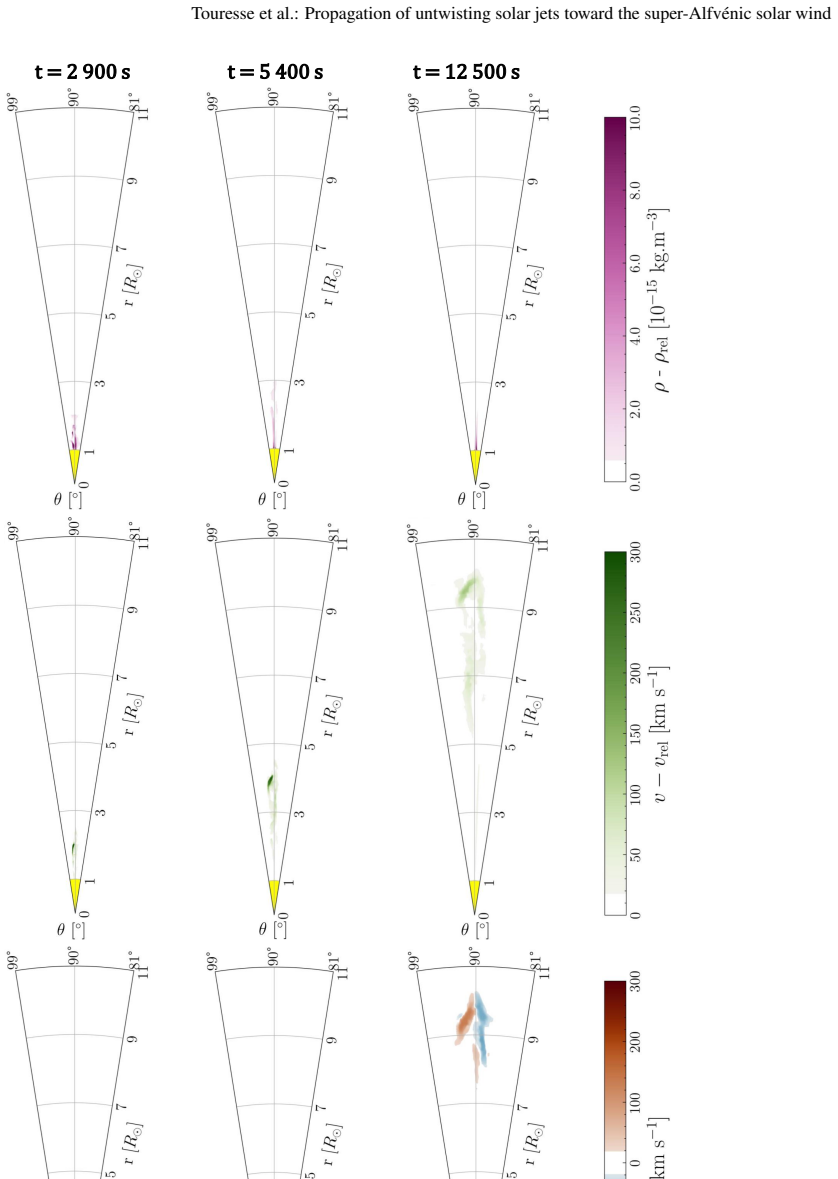
The paper's central claim is that a reconnection-driven coronal jet, modelled self-consistently by twisting an embedded magnetic polarity, launches an untwisting torsional Alfvén wave that propagates from the low-β corona through the sub-Alfvénic region and into the super-Alfvénic solar wind, where it reproduces the in situ switchback signature: a simultaneous rise in radial velocity, a drop of the radial magnetic field to about half its ambient value, a corresponding rise in the transverse field, and total magnetic field strength variations below fifteen percent, with deflection angles reaching about 62 degrees. It further claims that the U-loops (local magnetic field reversals greater than 90 degrees) that appear during jet onset do not survive upward propagation: strong Lorentz forces in the low-β corona straighten them below about 1.1 solar radii. Hence jet-associated untwisting waves can explain the majority of switchbacks, which are deflections without full reversal, while full-reversal switchbacks would require a secondary steepening process acting on these jet-launched deflections.
Load-bearing premise
The results rest on ideal, isothermal magnetohydrodynamics with no energy equation and no kinetic or collisionless wave physics, so the fate of the untwisting wave beyond the Alfvén surface in a real, heated, collisionless wind could differ.
Editorial extensions
If this is right
- A jet-generated untwisting Alfvénic wave can cross the Alfvén surface and reach the super-Alfvénic wind while still carrying a coherent magnetic deflection.
- The synthetic in situ signature of the wave matches switchback statistics: nearly constant total field strength, a deep drop in the radial field, and a coincident radial velocity increase.
- U-loops born at the jet site are straightened by Lorentz forces in the low-β corona, so full-reversal switchbacks cannot be formed by directly advecting these loops outward.
- The leading wave's phase speed and its separation from the trailing dense jet decrease as the background plasma β increases across the three parametric runs.
- Observed full-reversal switchbacks, if they are jet-related at all, would require a secondary in situ mechanism such as wave steepening or shear to push the deflection past 90 degrees.
Reading between the lines
- A natural extension is to test whether smaller-scale jet-like events, such as jetlets and spicules, scale in the same way, since the authors note that large coronal jets may be too infrequent to explain all switchbacks.
- If the two-step scenario is correct, the rate of non-reversing switchbacks should correlate with jet activity in the connected coronal hole, while full-reversal events should preferentially appear where expansion or shear steepening is strong.
- The opposite radial trends of deflection angle in the medium-β and high-β runs hint that the Alfvén-speed gradient, rather than plasma β alone, controls whether the wave front steepens; a parametric scan that varies the Alfvén-speed profile while holding β fixed could separate these effects.
- Replacing the infinitely fast synthetic spacecraft with a realistic trajectory could either strengthen or dilute the switchback-like appearance of the signatures, depending on how the wave front is crossed relative to its rotation axis.
Signed reviews
Editorial analysis
A structured set of objections, weighed in public.
Referee Report
Summary. The paper uses three 3D isothermal MHD simulations with the ARMS code to model self-consistent coronal jets launched by photospheric twisting in a Parker solar wind atmosphere, with parameters chosen to produce low-, medium-, and high-plasma-beta profiles. It identifies two propagating structures in all runs, a leading torsional Alfvénic wave and a trailing dense plasma flow, and follows their evolution up to 15 R_sun. In the medium- and high-beta runs the wave crosses an Alfvén surface located at 6.8 and 4.6 R_sun, respectively, while the low-beta run remains sub-Alfvénic throughout the domain. The authors construct synthetic in situ measurements at the leading wave front and report switchback-like signatures: a simultaneous decrease in B_r, roughly constant |B| (variations below about 15%), an increase in transverse field, and a radial velocity enhancement, with deflection angles up to about 62 degrees. They do not find full-reversal switchbacks, and they show that U-shaped loops present at jet onset are straightened in the low-beta corona. They conclude that jet-induced untwisting waves can propagate into a super-Alfvénic wind and produce non-reversing switchback-like deflections, while full reversals require secondary in situ processes.
Significance. If the results hold, this is a valuable step in testing the solar-origin scenario for switchbacks: it is one of the first studies to generate a jet self-consistently and then propagate its Alfvénic untwisting wave through a region of super-Alfvénic flow, with synthetic diagnostics that are directly comparable to PSP and Solar Orbiter data. The parametric design, spanning different plasma-beta profiles, is a clear strength, and the finding that no full-reversal switchbacks are produced in any run is a concrete falsifiable statement that sharpens the debate between in situ and solar-origin formation mechanisms. The paper also gives credit to earlier work (Pariat et al. 2016, Karpen et al. 2017, Roberts et al. 2018) and extends it with the explicit Alfvén-surface crossing. The main claims are qualitative and mostly robust across the three simulations, although the quantitative deflection angles and the absence of full reversals need to be evaluated against two modeling caveats discussed below.
major comments (2)
- [Sect. 2.2.3, Fig. 4; Sect. 5.2] The Alfvén surface positions in the two runs that claim super-Alfvénic propagation (r_A ≈ 6.8 R_sun in Mβ and r_A ≈ 4.6 R_sun in Hβ) are at the very low end of, or below, typical inner-heliosphere estimates, which lie around 10–20 R_sun. The Lβ run is sub-Alfvénic throughout the domain. Since the paper's central claim is that jet untwisting waves propagate into the super-Alfvénic wind, this is a load-bearing point: the authors have demonstrated propagation through an Alfvén surface, but not through a surface at a realistic location. The background sensitivity shown in their own Fig. 14 (deflection angle increases with radius in Hβ but decreases in Mβ) indicates that the behavior is not easily extrapolated to a farther Alfvén surface. Section 5.2 lists several model limitations but does not mention this one. I request that the authors either add a simulation with a more realistic Alfvén radius (e.g., higher background field or lower temperature), or explicitly qualify the headline claim as conditional on the chosen atmospheres and provide a physical argument that the location of the Alfvén surface should not change the qualitative outcome.
- [Sect. 2.1; Sect. 3.1; Sect. 4] No convergence or resolution study is presented. The AMR configuration is described in Sect. 2.1, but there is no test of the sensitivity of the leading Alfvénic wave structure, the quoted deflection angles (e.g., 62° in Fig. 13), or the straightening of U-loops to the maximum refinement level. The straightening of U-loops is a key negative result of the paper, and the conclusion that Lorentz forces immediately remove the inversion could be influenced by numerical diffusion if the grid is too coarse to resolve the relevant thin structures. I recommend either performing a resolution test on one representative case (e.g., Hβ) or clearly stating the spatial scales of the wave and the U-loop relative to the cell size at the relevant radii, together with a justification that the main results are insensitive to the remaining resolution. This will make the quantitative claims more robust.
minor comments (5)
- [Abstract and Sect. 5.1] The conclusion states that the results 'may explain the absence of full reversal SBs in the sub-Alfvénic wind', but the simulations show no full reversals in the super-Alfvénic regions either; the phrasing should be clarified to say that full reversals are absent in all simulated regions.
- [Sect. 5.1] The summary states that the deflection angle 'ranges from 17° to 67°', but the values explicitly quoted in the text are 31°, 36°, 38°, 42°, and 62°; the 17° value does not appear to be tied to a specific figure or simulation, so the source or criterion for the lower bound should be given.
- [Sect. 4, Fig. 12] The synthetic in situ sampling assumes an 'infinite speed' spacecraft moving along a single angular coordinate. This is acknowledged, but the paper does not discuss how the finite speed and the time evolution of the wave during a realistic crossing could alter the apparent deflection angle and the simultaneity of the B and V enhancements; a brief assessment of the magnitude of this effect would help calibrate the quantitative comparison to PSP data.
- [Sect. 2.2.1, Eq. (2)] The text says that the density profile is consistent with vr ∝ ln(r)^1/2, but the Parker solution has a more complex logarithmic dependence; the asymptotic form is fine, but the phrasing should be more precise to avoid implying an exact equality.
- [General] Minor typographical issues appear throughout, such as inconsistent spacing in 'V .' and 'K17' in the references list; a careful proofread is recommended.
Circularity Check
No significant circularity: the switchback-like criteria are independent observational definitions checked against simulation output, not fitted inputs.
full rationale
The paper's central chain is self-contained: it solves ideal MHD with a hand-chosen Parker background (Sect. 2.2.1), self-consistently generates jets via boundary shearing (Sect. 2.3.2), and then compares the resulting torsional Alfvénic wave against switchback criteria taken from independent PSP-era studies (Dudok de Wit et al. 2020; Larosa et al. 2021). The deflection angles, |B|/|B_SW| below about 1.12, Br depletion, and simultaneous vr increase are outputs read from the simulation, not parameters fitted to switchback data. The Parker-wind parameters (Tb, Pb, Bm) are chosen to span plasma-β regimes, not to reproduce any switchback statistic. The only mild dependence is the paper's adoption of the Pariat et al. (2009)/K17 jet-formation model and Roberts et al. (2018) interpretation, but those works supply the mechanism and the identification of the untwisting wave; the present paper's super-Alfvénic propagation and SB-like signature analysis are new checks, not restatements. Section 5.2 openly lists model limitations: uniform isothermal Parker wind, no energy equation, neglect of kinetic and collisionless effects, and idealized infinite-speed spacecraft trajectories. These limitations affect realism and external validity but do not introduce a circular loop: nothing in the simulation is defined in terms of the switchback quantities it aims to compare, and no fitted parameter is renamed as a prediction. Hence no circular step.
Assumptions & free parameters
free parameters (5)
- Base temperature T_b =
1e6 K (Lβ), 2e6 K (Mβ/Hβ)
- Base pressure P_b =
2.75e-8, 3.30e-8, 5.00e-8 bar
- Background monopole field B_m =
-2.5, -2.0, -1.5 G
- Embedded dipole field B_d =
35 G
- Photospheric flow amplitude v0 =
20 or 25 x 10^12 cm^2 s^-1 G^-1
assumptions (5)
- domain assumption Ideal MHD with an isothermal equation of state (constant T, no energy equation) is adequate for jet propagation from 1 to 15 solar radii.
- domain assumption A magnetic monopole background plus an embedded dipole reproduces the open-field coronal hole topology relevant to jet events.
- domain assumption The isothermal Parker solar wind solution (Eq. 2) with hand-chosen T_b, P_b, B_m represents the ambient wind.
- domain assumption The ARMS/FCT scheme with the stated grid and AMR settings resolves the jet dynamics without significant numerical diffusion altering the results.
- domain assumption The single jet injection profile of Eq. (8) and one jet size are representative of the coronal jets that could seed switchbacks.
Cite this review
Pith. "Pith review of Propagation of untwisting solar jets from the low-beta corona into the super-Alfv\'enic wind: Testing a solar origin scenario for switchbacks." pith.science (2026). https://pith.science/paper/DIK7ZN2L
@misc{pith2026241215930,
  author       = {Pith},
  title        = {Pith review of: Propagation of untwisting solar jets from the low-beta corona into the super-Alfv\'enic wind: Testing a solar origin scenario for switchbacks},
  year         = {2026},
  howpublished = {\url{https://pith.science/paper/DIK7ZN2L}},
  note         = {Machine review of arXiv:2412.15930}
}
abstract
Parker Solar Probe's (PSP) discovery of the prevalence of switchbacks (SBs), localised magnetic deflections in the nascent solar wind, has sparked interest in uncovering their origins. A prominent theory suggests these SBs originate in the lower corona through magnetic reconnection processes, closely linked to solar jet phenomena. Jets are impulsive events, observed across scales and solar atmosphere layers, associated with the release of magnetic twist and helicity. This study examines whether self-consistent jets can form and propagate into the super-Alfv\'enic wind, assesses the impact of distinct Parker solar wind profiles on jet dynamics, and determines if jet-induced magnetic untwisting waves display signatures typical of SBs. We employed parametric 3D numerical MHD simulations using the ARMS code to model the self-consistent generation of solar jets. Our study focuses on the propagation of solar jets in distinct atmospheric plasma $\beta$ and Alfv\'en velocity profiles, including a Parker solar wind. Our findings show that self-consistent coronal jets can form and propagate into the super-Alfv\'enic wind. Notable structures such as the leading Alfv\'enic wave and trailing dense-jet region were consistently observed across diverse plasma $\beta$ atmospheres. The jet propagation dynamics are significantly influenced by atmospheric variations, with changes in Alfv\'en velocity profiles affecting the group velocity and propagation ratio of the leading and trailing structures. U-loops, prevalent at jet onset, do not persist in the low-$\beta$ corona, but magnetic untwisting waves associated with jets show SB-like signatures. However, full-reversal SBs were not observed. These findings may explain the absence of full reversal SBs in the sub-Alfv\'enic wind and illustrate the propagation of magnetic deflections through jet-like events, shedding light on possible SB formation processes.
Figures


Figures from the paper (10 more)




Forward citations
Cited by 1 Pith paper
-
Evolution and Impact of Switchbacks Throughout the Heliosphere
Switchbacks grow under expansion then erode by multiple processes, contributing free energy to solar-wind turbulence, heating, acceleration and particle transport.
Reference graph
Works this paper leans on
-
[1]
2021, A&A, 650, A4
Akhavan-Tafti, M., Kasper, J., Huang, J., & Bale, S. 2021, A&A, 650, A4
2021
-
[2]
2022, ApJ, 937, L39
Akhavan-Tafti, M., Kasper, J., Huang, J., & Thomas, L. 2022, ApJ, 937, L39
2022
-
[3]
2020, A&A, 642, A10
Antonucci, E., Romoli, M., Andretta, V ., et al. 2020, A&A, 642, A10
2020
-
[4]
& Hood, A
Archontis, V . & Hood, A. W. 2013, The Astrophysical Journal Letters, 769, L21
2013
-
[5]
2010, Astronomy and Astro- physics, 512, L2
Archontis, V ., Tsinganos, K., & Gontikakis, C. 2010, Astronomy and Astro- physics, 512, L2
2010
-
[6]
D., Badman, S
Bale, S. D., Badman, S. T., Bonnell, J. W., et al. 2019, Nature, 576, 237
2019
-
[7]
D., Drake, J
Bale, S. D., Drake, J. F., McManus, M. D., et al. 2023, Nature, 618, 252
2023
-
[8]
D., Goetz, K., Harvey, P
Bale, S. D., Goetz, K., Harvey, P. R., et al. 2016, Space Sci. Rev., 204, 49
2016
Show all 102 references
-
[9]
H., McComas, D
Bandyopadhyay, R., Matthaeus, W. H., McComas, D. J., et al. 2022, The Astro- physical Journal Letters, 926, L1
2022
-
[10]
2023, ApJ, 958, 23
Bizien, N., Dudok de Wit, T., Froment, C., et al. 2023, ApJ, 958, 23
2023
-
[11]
S., & Velli, M
Bizien, N., Froment, C., Dudok de Wit, T., Madjarska, M. S., & Velli, M. 2024, A&A, submitted
2024
-
[12]
2022, The Astrophysical Journal, 937, 91
Chen, F., Rempel, M., & Fan, Y . 2022, The Astrophysical Journal, 937, 91
2022
-
[13]
D., Ran, H., et al
Cheng, W., Liu, Y . D., Ran, H., et al. 2024, The Astrophysical Journal, 967, 58
2024
-
[14]
R., Chhiber, R., Gilly, C
Cranmer, S. R., Chhiber, R., Gilly, C. R., et al. 2023, Solar Physics, 298, 126 de Pablos, D., Samanta, T., Badman, S. T., et al. 2022, Sol. Phys., 297, 90
2023
-
[15]
2022, in 2022 IEEE Aerospace Con- ference, 1–11 DeV ore, C
Deforest, C., Killough, R., Gibson, S., et al. 2022, in 2022 IEEE Aerospace Con- ference, 1–11 DeV ore, C. R. 1991, Journal of Computational Physics, 92, 142 DeV ore, C. R. & Antiochos, S. K. 2008, ApJ, 680, 740
2022
-
[16]
F., Scullion, E., et al
Doyle, L., Wyper, P. F., Scullion, E., et al. 2019, The Astrophysical Journal, 887, 246
2019
-
[17]
F., Agapitov, O., Swisdak, M., et al
Drake, J. F., Agapitov, O., Swisdak, M., et al. 2021, Astronomy & Astrophysics, 650, A2 Dudok de Wit, T., Krasnoselskikh, V . V ., Bale, S. D., et al. 2020, ApJS, 246, 39
2021
-
[18]
Fang, F., Fan, Y ., & Mcintosh, S. W. 2014, The Astrophysical Journal Letters, 789, L19
2014
-
[19]
P., et al
Fargette, N., Lavraud, B., Rouillard, A. P., et al. 2021, The Astrophysical Journal, 919, 96
2021
-
[20]
Fisk, L. A. & Kasper, J. C. 2020, ApJ, 894, L4
2020
-
[21]
J., Velli, M
Fox, N. J., Velli, M. C., Bale, S. D., et al. 2016, Space Science Reviews, 204, 7 García Marirrodriga, C., Pacros, A., Strandmoe, S., et al. 2021, A&A, 646, A121 González-Avilés, J. J., Murawski, K., Srivastava, A. K., Zaqarashvili, T. V ., & González-Esparza, J. A. 2021, Mont...
2016
-
[22]
T., McComas, D
Gosling, J. T., McComas, D. J., Roberts, D. A., & Skoug, R. M. 2009, ApJ, 695, L213
2009
-
[23]
2018, The Astrophysical Journal, 860, 142
Hanaoka, Y ., Hasuo, R., Hirose, T., et al. 2018, The Astrophysical Journal, 860, 142
2018
-
[24]
Holst, B. v. d., Sokolov, I. V ., Meng, X., et al. 2014, The Astrophysical Journal, 782, 81
2014
-
[25]
P., He, J., et al
Hou, C., Rouillard, A. P., He, J., et al. 2024, ApJ, 968, L28
2024
-
[26]
2023, The Astrophysical Journal Letters, 946, L17
Huang, N., D’Anna, S., & Wang, H. 2023, The Astrophysical Journal Letters, 946, L17
2023
-
[27]
2023, The Astrophysical Jour- nal Letters, 951, L47
Iijima, H., Matsumoto, T., Hotta, H., & Imada, S. 2023, The Astrophysical Jour- nal Letters, 951, L47
2023
-
[28]
K., Raouafi, N
Jagarlamudi, V . K., Raouafi, N. E., Bourouaine, S., et al. 2023, The Astrophysical Journal Letters, 950, L7
2023
-
[29]
2022, Physics of Plasmas, 29, 072902
Johnston, Z., Squire, J., Mallet, A., & Meyrand, R. 2022, Physics of Plasmas, 29, 072902
2022
-
[30]
2020, A&A, 639, A22
Joshi, R., Chandra, R., Schmieder, B., et al. 2020, A&A, 639, A22
2020
-
[31]
T., DeV ore, C
Karpen, J. T., DeV ore, C. R., Antiochos, S. K., & Pariat, E. 2017, The Astro- physical Journal, 834, 62, 29 pages including 12 figures
2017
-
[32]
C., Abiad, R., Austin, G., et al
Kasper, J. C., Abiad, R., Austin, G., et al. 2016, Space Sci. Rev., 204, 131
2016
-
[33]
C., Bale, S
Kasper, J. C., Bale, S. D., Belcher, J. W., et al. 2019, Nature, 576, 228
2019
-
[34]
& Goedbloed, J
Keppens, R. & Goedbloed, J. P. 1999, A&A, 343, 251
1999
-
[35]
T., Antiochos, S
Kumar, P., Karpen, J. T., Antiochos, S. K., et al. 2019, ApJ, 873, 93
2019
-
[36]
T., Uritsky, V
Kumar, P., Karpen, J. T., Uritsky, V . M., et al. 2022, The Astrophysical Journal, 933, 21
2022
-
[37]
T., Uritsky, V
Kumar, P., Karpen, J. T., Uritsky, V . M., et al. 2023, The Astrophysical Journal Letters, 951, L15
2023
-
[38]
2006, Geophys
Landi, S., Hellinger, P., & Velli, M. 2006, Geophys. Res. Lett., 33, L14101
2006
-
[39]
2021, A&A, 650, A3
Larosa, A., Krasnoselskikh, V ., Dudok de Wit, T., et al. 2021, A&A, 650, A3
2021
-
[40]
J., Archontis, V ., & Hood, A
Lee, E. J., Archontis, V ., & Hood, A. W. 2015, The Astrophysical Journal Letters, 798, L10
2015
-
[41]
2024, ApJ, 963, 79
Lee, J., Wang, H., Wang, J., & Wang, M. 2024, ApJ, 963, 79
2024
-
[42]
& Yang, J
Li, H. & Yang, J. 2019, ApJ, 872, 87
2019
-
[43]
2020, Astronomy & Astrophysics, 636, A41
Linan, L., Pariat, É., Aulanier, G., Moraitis, K., & Valori, G. 2020, Astronomy & Astrophysics, 636, A41
2020
-
[44]
A., & Miki´c, Z
Lionello, R., Linker, J. A., & Miki´c, Z. 2009, ApJ, 690, 902
2009
-
[45]
S., et al
Lionello, R., Török, T., Titov, V . S., et al. 2016, The Astrophysical Journal Let- ters, 831, L2
2016
-
[46]
2016, ApJ, 833, 150
Liu, J., Wang, Y ., Erdélyi, R., et al. 2016, ApJ, 833, 150
2016
-
[47]
Longcope, D. W. 2005, Living Reviews in Solar Physics, 2, 7
2005
-
[48]
J., Palmerio, E., DeV ore, C
Lynch, B. J., Palmerio, E., DeV ore, C. R., et al. 2021, ApJ, 914, 39
2021
-
[49]
M., Mobarry, C., de Fainchtein, R., & Packer, C
MacNeice, P., Olson, K. M., Mobarry, C., de Fainchtein, R., & Packer, C. 2000, Computer Physics Communications, 126, 330
2000
-
[50]
K., & DeV ore, C
Masson, S., Antiochos, S. K., & DeV ore, C. R. 2013, ApJ, 771, 82
2013
-
[51]
S., Neugebauer, M., & Goldstein, B
Matteini, L., Horbury, T. S., Neugebauer, M., & Goldstein, B. E. 2014, Geophys- ical Research Letters, 41, 259
2014
-
[52]
& Yokoyama, T
Miyagoshi, T. & Yokoyama, T. 2003, The Astrophysical Journal, 593, L133
2003
-
[53]
& Yokoyama, T
Miyagoshi, T. & Yokoyama, T. 2004, The Astrophysical Journal, 614, 1042
2004
-
[54]
L., Sterling, A
Moore, R. L., Sterling, A. C., & Falconer, D. A. 2015, The Astrophysical Journal, 806, 11
2015
-
[55]
2008, The Astrophysical Journal, 673, L211
Moreno-Insertis, F., Galsgaard, K., & Ugarte-Urra, I. 2008, The Astrophysical Journal, 673, L211
2008
-
[56]
J., Srivastava, A
Morton, R. J., Srivastava, A. K., & Erdélyi, R. 2012, A&A, 542, A70 Müller, D., St. Cyr, O. C., Zouganelis, I., et al. 2020, A&A, 642, A1
2012
-
[57]
2012, The Astrophysical Journal, 750, 50
Neugebauer, M. 2012, The Astrophysical Journal, 750, 50
2012
-
[58]
E., McComas, D
Neugebauer, M., Goldstein, B. E., McComas, D. J., Suess, S. T., & Balogh, A. 1995, Journal of Geophysical Research: Space Physics, 100, 23389
1995
-
[59]
Nishizuka, N., Nakamura, T., Kawate, T., Singh, K. A. P., & Shibata, K. 2011, The Astrophysical Journal, 731, 43 Nisticò, G., Bothmer, V ., Patsourakos, S., & Zimbardo, G. 2009, Solar Physics, 259, 87 , (c) 2009: The Author(s)
2011
-
[60]
F., Pontin, D
Pallister, R., Wyper, P. F., Pontin, D. I., DeV ore, C. R., & Chiti, F. 2021, The Astrophysical Journal, 923, 163
2021
-
[61]
2021, Space Sci
Parenti, S., Chifu, I., Del Zanna, G., et al. 2021, Space Sci. Rev., 217, 78
2021
-
[62]
K., & DeV ore, C
Pariat, E., Antiochos, S. K., & DeV ore, C. R. 2009, The Astrophysical Journal, 691, 61
2009
-
[63]
R., Antiochos, S
Pariat, E., Dalmasse, K., DeV ore, C. R., Antiochos, S. K., & Karpen, J. T. 2015, Astronomy and Astrophysics, 573, A130
2015
-
[64]
R., Antiochos, S
Pariat, E., Dalmasse, K., DeV ore, C. R., Antiochos, S. K., & Karpen, J. T. 2016, Astronomy and Astrophysics, 596, A36
2016
-
[65]
Parker, E. N. 1958, ApJ, 128, 664
1958
-
[66]
K., & Wuelser, J
Patsourakos, S., Pariat, E., V ourlidas, A., Antiochos, S. K., & Wuelser, J. P. 2008, The Astrophysical Journal, 680, L73
2008
-
[67]
C., & Romoli, M
Pucci, S., Poletto, G., Sterling, A. C., & Romoli, M. 2013, The Astrophysical Journal, 776, 16
2013
-
[68]
E., Matteini, L., Squire, J., et al
Raouafi, N. E., Matteini, L., Squire, J., et al. 2023, Space Science Reviews, 219, 8
2023
-
[69]
E., Patsourakos, S., Pariat, E., et al
Raouafi, N. E., Patsourakos, S., Pariat, E., et al. 2016, Space Science Reviews, 201, 1
2016
-
[70]
E., Petrie, G
Raouafi, N. E., Petrie, G. J. D., Norton, A. A., Henney, C. J., & Solanki, S. K. 2008, The Astrophysical Journal, 682, L137
2008
-
[71]
& Stenborg, G
Raouafi, N.-E. & Stenborg, G. 2014, The Astrophysical Journal, 787, 118
2014
-
[72]
A., Uritsky, V
Roberts, M. A., Uritsky, V . M., DeV ore, C. R., & Karpen, J. T. 2018, The Astro- physical Journal, 866, 14
2018
-
[73]
H., Chhiber, R., et al
Ruffolo, D., Matthaeus, W. H., Chhiber, R., et al. 2020, ApJ, 902, 94
2020
-
[74]
E., et al
Savcheva, A., Cirtain, J., DeLuca, E. E., et al. 2007, Publications of the Astro- nomical Society of Japan, 59, S771
2007
-
[75]
2013, A&A, 559, A1
Schmieder, B., Guo, Y ., Moreno-Insertis, F., et al. 2013, A&A, 559, A1
2013
-
[76]
R., Walters, J
Sheeley, N. R., Walters, J. H., Wang, Y . M., & Howard, R. A. 1999, J. Geo- phys. Res., 104, 24739
1999
-
[77]
2021, Proceedings of the Royal Society A, 477, 20200217
Shen, Y . 2021, Proceedings of the Royal Society A, 477, 20200217
2021
-
[78]
2001, The Astrophysical Journal, 550, 1051
Shimojo, M., Shibata, K., Yokoyama, T., & Hori, K. 2001, The Astrophysical Journal, 550, 1051
2001
-
[79]
& Tsuneta, S
Shimojo, M. & Tsuneta, S. 2009, The Astrophysical Journal, 706, L145
2009
-
[80]
Shoda, M., Chandran, B. D. G., & Cranmer, S. R. 2021, The Astrophysical Jour- nal, 915, 52
2021
-
[81]
J., et al
Skirvin, S., Verth, G., González-Avilés, J. J., et al. 2023, Advances in Space Research, 71, 1866
2023
-
[82]
Squire, J., Chandran, B. D. G., & Meyrand, R. 2020, The Astrophysical Journal, 891, L2
2020
-
[83]
2022, Physics of Plasmas, 29, 112903
Squire, J., Johnston, Z., Mallet, A., & Meyrand, R. 2022, Physics of Plasmas, 29, 112903
2022
-
[84]
Sterling, A. C. & Moore, R. L. 2020, The Astrophysical Journal Letters, 896, L18
2020
-
[85]
Szente, J., Toth, G., IV , W. B. M., et al. 2017, The Astrophysical Journal, 834, 123
2017
-
[86]
P., Sorriso-Valvo, L., et al
Telloni, D., Zank, G. P., Sorriso-Valvo, L., et al. 2022, The Astrophysical Journal, 935, 112
2022
-
[87]
Toth, G., Velli, M., & Holst, B. v. d. 2023, The Astrophysical Journal, 957, 95
2023
-
[88]
2023, Space Sci
Tziotziou, K., Scullion, E., Shelyag, S., et al. 2023, Space Sci. Rev., 219, 1
2023
-
[89]
M., Roberts, M
Uritsky, V . M., Roberts, M. A., DeV ore, C. R., & Karpen, J. T. 2017, The Astro- physical Journal, 837, 123
2017
-
[90]
G., & Maruca, B
Verscharen, D., Klein, K. G., & Maruca, B. A. 2019, Living Reviews in Solar Physics, 16, 5
2019
-
[91]
R., Howard, R
Wang, Y .-M., Sheeley, N. R., Howard, R. A., et al. 1998, The Astrophysical Journal, 508, 899 Article number, page 17 of 24 A&A proofs: manuscript no. main
1998
-
[92]
J., Seaton, D
West, M. J., Seaton, D. B., Wexler, D. B., et al. 2023, Solar Physics, 298, 78
2023
-
[93]
F., Antiochos, S
Wyper, P. F., Antiochos, S. K., & DeV ore, C. R. 2017, Nature, 544, 452
2017
-
[94]
Wyper, P. F. & DeV ore, C. R. 2016, The Astrophysical Journal, 820, 77
2016
-
[95]
F., DeV ore, C
Wyper, P. F., DeV ore, C. R., & Antiochos, S. K. 2018, The Astrophysical Journal, 852, 98
2018
-
[96]
F., DeV ore, C
Wyper, P. F., DeV ore, C. R., & Antiochos, S. K. 2019, Monthly Notices of the Royal Astronomical Society, 490, 3679
2019
-
[97]
F., DeV ore, C
Wyper, P. F., DeV ore, C. R., Antiochos, S. K., et al. 2022, The Astrophysical Journal Letters, 941, L29
2022
-
[98]
T., Steinberg, J
Yamauchi, Y ., Suess, S. T., Steinberg, J. T., & Sakurai, T. 2004, Journal of Geo- physical Research (Space Physics), 109, A03104
2004
-
[99]
& Shibata, K
Yokoyama, T. & Shibata, K. 1995, Nature, 375, 42
1995
-
[100]
& Shibata, K
Yokoyama, T. & Shibata, K. 1996, Publications of the Astronomical Society of Japan, 48, 353
1996
-
[101]
2023, The Astrophysical Journal, 949, 2
Zhu, J., Guo, Y ., Ding, M., & Schmieder, B. 2023, The Astrophysical Journal, 949, 2
2023
-
[102]
2016, in 41st COSPAR Scientific Assembly, V ol
Zhukov, A. 2016, in 41st COSPAR Scientific Assembly, V ol. 41, D2.2–4–16 Article number, page 18 of 24 Touresse et al.: Propagation of untwisting solar jets toward the super-Alfvénic solar wind t = 2 900 s t = 5 400 s t = 12 500 s Fig. 9. 2D cuts atϕ = 0◦ of the evolution of s...
2016
Reviewed August 11, 2026 · model on record in the stance chip above.
Discussion (0). Continue with ORCID to comment.