REVIEW 3 major objections 5 minor 38 references
Never Reset Again: A Mathematical Framework for Continual Inference in Recurrent Neural Networks
T0 review · 3 major / 5 minor · reviewed 2026-08-11 · deepseek-v4-flash
Pith's one-line read A dual cross-entropy/KL loss lets recurrent networks process extended streams with no hidden-state resets, matching periodic-reset performance across four RNN families.
desk verdict A useful empirical loss for reset-free continual inference, but the paper's claim of a mathematical proof of saturation prevention is not supported by the text. read the letter →
The pith
A machine-rendered reading of the paper's core claim, the machinery that carries it, and where it could break.
The reading
What carries the argument
The carrying mechanism is the dual-objective loss of Eq. (9), a time-masked sum of categorical cross-entropy (for informative steps, $m_t=1$) and KL divergence toward the uniform distribution (for noise steps, $m_t=0$). The KL term acts as a 'soft reset': it flattens the output distribution, which the paper argues prevents the hidden state from accumulating information to the point of saturation, while preserving gradient flow. The supporting theoretical analysis in the appendix formalizes saturation as fixed-point convergence and vanishing mutual information $I(x_t; h_t | X_{0:t-1}) \to 0$, and shows how the proposed objective counteracts both mechanisms.
What would settle it
On a network trained with the proposed loss, feed a stream where the temporal-intensity mask is deliberately miscalibrated—for example, set $m_t=1$ on all frames of pure silence or noise with high variance. If accuracy on a subsequent real sample degrades as steeply as the plain cross-entropy baseline, the reset-free behavior is an artifact of the mask rather than of the KL term; if accuracy stays high, the loss itself carries the reset-free property.
Extended reading notes
Core claim
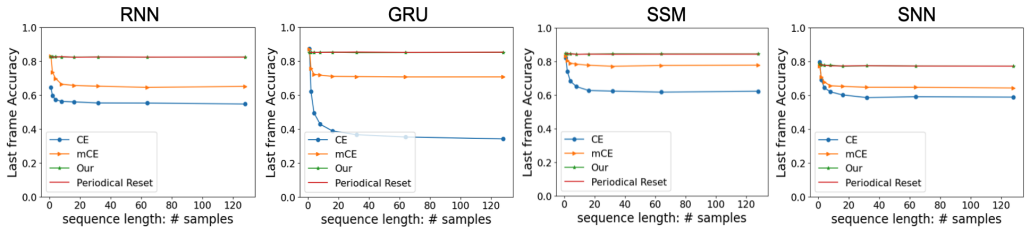
The central claim is that state saturation during continual inference is a loss-level problem, not a state-level one, and can be avoided without resetting hidden states. On each time step a binary mask $m_t$ decides whether the input is informative; the total loss is $L_{\text{total}} = \sum_t \left[ m_t L_{\text{CE}}(t) + (1 - m_t) L_{\text{KL}}(t) \right]$, where $L_{\text{CE}}$ is cross-entropy with the target label and $L_{\text{KL}}$ is the Kullback-Leibler divergence of the network's output distribution toward the uniform distribution over classes. The KL gradient shapes the recurrent dynamics so that extended exposure to noise drives output probabilities to maximum uncertainty while the hidden state evolves smoothly, preventing the information accumulation that produces saturation. On concatenated sequences up to 128 samples (more than 10,000 time steps), the proposed loss keeps last-frame accuracy at 86.7% on sequential Fashion-MNIST versus 84.8% for masked cross-entropy, and matches periodic-reset accuracy on Google Speech Commands across RNN, GRU, SSM, and SNN architectures.
Load-bearing premise
The method requires a binary mask $m_t$ at every time step that correctly distinguishes informative input from noise; when the mask comes from heuristic input statistics (as it must in real streams), any miscalibration directly changes the training objective, and without a trustworthy mask the reset-free guarantee has no handle.
Editorial extensions
If this is right
- Streaming systems can drop reset scheduling entirely; the network only needs a per-frame mask that separates signal from noise.
- The same training recipe applies across architecture families, so reset-free continual inference is a property of the objective, not of a particular RNN variant.
- Long-horizon accuracy degrades far less with the proposed loss than with masked cross-entropy: on sequential Fashion-MNIST, the drop from 1 to 128 concatenated sequences is -1.74% (detach) and -1.57% (reset), versus -3.72% and -11.89% for masked CE.
- Masking function design becomes a first-order factor: temporal-intensity masking maintains performance over 128 samples (-0.42% drop), while energy-based masking degrades more (-2.49%).
Reading between the lines
- If the KL term truly prevents saturation, hidden-state statistics (norm, effective rank, or mutual information with recent input) should remain bounded over arbitrarily long noise streams; the paper does not report such measurements, so this is a direct testable consequence of its mechanism.
- The mask is the main practical bottleneck: in settings without a reliable saliency signal, the method reduces to choosing between always-KL and always-CE, so learning the mask from data (e.g., with an auxiliary saliency predictor) is a natural next step that the paper itself lists as future work.
- Because transformer LLMs cache key-value states during generation and exhibit analogous long-context degradation, a loss-level 'soft reset' of output uncertainty might transfer to long-context inference, though that extension is speculative and not evaluated here.
- The KL-to-uniform regularizer is essentially confidence regularization toward maximum entropy; one cross-check would be to measure output entropy on out-of-domain noise, predicting near-uniform outputs when the mask is correct.
Editorial analysis
A structured set of objections, weighed in public.
Referee Report
Summary. The paper proposes a loss function for training RNNs to perform continual inference without hidden-state resets. The loss combines categorical cross-entropy on informative timesteps with KL divergence toward a uniform distribution on noise timesteps, gated by a binary mask m_t. The authors claim that this loss prevents hidden-state saturation and therefore eliminates the need for state resets, and they support the claim with experiments on Sequential Fashion-MNIST and Google Speech Commands v2 across RNN, GRU, SSM, and SNN architectures, reporting accuracies for sequence lengths up to 128 concatenated samples.
Significance. If the theoretical claims were supported, the contribution would be significant for streaming inference with recurrent models: reset-free operation would remove synchronization requirements and reduce inference-time overhead. The empirical comparison is a genuine strength: the authors evaluate four recurrent architecture families, report means and standard deviations over three runs, and compare two masking strategies (temporal-intensity and energy-based), which is informative for practitioners. However, the central theoretical claim—that the KL term provably prevents state saturation—is not established in the manuscript; the paper is better described as an empirical study of an output-distribution-regularizing loss. The reported results support at most parity with periodic resetting, not the abstract's claim of outperformance.
major comments (3)
- [Section III and Appendix A] The second listed contribution ("a mathematical analysis demonstrating saturation prevention") is not present. Appendix A (Eqs. 12-21) characterizes saturation for linear and tanh RNNs, but it never invokes the proposed total loss L_total from Eq. (9). No gradient ∂L_total/∂h_t is computed, no bound on ||h_t|| or on the distance to the fixed points/attractors of Eqs. (15) and (19) is proven, and no analysis shows that minimizing D_KL(p_t ‖ u) on masked timesteps affects the recurrent state trajectory. Because the KL term acts on the output distribution p_t = softmax(W_o h_t + b_o), it could in principle be minimized by changing only the output layer (e.g., making W_o small), leaving the hidden-state dynamics unchanged. The abstract and contribution list therefore overstate what is derived; either the analysis must be supplied or the claim must be downgraded to an empirical observation.
- [Abstract, Table I, Table III] The claim that the reset-free approach 'outperforms traditional reset-based methods' is not supported by the reported data. In Table I, in the 'train w/ Reset' configuration, the periodic-reset baseline achieves 85.69% last-frame accuracy at length 1 and 85.63% at length 128, whereas the proposed loss achieves 82.64% and 81.07%, respectively; periodic reset is strictly better throughout. In Table III, with temporal-intensity masking on GSCv2, the periodic-reset baseline (87.61%→87.27%) is not worse than the proposed method (87.61%→87.19%) at 128 samples. The captions of Figures 5 and 6 also describe the proposed method as 'overlapping' with periodic reset. The results demonstrate parity, not superiority; the abstract, introduction, and discussion should be revised to state this accurately.
- [Section III, Section IV-B] The method assumes a reliable binary mask m_t at every time step. On Sequential Fashion-MNIST the mask is ground-truth segment labels (Section IV-A); on GSCv2 it is a hand-crafted statistic thresholded at θ=0.9 (Section IV-B and Fig. 3). The paper does not explain how such a mask would be obtained in a genuinely boundary-free streaming setting, nor how to set the threshold without access to validation labels. Since the loss cannot be applied when no mask is available, the claim of 'eliminating the need for resets' is contingent on an external informativeness signal that may be as hard to obtain as a reset boundary. The paper should state this as an explicit conditioning assumption rather than presenting the method as universally reset-free.
minor comments (5)
- [Abstract] The abstract contains a typo: 't our reset-free approach' should read 'Our reset-free approach'.
- [Section II-C] The passage 'we examine two within this dynamical systems 1' is grammatically incomplete; it should read 'we examine two properties within this dynamical-systems view'.
- [Equation (5)] The information-preservation criterion γ is introduced in Eq. (5) but is never used afterwards; please either connect it to the proposed loss or remove it to avoid a dangling definition.
- [Section IV-B] The threshold θ for the temporal-intensity mask is only defined in the caption of Fig. 3; it should be defined in the main text together with the smoothing constant τ.
- [Appendix A] The concluding sentence of Appendix A stating that reset mechanisms 'successfully prevent state saturation' is at odds with the paper's own Table I, where periodic reset suffers no accuracy degradation; please reword to avoid overstatement.
Circularity Check
No significant circularity: the proposed loss is a designed objective and the main results are empirical measurements over trained rollouts.
full rationale
The central claim is a designed training loss (Eq. 9), not a quantity derived from its own inputs. The loss combines masked cross-entropy and KL-to-uniform terms; the mask m_t is either ground-truth (FashionMNIST) or computed from input statistics (GSCv2), and hyperparameters such as tau, alpha, and theta are selected rather than derived from the claimed result. The reported continual-inference accuracies are measured from trained network rollouts, not algebraically forced by the loss definition. The Appendix A saturation analysis covers linear eigenvalue growth, tanh fixed points, and mutual-information decay, and it is independent of Eq. 9; although it does not itself prove that Eq. 9 prevents saturation, that is a missing justification rather than a circular reduction. Self-citations [8] and [17] are used as learning-method and baseline/mask references, not as load-bearing evidence for the main reset-free claim. Therefore no load-bearing step reduces by construction to its own inputs.
Assumptions & free parameters
free parameters (3)
- mask threshold theta (GSC) =
0.9
- TI smoothing time constant tau =
5
- energy smoothing factor alpha =
0.7
assumptions (4)
- domain assumption RNN state saturation causes progressive accuracy degradation on long sequences.
- ad hoc to paper A binary mask m_t can be reliably computed or provided for all timesteps.
- ad hoc to paper Minimizing KL divergence to a uniform distribution for masked steps prevents overconfident outputs and supports continual inference.
- standard math Standard linear and nonlinear RNN dynamics analysis in Appendix A applies.
Cite this review
Pith. "Pith review of Never Reset Again: A Mathematical Framework for Continual Inference in Recurrent Neural Networks." pith.science (2026). https://pith.science/paper/NOQCEUFI
@misc{pith2026241215983,
  author       = {Pith},
  title        = {Pith review of: Never Reset Again: A Mathematical Framework for Continual Inference in Recurrent Neural Networks},
  year         = {2026},
  howpublished = {\url{https://pith.science/paper/NOQCEUFI}},
  note         = {Machine review of arXiv:2412.15983}
}
read the original abstract
Recurrent Neural Networks (RNNs) are widely used for sequential processing but face fundamental limitations with continual inference due to state saturation, requiring disruptive hidden state resets. However, reset-based methods impose synchronization requirements with input boundaries and increase computational costs at inference. To address this, we propose an adaptive loss function that eliminates the need for resets during inference while preserving high accuracy over extended sequences. By combining cross-entropy and Kullback-Leibler divergence, the loss dynamically modulates the gradient based on input informativeness, allowing the network to differentiate meaningful data from noise and maintain stable representations over time. Experimental results demonstrate that our reset-free approach outperforms traditional reset-based methods when applied to a variety of RNNs, particularly in continual tasks, enhancing both the theoretical and practical capabilities of RNNs for streaming applications.
Figures


Figures from the paper (2 more)

Reference graph
Works this paper leans on
-
[1]
Finding structure in time,
J. L. Elman, “Finding structure in time,” Cognitive science , vol. 14, no. 2, pp. 179–211, 1990
1990
-
[2]
Neural networks and physical systems with emergent collective computational abilities,
J. J. Hopfield, “Neural networks and physical systems with emergent collective computational abilities,” Proceedings of the national academy of sciences, vol. 79, no. 8, pp. 2554–2558, 1982
work page 1982
-
[3]
Learning phrase representations using rnn encoder-decoder for statistical machine translation,
K. Cho, B. Van Merri ¨enboer, C. Gulcehre, D. Bahdanau, F. Bougares, H. Schwenk, and Y . Bengio, “Learning phrase representations using rnn encoder-decoder for statistical machine translation,” arXiv preprint arXiv:1406.1078, 2014
arXiv 2014
-
[4]
Efficiently modeling long sequences with structured state spaces,
A. Gu, C. Gulcehre, T. Paine, M. Hoffman, and R. Pascanu, “Efficiently modeling long sequences with structured state spaces,” arXiv preprint arXiv:2111.00396, 2021
arXiv 2021
-
[5]
Resurrecting recurrent neural networks for long sequences,
A. Orvieto, S. L. Smith, A. Gu, A. Fernando, C. Gulcehre, R. Pascanu, and S. De, “Resurrecting recurrent neural networks for long sequences,” in International Conference on Machine Learning . PMLR, 2023, pp. 26 670–26 698
2023
-
[6]
Simplified state space layers for sequence modeling,
J. T. Smith, A. Warrington, and S. W. Linderman, “Simplified state space layers for sequence modeling,” arXiv preprint arXiv:2208.04933 , 2022
arXiv 2022
-
[7]
Surrogate gradient learning in spiking neural networks,
E. O. Neftci, H. Mostafa, and F. Zenke, “Surrogate gradient learning in spiking neural networks,” IEEE Signal Processing Magazine , vol. 36, no. 6, pp. 51–63, 2019
work page 2019
-
[8]
Accurate and efficient time-domain classification with adaptive spiking recurrent neural networks,
B. Yin, F. Corradi, and S. M. Boht ´e, “Accurate and efficient time-domain classification with adaptive spiking recurrent neural networks,” Nature Machine Intelligence, vol. 3, no. 10, pp. 905–913, 2021
2021
Show all 38 references
-
[9]
Attention is all you need,
A. Vaswani, N. Shazeer, N. Parmar, J. Uszkoreit, L. Jones, A. N. Gomez, Ł. Kaiser, and I. Polosukhin, “Attention is all you need,” Advances in neural information processing systems , vol. 30, 2017
2017
-
[10]
Roberta: A robustly optimized bert pretraining approach,
Y . Liu, M. Ott, N. Goyal, J. Du, M. Joshi, D. Chen, O. Levy, M. Lewis, L. Zettlemoyer, and V . Stoyanov, “Roberta: A robustly optimized bert pretraining approach,” arXiv preprint arXiv:1907.11692 , 2019
1907 arXiv
-
[11]
Language mod- els are few-shot learners,
T. Brown, B. Mann, N. Ryder, M. Subbiah, J. D. Kaplan, P. Dhariwal, A. Neelakantan, P. Shyam, G. Sastry, A. Askell et al., “Language mod- els are few-shot learners,” Advances in neural information processing systems, vol. 33, pp. 1877–1901, 2020
1901
-
[12]
Formal language theory meets modern nlp,
W. Merrill, “Formal language theory meets modern nlp,” arXiv preprint arXiv:2102.10094, 2021
2021 arXiv
-
[13]
Stuffed mamba: State collapse and state capacity of rnn-based long-context modeling,
Y . Chen, X. Zhang, S. Hu, X. Han, Z. Liu, and M. Sun, “Stuffed mamba: State collapse and state capacity of rnn-based long-context modeling,” arXiv preprint arXiv:2410.07145 , 2024
2024
-
[14]
Computational capabilities of neural networks,
H. T. Siegelmann and E. D. Sontag, “Computational capabilities of neural networks,” Journal of computer and system sciences , vol. 50, no. 1, pp. 132–150, 1995
1995
-
[15]
Neural networks with recurrent operations for processing arbitrary-length sequences,
J. Chung and H. T. Siegelmann, “Neural networks with recurrent operations for processing arbitrary-length sequences,” Nature Machine Intelligence, vol. 3, no. 2, pp. 154–163, 2021
2021
-
[16]
Neural machine translation in linear time,
N. Kalchbrenner, L. Espeholt, K. Simonyan, A. v. d. Oord, A. Graves, and K. Kavukcuoglu, “Neural machine translation in linear time,” arXiv preprint arXiv:1610.10099, 2016
2016 arXiv
-
[17]
Attentive decision-making and dynamic resetting of continual running srnns for end-to-end streaming keyword spotting,
B. Yin, Q. Guo, F. Corradi, and S. Bohte, “Attentive decision-making and dynamic resetting of continual running srnns for end-to-end streaming keyword spotting,” in Proceedings of the International Conference on Neuromorphic Systems 2022 , 2022, pp. 1–8
2022
-
[18]
Long range arena: A benchmark for efficient transformers,
Y . Tay, M. Dehghani, D. Bahri, and D. Metzler, “Long range arena: A benchmark for efficient transformers,” arXiv preprint arXiv:2011.04006, 2020
2011 arXiv
-
[19]
Generative models of brain dynamics–a review,
M. R. Panahi, G. Abrevaya, J.-C. Gagnon-Audet, V . V oleti, I. Rish, and G. Dumas, “Generative models of brain dynamics–a review,” arXiv preprint arXiv:2112.12147, 2021
2021 arXiv
-
[20]
Reservoir memory machines as neural computers,
B. Paaßen, A. Schulz, T. C. Stewart, and B. Hammer, “Reservoir memory machines as neural computers,” IEEE Transactions on Neural Networks and Learning Systems , vol. 33, no. 6, pp. 2575–2585, 2021
2021
-
[21]
Catplayinginthesnow: Impact of prior segmentation on a model of visually grounded speech,
W. N. Havard, J.-P. Chevrot, and L. Besacier, “Catplayinginthesnow: Impact of prior segmentation on a model of visually grounded speech,” arXiv preprint arXiv:2006.08387 , 2020
2006 arXiv
-
[22]
Efficient modeling of long sequences with structured state spaces,
A. Gu, W. Johnson, K. Goel, K. Saab, T. Dao, A. Rudra, and C. R ´e, “Efficient modeling of long sequences with structured state spaces,” International Conference on Learning Representations , 2022
2022
-
[23]
Decou- pled kullback-leibler divergence loss,
J. Cui, Z. Tian, Z. Zhong, X. Qi, B. Yu, and H. Zhang, “Decou- pled kullback-leibler divergence loss,” arXiv preprint arXiv:2305.13948, 2023
2023 arXiv
-
[24]
On the difficulty of training re- current neural networks,
R. Pascanu, T. Mikolov, and Y . Bengio, “On the difficulty of training re- current neural networks,” International conference on machine learning, pp. 1310–1318, 2013
2013
-
[25]
Learning long-term dependencies with gradient descent is difficult,
Y . Bengio, P. Simard, and P. Frasconi, “Learning long-term dependencies with gradient descent is difficult,”IEEE transactions on neural networks, vol. 5, no. 2, pp. 157–166, 1994
1994
-
[26]
Learning to forget: Continual prediction with lstm,
F. A. Gers, J. Schmidhuber, and F. Cummins, “Learning to forget: Continual prediction with lstm,” Neural computation , vol. 12, no. 10, pp. 2451–2471, 2000
2000
-
[27]
Surprisal-driven feedback in recurrent networks,
K. M. Rocki, “Surprisal-driven feedback in recurrent networks,” arXiv preprint arXiv:1608.06027, 2016
2016 arXiv
-
[28]
Reading selectively via binary input gated recurrent unit
Z. Li, P. Wang, H. Lu, and J. Cheng, “Reading selectively via binary input gated recurrent unit.” in IJCAI, 2019, pp. 5074–5080
2019
-
[29]
Long short-term memory,
S. Hochreiter and J. Schmidhuber, “Long short-term memory,” Neural computation, vol. 9, no. 8, pp. 1735–1780, 1997
1997
-
[30]
Lyapunov-stable deep equilibrium models,
H. Chu, S. Wei, T. Liu, Y . Zhao, and Y . Miyatake, “Lyapunov-stable deep equilibrium models,” in Proceedings of the AAAI Conference on Artificial Intelligence, vol. 38, no. 10, 2024, pp. 11 615–11 623
2024
-
[31]
Speech commands: A dataset for limited-vocabulary speech recognition,
P. Warden, “Speech commands: A dataset for limited-vocabulary speech recognition,” arXiv preprint arXiv:1804.03209 , 2018. APPENDIX A MATHEMATICAL ANALYSIS OF STATE SATURATION State saturation in RNNs can be formally analyzed through the lens of dynamical systems theory. Consi...
2018 arXiv
-
[32]
Eigenvalue Domination : If ∥λmax(W)∥ > 1, where λmax denotes the eigenvalue with largest magnitude, the term WT h0 grows exponentially, causing state explo- sion
-
[33]
This convergence limits the network’s ability to capture new information
Fixed Point Convergence: If ∥λmax(W)∥ < 1, the state converges to a fixed point: h∞ = (I − W)−1(U¯x + b) (15) where ¯x represents the average input. This convergence limits the network’s ability to capture new information. B. Nonlinear RNNs For nonlinear RNNs with bounded acti...
-
[34]
Activation Saturation: When ∥Wht + Uxt + b∥ ≫1, the tanh function saturates: lim z→∞ tanh(z) = 1, lim z→−∞ tanh(z) = −1 (17) The gradient in saturated regions approaches zero: ∂ tanh(z) ∂z = 1 − tanh2(z) ≈ 0 (18)
-
[35]
Dynamic Attractor Formation : The nonlinear system forms attractors in state space described by the fixed- point equation: h∗ = tanh(Wh∗ + U¯x + b) (19) Once the state approaches these attractors, the network’s capacity to encode new information diminishes. C. Information Theo...
-
[36]
The optimal reset timing cannot be determined a priori
-
[37]
Important temporal dependencies may span across reset points
-
[38]
APPENDIX B TRAINING We implement all experiments using the AdamW optimizer with a batch size of 512 and an initial learning rate of 3e-3 across all experimental conditions
The discontinuity in state evolution may introduce arti- facts in the output sequence. APPENDIX B TRAINING We implement all experiments using the AdamW optimizer with a batch size of 512 and an initial learning rate of 3e-3 across all experimental conditions. Hidden states wer...
Reviewed August 11, 2026 · model on record in the stance chip above.
Discussion (0). Continue with ORCID to comment.