REVIEW 3 major objections 5 minor 52 references
Personalized Representation from Personalized Generation
T0 review · 3 major / 5 minor · reviewed 2026-08-11 · deepseek-v4-flash
Pith's one-line read This paper claims that personalized representations trained with synthetic data, using only three real examples of an instance, outperform their pretrained counterparts across datasets, backbones, and downstream tasks.
desk verdict Worth refereeing: a practical recipe and new benchmark for few-shot personalized representation, with an honest limitations section; the mechanism claim needs one control experiment, and the intro overstates 'universal' gains. read the letter →
The pith
A machine-rendered reading of the paper's core claim, the machinery that carries it, and where it could break.
The reading
What carries the argument
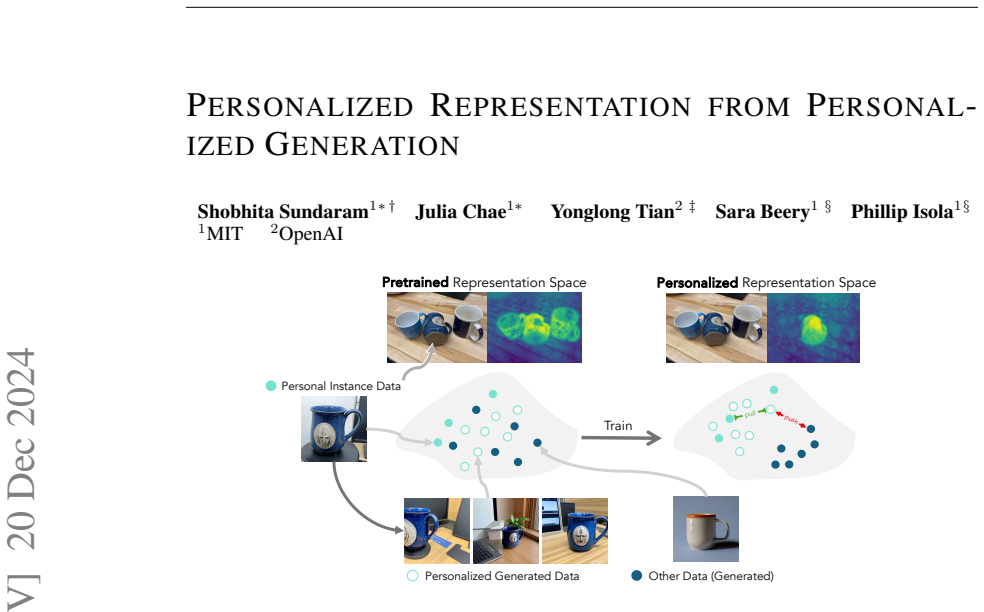
The machinery is the pairing of a personalized generator with a contrastive representation objective. A DreamBooth-adapted text-to-image diffusion model, conditioned on an identifier token and LLM-written prompts, produces synthetic positives of the target instance; the same model prompted with the generic category produces synthetic negatives. The InfoNCE loss then operates on the concatenated CLS and average-pooled patch features of a pretrained vision transformer adapted with LoRA, pulling real anchors toward synthetic positives and away from category negatives. This pairing carries the claim: the quality of the learned representation is set by the identity fidelity and diversity of the synthetic positives, which the paper measures through a DreamSim-based fidelity-diversity analysis.
What would settle it
Swap the synthetic positives for images of a different instance of the same category while keeping diversity and prompt distribution matched; if one-vs-all PR-AUC on real test images still rises, the paper's identity-preservation mechanism is not what carries the gain.
Extended reading notes
Core claim
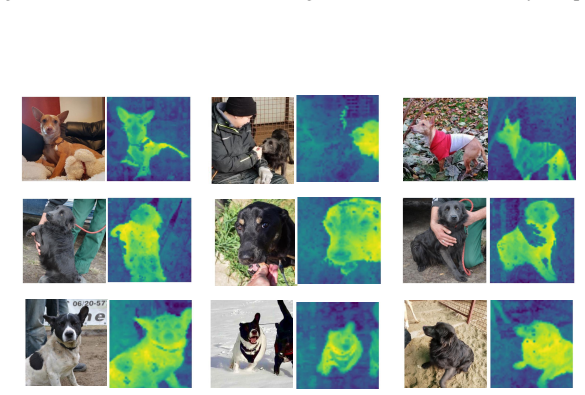
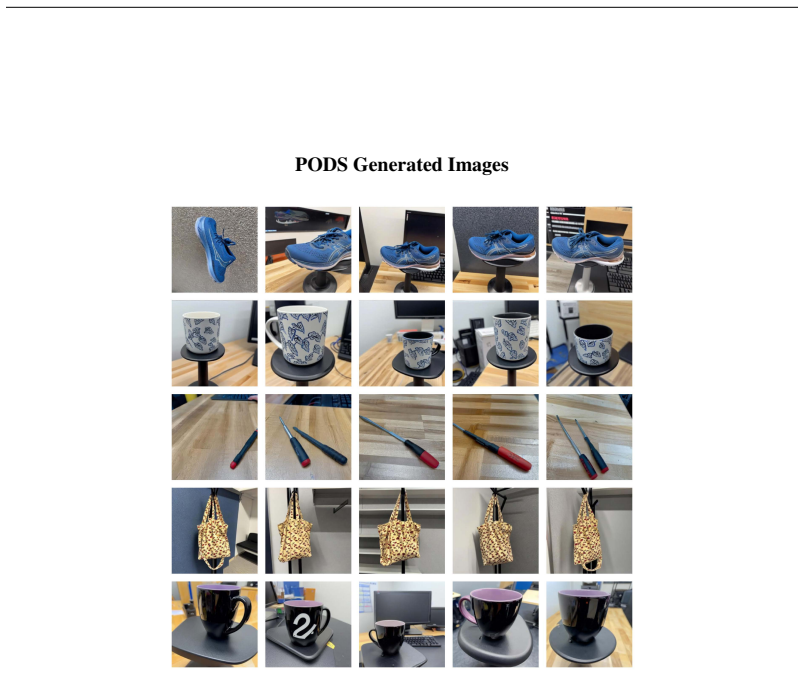
Personalized representations trained with synthetic data, using only three real examples of an instance, significantly outperform their pretrained counterparts across datasets, backbones, and downstream tasks. The recipe is: fine-tune a text-to-image diffusion model with DreamBooth on three real photos of the instance; generate a pool of synthetic positives with diverse prompts and a category-level pool of negatives; LoRA-fine-tune a pretrained vision encoder with the InfoNCE loss so that real anchors and synthetic positives are pulled together and category negatives are pushed apart. The resulting features improve one-vs-all classification, retrieval, detection, and segmentation for that instance without training task-specific heads. The paper also finds that combining masked DreamBooth with cut-and-paste gives the best training data, that LLM-generated captions help global tasks more than dense tasks, and that different generators leave complementary biases—DreamBooth handles pose but confuses similar instances, while cut-and-paste keeps identity but overfits pose.
Load-bearing premise
Everything rests on DreamBooth, trained from three real photos, producing synthetic positives that keep the target instance's identity well enough for contrastive training to transfer to real test images; the paper's own hard-negative failures in Section D.2 show that when identity drifts, the representation can encode spurious generator features instead.
Editorial extensions
If this is right
- With only three real images and no task-specific heads, a user can obtain an instance-tuned encoder that improves classification, retrieval, detection, and segmentation over the same pretrained encoder.
- The paper's scaling experiment shows gains persist as real data grows: synthetic augmentation adds 27% classification accuracy at three real images and 8% at twenty, so generation complements rather than only substitutes for collected data.
- Plugging the personalized encoder into a perSAM-style segmentation pipeline raises F1 scores on all three datasets, indicating the representation transfers to existing downstream methods.
- Because generator choice changes which failures remain—pose robustness versus fine-grained discrimination—users can select a generator or combine them to match their deployment distribution.
Reading between the lines
- If identity-preserving generation continues to improve, the practical minimum for personalizing a vision model could drop below three real images, and the same contrastive recipe might transfer to other modalities, such as audio or 3D object instances, wherever generative models exist.
- The hard-negative failure cases the paper reports imply that adding a strict fidelity filter on synthetic positives—rejecting generations whose perceptual similarity to the real anchors falls below a threshold—could further narrow the gap between synthetic and fully real training.
- A privacy-friendly consequence follows: because only three local images and a pretrained generator are needed, personalized models could be built without uploading user data or real negatives, keeping personalization siloed on the user's device.
Signed reviews
Editorial analysis
A structured set of objections, weighed in public.
Referee Report
Summary. The paper proposes a method for learning instance-specific ("personalized") visual representations from very few real images. For a target instance, a DreamBooth model is fine-tuned on three real images, a pool of synthetic images is generated with varying prompts and CFG scales, and a pretrained vision encoder (DINOv2, CLIP, or MAE) is contrastively fine-tuned via LoRA using the synthetic images as positives and generic-category synthetic images as negatives. The authors introduce a new dataset, PODS, and reformulate DeepFashion2 and DogFaceNet for instance-level evaluation across classification, retrieval, detection, and segmentation. They report improvements over pretrained baselines in 32 of 36 settings, compare generation methods (Masked DreamBooth, Cut-and-Paste, Combined), and show that the learned representations can be used within the PerSAM pipeline. The paper is thorough in its ablations and releases code, data, and detailed metadata.
Significance. If the central mechanism holds, the paper demonstrates a novel and practically appealing use of personalized generation for representation learning in data-scarce, fine-grained settings, and it provides a reusable evaluation suite (PODS plus reformulated datasets) that should be valuable to the community. The empirical study is unusually broad: three backbones, three datasets, four tasks, multiple generation methods, and an application to PerSAM. The strengths include careful dataset construction, transparent reporting of full results in the appendix, and public code/data release. The main caveat is that the paper's explanatory claim—that identity-preserving personalized generation is what drives the gains—is not directly tested, leaving an alternative explanation (category-level cues or generator artifacts) open.
major comments (3)
- [Section 3.4, Eq. (1)] The InfoNCE loss as written is internally inconsistent: the paragraph defines the tuple as (x, x+, x0, ..., xN) with x the real anchor, x+ the synthetic positive, and xi for i=0,...,N the synthetic negatives, but the displayed equation uses x0 as the anchor in both the numerator and the denominator. The numerator should use the real anchor x (or the notation should be changed so that the anchor is named x0). As printed, the equation does not define a valid contrastive loss for the stated setup. Please correct the equation and the surrounding notation.
- [Section 3.2 / Section 3.4] The central claim is that personalized generation from the target instance is what enables the learned representation to transfer to real test images. However, no experiment isolates the role of identity preservation. The paper compares against real-image-only training, but that is not a control for the generator's personalization: the positives in "Real Imgs" are the actual real images, not non-personalized synthetic images. A proper control would replace the DreamBooth positives with synthetic images generated without instance personalization, e.g., images of the same category from the pretrained generator, or DreamBooth images personalized to a different instance. Section D.2 itself documents failure cases where similarity to hard negatives increases and attributes them to "noisy positives," but the frequency of these failures is never quantified. Without such a control, the aggregate gains in Tables 1 and 7-8 could be explained by the synthetic data providing category-level or artifact-level cues rather than identity-specific information, undermining the advertised mechanism.
- [Introduction / Section 5.1] The Introduction states that performance "universally improves," while Section 5.1 says improvements occur in "32/36 cases." These statements are inconsistent, and the full results show clear exceptions: MAE retrieval regresses on PODS (MAE-P 30.7 vs. pretrained 34.6) and DF2 (23.7 vs. 25.8), and several CLIP/MAE dense-task cells show near-zero or negative changes. Please correct the overclaim and explicitly discuss the conditions under which the proposed method fails to improve over the pretrained backbone.
minor comments (5)
- [Section 5.1] The relative improvements quoted in the text (e.g., "DINOv2 detection improves by 48%") are not defined as relative or absolute; please state the computation to avoid ambiguity.
- [Appendix A.3.2] The DreamSim filtering threshold is described as "empirically chosen" (0.6 for DF2/PODS, 0.55 for Dogs); please specify how this was selected (e.g., on a validation set) so the reader can assess overfitting risk.
- [Appendix C.4] The fidelity metric in Figure 12 measures DreamSim similarity between synthetic images and the mean embedding of real images; as the caption notes, this can be influenced by background features. The main text should acknowledge this limitation or report a more identity-focused fidelity measure.
- [Tables 7-8] The min/max ranges are reported only for the highlighted best rows; the other rows are presumably single-seed runs. Please clarify this in the caption or provide ranges for all rows, since several differences are small relative to the reported ranges.
- [Section 4.2] The same validation set is used both for hyperparameter sweeps and for selecting the best synthetic dataset per backbone. A brief note on the selection protocol (e.g., no test-set information used) would strengthen the reproducibility statement.
Circularity Check
No circular derivation: the central claim is evaluated on held-out real test images; the few self-citations (StableRep, DreamSim) are non-load-bearing tools and do not make the result circular.
full rationale
The paper's central claim is empirical and externally grounded: a vision encoder is fine-tuned with InfoNCE on synthetic images generated by a DreamBooth model adapted from three real images, and then evaluated on held-out real test images across classification, retrieval, detection, and segmentation. The InfoNCE objective in Section 3.4 pulls real anchors toward synthetic positives, but nothing in that equation guarantees improved similarity to unseen real test images, so the reported gains are not forced by construction. Hyperparameters are swept on a validation set and the final numbers are reported on test splits, which is disclosed and standard. The DreamSim-based filtering in Section A.3.2 and the fidelity analysis in Section C.4 use a similarity model co-authored by present authors, but the main Table 1 results use unfiltered DreamBooth data, so the self-citation is not load-bearing. The StableRep citation in Sections 2 and 3.4 is also used only as inspiration for contrastive training on synthetic data; the paper's contribution and evaluation do not assume StableRep's correctness. The manuscript itself flags the most important validity threat in Section D.2: noisy synthetic positives can increase similarity to hard negatives, meaning some gains may be driven by spurious features rather than preserved identity. That is a correctness or mechanism concern, not a circularity concern, because the evaluation remains on real, held-out test images. Section 6.1 also acknowledges computational cost and inherited generator biases, again without introducing circularity. Overall, no prediction in the paper reduces to its inputs by definition, and no load-bearing premise is justified only by a self-citation chain.
Assumptions & free parameters
free parameters (5)
- Number of synthetic positives |D_S| =
450
- Anchor-positive pair count =
4500
- CFG guidance scale =
4.0, 5.0, 7.5; best per backbone chosen on validation
- DreamBooth filtering threshold (DreamSim cosine) =
0.6 for DF2/PODS, 0.55 for Dogs
- LoRA hyperparameters =
rank 16, alpha 0.5, dropout 0.3, learning rate 0.0003
assumptions (4)
- domain assumption DreamBooth fine-tuning on three real images yields synthetic images that share instance identity with the target.
- domain assumption Contrastive fine-tuning on synthetic pairs transfers to real test images.
- domain assumption Instance-level labels and masks in PODS, DF2, and Dogs splits are accurate.
- domain assumption Pretrained backbones provide a suitable starting point for personalization.
Cite this review
Pith. "Pith review of Personalized Representation from Personalized Generation." pith.science (2026). https://pith.science/paper/ZTFICTCR
@misc{pith2026241216156,
  author       = {Pith},
  title        = {Pith review of: Personalized Representation from Personalized Generation},
  year         = {2026},
  howpublished = {\url{https://pith.science/paper/ZTFICTCR}},
  note         = {Machine review of arXiv:2412.16156}
}
read the original abstract
Modern vision models excel at general purpose downstream tasks. It is unclear, however, how they may be used for personalized vision tasks, which are both fine-grained and data-scarce. Recent works have successfully applied synthetic data to general-purpose representation learning, while advances in T2I diffusion models have enabled the generation of personalized images from just a few real examples. Here, we explore a potential connection between these ideas, and formalize the challenge of using personalized synthetic data to learn personalized representations, which encode knowledge about an object of interest and may be flexibly applied to any downstream task relating to the target object. We introduce an evaluation suite for this challenge, including reformulations of two existing datasets and a novel dataset explicitly constructed for this purpose, and propose a contrastive learning approach that makes creative use of image generators. We show that our method improves personalized representation learning for diverse downstream tasks, from recognition to segmentation, and analyze characteristics of image generation approaches that are key to this gain.
Figures


Figures from the paper (25 more)






Reference graph
Works this paper leans on
-
[1]
Filtered DogFaceNet dog classes to keep classes with above 10 images per instance
-
[2]
Performed a random train-test split for every instance, keeping 3 images for train and rest for test
-
[3]
Manually inspected every instance in the dataset to remove data poisoning. This entailed looking through the training and test data and making sure that no test images were from the same sequential footage as the train data. When such images were discovered, they were removed from the test set
-
[4]
After data-cleanup, we removed instances with less then 4 remaining test images. The above procedure resulted in 80 total dog classes. Below is the metadata of our subselected dataset. • Unique Instances Selected: 80 • Total # Training Images: 240 • # of Training Images per Instance: 3 • Total # Test Images: 1218 • Range of Test Images per Instance: [6, 3...
work page 2023
-
[5]
A <new1> mug on a wooden desk
-
[6]
A <new1> mug in a cozy living room
-
[7]
A <new1> mug on a windowsill • Bottles
-
[8]
A <new1> bottle on a picnic table
Show all 52 references
-
[9]
A <new1> bottle in a backpack pocket
-
[10]
A <new1> bottle on a yoga mat • Screwdrivers
-
[11]
A <new1> screwdriver in a toolbox
-
[12]
A <new1> screwdriver on a wooden workbench
-
[13]
A <new1> screwdriver in a carpenter’s tool belt • Totes (Bags)
-
[14]
A <new1> bag in a car trunk
-
[15]
A <new1> bag on a park bench
-
[16]
A <new1> bag in a shopping cart
-
[17]
A <new1> bag on a library shelf
-
[18]
A <new1> bag in a gym locker
-
[19]
A <new1> bag on a wooden table • Shoes
-
[20]
A <new1> shoe in the rain
-
[21]
A <new1> shoe on a sandy beach 20
-
[22]
A <new1> shoe in a gym locker DF2 Dataset
-
[23]
A person wearing a <new1> shirt at a park
-
[24]
A <new1> shirt on a mannequin
-
[25]
A person wearing a <new1> shirt at a party
-
[26]
A <new1> shirt on a clothesline
-
[27]
A person wearing a <new1> shirt at a concert
-
[28]
A <new1> shirt on a chair
-
[29]
A person wearing a <new1> shirt at a caf´e
-
[30]
A <new1> shirt on a laundry basket
-
[31]
A person wearing a <new1> shirt at a stadium
-
[32]
A <new1> shirt on a hook
-
[33]
A person wearing a <new1> shirt at a bus stop
-
[34]
A <new1> shirt on a drying rack
-
[35]
A person wearing a <new1> shirt at a gym
-
[36]
A <new1> shirt on a shelf
-
[37]
A person wearing a <new1> shirt at a picnic Dogs Dataset
-
[38]
A <new1> dog in the park
-
[39]
A <new1> dog at the vet
-
[40]
A <new1> dog in a car
-
[41]
A <new1> dog at the groomer
-
[42]
A <new1> dog on a walk
-
[43]
A <new1> dog in the snow
-
[44]
A <new1> dog at the lake
-
[45]
A <new1> dog in the backyard
-
[46]
A <new1> dog at the <new1> dog park
-
[47]
A <new1> dog in a sweater
-
[48]
A <new1> dog in a bed
-
[49]
A <new1> dog at the farm
-
[50]
A <new1> dog in the woods
-
[51]
A <new1> dog in a kennel
-
[52]
<new1>" specifi- cation from every prompt: e.g
A <new1> dog at a barbecue A.3.2 M ASKED DREAM BOOTH - FILTERING We apply automatic filtering to the Masked DreamBooth pipeline as an additional data-processing step that we can take when masks are available, to ensure high-quality generated data. We use the masks to extract a...
2023
Reviewed August 11, 2026 · model on record in the stance chip above.
Discussion (0). Continue with ORCID to comment.