REVIEW 3 major objections 5 minor 58 references
GALOT: Generative Active Learning via Optimizable Zero-shot Text-to-image Generation
T0 review · 3 major / 5 minor · reviewed 2026-08-11 · deepseek-v4-flash
Pith's one-line read A text-to-image active-learning loop with prompt optimization beats state-of-the-art active learning on three image benchmarks.
desk verdict There's a real, novel combination here, but the paper's marquee claim that text-embedding optimization helps is not supported by its own controlled comparisons. read the letter →
The pith
A machine-rendered reading of the paper's core claim, the machinery that carries it, and where it could break.
The reading
What carries the argument
The load-bearing object is the optimizable text embedding $s$ of a conditional diffusion model. Starting from a template embedding $s^* = h_\tau(y_i)$ for class $y_i$, GALOT updates $s$ by projected gradient descent, $s_i = s_{i-1} + \alpha\,\mathrm{sgn}[\nabla_s \sigma(x_0, f_\theta)]$ under $\|s_i - s^*\|_2 \le \epsilon$, where $\sigma$ is the active-learning acquisition function. To make this tractable, Proposition 1 collapses the gradient sum over diffusion timesteps to the single term $\nabla_s \sigma(x_0, f_\theta) = T\,\nabla_{x_0}\sigma \cdot J_{x_0,s}$, assuming the forward noising relation $x_t = \sqrt{\alpha_t}x_0 + \sqrt{1-\alpha_t}\epsilon$ also holds across the reverse process, so the gradient is estimated by backpropagating through the last denoising step. The same embedding defines the generated image and its pseudo-label, coupling synthesis and annotation in one loop.
What would settle it
Compare GALOT's one-step gradient updates against random perturbations of the same radius $\epsilon$, and against gradients computed through all $T=50$ denoising steps, at a fixed annotation budget such as 1,000 labels on CIFAR10; if either alternative matches or beats GALOT's accuracy, the Proposition 1 gradient estimate is not the source of the reported gains.
Extended reading notes
Core claim
The central claim is that the text condition of a pre-trained text-to-image diffusion model can be treated as an optimizable data pool for active learning. GALOT initializes the condition from a task template such as 'a realistic photo of a {label}', scores the images the model generates with an active-learning acquisition function, and moves the text embedding in the direction that maximizes that score, subject to a small distance constraint from the template. The generated image is assigned the class name from the prompt as a pseudo-label, so the synthetic batch costs no annotation budget. On CIFAR10, CIFAR100, and TinyImageNet, the paper reports that this loop outperforms twelve active-learning baselines at every annotation budget, with average gains of 3.84%, 7.71%, and 3.29%, and that the embedding optimization adds up to 5.86% over using the plain template on CIFAR10.
Load-bearing premise
The load-bearing premise is that the gradient of the acquisition function with respect to the text embedding is usefully approximated by backpropagating through only the last reverse diffusion step, with the forward noising equation assumed to describe the reverse process; if that gradient is uninformative, prompt optimization adds little beyond the fixed template.
Editorial extensions
If this is right
- Active learning can be augmented with unlimited pseudo-labeled synthetic data at zero annotation cost, and Table 1 reports GALOT ahead of every compared active-learning method at every budget.
- A vision classifier can be trained from text alone: the generated-only baseline reaches 58.63% on CIFAR10, and adding 10,000 real labels reaches 92.46%.
- The generated data are reusable across architectures; the same pool trained VGG16, DenseNet121, MobileNetV2, and DLA, all above the margin and least-confidence active-learning baselines on average.
- Pseudo-label accuracy stays effectively perfect for descriptive templates even under text-embedding distortion, so annotation-free training is viable when the prompt template is chosen well.
Reading between the lines
- An implication the paper leaves implicit is that the same loop should transfer to any guided diffusion domain, since the condition $s$ is abstract and pseudo-labels can be read from it.
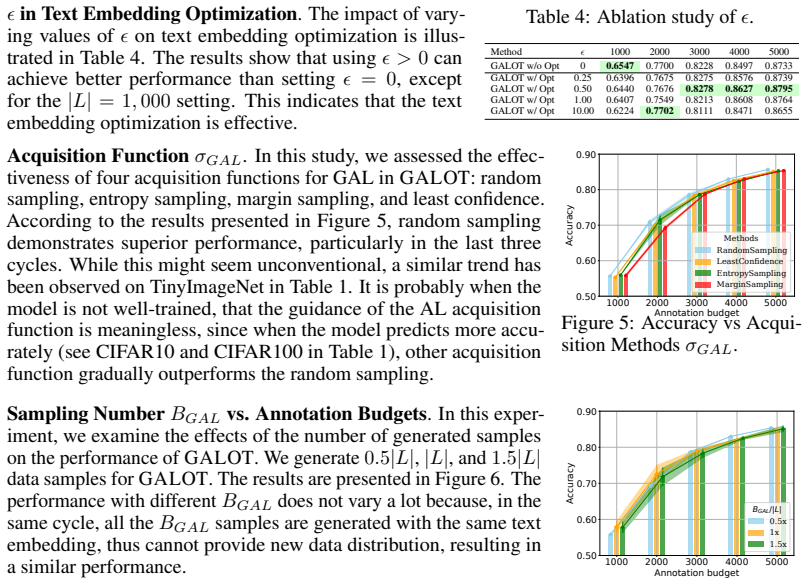
- The paper's own ablations leave open that most of the gain comes from adding synthetic data rather than from prompt optimization; a direct test would replace the learned gradient with random same-radius perturbations.
- A practical extension the paper does not discuss: if the one-step gradient is unreliable, black-box prompt search over text embeddings would preserve the method while working with API-only generation services.
Editorial analysis
A structured set of objections, weighed in public.
Referee Report
Summary. The paper proposes GALOT, an active learning framework that uses a pre-trained text-to-image diffusion model to synthesize training images from text prompts. The prompts are initialized from class names via a template, then 'optimized' by backpropagating an active-learning acquisition score through the diffusion model; the generated images are pseudo-labeled by the prompt class. Synthetic images are combined with conventionally selected real labeled samples. Experiments on CIFAR-10, CIFAR-100, and TinyImageNet compare against 12 AL baselines, with ablations over templates, perturbation radius epsilon, acquisition functions, and generative batch size. The headline claims are consistent improvements over SOTA (average +3.84, +7.71, and +3.29 percentage points, respectively) and that text optimization improves over the basic version by up to 5.86% on CIFAR-10.
Significance. If the central claims are validated, the paper introduces a promising direction: zero-shot text-to-image generation as an annotation-free source of informative training data for active learning, with potential text-to-model transfer. The strengths include the breadth of the benchmark (three datasets, twelve baselines), the human evaluation of pseudo-label accuracy, the dataset-reuse experiments showing that one generated pool helps several architectures, and the detailed hyperparameter table (Table 8). The strongest credible contribution is the basic version's improvement over traditional AL. However, the 'optimizable text' contribution is not supported: the proof of Proposition 1 is invalid, the headline comparison confounds template choice with optimization, and the only controlled optimization comparison shows a negligible effect. The significance of the paper as a text-optimization method is therefore not yet established.
major comments (3)
- [§3.3, Eq. (8)–(10)] Proposition 1 is not proved as stated. Equation (8) sums over all reverse-process timesteps t the product ∇xt σ · Jxt,s. Equation (9) factors Jxt,s as Jx0,xt · Jxt,x0 · Jx0,s and Equation (10) collapses the sum to T∇x0σ · Jx0,s by appealing to Eq. (3). But Eq. (3) describes the forward noising process (xt = √αt x0 + ...), not the reverse denoising transition p(xt−1|xt, s), and Jxt,x0 is not a well-defined Jacobian of the reverse generative map. The implemented gradient, which backpropagates only through the last reverse diffusion step (Section 3.3), is therefore a heuristic rather than a consequence of the proposition. Because Eq. (5) is the basis of the optimizable-text claim, the theoretical derivation must be corrected or the claim explicitly reframed as an empirical heuristic.
- [§4.1, Tables 1, 3, 4, 8] The headline GALOT-vs-GALOT(basic) gap is confounded. Table 8 shows that GALOT uses the template 'a realistic photo of a {label}' with epsilon growing linearly to 0.5, whereas GALOT(basic) uses the bare template '{label}' with epsilon = 0. Table 3 shows that the template alone changes the 1,000-budget accuracy from 0.5566 ('{label}') to 0.6074 ('a realistic photo of a {label}'), a 5.08-point gap that is nearly the size of the 5.86-point improvement attributed to text refinement. The same-template comparison in Table 4 (epsilon=0.5 vs. epsilon=0) yields only a 0.22-point average gain over 1k–5k budgets (0.7963 vs. 0.7941), with epsilon=0 better at the 1k budget, and no error bars are provided. Thus the evidence does not demonstrate that text-embedding optimization, rather than template choice, drives GALOT's advantage.
- [§4.1, Table 1; Appendix A] The main results are reported without variance estimates; the only uncertainty reported in the paper is SEM over 2 runs (Table 3, Figure 5, Figure 6). Several per-budget differences are small: on TinyImageNet, GALOT and GALOT(basic) differ by at most 1.6 points at 2k–10k, and GALOT is slightly worse than basic at 6k, 8k, and 9k. Without multiple seeds and error bars on the central comparison, the claim of 'consistently outperforms SOTA methods in all settings' is not fully supported, and the small differences between methods in the ablation studies cannot be interpreted reliably.
minor comments (5)
- [Abstract] The abstract says 'sorely using the text description'; this should be 'solely'.
- [Algorithm 1] Line 4 initializes the labeled pool L = ∅ inside the training loop; this would discard previously labeled data at every cycle, contradicting the cumulative budgets reported in the experiments. The initialization should be moved outside the loop.
- [§4.4] The human evaluation of pseudo-labels uses only 10 images per class per setting (100 total per setting in Table 9). This is a small sample; the paper should report confidence intervals or use a larger sample.
- [Table 1] There are minor typos in Table 1, including 'RandomSamping' and an apparent missing digit in the BALD row for TinyImageNet at 4000 ('0.251').
- [§3.3] The notation in Eq. (7)–(10) confuses the number of diffusion steps with a continuous time index: the sum in Eq. (8) runs from t=0 to T, while T is elsewhere the total number of steps, making the factor T in Eq. (7) ambiguous.
Circularity Check
No significant circularity: the headline results are external test-set accuracies, and the text-optimization loop is self-referential active learning by design rather than a definitional reduction.
full rationale
GALOT's claimed results are measured on held-out real test sets (CIFAR10, CIFAR100, TinyImageNet), and the labels used during training are pseudo-labels constructed from public class-name text inputs, not from the model's own predictions or from the test labels. The text-embedding optimization in Eq. (2) and Algorithm 1 is a standard active-learning feedback loop: the current classifier's acquisition function guides which synthetic queries are generated, the model is trained on those queries plus the real labeled pool, and performance is then evaluated externally. This is the defining mechanism of active learning, not an identity between an output and its input. There are no self-citations, so no uniqueness theorem or ansatz is imported from the authors' prior work. The invalid proof of Proposition 1 (Eq. (8)-(10), which invokes the forward noising relation Eq. (3) inside the reverse-process Jacobian chain) and the confounded GALOT-versus-basic comparison (Table 8 varies both the template and epsilon) are genuine scientific weaknesses, but they are correctness and experimental-design concerns rather than circular reductions that make the central claim equivalent to its inputs by construction. The comparison to SOTA active-learning baselines is externally falsifiable and does not collapse to a fitted parameter or a self-referential definition; therefore no circularity is found.
Assumptions & free parameters
free parameters (7)
- epsilon (text embedding perturbation bound) =
0 to 0.5, linear growth
- alpha (PGD step size) =
epsilon/5
- k (gradient sampling count) =
6
- n (text update steps) =
10
- text template =
a realistic photo of a {label}
- BGAL (synthetic samples per cycle) =
equal to |L| (cumulative labeled count)
- diffusion steps T =
50
assumptions (5)
- domain assumption The class-name template generates images that genuinely depict the class, so pseudo-labels are correct.
- ad hoc to paper Backpropagating through the last reverse diffusion step provides a useful approximation to the gradient in Eq (5).
- domain assumption Synthetic images from Stable Diffusion are close enough to real test images that classifiers trained on them transfer.
- domain assumption Maximizing the AL acquisition score on generated images yields more informative training samples.
- domain assumption CLIP text embeddings of class labels are a suitable optimization space for the constraint ||s-s*||<epsilon.
Cite this review
Pith. "Pith review of GALOT: Generative Active Learning via Optimizable Zero-shot Text-to-image Generation." pith.science (2026). https://pith.science/paper/SF5RRLVC
@misc{pith2026241216227,
  author       = {Pith},
  title        = {Pith review of: GALOT: Generative Active Learning via Optimizable Zero-shot Text-to-image Generation},
  year         = {2026},
  howpublished = {\url{https://pith.science/paper/SF5RRLVC}},
  note         = {Machine review of arXiv:2412.16227}
}
read the original abstract
Active Learning (AL) represents a crucial methodology within machine learning, emphasizing the identification and utilization of the most informative samples for efficient model training. However, a significant challenge of AL is its dependence on the limited labeled data samples and data distribution, resulting in limited performance. To address this limitation, this paper integrates the zero-shot text-to-image (T2I) synthesis and active learning by designing a novel framework that can efficiently train a machine learning (ML) model sorely using the text description. Specifically, we leverage the AL criteria to optimize the text inputs for generating more informative and diverse data samples, annotated by the pseudo-label crafted from text, then served as a synthetic dataset for active learning. This approach reduces the cost of data collection and annotation while increasing the efficiency of model training by providing informative training samples, enabling a novel end-to-end ML task from text description to vision models. Through comprehensive evaluations, our framework demonstrates consistent and significant improvements over traditional AL methods.
Figures


Figures from the paper (6 more)



Reference graph
Works this paper leans on
-
[1]
arXiv preprint arXiv:1603.04467 (2016)
Abadi, M., Agarwal, A., Barham, P., Brevdo, E., Chen, Z., Citro, C., Corrado, G.S., Davis, A., Dean, J., Devin, M., et al.: Tensorflow: Large-scale machine learning on heterogeneous distributed systems. arXiv preprint arXiv:1603.04467 (2016)
arXiv 2016
-
[2]
Angluin, D.: Queries and concept learning. Mach. Learn. 2(4), 319–342 (1987). https://doi.org/10.1007/BF00116828, https://doi.org/10.1007/BF00116828
-
[3]
arXiv preprint arXiv:1906.03671 (2019)
Ash, J.T., Zhang, C., Krishnamurthy, A., Langford, J., Agarwal, A.: Deep batch active learning by diverse, uncertain gradient lower bounds. arXiv preprint arXiv:1906.03671 (2019)
arXiv 2019
-
[4]
Bachman, P., Sordoni, A., Trischler, A.: Learning algorithms for active learning. In: 5th International Conference on Learning Representations, ICLR 2017, Toulon, France, April 24-26, 2017, Workshop Track Proceedings. OpenReview.net (2017),https://openreview. net/forum?id=rJj2ZxHtl
work page 2017
-
[5]
https://cdn.openai.com/papers/dall-e-3.pdf (2023)
Betker, J., Goh, G., Jing, L., Brook, T., Wang, J., Li, L., Ouyang, L., Zhuang, J., Lee, J., Guo, Y ., Manassra, W., Dhariwal, P., Chu, C., Jiao, Y ., Ramesh, A.: Improving image generation with better captions. https://cdn.openai.com/papers/dall-e-3.pdf (2023)
work page 2023
-
[6]
Cohn, D.A., Atlas, L.E., Ladner, R.E.: Improving generalization with active learning. Mach. Learn. 15(2), 201–221 (1994). https://doi.org/10.1007/BF00993277, https://doi.org/10. 1007/BF00993277
-
[7]
IEEE Transactions on Pattern Analysis and Machine Intelligence (2023)
Croitoru, F.A., Hondru, V ., Ionescu, R.T., Shah, M.: Diffusion models in vision: A survey. IEEE Transactions on Pattern Analysis and Machine Intelligence (2023)
work page 2023
-
[8]
In: 2009 IEEE conference on computer vision and pattern recognition
Deng, J., Dong, W., Socher, R., Li, L.J., Li, K., Fei-Fei, L.: Imagenet: A large-scale hierarchical image database. In: 2009 IEEE conference on computer vision and pattern recognition. pp. 248–255. Ieee (2009)
2009
Show all 58 references
-
[9]
In: Ranzato, M., Beygelzimer, A., Dauphin, Y .N., Liang, P., Vaughan, J.W
Ding, M., Yang, Z., Hong, W., Zheng, W., Zhou, C., Yin, D., Lin, J., Zou, X., Shao, Z., Yang, H., Tang, J.: Cogview: Mastering text-to-image generation via transform- ers. In: Ranzato, M., Beygelzimer, A., Dauphin, Y .N., Liang, P., Vaughan, J.W. (eds.) Advances in Neural Info...
2021
-
[10]
CoRR abs/1802.09841 (2018), http://arxiv.org/abs/1802.09841
Ducoffe, M., Precioso, F.: Adversarial active learning for deep networks: a margin based approach. CoRR abs/1802.09841 (2018), http://arxiv.org/abs/1802.09841
2018 arXiv
-
[11]
(No Title) (1965)
Freeman, L.C.: Elementary applied statistics: for students in behavioral science. (No Title) (1965)
1965
-
[12]
In: Precup, D., Teh, Y .W
Gal, Y ., Islam, R., Ghahramani, Z.: Deep bayesian active learning with image data. In: Precup, D., Teh, Y .W. (eds.) Proceedings of the 34th International Conference on Machine Learning, ICML 2017, Sydney, NSW, Australia, 6-11 August 2017. Proceedings of Machine Learning Rese...
2017
-
[13]
In: Pro- ceedings of the 34th International Conference on Machine Learning
Gal, Y ., Islam, R., Ghahramani, Z.: Deep Bayesian active learning with image data. In: Pro- ceedings of the 34th International Conference on Machine Learning. PMLR (2017)
2017
-
[14]
In: Ghahramani, Z., Welling, M., Cortes, C., Lawrence, N.D., Weinberger, K.Q
Goodfellow, I.J., Pouget-Abadie, J., Mirza, M., Xu, B., Warde-Farley, D., Ozair, S., Courville, A.C., Bengio, Y .: Generative adversarial nets. In: Ghahramani, Z., Welling, M., Cortes, C., Lawrence, N.D., Weinberger, K.Q. (eds.) Advances in Neural Information Processing System...
2014
-
[15]
In: Larochelle, H., Ranzato, M., Hadsell, R., Balcan, M., Lin, H
Ho, J., Jain, A., Abbeel, P.: Denoising diffusion probabilistic models. In: Larochelle, H., Ranzato, M., Hadsell, R., Balcan, M., Lin, H. (eds.) Advances in Neural Information Processing Systems 33: Annual Conference on Neural Information Processing Systems 2020, NeurIPS 2020,...
2020
-
[16]
In: Proceedings of the IEEE conference on computer vision and pattern recognition
Huang, G., Liu, Z., Van Der Maaten, L., Weinberger, K.Q.: Densely connected convolutional networks. In: Proceedings of the IEEE conference on computer vision and pattern recognition. pp. 4700–4708 (2017)
2017
-
[17]
In: Proceedings of the IEEE conference on computer vision and pattern recognition workshops
Kampffmeyer, M., Salberg, A.B., Jenssen, R.: Semantic segmentation of small objects and modeling of uncertainty in urban remote sensing images using deep convolutional neural networks. In: Proceedings of the IEEE conference on computer vision and pattern recognition workshops....
2016
-
[18]
Advances in Neural Information Processing Systems 34, 22919–22930 (2021)
Kim, Y .Y ., Song, K., Jang, J., Moon, I.C.: Lada: Look-ahead data acquisition via augmentation for deep active learning. Advances in Neural Information Processing Systems 34, 22919–22930 (2021)
2021
-
[19]
Krizhevsky, A., Hinton, G., et al.: Learning multiple layers of features from tiny images (2009)
2009
-
[20]
CS 231N7(7), 3 (2015)
Le, Y ., Yang, X.: Tiny imagenet visual recognition challenge. CS 231N7(7), 3 (2015)
2015
-
[21]
In: Proceedings of the 17th Annual International ACM-SIGIR Conference on Research and Development in Information Retrieval
Lewis, D.D., Gale, W.A.: A sequential algorithm for training text classifiers. In: Proceedings of the 17th Annual International ACM-SIGIR Conference on Research and Development in Information Retrieval. ACM/Springer (1994)
1994
-
[22]
In: Wal- lach, H.M., Larochelle, H., Beygelzimer, A., d’Alché-Buc, F., Fox, E.B., Garnett, R
Li, B., Qi, X., Lukasiewicz, T., Torr, P.H.S.: Controllable text-to-image generation. In: Wal- lach, H.M., Larochelle, H., Beygelzimer, A., d’Alché-Buc, F., Fox, E.B., Garnett, R. (eds.) Advances in Neural Information Processing Systems 32: Annual Conference on Neural In- form...
2019
-
[23]
In: ICBDT 2020: 3rd International Conference on Big Data Technologies, Qingdao, China, September, 2020
Ma, Y ., Lu, S., Xu, E., Yu, T., Zhou, L.: Combining active learning and data aug- mentation for image classification. In: ICBDT 2020: 3rd International Conference on Big Data Technologies, Qingdao, China, September, 2020. pp. 58–62. ACM (2020). https://doi.org/10.1145/3422713...
2020
-
[24]
In: International Conference on Learning Representations (2018)
Madry, A., Makelov, A., Schmidt, L., Tsipras, D., Vladu, A.: Towards deep learning models resistant to adversarial attacks. In: International Conference on Learning Representations (2018)
2018
-
[25]
In: IEEE Winter Conference on Applications of Computer Vision, WACV 2020, Snowmass Village, CO, USA, March 1- 5, 2020
Mayer, C., Timofte, R.: Adversarial sampling for active learning. In: IEEE Winter Conference on Applications of Computer Vision, WACV 2020, Snowmass Village, CO, USA, March 1- 5, 2020. pp. 3060–3068. IEEE (2020). https://doi.org/10.1109/WACV45572.2020.9093556, https://doi.org/...
2020
-
[26]
In: Chaudhuri, K., Jegelka, S., Song, L., Szepesvári, C., Niu, G., Sabato, S
Nichol, A.Q., Dhariwal, P., Ramesh, A., Shyam, P., Mishkin, P., McGrew, B., Sutskever, I., Chen, M.: GLIDE: towards photorealistic image generation and editing with text-guided diffusion models. In: Chaudhuri, K., Jegelka, S., Song, L., Szepesvári, C., Niu, G., Sabato, S. (eds...
2022
-
[27]
Advances in neural information processing systems 32 (2019)
Paszke, A., Gross, S., Massa, F., Lerer, A., Bradbury, J., Chanan, G., Killeen, T., Lin, Z., Gimelshein, N., Antiga, L., et al.: Pytorch: An imperative style, high-performance deep learning library. Advances in neural information processing systems 32 (2019)
2019
-
[28]
In: The Eleventh International Conference on Learning Representations, ICLR 2023, Kigali, Rwanda, May 1-5, 2023
Poole, B., Jain, A., Barron, J.T., Mildenhall, B.: Dreamfusion: Text-to-3d using 2d diffu- sion. In: The Eleventh International Conference on Learning Representations, ICLR 2023, Kigali, Rwanda, May 1-5, 2023. OpenReview.net (2023),https://openreview.net/pdf? id=FjNys5c7VyY 11
2023
-
[29]
In: Meila, M., Zhang, T
Popov, V ., V ovk, I., Gogoryan, V ., Sadekova, T., Kudinov, M.A.: Grad-tts: A diffusion probabilistic model for text-to-speech. In: Meila, M., Zhang, T. (eds.) Proceedings of the 38th International Conference on Machine Learning, ICML 2021, 18-24 July 2021, Virtual Event. Pro...
2021
-
[30]
In: International conference on machine learning
Radford, A., Kim, J.W., Hallacy, C., Ramesh, A., Goh, G., Agarwal, S., Sastry, G., Askell, A., Mishkin, P., Clark, J., et al.: Learning transferable visual models from natural language supervision. In: International conference on machine learning. pp. 8748–8763. PMLR (2021)
2021
-
[31]
arXiv preprint arXiv:2204.06125 (2022)
Ramesh, A., Dhariwal, P., Nichol, A., Chu, C., Chen, M.: Hierarchical text-conditional image generation with clip latents. arXiv preprint arXiv:2204.06125 (2022)
2022 arXiv
-
[32]
In: Meila, M., Zhang, T
Ramesh, A., Pavlov, M., Goh, G., Gray, S., V oss, C., Radford, A., Chen, M., Sutskever, I.: Zero-shot text-to-image generation. In: Meila, M., Zhang, T. (eds.) Proceedings of the 38th International Conference on Machine Learning, ICML 2021, 18-24 July 2021, Virtual Event. Proc...
2021
-
[33]
In: Balcan, M., Weinberger, K.Q
Reed, S.E., Akata, Z., Yan, X., Logeswaran, L., Schiele, B., Lee, H.: Generative adversarial text to image synthesis. In: Balcan, M., Weinberger, K.Q. (eds.) Proceedings of the 33nd International Conference on Machine Learning, ICML 2016, New York City, NY , USA, June 19-24, 2...
2016
-
[34]
In: IEEE/CVF Conference on Computer Vision and Pattern Recognition, CVPR 2022, New Orleans, LA, USA, June 18-24, 2022
Rombach, R., Blattmann, A., Lorenz, D., Esser, P., Ommer, B.: High-resolution image synthesis with latent diffusion models. In: IEEE/CVF Conference on Computer Vision and Pattern Recognition, CVPR 2022, New Orleans, LA, USA, June 18-24, 2022. pp. 10674–10685. IEEE (2022). http...
2022
-
[35]
In: NeurIPS (2022), http://papers.nips.cc/paper_files/paper/2022/hash/ ec795aeadae0b7d230fa35cbaf04c041-Abstract-Conference.html
Saharia, C., Chan, W., Saxena, S., Li, L., Whang, J., Denton, E.L., Ghasemipour, S.K.S., Lopes, R.G., Ayan, B.K., Salimans, T., Ho, J., Fleet, D.J., Norouzi, M.: Photorealistic text-to-image diffusion models with deep language understand- ing. In: NeurIPS (2022), http://papers...
2022
-
[36]
In: Proceedings of the IEEE conference on computer vision and pattern recognition
Sandler, M., Howard, A., Zhu, M., Zhmoginov, A., Chen, L.C.: Mobilenetv2: Inverted residuals and linear bottlenecks. In: Proceedings of the IEEE conference on computer vision and pattern recognition. pp. 4510–4520 (2018)
2018
-
[37]
In: Proceedings of the International Symposium on Intelligent Data Analysis (2001)
Scheffer, T., Decomain, C., Wrobel, S.: Active hidden Markov models for information extraction. In: Proceedings of the International Symposium on Intelligent Data Analysis (2001)
2001
-
[38]
In: 6th International Conference on Learning Representations, ICLR 2018, Vancouver, BC, Canada, April 30 - May 3, 2018, Conference Track Proceedings
Sener, O., Savarese, S.: Active learning for convolutional neural networks: A core-set approach. In: 6th International Conference on Learning Representations, ICLR 2018, Vancouver, BC, Canada, April 30 - May 3, 2018, Conference Track Proceedings. OpenReview.net (2018), https:/...
2018
-
[39]
Settles, B.: Active learning literature survey (2009)
2009
-
[40]
ACM SIGMOBILE mobile comput- ing and communications review 5(1), 3–55 (2001)
Shannon, C.E.: A mathematical theory of communication. ACM SIGMOBILE mobile comput- ing and communications review 5(1), 3–55 (2001)
2001
-
[41]
arXiv preprint arXiv:1409.1556 (2014)
Simonyan, K., Zisserman, A.: Very deep convolutional networks for large-scale image recogni- tion. arXiv preprint arXiv:1409.1556 (2014)
2014 arXiv
-
[42]
In: Bach, F.R., Blei, D.M
Sohl-Dickstein, J., Weiss, E.A., Maheswaranathan, N., Ganguli, S.: Deep unsupervised learning using nonequilibrium thermodynamics. In: Bach, F.R., Blei, D.M. (eds.) Proceedings of the 32nd International Conference on Machine Learning, ICML 2015, Lille, France, 6-11 July
2015
-
[43]
arXiv preprint arXiv:2302.07944 (2023)
Trabucco, B., Doherty, K., Gurinas, M., Salakhutdinov, R.: Effective data augmentation with diffusion models. arXiv preprint arXiv:2302.07944 (2023)
2023 arXiv
-
[44]
In: Chaudhuri, K., Salakhutdinov, R
Tran, T., Do, T., Reid, I.D., Carneiro, G.: Bayesian generative active deep learning. In: Chaudhuri, K., Salakhutdinov, R. (eds.) Proceedings of the 36th International Conference on Machine Learning, ICML 2019, 9-15 June 2019, Long Beach, California, USA. Pro- ceedings of Mach...
2019
-
[45]
IEEE Trans
Wang, K., Zhang, D., Li, Y ., Zhang, R., Lin, L.: Cost-effective active learning for deep image classification. IEEE Trans. Circuits Syst. Video Technol. 27(12), 2591–2600 (2017). https://doi.org/10.1109/TCSVT.2016.2589879, https://doi.org/10.1109/TCSVT.2016. 2589879
2017
-
[46]
In: Avidan, S., Brostow, G.J., Cissé, M., Farinella, G.M., Hassner, T
Wu, C., Liang, J., Ji, L., Yang, F., Fang, Y ., Jiang, D., Duan, N.: Nüwa: Visual synthesis pre-training for neural visual world creation. In: Avidan, S., Brostow, G.J., Cissé, M., Farinella, G.M., Hassner, T. (eds.) Computer Vision - ECCV 2022 - 17th European Conference, Tel ...
2022 doi
-
[47]
In: 2018 IEEE Conference on Computer Vision and Pattern Recognition, CVPR 2018, Salt Lake City, UT, USA, June 18- 22, 2018
Xu, T., Zhang, P., Huang, Q., Zhang, H., Gan, Z., Huang, X., He, X.: Attngan: Fine-grained text to image generation with attentional generative adversarial networks. In: 2018 IEEE Conference on Computer Vision and Pattern Recognition, CVPR 2018, Salt Lake City, UT, USA, June 1...
2018
-
[48]
ACM Computing Surveys (2022)
Yang, L., Zhang, Z., Song, Y ., Hong, S., Xu, R., Zhao, Y ., Zhang, W., Cui, B., Yang, M.H.: Diffusion models: A comprehensive survey of methods and applications. ACM Computing Surveys (2022)
2022
-
[49]
arXiv preprint arXiv:2304.08821 (2023)
Yin, Y ., Kaddour, J., Zhang, X., Nie, Y ., Liu, Z., Kong, L., Liu, Q.: Ttida: Controllable generative data augmentation via text-to-text and text-to-image models. arXiv preprint arXiv:2304.08821 (2023)
2023 arXiv
-
[50]
In: IEEE Conference on Computer Vision and Pattern Recognition, CVPR 2019, Long Beach, CA, USA, June 16-20, 2019
Yoo, D., Kweon, I.S.: Learning loss for active learning. In: IEEE Conference on Computer Vision and Pattern Recognition, CVPR 2019, Long Beach, CA, USA, June 16-20, 2019. pp. 93–
2019
-
[51]
In: Proceedings of the IEEE/CVF conference on computer vision and pattern recognition
Yoo, D., Kweon, I.S.: Learning loss for active learning. In: Proceedings of the IEEE/CVF conference on computer vision and pattern recognition. pp. 93–102 (2019)
2019
-
[52]
In: Proceedings of the IEEE conference on computer vision and pattern recognition
Yu, F., Wang, D., Shelhamer, E., Darrell, T.: Deep layer aggregation. In: Proceedings of the IEEE conference on computer vision and pattern recognition. pp. 2403–2412 (2018)
2018
-
[53]
arXiv preprint arXiv:2203.13450 (2022)
Zhan, X., Wang, Q., Huang, K.h., Xiong, H., Dou, D., Chan, A.B.: A comparative survey of deep active learning. arXiv preprint arXiv:2203.13450 (2022)
2022 arXiv
-
[54]
In: IEEE International Conference on Computer Vision, ICCV 2017, Venice, Italy, October 22-29, 2017
Zhang, H., Xu, T., Li, H.: Stackgan: Text to photo-realistic image synthesis with stacked generative adversarial networks. In: IEEE International Conference on Computer Vision, ICCV 2017, Venice, Italy, October 22-29, 2017. pp. 5908–5916. IEEE Computer Society (2017). https://...
2017 doi
-
[55]
CoRR abs/1702.07956 (2017), http://arxiv.org/abs/1702.07956
Zhu, J., Bento, J.: Generative adversarial active learning. CoRR abs/1702.07956 (2017), http://arxiv.org/abs/1702.07956
2017 arXiv
-
[56]
a photo of a {label }
Zhu, X., Zhang, P., Lin, X., Shi, Y .: Active learning from data streams. In: Proceed- ings of the 7th IEEE International Conference on Data Mining (ICDM 2007), Octo- ber 28-31, 2007, Omaha, Nebraska, USA. pp. 757–762. IEEE Computer Society (2007). https://doi.org/10.1109/ICDM...
2007 doi
-
[102]
https://doi.org/10.1109/CVPR.2019.00018, http://openaccess.thecvf.com/content_CVPR_2019/html/Yoo_Learning_Loss_ for_Active_Learning_CVPR_2019_paper.html
Computer Vision Foundation / IEEE (2019). https://doi.org/10.1109/CVPR.2019.00018, http://openaccess.thecvf.com/content_CVPR_2019/html/Yoo_Learning_Loss_ for_Active_Learning_CVPR_2019_paper.html
2019
-
[2015]
JMLR Workshop and Conference Proceedings, vol. 37, pp. 2256–2265. JMLR.org (2015), http://proceedings.mlr.press/v37/sohl-dickstein15.html 12
2015
Reviewed August 11, 2026 · model on record in the stance chip above.
Discussion (0). Continue with ORCID to comment.