REVIEW 3 major objections 5 minor 59 references
DMesh++: An Efficient Differentiable Mesh for Complex Shapes
T0 review · 3 major / 5 minor · reviewed 2026-08-11 · deepseek-v4-flash
Pith's one-line read The paper claims that replacing weighted Delaunay triangulation with a Minimum-Ball condition cuts differentiable mesh tessellation from linear to logarithmic time, enabling reconstruction of complex 2D and 3D shapes.
desk verdict A genuinely faster differentiable mesh tessellation, but the O(log N) headline is not what the implementation delivers. read the letter →
The pith
A machine-rendered reading of the paper's core claim, the machinery that carries it, and where it could break.
The reading
What carries the argument
The Minimum-Ball algorithm is the paper's central object. For each query face $F$, it computes the smallest ball whose circumference or surface passes through the face's vertices—via closed-form center formulas in 2D and 3D—and then finds the nearest point of the point set to the ball's center. The signed distance $d(B_F,P)$ between that point and the ball's boundary decides whether $F$ qualifies, and is passed through a scaled sigmoid $\sigma(d \cdot \alpha_{\min})$ to produce a face-existence probability. This single nearest-neighbor query replaces the whole weighted Delaunay triangulation of DMesh, converting a sequential $O(N)$ global construction into per-face queries that can be parallelized across the GPU; between optimization steps the algorithm caches nearest neighbors and periodically refreshes the candidate face list, so gradients flow through positions and real values without rebuilding the full structure each step.
What would settle it
Measure the wall-clock time of a single tessellation step on random point sets of size $N = 10^3$ through $10^6$, with the brute-force neighbor scan replaced by an exact accelerated search; if per-face query time does not stay near $O(\log N)$, or if total time scales as $O(N^2)$, the complexity claim fails. Separately, count the candidate faces $|F|$ during a running reconstruction: if $|F|$ grows linearly with $N$, the effective tessellation cost is $O(N \log N)$, not $O(\log N)$.
Extended reading notes
Core claim
DMesh++ claims that mesh connectivity can be made differentiable and scalable at the same time by substituting the Minimum-Ball condition for weighted Delaunay triangulation. For a candidate face $F$ with $d$ vertices in $d$-dimensional space, it computes the unique minimum bounding ball $B_F$ whose boundary passes through those vertices, then measures the signed distance from the ball's surface to the nearest other point. The face is real when that distance is positive (no other point lies strictly inside the ball) and every vertex carries a real value $\psi > 0.5$; the signed distance is mapped through a sigmoid to give a differentiable existence probability $\Lambda_{\min}(F)$. Because every face passing the Minimum-Ball condition also belongs to the ordinary Delaunay triangulation (Lemma 3.2), the resulting mesh inherits Delaunay's guarantees of no self-intersections and few thin triangles. Points carry only position, a real value, and optional extra features such as color, so optimizing these continuous quantities alone drives the discrete topology changes observed during reconstruction.
Load-bearing premise
The claimed logarithmic speedup rests on two premises: that the nearest point to a face's ball center can be found in logarithmic time by an accelerated search structure, and that the number of candidate faces does not grow as the point count grows—yet the reported implementation uses a brute-force neighbor scan and periodically rebuilds candidate faces with a full Delaunay triangulation.
Editorial extensions
If this is right
- Reconstruction of complex shapes becomes practical at high resolution: DMesh++ reports handling 2D drawings with nearly a million edges and 3D point clouds with hundreds of thousands of points, where DMesh exhausts memory or time.
- Tessellation is up to 32 times faster than DMesh in 3D while using up to 75% less GPU memory, so finer meshes fit in the same computational budget.
- Because the Minimum-Ball condition selects a subset of Delaunay faces, reconstructed meshes avoid self-intersections and thin triangles without a separate post-processing pass.
- Multi-view reconstruction recovers open and closed surfaces, including colored meshes, that can be used directly for downstream applications such as physics simulation.
- Discrete topology changes emerge from optimizing continuous per-point features alone, so no explicit connectivity prediction or remeshing operator is needed inside the optimization loop.
Reading between the lines
- The Minimum-Ball condition is a local version of Delaunay's empty-circumsphere property, so the expressible meshes form a subset of ordinary Delaunay meshes; shapes that demand strongly anisotropic or non-Delaunay connectivity may be under-represented no matter how the points are arranged.
- The $O(\log N)$ asymptotics presuppose a true spatial-index query and a bounded candidate count; the paper's timings use a brute-force neighbor scan and a periodically rebuilt triangulation, so the measured speedups and the stated complexity class describe different quantities until the implementation changes.
- The Reinforce-Ball procedure in the appendix—stochastic optimization of per-point existence probabilities with a log-derivative gradient—looks like a general template for differentiable mesh simplification that could extend to 3D and to learning connectivity priors.
- The reported failure on real-world multi-view images is diagnosed as a rendering-model limitation, so joining the Minimum-Ball tessellation with a photorealistic renderer is the most direct route to practical use.
Editorial analysis
A structured set of objections, weighed in public.
Referee Report
Summary. The paper introduces DMesh++, a differentiable mesh representation that replaces DMesh's Weighted Delaunay Triangulation (WDT) with a Minimum-Ball condition for face existence. The Minimum-Ball condition (Definition 3.1) declares a face present when its minimum bounding ball contains no other point, and Lemma 3.2 shows these faces are a subset of Delaunay faces. The paper claims an O(log N) tessellation complexity, lower memory use, and demonstrates 2D and 3D point-cloud reconstruction plus 3D multi-view reconstruction, comparing against PSR, VoroMesh, PoNQ, DMTet, FlexiCubes, GShell, and DMesh. The supplementary material adds implementation details, nearest-neighbor caching, a periodic query-face refresh that runs a full Delaunay triangulation, and an experimental Reinforce-Ball algorithm.
Significance. If the efficiency and reconstruction claims hold, the Minimum-Ball formulation is a useful step toward scalable differentiable meshes: the geometric lemma is correct, the method is benchmarked against external methods rather than only the authors' prior DMesh, the code and project page are promised, and the reported reconstruction metrics are often better than the baselines, especially on open surfaces. The measured wall-clock speedups over DMesh are plausible and the paper is transparent about remaining limitations such as non-manifoldness and real-image reconstruction. However, the central asymptotic claim in the abstract and Section 3.2 is not supported by the paper's own analysis or its implementation, and the actual pipeline still invokes full Delaunay triangulations. The practical contribution therefore needs to be separated from the unsupported O(log N) claim.
major comments (3)
- [Abstract and Sec. 3.2] The O(log N) complexity claim is not supported. Section 3.2 derives only O(|F| log |P|), and the reduction to O(log |P|) rests on parallelization and on the parenthetical assumption that |F| does not grow with |P|. Footnote 2 states that the implementation uses PyTorch3D's knn_points, which is a brute-force linear scan over all points for each query, so the per-face nearest-neighbor cost is O(|P|), not O(log |P|). Section 5.1 then chooses |F| = N query faces, making the total tessellation work O(N^2) even with an idealized logarithmic index. Parallelizing a fixed total amount of work changes wall-clock time on a given GPU but does not change the asymptotic complexity. The measured 'sub-linear' behavior up to 50K points and the sharper increase beyond that are consistent with brute-force GPU scans, not with O(log N) scaling. This claim must be removed or supported with an actual spatial-index implementation and an explicit accounting of |F|.
- [Algorithm 2, line 9 and Appendix 8.2.2] The statement that DMesh++ 'eliminates WDT' is contradicted by the reconstruction pipeline. Algorithm 2's Update-Query-Faces function performs a full Delaunay triangulation of the entire point set every n1 steps, and Step 3 (Appendix 8.2.3) explicitly computes the DT of the points and then checks which DT faces satisfy the Minimum-Ball condition. These operations have essentially the same cost class as the WDT that the paper claims to remove, and their cost is excluded from the O(log N) claim in Section 3.2. The paper should include these Delaunay computations in the complexity analysis, or reframe the contribution as reducing the cost of per-face probability evaluation given an externally supplied candidate-face set.
- [Definition 3.1 and Appendix 8.2.2] The theoretical tessellation function is not shown to be a complete tessellation. The paper concedes in Section 3.2 that Fmin is only a subset of Delaunay faces and may omit faces such as AB in Figure 5, so Fmin alone does not tessellate the convex domain. The actual reconstruction relies on candidate faces extracted from a full Delaunay triangulation (Appendix 8.2.2), not on Fmin alone. The relationship between the theoretical Minimum-Ball tessellation and the mesh generated in the experiments should be clarified, because the claim that DMesh++ retains DMesh's core advantage of a self-contained tessellation function depends on this point.
minor comments (5)
- [Sec. 5.1, Fig. 7] Figure 7 reports averages over 5 trials without error bars or per-trial values; given the small number of trials and the large speedup claims, the variability should be reported.
- [Footnote 4 and Sec. 5.1] The memory comparison is partly explained by the note that the 2D DMesh implementation is not CUDA-optimized; the '96% less GPU memory' claim should be stated with this caveat in the main text.
- [Sec. 3.2, footnote 3] The assumption that |F| does not grow exponentially with |P| is essential to the complexity claim but appears only in a footnote; it should be moved to the main text and justified with the actual query-face generation procedure.
- [Tables 3 and 5] The captions state that the best results for closed and open surfaces are highlighted in red and blue, but the printed tables do not show these colors unambiguously; a legend or explicit formatting marker would help.
- [Appendix 7.4] The nearest-neighbor caching introduces hyperparameters n0, n1, and K, but no ablation is provided for their effect on reconstruction quality or speed; a brief sensitivity study would strengthen the practical claims.
Circularity Check
No significant circularity: the Minimum-Ball derivation is self-contained, and the contested O(log N) claim is a correctness/implementation concern rather than a circular reduction.
full rationale
The paper's central derivation is Definition 3.1 (Minimum-Ball condition) together with the signed-distance formulation in Eqs. (3)-(5). The face probability is computed directly from point geometry and a sigmoid with a fixed coefficient derived from the initial grid density (Appendix 7.3), not from any fitted parameter that is later reported as a prediction. Lemma 3.2 is proven from the standard Delaunay characterization cited to Cheng et al., and the self-intersection and triangle-quality claims follow from the subset relation Fmin ⊆ Fdt; those are mathematical consequences, not imports of the authors' own prior results. The reconstruction losses (expected Chamfer distance, rendering L1, triangle quality, real-value regularization) are standard and are evaluated against external baselines (PSR, VoroMesh, PoNQ, DMTet, FlexiCubes, GShell, Remeshing) as well as the authors' prior DMesh; no benchmark result is a renamed fit. Self-citations to DMesh are used as a baseline and as a source of standard components, but the novel Minimum-Ball algorithm does not reduce to DMesh by construction. The strongest potential concern is the O(log N) complexity assertion in Sec. 3.2: the implementation uses PyTorch3D's brute-force kNN, the tessellation benchmark fixes |F| = N, and Algorithm 2 periodically performs a full Delaunay triangulation. These points undermine the asymptotic claim and are legitimate correctness risks, but they are not circularity: no equation in the paper is equal to its input by definition, and no fitted value is relabeled as a prediction. Therefore the appropriate circularity score is 0.
Assumptions & free parameters
free parameters (7)
- lambda_real =
1e-4
- epsilon_card =
1e-6 to 1e-5
- cache refresh interval n1 =
50
- cache size K =
10
- initial grid edge length =
3x point density (point cloud) / 0.05 (multi-view)
- learning rates =
0.3 / 0.001 / 0.01
- point retention thresholds =
0.01 and 0.5
assumptions (4)
- standard math A face is in Delaunay triangulation iff there exists an empty circumsphere; Minimum-Ball faces are a subset.
- domain assumption An O(log N) nearest-neighbor query oracle exists for the point set.
- ad hoc to paper The number of query faces |F| does not grow exponentially with N.
- domain assumption For multi-view reconstruction, lighting and camera parameters are fully known.
Cite this review
Pith. "Pith review of DMesh++: An Efficient Differentiable Mesh for Complex Shapes." pith.science (2026). https://pith.science/paper/LAW3VEJ6
@misc{pith2026241216776,
  author       = {Pith},
  title        = {Pith review of: DMesh++: An Efficient Differentiable Mesh for Complex Shapes},
  year         = {2026},
  howpublished = {\url{https://pith.science/paper/LAW3VEJ6}},
  note         = {Machine review of arXiv:2412.16776}
}
read the original abstract
Recent probabilistic methods for 3D triangular meshes capture diverse shapes by differentiable mesh connectivity, but face high computational costs with increased shape details. We introduce a new differentiable mesh processing method that addresses this challenge and efficiently handles meshes with intricate structures. Our method reduces time complexity from O(N) to O(log N) and requires significantly less memory than previous approaches. Building on this innovation, we present a reconstruction algorithm capable of generating complex 2D and 3D shapes from point clouds or multi-view images. Visit our project page (https://sonsang.github.io/dmesh2-project) for source code and supplementary material.
Figures


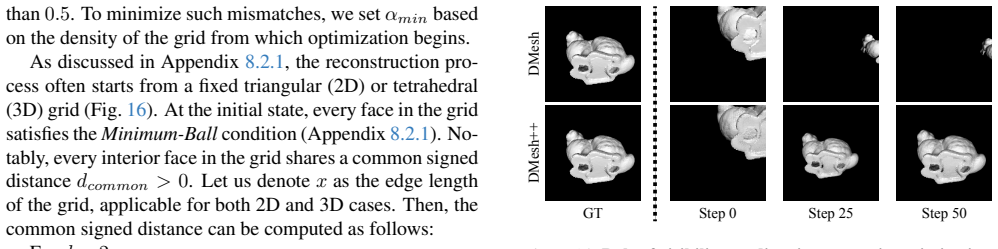
Figures from the paper (17 more)




Reference graph
Works this paper leans on
-
[1]
Power diagrams: properties, algo- rithms and applications
Franz Aurenhammer. Power diagrams: properties, algo- rithms and applications. SIAM Journal on Computing , 16 (1):78–96, 1987. 3
work page 1987
-
[2]
Continuous skele- ton computation by voronoi diagram
Jonathan W Brandt and V Ralph Algazi. Continuous skele- ton computation by voronoi diagram. CVGIP: Image under- standing, 55(3):329–338, 1992. 7
work page 1992
-
[3]
Fast poisson disk sampling in arbitrary di- mensions
Robert Bridson. Fast poisson disk sampling in arbitrary di- mensions. SIGGRAPH sketches, 10(1):1, 2007. 6
work page 2007
-
[4]
Learn- ing to predict 3d objects with an interpolation-based differ- entiable renderer
Wenzheng Chen, Huan Ling, Jun Gao, Edward Smith, Jaakko Lehtinen, Alec Jacobson, and Sanja Fidler. Learn- ing to predict 3d objects with an interpolation-based differ- entiable renderer. Advances in neural information processing systems, 32, 2019. 2
work page 2019
-
[5]
Meshanything: Artist-created mesh generation with au- toregressive transformers
Yiwen Chen, Tong He, Di Huang, Weicai Ye, Sijin Chen, Ji- axiang Tang, Xin Chen, Zhongang Cai, Lei Yang, Gang Yu, et al. Meshanything: Artist-created mesh generation with au- toregressive transformers. arXiv preprint arXiv:2406.10163,
-
[6]
Meshany- thing v2: Artist-created mesh generation with adjacent mesh tokenization
Yiwen Chen, Yikai Wang, Yihao Luo, Zhengyi Wang, Zilong Chen, Jun Zhu, Chi Zhang, and Guosheng Lin. Meshany- thing v2: Artist-created mesh generation with adjacent mesh tokenization. arXiv preprint arXiv:2408.02555, 2024. 1, 2
arXiv 2024
-
[7]
Zhiqin Chen, Andrea Tagliasacchi, Thomas Funkhouser, and Hao Zhang. Neural dual contouring. ACM Transactions on Graphics (TOG), 41(4):1–13, 2022. 5
work page 2022
-
[8]
Siu-Wing Cheng, Tamal Krishna Dey, Jonathan Shewchuk, and Sartaj Sahni. Delaunay mesh generation . CRC Press Boca Raton, 2013. 4
work page 2013
Show all 59 references
-
[9]
Meshlab: an open-source mesh processing tool
Paolo Cignoni, Marco Callieri, Massimiliano Corsini, Mat- teo Dellepiane, Fabio Ganovelli, Guido Ranzuglia, et al. Meshlab: an open-source mesh processing tool. In Eurographics Italian chapter conference , pages 129–136. Salerno, Italy, 2008. 6
2008
-
[10]
Objaverse: A universe of annotated 3d objects
Matt Deitke, Dustin Schwenk, Jordi Salvador, Luca Weihs, Oscar Michel, Eli VanderBilt, Ludwig Schmidt, Kiana Ehsani, Aniruddha Kembhavi, and Ali Farhadi. Objaverse: A universe of annotated 3d objects. In Proceedings of the IEEE/CVF Conference on Computer Vision and Pattern Rec...
2023
-
[11]
Variance reduction techniques for gradient estimates in rein- forcement learning
Evan Greensmith, Peter L Bartlett, and Jonathan Baxter. Variance reduction techniques for gradient estimates in rein- forcement learning. Journal of Machine Learning Research, 5(9), 2004. 10
2004
-
[12]
Meshudf: Fast and differentiable meshing of unsigned distance field networks
Benoit Guillard, Federico Stella, and Pascal Fua. Meshudf: Fast and differentiable meshing of unsigned distance field networks. In European Conference on Computer Vision , pages 576–592. Springer, 2022. 2
2022
-
[13]
2d gaussian splatting for geometrically ac- curate radiance fields
Binbin Huang, Zehao Yu, Anpei Chen, Andreas Geiger, and Shenghua Gao. 2d gaussian splatting for geometrically ac- curate radiance fields. In ACM SIGGRAPH 2024 conference papers, pages 1–11, 2024. 8
2024
-
[14]
3D triangulations
Cl ´ement Jamin, Sylvain Pion, and Monique Teillaud. 3D triangulations. In CGAL User and Reference Manual. CGAL Editorial Board, 5.6 edition, 2023. 3
2023
-
[15]
Large scale multi-view stereopsis eval- uation
Rasmus Jensen, Anders Dahl, George V ogiatzis, Engin Tola, and Henrik Aanæs. Large scale multi-view stereopsis eval- uation. In Proceedings of the IEEE conference on computer vision and pattern recognition, pages 406–413, 2014. 7, 8
2014
-
[16]
Dual contouring of hermite data
Tao Ju, Frank Losasso, Scott Schaefer, and Joe Warren. Dual contouring of hermite data. In Proceedings of the 29th an- nual conference on Computer graphics and interactive tech- niques, pages 339–346, 2002. 2
2002
-
[17]
Screened poisson sur- face reconstruction
Michael Kazhdan and Hugues Hoppe. Screened poisson sur- face reconstruction. ACM Transactions on Graphics (ToG), 32(3):1–13, 2013. 6
2013
-
[18]
3d gaussian splatting for real-time radiance field rendering
Bernhard Kerbl, Georgios Kopanas, Thomas Leimk ¨uhler, and George Drettakis. 3d gaussian splatting for real-time radiance field rendering. ACM Transactions on Graphics, 42 (4), 2023. 2, 8
2023
-
[19]
Modular primitives for high-performance differentiable rendering
Samuli Laine, Janne Hellsten, Tero Karras, Yeongho Seol, Jaakko Lehtinen, and Timo Aila. Modular primitives for high-performance differentiable rendering. ACM Transac- tions on Graphics (TOG), 39(6):1–14, 2020. 2, 3
2020
-
[20]
Deep march- ing cubes: Learning explicit surface representations
Yiyi Liao, Simon Donne, and Andreas Geiger. Deep march- ing cubes: Learning explicit surface representations. In Pro- ceedings of the IEEE Conference on Computer Vision and Pattern Recognition, pages 2916–2925, 2018. 2
2018
-
[21]
Soft ras- terizer: A differentiable renderer for image-based 3d reason- ing
Shichen Liu, Tianye Li, Weikai Chen, and Hao Li. Soft ras- terizer: A differentiable renderer for image-based 3d reason- ing. In Proceedings of the IEEE/CVF International Confer- ence on Computer Vision, pages 7708–7717, 2019. 2
2019
-
[22]
Neudf: Leaning neural unsigned distance fields with volume rendering
Yu-Tao Liu, Li Wang, Jie Yang, Weikai Chen, Xiaoxu Meng, Bo Yang, and Lin Gao. Neudf: Leaning neural unsigned distance fields with volume rendering. In Proceedings of the IEEE/CVF Conference on Computer Vision and Pattern Recognition, pages 237–247, 2023. 2
2023
-
[23]
Ghost on the shell: An expressive representation of general 3d shapes
Zhen Liu, Yao Feng, Yuliang Xiu, Weiyang Liu, Liam Paull, Michael J Black, and Bernhard Sch ¨olkopf. Ghost on the shell: An expressive representation of general 3d shapes. arXiv preprint arXiv:2310.15168, 2023. 2, 7, 6
2023 arXiv
-
[24]
Neuraludf: Learning unsigned distance fields for multi-view reconstruction of surfaces with arbitrary topolo- gies
Xiaoxiao Long, Cheng Lin, Lingjie Liu, Yuan Liu, Peng Wang, Christian Theobalt, Taku Komura, and Wenping Wang. Neuraludf: Learning unsigned distance fields for multi-view reconstruction of surfaces with arbitrary topolo- gies. In Proceedings of the IEEE/CVF Conference on Com- ...
-
[25]
Marching cubes: A high resolution 3d surface construction algorithm
William E Lorensen and Harvey E Cline. Marching cubes: A high resolution 3d surface construction algorithm. InSem- inal graphics: pioneering efforts that shaped the field, pages 347–353. 1998. 2
1998
-
[26]
V oromesh: Learning water- tight surface meshes with voronoi diagrams
Nissim Maruani, Roman Klokov, Maks Ovsjanikov, Pierre Alliez, and Mathieu Desbrun. V oromesh: Learning water- tight surface meshes with voronoi diagrams. In Proceedings of the IEEE/CVF International Conference on Computer Vi- sion, pages 14565–14574, 2023. 6
2023
-
[27]
Ponq: a neural qem-based mesh representation
Nissim Maruani, Maks Ovsjanikov, Pierre Alliez, and Math- ieu Desbrun. Ponq: a neural qem-based mesh representation. In Proceedings of the IEEE/CVF Conference on Computer Vision and Pattern Recognition, pages 3647–3657, 2024. 6, 7
2024
-
[28]
A level set theory for neural implicit evolution under 9 explicit flows
Ishit Mehta, Manmohan Chandraker, and Ravi Ramamoor- thi. A level set theory for neural implicit evolution under 9 explicit flows. In European Conference on Computer Vision, pages 711–729. Springer, 2022. 2
2022
-
[29]
Extracting triangular 3d models, materials, and lighting from images
Jacob Munkberg, Jon Hasselgren, Tianchang Shen, Jun Gao, Wenzheng Chen, Alex Evans, Thomas M¨uller, and Sanja Fi- dler. Extracting triangular 3d models, materials, and lighting from images. In Proceedings of the IEEE/CVF Conference on Computer Vision and Pattern Recognition , ...
2022
-
[30]
Scalable parallel programming with cuda: Is cuda the parallel programming model that application developers have been waiting for? Queue, 6(2):40–53, 2008
John Nickolls, Ian Buck, Michael Garland, and Kevin Skadron. Scalable parallel programming with cuda: Is cuda the parallel programming model that application developers have been waiting for? Queue, 6(2):40–53, 2008. 5
2008
-
[31]
Large steps in inverse rendering of geometry
Baptiste Nicolet, Alec Jacobson, and Wenzel Jakob. Large steps in inverse rendering of geometry. ACM Transactions on Graphics (TOG), 40(6):1–13, 2021. 2
2021
-
[32]
Unisurf: Unifying neural implicit surfaces and radiance fields for multi-view reconstruction
Michael Oechsle, Songyou Peng, and Andreas Geiger. Unisurf: Unifying neural implicit surfaces and radiance fields for multi-view reconstruction. In International Con- ference on Computer Vision (ICCV), 2021. 2
2021
-
[33]
Continuous remeshing for inverse render- ing
Werner Palfinger. Continuous remeshing for inverse render- ing. Computer Animation and Virtual Worlds, 33(5):e2101,
-
[34]
Deepsdf: Learning con- tinuous signed distance functions for shape representation
Jeong Joon Park, Peter Florence, Julian Straub, Richard Newcombe, and Steven Lovegrove. Deepsdf: Learning con- tinuous signed distance functions for shape representation. In Proceedings of the IEEE/CVF conference on computer vi- sion and pattern recognition, pages 165–174, 2019. 2
2019
-
[35]
Automatic differentiation in pytorch
Adam Paszke, Sam Gross, Soumith Chintala, Gregory Chanan, Edward Yang, Zachary DeVito, Zeming Lin, Al- ban Desmaison, Luca Antiga, and Adam Lerer. Automatic differentiation in pytorch. 2017. 5
2017
-
[36]
Illumination for computer generated pic- tures
Bui Tuong Phong. Illumination for computer generated pic- tures. In Seminal graphics: pioneering efforts that shaped the field, pages 95–101. 1998. 7
1998
-
[37]
Accelerating 3d deep learning with pytorch3d
Nikhila Ravi, Jeremy Reizenstein, David Novotny, Tay- lor Gordon, Wan-Yen Lo, Justin Johnson, and Georgia Gkioxari. Accelerating 3d deep learning with pytorch3d. arXiv preprint arXiv:2007.08501, 2020. 4
2007 arXiv
-
[38]
Deep marching tetrahedra: a hybrid repre- sentation for high-resolution 3d shape synthesis
Tianchang Shen, Jun Gao, Kangxue Yin, Ming-Yu Liu, and Sanja Fidler. Deep marching tetrahedra: a hybrid repre- sentation for high-resolution 3d shape synthesis. Advances in Neural Information Processing Systems , 34:6087–6101,
-
[39]
Flexible isosurface extraction for gradient-based mesh optimization
Tianchang Shen, Jacob Munkberg, Jon Hasselgren, Kangxue Yin, Zian Wang, Wenzheng Chen, Zan Gojcic, Sanja Fidler, Nicholas Sharp, and Jun Gao. Flexible isosurface extraction for gradient-based mesh optimization. ACM Transactions on Graphics (TOG), 42(4):1–16, 2023. 2, 7, 6
2023
-
[40]
Spacemesh: A continuous representation for learning man- ifold surface meshes
Tianchang Shen, Zhaoshuo Li, Marc Law, Matan Atzmon, Sanja Fidler, James Lucas, Jun Gao, and Nicholas Sharp. Spacemesh: A continuous representation for learning man- ifold surface meshes. arXiv preprint arXiv:2409.20562 ,
-
[41]
Meshgpt: Generating triangle meshes with decoder-only transformers
Yawar Siddiqui, Antonio Alliegro, Alexey Artemov, Ta- tiana Tommasi, Daniele Sirigatti, Vladislav Rosov, Angela Dai, and Matthias Nießner. Meshgpt: Generating triangle meshes with decoder-only transformers. In Proceedings of the IEEE/CVF Conference on Computer Vision and Patte...
2024
-
[42]
Dmesh: A differentiable represen- tation for general meshes
Sanghyun Son, Matheus Gadelha, Yang Zhou, Zexiang Xu, Ming C Lin, and Yi Zhou. Dmesh: A differentiable represen- tation for general meshes. arXiv preprint arXiv:2404.13445,
-
[43]
Visualizing data using t-sne
Laurens Van der Maaten and Geoffrey Hinton. Visualizing data using t-sne. Journal of machine learning research , 9 (11), 2008. 2
2008
-
[44]
Neus: Learning neural implicit surfaces by volume rendering for multi-view reconstruction
Peng Wang, Lingjie Liu, Yuan Liu, Christian Theobalt, Taku Komura, and Wenping Wang. Neus: Learning neural implicit surfaces by volume rendering for multi-view reconstruction. arXiv preprint arXiv:2106.10689, 2021. 2
2021 arXiv
-
[45]
Neus2: Fast learning of neural implicit surfaces for multi-view recon- struction
Yiming Wang, Qin Han, Marc Habermann, Kostas Dani- ilidis, Christian Theobalt, and Lingjie Liu. Neus2: Fast learning of neural implicit surfaces for multi-view recon- struction. In Proceedings of the IEEE/CVF International Conference on Computer Vision (ICCV), 2023
2023
-
[46]
Neumanifold: Neural watertight manifold reconstruction with efficient and high- quality rendering support
Xinyue Wei, Fanbo Xiang, Sai Bi, Anpei Chen, Kalyan Sunkavalli, Zexiang Xu, and Hao Su. Neumanifold: Neural watertight manifold reconstruction with efficient and high- quality rendering support. arXiv preprint arXiv:2305.17134,
-
[47]
Meshlrm: Large reconstruction model for high- quality mesh
Xinyue Wei, Kai Zhang, Sai Bi, Hao Tan, Fujun Luan, Valentin Deschaintre, Kalyan Sunkavalli, Hao Su, and Zex- iang Xu. Meshlrm: Large reconstruction model for high- quality mesh. arXiv preprint arXiv:2404.12385, 2024. 2
2024 arXiv
-
[48]
Simple statistical gradient-following al- gorithms for connectionist reinforcement learning
Ronald J Williams. Simple statistical gradient-following al- gorithms for connectionist reinforcement learning. Machine learning, 8:229–256, 1992. 9, 10
1992
-
[49]
V olume rendering of neural implicit surfaces
Lior Yariv, Jiatao Gu, Yoni Kasten, and Yaron Lipman. V olume rendering of neural implicit surfaces. In Thirty- Fifth Conference on Neural Information Processing Systems,
-
[50]
Surf-d: High-quality surface generation for arbitrary topologies using diffusion models
Zhengming Yu, Zhiyang Dou, Xiaoxiao Long, Cheng Lin, Zekun Li, Yuan Liu, Norman M ¨uller, Taku Komura, Marc Habermann, Christian Theobalt, et al. Surf-d: High-quality surface generation for arbitrary topologies using diffusion models. arXiv preprint arXiv:2311.17050, 2023. 2
2023 arXiv
-
[51]
Clay: A controllable large-scale generative model for creat- ing high-quality 3d assets
Longwen Zhang, Ziyu Wang, Qixuan Zhang, Qiwei Qiu, Anqi Pang, Haoran Jiang, Wei Yang, Lan Xu, and Jingyi Yu. Clay: A controllable large-scale generative model for creat- ing high-quality 3d assets. ACM Transactions on Graphics (TOG), 43(4):1–20, 2024. 2
2024
-
[52]
Thingi10k: A dataset of 10,000 3d-printing models
Qingnan Zhou and Alec Jacobson. Thingi10k: A dataset of 10,000 3d-printing models. arXiv preprint arXiv:1605.04797, 2016. 2, 5, 6, 7
2016 arXiv
-
[53]
Fully convolutional mesh autoencoder using efficient spatially varying kernels
Yi Zhou, Chenglei Wu, Zimo Li, Chen Cao, Yuting Ye, Jason Saragih, Hao Li, and Yaser Sheikh. Fully convolutional mesh autoencoder using efficient spatially varying kernels. Ad- vances in neural information processing systems , 33:9251– 9262, 2020. 2 10 DMesh++: An Efficient Di...
2020
-
[55]
Details about Minimum-Ball algorithm 7.1. Algorithm Algorithm 1 Minimum-Ball 1: P, F ← Set of points and query faces 2: αmin ← Coefficient for sigmoid function 3: Bc F, Br F ← Compute-Minimum-Ball(P, F) 4: P nearest F ← Find-Nearest-Neighbor(Bc F, P) 5: d(BF, P) ← Br F − ||P n...
2000
-
[56]
Details about Reconstruction Process In this section, we provide implementation details about our reconstruction process described in Sec. 4. Before delving into these details, we introduce the loss formulations for re- construction problems. 8.1. Loss Formulation Our final lo...
-
[57]
imaginary
Experimental Details and Additional Results In this section, we outline the experimental settings used for the results in Sec. 5 and present additional results to support our claims. 9.1. Dataset Here, we provide details on the datasets described in Sec. 5.2. 9.1.1. Font We us...
2000
-
[58]
As discussed in Sec
Reinforce-Ball algorithm Here we introduce an experimental algorithm that further enhances DMesh++’s capability. As discussed in Sec. 3.1, DMesh++ no longer uses the per-point weights found in DMesh [42]. In DMesh, optimizing per-point weights helps control mesh complexity: st...
-
[59]
cardinality
We optimize Φ(P) to do that. be: 0.2 + (1.0 − 0.2) · 1.0 = 1.0. (17) However, the alpha blending technique used here does not account for such dependencies, leading to a reduction in ac- cumulated opacity. This reduction artificially increases the reconstruction loss. To minim...
-
[2024]
1, 2, 3, 4, 5, 6, 7, 8, 10
Reviewed August 11, 2026 · model on record in the stance chip above.
Discussion (0). Continue with ORCID to comment.