REVIEW 4 major objections 5 minor 3 cited by
PromptDresser: Improving the Quality and Controllability of Virtual Try-On via Generative Textual Prompt and Prompt-aware Mask
T0 review · 4 major / 5 minor · reviewed 2026-08-11 · deepseek-v4-flash
Pith's one-line read Text prompts can drive how virtual try-on clothing fits, tucks, and rolls.
desk verdict A well-ablated text-editable try-on paper whose main contribution is the LMM-captioning + prompt-aware mask combination; the SOTA claim rests on unpaired metrics and the PMG step needs direct validation, but it deserves a serious referee. read the letter →
The pith
A machine-rendered reading of the paper's core claim, the machinery that carries it, and where it could break.
The reading
What carries the argument
The load-bearing mechanism is the pair formed by LMM-driven captioning and the prompt-aware mask. The captioning step uses in-context learning with a hand-labeled few-shot exemplar set to produce attribute-specific captions for the person and clothing images separately, so no textual description of the original outfit leaks into the generation. The mask mechanism is the training-time random dilation augmentation, $m_d=(m_f \oplus_n b)\cap m_c$, which forces the model to handle masks from fine to coarse, and the inference-time Prompt-aware Mask Generation (PMG), which uses an early-stopped denoising pass to $\sigma=0.5$, a human parsing model, and a union with the fine mask to set the actual editing region. PMG is what lets the model align the edited area with the text prompt instead of following the original garment's silhouette.
What would settle it
Take a set of test images with manual segmentations of the requested garment style, run PMG with $\sigma=0.5$, and compute the overlap (IoU) between the parsed coarse mask and the final generated garment region; also rerun the pipeline with a different human parsing model. If the IoU is low or the text-alignment accuracy changes sharply with the parsing model, the early-stop preview is not carrying the mask-refinement claim.
Extended reading notes
Core claim
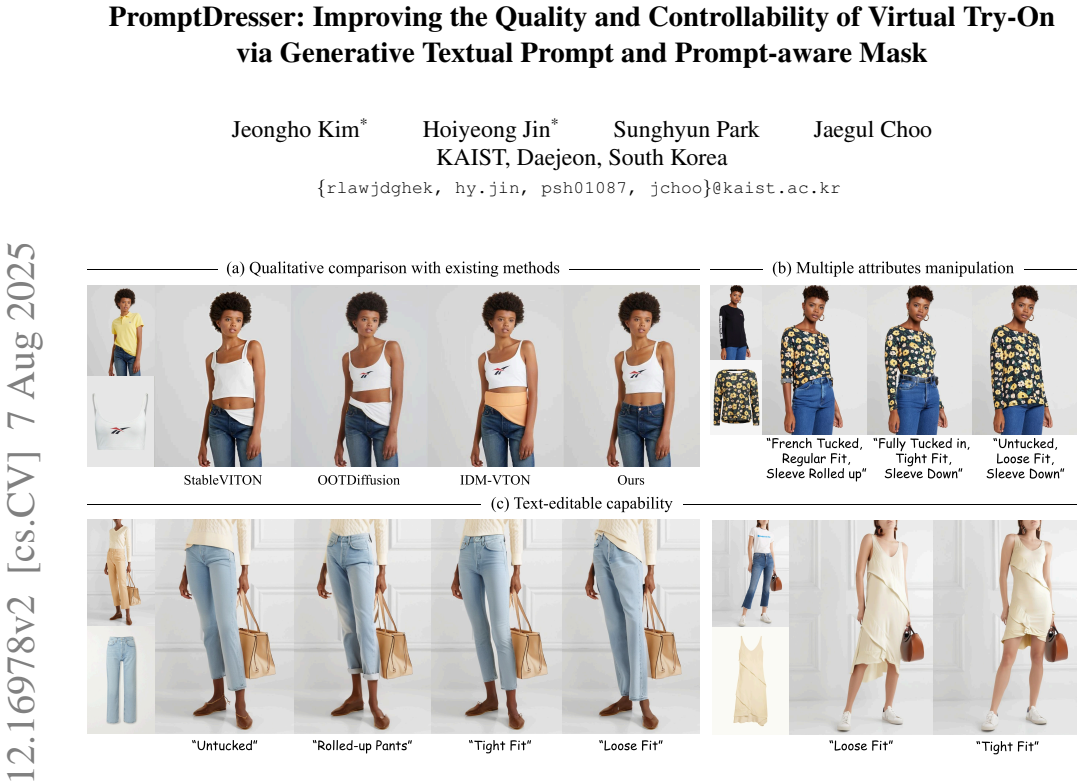
The central claim is that text-editable virtual try-on succeeds when the caption and the mask are both aligned to the requested style. The authors separate the prompt into person-specific attributes (body shape, pose, hand pose, tucking style) and clothing-specific attributes (category, material, neckline, sleeve), generated separately by an LMM with few-shot exemplars, then combined into a main prompt such as 'a slender woman wears tight, t-shirt (cotton), crew, short sleeve, untucked.' This separation prevents the original garment's text from contaminating the new garment, and the pose description replaces dense pose maps. The mask is trained with random dilation, $m_d=(m_f \oplus_n b)\cap m_c$, so the model learns to inpaint over both narrow and wide regions. At inference, Prompt-aware Mask Generation runs denoising only up to $\sigma T$ (with $\sigma=0.5$), parses the resulting preview with a human parsing model to obtain a coarse mask matching the text, and unions it with the fine agnostic mask; the result is the actual inpaint region. On VITON-HD and DressCode, the paper reports improved image-quality metrics and larger text-alignment accuracy over the compared baselines.
Load-bearing premise
The load-bearing assumption is that an early-stopped denoising preview at $\sigma=0.5$ is faithful enough for an off-the-shelf human parsing model to segment a clothing mask that matches the text; if the preview does not resemble the final garment for complex poses, transparent layers, or unusual styles, the refined mask will either erase person details or keep the original clothing shape.
Editorial extensions
If this is right
- Users can edit a garment's tucking style, fit, and sleeve state with natural-language instructions, not just swap the garment image.
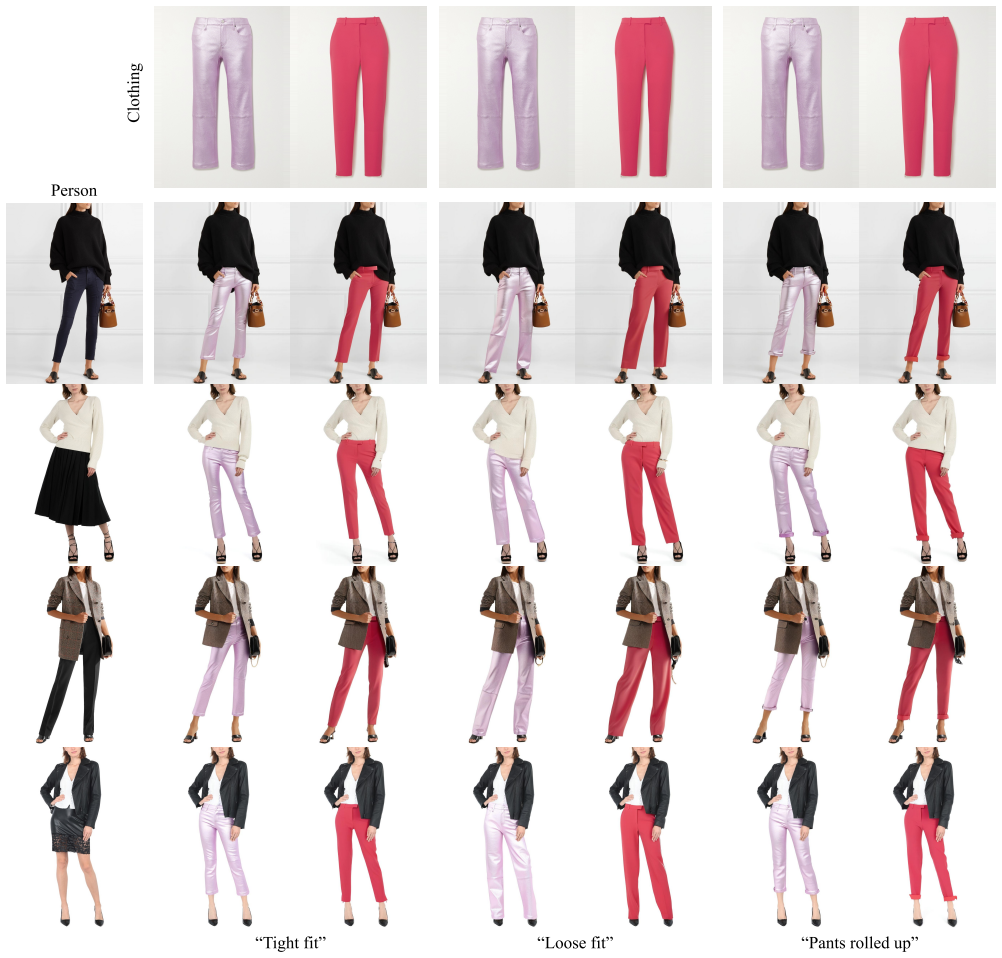
- Because the mask adapts to the prompt, the same model can handle tops, bottoms, and dresses without being locked to the original clothing's length or silhouette.
- The separate person and clothing captions allow unpaired person-clothing combinations, so arbitrary reference garments can be described even when the dataset has no paired caption.
- The random dilation training makes the model robust to mask shapes at inference, which is what enables the coarse-to-fine PMG to work.
- Text-alignment accuracy for attributes like 'untucked' and 'tight fit' rises well above the dataset base rate, indicating that the prompt actually steers the output.
Reading between the lines
- The same recipe of separate attribute captions plus a prompt-dependent mask could transfer to other text-driven inpainting tasks where the edited region's extent is itself content-dependent, such as hair, pose, or background editing.
- A direct stress test of PMG would be to compare the early-stopped preview's parsed mask against the final garment silhouette on hard cases such as transparent fabrics, complex poses, and multi-layer outfits; the paper's sigma ablation and supplementary transparent-layer examples suggest the margin is thin there.
- Because the 77-token CLIP text encoder forces the current hand-built in-context exemplars, moving to a longer-context text encoder would let the captioning include finer local details such as logos and prints, which the paper currently excludes, potentially improving fidelity.
- The reported text-alignment metric uses an LMM as labeler; although the paper adds a human study, an independent non-LMM automatic metric would guard against circularity between the caption generator and the evaluator.
Editorial analysis
A structured set of objections, weighed in public.
Referee Report
Summary. PromptDresser is a text-editable virtual try-on method built on an SDXL inpainting backbone. It uses GPT-4o with in-context learning to generate separate person and clothing captions, a random dilation mask augmentation during training, and a prompt-aware mask generation (PMG) procedure at inference that early-stops denoising, parses the decoded preview with an off-the-shelf human parsing model, and unions the resulting coarse mask with the fine mask. The paper reports quantitative comparisons on VITON-HD, DressCode, and SHHQ-1.0, claims state-of-the-art performance, and presents ablations, a text-alignment evaluation, and a user study.
Significance. If the method and its evaluation hold up, the paper makes a useful contribution to controllable virtual try-on: it demonstrates a concrete way to use LMM-generated textual prompts for fine-grained attributes such as tucking and fit, and it addresses the real problem that fixed clothing-agnostic masks constrain the garment shape. The strengths are explicit and should be credited: the code is released, the ablation studies cover several design choices, the user study is a genuine human evaluation, and the supplementary material shows robustness to an alternative open-source LMM (LLaVA) and an inference-time comparison with IDM-VTON. However, the significance is conditional on validating the key PMG component, since the current evidence does not directly measure whether the prompt-aware mask is correct, and on tempering the state-of-the-art claim, since the paired metrics are not state-of-the-art.
major comments (4)
- [§3.4, Fig. 3, Table 6] The load-bearing step of the method, Prompt-aware Mask Generation, is not directly validated. PMG runs denoising only to sigma*T, decodes the preview, and segments it with an unnamed off-the-shelf human parsing model; the union of that coarse mask with the fine mask defines the inpainting region. The sigma ablation in Table 6 reports only final image metrics (SSIM, LPIPS, FID, KID), which are aggregate and do not reveal whether the mask is semantically aligned with the text prompt. For the advertised use cases, cross-category edits such as pants-to-skirt and transparent or multi-layer garments in Fig. 9, a wrong preview can produce a mask that either erases person details or retains the old garment shape. Please name the parsing model, report direct mask-quality metrics (e.g., IoU against a text-conditioned ground-truth mask or human-labeled masks), and include a failure analysis with representative cases. This is necessary to support the claim that PMG, rather than the mask augmentation alone, enables text-driven control.
- [§3.4, Eq. (3)] There is a training/inference distribution mismatch for masks. In training, masks are generated by random dilation of the fine mask constrained by the coarse mask, per Eq. (3). In inference, the mask is obtained by parsing a partially denoised preview, which is a different distribution. The model is therefore not trained on the exact masks PMG produces, and the reported improvements could come from the general ability to handle wider masks rather than from prompt-aware mask contents. Please provide a controlled experiment that isolates prompt-awareness, for example by comparing PMG masks against prompt-agnostic masks of similar size on the text-alignment task, and either demonstrate that the parser-derived masks fall within the training mask distribution or describe how the model was adapted to them.
- [Tables 1 and 2, Abstract] The claim of state-of-the-art performance is stronger than what the paired metrics show. In Table 1 on VITON-HD, the proposed method has SSIM 0.8686, lower than StableVITON's 0.8757, and LPIPS 0.1119, higher than IDM-VTON's 0.1023; a similar pattern appears in the DressCode upper-body and dress rows in Table 2, where IDM-VTON has better LPIPS. The state-of-the-art claim rests on FID and KID, which are unpaired metrics reported without error bars or statistical significance tests. Please report confidence intervals or multiple-seed results, and revise the abstract and conclusion to distinguish paired-image fidelity from unpaired distribution quality. This is important because the title and abstract emphasize quality improvement, not only distribution-level realism.
- [§4.2, Table 3, Table 8] The text-alignment evaluation is partially circular. Table 3 uses GPT-4o to judge whether edited images match the intended attribute, and GPT-4o is also the model used to generate the captions that condition the method. The human STS check in Table 8 covers only 100 images, and the user study in Fig. 8(c) is a preference test rather than per-attribute accuracy on the full protocol. In addition, the 'untucked' result of 89.42% should be interpreted against the base rate of 44.64%: please report balanced accuracy or another base-rate-adjusted measure. Please add human per-attribute accuracy on a sufficiently large stratified sample of the 2,032-image protocol, with confidence intervals, or re-run the full evaluation with a different judge model and with human labels.
minor comments (5)
- [§3.4] In the paragraph on random dilation mask augmentation, 'The course mask' should be 'The coarse mask'.
- [Table 4] The caption says 'Comparison of qualitative results' but the table reports quantitative metrics; it should say 'quantitative results'.
- [Tables 1 and 4] The notation 'Ourspose' is awkward and should be formatted consistently, for example 'Ours$_{pose}$', and defined in the table caption.
- [Eq. (3)] The notation $\oplus_n$ for n-iterated dilation is used before it is defined in the sentence; please define it in-place and ensure the symbol matches the surrounding text.
- [Fig. 3] The figure does not make explicit how the text prompt enters the early-stopped denoising pass that produces the coarse mask; please clarify the conditioning path so that the prompt-aware nature of the mask is visually verifiable.
Circularity Check
No significant circularity; one self-referential LMM evaluation loop is mitigated by human checks and external FID/KID benchmarks.
-
other
[Section 4.2 (Evaluation on Text Alignment); Supplementary C (Implementation Details)]
"To validate our method’s editing capability, we generated edited versions of 2,032 test images from VITON-HD by fixing a specific attribute (e.g., “tucking style”) to a caption (e.g., “untucked”) and then evaluated whether the captions generated by the LMM for these edited images matched the intended caption."
Section 4.2 defines text-alignment accuracy as whether the captions generated by the LMM match the intended caption, while Supplementary C states that GPT-4o is used to automatically generate captions for all experimental datasets. Thus the same LMM family both defines the target attribute vocabulary used to condition the model and judges whether the generated image satisfies that attribute. The reported 89.42% accuracy for 'untucked' therefore measures agreement between PromptDresser and GPT-4o's own labeling preferences rather than an independent human measurement of text alignment.
full rationale
PromptDresser's core derivation chain is empirical and largely self-contained: an SDXL inpainting backbone is trained with LMM-generated attribute captions (Eq. 2) and randomly dilated masks (Eq. 3), and at inference Prompt-aware Mask Generation refines the mask via early-stopped denoising followed by an off-the-shelf human parsing model. None of these components is defined in terms of the reported FID/KID or text-alignment numbers. The quality claims are benchmarked against external baselines (LADI-VTON, DCI-VTON, StableVITON, OOTDiffusion, IDM-VTON) on standard datasets; the authors' own StableVITON and VITON-HD appear only as a baseline and a dataset, not as a load-bearing self-citation or uniqueness argument. The only self-referential element is the text-alignment evaluation in Table 3, where GPT-4o both generated the training captions and labels the edited outputs; however, the paper provides a human STS validation (Table 8) and a user study (Fig. 8c) that independently assess text alignment, and the main unpaired quality metrics are external. PMG's self-conditioning loop, in which the mask is estimated from the model's own early-stopped preview, is a potential robustness risk for cross-category or transparent-garment edits, but it is not a logical circularity because the refined mask is not equivalent to the final output by construction. Overall, no central claim reduces to its inputs by definition or by a self-citation chain.
Assumptions & free parameters
free parameters (5)
- Early-stopping ratio sigma in PMG =
0.5
- Attribute sets A_p, A_c =
Manually curated lists (body shape, fit, tucking style, material, etc.)
- In-context few-shot examples D_ex =
N manually labeled exemplar images (3 per category shown in supplementary)
- Dilation parameters n and structuring element b =
Not specified in main text ('sufficiently large but finite n')
- Number of denoising steps =
30
assumptions (4)
- domain assumption LMM-generated captions are accurate and complete for the pre-defined attributes
- domain assumption The human parsing model can reliably segment the early-stopped denoised image to obtain the coarse mask
- domain assumption Reference attention features from a frozen U-Net preserve fine clothing details when concatenated into the main U-Net
- domain assumption Training with randomly dilated masks generalizes to arbitrary test-time mask shapes
Cite this review
Pith. "Pith review of PromptDresser: Improving the Quality and Controllability of Virtual Try-On via Generative Textual Prompt and Prompt-aware Mask." pith.science (2026). https://pith.science/paper/5UTZLHYT
@misc{pith2026241216978,
  author       = {Pith},
  title        = {Pith review of: PromptDresser: Improving the Quality and Controllability of Virtual Try-On via Generative Textual Prompt and Prompt-aware Mask},
  year         = {2026},
  howpublished = {\url{https://pith.science/paper/5UTZLHYT}},
  note         = {Machine review of arXiv:2412.16978}
}
read the original abstract
Recent virtual try-on approaches have advanced by finetuning pre-trained text-to-image diffusion models to leverage their powerful generative ability. However, the use of text prompts in virtual try-on remains underexplored. This paper tackles a text-editable virtual try-on task that modifies the clothing based on the provided clothing image while editing the wearing style (e.g., tucking style, fit) according to the text descriptions. In the text-editable virtual try-on, three key aspects exist: (i) designing rich text descriptions for paired person-clothing data to train the model, (ii) addressing the conflicts where textual information of the existing person's clothing interferes the generation of the new clothing, and (iii) adaptively adjust the inpainting mask aligned with the text descriptions, ensuring proper editing areas while preserving the original person's appearance irrelevant to the new clothing. To address these aspects, we propose PromptDresser, a text-editable virtual try-on model that leverages large multimodal model (LMM) assistance to enable high-quality and versatile manipulation based on generative text prompts. Our approach utilizes LMMs via in-context learning to generate detailed text descriptions for person and clothing images independently, including pose details and editing attributes using minimal human cost. Moreover, to ensure the editing areas, we adjust the inpainting mask depending on the text prompts adaptively. Our approach enhances text editability while effectively conveying clothing details that are difficult to capture through images alone, leading to improved image quality. Experiments show that PromptDresser significantly outperforms baselines, demonstrating superior text-driven control and versatile clothing manipulation. Our code is available at https://github.com/rlawjdghek/PromptDresser.
Figures


Figures from the paper (14 more)


Forward citations
Cited by 3 Pith papers
-
Structure-Detail Decoupled Autoregressive Generation for Fast and High-Fidelity Virtual Try-On
STAR-VTON decouples latent VAR structure synthesis from pixel-space matching-based detail recovery, yielding faster high-fidelity virtual try-on than diffusion baselines.
-
Oxygen-TryOn: Fashion-Native Foundation Model for Any-item Virtual Try-On
Oxygen-TryOn performs any-item, multi-reference virtual try-on via understanding-driven generation, reporting state-of-the-art scores on public and internal benchmarks.
-
WearWow: Native 2K Multi-Garment Virtual Try-On via Adaptive Token Packing and Preference Alignment
WearWow generates native 2K multi-garment virtual try-on images without masks, using token packing plus dual preference rewards to preserve fabric texture.
Reference graph
Works this paper leans on
-
[1]
Gpt-4 technical report.arXiv preprint arXiv:2303.08774,
Josh Achiam, Steven Adler, Sandhini Agarwal, Lama Ah- mad, Ilge Akkaya, Florencia Leoni Aleman, Diogo Almeida, Janko Altenschmidt, Sam Altman, Shyamal Anadkat, et al. Gpt-4 technical report.arXiv preprint arXiv:2303.08774,
-
[2]
Flamingo: a visual language model for few-shot learning.Advances in neural information processing systems, 35:23716–23736,
Jean-Baptiste Alayrac, Jeff Donahue, Pauline Luc, Antoine Miech, Iain Barr, Yana Hasson, Karel Lenc, Arthur Men- sch, Katherine Millican, Malcolm Reynolds, et al. Flamingo: a visual language model for few-shot learning.Advances in neural information processing systems, 35:23716–23736,
-
[3]
Single stage virtual try-on via deformable attention flows
Shuai Bai, Huiling Zhou, Zhikang Li, Chang Zhou, and Hongxia Yang. Single stage virtual try-on via deformable attention flows. InEuropean Conference on Computer Vi- sion, pages 409–425. Springer, 2022. 2
work page 2022
-
[4]
Simone Bianco, Luigi Celona, Marco Donzella, and Paolo Napoletano. Improving image captioning descriptive- ness by ranking and llm-based fusion.arXiv preprint arXiv:2306.11593, 2023. 3
arXiv 2023
-
[5]
Demystifying mmd gans.arXiv preprint arXiv:1801.01401, 2018
Mikołaj Bi ´nkowski, Danica J Sutherland, Michael Arbel, and Arthur Gretton. Demystifying mmd gans.arXiv preprint arXiv:1801.01401, 2018. 7
arXiv 2018
-
[6]
In- structpix2pix: Learning to follow image editing instructions
Tim Brooks, Aleksander Holynski, and Alexei A Efros. In- structpix2pix: Learning to follow image editing instructions. InProceedings of the IEEE/CVF Conference on Computer Vision and Pattern Recognition, pages 18392–18402, 2023. 3
2023
-
[7]
Language models are few-shot learners
Tom B Brown. Language models are few-shot learners. arXiv preprint arXiv:2005.14165, 2020. 5
arXiv 2005
-
[8]
Junsong Chen, Jincheng Yu, Chongjian Ge, Lewei Yao, Enze Xie, Yue Wu, Zhongdao Wang, James Kwok, Ping Luo, Huchuan Lu, et al. Pixart-α: Fast training of diffusion transformer for photorealistic text-to-image synthesis.arXiv preprint arXiv:2310.00426, 2023. 2, 3
Show all 57 references
-
[9]
Wear-any-way: Manip- ulable virtual try-on via sparse correspondence alignment
Mengting Chen, Xi Chen, Zhonghua Zhai, Chen Ju, Xuewen Hong, Jinsong Lan, and Shuai Xiao. Wear-any-way: Manip- ulable virtual try-on via sparse correspondence alignment. arXiv preprint arXiv:2403.12965, 2024. 2, 3
2024 arXiv
-
[10]
Viton-hd: High-resolution virtual try-on via misalignment-aware normalization
Seunghwan Choi, Sunghyun Park, Minsoo Lee, and Jaegul Choo. Viton-hd: High-resolution virtual try-on via misalignment-aware normalization. InCVPR, pages 14131– 14140, 2021. 2, 4, 5, 6, 1
2021
-
[11]
Improving diffusion models for vir- tual try-on.arXiv preprint arXiv:2403.05139, 2024
Yisol Choi, Sangkyung Kwak, Kyungmin Lee, Hyungwon Choi, and Jinwoo Shin. Improving diffusion models for vir- tual try-on.arXiv preprint arXiv:2403.05139, 2024. 2, 3, 1
2024 arXiv
-
[12]
Torchmetrics-measuring reproducibility in pytorch
Nicki Skafte Detlefsen, Jiri Borovec, Justus Schock, Ananya Harsh Jha, Teddy Koker, Luca Di Liello, Daniel Stancl, Changsheng Quan, Maxim Grechkin, and William Falcon. Torchmetrics-measuring reproducibility in pytorch. Journal of Open Source Software, 7(70):4101, 2022. 7
2022
-
[13]
Diffusion models beat gans on image synthesis.Advances in neural informa- tion processing systems, 34:8780–8794, 2021
Prafulla Dhariwal and Alexander Nichol. Diffusion models beat gans on image synthesis.Advances in neural informa- tion processing systems, 34:8780–8794, 2021. 2
2021
-
[14]
Scaling rectified flow transformers for high-resolution image synthesis
Patrick Esser, Sumith Kulal, Andreas Blattmann, Rahim Entezari, Jonas M ¨uller, Harry Saini, Yam Levi, Dominik Lorenz, Axel Sauer, Frederic Boesel, et al. Scaling rectified flow transformers for high-resolution image synthesis. 2024. 8
2024
-
[15]
Stylegan-human: A data-centric odyssey of human genera- tion.arXiv preprint, arXiv:2204.11823, 2022
Jianglin Fu, Shikai Li, Yuming Jiang, Kwan-Yee Lin, Chen Qian, Chen-Change Loy, Wayne Wu, and Ziwei Liu. Stylegan-human: A data-centric odyssey of human genera- tion.arXiv preprint, arXiv:2204.11823, 2022. 2
2022 arXiv
-
[16]
Parser-free virtual try-on via distilling appearance flows
Yuying Ge, Yibing Song, Ruimao Zhang, Chongjian Ge, Wei Liu, and Ping Luo. Parser-free virtual try-on via distilling appearance flows. InCVPR, pages 8485–8493, 2021. 2
2021
-
[17]
Generative adversarial networks.Commu- nications of the ACM, 63(11):139–144, 2020
Ian Goodfellow, Jean Pouget-Abadie, Mehdi Mirza, Bing Xu, David Warde-Farley, Sherjil Ozair, Aaron Courville, and Yoshua Bengio. Generative adversarial networks.Commu- nications of the ACM, 63(11):139–144, 2020
2020
-
[18]
Taming the power of diffusion models for high-quality virtual try-on with appearance flow
Junhong Gou, Siyu Sun, Jianfu Zhang, Jianlou Si, Chen Qian, and Liqing Zhang. Taming the power of diffusion models for high-quality virtual try-on with appearance flow. arXiv preprint arXiv:2308.06101, 2023. 2, 3, 1
2023 arXiv
-
[19]
Densepose: Dense human pose estimation in the wild
Riza Alp G ¨uler, Natalia Neverova, and Iasonas Kokkinos. Densepose: Dense human pose estimation in the wild. In CVPR, pages 7297–7306, 2018. 4
2018
-
[20]
Video-bench: Human-aligned video generation benchmark.arXiv preprint arXiv:2504.04907, 2025
Hui Han, Siyuan Li, Jiaqi Chen, Yiwen Yuan, Yuling Wu, Chak Tou Leong, Hanwen Du, Junchen Fu, Youhua Li, Jie Zhang, et al. Video-bench: Human-aligned video generation benchmark.arXiv preprint arXiv:2504.04907, 2025. 2
2025 arXiv
-
[21]
Viton: An image-based virtual try-on network
Xintong Han, Zuxuan Wu, Zhe Wu, Ruichi Yu, and Larry S Davis. Viton: An image-based virtual try-on network. In CVPR, pages 7543–7552, 2018. 2
2018
-
[22]
Clothflow: A flow-based model for clothed person generation
Xintong Han, Xiaojun Hu, Weilin Huang, and Matthew R Scott. Clothflow: A flow-based model for clothed person generation. InICCV, pages 10471–10480, 2019. 2
2019
-
[23]
Image analysis using mathematical morphology
Robert M Haralick, Stanley R Sternberg, and Xinhua Zhuang. Image analysis using mathematical morphology. IEEE transactions on pattern analysis and machine intelli- gence, (4):532–550, 1987. 5
1987
-
[24]
GANs trained by a two time-scale update rule converge to a local nash equi- librium
Martin Heusel, Hubert Ramsauer, Thomas Unterthiner, Bernhard Nessler, and Sepp Hochreiter. GANs trained by a two time-scale update rule converge to a local nash equi- librium. 2017. 7
2017
-
[25]
Denoising dif- fusion probabilistic models.Advances in neural information processing systems, 33:6840–6851, 2020
Jonathan Ho, Ajay Jain, and Pieter Abbeel. Denoising dif- fusion probabilistic models.Advances in neural information processing systems, 33:6840–6851, 2020. 2, 3
2020
-
[26]
co / diffusers / stable - diffusion - xl - 1
Sdxl inpainting 0.1.https : / / huggingface . co / diffusers / stable - diffusion - xl - 1 . 0 - inpainting-0.1. 1 9
-
[27]
Sapiens: Foundation for human vision mod- els
Rawal Khirodkar, Timur Bagautdinov, Julieta Martinez, Su Zhaoen, Austin James, Peter Selednik, Stuart Anderson, and Shunsuke Saito. Sapiens: Foundation for human vision mod- els. InEuropean Conference on Computer Vision, pages 206–228. Springer, 2025. 1
2025
-
[28]
Stableviton: Learning semantic correspon- dence with latent diffusion model for virtual try-on
Jeongho Kim, Guojung Gu, Minho Park, Sunghyun Park, and Jaegul Choo. Stableviton: Learning semantic correspon- dence with latent diffusion model for virtual try-on. InPro- ceedings of the IEEE/CVF Conference on Computer Vision and Pattern Recognition, pages 8176–8185, 2024. 2,...
2024
-
[29]
High-resolution virtual try-on with misalignment and occlusion-handled conditions
Sangyun Lee, Gyojung Gu, Sunghyun Park, Seunghwan Choi, and Jaegul Choo. High-resolution virtual try-on with misalignment and occlusion-handled conditions. InECCV, pages 204–219. Springer, 2022. 2, 4
2022
-
[30]
Blip-2: Bootstrapping language-image pre-training with frozen image encoders and large language models
Junnan Li, Dongxu Li, Silvio Savarese, and Steven Hoi. Blip-2: Bootstrapping language-image pre-training with frozen image encoders and large language models. InIn- ternational conference on machine learning, pages 19730– 19742. PMLR, 2023. 3
2023
-
[31]
Controlling virtual try-on pipeline through render- ing policies
Kedan Li, Jeffrey Zhang, Shao-Yu Chang, and David Forsyth. Controlling virtual try-on pipeline through render- ing policies. InProceedings of the IEEE/CVF Winter Confer- ence on Applications of Computer Vision, pages 5866–5875,
-
[32]
How to configure good in-context sequence for visual question answering
Li Li, Jiawei Peng, Huiyi Chen, Chongyang Gao, and Xu Yang. How to configure good in-context sequence for visual question answering. InCVPR, pages 26710–26720, 2024. 8
2024
-
[33]
Cosmicman: A text-to-image foun- dation model for humans
Shikai Li, Jianglin Fu, Kaiyuan Liu, Wentao Wang, Kwan- Yee Lin, and Wayne Wu. Cosmicman: A text-to-image foun- dation model for humans. InProceedings of the IEEE/CVF Conference on Computer Vision and Pattern Recognition, pages 6955–6965, 2024. 5
2024
-
[34]
Anyfit: Controllable virtual try-on for any combination of attire across any scenario.arXiv preprint arXiv:2405.18172, 2024
Yuhan Li, Hao Zhou, Wenxiang Shang, Ran Lin, Xuanhong Chen, and Bingbing Ni. Anyfit: Controllable virtual try-on for any combination of attire across any scenario.arXiv preprint arXiv:2405.18172, 2024. 2, 3
2024 arXiv
-
[35]
Visual instruction tuning.Advances in neural information processing systems, 36, 2024
Haotian Liu, Chunyuan Li, Qingyang Wu, and Yong Jae Lee. Visual instruction tuning.Advances in neural information processing systems, 36, 2024. 3, 1
2024
-
[36]
Valley: Video assistant with large language model enhanced ability.arXiv preprint arXiv:2306.07207,
Ruipu Luo, Ziwang Zhao, Min Yang, Junwei Dong, Da Li, Pengcheng Lu, Tao Wang, Linmei Hu, Minghui Qiu, and Zhongyu Wei. Valley: Video assistant with large language model enhanced ability.arXiv preprint arXiv:2306.07207,
-
[37]
Dress code: High- resolution multi-category virtual try-on
Davide Morelli, Matteo Fincato, Marcella Cornia, Federico Landi, Fabio Cesari, and Rita Cucchiara. Dress code: High- resolution multi-category virtual try-on. InECCV, pages 2231–2235, 2022. 6, 7, 3
2022
-
[38]
Ladi-vton: Latent diffusion textual-inversion enhanced virtual try-on
Davide Morelli, Alberto Baldrati, Giuseppe Cartella, Mar- cella Cornia, Marco Bertini, and Rita Cucchiara. Ladi-vton: Latent diffusion textual-inversion enhanced virtual try-on. arXiv preprint arXiv:2305.13501, 2023. 2, 3, 1
2023 arXiv
-
[39]
Sdxl: Improving latent diffusion models for high-resolution image synthesis.arXiv preprint arXiv:2307.01952, 2023
Dustin Podell, Zion English, Kyle Lacey, Andreas Blattmann, Tim Dockhorn, Jonas M ¨uller, Joe Penna, and Robin Rombach. Sdxl: Improving latent diffusion models for high-resolution image synthesis.arXiv preprint arXiv:2307.01952, 2023. 2, 3, 1
2023 arXiv
-
[40]
Exploring the limits of transfer learning with a unified text-to-text transformer.Journal of machine learning research, 21(140):1–67, 2020
Colin Raffel, Noam Shazeer, Adam Roberts, Katherine Lee, Sharan Narang, Michael Matena, Yanqi Zhou, Wei Li, and Peter J Liu. Exploring the limits of transfer learning with a unified text-to-text transformer.Journal of machine learning research, 21(140):1–67, 2020. 8
2020
-
[41]
Zero-shot text-to-image generation
Aditya Ramesh, Mikhail Pavlov, Gabriel Goh, Scott Gray, Chelsea V oss, Alec Radford, Mark Chen, and Ilya Sutskever. Zero-shot text-to-image generation. InInternational Confer- ence on Machine Learning, pages 8821–8831. PMLR, 2021. 2
2021
-
[42]
Grounded sam: Assembling open-world models for diverse visual tasks.arXiv preprint arXiv:2401.14159,
Tianhe Ren, Shilong Liu, Ailing Zeng, Jing Lin, Kunchang Li, He Cao, Jiayu Chen, Xinyu Huang, Yukang Chen, Feng Yan, et al. Grounded sam: Assembling open-world models for diverse visual tasks.arXiv preprint arXiv:2401.14159,
-
[43]
High-resolution image synthesis with latent diffusion models
Robin Rombach, Andreas Blattmann, Dominik Lorenz, Patrick Esser, and Bj ¨orn Ommer. High-resolution image synthesis with latent diffusion models. InProceedings of the IEEE/CVF conference on computer vision and pattern recognition, pages 10684–10695, 2022. 2, 3
2022
-
[44]
Photorealistic text-to-image diffusion models with deep language understanding.Advances in neural information processing systems, 35:36479–36494, 2022
Chitwan Saharia, William Chan, Saurabh Saxena, Lala Li, Jay Whang, Emily L Denton, Kamyar Ghasemipour, Raphael Gontijo Lopes, Burcu Karagol Ayan, Tim Salimans, et al. Photorealistic text-to-image diffusion models with deep language understanding.Advances in neural information ...
2022
-
[45]
Imagdressing-v1: Customizable virtual dressing.arXiv preprint arXiv:2407.12705, 2024
Fei Shen, Xin Jiang, Xin He, Hu Ye, Cong Wang, Xiaoyu Du, Zechao Li, and Jinhui Tang. Imagdressing-v1: Customizable virtual dressing.arXiv preprint arXiv:2407.12705, 2024. 3
2024 arXiv
-
[46]
Emergent correspondence from image diffusion.Advances in Neural Information Pro- cessing Systems, 36:1363–1389, 2023
Luming Tang, Menglin Jia, Qianqian Wang, Cheng Perng Phoo, and Bharath Hariharan. Emergent correspondence from image diffusion.Advances in Neural Information Pro- cessing Systems, 36:1363–1389, 2023. 3
2023
-
[47]
Llama: Open and efficient foundation language models
Hugo Touvron, Thibaut Lavril, Gautier Izacard, Xavier Martinet, Marie-Anne Lachaux, Timoth ´ee Lacroix, Bap- tiste Rozi `ere, Naman Goyal, Eric Hambro, Faisal Azhar, et al. Llama: Open and efficient foundation language models. arXiv preprint arXiv:2302.13971, 2023. 3
2023 arXiv
-
[48]
Toward characteristic-preserving image-based virtual try-on network
Bochao Wang, Huabin Zheng, Xiaodan Liang, Yimin Chen, Liang Lin, and Meng Yang. Toward characteristic-preserving image-based virtual try-on network. InECCV, pages 589– 604, 2018. 2
2018
-
[49]
Visionllm: Large language model is also an open- ended decoder for vision-centric tasks.Advances in Neural Information Processing Systems, 36, 2024
Wenhai Wang, Zhe Chen, Xiaokang Chen, Jiannan Wu, Xizhou Zhu, Gang Zeng, Ping Luo, Tong Lu, Jie Zhou, Yu Qiao, et al. Visionllm: Large language model is also an open- ended decoder for vision-centric tasks.Advances in Neural Information Processing Systems, 36, 2024. 3
2024
-
[50]
Real-esrgan: Training real-world blind super-resolution with pure synthetic data
Xintao Wang, Liangbin Xie, Chao Dong, and Ying Shan. Real-esrgan: Training real-world blind super-resolution with pure synthetic data. InProceedings of the IEEE/CVF inter- national conference on computer vision, pages 1905–1914,
1905
-
[51]
Magicanimate: Temporally consistent human im- age animation using diffusion model
Zhongcong Xu, Jianfeng Zhang, Jun Hao Liew, Hanshu Yan, Jia-Wei Liu, Chenxu Zhang, Jiashi Feng, and Mike Zheng Shou. Magicanimate: Temporally consistent human im- age animation using diffusion model. InProceedings of the IEEE/CVF Conference on Computer Vision and Pattern Recog...
2024
-
[52]
Towards photo-realistic virtual try-on by adaptively generating-preserving image content
Han Yang, Ruimao Zhang, Xiaobao Guo, Wei Liu, Wang- meng Zuo, and Ping Luo. Towards photo-realistic virtual try-on by adaptively generating-preserving image content. In CVPR, pages 7850–7859, 2020. 2
2020
-
[53]
Lc-vton: Length control- lable virtual try-on network.IEEE Access, 2023
Jinliang Yao and Haonan Zheng. Lc-vton: Length control- lable virtual try-on network.IEEE Access, 2023. 3
2023
-
[54]
The unreasonable effectiveness of deep features as a perceptual metric
Richard Zhang, Phillip Isola, Alexei A Efros, Eli Shechtman, and Oliver Wang. The unreasonable effectiveness of deep features as a perceptual metric. InCVPR, 2018. 7
2018
-
[55]
Gpt-4v (ision) as a general- ist evaluator for vision-language tasks.arXiv preprint arXiv:2311.01361, 2023
Xinlu Zhang, Yujie Lu, Weizhi Wang, An Yan, Jun Yan, Lianke Qin, Heng Wang, Xifeng Yan, William Yang Wang, and Linda Ruth Petzold. Gpt-4v (ision) as a general- ist evaluator for vision-language tasks.arXiv preprint arXiv:2311.01361, 2023. 2
2023 arXiv
-
[56]
Minigpt-4: Enhancing vision-language understanding with advanced large language models.arXiv preprint arXiv:2304.10592, 2023
Deyao Zhu, Jun Chen, Xiaoqian Shen, Xiang Li, and Mo- hamed Elhoseiny. Minigpt-4: Enhancing vision-language understanding with advanced large language models.arXiv preprint arXiv:2304.10592, 2023. 3
2023 arXiv
-
[57]
untucked, tight fit, and sleeve rolled up
Luyang Zhu, Yingwei Li, Nan Liu, Hao Peng, Dawei Yang, and Ira Kemelmacher-Shlizerman. M&m vto: Multi-garment virtual try-on and editing. InProceedings of the IEEE/CVF Conference on Computer Vision and Pattern Recognition, pages 1346–1356, 2024. 3 11 PromptDresser: Improving t...
2024
Reviewed August 11, 2026 · model on record in the stance chip above.
Discussion (0). Continue with ORCID to comment.