REVIEW 3 major objections 6 minor 55 references
Supercell Wannier Functions and Emergent Kondo Lattices in Topological Bands
T0 review · 3 major / 6 minor · reviewed 2026-08-11 · deepseek-v4-flash
Pith's one-line read This paper argues that strong short-ranged repulsion in a fractionally filled topological band can reorganize the band into N-1 localized supercell orbitals plus one extended topological orbital, creating an emergent Kondo lattice and a…
desk verdict New organizing principle for Mott states in Chern bands, with testable tMoTe2 predictions; the unproven localization step is real but not fatal. read the letter →
The pith
A machine-rendered reading of the paper's core claim, the machinery that carries it, and where it could break.
The reading
What carries the argument
The central object is the partial supercell Wannier basis, built from a supercell Hamiltonian and the projector P(K) onto the folded topological bands. Smooth trial wavefunctions are projected, orthonormalized by Gram-Schmidt, and Fourier transformed: the first N-1 produce SCWOs with exponential decay, while the last state retains the phase-vortex nonanalyticities and becomes a TPLO with power-law decay. This basis performs the work of translating a topological band with no local Wannier description into a Hubbard-like model of local moments plus an itinerant topological band, which is the emergent Kondo lattice.
What would settle it
A direct test is to compute the SCWO decay for a Chern band on a 16- or 32-unit-cell supercell, or for a band with strongly nonuniform Berry curvature; if the amplitudes decay algebraically rather than exponentially, the partial Wannier basis fails and the Mott description would not survive. Experimentally, a measurement on twisted bilayer MoTe2 at twist angles around or above 4 degrees and at -1/3 filling that finds a fully spin-polarized fractional Chern insulator with no square-root-of-3 charge order and no local moments would rule out the predicted antiferromagnetic Kondo-lattice phase in that material.
Extended reading notes
Core claim
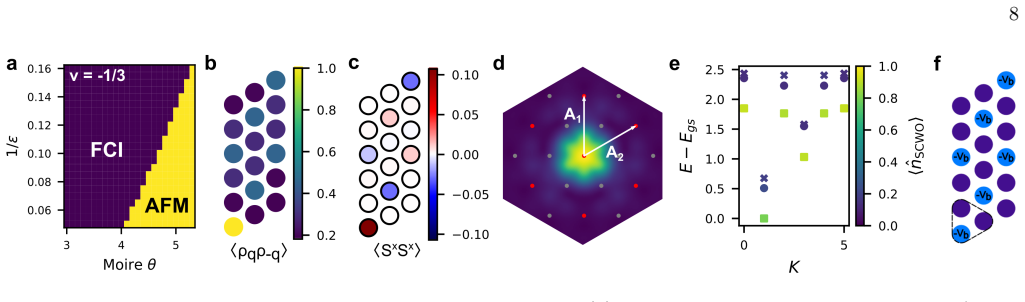
At the center of the paper is a constructive claim: for a manifold of N bands with net Chern number C, one can choose a smooth gauge on an enlarged supercell so that N-1 orbitals become exponentially localized supercell Wannier orbitals (SCWOs) while a single topological power-law orbital (TPLO) inherits all the vortices and carries the Chern number. Strong short-ranged interactions then naturally favor one electron per SCWO, leaving the TPLO band empty or dilutely filled, and the resulting low-energy Hilbert space is a Kondo lattice of local moments exchange-coupled to an itinerant topological band. The paper verifies this picture numerically: in the BHZ model the low-lying eigenstates of the interacting model have about 95% overlap with the magnetic Wannier basis, and in twisted MoTe2 the -1/3 filled system develops a square-root-of-3 by square-root-of-3 charge-ordered antiferromagnetic Mott phase at larger twist angles, competing with the Laughlin fractional Chern insulator.
Load-bearing premise
The load-bearing assumption is that for any topological band and any supercell size, a gauge rotation can push all the topological obstruction into a single extended orbital while the other N-1 orbitals stay exponentially localized; the paper shows this numerically for supercells up to eight unit cells but gives no general proof.
Editorial extensions
If this is right
- Strong interactions in time-reversal-symmetric moiré bands can stabilize spin-unpolarized topological Mott insulators without breaking time-reversal symmetry, making them direct competitors to fractional Chern insulators.
- At 3/2 filling of a spin Chern band the TPLO band is fully occupied, producing a quantum spin Hall crystal, an integer quantum spin Hall insulator with spontaneously broken translation symmetry.
- Any rational filling p/q admits a q-fold enlarged supercell and an associated partial Wannier basis, implying a hierarchy of translation-symmetry-broken Mott and Kondo-lattice states at nearby fillings.
- The partial Wannier basis gives a concrete computational route to Hubbard parameters, spin exchange couplings, and RKKY interactions in topological bands, making quantitative predictions for magnetic order possible.
Reading between the lines
- One testable extension is that the same construction should produce spin-unpolarized charge-ordered insulators in other time-reversal-symmetric moiré systems, such as twisted bilayer graphene or pentalayer graphene, where the SCWO localization length can be checked directly.
- The competition between FCI and Kondo-lattice phases should be tunable: as twist angle or screening changes, the SCWO localization length should control which phase wins, giving a prediction for the phase boundary that could be tested in transport and local-probe experiments.
- If the construction extends to three-dimensional Z2 topological bands, the emergent antiferromagnetic Kondo lattice would become a magnetic topological Mott insulator with axion electrodynamics, a possibility the paper notes as future work.
Editorial analysis
A structured set of objections, weighed in public.
Referee Report
Summary. The paper proposes that for an isolated N-band manifold with net Chern number C, one can construct a partial Wannier basis consisting of N-1 exponentially localized supercell Wannier orbitals (SCWOs) and one power-law-localized topological orbital (TPLO) that retains the topological obstruction. It argues that strong short-ranged Coulomb interactions in fractionally filled topological bands naturally favor Mott insulating states described by this basis, yielding an emergent Kondo lattice of local moments in SCWOs coupled to an itinerant TPLO band. The authors support this with exact diagonalization (ED) of the interacting BHZ model at 1/2 and 3/2 valence filling and of twisted MoTe2 at -1/3 hole filling, reporting charge-ordered ferromagnetic or antiferromagnetic insulating phases whose low-energy many-body states have high overlap with the SCWO magnetic basis.
Significance. If the partial Wannier basis construction is rigorous, it would provide a genuinely new single-particle tool for correlated insulators in Chern bands and a new scenario for time-reversal-symmetric interacting topological bands, going beyond both Landau-level FQH paradigms and conventional Wannier-based Mott-Hubbard descriptions. The ED phase diagrams and the high overlaps f_n (Fig. 2i) and counts <n_SCWO> (Fig. 4e) are concrete and valuable evidence that the proposed physical picture captures real physics in small clusters. However, the central localization claim is not proven, and the predictive power of the construction is weakened by the post hoc selection of the supercell and the addition of a bias field to favor the symmetry-broken state. These issues are fixable within the scope of the manuscript, but they are load-bearing for the paper's central claim.
major comments (3)
- [Sec. II.A and II.B] The claim that N-1 supercell Wannier orbitals are exponentially localized for arbitrary supercell sizes is the load-bearing assumption of the paper, but it is only argued heuristically. The assertion that a U(N) rotation can shift all phase-vortex nonanalyticities into a single state, leaving N-1 globally smooth states, is not proven, and the projective construction in Sec. II.B requires that the projected trial states P(K)|psi_m(K)> be nowhere vanishing and analytic over the rBZ; no general argument for non-vanishing is given. The numerical evidence in Fig. 3 shows decay of SCWO/TPLO amplitudes for supercells up to N=8, but the panels contain no fits distinguishing exponential from power-law decay, no localization lengths as a function of N, and no data for larger supercells. Since the Mott-Hubbard description of SCWOs and the emergent Kondo lattice picture depend on exponential localization, the paper should either provide a proof or a precise sufficient condition, or present numerical fits (e.g., log-linear decay and localization length vs N) that support exponential localization.
- [Sec. III (before III.A), Fig. 2(i), Fig. 4(e-f)] The supercell is chosen after seeing the ED charge order ("The supercell is chosen based on the charge ordering found in the ED calculations"), and a bias field V_b is added to select the translation-symmetry-broken partner encoded by the trial wavefunctions. This introduces a degree of circularity: the high overlap f_n and the near-unit occupancy <n_SCWO> are partly consequences of fitting the basis to the ED-identified order, rather than independent predictions. To support the claim that strong interactions 'naturally' stabilize these states, the authors should demonstrate that the supercell and SCWO can be predicted from filling fraction and lattice symmetries alone, or at least show that f_n and <n_SCWO> are robust to variations of the trial states and supercell orientation.
- [Sec. III.A, Fig. 2(d-e)] The artificially tuned valence band width Gamma is changed by adding longer-ranged hoppings while "keeping the Bloch states and Chern number identical," but the SCWO localization depends on the quantum geometry, not only on the Chern number. The phase diagrams as functions of Gamma/U are therefore only meaningful if the SCWO spread is held fixed or its variation with Gamma is reported. Please provide the SCWO localization length as a function of Gamma and discuss whether the FM-to-AFM transition could be driven by a change in the Wannier localization rather than by the intended bandwidth effect.
minor comments (6)
- [Sec. II.B] The statement that "the final Nth projected trial state must vanish at discrete points in the rBZ" is asserted without proof; it would be helpful to mark this as a conjecture or provide a proof sketch, since it is central to the topological splitting argument.
- [Fig. 2(i) and Sec. III.A] The caption says "projection f_n for the first n = 1200 many-body eigenstates," while the text discusses the first 256 states, the next 256 states, and states beyond the 512th; please harmonize the caption with the text.
- [Fig. 3] Please state whether the decay plots are on a linear, log-linear, or log-log scale, and include fits to exponential decay with the inferred localization lengths; otherwise the claim of exponential localization cannot be assessed from the figures.
- [Sec. III.B] The authors note that the 6x3 torus breaks rotational symmetry and may artificially favor striped AFM over competing Neeel order; please estimate the impact of this choice on the phase boundary and clarify whether the AFM phase remains stable on more symmetric clusters.
- [Eq. (2.3)] The embedding operator T(g) and the matrix O_{t,t'} are introduced compactly; a concrete example for the N=2 doubled supercell would improve the readability of the construction.
- [Sec. III.A, paragraph on FM-to-AFM transition] The discussion of direct Coulomb exchange versus superexchange would benefit from explicit definitions of these couplings in terms of the projected interaction matrix elements and the SCWO overlap integrals.
Circularity Check
No significant circularity: the interacting phase diagrams are obtained from exact diagonalization and are independent of the partial-Wannier basis, which is applied post hoc as an interpretive check.
full rationale
The paper's central claim—that strong short-ranged interactions stabilize topological Mott insulators on emergent Kondo lattices—is established by exact diagonalization of the projected interacting models (Eqs. 3.1 and 3.6), which make no reference to the supercell Wannier construction. The partial Wannier basis is introduced in Sec. II as a heuristic tool and applied afterward to decompose the ED eigenstates; the paper explicitly states that 'the supercell is chosen based on the charge ordering found in the ED calculations' and that a small bias field is added 'to favor the symmetry-broken configuration that was enforced by the ansatz.' Thus the reported high overlaps are consistency checks of an interpretive basis, not predictions derived from that basis, and no fitted parameter is renamed as a prediction. The N-1 exponentially localized SCWO claim rests on an unproven smoothness/non-vanishing assumption and numerical decay plots, which is a correctness risk rather than circular reasoning. The self-citations (Refs. 17 and 19) are background references on quantum geometry and are not load-bearing for the derivation. No step in the argument reduces, by the paper's own equations, to its inputs by construction.
Assumptions & free parameters
free parameters (2)
- Artificial valence band bandwidth Gamma/U after projection (BHZ) =
0 to about 2 (phase diagram axis)
- Bias field Vb =
approximately 0.05U
assumptions (4)
- ad hoc to paper For an N-band manifold with net Chern number C, a U(N) gauge rotation can concentrate all phase-vortex nonanalyticities in one state, leaving N-1 globally smooth states that Fourier transform to exponentially localized supercell Wannier orbitals.
- domain assumption The many-body Hilbert space can be restricted to isolated topological valence bands; projection is valid for interactions smaller than the single-particle band gap.
- domain assumption For twisted MoTe2, projection only onto the topmost time-reversed pair of Chern C=1 valence bands is sufficient; interband mixing with the second moire valence band is neglected.
- domain assumption The finite-size torus (4x4 BHZ, 6x3 tMoTe2) with periodic boundary conditions captures the thermodynamic phases, and the 6x3 aspect-ratio-driven breaking of rotation symmetry does not qualitatively change the phase diagram.
Cite this review
Pith. "Pith review of Supercell Wannier Functions and Emergent Kondo Lattices in Topological Bands." pith.science (2026). https://pith.science/paper/KGRHB3CX
@misc{pith2026241217190,
  author       = {Pith},
  title        = {Pith review of: Supercell Wannier Functions and Emergent Kondo Lattices in Topological Bands},
  year         = {2026},
  howpublished = {\url{https://pith.science/paper/KGRHB3CX}},
  note         = {Machine review of arXiv:2412.17190}
}
read the original abstract
Conventional theories for Mott insulators involve well-localized electronic orbitals. This picture fails in the presence of topological obstructions in Chern bands which prevent the formation of exponentially localized orbitals and are instead often viewed by analogy to Landau levels. Here, we show that strong interactions in fractionally-filled topological bands realize a class of Mott insulating states on emergent topological Kondo lattices. These can be naturally described by a partial Wannier basis of N-1 exponentially-localized orbitals for an N-band manifold with net non-zero Chern number. Choosing a gauge which breaks translation symmetry, we construct a supercell basis which segregates an isolated topological band into well-localized supercell Wannier orbitals that can host the local moments of a Mott insulating state, as well as an itinerant power-law-localized orbital that retains the topological obstruction. Together, they constitute a spontaneous Kondo lattice. We study fractionally-filled interacting quantum spin Hall bands in the Bernevig-Hughes-Zhang model as well as twisted bilayers of MoTe2 at -1/3 filling. We demonstrate that strong short-ranged Coulomb interactions can stabilize a new class of topological Mott insulating states with broken translation symmetry and antiferromagnetic order, which compete with fractional Chern insulating states. Our results predict a new scenario for time-reversal-symmetric interacting topological bands in solids, beyond conventional Landau level paradigms for the fractional quantum Hall effect.
Figures


Figures from the paper (1 more)
Reference graph
Works this paper leans on
-
[1]
N. Regnault and B. A. Bernevig, Fractional Chern Insu- lator, Phys. Rev. X1, 021014 (2011)
work page 2011
-
[2]
K. Sun, Z. Gu, H. Katsura, and S. Das Sarma, Nearly Flatbands with Nontrivial Topology, Phys. Rev. Lett. 106, 236803 (2011)
2011
-
[3]
Y.-L. Wu, B. A. Bernevig, and N. Regnault, Zoology of fractional Chern insulators, Phys. Rev. B85, 075116 (2012)
work page 2012
-
[4]
B. A. Bernevig and N. Regnault, Emergent Many-Body Translational Symmetries of Abelian and Non-Abelian Fractionally Filled Topological Insulators, Phys. Rev. B 85, 075128 (2012)
work page 2012
-
[5]
J. McGreevy, B. Swingle, and K.-A. Tran, Wave functions for fractional Chern insulators, Phys. Rev. B85, 125105 (2012)
work page 2012
-
[6]
Y.-L. Wu, N. Regnault, and B. A. Bernevig, Bloch Model Wave Functions and Pseudopotentials for All Fractional Chern Insulators, Phys. Rev. Lett.110, 106802 (2013)
work page 2013
-
[7]
Estienne, N
B. Estienne, N. Regnault, and V. Crépel, Ideal Chern bands as Landau levels in curved space, Phys. Rev. Res. 5, L032048 (2023)
2023
-
[8]
J. Cai, E. Anderson, C. Wang, X. Zhang, X. Liu, W. Holtz- mann, Y. Zhang, F. Fan, T. Taniguchi, K. Watanabe, Y. Ran, T. Cao, L. Fu, D. Xiao, W. Yao, and X. Xu, Signatures of fractional quantum anomalous Hall states in twisted MoTe2, Nature622, 63 (2023)
work page 2023
Show all 55 references
-
[9]
Redekop, C
E. Redekop, C. Zhang, H. Park, J. Cai, E. Anderson, O. Sheekey, T. Arp, G. Babikyan, S. Salters, K. Watanabe, T. Taniguchi, M. E. Huber, X. Xu, and A. F. Young, Direct magnetic imaging of fractional Chern insulators in twisted MoTe2, Nature635, 584 (2024)
2024
-
[10]
H. Park, J. Cai, E. Anderson, Y. Zhang, J. Zhu, X. Liu, C. Wang, W. Holtzmann, C. Hu, Z. Liu, T. Taniguchi, K. Watanabe, J.-H. Chu, T. Cao, L. Fu, W. Yao, C.-Z. Chang, D. Cobden, D. Xiao, and X. Xu, Observation of fractionally quantized anomalous Hall effect, Nature622, 74 (2023)
2023
-
[11]
Y. Zeng, Z. Xia, K. Kang, J. Zhu, P. Knüppel, C. Vaswani, K. Watanabe, T. Taniguchi, K. F. Mak, and J. Shan, Thermodynamic evidence of fractional Chern insulator in moiré MoTe2, Nature622, 69 (2023)
2023
-
[12]
Z. Lu, T. Han, Y. Yao, A. P. Reddy, J. Yang, J. Seo, K. Watanabe, T. Taniguchi, L. Fu, and L. Ju, Fractional quantum anomalous Hall effect in multilayer graphene, Nature 626, 759 (2024)
2024
-
[13]
Anderson, F.-R
E. Anderson, F.-R. Fan, J. Cai, W. Holtzmann, T. Taniguchi, K. Watanabe, D. Xiao, W. Yao, and X. Xu, Programming correlated magnetic states with gate-controlled moiré geometry, Science381, 325 (2023)
2023
-
[14]
F. Wu, T. Lovorn, E. Tutuc, I. Martin, and A. H. Mac- Donald, Topological Insulators in Twisted Transition Metal Dichalcogenide Homobilayers, Phys. Rev. Lett.122, 086402 (2019)
2019
-
[15]
Devakul, V
T. Devakul, V. Crépel, Y. Zhang, and L. Fu, Magic in twisted transition metal dichalcogenide bilayers, Nature Comm. 12, 6730 (2021). 11
2021
-
[16]
Roy, Band geometry of fractional topological insulators, Phys
R. Roy, Band geometry of fractional topological insulators, Phys. Rev. B90, 165139 (2014)
2014
-
[17]
Claassen, C
M. Claassen, C. H. Lee, R. Thomale, X.-L. Qi, and T. P. Devereaux, Position-momentum duality and fractional quantum hall effect in chern insulators, Phys. Rev. Lett. 114, 236802 (2015)
2015
-
[18]
T. S. Jackson, G. Möller, and R. Roy, Geometric stabil- ity of topological lattice phases, Nature Comm.6, 8629 (2015)
2015
-
[19]
C. H. Lee, M. Claassen, and R. Thomale, Band structure engineering of ideal fractional Chern insulators, Phys. Rev. B 96, 165150 (2017)
2017
-
[20]
J. Wang, J. Cano, A. J. Millis, Z. Liu, and B. Yang, Exact landau level description of geometry and interaction in a flatband, Phys. Rev. Lett.127, 246403 (2021)
2021
-
[21]
P. J. Ledwith, A. Vishwanath, and D. E. Parker, Vor- texability: A unifying criterion for ideal fractional chern insulators, Phys. Rev. B108, 205144 (2023)
2023
-
[22]
Z. Liu, B. Mera, M. Fujimoto, T. Ozawa, and J. Wang, Theory of generalized landau levels and implication for non-abelian states, arXiv:2405.14479 (2024)
2024 arXiv
-
[23]
Sheng, A
D. Sheng, A. P. Reddy, A. Abouelkomsan, E. J. Bergholtz, and L. Fu, Quantum anomalous hall crystal at fractional filling of moiré superlattices, Phys. Rev. Lett.133, 066601 (2024)
2024
-
[24]
Perea-Causin, H
R. Perea-Causin, H. Liu, and E. J. Bergholtz, Quantum anomalous hall crystals in moiré bands with higher chern number, arXiv:2412.02745 (2024)
2024 arXiv
-
[25]
Zhou and Y.-H
B. Zhou and Y.-H. Zhang, New classes of quantum anoma- lous hall crystals in multilayer graphene, arXiv:2411.04174 (2024)
2024 arXiv
-
[26]
J. Wang, J. Cano, A. J. Millis, Z. Liu, and B. Yang, Exact Landau Level Description of Geometry and Interaction in a Flatband, Phys. Rev. Lett.127, 246403 (2021)
2021
-
[27]
Brouder, G
C. Brouder, G. Panati, M. Calandra, C. Mourougane, and N. Marzari, Exponential localization of wannier functions in insulators, Phys. Rev. Lett.98, 046402 (2007)
2007
-
[28]
Thonhauser and D
T. Thonhauser and D. Vanderbilt, Insulator/chern- insulator transition in the haldane model, Phys. Rev. B 74, 235111 (2006)
2006
-
[29]
A. A. Soluyanov and D. Vanderbilt, Wannier representa- tion of Z 2 topological insulators, Phys. Rev. B83, 035108 (2011)
2011
-
[30]
H. C. Po, H. Watanabe, and A. Vishwanath, Fragile topology and Wannier obstructions, Phys. Rev. Lett.121, 126402 (2018)
2018
-
[31]
Koshino, N
M. Koshino, N. F. Yuan, T. Koretsune, M. Ochi, K. Kuroki, and L. Fu, Maximally Localized Wannier Or- bitals and the Extended Hubbard Model for Twisted Bilayer Graphene, Phys. Rev. X8, 031087 (2018)
2018
-
[32]
S. Carr, S. Fang, H. C. Po, A. Vishwanath, and E. Kaxiras, Derivation of Wannier orbitals and minimal-basis tight- binding Hamiltonians for twisted bilayer graphene: First- principles approach, Phys. Rev. Res.1, 033072 (2019)
2019
-
[33]
B. A. Bernevig, T. L. Hughes, and S.-C. Zhang, Quantum spin Hall effect and topological phase transition in HgTe quantum wells, Science314, 1757 (2006)
2006
-
[34]
Marzari and D
N. Marzari and D. Vanderbilt, Maximally localized gen- eralized Wannier functions for composite energy bands, Phys. Rev. B56, 12847 (1997)
1997
-
[35]
Brouder, G
C. Brouder, G. Panati, M. Calandra, C. Mourougane, and N. Marzari, Exponential Localization of Wannier Func- tions in Insulators, Phys. Rev. Lett.98, 046402 (2007)
2007
-
[36]
G. W. Winkler, A. A. Soluyanov, and M. Troyer, Smooth gauge and Wannier functions for topological band struc- tures in arbitrary dimensions, Phys. Rev. B93, 035453 (2016)
2016
-
[37]
Savary and L
L. Savary and L. Balents, Quantum spin liquids: a review, Rep. Prog. Phys.80, 016502 (2016)
2016
-
[38]
Broholm, R
C. Broholm, R. Cava, S. Kivelson, D. Nocera, M. Nor- man, and T. Senthil, Quantum spin liquids, Science367, eaay0668 (2020)
2020
-
[39]
Y. Zhou, K. Kanoda, and T.-K. Ng, Quantum spin liquid states, Rev. Mod. Phys.89, 025003 (2017)
2017
-
[40]
Hall crystal
Z. Tešanović, F. Axel, and B. I. Halperin, “Hall crystal” versus Wigner crystal, Phys. Rev. B39, 8525 (1989)
1989
-
[41]
Murthy, Hall crystal states atν = 2 and moderate landau level mixing, Phys
G. Murthy, Hall crystal states atν = 2 and moderate landau level mixing, Phys. Rev. Lett.85, 1954 (2000)
2000
-
[42]
Marzari and D
N. Marzari and D. Vanderbilt, Maximally localized gen- eralized wannier functions for composite energy bands, Phys. Rev. B56, 12847 (1997)
1997
-
[43]
A. M. Läuchli, Z. Liu, E. J. Bergholtz, and R. Moessner, Hierarchy of fractional Chern insulators and competing compressible states, Phys. Rev. Lett.111, 126802 (2013)
2013
-
[44]
Alidoust, G
N. Alidoust, G. Bian, S.-Y. Xu, R. Sankar, M. Neupane, C. Liu, I. Belopolski, D.-X. Qu, J. D. Denlinger, F.-C. Chou, and M. Z. Hasan, Observation of monolayer valence band spin-orbit effect and induced quantum well states in MoX2, Nature Comm.5, 4673 (2014)
2014
-
[45]
Wang, X.-W
C. Wang, X.-W. Zhang, X. Liu, Y. He, X. Xu, Y. Ran, T. Cao, and D. Xiao, Fractional chern insulator in twisted bilayer mote2, Phys. Rev. Lett.132, 036501 (2024)
2024
-
[46]
J. Yu, J. Herzog-Arbeitman, M. Wang, O. Vafek, B. A. Bernevig, and N. Regnault, Fractional chern insulators versus nonmagnetic states in twisted bilayermote2, Phys. Rev. B 109, 045147 (2024)
2024
-
[47]
Song and B
Z.-D. Song and B. A. Bernevig, Magic-angle twisted bi- layer graphene as a topological heavy fermion problem, Phys. Rev. Lett.129, 047601 (2022)
2022
-
[48]
E. C. Regan, D. Wang, C. Jin, M. I. Bakti Utama, B. Gao, X. Wei, S. Zhao, W. Zhao, Z. Zhang, K. Yumigeta, M. Blei, J. D. Carlström, K. Watanabe, T. Taniguchi, S. Tongay, M. Crommie, A. Zettl, and F. Wang, Mott and generalized Wigner crystal states in WSe2/WS2 moiré superlattic...
2020
-
[49]
H. Li, S. Li, E. C. Regan, D. Wang, W. Zhao, S. Kahn, K. Yumigeta, M. Blei, T. Taniguchi, K. Watanabe, S. Ton- gay, A. Zettl, M. F. Crommie, and F. Wang, Imaging two-dimensional generalized Wigner crystals, Nature597, 650 (2021)
2021
-
[50]
C. Jin, Z. Tao, T. Li, Y. Xu, Y. Tang, J. Zhu, S. Liu, K. Watanabe, T. Taniguchi, J. C. Hone, L. Fu, J. Shan, and K. F. Mak, Stripe phases in WSe2/WS2 moiré super- lattices, Nature Mat.20, 940 (2021)
2021
-
[51]
T. Han, Z. Lu, G. Scuri, J. Sung, J. Wang, T. Han, K. Watanabe, T. Taniguchi, H. Park, and L. Ju, Cor- related insulator and Chern insulators in pentalayer rhombohedral-stacked graphene, Nature Nanotech. , 1 (2023)
2023
-
[52]
X.-L. Qi, T. L. Hughes, and S.-C. Zhang, Topological field theory of time-reversal invariant insulators, Phys. Rev. B 78, 195424 (2008)
2008
-
[53]
A. M. Essin, J. E. Moore, and D. Vanderbilt, Magnetoelec- tric polarizability and axion electrodynamics in crystalline insulators, Phys. Rev. Lett.102, 146805 (2009)
2009
-
[54]
R. Li, J. Wang, X.-L. Qi, and S.-C. Zhang, Dynamical axion field in topological magnetic insulators, Nature Physics 6, 284 (2010). 12
2010
-
[55]
Tokura, K
Y. Tokura, K. Yasuda, and A. Tsukazaki, Magnetic topo- logical insulators, Nature Reviews Physics1, 126 (2019)
2019
Reviewed August 11, 2026 · model on record in the stance chip above.
Discussion (0). Continue with ORCID to comment.