REVIEW 3 major objections 6 minor 1 cited by
Spectral analysis for nucleon-pion and nucleon-pion-pion states in both parity sectors using distillation with domain-wall fermions
T0 review · 3 major / 6 minor · reviewed 2026-08-11 · deepseek-v4-flash
Pith's one-line read A three-operator GEVP with a new Nππ operator resolves the positive-parity nucleon spectrum and shows multi-pion contamination of the nucleon mass is negligible.
desk verdict Competent exploratory distillation study; new Npi-pi GEVP analysis is plausible, but the mode-truncation systematic is real and unquantified. read the letter →
The pith
A machine-rendered reading of the paper's core claim, the machinery that carries it, and where it could break.
The reading
What carries the argument
The machinery is distillation: smearing quark fields with the lowest $N_d$ eigenvectors of the three-dimensional lattice Laplacian (Eqs. 19–20), which converts correlation functions into contractions of perambulators, momentum insertions, and modified elementals. To handle the factorial growth of Wick contractions for $N\pi\pi$ correlation functions, the paper introduces an automatic contraction algorithm that classifies each diagram as trace-full or trace-less and generates the corresponding tensor contractions. Energies are extracted through a GEVP with a fixed time separation $t-t_0=a$, and the paper defines an “extrapolation check” $\sigma_{\tau_0-1}$ to select fit ranges where the excited-state model describes the first excluded time slice.
What would settle it
Repeat the positive-parity GEVP on ensemble C with a substantially larger mode count (for example, $N_d > 200$) or with a distillation-plus-all-to-all completion, and check whether the $N\pi$ and $N\pi\pi$ energies and the inferred nucleon mass move outside the quoted uncertainties; a systematic shift would indicate that the clean reported spectrum is a truncation artifact.
Extended reading notes
Core claim
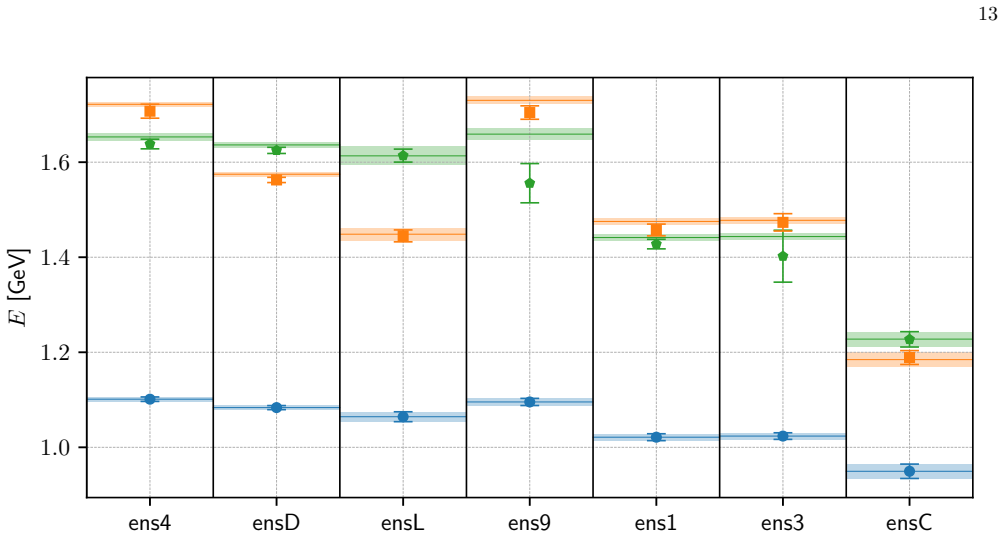
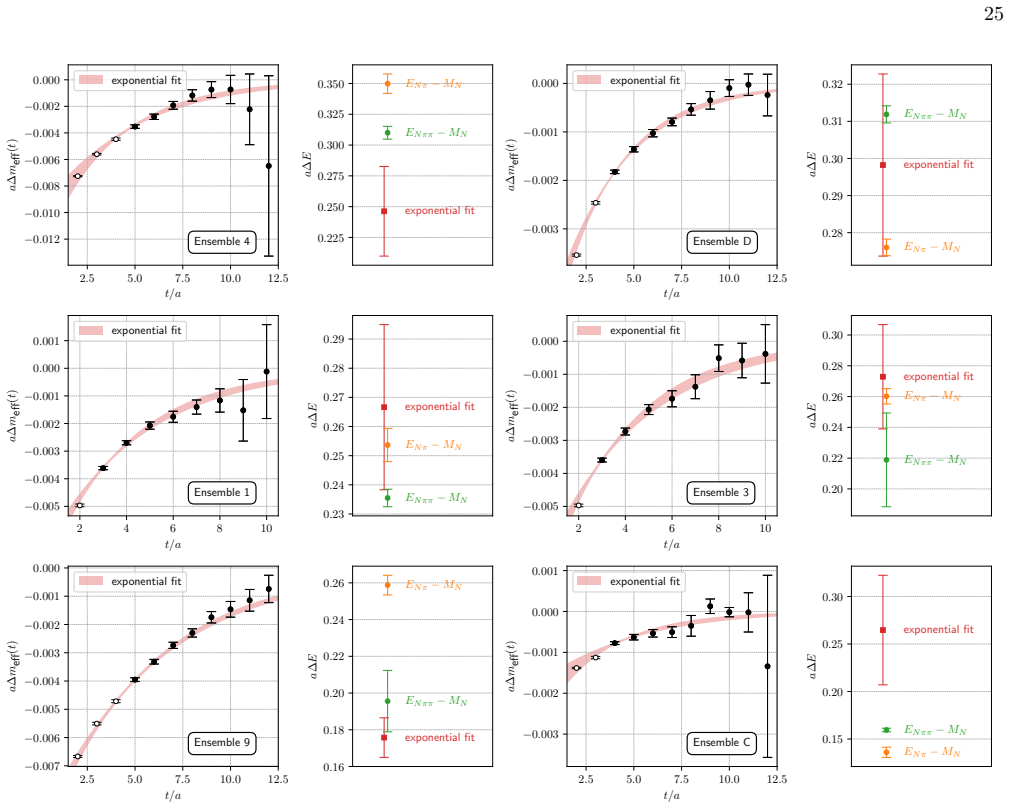
In the positive-parity sector, the central discovery is that a $3\times 3$ GEVP built from a nucleon operator, a p-wave nucleon-pion operator, and a newly introduced s-wave nucleon-pion-pion operator yields clear, stable energy levels on all ensembles: the ground state tracks the nucleon mass, and the two excited levels sit at the non-interacting $N\pi$ and $N\pi\pi$ thresholds. The difference between the nucleon two-point effective mass and the GEVP ground-state effective mass is at the per-mil level, and an exponential fit to this difference gives an energy gap consistent with the $\Delta E_{N\pi\pi}$ gap, showing that within the considered operator set $N\pi\pi$ is the dominant multi-hadronic contamination of the nucleon two-point function. The paper concludes that $N\pi$ and $N\pi\pi$ contributions to the nucleon two-point function are negligible, consistent with chiral perturbation theory, and that the distillation setup, though originally designed for the muon $g-2$ program, is well suited to baryon multi-hadron spectroscopy.
Load-bearing premise
The claim that the positive-parity spectrum is clean rests on the assumption that keeping only the lowest 60 (or 120) Laplacian eigenmodes preserves the low-lying baryon states; the paper's own negative-parity results, where the same truncation degrades the nucleon signal, show this assumption is fragile.
Editorial extensions
If this is right
- The new $N\pi\pi$ operator can be included in future GEVP analyses for form factors, such as the nucleon axial-vector charge, to remove excited-state contamination from the nucleon interpolating operator.
- The automatic Wick-contraction algorithm generalizes to correlation functions with an arbitrary number of pions at source and sink, making multi-hadron baryon spectroscopy with many contractions feasible in distillation.
- The physical-point nucleon mass $M_N = 0.927(21)(05)$ GeV, within $1\sigma$ of the experimental value, supports the continuum and physical-mass extrapolation strategy based on Akaike-model averaging.
- The observation that $N\pi\pi$ contamination dominates over $N\pi$ in the nucleon two-point function, based on the energy-gap fit, provides guidance on which multi-hadron operators to prioritize in future, larger operator bases.
- In the negative-parity channel, the significant overlap between the nucleon two-point function and the nucleon-pion states implies that multi-hadron operators are essential there, but a larger distillation-mode count or an all-to-all completion is needed first.
Reading between the lines
- If the positive-parity mode-truncation systematic is comparable to what the paper observes in the negative-parity sector, the reported per-mil-level contamination might be an artifact of the specific distillation mode count, and the true $N\pi$/$N\pi\pi$ contamination could be larger with more modes.
- The same GEVP framework could be extended to resonances such as the Roper and $N(1535)$, but the negative-parity results caution that the distillation basis must be enlarged for those channels.
- A testable extension is to compute the nucleon axial-vector form factor using the GEVP-constructed excited-state-free nucleon operator from this paper and compare the excited-state contamination with that of the plain nucleon two-point function.
- The mode-truncation systematic could be probed directly by varying $N_d$ on a single ensemble and tracking the trend of the nucleon mass and the level splittings.
Editorial analysis
A structured set of objections, weighed in public.
Referee Report
Summary. The manuscript reports a distillation-based GEVP spectroscopy study of baryon states on seven RBC/UKQCD domain-wall fermion ensembles with pion masses from 139 to 279 MeV, two lattice spacings, and several volumes. In the positive-parity channel a 3x3 GEVP is built from nucleon, p-wave nucleon-pion, and s-wave nucleon-pion-pion interpolating operators; in the negative-parity channel a 3x3 GEVP uses a nucleon and two nucleon-pion operators. The authors introduce an automated Wick-contraction algorithm for nucleon-plus-multipion correlation functions, apply All Mode Averaging, and use Wigner-Eckart relations to reduce the number of contractions. The central results are stable positive-parity GEVP plateaus with energies close to non-interacting N, Npi, and Npipi benchmarks, a per-mil difference between GEVP mode 0 and the nucleon two-point function, a finite-volume-corrected nucleon mass extrapolated to the physical point as M_N = 0.927(21)(05) GeV, and a negative-parity analysis in which the multi-hadron states are resolved but the nucleon two-point function suffers from signal degradation attributed to insufficient distillation modes.
Significance. If the identification of the three positive-parity GEVP modes as N, Npi, and Npipi is accepted, the paper provides the first Npipi baryon operator in a distillation GEVP analysis and an explicit demonstration that multi-hadron contaminations in the nucleon two-point function are at the per-mil level, validating a workflow for excited-state-free nucleon operators in future form-factor calculations. The automatic contraction tool and the Wigner-Eckart reduction are useful methodological contributions, and the physical-point nucleon mass obtained from AIC model averaging is a nontrivial cross-check. However, the central demonstration is not yet quantitative: the distillation-mode truncation is shown by the paper's own negative-parity results to be a limiting systematic, and the positive-parity multi-hadron levels are compared only with non-interacting energies without a direct truncation control. Several preferred fits also violate the paper's stated extrapolation-check criterion.
major comments (3)
- [Sec. V, Sec. VI, Figs. 3, 6, 12] The central claim that the positive-parity GEVP cleanly separates N, Npi, and Npipi states depends on the unquantified effect of truncating the distillation Laplacian to Nd=60 (or 120) modes. The paper's own negative-parity analysis (Sec. V; Fig. 15) shows that the same truncation is insufficient for the nucleon two-point function, with the authors explicitly attributing the degradation to missing high modes (Sec. VI: "the number of distillation modes is too small for most ensembles to perform sophisticated analyses"). Because the positive-parity Npi and Npipi levels are tested only against non-interacting energies, a mode-truncation shift comparable to the level spacing cannot currently be excluded. I request a concrete control, for example repeating the positive-parity GEVP with a larger Nd on at least one ensemble, or comparing the GEVP ground-state mass with a conventional smeared or point-source nucleon mass, together with an estimate of the resulting shift in the Npi and Npipi energies.
- [Sec. III E, Table V, Eq. (49)] The paper states that fits are selected with an extrapolation-check tension sigma_{tau0-1} < 2, but several preferred fits in Table V violate this criterion. Positive-parity examples include Ensemble-4 GEVP0 with sigma_{tau0-1}=2.23, Ensemble-9 GEVP2 with -3.28, and Ensemble-3 GEVP0 with 2.15 and N2N with 2.17; negative-parity entries show many more violations. Since Table V reports the fits used in the analysis, either these fits should be replaced by ranges satisfying the stated criterion, or the criterion and its application should be revised and documented. As written, the selection rule is not consistently enforced, which weakens the fit-quality argument for the preferred mass estimates.
- [Sec. IV B, Sec. IV A, Figs. 6 and 7] The finite-volume correction is applied only to the nucleon masses; the Npi and Npipi energies are compared with non-interacting finite-volume energies without an estimate of the finite-volume interaction shift. For ensemble 9 both multi-hadron energies lie about 2 sigma below the non-interacting benchmarks, and the discussion in Sec. VI treats this as a marginal fluctuation. Since the assignment of GEVP modes 1 and 2 to Npi and Npipi is part of the central claim, the size of the missing finite-volume corrections for the multi-hadron states should be estimated or explicitly argued to be negligible.
minor comments (6)
- [Eq. (28)] The phase factor in the definition of the momentum insertion P^{nm}(t,p) is written as e^{ix·y}, but y is not defined and the momentum variable should appear in the exponent; presumably e^{ix·p} is intended.
- [Fig. 5 and Sec. IV A] The caption of Fig. 5 states that eigenvectors are shown at t/a = 12, while the text discusses the eigenvectors at t/a = 8; the caption should be corrected to match the actual time slice.
- [Eq. (49), Sec. III E] The tension is defined as sigma[X]/E[X], which is the inverse of the usual standardized residual; the values reported in Table V suggest that E[X]/sigma[X] is meant, so the definition should be corrected.
- [Sec. IV heading] The heading "POSITVE PARITY RESULTS" contains a typo and should read "POSITIVE PARITY RESULTS".
- [Table I and Fig. 6] The ensemble naming is inconsistent: Table I uses the label "4" while the text and Fig. 6 refer to "Ens 4"; a uniform naming convention would improve readability.
- [Sec. III F and Table V] The sentence in Sec. III F describes a normalization of GEVP eigenvectors, but the figure captions and table headers use different notations for the same objects; a single definition and consistent notation across Secs. IV, V, and the appendix would help the reader.
Circularity Check
No significant circularity: the positive-parity spectral extraction is a self-contained GEVP analysis checked against external non-interacting and chiral benchmarks; the self-citations concern data/tool reuse and are not load-bearing.
full rationale
The central derivation chain is independent of its own outputs. The nucleon mass is extracted from a 3x3 GEVP of correlation functions built directly from distillation perambulators, with no parameter fitted from the target nucleon-mass result. The non-interacting Npi and Npipi energies used as comparison lines are computed from the extracted nucleon mass, the independently known pion mass, and lattice momenta; they are benchmarks, not predictions forced by construction, and the agreement with the separately fitted GEVP energy levels is a genuine consistency test. The claim that Npi/Npipi contamination of the nucleon two-point function is negligible follows from the smallness of Delta_m_eff between the GEVP mode 0 and the two-point function, which is a data-dependent observation rather than an identity. The finite-volume correction uses SU(2) BChPT constants taken from the external Bali et al. 2013 analysis, and the continuum/physical-point extrapolation uses external physical pion and kaon masses with AIC model averaging; none of these steps fit the target prediction. The self-citations to the RBC/UKQCD g-2 distillation data, AMA methodology, GPT, and the AutoWick contraction code are reuse of computational infrastructure and data generation, not load-bearing evidence for the physics claims. The acknowledged difficulty in the negative-parity sector is a limitation or systematic-risk statement about distillation mode truncation, not a circular argument. The paper is therefore best characterized as having, at most, a minor non-load-bearing self-citation rather than any reduction of a prediction to its own inputs.
Assumptions & free parameters
free parameters (4)
- Continuum extrapolation coefficients (MN, c0, c1, c2, c3 per model) =
e.g., MN = 0.924(21) GeV for π(1)K(0) model; see Table IV
- BχPT low-energy constants for finite-volume correction =
gA = 1.256, fπ = 92.4 MeV, c2 = 3.3(2) GeV^-1, c3 = -4.7(1.3) GeV^-1, m0 = 0.89(3) GeV, c1 = -0.78(8) GeV^-1
- Excited-state fit parameters A and aEex =
listed per fit in Table V (A omitted due to asymmetric jackknife)
- Distillation smearing and mode count (ρ = 0.1, N = 30, Nd = 60 or 120) =
ρ = 0.1, N = 30, Nd = 60 (ensembles 4, D, 9, L, 1, 3) or 120 (C)
assumptions (6)
- standard math GEVP spectral decomposition: correlation matrices are a sum over a finite tower of states with energies En (Eq. 13), and the GEVP eigenvalues approach e^{-En(t-t0)} with corrections suppressed for t0 >= t/2 (Eqs. 14-17).
- domain assumption Distillation truncation: the first Nd eigenmodes of the 3D Laplacian (Eq. 20) dominate the low-lying hadron states; high-mode truncation does not bias extracted energies.
- domain assumption Finite-volume correction from SU(2) BχPT: mN(L) - mN(∞) = Δa(L) + Δb(L) (Eq. 54), with LECs from an external fit.
- ad hoc to paper Set of nine continuum-extrapolation models (Table III) covers the pion-mass, kaon-mass, and lattice-spacing dependence; AIC model averaging gives unbiased estimate.
- domain assumption Configurations in each ensemble are statistically independent, so no binning is needed.
- domain assumption Back-to-back momentum Nπ and s-wave Nππ operators project onto the intended non-interacting energy levels; inter-hadron interactions are small enough that comparison to free energies identifies the states.
Cite this review
Pith. "Pith review of Spectral analysis for nucleon-pion and nucleon-pion-pion states in both parity sectors using distillation with domain-wall fermions." pith.science (2026). https://pith.science/paper/ZRZTWYYF
@misc{pith2026241217442,
  author       = {Pith},
  title        = {Pith review of: Spectral analysis for nucleon-pion and nucleon-pion-pion states in both parity sectors using distillation with domain-wall fermions},
  year         = {2026},
  howpublished = {\url{https://pith.science/paper/ZRZTWYYF}},
  note         = {Machine review of arXiv:2412.17442}
}
abstract
We present a study using the distillation method to analyze the spectra of nucleon, nucleon-pion, and nucleon-pion-pion states in the positive-parity sector, as well as nucleon and nucleon-pion states in the negative-parity sector. The study uses seven domain-wall fermion ensembles with varying pion masses ($m_\pi = 139 - 279~\text{MeV}$), lattice spacings ($a^{-1} = 1.730~\text{GeV}$ and $a^{-1}=2.359~\text{GeV}$) and volumes ($m_\pi L = 3.8 - 7.5$). To address the large number of contractions in this project, we implemented an algorithm to automate the contraction of nucleon-pion correlation functions that contain an arbitrary number of pions. In the positive parity sector, we extrapolate the nucleon mass to the physical point. This study demonstrates the effectiveness of the distillation method for baryonic quantities with a focus on multi-hadronic states and establishes a foundation for future work.
Figures


Figures from the paper (16 more)






Forward citations
Cited by 1 Pith paper
-
The Neutron Electric Dipole Moment from Lattice QCD using a Background Electric Field
Using background electric fields, local topological charge, and non-Hermitian GEVP, lattice QCD yields dn = -0.0050(4)stat(8)sys θ-bar e fm at the physical point.
Reference graph
Works this paper leans on
- [1]
- [2]
-
[3]
J. A. Formaggio and G. P. Zeller, Rev. Mod. Phys. 84, 1307 (2012), arXiv:1305.7513 [hep-ex]
arXiv 2012
-
[4]
A. S. Kronfeld, D. G. Richards, W. Detmold, R. Gupta, H.-W. Lin, K.-F. Liu, A. S. Meyer, R. Sufian, and S. Syritsyn (USQCD), Eur. Phys. J. A 55, 196 (2019), arXiv:1904.09931 [hep-lat]
arXiv 2019
-
[5]
A. S. Meyer, A. Walker-Loud, and C. Wilkinson, Ann. Rev. Nucl. Part. Sci. 72, 205 (2022), arXiv:2201.01839 [hep-lat]
arXiv 2022
-
[6]
L. A. Ruso et al. , (2022), arXiv:2203.09030 [hep-ph]
arXiv 2022
-
[7]
B¨ ar, Physical Review D92 (2015), 10.1103/physrevd.92.074504
O. B¨ ar, Physical Review D92 (2015), 10.1103/physrevd.92.074504
-
[8]
B¨ ar, Physical Review D97 (2018), 10.1103/physrevd.97.094507
O. B¨ ar, Physical Review D97 (2018), 10.1103/physrevd.97.094507
Show all 54 references
-
[9]
G. S. Bali, S. Collins, M. Gruber, A. Sch¨ afer, P. Wein, and T. Wurm, Phys. Lett. B 789, 666 (2019), arXiv:1810.05569 [hep-lat]
2019 arXiv
-
[10]
G. S. Bali, L. Barca, S. Collins, M. Gruber, M. L¨ offler, A. Sch¨ afer, W. S¨ oldner, P. Wein, S. Weish¨ aupl, and T. Wurm (RQCD), JHEP 05, 126 (2020), arXiv:1911.13150 [hep-lat]
2020 arXiv
-
[11]
Y.-C. Jang, R. Gupta, B. Yoon, and T. Bhattacharya, Phys. Rev. Lett. 124, 072002 (2020), arXiv:1905.06470 [hep-lat]
2020 arXiv
-
[12]
S. Park, R. Gupta, B. Yoon, S. Mondal, T. Bhattacharya, Y.-C. Jang, B. Jo´ o, and F. Winter (Nucleon Matrix Elements (NME)), Phys. Rev. D 105, 054505 (2022), arXiv:2103.05599 [hep-lat]
2022 arXiv
-
[13]
Djukanovic, G
D. Djukanovic, G. von Hippel, J. Koponen, H. B. Meyer, K. Ottnad, T. Schulz, and H. Wittig, Phys. Rev. D 106, 074503 (2022), arXiv:2207.03440 [hep-lat]
2022 arXiv
- [14]
-
[15]
Barca, G
L. Barca, G. Bali, and S. Collins, Physical Review D 107 (2023), 10.1103/physrevd.107.l051505
2023 doi
-
[16]
Alexandrou, G
C. Alexandrou, G. Koutsou, Y. Li, M. Petschlies, and F. Pittler, PoS LA TTICE2023, 080 (2024), arXiv:2312.15737 [hep-lat]
2024 arXiv
-
[17]
Alexandrou, G
C. Alexandrou, G. Koutsou, Y. Li, M. Petschlies, and F. Pittler, (2024), arXiv:2408.03893 [hep-lat]
2024 arXiv
-
[18]
A. V. Grebe and M. Wagman, (2023), arXiv:2312.00321 [hep-lat]
2023 arXiv
-
[19]
Simons, N
D. Simons, N. Steinberg, A. Lovato, Y. Meurice, N. Rocco, and M. Wagman, (2022), arXiv:2210.02455 [hep-ph]
2022 arXiv
-
[20]
Peardon, J
M. Peardon, J. Bulava, J. Foley, C. Morningstar, J. Dudek, R. G. Edwards, B. Jo´ o, H.-W. Lin, D. G. Richards, and K. J. Juge, Physical Review D 80 (2009), 10.1103/physrevd.80.054506
2009 doi
-
[21]
Bruno, T
M. Bruno, T. Izubuchi, C. Lehner, and A. S. Meyer, PoS LA TTICE2019, 239 (2019), arXiv:1910.11745 [hep-lat]
2019 arXiv
-
[22]
Bruno, D
M. Bruno, D. Hoying, T. Izubuchi, C. Lehner, A. S. Meyer, and M. Tomii, (2023), arXiv:2304.03313 [hep-lat]
2023 arXiv
- [23]
-
[24]
AutoWick,
A. Hackl, “AutoWick,” (2024)
2024
-
[25]
C. B. Lang and V. Verduci, Physical Review D 87 (2013), 10.1103/physrevd.87.054502
2013 doi
-
[26]
C. Lang, L. Leskovec, M. Padmanath, and S. Prelovsek, Physical Review D 95 (2017), 10.1103/physrevd.95.014510
2017 doi
-
[27]
Egerer, D
C. Egerer, D. Richards, and F. Winter, Physical Review D 99 (2019), 10.1103/physrevd.99.034506
2019 doi
-
[28]
DeGrand and S
T. DeGrand and S. Schaefer, Nuclear Physics B - Proceedings Supplements 140, 296–298 (2005)
2005
-
[29]
G. S. Bali, S. Collins, and A. Sch¨ afer, Computer Physics Communications 181, 1570–1583 (2010)
2010
-
[30]
T. Blum, T. Izubuchi, and E. Shintani, Physical Review D 88 (2013), 10.1103/physrevd.88.094503
2013 doi
-
[31]
Shintani, R
E. Shintani, R. Arthur, T. Blum, T. Izubuchi, C. Jung, and C. Lehner, Physical Review D 91 (2015), 10.1103/phys- revd.91.114511
2015 doi
-
[32]
Prelovsek, U
S. Prelovsek, U. Skerbis, and C. B. Lang, JHEP 01, 129 (2017), arXiv:1607.06738 [hep-lat]
2017 arXiv
-
[33]
collaboration, B
A. collaboration, B. Blossier, M. D. Morte, G. v. Hippel, T. Mendes, and R. Sommer, Journal of High Energy Physics 2009, 094–094 (2009)
2009
-
[34]
L¨ uscher and U
M. L¨ uscher and U. Wolff, Nuclear Physics B339, 222 (1990)
1990
-
[35]
T. Blum, P. A. Boyle, M. Bruno, D. Hoying, T. Izubuchi, L. Jin, C. Jung, C. Kelly, C. Lehner, A. S. Meyer, A. Soni, and M. Tomii, Physical Review D 107 (2023), 10.1103/physrevd.107.094512
2023 doi
-
[36]
The m¨ obius domain wall fermion algorithm,
R. C. Brower, H. Neff, and K. Orginos, “The m¨ obius domain wall fermion algorithm,” (2014), arXiv:1206.5214
2014 arXiv
-
[37]
Shamir, Nuclear Physics B 406, 90–106 (1993)
Y. Shamir, Nuclear Physics B 406, 90–106 (1993)
1993
-
[38]
Furman and Y
V. Furman and Y. Shamir, Nuclear Physics B 439, 54–78 (1995)
1995
-
[39]
T. Blum, P. Boyle, N. Christ, J. Frison, N. Garron, R. Hudspith, T. Izubuchi, T. Janowski, C. Jung, A. J¨ uttner, C. Kelly, R. Kenway, C. Lehner, M. Marinkovic, R. Mawhinney, G. McGlynn, D. Murphy, S. Ohta, A. Portelli, C. Sachrajda, and A. Soni, Physical Review D 93 (2016), 1...
2016 doi
-
[40]
Grid Python Toolkit (GPT), 2024-10,
C. Lehner, M. Bruno, D. Richtmann, M. Schlemmer, R. Lehner, D. Kn¨ uttel, T. Wurm, L. Jin, S. B¨ urger, A. Hackl, and A. Klein, “Grid Python Toolkit (GPT), 2024-10,” (2024)
2024
-
[41]
Detmold and K
W. Detmold and K. Orginos, Phys. Rev. D 87, 114512 (2013), arXiv:1207.1452 [hep-lat]
2013 arXiv
-
[42]
Barca, Nucleon form factors from Lattice QCD for neutrino oscillation experiments , Ph.D
L. Barca, Nucleon form factors from Lattice QCD for neutrino oscillation experiments , Ph.D. thesis, Universit¨ at Regens- burg, Regensburg U. (2022)
2022
-
[43]
Ali Khan, T
A. Ali Khan, T. Bakeyev, M. G¨ ockeler, T. Hemmert, R. Horsley, A. Irving, B. Jo´ o, D. Pleiter, P. Rakow, G. Schierholz, and H. St¨ uben, Nuclear Physics B689, 175–194 (2004)
2004
-
[44]
Procura, T
M. Procura, T. R. Hemmert, and W. Weise, Physical Review D 69 (2004), 10.1103/physrevd.69.034505
2004 doi
-
[45]
G. Bali, P. Bruns, S. Collins, M. Deka, B. Gl¨ aßle, M. G¨ ockeler, L. Greil, T. Hemmert, R. Horsley, J. Najjar, Y. Nakamura, A. Nobile, D. Pleiter, P. Rakow, A. Sch¨ afer, R. Schiel, G. Schierholz, A. Sternbeck, and J. Zanotti, Nuclear Physics B 21 866, 1–25 (2013)
2013
-
[46]
Quark mass dependence of baryon properties,
U.-G. Meißner, “Quark mass dependence of baryon properties,” (2005), arXiv:hep-lat/0509029 [hep-lat]
2005 arXiv
-
[47]
Information theory and an extension of the maximum likelihood principle,
H. Akaike, “Information theory and an extension of the maximum likelihood principle,” in Selected Papers of Hirotugu Akaike, edited by E. Parzen, K. Tanabe, and G. Kitagawa (Springer New York, New York, NY, 1998) pp. 199–213
1998
-
[48]
Akaike, IEEE Transactions on Automatic Control 19, 716 (1974)
H. Akaike, IEEE Transactions on Automatic Control 19, 716 (1974)
1974
-
[49]
New lessons from the nucleon mass, lattice qcd and heavy baryon chiral perturbation theory,
A. Walker-Loud, “New lessons from the nucleon mass, lattice qcd and heavy baryon chiral perturbation theory,” (2008), arXiv:0810.0663 [hep-lat]
2008 arXiv
-
[50]
Navas et al
S. Navas et al. (Particle Data Group), Phys. Rev. D 110, 030001 (2024)
2024
-
[51]
Knechtli, T
F. Knechtli, T. Korzec, M. Peardon, and J. A. Urrea-Ni˜ no, Phys. Rev. D 106, 034501 (2022), arXiv:2205.11564 [hep-lat]
2022 arXiv
-
[52]
Boyle et al., “Grid,”
P.A. Boyle et al., “Grid,”
-
[53]
P. A. Boyle, G. Cossu, A. Yamaguchi, and A. Portelli, PoS LA TTICE2015, 023 (2016)
2016
-
[54]
Yamaguchi, P
A. Yamaguchi, P. Boyle, G. Cossu, G. Filaci, C. Lehner, and A. Portelli, PoS LA TTICE2021, 035 (2022), arXiv:2203.06777 [hep-lat]. 22 Appendix A: Interpolating operator construction For interpolating operators with back-to-back momentum, the projection to the irreducible repre...
2022 arXiv
Reviewed August 11, 2026 · model on record in the stance chip above.
Discussion (0). Continue with ORCID to comment.