REVIEW 3 major objections 5 minor 37 references
Sampling Bag of Views for Open-Vocabulary Object Detection
T0 review · 3 major / 5 minor · reviewed 2026-08-11 · deepseek-v4-flash
Pith's one-line read Sampling concept views beats region bags for open-vocabulary detection.
desk verdict Solid extension of BARON with genuinely new sampling and view-mask machinery, but the 80.3% FLOPs headline rests on an unvalidated sparse-attention assumption and needs runtime verification. read the letter →
The pith
A machine-rendered reading of the paper's core claim, the machinery that carries it, and where it could break.
The reading
What carries the argument
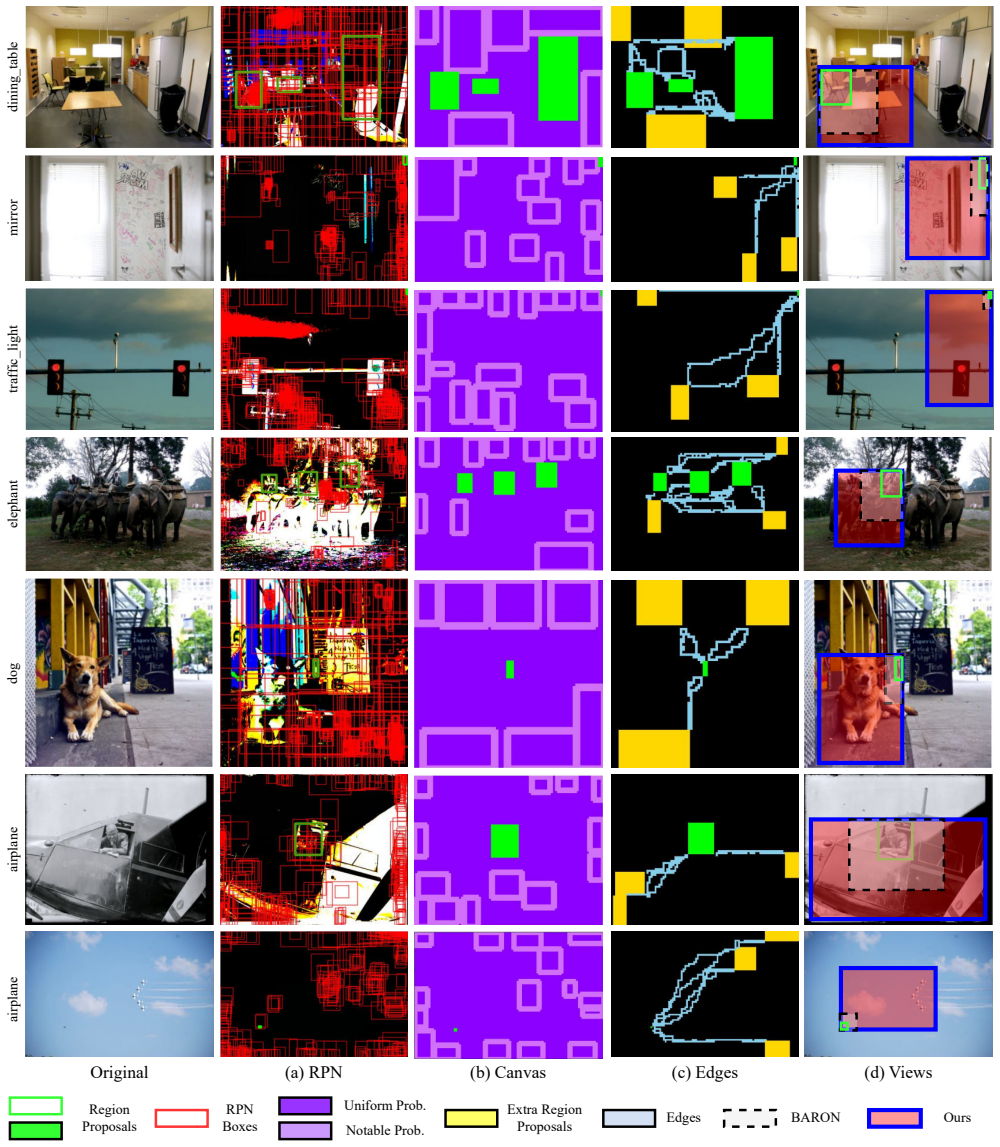
The central object is the bag of views, built from concept windows. A concept window is a crop that merges a region proposal with a nearby visual concept chosen probabilistically from a canvas of RPN boxes; the bag is the set of these merged windows. This object carries the argument in three ways: it samples only windows that contain at least one semantic concept, so fewer CLIP inputs are needed; it switches each concept to a global, middle, or local view at an optimal scale via a threshold on size ratio and co-occurring concept count; and it applies noise masks and view masks inside CLIP's self-attention to suppress background and weight important patches. The paper also adds extra farthest RPN proposals to generate more edges when the RPN finds too few proposals, which prevents the method from missing concepts in images with sparse detections.
What would settle it
Measure actual FLOPs or wall-clock time of CLIP inference with and without the noise and view masks using a standard implementation that accounts for dense matrix multiplications; if masked positions do not reduce the dimensions of the QK^T and attention-value products, the 80.3% figure will not reproduce.
Extended reading notes
Core claim
The central claim is that compositional structure in vision-language models is better exploited by sampling semantically related concepts around each region proposal and aligning a bag of views, rather than a bag of spatially neighboring regions. The paper demonstrates this by replacing BARON's fixed-window neighbor sampling with an adaptive sampling strategy: RPN boxes are reduced, a canvas records probabilities of nearby concepts, edges are generated between proposal pairs, and a distance-and-aspect-ratio weighted selection picks representative concepts. For each concept, representation switching chooses among global, middle, and local views based on size ratio and co-occurring concept count; noise masks and view masks are applied inside CLIP's self-attention. Combined with Faster R-CNN, SBV outperforms BARON by 2.6 box AP50 on OV-COCO novel categories and 0.5 mask mAP on OV-LVIS rare categories, while reporting an 80.3% reduction in CLIP FLOPs.
Load-bearing premise
The claimed 80.3% FLOPs reduction relies on the assumption that masking positions in CLIP's self-attention removes those positions from the FLOP count; if the underlying matrix multiplications still run at full size, the reported efficiency gain is not realized.
Editorial extensions
If this is right
- On OV-COCO, novel-category box AP50 rises from 34.0 for BARON to 36.6; on OV-LVIS, rare-category mask mAP rises from 22.6 to 23.1.
- SBV samples 56 regions per image instead of BARON's 216, so fewer CLIP forward passes are needed for the same alignment objective.
- The noise mask and view mask concentrate CLIP attention on foreground patches, which is the source of the reported 80.3% FLOPs reduction.
- The gains come from fewer, semantically valid CLIP inputs rather than larger models or extra training data, since the backbone and schedule match BARON.
Reading between the lines
- Inference (editorial): the canvas-and-edge concept selection is not tied to CLIP; it could be reused for other region-based alignment or grounding objectives.
- Inference (editorial): the 80.3% FLOPs reduction should be verified on real hardware, because attention masks that only zero softmax entries do not skip the underlying matrix multiplications in many implementations.
- Inference (editorial): representation switching suggests the optimal context size depends on scene composition, so the threshold could be learned from data rather than fixed.
- Inference (editorial): since the sampler relies only on RPN boxes and objectness scores, it may extend to weakly supervised or self-supervised detection settings without ground-truth boxes.
Signed reviews
Editorial analysis
A structured set of objections, weighed in public.
Referee Report
Summary. The paper proposes SBV (Sampling Bag of Views), an open-vocabulary object detection method built on the BARON bag-of-regions framework. SBV first constructs a graph-based 'canvas' over RPN proposals and probabilistically samples a bag of semantically related 'concepts' through edge traversal. It then selects among three hierarchical views (global, middle, local) for each concept using a representation-switching rule, and uses noise masks and view masks inside the CLIP image encoder to suppress background patches and emphasize important views. Experiments on OV-COCO and OV-LVIS report a novel-category box AP50 of 36.6 and a rare-category mask mAP of 23.1, respectively, surpassing prior state-of-the-art methods, and the paper claims an 80.3% reduction in CLIP FLOPs compared to BARON.
Significance. If the reported numbers are reliable, SBV would be a useful contribution to open-vocabulary detection: it advances the state of the art on two widely used benchmarks and introduces a more semantic sampling strategy than BARON's spatial neighbors. The paper includes a comparatively detailed description of the adaptive sampling procedure, ablations over its main components, and qualitative visualizations that help the reader understand the behavior of the canvas and edge-generation modules. However, the main empirical gains are modest (2.6 AP50 on OV-COCO, 0.5 mAP on OV-LVIS over BARON), the efficiency claim is based on a FLOPs model that appears to be invalid for standard masked attention, and the system has many hyperparameters tuned on the same validation set used for reporting. The central efficiency claim is therefore not yet supported, which limits the paper's current significance.
major comments (3)
- [A.5, Eq. (9)] The claimed 80.3% reduction in CLIP FLOPs rests on Eq. (9), which models self-attention cost as proportional to W·N, where N is the number of unmasked positions. In standard dense attention implementations, an attention mask is applied by adding -inf or 0 to the logits before softmax; the QK^T multiplication and the attention-value multiplication are still performed over all W positions. The paper does not state that it uses sparse attention kernels, and no wall-clock timing or profiler-based FLOPs measurements are reported anywhere in the main text or appendix. Consequently, the FLOPs numbers in Table 2 and the abstract's efficiency claim are unsupported as stated.
- [4.2.2, Eq. (4) and Table 2] The implementation of the noise mask is described in Eq. (4) as adding -inf to the logits and then multiplying the softmax output by a view mask. This operates on already-computed attention weights and does not reduce the arithmetic cost of the underlying matrix multiplications in a dense implementation. The ablation rows in Table 2 that attribute large PFLOPs reductions to the noise mask alone (55.3 to 25.7) therefore appear to be artifacts of the same incorrect FLOPs model rather than real computational savings. Please either provide measurements from an actual sparse-attention implementation or revise the efficiency claims.
- [5.2 and B.2] The hyperparameters η, N, τ, view weights, and the scaling factor s are selected by searching on the COCO validation split, and the same split's AP numbers are then reported as the final results in Tables 1–7. Because the paper reports single-run results without variance or significance estimates, the gains of 2.6 AP50 over BARON on OV-COCO and 0.5 mAP on OV-LVIS could reflect validation-set selection rather than a robust improvement. Please report results with a fixed default hyperparameter configuration, or provide multiple-seed statistics, to support the state-of-the-art claim.
minor comments (5)
- [A.5, Eq. (10)] The text states that the noise mask affects both self-attention and MLP FLOPs, but Eq. (10) for the MLP layer contains no dependence on the mask N. Please clarify which components actually change.
- [Eq. (3)-(4) and Eq. (9)] The symbol N is used both for the noise mask and for the number of unmasked positions in the FLOPs formula; using different symbols would avoid confusion.
- [Table 7] A large part of the claimed efficiency gain is already explained by the reduction in the number of regions per bag (216 for BARON versus 56 for SBV). The mask-based savings should be separated from the sampling-based savings so the reader can understand the sources of the reduction.
- [5.3] The qualitative comparisons in Figures 5 and 6 show only a few favorable examples; including a broader set or a quantitative explainability metric would strengthen the claim that SBV focuses on meaningful concepts.
- [B.2] The hyperparameter guidance in the supplementary is helpful, but the main text should include a compact version of Table 8, since several of these choices (e.g., number of edges E, interval Δ, view weights) are not obvious from the equations alone.
Circularity Check
No significant circularity: SBV is an empirical detection method whose claimed gains are measured on external benchmarks; the FLOPs model in Sec. A.5 is an engineering assumption, not a self-referential derivation.
full rationale
The paper does not derive its central results from its own definitions in a circular way. The method is an empirical pipeline: adaptive sampling selects concept windows, representation switching chooses among global/middle/local views, and view/noise masks modulate CLIP features during training. Performance is then measured on held-out novel categories of OV-COCO and OV-LVIS against external baselines, so the headline AP gains are externally grounded rather than forced by construction. The noise embeddings used in Eq. (3) are trained separately on a baseline model before being applied as masks; they do not encode the target benchmark metric, so this is a mild self-reference rather than fitted-input-called-prediction circularity. There are no load-bearing self-citations: the cited BARON and MaskCLIP works are by other authors and provide independent baselines/evidence. The 80.3% FLOPs-reduction claim rests on the FLOPs model in Sec. A.5, Eq. (9), which assumes that masked attention positions reduce self-attention FLOPs proportionally to unmasked positions. That assumption is questionable in standard implementations and may overstate efficiency, but it is a correctness/runtime-modeling issue, not circularity: the claimed reduction is not equivalent to an input by construction. Hyperparameter choices and benchmark-specific tuning, including the guidance in Sec. B.2, are selection concerns rather than circular reasoning. Overall, no step of the paper's argument reduces to its own inputs by definition, equation identity, or self-citation chain.
Assumptions & free parameters
free parameters (8)
- Distance threshold η =
0.4
- Extra region proposals N =
3
- Number of edges E =
2 (COCO), 4 (LVIS)
- Canvas interval ∆ =
100
- Noise-mask scaling factor s =
4
- View weights (δglobal, δmiddle, δlocal) =
(0.0, 0.8, 1.0)
- Sampling weights λ and α =
0.5 and 0.5
- Noise embeddings χ =
Learned vectors
assumptions (4)
- domain assumption CLIP implicitly learns compositional structures of semantic concepts in images.
- domain assumption RPN proposals with high objectness scores are reliable indicators of semantic concepts, including novel objects.
- domain assumption Noise embeddings trained on base categories generalize to novel categories when constructing noise masks.
- ad hoc to paper Attention masks reduce actual CLIP FLOPs in proportion to the number of unmasked tokens.
Cite this review
Pith. "Pith review of Sampling Bag of Views for Open-Vocabulary Object Detection." pith.science (2026). https://pith.science/paper/7JLD4KB2
@misc{pith2026241218273,
  author       = {Pith},
  title        = {Pith review of: Sampling Bag of Views for Open-Vocabulary Object Detection},
  year         = {2026},
  howpublished = {\url{https://pith.science/paper/7JLD4KB2}},
  note         = {Machine review of arXiv:2412.18273}
}
read the original abstract
Existing open-vocabulary object detection (OVD) develops methods for testing unseen categories by aligning object region embeddings with corresponding VLM features. A recent study leverages the idea that VLMs implicitly learn compositional structures of semantic concepts within the image. Instead of using an individual region embedding, it utilizes a bag of region embeddings as a new representation to incorporate compositional structures into the OVD task. However, this approach often fails to capture the contextual concepts of each region, leading to noisy compositional structures. This results in only marginal performance improvements and reduced efficiency. To address this, we propose a novel concept-based alignment method that samples a more powerful and efficient compositional structure. Our approach groups contextually related ``concepts'' into a bag and adjusts the scale of concepts within the bag for more effective embedding alignment. Combined with Faster R-CNN, our method achieves improvements of 2.6 box AP50 and 0.5 mask AP over prior work on novel categories in the open-vocabulary COCO and LVIS benchmarks. Furthermore, our method reduces CLIP computation in FLOPs by 80.3% compared to previous research, significantly enhancing efficiency. Experimental results demonstrate that the proposed method outperforms previous state-of-the-art models on the OVD datasets.
Figures


Figures from the paper (7 more)




Reference graph
Works this paper leans on
-
[1]
Emerg- ing properties in self-supervised vision transformers
Mathilde Caron, Hugo Touvron, Ishan Misra, Herv ´e J´egou, Julien Mairal, Piotr Bojanowski, and Armand Joulin. Emerg- ing properties in self-supervised vision transformers. In ICCV, pages 9630–9640, 2021. 2
work page 2021
-
[2]
BERT: pre-training of deep bidirectional trans- formers for language understanding
Jacob Devlin, Ming-Wei Chang, Kenton Lee, and Kristina Toutanova. BERT: pre-training of deep bidirectional trans- formers for language understanding. In Proceedings of the 2019 Conference of the North American Chapter of the As- sociation for Computational Linguistics: Human Language Technologies, NAACL-HLT 2019, Minneapolis, MN, USA, June 2-7, 2019, Volu...
work page 2019
-
[3]
Maskclip: Masked self-distillation advances contrastive language-image pretraining
Xiaoyi Dong, Jianmin Bao, Yinglin Zheng, Ting Zhang, Dongdong Chen, Hao Yang, Ming Zeng, Weiming Zhang, Lu Yuan, Dong Chen, Fang Wen, and Nenghai Yu. Maskclip: Masked self-distillation advances contrastive language-image pretraining. In CVPR, pages 10995–11005,
-
[4]
An image is worth 16x16 words: Transformers for image recognition at scale
Alexey Dosovitskiy, Lucas Beyer, Alexander Kolesnikov, Dirk Weissenborn, Xiaohua Zhai, Thomas Unterthiner, Mostafa Dehghani, Matthias Minderer, Georg Heigold, Syl- vain Gelly, Jakob Uszkoreit, and Neil Houlsby. An image is worth 16x16 words: Transformers for image recognition at scale. In ICLR, 2021. 6, 7, 3
work page 2021
-
[5]
Learning to prompt for open-vocabulary ob- ject detection with vision-language model
Yu Du, Fangyun Wei, Zihe Zhang, Miaojing Shi, Yue Gao, and Guoqi Li. Learning to prompt for open-vocabulary ob- ject detection with vision-language model. In CVPR, pages 14064–14073, 2022. 2, 6
work page 2022
-
[6]
Instagen: Enhancing object detection by training on synthetic dataset
Chengjian Feng, Yujie Zhong, Zequn Jie, Weidi Xie, and Lin Ma. Instagen: Enhancing object detection by training on synthetic dataset. In CVPR, pages 14121–14130, 2024. 2
work page 2024
-
[7]
Open vocabulary object detection with pseudo bounding-box labels
Mingfei Gao, Chen Xing, Juan Carlos Niebles, Junnan Li, Ran Xu, Wenhao Liu, and Caiming Xiong. Open vocabulary object detection with pseudo bounding-box labels. InECCV, pages 266–282, 2022. 2, 6, 7
work page 2022
-
[8]
Open-vocabulary object detection via vision and language knowledge distillation
Xiuye Gu, Tsung-Yi Lin, Weicheng Kuo, and Yin Cui. Open-vocabulary object detection via vision and language knowledge distillation. In ICLR, 2022. 2, 6
work page 2022
Show all 37 references
-
[9]
Girshick
Agrim Gupta, Piotr Doll ´ar, and Ross B. Girshick. LVIS: A dataset for large vocabulary instance segmentation. InCVPR, pages 5356–5364, 2019. 6
2019
-
[10]
Llms meet vlms: Boost open vocabulary object detection with fine-grained descriptors
Sheng Jin, Xueying Jiang, Jiaxing Huang, Lewei Lu, and Shijian Lu. Llms meet vlms: Boost open vocabulary object detection with fine-grained descriptors. In ICLR, 2024. 2
2024
-
[11]
Berg, Wan-Yen Lo, Piotr Doll ´ar, and Ross B
Alexander Kirillov, Eric Mintun, Nikhila Ravi, Hanzi Mao, Chlo´e Rolland, Laura Gustafson, Tete Xiao, Spencer White- head, Alexander C. Berg, Wan-Yen Lo, Piotr Doll ´ar, and Ross B. Girshick. Segment anything. In ICCV, pages 3992– 4003, 2023. 1, 2
2023
-
[12]
Weicheng Kuo, Yin Cui, Xiuye Gu, A. J. Piergiovanni, and Anelia Angelova. F-VLM: open-vocabulary object de- tection upon frozen vision and language models. CoRR, abs/2209.15639, 2022. 6
2022 arXiv
-
[13]
Grounded language-image pre-training
Liunian Harold Li, Pengchuan Zhang, Haotian Zhang, Jian- wei Yang, Chunyuan Li, Yiwu Zhong, Lijuan Wang, Lu Yuan, Lei Zhang, Jenq-Neng Hwang, Kai-Wei Chang, and Jianfeng Gao. Grounded language-image pre-training. In CVPR, pages 10955–10965, 2022. 2
2022
-
[14]
Learning object-language alignments for open-vocabulary object de- tection
Chuang Lin, Peize Sun, Yi Jiang, Ping Luo, Lizhen Qu, Gho- lamreza Haffari, Zehuan Yuan, and Jianfei Cai. Learning object-language alignments for open-vocabulary object de- tection. In ICLR, 2023. 6
2023
-
[15]
Belongie, James Hays, Pietro Perona, Deva Ramanan, Piotr Doll ´ar, and C
Tsung-Yi Lin, Michael Maire, Serge J. Belongie, James Hays, Pietro Perona, Deva Ramanan, Piotr Doll ´ar, and C. Lawrence Zitnick. Microsoft COCO: common objects in context. In ECCV, pages 740–755, 2014. 3, 6
2014
-
[16]
Girshick, Kaiming He, Bharath Hariharan, and Serge J
Tsung-Yi Lin, Piotr Doll ´ar, Ross B. Girshick, Kaiming He, Bharath Hariharan, and Serge J. Belongie. Feature pyramid networks for object detection. In CVPR, pages 936–944,
-
[17]
Hayes, Elisa Ricci, Gabriela Csurka, and Riccardo V olpi
Mingxuan Liu, Tyler L. Hayes, Elisa Ricci, Gabriela Csurka, and Riccardo V olpi. Shine: Semantic hierarchy nexus for open-vocabulary object detection. In CVPR, pages 16634– 16644, 2024. 2
2024
-
[18]
Grounding DINO: marrying DINO with grounded pre-training for open-set object detection
Shilong Liu, Zhaoyang Zeng, Tianhe Ren, Feng Li, Hao Zhang, Jie Yang, Chunyuan Li, Jianwei Yang, Hang Su, Jun Zhu, and Lei Zhang. Grounding DINO: marrying DINO with grounded pre-training for open-set object detection. CoRR, abs/2303.05499, 2023. 2
2023 arXiv
-
[19]
Eigen-cam: Class activation map using principal compo- nents
Mohammed Bany Muhammad and Mohammed Yeasin. Eigen-cam: Class activation map using principal compo- nents. In 2020 International Joint Conference on Neural Net- works, IJCNN 2020, Glasgow, United Kingdom, July 19-24, 2020, pages 1–7, 2020. 8
2020
-
[20]
Learning transferable visual models from natural language supervision
Alec Radford, Jong Wook Kim, Chris Hallacy, Aditya Ramesh, Gabriel Goh, Sandhini Agarwal, Girish Sastry, Amanda Askell, Pamela Mishkin, Jack Clark, Gretchen Krueger, and Ilya Sutskever. Learning transferable visual models from natural language supervision. In Proceedings of th...
2021
-
[21]
Khan, and Fahad Shahbaz Khan
Hanoona Abdul Rasheed, Muhammad Maaz, Muham- mad Uzair Khattak, Salman H. Khan, and Fahad Shahbaz Khan. Bridging the gap between object and image-level representations for open-vocabulary detection. In NeurIPS,
-
[22]
Girshick, and Jian Sun
Shaoqing Ren, Kaiming He, Ross B. Girshick, and Jian Sun. Faster R-CNN: towards real-time object detection with re- gion proposal networks. In NeurIPS, pages 91–99, 2015. 1, 2, 3, 4, 6, 5
2015
-
[23]
Object-aware dis- tillation pyramid for open-vocabulary object detection
Luting Wang, Yi Liu, Penghui Du, Zihan Ding, Yue Liao, Qiaosong Qi, Biaolong Chen, and Si Liu. Object-aware dis- tillation pyramid for open-vocabulary object detection. In CVPR, pages 11186–11196, 2023. 2, 6
2023
-
[24]
Aligning pretraining for detection via object-level con- trastive learning
Fangyun Wei, Yue Gao, Zhirong Wu, Han Hu, and Stephen Lin. Aligning pretraining for detection via object-level con- trastive learning. In NeurIPS, pages 22682–22694, 2021. 6
2021
-
[25]
Aligning bag of regions for open- vocabulary object detection
Size Wu, Wenwei Zhang, Sheng Jin, Wentao Liu, and Chen Change Loy. Aligning bag of regions for open- vocabulary object detection. In CVPR, pages 15254–15264,
-
[26]
CORA: adapting CLIP for open-vocabulary detection with 9 region prompting and anchor pre-matching
Xiaoshi Wu, Feng Zhu, Rui Zhao, and Hongsheng Li. CORA: adapting CLIP for open-vocabulary detection with 9 region prompting and anchor pre-matching. In CVPR, pages 7031–7040, 2023. 2
2023
-
[27]
Open-vocabulary DETR with conditional matching
Yuhang Zang, Wei Li, Kaiyang Zhou, Chen Huang, and Chen Change Loy. Open-vocabulary DETR with conditional matching. In ECCV, pages 106–122, 2022. 2, 6, 7
2022
-
[28]
Contextual object detection with multi- modal large language models
Yuhang Zang, Wei Li, Jun Han, Kaiyang Zhou, and Chen Change Loy. Contextual object detection with multi- modal large language models. CoRR, abs/2305.18279, 2023. 2
2023 arXiv
-
[29]
Open-vocabulary object detection using captions
Alireza Zareian, Kevin Dela Rosa, Derek Hao Hu, and Shih- Fu Chang. Open-vocabulary object detection using captions. In CVPR, pages 14393–14402, 2021. 2, 6, 8
2021
-
[30]
Dana, Jianping Shi, Zhongyue Zhang, Xiaogang Wang, Ambrish Tyagi, and Amit Agrawal
Hang Zhang, Kristin J. Dana, Jianping Shi, Zhongyue Zhang, Xiaogang Wang, Ambrish Tyagi, and Amit Agrawal. Context encoding for semantic segmentation. In CVPR, pages 7151–7160, 2018. 6
2018
-
[31]
Exploring region-word alignment in built-in detector for open-vocabulary object de- tection
Heng Zhang, Qiuyu Zhao, Linyu Zheng, Hao Zeng, Zhi- wei Ge, Tianhao Li, and Sulong Xu. Exploring region-word alignment in built-in detector for open-vocabulary object de- tection. In CVPR, pages 16975–16984, 2024. 2, 3, 6
2024
-
[32]
Scene-adaptive and region-aware multi- modal prompt for open vocabulary object detection
Xiaowei Zhao, Xianglong Liu, Duorui Wang, Yajun Gao, and Zhide Liu. Scene-adaptive and region-aware multi- modal prompt for open vocabulary object detection. In CVPR, pages 16741–16750, 2024. 6
2024
-
[33]
Regionclip: Region-based language-image pretraining
Yiwu Zhong, Jianwei Yang, Pengchuan Zhang, Chunyuan Li, Noel Codella, Liunian Harold Li, Luowei Zhou, Xiyang Dai, Lu Yuan, Yin Li, and Jianfeng Gao. Regionclip: Region-based language-image pretraining. In CVPR, pages 16772–16782, 2022. 2, 6, 7
2022
-
[34]
Detecting twenty-thousand classes using image-level supervision
Xingyi Zhou, Rohit Girdhar, Armand Joulin, Philipp Kr¨ahenb¨uhl, and Ishan Misra. Detecting twenty-thousand classes using image-level supervision. In ECCV, pages 350– 368, 2022. 2, 6
2022
-
[35]
Deformable DETR: deformable transformers for end-to-end object detection
Xizhou Zhu, Weijie Su, Lewei Lu, Bin Li, Xiaogang Wang, and Jifeng Dai. Deformable DETR: deformable transformers for end-to-end object detection. In ICLR, 2021. 6 10 Sampling Bag of Views for Open-Vocabulary Object Detection Supplementary Material Contents A . Implementation D...
2021
-
[36]
We design these concept windows to avoid repeatedly including other regional proposals. To achieve this, we trim the concept windows at the boundaries of all region propos- als, preventing training bias and reducing the risk of over- fitting certain objects while underpredicti...
-
[37]
dog”, “mirror
Additionally, we incorporate BARON’s sampling 1 Algorithm 1 Aligning Bag of Views Require: an input image I, region proposals R, top-k proposals Rtopk, noise embeddings χ Hyperparameters: interval ∆, number of edges E, number of extra region proposals N, scaling factor for noi...
Reviewed August 11, 2026 · model on record in the stance chip above.
Discussion (0). Continue with ORCID to comment.