REVIEW 3 major objections 6 minor 1 cited by
Explanatory Instructions: Towards Unified Vision Tasks Understanding and Zero-shot Generalization
T0 review · 3 major / 6 minor · reviewed 2026-08-11 · deepseek-v4-flash
Pith's one-line read A vision-language model fine-tuned on plain-language descriptions of image-to-image transformations can carry out vision tasks it never trained on, including turning edge maps, depth maps, and outlines into photographs.
desk verdict A useful new dataset and a plausible but unproven central claim; the missing terminological-instruction control is load-bearing. read the letter →
The pith
A machine-rendered reading of the paper's core claim, the machinery that carries it, and where it could break.
The reading
What carries the argument
The load-bearing object is the Explanatory Instruction, defined as a detailed linguistic description of the transformation from an input image to an output image, written without task jargon and usually provided in both directions. Around it sits DECVT, a dataset of about 12 million 'image input to explanatory instruction to output' triplets assembled from terminological tasks such as restoration, detection, depth estimation, pose estimation, segmentation, and controllable generation, plus open-ended image-pair editing data, with instructions generated by a large multimodal model and by manual templates. The model is a vanilla token-based autoregressive vision-language model: a VQ-VAE image tokenizer converts images to discrete tokens, the tokens are concatenated with instruction text, and a decoder-only transformer trained with next-token prediction generates the output image, initialized from a pretrained multimodal generative model rather than trained from scratch. A supporting observation is that in a PCA-reduced feature space, explanatory instructions form continuous, overlapping distributions across tasks, whereas terminological instructions cluster discretely, which the paper identifies as the driver of zero-shot generalization.
What would settle it
Fine-tune the same pretrained model on the same data with only terminological labels instead of explanatory instructions and test on the same held-out tasks; if that control also produces faithful edge-to-image and depth-to-image outputs, the explanatory format is not the cause.
Extended reading notes
Core claim
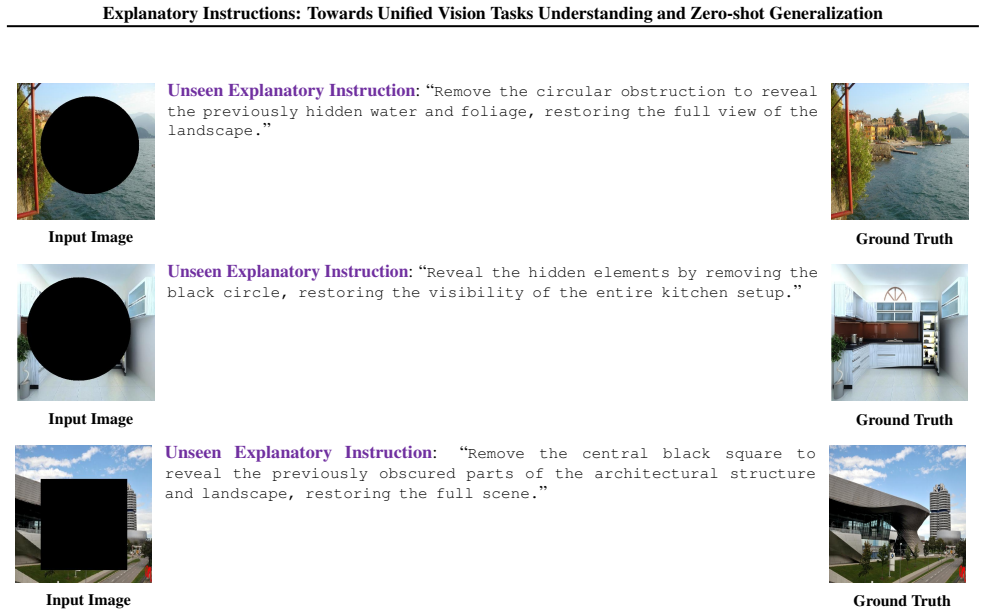
The central discovery claimed is that representing a vision task as an explanatory instruction, a natural-language description of the transformations between an input image and an output image, lets an autoregressive vision-language model generalize beyond the terminological task categories it was trained on. After supervised fine-tuning on the DECVT dataset, the model performs previously seen tasks from instructions it has not encountered, and, when entire tasks such as HED-to-Image, Canny-to-Image, and Depth-to-Image are held out of training, it can still produce plausible outputs when given a textual explanation of the desired transformation. The paper reports that generalization is asymmetric: the model succeeds on generation tasks that turn edges, maps, or masks into images, and on low-level tasks such as low-light enhancement and deblurring, but fails on the inverse tasks such as Image-to-Canny and Image-to-Depth, a failure the authors attribute to missing alignment between the image tokenizer and text modality in the pretrained initialization. On standard benchmarks the fine-tuned model still lags behind task-specific and specialist generalist models, so the claimed contribution is the new form of task specification and the zero-shot capability it enables, not state-of-the-art generation quality.
Load-bearing premise
The load-bearing premise is that the zero-shot behavior shown for unseen tasks comes from the explanatory-instruction fine-tuning and not from abilities already present in the pretrained model used to initialize training; the paper does not compare against a control fine-tuned on the same data with terminological-only instructions.
Editorial extensions
If this is right
- If the claim holds, a vision model's ability to do a new task depends on being told what the task does, not on having seen that task category in training.
- The same model can be steered by arbitrary user-written descriptions of image transformations, making instruction following a general interface for image generation and editing.
- Task-level zero-shot generalization is expected mainly for tasks whose output distribution the pretrained image tokenizer can already represent, such as photographs, and fails for outputs like depth maps and Canny edges that the tokenizer was not aligned to produce.
- Combining multiple tasks in one fine-tuning run with explanatory instructions supports mixed and combined task objectives, rather than one instruction format per task.
- Explanatory instructions also help on seen tasks for unseen categories or descriptions: a model can follow 'the creature on the leaf' even when the category name was never trained.
Reading between the lines
- If explanatory instructions rather than pretrained abilities cause the reported behavior, the same dataset format could be applied to video, 3D, or audio-visual transformations, where task vocabularies are even less standardized.
- The paper's own explanation of failures suggests a concrete test: aligning the image tokenizer with text-image data before fine-tuning should extend task-level zero-shot to inverse tasks such as image-to-depth and image-to-canny; this is an inference, not a paper claim.
- A control experiment that fine-tunes the same initialization on the same data with terminological labels would isolate whether the explanatory format, rather than data scale and diversity, drives zero-shot generalization.
- The latent-space continuity argument implies that generalization strength should track the overlap of instruction embeddings between training and test tasks, a prediction the paper does not test.
Editorial analysis
A structured set of objections, weighed in public.
Referee Report
Summary. The paper proposes "Explanatory Instructions": free-form linguistic descriptions of image-to-image transformations, as an alternative to short terminological task labels such as "semantic segmentation" or "depth estimation." The authors construct DECVT, a dataset of roughly 12 million "input image → explanatory instruction → output image" triplets, and fine-tune the 7B autoregressive multimodal model Lumina-mGPT-7B on subsets of this data (Sections 3, 4.1). The central claim is that after fine-tuning, the model acquires (a) instruction-level zero-shot generalization to unseen paraphrases of instructions and (b) task-level zero-shot generalization to entire vision tasks omitted from training, such as HED-to-Image, Canny-to-Image, and Depth-to-Image (Section 4.2, Figures 6-8). The quantitative sections (Tables 1, 2, and Appendix B) report results on Canny-to-Image, HED-to-Image, inpainting/outpainting, dense prediction, and low-level restoration tasks, showing that the fine-tuned model is competitive with the vanilla Lumina-mGPT initialization but generally well below task-specific and vision-generalist baselines. The paper also includes explicit limitation statements in Section 5 and Appendix D, acknowledging that task-level zero-shot is unstable and fails for Image-to-Canny and Image-to-Depth.
Significance. If the causal claim were established—that a textual explanation of a transformation is what enables a vision-language model to execute a task it never trained on—this would be a meaningful step toward task-level zero-shot generalization in computer vision, analogous to instruction following in NLP. The paper has several strengths: the DECVT dataset is large and integrates many tasks and inverse directions; the method is simple and reproducible in principle; the authors do not claim state-of-the-art performance; and the limitation sections are unusually candid about instabilities and poor cases. The main weakness is evidential: the paper's headline phenomenon is supported almost entirely by three selected qualitative examples in Section 4.2, and the experimental design lacks the control condition needed to attribute the behavior to explanatory instructions rather than to the pretrained initialization or to generic image-to-image fine-tuning. The same GPT-4o pipeline is used to generate both training and evaluation instructions, which further weakens the "zero-shot instruction" interpretation.
major comments (3)
- [Section 4.2 and Figures 6-8] The central causal claim—that explanatory instructions, rather than the underlying image-to-image fine-tuning, enable task-level zero-shot generalization—is not tested because the design lacks a control condition. The model is initialized from Lumina-mGPT-7B-768 (Section 3), and Table 1 shows that this initialization already performs the held-out tasks weakly: Canny-to-Image F1=10.09 and HED-to-Image FID=69.49 under fixed terminological instructions. A control model fine-tuned on the same 1.5M-pair subset with only terminological instructions (e.g., "canny edge map to image" or "depth map to image") is necessary to rule out that the observed generalization comes from (a) the pretrained model's latent ability to naturalize edge/depth inputs or (b) generic supervised fine-tuning on diverse image-to-image pairs, independent of instruction wording. Appendix D item 7 states that additional validation experiments could not be run due to resource constraints; this is exactly the missing experiment. Without it, the paper's headline claim remains unverified.
- [Section 4.2, Section 5, Tables 1-2] The claimed "strong zero-shot generalization for unseen CV tasks" rests on three qualitative examples (Figures 6-8), and the exact held-out setting of Section 4.2 is never evaluated quantitatively. Tables 1 and 2 use the full-DECVT model from Section 4.1, not the Section 4.2 model from which HED-to-Image, Canny-to-Image, and Depth-to-Image were excluded. Meanwhile, Section 5 states that task-level zero-shot fails for Image-to-Canny and Image-to-Depth, and Appendix D item 7 and the caption of Figure 48 describe the behavior as "unstable" and of "relatively low" success rate. The authors should provide quantitative metrics (e.g., F1, FID, SSIM, or a success-rate estimate) on a random sample of held-out inputs for the Section 4.2 model, and should report failure cases alongside successes; otherwise the strength of the generalization claim cannot be assessed.
- [Section 4.1, Appendix A.1, Figures 33-43] Instruction-level zero-shot is evaluated with instructions generated by the same GPT-4o prompt pipeline used to produce the training instructions. The test instructions are therefore drawn from the same distribution as the training instructions, so "unseen" means token-level novelty within one generator distribution rather than distributional novelty. This circularity also affects the task-level instructions in Section 4.2, which are constructed with the same template. The authors should either test with out-of-distribution instruction sources (human-written instructions, a different generation model, or expert paraphrases) or soften the claim from "zero-shot instruction generalization" to "robustness to paraphrases within the GPT-4o instruction distribution."
minor comments (6)
- [Section 2 heading] The heading contains a typo: "Computer Vison Tasks" should be "Computer Vision Tasks."
- [Abstract and Introduction] The abstract and Section 1 state that code and dataset will be or have been released, but no repository link is included in the manuscript; please add the URL or note that it will be added in the camera-ready version.
- [Tables 1 and 2] The labels "T. Z.-s." and "I. Z.-s." are easy to misread: for example, HED-to-Image is marked "I. Z.-s." while Canny-to-Image is marked "T. Z.-s.," even though both are evaluated with unseen instructions. Clarify that Table 1 uses the full-DECVT model, and state explicitly which tasks are seen or unseen for that model.
- [Appendix D item 2 and Figure 57] The latent-space visualization claims that explanatory instructions form a continuum while terminological instructions cluster discretely, but it uses only one text encoder and no quantitative separation measure; please add a metric or a second encoder to support the claim.
- [Section 3, Inference] The top-k value of 2048 for image generation is a free hyperparameter, and Appendix D notes that its effect is task-dependent; a brief ablation or a discussion of sensitivity would improve reproducibility.
- [Appendix D item 5] The hypothesis of an optimal instruction-complexity threshold is not tested; consider labeling it explicitly as a conjecture, since the current phrasing reads as a finding.
Circularity Check
No significant circularity: the zero-shot claims are empirical, evaluated against external benchmarks; the missing terminological control is a validity concern, not a circular derivation.
full rationale
The paper makes no formal derivation: its central claims are empirical demonstrations that fine-tuning an AR-based VLM on image-to-instruction-to-image triplets yields instruction-level and task-level generalization. I checked each load-bearing step. (1) DECVT construction (Sec. 2 and Appendix A) is an external data-construction pipeline; instructions are generated by GPT-4o from image pairs, not defined in terms of the model's outputs, so there is no self-definitional loop. (2) The task-level zero-shot protocol (Sec. 4.2) excludes HED-to-Image, Depth-to-Image, and related tasks from training and then tests on those tasks; the test instructions are newly generated, and the paper reports quantitative results against external benchmarks such as MultiGen-20M, ADE20K, and NYU-Depth V2, so the evaluation is not a rename of the training objective. (3) Initialization from Lumina-mGPT and citations to Chameleon and PixWizard are architectural or related-work citations; no load-bearing argument reduces to a self-citation. (4) The absence of a control trained on terminological instructions and the fact that evaluation instructions are generated by the same GPT-4o pipeline as training instructions are genuine validity concerns about whether explanatory language per se causes the effect, but under the review rules those are correctness-risk issues, not circularity: no equation, fitted parameter, or cited uniqueness theorem makes the reported behavior equal to the input by construction. I therefore find no significant circularity.
Assumptions & free parameters
free parameters (2)
- top-k sampling value for image token generation =
2048
- DECVT subset sampling ratios for task-level zero-shot experiments =
30% explanatory (50% editing / 50% visual pairs), 20% terminological
assumptions (3)
- domain assumption GPT-4o-generated explanatory instructions are an accurate and sufficient representation of the transformation between image pairs.
- domain assumption The autoregressive next-token prediction objective on discrete image tokens is an appropriate learning signal for acquiring task-level generalization.
- domain assumption Capabilities demonstrated on held-out tasks after fine-tuning are attributable to the explanatory instruction training rather than to the pretrained initialization.
Cite this review
Pith. "Pith review of Explanatory Instructions: Towards Unified Vision Tasks Understanding and Zero-shot Generalization." pith.science (2026). https://pith.science/paper/S5224KQ3
@misc{pith2026241218525,
  author       = {Pith},
  title        = {Pith review of: Explanatory Instructions: Towards Unified Vision Tasks Understanding and Zero-shot Generalization},
  year         = {2026},
  howpublished = {\url{https://pith.science/paper/S5224KQ3}},
  note         = {Machine review of arXiv:2412.18525}
}
abstract
Computer Vision (CV) has yet to fully achieve the zero-shot task generalization observed in Natural Language Processing (NLP), despite following many of the milestones established in NLP, such as large transformer models, extensive pre-training, and the auto-regression paradigm, among others. In this paper, we explore the idea that CV adopts discrete and terminological task definitions (\eg, ``image segmentation''), which may be a key barrier to zero-shot task generalization. Our hypothesis is that without truly understanding previously-seen tasks--due to these terminological definitions--deep models struggle to generalize to novel tasks. To verify this, we introduce Explanatory Instructions, which provide an intuitive way to define CV task objectives through detailed linguistic transformations from input images to outputs. We create a large-scale dataset comprising 12 million ``image input $\to$ explanatory instruction $\to$ output'' triplets, and train an auto-regressive-based vision-language model (AR-based VLM) that takes both images and explanatory instructions as input. By learning to follow these instructions, the AR-based VLM achieves instruction-level zero-shot capabilities for previously-seen tasks and demonstrates strong zero-shot generalization for unseen CV tasks. Code and dataset will be openly available on our GitHub repository.
Figures


Figures from the paper (54 more)




Forward citations
Cited by 1 Pith paper
-
Under One Sun: Multi-Object Generative Perception of Materials and Illumination
Factorizing video editing into semantic-token anchoring and motion-restoration pre-training produces strong zero-shot and SOTA open-source instruction-guided video edits without heavy external structural priors.
Reference graph
Works this paper leans on
-
[1]
Traditional stone building with a steeply pitched red-tiled roof
-
[2]
Multiple chimneys and dormer windows
-
[3]
Large white-framed windows
-
[4]
Well-kept lawn in front
-
[5]
Taming transformers for high-resolution image synthesis
5 Esser, P., Rombach, R., and Ommer, B. Taming transformers for high-resolution image synthesis. In Proc. IEEE Conf. Comp. Vis. Patt. Recogn., pp. 12873–12883, 2021. 5 Fei, H., Wu, S., Zhang, H., Chua, T.-S., and YAN, S. VIT- RON: A unified pixel-level vision LLM for understand- ing, generating, segmenting, editing. In Advances in Neu- ral Inf. Process. S...
arXiv 2021
- [6]
-
[7]
An underwater image enhancement benchmark dataset and beyond
8 Li, C., Guo, C., Ren, W., Cong, R., Hou, J., Kwong, S., and Tao, D. An underwater image enhancement benchmark dataset and beyond. IEEE Trans. Image Process. , 29: 4376–4389, 2019a. 4 Li, F., Zhang, H., Xu, H., Liu, S., Zhang, L., Ni, L. M., and Shum, H.-Y . Mask DINO: Towards a unified transformer- based framework for object detection and segmentation. ...
work page 2024
-
[8]
Just as with language understanding, visual cognition also vary from person to person. For various vision tasks, even when dealing with vision tasks related to a single image pair, different people may interpret and describe the images and tasks differently. Therefore, we think that the simple next-token prediction approach may be well-suited to those vis...
Show all 68 references
-
[9]
VisionLLM v2: An end-to-end generalist multimodal large language model for hundreds of vision- language tasks
9 Wu, J., Zhong, M., Xing, S., Lai, Z., Liu, Z., Wang, W., Chen, Z., Zhu, X., Lu, L., Lu, T., Luo, P., Qiao, Y ., and Dai, J. VisionLLM v2: An end-to-end generalist multimodal large language model for hundreds of vision- language tasks. arXiv preprint arXiv:2406.08394, 2024. 9...
2024 arXiv
-
[10]
gpt-4o-2024-05-13
28 Zhu, D., Chen, J., Shen, X., Li, X., and Elhoseiny, M. MiniGPT-4: Enhancing vision-language understanding with advanced large language models. arXiv preprint arXiv:2304.10592, 2023. 9 14 Explanatory Instructions: Towards Unified Vision Tasks Understanding and Zero-shot Gene...
2023 arXiv
-
[15]
Stone wall in front of the building
-
[17]
The same building with specific modifications
-
[18]
Building and extension shaded with a semi-transparent reddish hue
-
[19]
Sky colored a bright blue
-
[20]
Lawn colored a vivid green
-
[21]
Stone wall highlighted with a grayish color
-
[22]
Explanatory instruction from A to B:
Bush to the right of the stone wall colored yellow. Explanatory instruction from A to B:
-
[23]
2) Fill the selected area with a bright, distinct color to make the sky stand out
Color the Sky: 1) Select the sky area. 2) Fill the selected area with a bright, distinct color to make the sky stand out
-
[24]
2) Apply a semi- transparent hue over the selected area to give it a shaded appearance while still allowing the underlying details to be visible
Shade the Building: 1) Select the entire building and its extension, including the roof and chimneys. 2) Apply a semi- transparent hue over the selected area to give it a shaded appearance while still allowing the underlying details to be visible
-
[25]
2) Fill this area with a bright, vibrant color to emphasize the grassy area
Color the Lawn: 1) Select the lawn area in front of the building. 2) Fill this area with a bright, vibrant color to emphasize the grassy area
-
[26]
2) Apply a distinct, muted color to the wall to make it stand out from the lawn and building
Highlight the Stone Wall: 1) Select the stone wall in front of the building. 2) Apply a distinct, muted color to the wall to make it stand out from the lawn and building
-
[27]
2) Fill this area with a bright, distinct color to differentiate it from the surrounding elements
Color the Bush: 1) Identify and select the bush or shrub to the right of the stone wall. 2) Fill this area with a bright, distinct color to differentiate it from the surrounding elements. Explanatory instruction from B to A:
-
[28]
2) Replace the bright color with a natural sky color, making it appear more realistic
Restore the Sky: 1)Select the area of the sky that has been filled with a bright, distinct color. 2) Replace the bright color with a natural sky color, making it appear more realistic
-
[29]
2) Remove the shading to restore the building’s natural appearance, showing its original material and color
Remove the Building Shading: 1) Select the area of the building and its extension shaded with a semi-transparent hue. 2) Remove the shading to restore the building’s natural appearance, showing its original material and color
-
[30]
2) Replace the bright color with a natural grass color to make it look realistic
Restore the Lawn Color: 1) Select the area of the lawn that has been filled with a bright, vibrant color. 2) Replace the bright color with a natural grass color to make it look realistic
-
[31]
Remove the Highlight from the Stone Wall: 1) Select the stone wall that has been highlighted with a distinct, muted color
-
[32]
Remove the highlighting to return the stone wall to its natural appearance
-
[33]
gpt-4o-2024-05-13
Restore the Bush Color: 1) Select the bush or shrub to the right of the stone wall that has been colored with a bright, distinct color. 2) Replace the bright color with a natural color to make it look realistic and blend in with the surrounding environment. Table 3. Examples o...
2024
-
[34]
Increase the color saturation of the entire image dramatically
-
[35]
Change the sky to a bright, unnatural shade of blue
-
[36]
Alter the grass color to a vivid, artificial-looking green
-
[37]
Add a bright, contrasting color to one side of the building, perhaps representing vegetation in an exaggerated way
-
[38]
Explanatory instruction from B to A: To transform Image B into something resembling Image A without referencing A’s content:
Simplify the textures and details to create a more flat, cartoon-like appearance. Explanatory instruction from B to A: To transform Image B into something resembling Image A without referencing A’s content:
-
[39]
Reduce the overall color saturation of the image significantly
-
[40]
Adjust the sky color to a more natural, pale blue tone
-
[41]
Change the grass to a more muted, realistic shade of green
-
[42]
Remove any unnaturally bright or contrasting colors from the building and surroundings
-
[43]
claude-3-5-sonnet-20240620
Enhance the texture and details of the building to create a more realistic, photographic appearance. Table 5. Examples of outputs from “claude-3-5-sonnet-20240620”. 17 Explanatory Instructions: Towards Unified Vision Tasks Understanding and Zero-shot Generalization Caption of ...
2023
-
[44]
turtle” and descriptive phrases such as “the creature swimming in the water
as backbones (e.g., OmniGen (Xiao et al., 2024) and PixWizard (Lin et al., 2024)), the performance of our model still shows a noticeable gap. Nevertheless, compared to a vanilla token-based VLM (i.e., Lumina-mGPT (Liu et al., 2024)), the fine-tuned model achieves significant p...
2024
-
[45]
While the top- k value is typically set to 5 for text generation in large language models (LLMs), we recommend setting the top-k to 2048 during the image generation stage
As we have mentioned in Sec. 3 of the paper: “ While the top- k value is typically set to 5 for text generation in large language models (LLMs), we recommend setting the top-k to 2048 during the image generation stage.” This recommendation is also consistent with findings in L...
2024
-
[46]
In contrast, explanatory instructions span a continuous spectrum across tasks, which we identify as the primary driver of zero-shot generalization capability
When visualized in a reduced feature space, fixed task-specific instructions (e.g., Semantic Segmentation) exhibit discrete clustering—a property that inherently ties task execution to rigid syntactic forms, potentially limiting generalization. In contrast, explanatory instruc...
2019
-
[47]
Actually, in the early stage of our experiments, we attempted to construct explanatory instructions between different frames in videos
Experiments in this work are limited to image pairs, and we do not explore more complex data such as video or 3D data. Actually, in the early stage of our experiments, we attempted to construct explanatory instructions between different frames in videos. Unfortunately, for com...
-
[48]
While GPT-4o exhibits one of the most advanced descriptive capabilities among existing models, it still faces challenges such as incomplete descriptions and occasional deviations
In constructing the Dataset of Explanatory CV Tasks, we adhered as closely as possible to the principle that the provided instructions should avoid obvious inaccuracies. While GPT-4o exhibits one of the most advanced descriptive capabilities among existing models, it still fac...
-
[49]
A closed structure with no visible contents
-
[50]
The structure begins to reveal an internal object
-
[51]
Descriptions of image flow B: (d) (e) (f)
The internal object becomes partially visible. Descriptions of image flow B: (d) (e) (f)
-
[52]
A partially revealed internal object within a structure
-
[53]
The internal object becomes more visible
-
[54]
Explanatory instruction from A to B:
The structure closes, hiding the internal object. Explanatory instruction from A to B:
-
[55]
Start with a closed structure
-
[56]
Gradually reveal an internal object
-
[57]
Continue revealing more of the internal object until it is partially visible
-
[58]
Progress to showing the internal object more clearly
-
[59]
Explanatory instruction from B to A:
Finally, close the structure, hiding the internal object again. Explanatory instruction from B to A:
-
[60]
Begin with a partially revealed internal object within a structure
-
[61]
Gradually hide the internal object until it is no longer visible
-
[62]
Ensure the structure is completely closed with no visible contents
-
[63]
Open the structure slightly to start revealing an internal object
-
[64]
Continue to reveal more of the internal object until it is partially visible. Table 8. Video output sample from GPT-4o. Content that does not meet the description requirements is highlighted in red. they also lead to certain trade-offs. Specifically, the inclusion of these dat...
-
[65]
We hypothesize that there exists an optimal level of instruction complexity for models
Although the dataset construction and training approach described above have several limitations, we believe that the use of explanatory instructions can enhance the model’s adaptability to complex instructions and objectives. We hypothesize that there exists an optimal level ...
-
[66]
However, based on empirical observations, we recommend that the model generate image captions before producing explanatory instructions
Due to budget constraints during the construction of the Dataset of Explanatory CV Tasks, a significant portion of the data was generated by directly instructing the model to output explanatory instructions, bypassing the generation of image captions. However, based on empiric...
-
[67]
While this work demonstrates that explanatory instructions can enable zero-shot generalization at the vision task level, this ability remains unstable
Due to resource limitations, we only conducted our experiments on the vanilla token-based VLM with 7B parameter, and 43 Explanatory Instructions: Towards Unified Vision Tasks Understanding and Zero-shot Generalization no image-caption-based data were used for image generation ...
-
[342]
PixWizard: Versatile image-to-image visual assistant with open-language in- structions
9 Lin, W., Wei, X., Zhang, R., Zhuo, L., Zhao, S., Huang, S., Xie, J., Qiao, Y ., Gao, P., and Li, H. PixWizard: Versatile image-to-image visual assistant with open-language in- structions. arXiv preprint arXiv:2409.15278, 2024. 1, 8, 9, 27 11 Explanatory Instructions: Towards...
2024 arXiv
-
[2019]
Cogview: Mastering text-to-image generation via transformers
42 Ding, M., Yang, Z., Hong, W., Zheng, W., Zhou, C., Yin, D., Lin, J., Zou, X., Shao, Z., Yang, H., and Tang, J. Cogview: Mastering text-to-image generation via transformers. In Advances in Neural Inf. Process. Syst. , pp. 19822–19835,
-
[2021]
8 Brooks, T., Holynski, A., and Efros, A. A. InstructPix2Pix: Learning to follow image editing instructions. In Proc. IEEE Conf. Comp. Vis. Patt. Recogn., pp. 18392–18402,
-
[2022]
Single-image depth perception in the wild
8, 28 Chen, W., Fu, Z., Yang, D., and Deng, J. Single-image depth perception in the wild. In Advances in Neural Inf. Process. Syst., pp. 730–738, 2016. 4 Chen, Z., Wu, J., Wang, W., Su, W., Chen, G., Xing, S., Zhong, M., Zhang, Q., Zhu, X., Lu, L., Li, B., Luo, P., Lu, T., Yu,...
2016 arXiv
-
[2023]
4, 27 Brown, T., Mann, B., Ryder, N., Subbiah, M., Kaplan, J. D., Dhariwal, P., Neelakantan, A., Shyam, P., Sastry, G., Askell, A., Agarwal, S., Herbert-V oss, A., Krueger, G., Henighan, T., Child, R., Ramesh, A., Ziegler, D., Wu, J., Winter, C., Hesse, C., Chen, M., Sigler, E...
1901
-
[2024]
HQ-Edit: A high-quality dataset for instruction-based image editing
9 Hui, M., Yang, S., Zhao, B., Shi, Y ., Wang, H., Wang, P., Zhou, Y ., and Xie, C. HQ-Edit: A high-quality dataset for instruction-based image editing. arXiv preprint arXiv:2404.09990, 2024. 4 Ke, B., Obukhov, A., Huang, S., Metzger, N., Daudt, R. C., and Schindler, K. Repurp...
2024 arXiv
Reviewed August 11, 2026 · model on record in the stance chip above.
Discussion (0). Continue with ORCID to comment.