REVIEW 3 major objections 5 minor 79 references
Photoreforming of plastic waste into valuable products and hydrogen using a high-entropy oxynitride with distorted atomic-scale structure
T0 review · 3 major / 5 minor · reviewed 2026-08-11 · deepseek-v4-flash
Pith's one-line read A high-entropy oxynitride with nitrogen-distorted atomic bonds outperforms its oxide counterpart for sunlight-driven conversion of PET plastic into hydrogen, formic acid, and acetic acid.
desk verdict The HEON/HEO activity gap is a genuine new result, but the EXAFS-based vacancy mechanism is underdetermined and needs a revision. read the letter →
The pith
A machine-rendered reading of the paper's core claim, the machinery that carries it, and where it could break.
The reading
What carries the argument
The load-bearing object is the high-entropy oxynitride (HEON), a five-cation Ti-Zr-Hf-Nb-Ta ceramic with mixed O/N anions, made by arc melting, high-pressure torsion, oxidation, and ammonia nitriding. The mechanism that carries the argument is nitrogen-induced local atomic distortion: X-ray absorption spectroscopy shows that nitrogen changes the coordination environment of Ti and Nb, expands Zr and Ta bonds, contracts Hf bonds, and lowers the binding energy of Ti, Nb, and Ta, while reduced first-shell EXAFS amplitudes are interpreted as additional oxygen vacancies around Ti, Nb, and Ta. These distortions, combined with N-$2p$/O-$2p$ hybridization, narrow the bandgap and suppress photogenerated electron-hole recombination, so more electrons reach the surface to reduce water to H$_2$ and more holes oxidize PET to formic and acetic acid. The dual-phase monoclinic/face-centered-cubic microstructure, with dislocation-like defects, supplies additional strain and defect sites.
What would settle it
Quantitative EXAFS fitting of the Ti, Nb, and Ta first shells in both materials, with Debye-Waller factors treated explicitly, would settle the vacancy question: unchanged coordination numbers with larger disorder would falsify the vacancy interpretation, while genuinely lower coordination numbers would support it. An independent oxygen-vacancy probe, such as positron annihilation or O K-edge X-ray absorption, would give a second test.
Extended reading notes
Core claim
This work reports the first use of a high-entropy oxynitride for photoreforming plastic waste. The central claim is that nitrogen incorporation into a Ti-Zr-Hf-Nb-Ta high-entropy oxide creates a distorted local structure around titanium and niobium — the elements that dominate the conduction-band minimum — while lengthening Zr-O/N and Ta-O/N bonds, shortening Hf-O/N bonds, and lowering the binding energy of Ti, Nb, and Ta. These changes, together with hybridization of O-$2p$ and N-$2p$ orbitals and oxygen vacancies around Ti, Nb, and Ta, narrow the bandgap from 3.2 eV to about 1.5 eV and reduce radiative electron-hole recombination. On PET in strongly alkaline solution under a xenon lamp, the oxynitride releases 1.63 mmol/g H$_2$ versus 0.84 mmol/g for the oxide in 4 h, produces 0.814 mmol/g formic acid and 0.215 mmol/g acetic acid (the oxide produces 0.38 mmol/g formic acid and no acetic acid), and retains about 99% of its hydrogen evolution after four cycles. The authors conclude that high-entropy oxynitrides combine low bandgap, high stability, and useful activity for converting plastic waste into fuels and chemicals.
Load-bearing premise
The paper's mechanism rests on reading the smaller first-shell X-ray absorption peaks around titanium, niobium, and tantalum as extra oxygen vacancies, but those peaks also shrink when atoms become more disordered, and the paper does not separate the two effects; if disorder is the real cause, the vacancy-based explanation weakens even though the activity gap between oxide and oxynitride remains.
Editorial extensions
If this is right
- PET photoreforming over the HEON produces 1.63 mmol/g H$_2$ in 4 h, about twice the 0.84 mmol/g produced by the corresponding HEO.
- The HEON oxidizes PET to 0.814 mmol/g formic acid and 0.215 mmol/g acetic acid, whereas the HEO gives 0.38 mmol/g formic acid and no detectable acetic acid.
- Nitrogen incorporation narrows the bandgap from about 3.2 eV to 1.5 eV and removes the photoluminescence peak seen for the HEO, indicating much weaker radiative electron-hole recombination.
- Scavenger tests indicate that electrons and holes, rather than free hydroxyl radicals, are the essential reactive species: electrons reduce water to H$_2$ and holes drive PET oxidation.
- The catalyst keeps about 99% of its hydrogen yield over four reaction cycles with no detectable change in XRD, Raman, or SEM, indicating stability under strongly alkaline photoreforming conditions.
Reading between the lines
- If the vacancy/distortion mechanism is right, other anion substitutions in five-cation oxides — sulfur, phosphorus, or different N/O ratios — should also reshape the conduction band and could be screened with the same XAS-plus-bandgap workflow.
- The material's surface area is only 2.3 m2/g, so nanostructuring or porous versions of the same composition are a direct test of whether the measured yields are surface-limited; higher surface area could push rates well above the reported values.
- Because precipitated terephthalate is filtered out before NMR, the reported carbon balance is incomplete; a mass-balance experiment that accounts for the solid terephthalate would show whether formic and acetic acid are the dominant soluble products or only a fraction.
- A cleaner mechanistic test would compare the HEON against an oxide with the same ~1.5 eV bandgap obtained by a different chemical route; if the oxide matched the H$_2$ yield, bandgap narrowing would be the key factor, and if not, the nitrogen-induced distortion would be.
Editorial analysis
A structured set of objections, weighed in public.
Referee Report
Summary. The paper reports the synthesis of a Ti-Zr-Hf-Nb-Ta high-entropy oxynitride (HEON) by nitriding the corresponding high-entropy oxide (HEO), and evaluates both materials for the photoreforming of polyethylene terephthalate (PET) into H2, formic acid, and acetic acid. Under identical conditions, the HEON yields 1.63 mmol/g H2 versus 0.84 mmol/g for the HEO after 4 h, with higher formic and acetic acid production, and retains ~99% activity over four cycles. The authors attribute the improved performance to nitrogen-induced lattice distortion, a narrowed bandgap (1.5 eV vs 3.2 eV), and reduced electron-hole recombination, supported by XRD, TEM, XANES/EXAFS, UV-Vis, photoluminescence, and photocurrent measurements. The paper presents a plausible empirical advance but the mechanistic chain connecting nitrogen substitution to oxygen vacancies to enhanced activity is not uniquely established by the data.
Significance. If the activity difference is robust, this is a valuable demonstration of high-entropy oxynitrides for plastic-waste photoreforming, and the direct HEO-versus-HEON comparison under identical conditions is a clean experimental benchmark that does not reduce to prior fits or simulations. The stability test over 16 h and the quantitative NMR-based product analysis with an internal standard are additional strengths. However, the central mechanistic claim—that nitrogen-induced oxygen vacancies and lattice distortion create the active sites—rests on an underdetermined EXAFS interpretation, and the headline quantitative comparison lacks error bars. The paper is therefore significant but currently overclaims the causal explanation.
major comments (3)
- [Section 3.2, sixth point; Section 4] The interpretation of the reduced first-shell FT-EXAFS amplitudes at the Ti K-, Nb K-, and Ta L3-edges as evidence for increased oxygen-vacancy concentrations is not uniquely determined. Because the HEON contains 20.6 at% N, the first coordination shell is an O/N mixture, and N substitution alone lowers the backscattering amplitude even at constant coordination number; static and thermal disorder (Debye-Waller factors) also reduce FT amplitudes. No shell-by-shell EXAFS fits, coordination numbers, Debye-Waller parameters, or uncertainty estimates are reported, so 'increased oxygen vacancies' is one of several equally consistent explanations. Since Section 4 uses these vacancies as the structural origin of the active sites, the mechanistic chain is not established by the data as presented.
- [Section 3.4, Fig. 7a] The central quantitative claim—1.63 mmol/g H2 for the HEON versus 0.84 mmol/g for the HEO—is presented without replicate experiments, error bars, or a statistical test. Given that this factor-of-two difference is the headline result, at least triplicate runs with standard deviations (or an explicit statement of the number of runs) are needed to support the claim that the HEON is more active than the HEO.
- [Sections 3.4 and 4] The specific surface area of the HEO is not reported, while that of the HEON (2.3 m2/g) is given and used in the literature comparison. If the two materials differ substantially in surface area, the mass-normalized activity comparison is not a clean test of the electronic-structure advantage; the per-surface-area activities could rank differently. Please report BET surface areas for both materials or otherwise rule out a surface-area effect.
minor comments (5)
- [Table 1, first row] The listed 'Reaction time: 3 h' and the derived rates (0.543 mmol/h.g H2, 0.271 mmol/h.g formic acid, 0.072 mmol/h.g acetic acid) are inconsistent with the 4 h reaction time used in Figs. 7 and 8 and with the reported total yields (1.63, 0.814, and 0.215 mmol/g); the table should be corrected or the discrepancy explained.
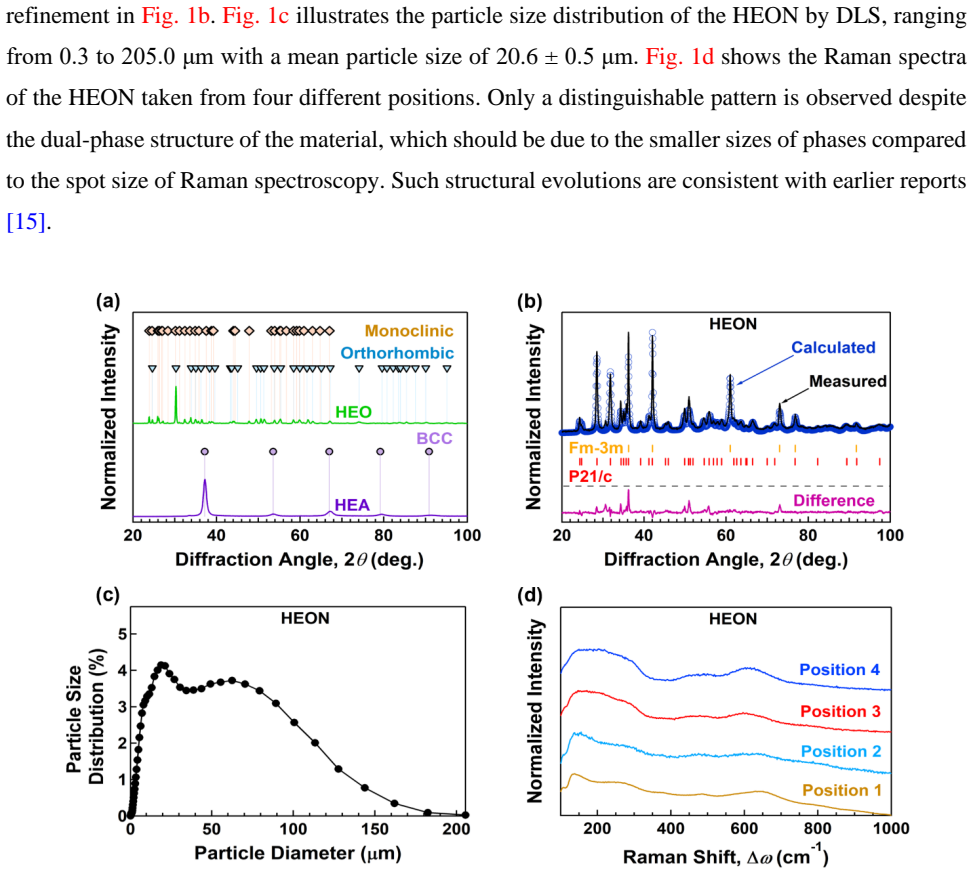
- [Section 3.1, Fig. 1b] The Rietveld refinement is reported only as phase fractions and lattice parameters; adding reliability factors (Rwp, χ2) would allow readers to judge the quality of the fit.
- [Section 3.3, Fig. 6e] The authors state that the comparison of photocurrent intensity is 'hard due to the difference in their behavior in bonding to the FTO glass,' yet the shape differences are used to support the reduced-recombination claim. A more controlled photocurrent measurement (e.g., normalized loading) would strengthen this inference, or the claim should be softened.
- [Section 4] In the phrase 'the replacement of O2 sites with N3 sites,' the anion charges should be written as O2- and N3-.
- [Section 3.1] The particle size distribution '0.3 to 205.0 μm with a mean particle size of 20.6 ± 0.5 μm' would benefit from a statement of the number of measurements or the distribution width, since DLS mean values without distribution parameters are difficult to interpret.
Circularity Check
No significant circularity: the HEO-versus-HEON activity comparison is an independent experimental benchmark; self-citations are contextual, not load-bearing.
full rationale
The central claim is a direct head-to-head experiment reported in Section 3.4: 'The H2 production of the HEON is two times higher than that of the HEO (1.63 mmol/g versus 0.84 mmol/g), confirming that the addition of nitrogen to the HEO and the production of the HEON is effective.' This is an independent experimental benchmark under identical conditions, not a quantity derived from any fitted parameter or from the authors' prior work. The optical and electronic claims are likewise supported by measurements made in this paper (Section 3.3): the HEON bandgap of about 1.5 eV versus 3.2 eV for the HEO, the XPS VBM values, the photocurrent response, and the photoluminescence data. Self-citations [15, 35, 53, 69] are used to rationalize why nitrogen narrows the bandgap and why Ti/Nb influence the conduction band, but these citations are contextual support rather than the source of the present activity result or band-structure measurements. No uniqueness theorem is invoked, and no external benchmark is replaced by a self-citation. The paper also honestly notes a limitation in the photocurrent comparison ('the comparison of photocurrent intensity for these two materials is hard due to the difference in their behavior in bonding to the FTO glass'), which weakens a sub-claim but is not circularity. The weakest point is mechanistic rather than circular: the decreased EXAFS first-shell amplitudes around Ti, Nb, and Ta are interpreted as increased oxygen vacancies (Section 3.2, sixth point), but static/thermal disorder and O/N backscattering changes could also contribute; this is an underdetermined interpretation of measured data, not a fitted input renamed as a prediction. Because self-citations appear in the interpretation but the central HEO-versus-HEON comparison does not reduce to them, the circularity score is low.
Assumptions & free parameters
assumptions (4)
- domain assumption XANES and EXAFS peak shifts and amplitude changes are interpreted using standard coordination and bonding rules from cited references.
- domain assumption The bandgap is assumed to be direct and is analyzed by Kubelka-Munk extrapolation of (alpha*h*nu)^2.
- domain assumption Photocurrent and photoluminescence differences are attributed to carrier lifetime and recombination despite the acknowledged different FTO adhesion behavior.
- domain assumption The lower average oxidation state inferred from XANES white-line and edge shifts is linked to favorable adsorption strength via Sabatier-type reasoning.
Cite this review
Pith. "Pith review of Photoreforming of plastic waste into valuable products and hydrogen using a high-entropy oxynitride with distorted atomic-scale structure." pith.science (2026). https://pith.science/paper/7EDZV5GZ
@misc{pith2026241218722,
  author       = {Pith},
  title        = {Pith review of: Photoreforming of plastic waste into valuable products and hydrogen using a high-entropy oxynitride with distorted atomic-scale structure},
  year         = {2026},
  howpublished = {\url{https://pith.science/paper/7EDZV5GZ}},
  note         = {Machine review of arXiv:2412.18722}
}
read the original abstract
The persistent existence of plastic waste causes serious problems for the environment, directly and indirectly affecting the health of organisms and humans. Photoreforming is a nature-friendly method that only uses solar energy to convert plastic waste into green hydrogen (H2) and valuable organic products. This study shows that a high-entropy oxynitride (HEON) photocatalyst, synthesized by the addition of nitrogen to a Ti-Zr-Hf-Nb-Ta-containing high-entropy oxide (HEO), exhibits a higher potential for the production of H2, formic acid and acetic acid from polyethylene terephthalate (PET) photoreforming compared to the relevant HEO. Examination of X-ray absorption near edge structure (XANES) and extended X-ray absorption fine structure (EXAFS) by synchrotron light shows that, in addition to hybridization of 2p orbitals from oxygen and nitrogen, nitrogen atoms distort the structure and completely change the neighborhood of niobium and titanium (a main contributor to the conduction band), expands the atomic bonds of zirconium and tantalum, contracts the atomic bonds of hafnium and decreases the binding energy of titanium, niobium and tantalum. These electronic structure changes lead to a narrower bandgap and diminished electron-hole recombination, enhancing the photoreforming performance. This study introduces HEONs with distorted atomic bond structures as efficient low-bandgap and stable catalysts for transforming plastics into high-value organic chemicals and H2 by photocatalysis.
Figures


Figures from the paper (7 more)


Reference graph
Works this paper leans on
-
[1]
Introduction The consumption of fossil fuel resources and increasing the level of carbon dioxide ( CO2) emissions worldwide are leading to energy and environmental crises [1]. Hydrogen (H2) is a clean fuel with high energy density (122 kJ/g) which does not emit CO 2 or any other toxic substances, meeting the criteria for a green and sustainable energy car...
-
[2]
Materials and methods 2.1. Reagents Five metals with high purity, titanium 99.9%, zirconium 99%, hafnium 99.7%, niobium 99.9% and tantalum 99.9%, were purchased from Furuuchi Chemical Cooperation, Japan. Sodium hydroxide, sodium deuteroxide, hydrogen hexachloroplatinate (Ⅳ) hexahydrate, PET with a particle size of 300 μm and maleic acid were purchased fro...
-
[3]
Results 3.1. Microstructure and composition characterization Fig. 1a and Fig.1b depict the crystal structures of HEA, HEO and HEON, respectively. HEA has only a body -centered cubic (BCC) phase, but it transforms to HEO with two monoclinic and orthorhombic phases by oxidation. The HEON has a two-phase structure containing 37% monoclinic (P21/c group, a = ...
-
[4]
Discussion This investigation reports the first application of HEONs for the photoreforming process to degrade plastics and simultaneously produce H2. Two issues are discussed in this section: (i) reasons behind the higher catalytic activity of the HEON than the HEO, and (ii) the PET degradation pathway to form valuable products. Regarding the first issue...
-
[5]
Conclusion In this investigation, an entropy-stabilized oxynitride catalyst was developed by adding nitrogen to a Ti-Zr-Hf-Nb-Ta-based high -entropy oxide and applied for the photoreforming of plastics for the first time. The addition of nitrogen le d to unique electronic modifications such as changing electronic structure in the vicinity of titanium and ...
-
[6]
K. Hiraga, I. Taniguchi, S. Yoshida, Y. Kimura, K. Oda, Biodegradation of waste PET: A sustainable solution for dealing with plastic pollution, EMBO Rep. 20 (2019) e49365. https://doi.org/10.15252/embr.201949365. 24
-
[7]
S. Guo, X. Li, J. Li, B. Wei, Boosting photocatalytic hydrogen production from water by photothermally induced biphase systems, Nat. Commun. 12 (2021) 1343. https://doi.org/10.1038/s41467-021-21526-4
-
[8]
C. Acar, I. Dincer, C. Zamfirescu, A review on selected heterogeneous photocatalysts for hydrogen production: Review heterogeneous photocatalysts hydrogen production from water, Int. J. Energy Res. 38 (2014) 1903–1920. https://doi.org/10.1002/er.3211
Show all 79 references
-
[9]
Xie, G.R
T. Xie, G.R. Wittreich, D.G. Vlachos, Multiscale modeling of hydrogenolysis of ethane and propane on Ru(0001): Implications for plastics recycling, Appl. Catal. B Environ. 316 (2022) 121597. https://doi.org/10.1016/j.apcatb.2022.121597
2022
-
[10]
Uekert, H
T. Uekert, H. Kasap, E. Reisner, Photoreforming of Nonrecyclable Plastic Waste over a Carbon Nitride/Nickel Phosphide Catalyst, J. Am. Chem. Soc. 141 (2019) 15201 –15210. https://doi.org/10.1021/jacs.9b06872
2019 doi
-
[11]
Cowger, K.A
W. Cowger, K.A. Willis, S. Bullock, K. Conlon, J. Emmanuel, L.M. Erdle, M. Eriksen, T.A. Farrelly, B.D. Hardesty, K. Kerge, N. Li, Y. Li, A. Liebman, N. Tangri, M. Thiel, P. Villarrubia- Gómez, T.R. Walker, M. Wang, Global producer responsibility for plastic pollution, Sci. Ad...
2024 doi
-
[12]
Wakerley, M.F
D.W. Wakerley, M.F. Kuehnel, K.L. Orchard, K.H. Ly, T.E. Rosser, E. Reisner, Solar -driven reforming of lignocellulose to H2 with a CdS/CdOx photocatalyst, Nat. Energy 2 (2017) 17021. https://doi.org/10.1038/nenergy.2017.21
2017 doi
-
[13]
P. Li, X. Wang, M. Su, X. Zou, L. Duan, H. Zhang, Characteristics of Plastic Pollution in the Environment: A Review, Bull. Environ. Contam. Toxicol. 107 (2021) 577 –584. https://doi.org/10.1007/s00128-020-02820-1
2021 doi
-
[14]
MacLeod, H.P.H
M. MacLeod, H.P.H. Arp, M.B. Tekman, A. Jahnke, The global threat from plastic pollution, Science 373 (2021) 61–65. https://doi.org/10.1126/science.abg5433
2021 doi
-
[15]
Sharma, A
S. Sharma, A. Bhardwaj, M. Thakur, A. Saini, Understanding microplastic pollution of marine ecosystem: a review, Environ. Sci. Pollut. Res. 31 (2023) 41402–41445. https://doi.org/10.1007/s11356-023-28314-1
2023 doi
-
[16]
Nguyen, N.T.T
N.T. Nguyen, N.T.T. Nhon, H.T.N. Hai, N.D.T. Chi, T.T. Hien, Characteristics of Microplastics and Their Affiliated PAHs in Surface Water in Ho Chi Minh City, Vietnam, Polymers 14 (2022)
2022
-
[17]
S. Tang, Y. -S. Xu, X. Ling, L. -Y. Tang, X. -Z. Wang, Y. -X. Yu, W. -D. Zhang, Building Mo2C/C/TCN heterojunction for efficient noble -metal-free plastic photoreforming and hydrogen generation, J. Mater. Sci. Technol. (2024) S1005030224010521. https://doi.org/10.1016/j.jmst.2...
2024 doi
-
[18]
L. Mao, B. Zhai, L. Wen, W. Xiao, J. Shi, X. Kang, Y. Liu, C. Cheng, H. Jin, L. Guo, Simultaneous bulk and surface modifications of g -C3N4 via supercritical CO 2-assisted post - treatment towards enhanced photocatalytic activity, Appl. Catal. B Environ. Energy 362 (2025) 1247...
2025
-
[19]
D.-E. Lee, M. -K. Kim, M. Danish, W. -K. Jo, State -of-the-art review on photocatalysis for efficient wastewater treatment: Attractive approach in photocatalyst design and parameters affecting the photocatalytic degradation, Catal. Commun. 183 (2023) 106 764. https://doi.org/1...
2023
-
[20]
F. Kang, H. Zhao, Y. Liu, C. Wang, Z. Huang, J. Hu, Spatial charge separation enable Ni2P/Zn0.3Cd0.7S performance of cellulose photoreforming, Chem. Eng. J. 475 (2023) 146296. https://doi.org/10.1016/j.cej.2023.146296
2023
-
[21]
Nguyen, K
T.T. Nguyen, K. Edalati, Brookite TiO2 as an active photocatalyst for photoconversion of plastic wastes to acetic acid and simultaneous hydrogen production: Comparison with anatase and rutile, Chemosphere 355 (2024) 141785. https://doi.org/10.1016/j.chemosphere.2024.141785
2024
-
[22]
Edalati, X.F
P. Edalati, X.F. Shen, M. Watanabe, T. Ishihara, M. Arita, M. Fuji, K. Edalati, High -entropy oxynitride as a low-bandgap and stable photocatalyst for hydrogen production, J. Mater. Chem. A 9 (2021) 15076–15086. https://doi.org/10.1039/D1TA03861C
2021 doi
-
[23]
A. Wang, W. Quan, H. Zhang, H. Li, S. Yang, Heterogeneous ZnO -containing catalysts for efficient biodiesel production, RSC Adv. 11 (2021) 20465 –20478. https://doi.org/10.1039/D1RA03158A
2021 doi
-
[24]
H. Xu, Z. Zhang, J. Liu, C.-L. Do-Thanh, H. Chen, S. Xu, Q. Lin, Y. Jiao, J. Wang, Y. Wang, Y. Chen, S. Dai, Entropy -stabilized single-atom Pd catalysts via high -entropy fluorite oxide supports, Nat. Commun. 11 (2020) 3908. https://doi.org/10.1038/s41467-020-17738-9
2020 doi
-
[25]
Nguyen, T
T.K.A. Nguyen, T. Trần‐Phú, X.M.C. Ta, T.N. Truong, J. Leverett, R. Daiyan, R. Amal, A. Tricoli, Understanding Structure‐Activity Relationship in Pt‐loaded g‐C3N4 for Efficient Solar‐ Photoreforming of Polyethylene Terephthalate Plastic and Hydrogen Production, Small Methods 8...
2024 doi
-
[26]
Edalati, Q
P. Edalati, Q. Wang, H. Razavi -Khosroshahi, M. Fuji, T. Ishihara, K. Edalati, Photocatalytic hydrogen evolution on a high -entropy oxide, J. Mater. Chem. A 8 (2020) 3814 –3821. https://doi.org/10.1039/C9TA12846H
2020 doi
-
[27]
L. Lin, Y. Ma, J.J.M. Vequizo, M. Nakabayashi, C. Gu, X. Tao, H. Yoshida, Y. Pihosh, Y. Nishina, A. Yamakata, N. Shibata, T. Hisatomi, T. Takata, K. Domen, Efficient and stable visible-light-driven Z -scheme overall water splitting using an oxysulfide H2 evolution photocatalys...
2024 doi
-
[28]
Q. Wang, M. Nakabayashi, T. Hisatomi, S. Sun, S. Akiyama, Z. Wang, Z. Pan, X. Xiao, T. Watanabe, T. Yamada, N. Shibata, T. Takata, K. Domen, Oxysulfide photocatalyst for visible- light-driven overall water splitting, Nat. Mater. 18 (2019) 827 –832. https://doi.org/10.1038/s415...
2019 doi
-
[29]
C. Oses, C. Toher, S. Curtarolo, High -entropy ceramics, Nat. Rev. Mater. 5 (2020) 295 –309. https://doi.org/10.1038/s41578-019-0170-8. 25
2020 doi
-
[30]
N. Qiu, H. Chen, Z. Yang, S. Sun, Y. Wang, Y. Cui, A high entropy oxide (Mg0.2Co0.2Ni0.2Cu0.2Zn0.2O) with superior lithium storage performance, J. Alloys Compd. 777 (2019) 767–774. https://doi.org/10.1016/j.jallcom.2018.11.049
2019 doi
-
[31]
Akrami, P
S. Akrami, P. Edalati, M. Fuji, K. Edalati, High -entropy ceramics: Review of principles, production and applications, Mater. Sci. Eng. R Rep. 146 (2021) 100644. https://doi.org/10.1016/j.mser.2021.100644
2021
-
[32]
H. Chen, W. Lin, Z. Zhang, K. Jie, D.R. Mullins, X. Sang, S.-Z. Yang, C.J. Jafta, C.A. Bridges, X. Hu, R.R. Unocic, J. Fu, P. Zhang, S. Dai, Mechanochemical Synthesis of High Entropy Oxide Materials under Ambient Conditions: Dispersion of Catalysts via Entropy Maximization, AC...
2019 doi
-
[33]
K. Miao, W. Jiang, Z. Chen, Y. Luo, D. Xiang, C. Wang, X. Kang, Hollow‐Structured and Polyhedron‐Shaped High Entropy Oxide toward Highly Active and Robust Oxygen Evolution Reaction in a Full pH Range, Adv. Mater. 36 (2024) 2308490. https://doi.org/10.1002/adma.202308490
2024 doi
-
[34]
Nguyen, Y
T.X. Nguyen, Y. Liao, C. Lin, Y. Su, J. Ting, Advanced High Entropy Perovskite Oxide Electrocatalyst for Oxygen Evolution Reaction, Adv. Funct. Mater. 31 (2021) 2101632. https://doi.org/10.1002/adfm.202101632
2021 doi
-
[35]
F. Wu, Y. Dou, J. Zhou, J. Qin, T. Jiang, Y. Yao, C. Hélix -Nielsen, W. Zhang, High -entropy (FeCoNiCuZn)WO4 photocatalysts-based fibrous membrane for efficient capturing and upcycling of plastic, Chem. Eng. J. 470 (2023) 144134. https://doi.org/10.1016/j.cej.2023.144134
2023
-
[36]
L. Zhou, F. Li, J. -X. Liu, S.-K. Sun, Y. Liang, G. -J. Zhang, High-entropy A2B2O7-type oxide ceramics: A potential immobilising matrix for high -level radioactive waste, J. Hazard. Mater. 415 (2021) 125596. https://doi.org/10.1016/j.jhazmat.2021.125596
2021
-
[37]
Y. Pan, J. -X. Liu, T. -Z. Tu, W. Wang, G. -J. Zhang, High -entropy oxides for catalysis: A diamond in the rough, Chem. Eng. J. 451 (2023) 138659. https://doi.org/10.1016/j.cej.2022.138659
2023
-
[38]
Subramanian, C.V
B. Subramanian, C.V. Muraleedharan, R. Ananthakumar, M. Jayachandran, A comparative study of titanium nitride (TiN), titanium oxy nitride (TiON) and titanium aluminum nitride (TiAlN), as surface coatings for bio implants, Surf. Coat. Technol. 205 (201 1) 5014 –5020. https://do...
-
[39]
Y. Sun, S. Dai, High -entropy materials for catalysis: A new frontier, Sci. Adv. 7 (2021) eabg1600. https://doi.org/10.1126/sciadv.abg1600
2021 doi
-
[40]
Moriya, T
Y. Moriya, T. Takata, K. Domen, Recent progress in the development of (oxy)nitride photocatalysts for water splitting under visible-light irradiation, Coord. Chem. Rev. 257 (2013) 1957–1969. https://doi.org/10.1016/j.ccr.2013.01.021
2013 doi
-
[41]
J. Liu, X. Zhang, V. Pelenovich, X. Zeng, Z. Zeng, L. Hu, T. Xu, X. Zhan, Y. Lei, Y. Chen, B. Yang, Structure and mechanical properties of multi -principal AlCrNbSiTiON oxynitride coatings, Vacuum 227 (2024) 113366. https://doi.org/10.1016/j.vacuum.2024.113366
2024
-
[42]
Hidalgo-Jiménez, T
J. Hidalgo-Jiménez, T. Akbay, T. Ishihara, K. Edalati, Investigation of a high -entropy oxide photocatalyst for hydrogen generation by first -principles calculations coupled with experiments: Significance of electronegativity, Scr. Mater. 250 (2024) 116205. https://doi.org/10....
2024
-
[43]
Edalati, Z
K. Edalati, Z. Horita, A review on high-pressure torsion (HPT) from 1935 to 1988, Mater. Sci. Eng. A 652 (2016) 325–352. https://doi.org/10.1016/j.msea.2015.11.074
2016 doi
-
[44]
Katai, P
M. Katai, P. Edalati, J. Hidalgo-Jimenez, Y. Shundo, T. Akbay, T. Ishihara, M. Arita, M. Fuji, K. Edalati, Black brookite rich in oxygen vacancies as an active photocatalyst for CO 2 conversion: Experiments and first-principles calculations, J. Photochem. Photobiol. Chem. 449 ...
2024
-
[45]
Iglesias‐Juez, G.L
A. Iglesias‐Juez, G.L. Chiarello, G.S. Patience, M.O. Guerrero‐Pérez, Experimental methods in chemical engineering: X ‐ray absorption spectroscopy — XAS , XANES , EXAFS, Can. J. Chem. Eng. 100 (2022) 3–22. https://doi.org/10.1002/cjce.24291
2022 doi
-
[46]
Xie, H.T
R. Xie, H.T. (Bert) Hintzen, Optical Properties of (Oxy)Nitride Materials: A Review, J. Am. Ceram. Soc. 96 (2013) 665–687. https://doi.org/10.1111/jace.12197
2013 doi
-
[47]
Schneider, D
K. Schneider, D. Zajac, M. Sikora, Cz. Kapusta, K. Michalow -Mauke, Th. Graule, M. Rekas, XAS study of TiO 2-based nanomaterials, Radiat. Phys. Chem. 112 (2015) 195 –198. https://doi.org/10.1016/j.radphyschem.2015.03.010
2015 doi
-
[48]
Yano, V.K
J. Yano, V.K. Yachandra, X -ray absorption spectroscopy, Photosynth. Res. 102 (2009) 241 –
2009
-
[49]
Berregi, G
I. Berregi, G. Del Campo, R. Caracena, J.I. Miranda, Quantitative determination of formic acid in apple juices by 1H NMR spectrometry, Talanta 72 (2007) 1049 –1053. https://doi.org/10.1016/j.talanta.2006.12.031
2007 doi
-
[50]
Kerr, H.J
B.V. Kerr, H.J. King, C.F. Garibello, P.R. Dissanayake, A.N. Simonov, B. Johannessen, D.S. Eldridge, R.K. Hocking, Characterization of Energy Materials with X -ray Absorption Spectroscopy─Advantages, Challenges, and Opportunities, Energy Fuels 36 (2022 ) 2369 –
2022
-
[51]
M. Li, S. Zhang, Tandem Chemical Depolymerization and Photoreforming of Waste PET Plastic to High -Value-Added Chemicals, ACS Catal. 14 (2024) 2949 –2958. https://doi.org/10.1021/acscatal.3c05535
2024 doi
-
[52]
The current results together with a recent publication about HEOs [69] confirm the high potential of high -entropy photocatalysts for photoreforming of plastic waste
and Pt/C3N4 with 2.79 eV bandgap [18]. The current results together with a recent publication about HEOs [69] confirm the high potential of high -entropy photocatalysts for photoreforming of plastic waste. Further studies should consider optimizing the characterization and sur...
-
[53]
Yoshitake, T
H. Yoshitake, T. Sugihara, T. Tatsumi, XAFS study on the local structure of Ti in amorphous mesoporous titania, Phys. Chem. Chem. Phys. 5 (2003) 767 –772. https://doi.org/10.1039/b210209a
2003 doi
-
[54]
Matsuo, N
S. Matsuo, N. Sakaguchi, H. Wakita, Pre -edge Features of Ti K -edge X-ray Absorption Near- edge Structure for the Local Structure of Sol -Gel Titanium Oxides, Anal. Sci. 21 (2005) 805 –
2005
-
[55]
Baek, M.D
J. Baek, M.D. Hossain, P. Mukherjee, J. Lee, K.T. Winther, J. Leem, Y. Jiang, W.C. Chueh, M. Bajdich, X. Zheng, Synergistic effects of mixing and strain in high entropy spinel oxides for oxygen evolution reaction, Nat. Commun. 14 (2023) 5936. https://doi.org/10.1038/s41467-023...
2023 doi
-
[56]
Morris, P
D.J. Morris, P. Zhang, In situ X‐ray Absorption Spectroscopy of Platinum Electrocatalysts, Chemistry–Methods 1 (2021) 162–172. https://doi.org/10.1002/cmtd.202000069
2021 doi
-
[57]
Z.W. Chen, J. Li, P. Ou, J.E. Huang, Z. Wen, L. Chen, X. Yao, G. Cai, C.C. Yang, C.V. Singh, Q. Jiang, Unusual Sabatier principle on high entropy alloy catalysts for hydrogen evolution reactions, Nat. Commun. 15 (2024) 359. https://doi.org/10.1038/s41467-023-44261-4
2024 doi
-
[58]
Q. Cong, L. Chen, X. Wang, H. Ma, J. Zhao, S. Li, Y. Hou, W. Li, Promotional effect of nitrogen-doping on a ceria unary oxide catalyst with rich oxygen vacancies for selective catalytic reduction of NO with NH 3, Chem. Eng. J. 379 (2020) 122302. https://doi.org/10.1016/j.cej.2...
2020
-
[59]
Y. Chen, S. Xu, C. Fang Wen, H. Zhang, T. Zhang, F. Lv, Y. Yue, Z. Bian, Unravelling the Role of Free Radicals in Photocatalysis, Chem. – Eur. J. 30 (2024) e202400001. https://doi.org/10.1002/chem.202400001
2024 doi
-
[60]
Kornberger, T
D. Kornberger, T. Paatsch, M. Schmidt, U. Salat, New combined absorption/ 1H NMR method for qualitative and quantitative analysis of PET degradation products, Environ. Sci. Pollut. Res. 31 (2024) 20689–20697. https://doi.org/10.1007/s11356-024-32481-0
2024 doi
-
[61]
Ashraf, N
M. Ashraf, N. Ullah, I. Khan, W. Tremel, S. Ahmad, M.N. Tahir, Photoreforming of Waste Polymers for Sustainable Hydrogen Fuel and Chemicals Feedstock: Waste to Energy, Chem. Rev. 123 (2023) 4443–4509. https://doi.org/10.1021/acs.chemrev.2c00602
2023 doi
-
[62]
M. Du, Y. Zhang, S. Kang, X. Guo, Y. Ma, M. Xing, Y. Zhu, Y. Chai, B. Qiu, Trash to Treasure: Photoreforming of Plastic Waste into Commodity Chemicals and Hydrogen over MoS2-Tipped CdS Nanorods, ACS Catal. 12 (2022) 12823–12832. https://doi.org/10.1021/acscatal.2c03605
2022 doi
-
[63]
Akrami, P
S. Akrami, P. Edalati, Y. Shundo, M. Watanabe, T. Ishihara, M. Fuji, K. Edalati, Significant CO2 photoreduction on a high -entropy oxynitride, Chem. Eng. J. 449 (2022) 137800, 2022. https://doi.org/10.1016/j.cej.2022.137800
2022
-
[64]
Lawley, A
C. Lawley, A. Arab, A. Hartl, A. Staykov, M. Döbeli, T. Schmitt, D. Pergolesi, T. Lippert, V.N. Strocov, Momentum-resolved electronic structure of LaTiO2N photocatalysts by resonant Soft- X-ray ARPES, Commun. Mater. 4 (2023) 15. https://doi.org/10.1038/s43246-023-00344-9
2023 doi
-
[65]
Zheng, P
Y. Zheng, P. Fan, R. Guo, X. Liu, X. Zhou, C. Xue, H. Ji, Visible light driven reform of wasted plastics to generate green hydrogen over mesoporous ZnIn 2S4, RSC Adv. 13 (2023) 12663 – 12669. https://doi.org/10.1039/D3RA02279J
2023 doi
-
[66]
Pozo -Gonzalo, O
C. Pozo -Gonzalo, O. Kartachova, A.A.J. Torriero, P.C. Howlett, A.M. Glushenkov, D.M. Fabijanic, Y. Chen, S. Poissonnet, M. Forsyth, Nanoporous transition metal oxynitrides as catalysts for the oxygen reduction reaction, Electrochimica Acta 103 (2013) 151 –160. https://doi.org...
2013 doi
-
[67]
Uekert, M.F
T. Uekert, M.F. Kuehnel, D.W. Wakerley, E. Reisner, Plastic waste as a feedstock for solar - driven H 2 generation, Energy Environ. Sci. 11 (2018) 2853 –2857. https://doi.org/10.1039/C8EE01408F
2018 doi
-
[68]
Anh Nguyen, T
T.K. Anh Nguyen, T. Trần‐Phú, R. Daiyan, X. Minh Chau Ta, R. Amal, A. Tricoli, From Plastic Waste to Green Hydrogen and Valuable Chemicals Using Sunlight and Water, Angew. Chem. Int. Ed. 63 (2024) e202401746. https://doi.org/10.1002/anie.202401746
2024 doi
-
[69]
Nguyen, K
T.T. Nguyen, K. Edalati, Efficient photoreforming of plastic waste using a high -entropy oxide catalyst, J. Catal. 440 (2024) 115808. https://doi.org/10.1016/j.jcat.2024.115808. 28 Supplementary Information Figure S1. Schematics of photoreforming experiment
2024
-
[70]
S. Chu, B. Zhang, X. Zhao, H.S. Soo, F. Wang, R. Xiao, H. Zhang, Photocatalytic Conversion of Plastic Waste: From Photodegradation to Photosynthesis, Adv. Energy Mater. 12 (2022) 2200435. https://doi.org/10.1002/aenm.202200435
2022 doi
-
[72]
Haynes, ed., CRC handbook of chemistry and physics: a ready -reference book of chemical and physical data, 97th edition, CRC Press, Boca Raton London New York, 2017
W.M. Haynes, ed., CRC handbook of chemistry and physics: a ready -reference book of chemical and physical data, 97th edition, CRC Press, Boca Raton London New York, 2017
2017
-
[73]
Y. Ma, Y. Zhang, W. Yuan, M. Du, S. Kang, B. Qiu, Electroreforming injects a new life into solid waste, EES Catal. 1 (2023) 892–920. https://doi.org/10.1039/D3EY00147D
2023 doi
-
[74]
X. Han, M. Jiang, H. Li, R. Li, N.H.M. Sulaiman, T. Zhang, H. Li, L. Zheng, J. Wei, L. He, X. Zhou, Upcycle polyethylene terephthalate waste by photoreforming: Bifunction of Pt cocatalyst, J. Colloid Interface Sci. 665 (2024) 204 –218. https://doi.org/10.1016/j.jcis.2024.03.094
2024 doi
-
[76]
C.-X. Liu, R. Shi, W. Ma, F. Liu, Y. Chen, Photoreforming of polyester plastics into added - value chemicals coupled with H 2 evolution over a Ni 2P/ZnIn2S4 catalyst, Inorg. Chem. Front. 10 (2023) 4562–4568. https://doi.org/10.1039/D3QI00914A
2023 doi
-
[78]
S. Guo, Y. Huang, D. Li, Z. Xie, Y. Jia, X. Wu, D. Xu, W. Shi, Visible -light-driven photoreforming of poly(ethylene terephthalate) plastics via carbon nitride porous microtubes, Chem. Commun. 59 (2023) 7791–7794. https://doi.org/10.1039/d3cc02012f
2023 doi
-
[254]
https://doi.org/10.1007/s11120-009-9473-8
-
[809]
https://doi.org/10.2116/analsci.21.805
-
[2389]
https://doi.org/10.1021/acs.energyfuels.1c04072
-
[2450]
https://doi.org/10.3390/polym14122450
Reviewed August 11, 2026 · model on record in the stance chip above.
Discussion (0). Continue with ORCID to comment.