REVIEW 2 major objections 7 minor 49 references
Context-Based Semantic-Aware Alignment for Semi-Supervised Multi-Label Learning
T0 review · 2 major / 7 minor · reviewed 2026-08-11 · deepseek-v4-flash
Pith's one-line read CLIP can be adapted to semi-supervised multi-label learning by aligning each class prompt with its own label-specific image feature instead of a whole-image feature; adding a co-occurrence context identification task improves the…
desk verdict Solid, genuinely useful SSMLL paper — first CLIP fine-tuning in that setting, consistent gains, honest ablations — but the context-module write-up has a denominator bug and an unspecified assignment rule that block reproducibility as written. read the letter →
The pith
A machine-rendered reading of the paper's core claim, the machinery that carries it, and where it could break.
The reading
What carries the argument
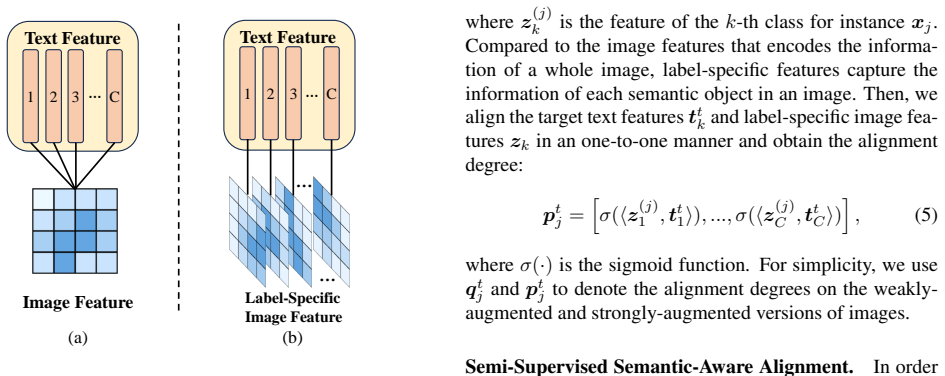
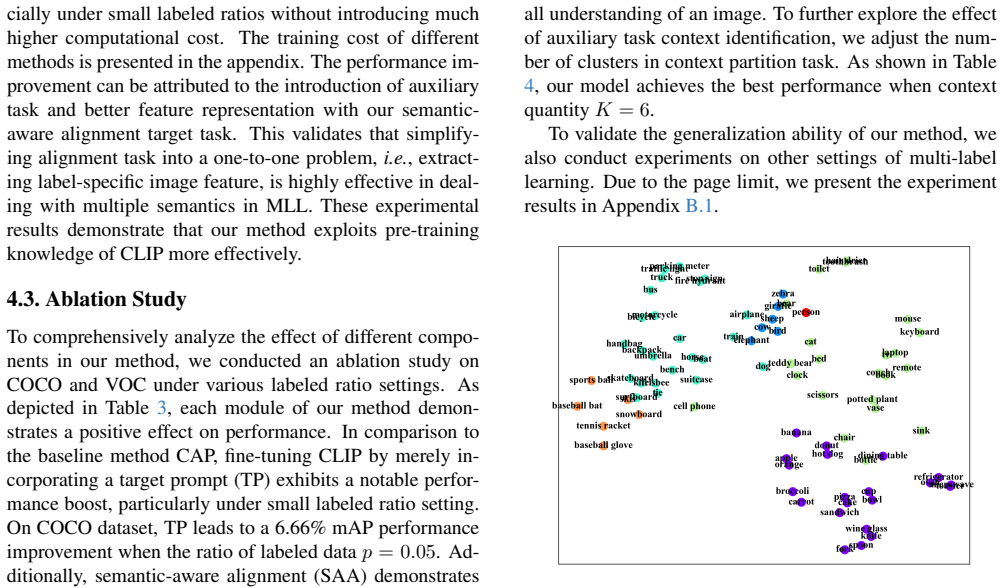
Two components carry the argument. First, the semantic-aware alignment module: a frozen CLIP image encoder provides local features; learnable class-specific 'semantic-aware' prompts are used as queries in a two-layer transformer decoder to read out a label-specific feature for each class, which is then aligned with a 'target' prompt embedding via Asymmetric Loss. This converts many-to-one alignment into one-to-one alignment. Second, the context identification module: a $C \times C$ co-occurrence matrix $S$ with $S_{kl} = e_{kl}/n_k$ is built from the labeled set, symmetrized, spectrally clustered into K context groups, and each image is assigned a context label; a classifier on the global image feature is trained semi-supervised with a confidence threshold, and its cross-entropy loss is added to the total objective. The clustering gives K=6 for COCO and K=2 for VOC and NUS-WIDE. The whole training objective is $L_{\text{sup}} + L_{\text{unsup}} + L_{\text{aux}}$.
What would settle it
Run the full CBSA pipeline on COCO at p=0.05 twice, each time recomputing the six context clusters from a different random 5% labeled subset, and compare the mAP gain of the full model over the no-context ablation; if the gain varies widely or vanishes when the clusters change, the co-occurrence assumption is not carrying the reported improvement.
Extended reading notes
Core claim
The paper's central claim is that the bottleneck in adapting CLIP to multi-label fine-tuning is not the pre-training knowledge but the alignment geometry: forcing one global image embedding to be close to many class text embeddings at once conflates the semantics of co-present objects. CBSA replaces that whole-image match with per-class image features $z_k$ obtained by cross-attending class-specific semantic-aware text prompts to CLIP's local feature map, then matches $z_k$ to a separate target text embedding for the same class. This reduces the task to C one-to-one alignments. A separate context branch partitions the label set into K co-occurrence clusters via spectral clustering on the normalized co-occurrence matrix and trains a semi-supervised classifier to predict an image's context, whose loss is added to the supervised and unsupervised alignment losses. The experiments claim that both changes contribute, with the larger gain coming from semantic-aware alignment, and that the full method is best across all settings.
Load-bearing premise
The entire gain credited to context identification depends on the co-occurrence counts computed from the few labeled images being representative of true label co-occurrence, so that spectral clustering produces stable, meaningful contexts and each labeled image can be assigned a single correct context label.
Editorial extensions
If this is right
- At every labeled ratio tested, the full CBSA model reports the highest mAP on COCO, VOC-2012, and NUS-WIDE, so CLIP fine-tuning becomes a viable route for semi-supervised multi-label learning.
- Because semantic-aware alignment helps more as labeled data grows (Table 3), the per-class matching benefit compounds with more supervision.
- The context identification auxiliary task contributes a consistent average 0.67% mAP on COCO and VOC, so co-occurrence modelling helps even with very few labels.
- Pseudo-label quality (CF1) improves on all three datasets, meaning the unlabeled data is being used more effectively, not just the labeled data.
- The same label-specific alignment transfers to the partial-label setting (appendix), suggesting the mechanism is not specific to semi-supervised multi-label learning.
Reading between the lines
- A stress test the paper does not run: re-estimate the co-occurrence matrix as pseudo-labels improve, rather than only from the initial labeled set; if gains shrink, the purity of the original co-occurrence estimate is what matters.
- The context identification idea should transfer to other label-correlated problems, such as multi-class classification with hierarchical labels or multi-label learning with only single positive labels, since the co-occurrence matrix can be built from any partial annotation.
- If per-class alignment is the real cause of improvement, then combining CBSA with other adaptation designs, such as visual prompts or adapters, should stack gains; the paper does not test this.
- The number of context clusters K is fixed by hand (K=6 for COCO, K=2 elsewhere); an automatic choice based on the spectrum of the co-occurrence Laplacian would make the method parameter-free.
Editorial analysis
A structured set of objections, weighed in public.
Referee Report
Summary. The manuscript proposes CBSA, a method for semi-supervised multi-label learning (SSMLL) built on CLIP. It introduces two components: (i) a semantic-aware alignment task that extracts label-specific image features via cross-attention with semantic-aware prompts and aligns them one-to-one with class text features, and (ii) a semi-supervised context identification auxiliary task that partitions the label space by spectral clustering on a label co-occurrence matrix and trains a context classifier with a supervised and an unsupervised loss. The overall loss combines the supervised and unsupervised alignment losses with the auxiliary context loss. Experiments on COCO, VOC, and NUS-WIDE at labeled proportions p in {0.05, 0.10, 0.15, 0.20} report mAP improvements over CAP, DualCoOp, DualCoOp++, TaI, and SCPNet, and ablations show positive contributions from each module.
Significance. If the method is fully specified and reproducible, the contribution is relevant to SSMLL: it is one of the first adaptations of CLIP to this setting, and the one-to-one alignment between text features and label-specific image features is a clean way to avoid the many-to-one alignment bottleneck. The empirical study is broad, covering three datasets, four labeled ratios, a partial-label extension, computational cost, prompt-length sensitivity, and three-seed error bars on COCO; the reported gains are consistent across settings. The main weaknesses lie in the specification of the context partition and the context-label assignment, which must be resolved before the central claim can be accepted.
major comments (2)
- [Sec. 3.2, Eq. (9)] The definition of the co-occurrence matrix is not reproducible as written. The text states S_kl = e_kl / n_k, where n_k represents the number of images containing only the k-th label. This normalization is nonstandard and breaks down for classes that never appear alone in the labeled subset, producing a zero denominator; it also does not match the standard co-occurrence probability (which would use the number of images containing label k). The meaningful clusters shown in Fig. 5 suggest that a different denominator was actually used. Please state the precise definition of e_kl and n_k, clarify whether they are computed from the labeled set only or also from pseudo-labels, and describe how degenerate cases are handled. In addition, since the clustering is estimated from a small labeled set (about 4,100 COCO images at p=0.05), please report the stability of the resulting partition under different labeled subsets; the context identification module is credited with consistent gains in Table 3, so this component must be exactly reproducible.
- [Sec. 3.2, supervised context loss] The assignment of a context label to a multi-label image is not fully specified. The sentence "we determine its context label c_i based on which subset its semantic labels belong to" is not an algorithm for images whose positive labels fall into multiple of the K clusters, which is common on COCO (e.g., an image with both "person" and "pizza"). Since the supervised term L_ce(p^a_i, c_i) in Eq. (11) requires exactly one context label per image, the method is undefined unless a tie-breaking or aggregation rule is supplied (e.g., cluster with the most labels, highest confidence, or a fixed priority). Please specify the rule explicitly and, if possible, justify it empirically; without this, the ablation gains attributed to the context identification module cannot be reproduced.
minor comments (7)
- [Abstract] The phrase "real word" should be "real world".
- [Sec. 2.1] The acronym "LTSM" should be "LSTM".
- [Sec. 3.2] The term "fully-connection layer" should be "fully-connected layer".
- [Table 3] The sentence "the performance further improves by an average of 0.67%" appears to reflect only the VOC rows; the COCO average is approximately 0.39% and the combined average across both datasets is approximately 0.53%. Please clarify which average is being reported.
- [Fig. 4] The caption "visualization of images within various contexts that have top prediction probability" is vague; please specify how the images were selected and which prediction scores were used.
- [General] No code release or repository link is mentioned; providing code would substantially improve the reproducibility of the context-partition and context-assignment steps.
- [Eq. (11)] The indicator term 1(max(q^a_j) > τ) uses the weakly-augmented confidence to select pseudo-labels while the loss is computed on the strongly-augmented prediction; this is consistent with FixMatch but should be stated explicitly in the text.
Circularity Check
No significant circularity: the reported gains are held-out test mAP results, and the only overlap is a disclosed use of the authors' own CAP thresholding as a component.
full rationale
The paper's derivation chain consists of (i) extracting label-specific image features via a transformer decoder (Eq. 4), (ii) aligning them one-to-one with target text features (Eq. 5), (iii) optimizing supervised and unsupervised ASL losses (Eqs. 7-8), (iv) partitioning the label space with spectral clustering on a co-occurrence matrix (Eqs. 9-10), and (v) training a context-identification auxiliary classifier (Eq. 11). The final claim 'our method achieves the best performance in all experimental settings' is evaluated as mAP on held-out test splits of COCO, VOC, and NUS-WIDE, against external baselines. No equation defines the reported test mAP in terms of the training labels, the fitted thresholds, or the cluster assignments; the pseudo-label thresholds and context confidence threshold are standard semi-supervised components with fixed rules rather than fitted parameters that are then reported as predictions. The one self-citation overlap is the use of CAT/CAP [40] as the pseudo-label thresholding mechanism (Eq. 6); CAP is also listed as a baseline. This is disclosed and not load-bearing because the thresholding method is an independently published and externally benchmarked approach, and all compared methods are evaluated on the same held-out data. The ambiguities noted in the definition of S_kl and the unspecified multi-cluster assignment rule for c_i are reproducibility and completeness concerns, not circularity: they do not make the test result an algebraic consequence of the inputs. Therefore no circular step can be exhibited from the paper's equations, and the appropriate finding is a low score reflecting only the minor self-citation.
Assumptions & free parameters
free parameters (5)
- Number of context clusters K =
6 (COCO), 2 (VOC), 2 (NUS-WIDE)
- Context pseudo-label threshold tau =
0.9
- CAT class-wise thresholds tau+_k and tau-_k =
Estimated from labeled examples (per CAP [40])
- Prompt length N =
16
- ASL focusing parameters gamma1 and gamma2 =
Not stated in the paper (adopted from [28])
assumptions (5)
- domain assumption CLIP's local feature map l_j preserves spatially meaningful semantics, so cross-attention with semantic-aware text prompts can extract label-specific image features.
- domain assumption The co-occurrence matrix computed from the labeled set alone is a reliable basis for spectral clustering into context groups.
- domain assumption Each labeled multi-label image can be assigned a single context label from its positive labels' cluster memberships.
- domain assumption Class-distribution-aware thresholds from CAP transfer to unlabeled data and yield correct pseudo-labels.
- standard math Spectral clustering via normalized graph-cut on the affinity matrix P produces meaningful context partitions.
Cite this review
Pith. "Pith review of Context-Based Semantic-Aware Alignment for Semi-Supervised Multi-Label Learning." pith.science (2026). https://pith.science/paper/3WNDVOEM
@misc{pith2026241218842,
  author       = {Pith},
  title        = {Pith review of: Context-Based Semantic-Aware Alignment for Semi-Supervised Multi-Label Learning},
  year         = {2026},
  howpublished = {\url{https://pith.science/paper/3WNDVOEM}},
  note         = {Machine review of arXiv:2412.18842}
}
read the original abstract
Due to the lack of extensive precisely-annotated multi-label data in real word, semi-supervised multi-label learning (SSMLL) has gradually gained attention. Abundant knowledge embedded in vision-language models (VLMs) pre-trained on large-scale image-text pairs could alleviate the challenge of limited labeled data under SSMLL setting.Despite existing methods based on fine-tuning VLMs have achieved advances in weakly-supervised multi-label learning, they failed to fully leverage the information from labeled data to enhance the learning of unlabeled data. In this paper, we propose a context-based semantic-aware alignment method to solve the SSMLL problem by leveraging the knowledge of VLMs. To address the challenge of handling multiple semantics within an image, we introduce a novel framework design to extract label-specific image features. This design allows us to achieve a more compact alignment between text features and label-specific image features, leading the model to generate high-quality pseudo-labels. To incorporate the model with comprehensive understanding of image, we design a semi-supervised context identification auxiliary task to enhance the feature representation by capturing co-occurrence information. Extensive experiments on multiple benchmark datasets demonstrate the effectiveness of our proposed method.
Figures


Figures from the paper (4 more)



Reference graph
Works this paper leans on
-
[1]
Multi- label classification for recommender systems
Dolly Carrillo, Vivian F L ´opez, and Mar´ıa N Moreno. Multi- label classification for recommender systems. In Trends in Practical Applications of Agents and Multiagent Systems: 11th International Conference on Practical Applications of Agents and Multi-Agent Systems , pages 181–188. Springer,
-
[2]
Deep hiearchical multi-label classifi- cation applied to chest x-ray abnormality taxonomies
Haomin Chen, Shun Miao, Daguang Xu, Gregory D Hager, and Adam P Harrison. Deep hiearchical multi-label classifi- cation applied to chest x-ray abnormality taxonomies. Med- ical image analysis, 66:101811, 2020. 1, 2
work page 2020
-
[3]
Learning semantic-specific graph representa- tion for multi-label image recognition
Tianshui Chen, Muxin Xu, Xiaolu Hui, Hefeng Wu, and Liang Lin. Learning semantic-specific graph representa- tion for multi-label image recognition. In Proceedings of the IEEE/CVF international conference on computer vision, pages 522–531, 2019. 1, 2
work page 2019
-
[4]
Structured semantic transfer for multi-label recognition with partial labels
Tianshui Chen, Tao Pu, Hefeng Wu, Yuan Xie, and Liang Lin. Structured semantic transfer for multi-label recognition with partial labels. In Proceedings of the AAAI conference on artificial intelligence, pages 339–346, 2022. 1, 2
work page 2022
-
[5]
Heterogeneous semantic transfer for multi- label recognition with partial labels
Tianshui Chen, Tao Pu, Lingbo Liu, Yukai Shi, Zhijing Yang, and Liang Lin. Heterogeneous semantic transfer for multi- label recognition with partial labels. International Journal of Computer Vision, 2024. 1, 2
work page 2024
-
[6]
Multi-label image recognition with graph convolu- tional networks
Zhao-Min Chen, Xiu-Shen Wei, Peng Wang, and Yanwen Guo. Multi-label image recognition with graph convolu- tional networks. In Proceedings of the IEEE/CVF conference on computer vision and pattern recognition , pages 5177– 5186, 2019. 2, 4, 1
work page 2019
-
[7]
Nus-wide: a real-world web im- age database from national university of singapore
Tat-Seng Chua, Jinhui Tang, Richang Hong, Haojie Li, Zhip- ing Luo, and Yantao Zheng. Nus-wide: a real-world web im- age database from national university of singapore. In Pro- ceedings of the ACM international conference on image and video retrieval, pages 1–9, 2009. 5
2009
-
[8]
Multi-label learning from single positive labels
Elijah Cole, Oisin Mac Aodha, Titouan Lorieul, Pietro Per- ona, Dan Morris, and Nebojsa Jojic. Multi-label learning from single positive labels. In Proceedings of the IEEE/CVF Conference on Computer Vision and Pattern Recognition , pages 933–942, 2021. 2
work page 2021
Show all 49 references
-
[9]
Explor- ing structured semantic prior for multi label recognition with incomplete labels
Zixuan Ding, Ao Wang, Hui Chen, Qiang Zhang, Pengzhang Liu, Yongjun Bao, Weipeng Yan, and Jungong Han. Explor- ing structured semantic prior for multi label recognition with incomplete labels. In Proceedings of the IEEE/CVF Con- ference on Computer Vision and Pattern Recogniti...
2023
-
[10]
The pascal visual object classes challenge: A retrospective
Mark Everingham, SM Ali Eslami, Luc Van Gool, Christo- pher KI Williams, John Winn, and Andrew Zisserman. The pascal visual object classes challenge: A retrospective. In- ternational journal of computer vision , 111:98–136, 2015. 5
2015
-
[11]
Clip-adapter: Better vision-language models with feature adapters
Peng Gao, Shijie Geng, Renrui Zhang, Teli Ma, Rongyao Fang, Yongfeng Zhang, Hongsheng Li, and Yu Qiao. Clip-adapter: Better vision-language models with feature adapters. International Journal of Computer Vision , pages 1–15, 2023. 3
2023
-
[12]
Domain adaptation via prompt learning
Chunjiang Ge, Rui Huang, Mixue Xie, Zihang Lai, Shiji Song, Shuang Li, and Gao Huang. Domain adaptation via prompt learning. arXiv preprint arXiv:2202.06687, 2022. 2
2022 arXiv
-
[13]
Improving multi- label chest x-ray disease diagnosis by exploiting disease and health labels dependencies
Zongyuan Ge, Dwarikanath Mahapatra, Xiaojun Chang, Ze- tao Chen, Lianhua Chi, and Huimin Lu. Improving multi- label chest x-ray disease diagnosis by exploiting disease and health labels dependencies. Multimedia Tools and Applica- tions, 79:14889–14902, 2020. 1
2020
-
[14]
Long-tailed multi-label visual recognition by collaborative training on uniform and re- balanced samplings
Hao Guo and Song Wang. Long-tailed multi-label visual recognition by collaborative training on uniform and re- balanced samplings. In Proceedings of the IEEE/CVF Con- ference on Computer Vision and Pattern Recognition, pages 15089–15098, 2021. 2
2021
-
[15]
Texts as images in prompt tun- ing for multi-label image recognition
Zixian Guo, Bowen Dong, Zhilong Ji, Jinfeng Bai, Yiwen Guo, and Wangmeng Zuo. Texts as images in prompt tun- ing for multi-label image recognition. In Proceedings of the IEEE/CVF Conference on Computer Vision and Pattern Recognition, pages 2808–2817, 2023. 3, 6
2023
-
[16]
Deep residual learning for image recognition
Kaiming He, Xiangyu Zhang, Shaoqing Ren, and Jian Sun. Deep residual learning for image recognition. In Proceed- ings of the IEEE conference on computer vision and pattern recognition, pages 770–778, 2016. 4, 5
2016
-
[17]
Dualcoop++: Fast and effective adaptation to multi-label recognition with limited annotations
Ping Hu, Ximeng Sun, Stan Sclaroff, and Kate Saenko. Dualcoop++: Fast and effective adaptation to multi-label recognition with limited annotations. arXiv preprint arXiv:2308.01890, 2023. 6
2023 arXiv
-
[18]
Asymmetric polynomial loss for multi-label classifica- tion
Yusheng Huang, Jiexing Qi, Xinbing Wang, and Zhouhan Lin. Asymmetric polynomial loss for multi-label classifica- tion. In ICASSP 2023-2023 IEEE International Conference on Acoustics, Speech and Signal Processing (ICASSP), pages 1–5. IEEE, 2023. 2
2023
-
[19]
Vi- sual prompt tuning
Menglin Jia, Luming Tang, Bor-Chun Chen, Claire Cardie, Serge Belongie, Bharath Hariharan, and Ser-Nam Lim. Vi- sual prompt tuning. In European Conference on Computer Vision, pages 709–727. Springer, 2022. 2
2022
-
[20]
Correlated la- bel propagation with application to multi-label learning
Feng Kang, Rong Jin, and Rahul Sukthankar. Correlated la- bel propagation with application to multi-label learning. In 2006 IEEE Computer Society Conference on Computer Vi- sion and Pattern Recognition (CVPR’06), pages 1719–1726. IEEE, 2006. 1
2006
-
[21]
Large loss matters in weakly supervised multi- label classification
Youngwook Kim, Jae Myung Kim, Zeynep Akata, and Jung- woo Lee. Large loss matters in weakly supervised multi- label classification. In Proceedings of the IEEE/CVF Con- ference on Computer Vision and Pattern Recognition, pages 14156–14165, 2022. 2 9
2022
-
[22]
General multi-label image classification with transform- ers
Jack Lanchantin, Tianlu Wang, Vicente Ordonez, and Yanjun Qi. General multi-label image classification with transform- ers. In Proceedings of the IEEE/CVF Conference on Com- puter Vision and Pattern Recognition , pages 16478–16488,
-
[23]
Microsoft coco: Common objects in context
Tsung-Yi Lin, Michael Maire, Serge Belongie, James Hays, Pietro Perona, Deva Ramanan, Piotr Doll´ar, and C Lawrence Zitnick. Microsoft coco: Common objects in context. In Computer Vision–ECCV 2014: 13th European Conference, Zurich, Switzerland, September 6-12, 2014, Proceeding...
2014
-
[24]
Optimized multi-label convolutional neural network using modified genetic algorithm for pop- ularity based personalized news recommendation system
Saravanapriya Manoharan, Radha Senthilkumar, and Sak- theeswaran Jayakumar. Optimized multi-label convolutional neural network using modified genetic algorithm for pop- ularity based personalized news recommendation system. Concurrency and Computation: Practice and Experience,...
2022
-
[25]
Semantic-aware representation blending for multi-label im- age recognition with partial labels
Tao Pu, Tianshui Chen, Hefeng Wu, and Liang Lin. Semantic-aware representation blending for multi-label im- age recognition with partial labels. In Proceedings of the AAAI Conference on Artificial Intelligence , pages 2091– 2098, 2022. 2, 1
2022
-
[26]
Dual-perspective semantic-aware representation blending for multi-label image recognition with partial labels
Tao Pu, Tianshui Chen, Hefeng Wu, Yukai Shi, Zhijing Yang, and Liang Lin. Dual-perspective semantic-aware representation blending for multi-label image recognition with partial labels. Expert Systems with Applications , 249: 123526, 2024. 1, 2
2024
-
[27]
Denseclip: Language-guided dense prediction with context- aware prompting
Yongming Rao, Wenliang Zhao, Guangyi Chen, Yansong Tang, Zheng Zhu, Guan Huang, Jie Zhou, and Jiwen Lu. Denseclip: Language-guided dense prediction with context- aware prompting. In Proceedings of the IEEE/CVF Con- ference on Computer Vision and Pattern Recognition, pages 1808...
2022
-
[28]
Asymmetric loss for multi-label classification
Tal Ridnik, Emanuel Ben-Baruch, Nadav Zamir, Asaf Noy, Itamar Friedman, Matan Protter, and Lihi Zelnik-Manor. Asymmetric loss for multi-label classification. In Proceed- ings of the IEEE/CVF International Conference on Com- puter Vision, pages 82–91, 2021. 2, 4
2021
-
[29]
Grad-cam: Visual explanations from deep networks via gradient-based localization
Ramprasaath R Selvaraju, Michael Cogswell, Abhishek Das, Ramakrishna Vedantam, Devi Parikh, and Dhruv Batra. Grad-cam: Visual explanations from deep networks via gradient-based localization. In Proceedings of the IEEE in- ternational conference on computer vision , pages 618–626,
-
[30]
Multitask vision-language prompt tuning
Sheng Shen, Shijia Yang, Tianjun Zhang, Bohan Zhai, Joseph E Gonzalez, Kurt Keutzer, and Trevor Darrell. Multitask vision-language prompt tuning. arXiv preprint arXiv:2211.11720, 2022. 2
2022 arXiv
-
[31]
Test- time prompt tuning for zero-shot generalization in vision- language models
Manli Shu, Weili Nie, De-An Huang, Zhiding Yu, Tom Goldstein, Anima Anandkumar, and Chaowei Xiao. Test- time prompt tuning for zero-shot generalization in vision- language models. Advances in Neural Information Process- ing Systems, 35:14274–14289, 2022. 2
2022
-
[32]
Fixmatch: Simplifying semi-supervised learning with consistency and confidence
Kihyuk Sohn, David Berthelot, Nicholas Carlini, Zizhao Zhang, Han Zhang, Colin A Raffel, Ekin Dogus Cubuk, Alexey Kurakin, and Chun-Liang Li. Fixmatch: Simplifying semi-supervised learning with consistency and confidence. Advances in neural information processing systems, 33:5...
2020
-
[33]
Combining metric learning and atten- tion heads for accurate and efficient multilabel image classi- fication
Vladislav Sovrasov. Combining metric learning and atten- tion heads for accurate and efficient multilabel image classi- fication. arXiv preprint arXiv:2209.06585, 2022. 2
2022 arXiv
-
[34]
Dualcoop: Fast adaptation to multi-label recognition with limited annota- tions
Ximeng Sun, Ping Hu, and Kate Saenko. Dualcoop: Fast adaptation to multi-label recognition with limited annota- tions. Advances in Neural Information Processing Systems , 35:30569–30582, 2022. 2, 3, 5, 6, 1
2022
-
[35]
Dynamic la- bel propagation for semi-supervised multi-class multi-label classification
Bo Wang, Zhuowen Tu, and John K Tsotsos. Dynamic la- bel propagation for semi-supervised multi-class multi-label classification. In Proceedings of the IEEE international con- ference on computer vision, pages 425–432, 2013. 2
2013
-
[36]
Dual relation semi-supervised multi-label learning
Lichen Wang, Yunyu Liu, Can Qin, Gan Sun, and Yun Fu. Dual relation semi-supervised multi-label learning. In Pro- ceedings of the AAAI Conference on Artificial Intelligence , pages 6227–6234, 2020. 2
2020
-
[37]
Multi-label image recognition by recurrently dis- covering attentional regions
Zhouxia Wang, Tianshui Chen, Guanbin Li, Ruijia Xu, and Liang Lin. Multi-label image recognition by recurrently dis- covering attentional regions. In Proceedings of the IEEE in- ternational conference on computer vision , pages 464–472,
-
[38]
Partial multi-label learning
Ming-Kun Xie and Sheng-Jun Huang. Partial multi-label learning. In Proceedings of the AAAI conference on artifi- cial intelligence, 2018. 2
2018
-
[39]
Partial multi-label learning with meta disambiguation
Ming-Kun Xie, Feng Sun, and Sheng-Jun Huang. Partial multi-label learning with meta disambiguation. In Proceed- ings of the 27th ACM SIGKDD conference on knowledge dis- covery & data mining, pages 1904–1912, 2021. 2
1904
-
[40]
Class-distribution-aware pseudo labeling for semi-supervised multi-label learning
Ming-Kun Xie, Jia-Hao Xiao, Gang Niu, Masashi Sugiyama, and Sheng-Jun Huang. Class-distribution-aware pseudo labeling for semi-supervised multi-label learning. arXiv preprint arXiv:2305.02795, 2023. 4, 5, 6, 1
2023 arXiv
-
[41]
Boosting multi-label image classi- fication with complementary parallel self-distillation
Jiazhi Xu, Sheng Huang, Fengtao Zhou, Luwen Huangfu, Daniel Zeng, and Bo Liu. Boosting multi-label image classi- fication with complementary parallel self-distillation. arXiv preprint arXiv:2205.10986, 2022. 2, 4, 5
2022 arXiv
-
[42]
Orderless recurrent models for multi-label classification
Vacit Oguz Yazici, Abel Gonzalez-Garcia, Arnau Ramisa, Bartlomiej Twardowski, and Joost van de Weijer. Orderless recurrent models for multi-label classification. In Proceed- ings of the IEEE/CVF Conference on Computer Vision and Pattern Recognition, pages 13440–13449, 2020. 2
2020
-
[43]
Graph attention trans- former network for multi-label image classification
Jin Yuan, Shikai Chen, Yao Zhang, Zhongchao Shi, Xin Geng, Jianping Fan, and Yong Rui. Graph attention trans- former network for multi-label image classification. ACM Transactions on Multimedia Computing, Communications and Applications, 19(4):1–16, 2023. 2
2023
-
[44]
Tip- adapter: Training-free adaption of clip for few-shot classifi- cation
Renrui Zhang, Wei Zhang, Rongyao Fang, Peng Gao, Kun- chang Li, Jifeng Dai, Yu Qiao, and Hongsheng Li. Tip- adapter: Training-free adaption of clip for few-shot classifi- cation. In European Conference on Computer Vision, pages 493–510. Springer, 2022. 3
-
[45]
Prompt, generate, then cache: Cascade of foundation models makes strong few-shot learners
Renrui Zhang, Xiangfei Hu, Bohao Li, Siyuan Huang, Han- qiu Deng, Yu Qiao, Peng Gao, and Hongsheng Li. Prompt, generate, then cache: Cascade of foundation models makes strong few-shot learners. In Proceedings of the IEEE/CVF Conference on Computer Vision and Pattern Recognitio...
2023
-
[46]
Domain prompt learning for efficiently adapting clip to unseen domains
Xin Zhang, Shixiang Shane Gu, Yutaka Matsuo, and Yusuke Iwasawa. Domain prompt learning for efficiently adapting clip to unseen domains. arXiv preprint arXiv:2111.12853 ,
-
[47]
Semi-supervised multi-label learning with incomplete labels
Feipeng Zhao and Yuhong Guo. Semi-supervised multi-label learning with incomplete labels. In Twenty-fourth interna- tional joint conference on artificial intelligence, 2015. 2
2015
-
[48]
Learning to prompt for vision-language models
Kaiyang Zhou, Jingkang Yang, Chen Change Loy, and Ziwei Liu. Learning to prompt for vision-language models. In- ternational Journal of Computer Vision, 130(9):2337–2348,
-
[2022]
Experiment Settings A.1
2, 3, 5, 1 11 Context-Based Semantic-Aware Alignment for Semi-Supervised Multi-Label Learning Supplementary Material A. Experiment Settings A.1. Details of Datasets We conduct experiments on three benchmark datasets: MS- COCO-2014, VOC-2012, and NUS-WIDE. MS-COCO comprises a t...
2014
Reviewed August 11, 2026 · model on record in the stance chip above.
Discussion (0). Continue with ORCID to comment.