REVIEW 4 major objections 5 minor 1 cited by
A Culturally-Aware Benchmark for Person Re-Identification in Modest Attire
T0 review · 4 major / 5 minor · reviewed 2026-08-11 · deepseek-v4-flash
Pith's one-line read This paper introduces IUST_PersonReId, a benchmark of 1,847 identities from Iranian and Iraqi scenes, and claims that current state-of-the-art re-identification models lose tens of mAP points on modest attire compared with standard…
desk verdict The dataset is a real and useful resource, but the modest-attire explanation for the performance drop is not controlled for; review should focus on separating the resource from the causal claim. read the letter →
The pith
A machine-rendered reading of the paper's core claim, the machinery that carries it, and where it could break.
The reading
What carries the argument
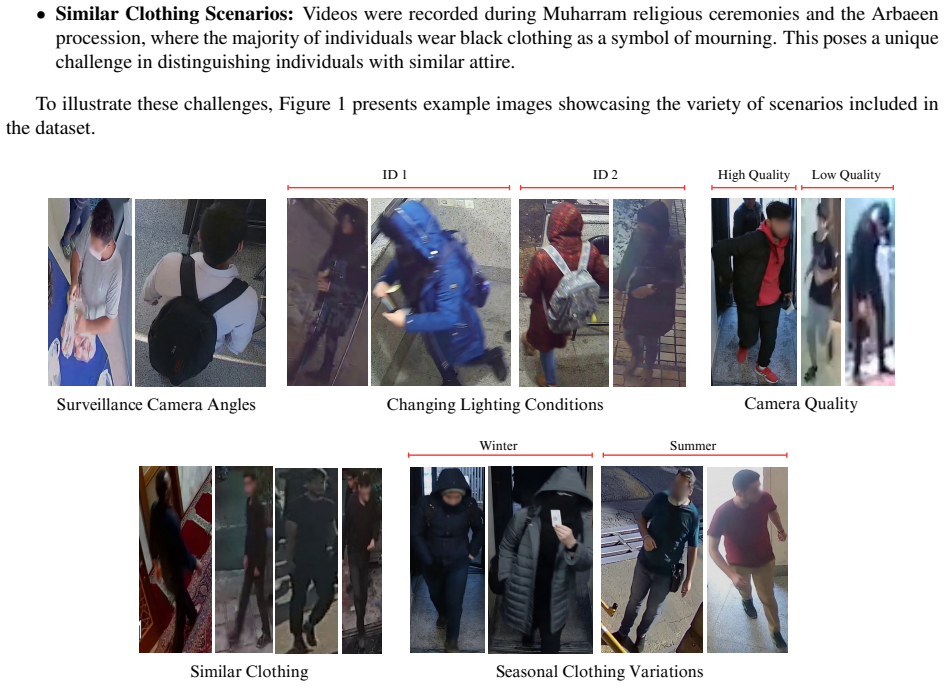
The load-bearing object is the dataset itself: IUST_PersonReId, with 1,847 identities, 117,455 annotated bounding boxes, roughly 19 cameras, and five locations in Iran and Iraq, sampled at 250-millisecond intervals and filtered by the BRISQUE quality measure, then split 75/25 by video duration. Around the dataset, the argument runs through three instruments: single-image fine-tuning of SOLIDER (a semantic self-supervised human representation model) and CLIP-ReID (a vision-language re-identification method), sequence-based re-identification with majority voting over multiple frames of the same identity, and ablations on cross-dataset transfer, gender balance, keypoint-based visibility, and face blurring or fusion. The dataset carries the claim, while the ablations are meant to show that the performance gap is tied to occlusion, female clothing, and limited facial cues rather than only to generic dataset difficulty.
What would settle it
Train the same models on the same identities photographed in both modest and non-modest clothing under identical camera, lighting, and occlusion conditions; if the mAP gap between clothing conditions is near zero, the benchmark-level drop is not attributable to attire.
Extended reading notes
Core claim
On its own terms, the paper's central discovery is that person re-identification models trained on existing benchmarks do not generalize to modest Islamic clothing: SOLIDER's mAP is 42.35 on IUST_PersonReId versus 93.10 on Market1501 and 65.36 on MSMT17, and CLIP-ReID's mAP is 51.60 versus 89.67 and 73.32. The paper reads these gaps as evidence that hijab-based modest attire creates occlusions and removes distinctive cues such as hair, body contours, and full face exposure, which current models implicitly rely on. It further finds that using multiple frames of the same person with majority voting substantially raises mAP (SOLIDER from 42.35 to 69.6, CLIP-ReID from 51.6 to 71.0), that female re-identification is harder even after balancing gender proportions, and that blurring faces barely hurts performance while fusing face-recognition distances with body re-identification does not help. The intended upshot is that cultural clothing variation is a genuine and under-served re-identification domain, not a minor annotation artifact.
Load-bearing premise
The argument assumes the large mAP drop is caused by modest attire, but IUST_PersonReId also differs from Market1501 and MSMT17 in camera count, scene types, occlusion distribution, and identity count, and no experiment controls for those variables.
Editorial extensions
If this is right
- Re-identification systems deployed in modest-attire regions should be trained or adapted on culturally matched data; cross-dataset testing shows transfer mAP below 14 percent for both models on IUST_PersonReId.
- Video and sequence-based re-identification is a practical mitigation: majority voting over tracklets lifts SOLIDER mAP from 42.35 to 69.6 and CLIP-ReID from 51.6 to 71.0, so deployment should use multiple frames rather than single detections.
- Benchmarking protocols should report gender- and visibility-disaggregated metrics, because overall mAP hides the sharp female and occluded-subgroup drops that the ablations expose.
- Future re-identification models and domain-adaptation methods can use IUST_PersonReId as an explicit cultural-domain target, since current models leave tens of mAP points unclaimed there.
- The face-blurring and face-fusion results imply that body-based cues are the reliable signal in this domain, so privacy-preserving re-identification does not have to sacrifice accuracy to avoid using facial identity.
Reading between the lines
- The same cross-dataset protocol could isolate the attire effect by synthetically re-dressing Western-benchmark pedestrians in modest clothing and checking whether mAP drops by comparable amounts; the paper does not run that controlled experiment.
- Because the dataset's temporal split keeps training and testing videos non-overlapping in time, it offers a natural testbed for domain adaptation and continual learning under distribution shift, which the paper only partially exploits.
- The face-blur and face-fusion outcomes suggest that privacy-aware training objectives could be built directly on this dataset, but the paper does not propose such an objective; that is a direct next step.
Editorial analysis
A structured set of objections, weighed in public.
Referee Report
Summary. The paper introduces IUST_PersonReId, a person re-identification dataset with 1,847 identities and 117,455 images collected from Iranian and Iraqi settings, with emphasis on modest attire such as hijabs. The authors fine-tune SOLIDER and CLIP-ReID on the dataset, report substantial mAP drops compared with Market1501 and MSMT17, and interpret these drops as evidence that modest attire and cultural clothing create distinct ReID challenges. The paper also presents sequence-based majority voting, cross-dataset transfer experiments, gender-based analyses, visibility analyses, and face-blurring/fusion experiments, and it releases the dataset and an annotation tool.
Significance. If the central attribution is substantiated, the dataset would fill a real gap: existing ReID benchmarks are dominated by Western and East Asian clothing, and a publicly available, culturally specific dataset with trained baselines would be a useful resource for fairness and domain-generalization research. The paper's strengths include the public release of the dataset and annotation tool, careful multi-stage annotation with quality filtering, and the observation that sequence-based voting improves performance on this data. However, the paper's title-level claim that modest attire drives the performance drop is currently supported only by uncontrolled cross-dataset comparisons, so the significance of the scientific conclusion is conditional on additional controlled evidence.
major comments (4)
- [Section 4.1] The train/test split is described as a temporal division by video duration, not an identity-disjoint split. In standard ReID evaluation, identities in the training set must be disjoint from those in the gallery and query sets. If the first 75% of video footage and the remaining 25% can contain the same tracked person at different times, the evaluation protocol is not identity-disjoint and the reported numbers are not comparable with standard benchmarks. Please clarify whether any identity appears in both subsets, and if so, re-split by identity.
- [Section 4.2, Tables 3, 5, 6] The claim that the performance drop 'demonstrates the challenges introduced by the new domain, where individuals wear modest attire characteristic of Iranian culture' is not supported by the presented evidence. IUST_PersonReId differs from Market1501 and MSMT17 in camera count (17 vs. 6 and 15), identity count, image count, collection locations (mosque, Arbaeen procession, market, campus), camera types, and annotation pipeline. Tables 5 and 6 themselves show large cross-dataset drops among existing benchmarks (e.g., SOLIDER Market-to-MSMT is 16.95 mAP), so an additional drop on IUST_PersonReId does not isolate attire as the cause. A controlled comparison is needed, such as matching visibility/occlusion distributions, evaluating on a non-modest-attire subset from the same cameras, or using attire labels as a covariate.
- [Section 4.4.3, Table 8] The gender performance analysis is confounded with visibility. Table 8 shows that 74 of 91 occluded queries are female, whereas 401 of 484 clear queries are male. The lower female performance in Table 7 could therefore be explained by occlusion rather than by hijab or modest attire per se. Please report performance stratified by both gender and visibility category, and avoid attributing the aggregate female deficit to cultural attire without controlling for the visibility distribution.
- [Section 3.5 and Section 4.4.3] The released dataset does not contain an image-level label for 'modest attire' or 'hijab,' so the proposed mechanism is never directly tested. The paper infers modest attire from the collection context and from gender, but this is not a measurement. To support the central claim, the authors should either release attire annotations or design an experiment in which attire is explicitly varied while other factors are held fixed.
minor comments (5)
- [Throughout] The dataset name is written inconsistently as 'IUST PersonReId', 'IUSTPersonReId', and 'IUST PersonReId' in the abstract, Table 1, and the main text; please standardize the spelling.
- [Section 3.3] 'CV AT' should be 'CVAT', and 'builtin trackers' should be 'built-in trackers'.
- [Figure 5] The y-axis label 'Overal' contains a typo; it should be 'Overall'.
- [Section 4.4.4] The face-recognition experiment uses ArcFace but does not specify which pre-trained weights or training data were used for the face model; please provide this information for reproducibility.
- [Table 5] The parenthetical drop values for the diagonal elements are not drops, and the notation '(↑ 0.01)' is confusing; please use a clearer convention or remove the parenthetical values from diagonal entries.
Circularity Check
No circularity: measured drops vs external benchmarks; causal attribution is underdetermined but not circular.
full rationale
The paper's central empirical claim (Sections 1, 4.2, Table 3) is that SOLIDER and CLIP-ReID lose mAP on IUST_PersonReId relative to Market1501 and MSMT17. These numbers are obtained by fine-tuning externally published models with standard protocols and comparing against published benchmark results; no parameter is fitted to the drop and then reported as a prediction. The cross-dataset ablations (Tables 5-6) are also direct evaluations, not constructions. The only self-referential element is the authors' own annotation tool (Section 3.3, CVLab-ReID-Tool), which is released but is not used to compute the reported performance numbers, so it is not load-bearing. Section 4.2's sentence 'This decline demonstrates the challenges introduced by the new domain, where individuals wear modest attire characteristic of Iranian culture' is a causal interpretation of measured drops, not a derivation: even if confounds (camera count, occlusion skew, collection setting) make that attribution uncertain, underdetermination is a validity concern, not circularity per the rubric. The paper itself reports the gender/visibility confound in Table 8 (74 female vs 17 male occluded queries), further supporting that the modest-attire explanation is underdetermined rather than derived. No equation is defined in terms of a target result, no fitted input is renamed as a prediction, and no load-bearing result is imported from the authors' own prior work. The derivation chain is self-contained against external benchmarks; therefore the correct circularity finding is none.
Assumptions & free parameters
free parameters (2)
- Visibility thresholds for clarity categories =
4, 9 keypoints
- Max frames per identity in sampling =
50
assumptions (3)
- domain assumption Default hyperparameters for SOLIDER and CLIP-ReID fine-tuning produce results comparable to published benchmark numbers.
- domain assumption The performance gap between IUST_PersonReId and established benchmarks is attributable to cultural attire rather than dataset difficulty.
- domain assumption Keypoint visibility categories (Clear/Partial/Occluded) provide a meaningful measure of visual occlusion.
Cite this review
Pith. "Pith review of A Culturally-Aware Benchmark for Person Re-Identification in Modest Attire." pith.science (2026). https://pith.science/paper/DCFEHDOF
@misc{pith2026241218874,
  author       = {Pith},
  title        = {Pith review of: A Culturally-Aware Benchmark for Person Re-Identification in Modest Attire},
  year         = {2026},
  howpublished = {\url{https://pith.science/paper/DCFEHDOF}},
  note         = {Machine review of arXiv:2412.18874}
}
read the original abstract
Person Re-Identification (ReID) is a fundamental task in computer vision with critical applications in surveillance and security. Despite progress in recent years, most existing ReID models often struggle to generalize across diverse cultural contexts, particularly in Islamic regions like Iran, where modest clothing styles are prevalent. Existing datasets predominantly feature Western and East Asian fashion, limiting their applicability in these settings. To address this gap, we introduce Iran University of Science and Technology Person Re-Identification (IUST_PersonReId), a dataset designed to reflect the unique challenges of ReID in new cultural environments, emphasizing modest attire and diverse scenarios from Iran, including markets, campuses, and mosques. Experiments on IUST_PersonReId with state-of-the-art models, such as Semantic Controllable Self-supervised Learning (SOLIDER) and Contrastive Language-Image Pretraining Re-Identification (CLIP-ReID), reveal significant performance drops compared to benchmarks like Market1501 and Multi-Scene MultiTime (MSMT17), specifically, SOLIDER shows a drop of 50.75% and 23.01% Mean Average Precision (mAP) compared to Market1501 and MSMT17 respectively, while CLIP-ReID exhibits a drop of 38.09% and 21.74% mAP, highlighting the challenges posed by occlusion and limited distinctive features. Sequence-based evaluations show improvements by leveraging temporal context, emphasizing the dataset's potential for advancing culturally sensitive and robust ReID systems. IUST_PersonReId offers a critical resource for addressing fairness and bias in ReID research globally.
Figures


Figures from the paper (2 more)


Forward citations
Cited by 1 Pith paper
-
Contextualized Multimodal Lifelong Person Re-Identification in Hybrid Clothing States
CMLReID uses dynamic text prompts and dual-path prototypes to improve lifelong person re-identification in hybrid clothing states, reporting gains of about 5 mAP over four baselines.
Reference graph
Works this paper leans on
-
[1]
S. Perkowitz, The Bias in the Machine: Facial Recognition Technology and Racial Disparities, MIT Case Studies in Social and Ethical Responsibilities of Computing (Winter 2021), https://mit-serc.pubpub.org/pub/bias-in-machine (feb 5 2021)
work page 2021
-
[2]
W. Li, R. Zhao, T. Xiao, X. Wang, Deepreid: Deep filter pairing neural network for person re-identification, IEEE Conference on Computer Vision and Pattern Recognition (2014) 152–159
work page 2014
-
[3]
N. Narayan, N. Sankaran, D. Arpit, K. Dantu, S. Setlur, V . Govindaraju, Person re-identification for improved multi-person multi-camera tracking by continuous entity association, in: Proceedings of the IEEE Conference on Computer Vision and Pattern Recognition Workshops, 2017, pp. 64–70
work page 2017
- [4]
- [5]
-
[6]
L. Wei, S. Zhang, W. Gao, Q. Tian, Person transfer gan to bridge domain gap for person re-identification, IEEE Conference on Computer Vision and Pattern Recognition (2018) 79–88
work page 2018
-
[7]
D. Fu, D. Chen, J. Bao, H. Yang, L. Yuan, L. Zhang, H. Li, D. Chen, Unsupervised pre-training for person re-identification, in: Proceedings of the IEEE/CVF conference on computer vision and pattern recognition, 2021, pp. 14750–14759
work page 2021
-
[8]
D. Fu, D. Chen, H. Yang, J. Bao, L. Yuan, L. Zhang, H. Li, F. Wen, D. Chen, Large-scale pre-training for person re-identification with noisy labels, in: Proceedings of the IEEE/CVF conference on computer vision and pattern recognition, 2022, pp. 2476–2486
work page 2022
Show all 36 references
-
[9]
P. F. Felzenszwalb, R. B. Girshick, D. McAllester, D. Ramanan, Object detection with discriminatively trained part-based models, IEEE transactions on pattern analysis and machine intelligence 32 (9) (2009) 1627–1645
2009
-
[10]
Zheng, Z
L. Zheng, Z. Bie, Y . Sun, J. Wang, C. Su, S. Wang, Q. Tian, Mars: A video benchmark for large-scale person re-identification, European Conference on Computer Vision (2016) 868–884
2016
-
[11]
Dehghan, S
A. Dehghan, S. Modiri Assari, M. Shah, Gmmcp tracker: Globally optimal generalized maximum multi clique problem for multiple object tracking, in: Proceedings of the IEEE conference on computer vision and pattern recognition, 2015, pp. 4091–4099
2015
-
[12]
Ristani, F
E. Ristani, F. Solera, R. Zou, R. Cucchiara, C. Tomasi, Performance measures and a data set for multi-target, multi-camera tracking, in: European conference on computer vision, Springer, 2016, pp. 17–35
2016
-
[13]
Benenson, M
R. Benenson, M. Omran, J. Hosang, B. Schiele, Ten years of pedestrian detection, what have we learned?, in: Computer Vision-ECCV 2014 Workshops: Zurich, Switzerland, September 6-7 and 12, 2014, Proceedings, Part II 13, Springer, 2015, pp. 613–627
2014
-
[14]
Y . Wu, Y . Lin, X. Dong, Y . Yan, W. Ouyang, X. Yang, Exploit the unknown gradually: One-shot video-based person re-identification by stepwise learning, IEEE Conference on Computer Vision and Pattern Recognition (2018) 5177–5186
2018
-
[15]
M. Gou, Z. Wu, A. Rates-Borras, O. Camps, R. J. Radke, et al., A systematic evaluation and benchmark for person re-identification: Features, metrics, and datasets, IEEE transactions on pattern analysis and machine intelligence 41 (3) (2018) 523–536
2018
-
[16]
Felsen, Y .-C
P. Felsen, Y .-C. Tsai, W.-C. Huang, Y .-C. Huang, Will it collide? probabilistic trajectory prediction for sports video analysis, IEEE Conference on Computer Vision and Pattern Recognition (2017) 3999–4008
2017
-
[17]
Zheng, S
M. Zheng, S. Karanam, R. J. Radke, Rpifield: A new dataset for temporally evaluating person re-identification, in: Proceedings of the IEEE conference on computer vision and pattern recognition workshops, 2018, pp. 1893–1895
2018
-
[18]
Giancola, A
S. Giancola, A. Cioppa, A. Deli `ege, F. Magera, V . Somers, L. Kang, X. Zhou, O. Barnich, C. De Vleeschouwer, A. Alahi, et al., Soccernet 2022 challenges results, in: Proceedings of the 5th International ACM Workshop on Multimedia Content Analysis in Sports, 2022, pp. 75–86
2022
-
[19]
Y . Wu, Y . Lin, X. Dong, Y . Yan, W. Ouyang, X. Yang, Destre: A dataset for person re-identification in open-world surveillance, IEEE Transactions on Pattern Analysis and Machine Intelligence (2020)
2020
-
[20]
X. Shu, X. Wang, X. Zang, S. Zhang, Y . Chen, G. Li, Q. Tian, Large-scale spatio-temporal person re-identification: Algorithms and bench- mark, IEEE Transactions on Circuits and Systems for Video Technology 32 (7) (2021) 4390–4403
2021
-
[21]
G. Song, B. Leng, Y . Liu, C. Hetang, S. Cai, Region-based quality estimation network for large-scale person re-identification, IEEE Confer- ence on Computer Vision and Pattern Recognition (2018) 6199–6208
2018
-
[22]
S. Yang, Y . Zhou, Z. Zheng, Y . Wang, L. Zhu, Y . Wu, Towards unified text-based person retrieval: A large-scale multi-attribute and language search benchmark, in: Proceedings of the 31st ACM International Conference on Multimedia, 2023, pp. 4492–4501. 13
2023
-
[23]
Jocher, YOLOv5 by Ultralytics (May 2020)
G. Jocher, YOLOv5 by Ultralytics (May 2020). doi:10.5281/zenodo.3908559. URL https://github.com/ultralytics/yolov5
2020 doi
-
[24]
Zhang, P
Y . Zhang, P. Sun, Y . Jiang, D. Yu, F. Weng, Z. Yuan, P. Luo, W. Liu, X. Wang, Bytetrack: Multi-object tracking by associating every detection box, in: European conference on computer vision, Springer, 2022, pp. 1–21
2022
-
[25]
Zhang, C
Y . Zhang, C. Wang, X. Wang, W. Zeng, W. Liu, Fairmot: On the fairness of detection and re-identification in multiple object tracking, International journal of computer vision 129 (2021) 3069–3087
2021
-
[26]
Authors, Paddledetection, object detection and instance segmentation toolkit based on paddlepaddle., https://github.com/ PaddlePaddle/PaddleDetection (2019)
P. Authors, Paddledetection, object detection and instance segmentation toolkit based on paddlepaddle., https://github.com/ PaddlePaddle/PaddleDetection (2019)
2019
-
[27]
CV AT.ai Corporation, Computer Vision Annotation Tool (CV AT) (Nov. 2023). URL https://github.com/cvat-ai/cvat
2023
-
[28]
N. T. U. ROSE Lab, Person re-identification, https://www.ntu.edu.sg/rose/research-focus/ deep-learning-video-analytics/person-re-identification
-
[29]
T. Zhao, S. Liao, Z. Lei, Semi-automatic data annotation tool for person re-identification across multi cameras, in: 2018 IEEE International Conference on Big Data (Big Data), IEEE, 2018, pp. 4672–4677
2018
-
[30]
Mittal, A
A. Mittal, A. K. Moorthy, A. C. Bovik, No-reference image quality assessment in the spatial domain, IEEE Transactions on image processing 21 (12) (2012) 4695–4708
2012
-
[31]
W. Chen, X. Xu, J. Jia, H. Luo, Y . Wang, F. Wang, R. Jin, X. Sun, Beyond appearance: a semantic controllable self-supervised learning framework for human-centric visual tasks, in: Proceedings of the IEEE /CVF conference on computer vision and pattern recognition, 2023, pp. 15...
2023
-
[32]
S. Li, L. Sun, Q. Li, Clip-reid: exploiting vision-language model for image re-identification without concrete text labels, in: Proceedings of the AAAI Conference on Artificial Intelligence, V ol. 37, 2023, pp. 1405–1413
2023
-
[33]
Radford, J
A. Radford, J. W. Kim, C. Hallacy, A. Ramesh, G. Goh, S. Agarwal, G. Sastry, A. Askell, P. Mishkin, J. Clark, et al., Learning transferable visual models from natural language supervision, in: International conference on machine learning, PMLR, 2021, pp. 8748–8763
2021
-
[34]
M. Ye, J. Shen, G. Lin, T. Xiang, L. Shao, S. C. Hoi, Deep learning for person re-identification: A survey and outlook, IEEE transactions on pattern analysis and machine intelligence 44 (6) (2021) 2872–2893
2021
-
[35]
H.-S. Fang, J. Li, H. Tang, C. Xu, H. Zhu, Y . Xiu, Y .-L. Li, C. Lu, Alphapose: Whole-body regional multi-person pose estimation and tracking in real-time, IEEE Transactions on Pattern Analysis and Machine Intelligence 45 (6) (2022) 7157–7173
2022
-
[36]
J. Deng, J. Guo, N. Xue, S. Zafeiriou, Arcface: Additive angular margin loss for deep face recognition, in: Proceedings of the IEEE /CVF Conference on Computer Vision and Pattern Recognition, 2019, pp. 4690–4699. 14
2019
Reviewed August 11, 2026 · model on record in the stance chip above.
Discussion (0). Continue with ORCID to comment.