REVIEW 3 major objections 5 minor 56 references
Transit-Length Distribution for Particle Transport in Binary Markovian Mixed Media
T0 review · 3 major / 5 minor · reviewed 2026-08-11 · deepseek-v4-flash
Pith's one-line read This paper derives an exact transit-length distribution for particles in binary Markovian mixtures, with a stable asymptotic form that beats atomic-mix in porous media.
desk verdict Useful exact distribution and high-mixing asymptotics, but Section 3 has a wrong 1/μ attenuation factor that undercuts the non-beam light-transmission results. read the letter →
The pith
A machine-rendered reading of the paper's core claim, the machinery that carries it, and where it could break.
The reading
What carries the argument
The machinery is the mapping of binary Markovian transport onto the telegraph process: total distance $s$ plays the role of time, net distance in material A minus material B plays the role of position, unit speed is used, and the zone-crossing rates $\alpha,\beta$ play the role of switching rates. The derivation solves a Neumann expansion of first-order PDEs for $p_A^m(x,s)$ and $p_B^m(x,s)$, transforms them with an exponential ansatz, and sums the series to closed form via modified Bessel functions. The asymptotic analysis uses the large-argument form $I_n(z)\sim e^z/\sqrt{2\pi z}$ together with the substitution $u=\sqrt{\ell}-\sqrt{k(s-\ell)}$ to expose a Gaussian factor $e^{-\alpha u^2}$; a first-order Taylor expansion of the remaining fourth-root factor yields the analytically tractable skewed Gaussian of Eq. (40), with renormalization constants computed by enforcing unit probability.
What would settle it
Simulate or measure the transit-length density in a binary mixture where chord lengths are drawn from distributions with the same means but nonzero correlations or nonexponential tails; if the measured density departs from Eq. (24) beyond Monte Carlo or experimental uncertainty, the Markovian premise is refuted. A cheaper check: compare the predicted L1 convergence rate of the asymptotic form (roughly $\alpha^{-1}$) against a high-resolution Monte Carlo for $\alpha$ from 10 to 200 cm$^{-1}$ in the paper's slab test case.
Extended reading notes
Core claim
The paper's central claim is that for a binary Markovian mixture with exponential chord-length rates $\alpha=1/\Lambda_A$ and $\beta=1/\Lambda_B$, the density of the distance $\ell$ spent in material A after total travel $s$, starting from material A or B, is given by Eqs. (22a)-(22b), with the mixed-start version in Eq. (24). The density is a superposition of Dirac deltas for particles that never leave their starting material, plus continuous terms built from modified Bessel functions $I_0$ and $I_1$; the $I_0$ terms count odd numbers of zone crossings and the $I_1$ terms count positive even numbers. The paper further claims that in the highly mixed limit the density approaches a skewed Gaussian (Eq. (40)) in the variable $u=\sqrt{\ell}-\sqrt{k(s-\ell)}$, and that this asymptotic form converges to the Dirac delta at the atomic-mix transit length $\ell = ks/(1+k)$ as $\alpha\to\infty$. Monte Carlo sampling of the exponential telegraph process confirms the exact density, and the applications show the asymptotic model is more accurate than atomic mix for highly mixed, not-too-thick porous slabs.
Load-bearing premise
The load-bearing premise is that the distance a particle travels inside either material before crossing to the other is exponentially distributed with fixed rates $\alpha$ and $\beta$; if real mixtures have correlated or otherwise nonexponential chord-length statistics, the telegraph-process equivalence, the closed-form density, and both applications no longer follow.
Editorial extensions
If this is right
- Ensemble-averaged angular flux in a purely absorbing porous slab can be written exactly as an integral of the transit-length density (Eq. (56)) and, under the asymptotic model, reduced to standard functions (Eq. (62)).
- For highly mixed, not-too-optically-thick slabs, the analytic asymptotic transmission probability is more accurate than the atomic-mix result, reaching sub-0.1% error for beam sources at modest $\alpha$ while atomic mix requires much larger $\alpha$.
- Charged-particle stopping in porous media can be treated with the same distribution: transmission probability, energy spectrum, and angular flux all follow from integrating the transit-length density against the stopping-power relation, with the caveat that the analytic asymptotic transmission form is reliable only when particles transmit in the atomic-mix limit.
- The exact density is verified against a $10^9$-sample Monte Carlo simulation of the exponential telegraph process, so the formulas can serve as reference solutions for testing approximations in stochastic media transport.
- Because the asymptotic density converges to the atomic-mix limit, it provides a controlled bridge between full stochastic-media models and simple volumetric homogenization.
Reading between the lines
- Beyond the paper, the same density could be used to construct reaction-rate path-length estimators for Monte Carlo particle transport that average over material randomness inside a single flight, potentially lowering variance; the paper mentions this as future work, not a demonstrated result.
- Beyond the paper, if the Markovian premise is replaced by correlated or nonexponential chord lengths, the closed Bessel form will not hold, but the general strategy of solving a hierarchy of crossing-count equations might extend to renewal-type mixtures, yielding a generalized transit-length density.
- Beyond the paper, the asymptotic skewed-Gaussian form suggests that in highly mixed media the transit-length statistics depend on the single combination $\alpha$ times an effective quadratic form, so error estimates for homogenization could be expressed in terms of $\alpha s$ and $k$ alone.
- Beyond the paper, one could test the model against transmission measurements in fabricated random slabs with engineered chord-length statistics; agreement for exponential statistics and systematic deviation for non-exponential statistics would isolate the role of the Markovian assumption.
Editorial analysis
A structured set of objections, weighed in public.
Referee Report
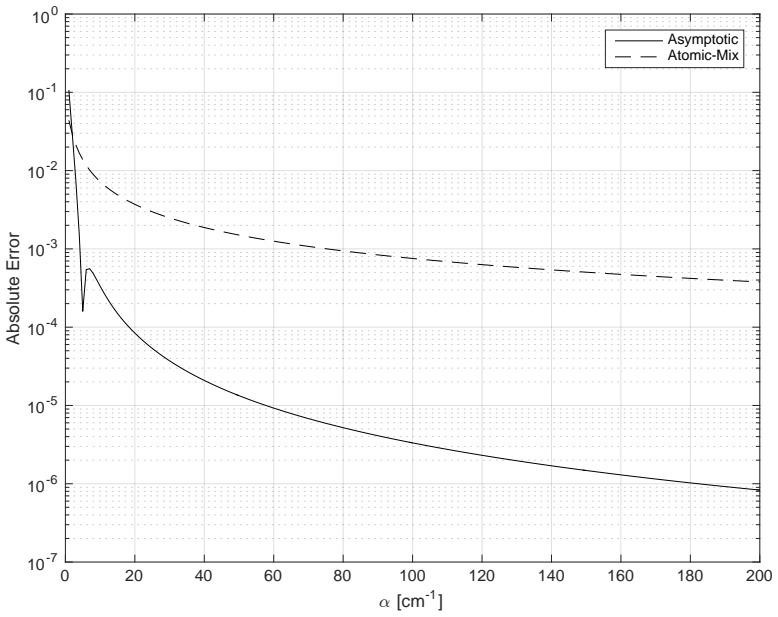
Summary. This paper derives an exact distribution for the transit length ℓ that a particle spends in material A while traveling a fixed total distance s through a binary Markovian random mixture. The authors map the problem onto a telegraph process in which the net distance X_A = 2ℓ − s plays the role of position and the total path length s plays the role of time, solve the resulting two-state first-order PDE system by the method of characteristics, and sum the Neumann series in the number of zone crossings to obtain the Bessel-function densities in Eqs. (22a)–(24), including Dirac masses for particles that never leave their starting zone. For strongly mixed media they derive an asymptotically Gaussian density in the variable u = √ℓ − √(k(s−ℓ)) (Eqs. (31)–(40)), with renormalization fixed by a unit-integral condition, and they show analytically that the asymptotic forms reduce to a Dirac delta at the atomic-mix transit length as α → ∞. Numerical support includes a 10^9-sample Monte Carlo simulation of the Markov process (agreement within 1σ, Fig. 2) and an L1 error study showing α^{−1} convergence of the asymptotic form (Fig. 3). The distribution is then applied to two porous-media problems: light transmission through a purely absorbing slab, for which an exact ensemble-averaged angular flux (Eq. (56)) and an analytic approximate form (Eqs. (58)–(62)) are derived; and charged-particle stopping, for which transmission probabilities, energy spectra, and angular fluxes are computed.
Significance. The Section 2 derivation is internally consistent: the characteristic integrations, the Bessel-function resummation, the normalization constants, and the atomic-mix limit all check out, and the Monte Carlo and L1-norm evidence supports the claims. The paper ships reproducible implementations (C++, Python, MATLAB) and all scripts, and it states its own limitations explicitly, notably in §4.1.1, where the asymptotic transmission model is honestly restricted to the atomic-mix-transmitting regime and its failure for thick slabs is demonstrated. These are genuine strengths. However, the light-transmission application contains a real error for μ ≠ 1: the printed ensemble average uses e^{−Σ_tℓ/μ} where the physics requires e^{−Σ_tℓ}, so the isotropic-flux exact results in Fig. 5 and any μ-averaged statements in Section 3 are invalid as printed, while the beam-source results (μ = 1) are unaffected. The central printed formula Eq. (24) also carries a support-sign typo in its Heaviside factor. Both issues are local and fixable, and they do not touch the Section 2 derivation or the charged-particle application.
major comments (3)
- [§2.1, Eqs. (22a), (22b), (24)] The Heaviside factor Θ(ℓ(ℓ−s)) in the continuous parts of Eqs. (22a), (22b), and (24) has the wrong sign. With the paper's definition of Θ (unity for non-negative argument), Θ(ℓ(ℓ−s)) vanishes for 0 < ℓ < s, so the printed densities are zero on their claimed support. From Eqs. (17) and (20), the factor before the change of variables is Θ((s−x)(s+x)), which becomes Θ(4ℓ(s−ℓ)) = Θ(ℓ(s−ℓ)) under x = 2ℓ − s; the correct support is 0 ≤ ℓ ≤ s. Because the Monte Carlo verification in Fig. 2 and all subsequent numerical results evidently used the correct support, this is presumably a typographical slip, but it must be corrected because a reader implementing Eq. (24) as printed would obtain a density that vanishes almost everywhere on (0, s).
- [§3.1, Eqs. (55)–(56)] For a ray with direction cosine μ, the path increment along the ray is ds = dx/μ, and the projected length of the A-segments is μℓ, where ℓ is the along-ray transit length in A; hence ∫_0^x Σ_t(x′)dx′ = Σ_t μℓ and the middle expression exp[−(1/μ)∫Σ_t dx′] equals e^{−Σ_tℓ}, not e^{−Σ_tℓ/μ}. The second equality in Eq. (55) is therefore inconsistent with the first for μ ≠ 1, and the ensemble average in Eq. (56) inherits the error. The limiting case ω → 1 makes this crisp: f_A(ℓ, x/μ) = δ(ℓ − x/μ) and Eq. (56) gives g(μ)e^{−Σ_t x/μ²} instead of the standard g(μ)e^{−Σ_t x/μ}. Independently, the asymptotic expansion in Eq. (58) has leading factor e^{−ωΣ_t x/μ}, which is the expansion of e^{−Σ_tℓ} about ℓ(0) = ωx/μ, so the approximate solution is consistent with the corrected attenuation rather than with Eq. (56). The exact and approximate results in Section 3 are thus internally inconsistent whenever μ ≠ 1. The beam-source results (Figs. 4 and 6–9) are unaffected because μ = 1, but the isotropic-flux exact curve in Fig. 5 and any μ-averaged transmission comparisons must be recomputed after replacing e^{−Σ_tℓ/μ} with e^{−Σ_tℓ} in Eqs. (55)–(56).
- [§2.2 vs. §§3.3 and 4.3] The asymptotic derivation states that 'we require that α is large, and since k is on the order of or greater than 1' (text following Eq. (26)), yet the applications use k = 0.2 (§3.3.1), sweep k from 0 to 10 (§3.3.2), and use k = 0.25 (§4.3). The negative-density analysis of Eqs. (34) and (38) covers the regimes k > 3 and k < 1/3, and the truncation bounds in Eqs. (42) are designed for the k < 1 cases, but the paper never states the regime of validity of the asymptotic model as a function of k, nor analyzes the error introduced by the truncation when k < 1. As printed, the validity of Eqs. (40)–(43) at k = 0.2 and k = 0.25 rests entirely on the numerical comparisons in Figs. 4–9. I ask the authors to make the domain of validity explicit (including whether Eq. (42) fully removes the negative-density defect) or to qualify the accuracy claims for k substantially below one.
minor comments (5)
- [§2.2, text after Eq. (34)] The stated negativity onset u < −2√(ks)/(k+1) is not the zero of the prefactor 1 + (1/2)√((1+k)/(ks))u; the zero occurs at u = −2√(ks/(1+k)). The analogous bound after Eq. (38) should likewise be u > 2√(ks/(1+k)). The threshold conditions k > 3 and k < 1/3 are correct, and only the locations are misstated.
- [§3.1, Eq. (53)] The domain is given as '0 ≤ x ≤ L' although the slab width is denoted X throughout Section 3; use one symbol consistently.
- [Throughout] Typos: 'Isotopic flux' appears in the captions of Figs. 5, 14, and 15 and in §3.3.1 and should be 'isotropic flux'; 'chracteristic' in the Fig. 1 caption; 'The transport of light though this problem' in §3.1; 'a vector of of evaluation points' in §2.4.4; 'This asympotic solution' in §4.1.1; 'Theortical' in reference [4]; 'Generized' in reference [5].
- [§3.3.1] The description 'a grid of 100 even cosine µ intervals' is unclear; please state the integration rule (for example, uniform in µ) and the quadrature used to produce the isotropic-flux results in Fig. 5.
- [§2.5.2] The sentence 'The L-1 norm is computed shown as a function of α' contains a redundant word, and the text discusses only the asymptotic error curve in Fig. 3 although the caption also distinguishes the atomic-mix error.
Circularity Check
No significant circularity: the transit-length derivation is self-contained from the stated Markovian premise, and the asymptotic/applied results are not fitted to their own outputs.
full rationale
The central derivation (Sec. 2) starts from an explicit modeling premise — exponential chord-length statistics with rates α and β — and solves the resulting first-order PDE system by characteristics, summing Neumann terms into the Bessel-function forms (22a)-(24). Every step is a mathematical consequence of that premise; no parameter is adjusted to reproduce the distribution. The asymptotic forms (32)-(40) are obtained by uniform asymptotic expansion of the Bessel functions, and the constants C_A, C_B, and C are fixed by unit-integral normalization, not by fitting to the exact distribution or to transport results; the α^{-1} L^1 convergence in Fig. 3 is an independent numerical check against the exact form. The Monte Carlo verification in Sec. 2.5.1 samples the same exponential-chord process, so it validates algebra/implementation rather than the physical premise; that is appropriate and not circular. The atomic-mix limit follows because the Gaussian width σ^2=1/α → 0 and ℓ(0)=ks/(1+k)=ωs is obtained from the definitions of k and ω, not assumed. In the applications, the transit-length distribution is used as an input to a Boltzmann attenuation problem; the renormalization constants do not encode the transmission results, and the numerical comparisons to atomic mix are genuine posterior checks. The self-citations [9,10] document prior applications of the distribution and are not load-bearing for the derivation, which relies on Kac [7] and Ratanov [8] as external prior work. The apparent missing-cosine-factor inconsistency in Eqs. (55)-(58) is a correctness issue, not a circularity, and is outside this pass. No circular step qualifies under the quoted-reduction standard.
Assumptions & free parameters
assumptions (6)
- domain assumption Chord lengths in each material are exponentially distributed with fixed rates alpha and beta, making the material sequence a two-state Markov process.
- domain assumption Starting material probabilities are equal to volume fractions.
- domain assumption For the light application, material A is a pure absorber and material B is void.
- domain assumption For charged particles, the continuous slowing down approximation holds with no energy straggling or angular deflection.
- standard math Modified Bessel functions of the first kind have the standard asymptotic form In(z) ~ exp(z)/sqrt(2 pi z).
- standard math Superposition of characteristic solutions and interchange of the infinite Neumann sum are valid for these PDEs.
Cite this review
Pith. "Pith review of Transit-Length Distribution for Particle Transport in Binary Markovian Mixed Media." pith.science (2026). https://pith.science/paper/AVV4GSVO
@misc{pith2026241219359,
  author       = {Pith},
  title        = {Pith review of: Transit-Length Distribution for Particle Transport in Binary Markovian Mixed Media},
  year         = {2026},
  howpublished = {\url{https://pith.science/paper/AVV4GSVO}},
  note         = {Machine review of arXiv:2412.19359}
}
read the original abstract
The correspondence between the telegraph random process and transport within a binary stochastic Markovian mixture is established. This equivalence is used to derive the distribution function for the transit length, defined as the distance a particle moving along a straight-line trajectory travels through a specific material zone within the random mixture. A numerically robust asymptotic form of this distribution is obtained for highly mixed materials and the convergence to the atomic-mix limit is shown. The validity of the distribution is verified using a Monte Carlo simulation of the transport process. The distribution is applied to particle transport in slab geometry containing porous media for two cases: the transmission of light and the stopping of charged particles. For both of these applications, analytical forms using the approximate asymptotic model for the transmission probability of beam sources are obtained and illustrative numerical results are provided. These results show that in cases of highly mixed materials, the asymptotic forms are more accurate than the atomic-mix limit.
Figures


Figures from the paper (13 more)




Reference graph
Works this paper leans on
-
[1]
C. A. Levermore , G. C. Pomraning , D. L. Sanzo , and J. Wong , Linear Transport Theory in a Random Medium, J. Math. Phys., 27, 10, 2526 (1986)
work page 1986
-
[2]
C. A. Levermore , J. Wong , and G. C. Pomraning , Renewal Theory for Transport Processes in Binary Statistical Mixtures, J. Math. Phys., 29, 995 (1988)
work page 1988
-
[3]
R. C. Sanchez , Linear Kinetic Theory in Stochastic Media, J. Math. Phys., 30, 11, 2498 (1989)
work page 1989
-
[4]
A. B. Davis and F. Xu , A Generalized Linear Transport Model for Spatially Correlated Stochastic Media, J. Comp. Theortical Transport, 43, 474--514 (2014)
work page 2014
-
[5]
S. D. Pautz and B. C. Franke , A Generized Levermore-Pomraning Closure for Stochastic Media Transport Problems, in Proc. M&C 2015, (2015)
work page 2015
-
[6]
A Reciprocal Formulation of Nonexponential Radiative Transfer. 3: Binary Mixtures
E. d'Eon , A Reciprocal Formulation of Nonexponential Radiative Transfer. 3: Binary Mixtures, arXiv:1903.08783 (2019)
work page Pith review arXiv 2019
-
[7]
Kac , A Stochastic Model Related to the Telegrapher's Equation, Rocky Mountain J
M. Kac , A Stochastic Model Related to the Telegrapher's Equation, Rocky Mountain J. Math., 4, 3, 497 (1974)
work page 1974
-
[8]
Ratanov , A Jump Telegraph Model for Option Pricing, Quantitative Finance, 7, 5, 575 (2007)
N. Ratanov , A Jump Telegraph Model for Option Pricing, Quantitative Finance, 7, 5, 575 (2007)
work page 2007
Show all 56 references
-
[9]
E. H. Vu and B. C. Kiedrowski , Angular Deflection Distribution for Condensed History Electron Transport in Binary Markovian Media, Trans. Am. Nucl. Soc., 125, 427 (2021)
2021
-
[10]
E. H. Vu and B. C. Kiedrowski , Energy Loss Straggling Distribution for Condensed History Electron Transport in Binary Markovian Media, Trans. Am. Nucl. Soc., 125, 431 (2021)
2021
-
[11]
``Nuclear Criticality Safety in Operations with Fissionable Material Outside Reactors,'' American Nuclear Society, American National Standard ANSI/ANS-8.1-1998 (1998) (Reaffirmed 2007)
1998
-
[12]
``Validation of Neutron Transport Methods for Nuclear Criticality Safety Calculations,'' American Nuclear Society, American National Standard ANSI/ANS-8.24-2007 (2007)
2007
-
[13]
GOORLEY, et al., ``Initial MCNP6 Release Overview'', Nucl
J.T. GOORLEY, et al., ``Initial MCNP6 Release Overview'', Nucl. Technol. , 180 , 298-315 (2012)
2012
-
[14]
CHADWICK, et al., ``ENDF/B-VII.1: Nuclear Data for Science and Technology: Cross Sections, Covariances, Fission Product Yields and Decay Data,'' Nucl
M.B. CHADWICK, et al., ``ENDF/B-VII.1: Nuclear Data for Science and Technology: Cross Sections, Covariances, Fission Product Yields and Decay Data,'' Nucl. Data Sheets , 112 , 2887 (2011)
2011
-
[15]
CONLIN, et al., ``Continuous Energy Neutron Cross Section Data Tables Based upon ENDF/B-VII.1,'' Los Alamos National Laboratory Report, LA-UR-13-20137, (2013)
J.L. CONLIN, et al., ``Continuous Energy Neutron Cross Section Data Tables Based upon ENDF/B-VII.1,'' Los Alamos National Laboratory Report, LA-UR-13-20137, (2013)
2013
-
[16]
BROADHEAD, et al., ``Sensitivity- and Uncertainty-Based Criticality Safety Validation Techniques,'' Nucl
B.L. BROADHEAD, et al., ``Sensitivity- and Uncertainty-Based Criticality Safety Validation Techniques,'' Nucl. Sci. Eng. , 146 , 340-366 (2004)
2004
-
[17]
REARDEN, ``Perturbation Theory Eigenvalue Sensitivity Analysis with Monte Carlo Techniques,'' Nucl
B.T. REARDEN, ``Perturbation Theory Eigenvalue Sensitivity Analysis with Monte Carlo Techniques,'' Nucl. Sci. Eng. , 146 , 367-382 (2004)
2004
-
[18]
KIEDROWSKI, F.B
B.C. KIEDROWSKI, F.B. BROWN, ``Adjoint-Based k-Eigenvalue Sensitivity Coefficients to Nuclear Data Using Continuous-Energy Monte Carlo,'' Nucl. Sci. Eng. , 174 , 227-244 (2013)
2013
-
[19]
PERFETTI, W.R
C.M. PERFETTI, W.R. MARTIN, B.T. REARDEN, M.L. WILLIAMS, ``Advanced Methods for Eigenvalue Sensitivity Coefficient Calculations,'' Trans. Am. Nucl. Soc. , 107 , 575-578 (2012)
2012
-
[20]
SHIM, C.H
H.J. SHIM, C.H. KIM, ``Adjoint Sensitivity and Uncertainty Analyses in Monte Carlo Forward Calculations,'' J. Nucl. Sci. Technol. , 48 , 1453-1461 (2011)
2011
-
[21]
RASKACH, A.A
K.F. RASKACH, A.A. BLYSKAVKA, ``An Experience of Applying Iterated Fission Probability Method to Calculation of Effective Kinetics Parameters and keff Sensitivities with Monte Carlo,'' Proc. PHYSOR 2010 -- Advances in Reactor Physics to Power the Nuclear Renaissance , Pittsbur...
2010
-
[22]
BOWMAN, ``SCALE 6: Comprehensive Nuclear Safety Analysis Code System,'' Nucl
S.M. BOWMAN, ``SCALE 6: Comprehensive Nuclear Safety Analysis Code System,'' Nucl. Technol. , 174 , 126-148 (2011)
2011
-
[23]
REARDEN, et
B.T. REARDEN, et. al., ``Sensitivity and Uncertainty Analysis Capabilities and Data in SCALE,'' Nucl. Technol. , 174 , 236-288 (2011)
2011
-
[24]
B.C. KIEDROWSKI, ``User Manual for Whisper (v1.0.0), Software for Sensitivity- and Uncertainty-Based Nuclear Criticality Safety Validation,'' Los Alamos National Laboratory Report, LA-UR-14-26436 (2014)
2014
-
[25]
KIEDROWSKI, et al., ``Validation of MCNP6.1 for Criticality Safety of Pu-Metal, -Solution, and -Oxide Systems,'' Los Alamos National Laboratory Report, LA-UR-14-23352 (2014)
B.C. KIEDROWSKI, et al., ``Validation of MCNP6.1 for Criticality Safety of Pu-Metal, -Solution, and -Oxide Systems,'' Los Alamos National Laboratory Report, LA-UR-14-23352 (2014)
2014
-
[26]
KIMBALL, E.F
K.D. KIMBALL, E.F. TRUMBLE, ``Statistical Methods for Accurately Determining Criticality Code Bias,'' Proc. Topl. Mtg. Criticality Safety Challenges in the Next Decade , Chelan, Washington, USA, Sep. 7-11 (1997)
1997
-
[27]
NATRELLA, ``Experimental Statistics,'' National Bureau of Standards Handbook 91 , US Department of Commerce (1963)
M.G. NATRELLA, ``Experimental Statistics,'' National Bureau of Standards Handbook 91 , US Department of Commerce (1963)
1963
-
[28]
BISWAS, Q
D. BISWAS, Q. AO, R. REED, ``Comparison of a Few Statistical Methods for Validation,'' Proc. Nuclear Criticality Safety Division Topical Mtg. , Richland, Washington, USA, Sep. 13-17 (2009)
2009
-
[29]
LICHTENWALTER, S.M
J.J. LICHTENWALTER, S.M. BOWMAN, M.D. DEHART, and C.M. HOPPER, ``Criticality Benchmark Guide for Light-Water-Reactor Fuel in Transportation and Storage Packages,'' NUREG0CR-6361 (ORNL/TM-13211), U.S. Nuclear Regulatory Commission/Oak Ridge National Laboratory (1997)
1997
-
[30]
AO, ``A Statistical Methodology for Validating Criticality Analysis Code,'' Proc
Q. AO, ``A Statistical Methodology for Validating Criticality Analysis Code,'' Proc. 8th International Conference on Nuclear Criticality , St. Petersburg, Russia, May 28 - Jun. 1 (2007)
2007
-
[31]
AO, ``USLSA -- A Statistical Tool for Criticality Analysis Code Validation,'' Trans Am
Q. AO, ``USLSA -- A Statistical Tool for Criticality Analysis Code Validation,'' Trans Am. Nucl. Soc. , 96 , 271-273 (2007)
2007
-
[32]
AO, ``PARANAL: An Efficient Tool for Parametric Analysis of Criticality Safety,'' Trans
Q. AO, ``PARANAL: An Efficient Tool for Parametric Analysis of Criticality Safety,'' Trans. Am. Nucl. Soc. , 100 , 359-361 (2009)
2009
-
[33]
FERNEX, Y
F. FERNEX, Y. RICHET, E. LETANG, ``MACSENS: A New MORET Tool to Assist Code Bias Estimation,'' Proc. Nuclear Criticality Safety Division Topical, Integrating Criticality Safety into the Resurgence of Nuclear Power , Knoxville, TN USA Sep. 19-22 (2005)
2005
-
[34]
KIEDROWSKI, F.B
B.C. KIEDROWSKI, F.B. BROWN, P.P.H. WILSON, ``Adjoint-Weighted Tallies for k-Eigenvalue Calculations with Continuous-Energy Monte Carlo,'' Nucl. Sci. Eng. , 168 , 226-241 (2011)
2011
-
[35]
ATHE, H.S
P. ATHE, H.S. ABDEL-KHALIK, ``Mutual Information: A Generalization of Similarity Indices,'' Trans. Am. Nucl. Soc. , 111 , 1299-1302 (2014)
2014
-
[36]
VAN DER MARCK, ``Benchmarking ENDF/B-VII.1, JENDL-4.0 and JEFF-3.1.1 with MCNP6,'' Nucl
S.C. VAN DER MARCK, ``Benchmarking ENDF/B-VII.1, JENDL-4.0 and JEFF-3.1.1 with MCNP6,'' Nucl. Data Sheets , 113 , 2935-3005 (2012)
2012
-
[37]
WAGSCHAL, C.M
J.J. WAGSCHAL, C.M. HOPPER, ``Determination of Consistent Benchmarks Used for Nuclear Criticality Safety Analysis Applications,'' Trans. Am. Nucl. Soc. , 93 , 257-259 (2005)
2005
-
[38]
``International Handbook of Evaluated Criticality Safety Benchmark Experiments,'' Organization for Economic Co-operation and Development Nuclear Energy Agency, NEA/NSC/DOC(95)03 (2013)
2013
-
[39]
18, 2014)
``Database for the International Criticality Safety Benchmark Evaluation Project (DICE),'' Organization for Economic Co-operation and Development Nuclear Energy Agency, Available online at URL: https://www.oecd-nea.org/science/wpncs/icsbep/dice.html (accessed Apr. 18, 2014)
2014
-
[40]
M. BOCK, M. STUKE, ``Determination of Correlations Among Benchmark Experiments by Monte Carlo Sampling Techniques,'' Proc. ANS Nuclear Criticality Safety Division Topical Meeting (NCSD2013) , Wilmington, NC, USA Sep. 29 - Oct. 3 (2013)
2013
-
[41]
DUGGAN, F
B.T REARDEN, K.J. DUGGAN, F. HAVLUJ, ``Quantification of Uncertainties and Correlations in Criticality Experiments with SCALE,'' Proc. ANS Nuclear Criticality Safety Division Topical Meeting (NCSD2013) , Wilmington, NC, USA Sep. 29 - Oct. 3 (2013)
2013
-
[42]
IVANOVA, E
T. IVANOVA, E. IVANOV, G.E. BIANCHI, ``Establishment of Correlations for Some Critical and Reactor Physics Experiments,'' Nucl. Sci. Eng. , 178 , 311-325 (2014)
2014
-
[43]
MARSHALL, B.T
W.J. MARSHALL, B.T. REARDEN, ``Determination of Experimental Correlations Using the Sampler Sequence Within SCALE 6.2,'' Trans. Am. Nucl. Soc. , 111 , 867-870 (2014)
2014
-
[44]
KAMM, ``Validation of MCNP5 on the Ganglion Cyst Computer Cluster with Various Cross Section Libraries,'' Los Alamos National Laboratory Report, NCS-TECH-007-002 (2007)
R.J. KAMM, ``Validation of MCNP5 on the Ganglion Cyst Computer Cluster with Various Cross Section Libraries,'' Los Alamos National Laboratory Report, NCS-TECH-007-002 (2007)
2007
-
[45]
BROWN, B.C
F.B. BROWN, B.C. KIEDROWSKI, J.S. BULL, ``Verification of MCNP5-1.60 and MCNP6.1 for Criticality Safety Applications,'' Los Alamos National Laboratory Report, LA-UR-13-22196 (2013)
2013
-
[46]
MOSTELLER, ``An Expanded Criticality Validation Suite for MCNP,'' Los Alamos National Laboratory Report, LA-UR-10-06230, Rev
R.D. MOSTELLER, ``An Expanded Criticality Validation Suite for MCNP,'' Los Alamos National Laboratory Report, LA-UR-10-06230, Rev. 3 (2010)
2010
-
[47]
KAHLER, et al., ``ENDF/B-VII.1 Neutron Cross Section Data Testing with Critical Assembly Benchmark and Reactor Experiments,'' Nucl
A.C. KAHLER, et al., ``ENDF/B-VII.1 Neutron Cross Section Data Testing with Critical Assembly Benchmark and Reactor Experiments,'' Nucl. Data Sheets , 112 , 2997 (2011)
2011
-
[48]
WILLIAMS, B.T
M.L. WILLIAMS, B.T. REARDEN, ``SCALE-6 Sensitivity/Uncertainty Methods and Covariance Data,'' Nucl. Data Sheets , 109 , 2796-2800 (2008),
2008
-
[49]
MCCONN, et al., ``Compendium of Material Composition Data for Radiation Transport Modeling,'' Pacific Northwest National Laboratory Report, PNNL-15870, Rev
R.J. MCCONN, et al., ``Compendium of Material Composition Data for Radiation Transport Modeling,'' Pacific Northwest National Laboratory Report, PNNL-15870, Rev. 1 (2011)
2011
-
[50]
``International Handbook of Evaluated Reactor Physics Benchmark Experiments,'' Organization for Economic Co-operation and Development Nuclear Energy Agency, NEA/NSC/DOC(2006)1 (2013)
2006
-
[51]
DUNN, B.T
M.E. DUNN, B.T. REARDEN, ``Application of Sensitivity and Uncertainty Analysis Methods to a Validation Study for Weapons-Grade Mixed-Oxide Fuel,'' Proc. 2001 Embedded Topical Mtg. on Practical Implementation of Nuclear Criticality Safety , Reno, Nevada, USA, Nov. 11-15 (2001)
2001
-
[52]
MEULLER, B.T
D.E. MEULLER, B.T. REARDEN, D.F. HOLLENBACH, ``Application of the SCALE TSUNAMI Tools for the Validation of Criticality Safety Calculations Involving U 233 ,'' Oak Ridge National Laboratory Report, ORNL/TM-2008/196 (2009)
2009
-
[53]
IVANOVA, et
T.T. IVANOVA, et. al., ``Influence of the Correlations of Experimental Uncertainties on Criticality Prediction,'' Nucl. Sci. Eng. , 145 , 97-104, (2003)
2003
-
[54]
M. BOCK, M. BEHLER, ``Impact of Correlated Benchmark Experiments on the Computational Bias in Criticality Safety Assessment,'' Proc. ANS Nuclear Criticality Safety Division Topical Meeting (NCSD2013) , Wilmington, NC, USA Sep. 29 - Oct. 3 (2013)
2013
-
[55]
PERFETTI, B.T
C.M. PERFETTI, B.T. REARDEN, ``A New Method for Calculating Generalized Response Sensitivities in Continuous-Energy Monte Carlo Applications in SCALE,'' Trans. Am. Nucl. Soc. , 109 , 739-742 (2013)
2013
-
[56]
P. ATHE, U. MERTYUREK, H.S. ABDEL-KHALIK, ``Determination of Bias, Bias Uncertainty, and Coverage Using Data Assimilation,'' Trans. Am. Nucl. Soc. , 111 , 1299-1302 (2014)
2014
Reviewed August 11, 2026 · model on record in the stance chip above.
Discussion (0). Continue with ORCID to comment.