REVIEW 4 major objections 7 minor 53 references
Residual Feature-Reutilization Inception Network for Image Classification
T0 review · 4 major / 7 minor · reviewed 2026-08-11 · deepseek-v4-flash
Pith's one-line read Parallel convolution paths that reuse each other's features push a small CNN to 97.94% on CIFAR-10.
desk verdict A coherent block-design paper with a SOTA claim that is not supportable as written: pruning hyperparameters are test-selected, the architecture is under-specified, and some baselines are misattributed. read the letter →
The pith
A machine-rendered reading of the paper's core claim, the machinery that carries it, and where it could break.
The reading
What carries the argument
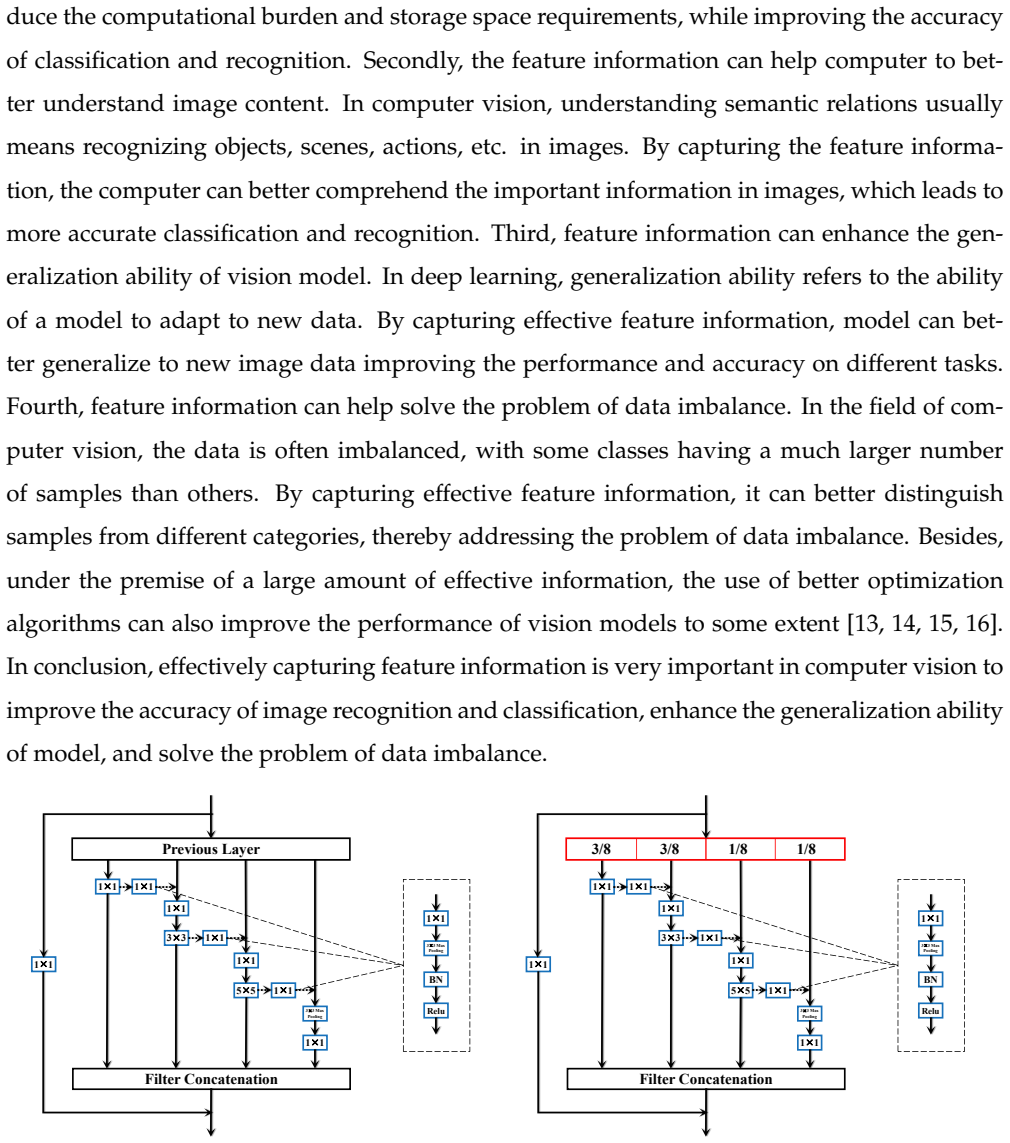
The load-bearing object is the ResFRI block: four parallel convolutional combinations (1x1, 1x1-3x3, 1x1-5x5, and 1x1 plus 3x3 max-pooling paths, drawn from GoogLeNet's inception design), joined by information interaction passages that apply 1x1 convolution, pooling, BatchNorm, and ReLU to the previous branch's output and then add or concatenate it to the next branch's input, with an overall residual connection around the block. In Split-ResFRI, the input feature map is partitioned across branches in channel ratios 3/8, 3/8, 1/8, and 1/8 before processing. These passages are what reutilize features across scales, the residual connection eases optimization, and the channel split is what shrinks parameter count.
What would settle it
Retrain ResFRI-concatenation on CIFAR-10 using the listed hyperparameters (SGD momentum 0.9, weight decay 0.0005, batch size 64, initial learning rate 0.01 halved on validation plateau, and the CIFAR augmentation schedule from [5]) with the full network configuration specified; if its top-1 error exceeds 2.06% on CIFAR-10 or 14.31% on CIFAR-100, or if a similarly sized listed baseline run under the same protocol surpasses 97.94% accuracy on CIFAR-10, the core state-of-the-art claim does not reproduce.
Extended reading notes
Core claim
The central discovery is that letting each of four parallel convolution branches receive not only the block input but also the processed output of the previous branch, through passages made of 1x1 convolution, pooling, BatchNorm, and ReLU, plus a global residual connection, produces richer multi-scale features than the standard inception design, which only concatenates branch outputs. Split-ResFRI divides the input channels into 3/8, 3/8, 1/8, and 1/8 shares before routing them to the four branches, cutting parameters and FLOPs while keeping accuracy close to the unsplit version. The authors report that ResFRI-concatenation reaches 2.06% top-1 error on CIFAR-10 and 14.31% on CIFAR-100, and that pruning the interaction passages at rate 0.7 helps the addition variant while the concatenation variant is best with no pruning.
Load-bearing premise
The accuracy comparisons assume that the baseline numbers from earlier papers were measured the same way and that the paper's unstated network details (depth, channel widths, stem, and per-stage layer arrangement) do not change the reported results.
Editorial extensions
If this is right
- On CIFAR-10 and CIFAR-100, the four ResFRI and Split-ResFRI variants all beat ResNet-101 with far fewer parameters, while the GoogLeNet-sized Split-ResFRI models lead GoogLeNet by more than 2.8 percentage points on CIFAR-10.
- On Tiny ImageNet, ResFRI-concatenation reaches 70.54% accuracy with 13.7M parameters, above the 70.28% of the 77.79M-parameter DCDN model and above FocusNet's 64.49%.
- Ablations attribute part of the gain to each component: replacing max pooling with average pooling, keeping the residual connection, and keeping the inter-branch passages each improve accuracy on CIFAR-10.
- The pruning result is fusion-dependent: the addition variant of ResFRI benefits from dropping 70% of interaction passages, while the concatenation variant is best with no pruning.
- Because the blocks are self-contained inception-style units, the authors argue they can be dropped into existing inception-like networks and used as backbones for other vision tasks such as segmentation and detection.
Reading between the lines
- The cross-branch reutilization pattern is not tied to GoogLeNet's four kernel choices; applying the same passage idea to other multi-branch blocks, such as Res2Net-style hierarchical splits or transformer attention heads, is a direct next test.
- The 3/8, 3/8, 1/8, and 1/8 split ratio comes from GoogLeNet's channel budget; treating the split as a tunable hyperparameter per dataset could push accuracy further or shrink the model more, which the authors name as future work.
- The ablation pattern suggests the passages and residual path carry independent gains, so stacking ResFRI blocks in a deeper or wider configuration may scale the improvement beyond the three datasets tested here.
- Because Split-ResFRI keeps nearly all of ResFRI's accuracy at roughly two-thirds the parameters, the split idea is plausibly useful in deployment settings where memory or FLOPs are the binding constraint.
Editorial analysis
A structured set of objections, weighed in public.
Referee Report
Summary. The paper proposes two CNN building blocks, ResFRI and Split-ResFRI, which combine four parallel convolution paths of different kernel sizes, 1x1 convolution information-interaction passages between adjacent paths, a residual connection, and a pooling layer; the Split variant divides input channels into 3/8, 3/8, 1/8, 1/8 groups to reduce parameters. The authors report top-1 errors of 2.06% on CIFAR-10, 14.09% on CIFAR-100, and 29.46% on Tiny ImageNet and claim state-of-the-art results among models of approximate size trained without extra data. Experiments also include MNIST, Fashion-MNIST, SVHN, and ablations on pruning ratio, pooling, residual connection, and interaction passages.
Significance. If the reported numbers are reproducible and the comparisons are fair, the architecture could be a useful efficient multi-scale CNN backbone, with the split version offering parameter savings at a small accuracy cost. The paper's strengths are the breadth of datasets, the component ablations, and the explicit attention to parameter and FLOP counts. However, the significance is currently limited because the central SOTA claim rests on unreproducible architecture details, test-set-selected hyperparameters, and comparison tables with mis-sourced or omitted baselines; until those are fixed, the contribution is not established.
major comments (4)
- [§2.1, §3.1] The network is not fully specified. Equations (1)–(3) and Figures 2–4 define block-level operations but omit the overall network depth, channel widths per stage, stem, downsampling method, number of blocks per stage, and the exact placement of pooling and pruning operations. The implementation details in Section 3.1 give only the optimizer, batch size, and data augmentation, not the architecture. Without a complete specification or released code, the reported accuracies cannot be reproduced or verified, and it is impossible to tell whether the state-of-the-art claim depends on unstated implementation choices.
- [§3.9, Eq. (4), Table 10] The pruning ratio and pooling type are selected using test-set performance. Section 2.3 and Eq. (4) fix the pruning ratio to 0.7 for the addition version and 0 for the concatenation version based on Table 10, which reports CIFAR-10 test errors; Section 3.5 and Table 5 similarly adopt the better of pruned and unpruned ResFRI-addition on Tiny ImageNet (70.40% versus 68.5%). Since the best of several configurations is chosen with test labels, the quoted accuracies are selection statistics. The margins over the closest baselines are small (0.04% over PyramidNet+ShakeDrop on CIFAR-10 and 0.26% over DCDN on Tiny ImageNet), and no error bars or validation-based selection are reported, so the central SOTA claim is currently not supported.
- [Tables 1, 3, 5] The baseline comparisons are not reliable. Several numbers are cited to secondary sources (WRN-28-10 is cited to [27], the ASAM paper, rather than the original Wide-ResNet paper; Shake-Shake and PyramidNet+ShakeDrop are cited to [28], the SAM paper), and Table 2 lists WRN-28-10 (200 epochs) at 2.6% error but WRN-28-10 + SAM at 2.7%, which is inconsistent with the usual effect of SAM and indicates the numbers come from different training protocols. The tables also omit many modern efficient architectures at comparable FLOP counts, and Table 6 compares against test-time adaptation and ensemble methods (OCD variants) rather than standard training. The 'approximate model size' claim is further strained by DCDN having 77.79M parameters on Tiny ImageNet versus roughly 12–14M for the proposed models.
- [§3.9, Table 10] The ablation study confounds multiple factors. For example, 'ResFRI without AvgPooling layer (addition, pruning ratio 0.7)' is compared against the full addition version with pruning ratio 0.7, while 'ResFRI without AvgPooling layer (concatenation, pruning ratio 0)' is compared against the full concatenation version with pruning ratio 0; pooling and pruning ratio are thus not varied one at a time. Similarly, removing the residual connection in the addition version changes the parameter count from 12.1M to 8.9M, so the comparison mixes architectural change with capacity change. The ablation therefore does not cleanly identify which component drives the gains.
minor comments (7)
- [§2.1] The text mentions 'Split-ResPRI' where 'Split-ResFRI' is intended.
- [Contribution 4, §1] The phrase 'start-of-the-art' should be 'state-of-the-art'.
- [Figure 5] The label 'MNSIT' should be 'MNIST'.
- [§3.8, §4, §3.10] There are typos such as 'FashinMNIST', 'incpetion-like', 'practival', and 'dose not'; these should be corrected before resubmission.
- [Table 6] The table is titled 'Tiny Imagenet Dataset' but lists ViT/DeiT/OCD methods; the comparison is not a standard same-setting head-to-head and should be clearly labeled as such.
- [Eq. (5)] The accuracy formula using TP/TN/FP/FN is written for binary classification; for multiclass datasets it should define overall accuracy or per-class average explicitly.
- [References [27], [28]] The original sources for WRN, Shake-Shake, and PyramidNet+ShakeDrop baseline numbers should be cited in addition to the papers from which the numbers were taken.
Circularity Check
No derivation chain exists to be circular; the architecture proposal is independent, but the reported state-of-the-art accuracies are partly fitted because pruning ratios and variant choices were selected on the same test sets used to claim SOTA.
-
fitted input called prediction
[Section 2.3 (Eq. 4) and Section 3.9/Table 10, feeding the CIFAR-10 accuracies in the abstract and Table 1]
"Finally, we set the drop rate of passages of information transference to 0.7 and 0 on addition and concatenation version of ResFRI respectively ... In the preliminary stage of our experiment, we notice that for the addition version of ResFRI, a proper ratio of pruning may help to promote the accuracy of the model. And in the version of concatenation, no pruning may further enhance performance of the network."
Table 10 evaluates ResFRI addition and concatenation at pruning ratios 0.7, 0.35, and 0 using CIFAR-10 test error. The configurations kept for the main comparison (2.08% error for addition-0.7; 2.06% error for concatenation-0) are exactly the best test-error rows in that grid. The same test set is therefore both the selection criterion and the evidence for the abstract's 97.94% SOTA claim, so the headline number is a test-selected maximum rather than an independent evaluation of a pre-specified configuration.
-
fitted input called prediction
[Section 3.5, Table 5 (Tiny ImageNet comparison and abstract's 70.54%)]
"ResFRI-addition (pruning ratio 0.7) 3.13G 12.4M 31.5 68.5; ResFRI-addition (pruning ratio 0) 3.13G 12.4M 29.60 70.40; ResFRI-concatenation 3.4G 13.7M 29.46 70.54"
On Tiny ImageNet the paper reports two pruning-ratio variants of the same architecture and retains the better one (ratio 0: 70.40%) in its comparison; the headline 70.54% is the best of the table's configurations. Because the variant choice is made after observing test accuracy on the same benchmark, the claimed edge over DCDN (70.28%) is a selected-best statistic, not an unbiased comparison of a fixed architecture.
full rationale
This is an empirical architecture paper: there is no first-principles derivation in which an output is mathematically forced by an input, so the classical circular-derivation patterns (self-definitional equations, imported uniqueness theorems, ansatz-by-self-citation, renaming) do not apply. The self-citations in the applications section are not load-bearing for the architecture or the experimental claim. The only reduction-like step is hyperparameter selection: Eq. (4) fixes the pruning ratio after observing that the ratio affects accuracy, and Table 10 shows that the final CIFAR-10 configurations are the best of the tested grid on the test set; Table 5 does the same for Tiny ImageNet. Consequently the numeric SOTA claims are partly fitted statistics, but the proposed block design and multi-scale feature-reuse concept remain independent content, and no external result is imported solely by self-citation. Score 4 reflects partial circularity in the headline numbers without treating the whole architecture contribution as circular.
Assumptions & free parameters
free parameters (2)
- Pruning ratio for ResFRI-addition =
0.7
- Pooling type =
AvgPool (figures show MaxPool)
assumptions (4)
- domain assumption Standard CNN operations (convolution, batch norm, ReLU, pooling) work as expected
- domain assumption The same data augmentation strategy as ResNet [5] is used
- domain assumption Baseline results in Tables 1, 3, and 5 are accurate and directly comparable
- domain assumption The training hyperparameters (SGD, momentum 0.9, weight decay 0.0005, batch 64, initial LR 0.01) are sufficient for all variants
Cite this review
Pith. "Pith review of Residual Feature-Reutilization Inception Network for Image Classification." pith.science (2026). https://pith.science/paper/6VIUDTCC
@misc{pith2026241219433,
  author       = {Pith},
  title        = {Pith review of: Residual Feature-Reutilization Inception Network for Image Classification},
  year         = {2026},
  howpublished = {\url{https://pith.science/paper/6VIUDTCC}},
  note         = {Machine review of arXiv:2412.19433}
}
abstract
Capturing feature information effectively is of great importance in the field of computer vision. With the development of convolutional neural networks (CNNs), concepts like residual connection and multiple scales promote continual performance gains in diverse deep learning vision tasks. In this paper, we propose a novel CNN architecture that it consists of residual feature-reutilization inceptions (ResFRI) or split-residual feature-reutilization inceptions (Split-ResFRI). And it is composed of four convolutional combinations of different structures connected by specially designed information interaction passages, which are utilized to extract multi-scale feature information and effectively increase the receptive field of the model. Moreover, according to the network structure designed above, Split-ResFRI can adjust the segmentation ratio of the input information, thereby reducing the number of parameters and guaranteeing the model performance. Specifically, in experiments based on popular vision datasets, such as CIFAR10 ($97.94$\%), CIFAR100 ($85.91$\%) and Tiny Imagenet ($70.54$\%), we obtain state-of-the-art results compared with other modern models under the premise that the model size is approximate and no additional data is used.
Figures


Figures from the paper (3 more)


Reference graph
Works this paper leans on
-
[27]
J. Kwon, J. Kim, H. Park, I. K. Choi, ASAM: adaptive sharpness-aware minimization for scale-invariant learning of deep neural networks, in: Proceedings of the 38th International Conference on Machine Learning, ICML 2021, 18-24 July 2021, Virtual Event, Vol. 139, PMLR, 2021, pp. 5905–5914
work page 2021
- [28]
-
[1]
K. Han, Y. Wang, H. Chen, X. Chen, J. Guo, Z. Liu, Y. Tang, A. Xiao, C. Xu, Y. Xu, Z. Yang, Y. Zhang, D. Tao, A survey on vision transformer, IEEE Trans. Pattern Anal. Mach. Intell. 45 (1) (2023) 87–110
work page 2023
-
[2]
A. Lin, B. Chen, J. Xu, Z. Zhang, G. Lu, D. Zhang, Ds-transunet: Dual swin transformer u-net for medical image segmentation, IEEE Trans. Instrum. Meas. 71 (2022) 1–15
work page 2022
-
[3]
X. Yu, J. Wang, Y. Zhao, Y. Gao, Mix-vit: Mixing attentive vision transformer for ultra-fine- grained visual categorization, Pattern Recognit. 135 (2023) 109131. 26
work page 2023
-
[4]
Y. Dong, Q. Liu, B. Du, L. Zhang, Weighted feature fusion of convolutional neural network and graph attention network for hyperspectral image classification, IEEE Trans. Image Process. 31 (2022) 1559–1572
work page 2022
-
[5]
K. He, X. Zhang, S. Ren, J. Sun, Deep residual learning for image recognition, in: 2016 IEEE Conference on Computer Vision and Pattern Recognition, CVPR 2016, Las Vegas, NV , USA, June 27-30, 2016, IEEE Computer Society, 2016, pp. 770–778
work page 2016
-
[6]
V . Dentamaro, P . Giglio, D. Impedovo, L. Moretti, G. Pirlo, AUCO resnet: an end-to-end network for covid-19 pre-screening from cough and breath, Pattern Recognit. 127 (2022) 108656
work page 2022
Show all 53 references
-
[7]
K. Gao, L. Huang, Y. Zheng, Fault detection on seismic structural images using a nested residual u-net, IEEE Trans. Geosci. Remote. Sens. 60 (2022) 1–15
2022
-
[8]
S. Han, H. Shao, C. Junsheng, X. Yang, B. Cai, Convformer-nse: A novel end-to-end gear- box fault diagnosis framework under heavy noise using joint global and local information, IEEE/ASME Transactions on Mechatronics PP (2022) 1–10
2022
-
[9]
L. Qi, J. Kuen, J. Gu, Z. Lin, Y. Wang, Y. Chen, Y. Li, J. Jia, Multi-scale aligned distillation for low-resolution detection, in: IEEE Conference on Computer Vision and Pattern Recog- nition, CVPR 2021, virtual, June 19-25, 2021, Computer Vision Foundation / IEEE, 2021, pp. 1...
2021
-
[10]
Szegedy, S
C. Szegedy, S. Ioffe, V . Vanhoucke, A. A. Alemi, Inception-v4, inception-resnet and the impact of residual connections on learning, in: S. Singh, S. Markovitch (Eds.), Proceed- ings of the Thirty-First AAAI Conference on Artificial Intelligence, February 4-9, 2017, San Franci...
2017
-
[11]
S. Gao, M. Cheng, K. Zhao, X. Zhang, M. Yang, P . H. S. Torr, Res2net: A new multi-scale backbone architecture, IEEE Trans. Pattern Anal. Mach. Intell. 43 (2) (2021) 652–662
2021
-
[12]
T. Lin, P . Doll´ar, R. B. Girshick, K. He, B. Hariharan, S. J. Belongie, Feature pyramid net- works for object detection, in: 2017 IEEE Conference on Computer Vision and Pattern Recognition, CVPR 2017, Honolulu, HI, USA, July 21-26, 2017, IEEE Computer Society, 2017, pp. 936–944. 27
2017
-
[13]
Ghasemi, M
M. Ghasemi, M. Zare, A. Zahedi, M.-A. Akbari, S. Mirjalili, L. Abualigah, Geyser inspired algorithm: A new geological-inspired meta-heuristic for real-parameter and constrained engineering optimization, Journal of Bionic Engineering (2023) 1–35
2023
-
[14]
A. E. Ezugwu, J. O. Agushaka, L. Abualigah, S. Mirjalili, A. H. Gandomi, Prairie dog opti- mization algorithm, Neural Computing and Applications 34 (22) (2022) 20017–20065
2022
-
[15]
J. O. Agushaka, A. E. Ezugwu, L. Abualigah, Gazelle optimization algorithm: a novel nature-inspired metaheuristic optimizer, Neural Computing and Applications 35 (5) (2023) 4099–4131
2023
-
[16]
G. Hu, Y. Zheng, L. Abualigah, A. G. Hussien, Detdo: An adaptive hybrid dandelion opti- mizer for engineering optimization, Advanced Engineering Informatics 57 (2023) 102004
2023
-
[17]
Szegedy, W
C. Szegedy, W. Liu, Y. Jia, P . Sermanet, S. E. Reed, D. Anguelov, D. Erhan, V . Vanhoucke, A. Rabinovich, Going deeper with convolutions, in: IEEE Conference on Computer Vision and Pattern Recognition, CVPR 2015, Boston, MA, USA, June 7-12, 2015, IEEE Computer Society, 2015, pp. 1–9
2015
-
[18]
Huang, S
G. Huang, S. Liu, L. van der Maaten, K. Q. Weinberger, Condensenet: An efficient densenet using learned group convolutions, in: 2018 IEEE Conference on Computer Vision and Pattern Recognition, CVPR 2018, Salt Lake City, UT, USA, June 18-22, 2018, Computer Vision Foundation / I...
2018
-
[19]
Huang, Z
G. Huang, Z. Liu, G. Pleiss, L. van der Maaten, K. Q. Weinberger, Convolutional networks with dense connectivity, IEEE Trans. Pattern Anal. Mach. Intell. 44 (12) (2022) 8704–8716
2022
-
[20]
Kowsari, M
K. Kowsari, M. Heidarysafa, D. E. Brown, K. J. Meimandi, L. E. Barnes, RMDL: random multimodel deep learning for classification, in: Proceedings of the 2nd International Con- ference on Information System and Data Mining, ICISDM 2018, Lakeland, FL, USA, April 09-11, 2018, ACM,...
2018
-
[21]
Y. S. Assiri, Stochastic optimization of plain convolutional neural networks with simple methods, in: Machine Learning and Data Mining in Pattern Recognition, 15th Interna- tional Conference on Machine Learning and Data Mining, MLDM 2019, New York, NY, USA, July 20-25, 2019, P...
2019
-
[22]
Zhang, Z
X. Zhang, Z. Sheng, H. Shen, Focusnet: Classifying better by focusing on confusing classes, Pattern Recognit. 129 (2022) 108709
2022
-
[23]
Santiago, C
C. Santiago, C. Barata, M. Sasdelli, G. Carneiro, J. C. Nascimento, LOW: training deep neural networks by learning optimal sample weights, Pattern Recognit. 110 (2021) 107585
2021
-
[24]
C. Yang, Z. An, H. Zhu, X. Hu, K. Zhang, K. Xu, C. Li, Y. Xu, Gated convolutional networks with hybrid connectivity for image classification, in: The Thirty-Fourth AAAI Conference on Artificial Intelligence, AAAI 2020, The Thirty-Second Innovative Applications of Ar- tificial ...
2020
-
[25]
Patel, G
K. Patel, G. Wang, A discriminative channel diversification network for image classifica- tion, Pattern Recognit. Lett. 153 (2022) 176–182
2022
-
[26]
Y. Hu, N. Belkhir, J. Angulo, A. Yao, G. Franchi, Learning deep morphological networks with neural architecture search, Pattern Recognit. 131 (2022) 108893
2022
-
[29]
Lutati, L
S. Lutati, L. Wolf, OCD: learning to overfit with conditional diffusion models, in: A. Krause, E. Brunskill, K. Cho, B. Engelhardt, S. Sabato, J. Scarlett (Eds.), International Conference on Machine Learning, ICML 2023, 23-29 July 2023, Honolulu, Hawaii, USA, Vol. 202 of Proce...
2023
-
[30]
Oquab, T
M. Oquab, T. Darcet, T. Moutakanni, H. Vo, M. Szafraniec, V . Khalidov, P . Fernandez, D. Haziza, F. Massa, A. El-Nouby, M. Assran, N. Ballas, W. Galuba, R. Howes, P . Huang, 29 S. Li, I. Misra, M. G. Rabbat, V . Sharma, G. Synnaeve, H. Xu, H. J´egou, J. Mairal, P . Labatut, A...
- [31]
-
[32]
X. Pan, J. Xu, Y. Pan, L. Wen, W. Lin, K. Bai, H. Fu, Z. Xu, Afinet: Attentive feature integra- tion networks for image classification, Neural Networks 155 (2022) 360–368
2022
-
[33]
D. Han, J. Kim, J. Kim, Deep pyramidal residual networks, in: 2017 IEEE Conference on Computer Vision and Pattern Recognition, CVPR 2017, Honolulu, HI, USA, July 21-26, 2017, IEEE Computer Society, 2017, pp. 6307–6315
2017
-
[34]
D. Zhao, Y. Li, Y. Zeng, J. Wang, Q. Zhang, Spiking capsnet: A spiking neural network with a biologically plausible routing rule between capsules, Inf. Sci. 610 (2022) 1–13
2022
-
[35]
K. He, X. Zhang, S. Ren, J. Sun, Identity mappings in deep residual networks, in: Computer Vision - ECCV 2016 - 14th European Conference, Amsterdam, The Netherlands, October 11-14, 2016, Proceedings, Part IV, Vol. 9908, Springer, 2016, pp. 630–645
2016
-
[36]
Nøkland, L
A. Nøkland, L. H. Eidnes, Training neural networks with local error signals, in: Proceed- ings of the 36th International Conference on Machine Learning, ICML 2019, 9-15 June 2019, Long Beach, California, USA, Vol. 97, PMLR, 2019, pp. 4839–4850
2019
-
[37]
Huang, Y
G. Huang, Y. Sun, Z. Liu, D. Sedra, K. Q. Weinberger, Deep networks with stochastic depth, in: Computer Vision - ECCV 2016 - 14th European Conference, Amsterdam, The Nether- lands, October 11-14, 2016, Proceedings, Part IV, Vol. 9908, Springer, 2016, pp. 646–661
2016
-
[38]
Y. He, L. Li, T. Zhan, A matrix-based distance of pythagorean fuzzy set and its application in medical diagnosis (2024). arXiv:2102.01538. URL https://arxiv.org/abs/2102.01538 30
2024 arXiv
-
[39]
Y. He, F. Xiao, Conflicting management of evidence combination from the point of im- provement of basic probability assignment, International Journal of Intelligent Systems 36 (5) (2021) 1914–1942
2021
-
[40]
M. Li, H. Sun, Y. Lei, X. Zhang, Y. Dong, Y. Zhou, Z. Li, X. Chen, High-fidelity document stain removal via a large-scale real-world dataset and a memory-augmented transformer, in: WACV , 2024
2024
-
[41]
Y. He, Y. Deng, Tdqmf: Two-dimensional quantum mass function, Information Sciences 621 (2023) 749–765
2023
-
[42]
Y. He, L. Li, T. Zhan, W. Jiao, C.-M. Pun, Generalized uncertainty-based evidential fu- sion with hybrid multi-head attention for weak-supervised temporal action localization, in: ICASSP 2024-2024 IEEE International Conference on Acoustics, Speech and Signal Pro- cessing (ICAS...
2024
-
[43]
L. Li, Y. He, L. Li, Nndf: A new neural detection network for aspect-category sentiment analysis, in: International Conference on Knowledge Science, Engineering and Manage- ment, Springer, 2022, pp. 339–355
2022
-
[44]
Jiang, X
Y. Jiang, X. Chen, C.-M. Pun, S. Wang, W. Feng, Mfdnet: Multi-frequency deflare network for efficient nighttime flare removal, The Visual Computer 40 (11) (2024) 7575–7588
2024
-
[45]
Y. He, Y. Deng, Mmget: a markov model for generalized evidence theory, Computational and Applied Mathematics 41 (2022) 1–41
2022
-
[46]
Y. He, Y. Deng, Ordinal fuzzy entropy, Iranian Journal of Fuzzy Systems 19 (3) (2022) 171– 186
2022
-
[47]
Z. Li, X. Chen, C.-M. Pun, X. Cun, High-resolution document shadow removal via a large- scale real-world dataset and a frequency-aware shadow erasing net, in: ICCV , 2023, pp. 12449–12458
2023
-
[48]
Y. He, F. Xiao, A new base function in basic probability assignment for conflict manage- ment, Applied Intelligence 52 (4) (2022) 4473–4487
2022
-
[49]
Y. He, Y. Deng, Ordinal belief entropy, Soft Computing 27 (11) (2023) 6973–6981. 31
2023
-
[50]
M. Zare, M. Ghasemi, A. Zahedi, K. Golalipour, S. K. Mohammadi, S. Mirjalili, L. Abuali- gah, A global best-guided firefly algorithm for engineering problems, Journal of Bionic Engineering (2023) 1–30
2023
-
[51]
Abualigah, S
L. Abualigah, S. Ekinci, D. Izci, R. Abu Zitar, Modified elite opposition-based artificial hummingbird algorithm for designing fopid controlled cruise control system, Intelligent Automation & Soft Computing (2023)
2023
-
[52]
T. Xu, K. Yan, Y. He, S. Gao, K. Yang, J. Wang, J. Liu, Z. Liu, Spatio-temporal variability analysis of vegetation dynamics in china from 2000 to 2022 based on leaf area index: A multi-temporal image classification perspective, Remote Sensing 15 (12) (2023) 2975
2023
-
[53]
J. O. Agushaka, A. E. Ezugwu, L. Abualigah, Dwarf mongoose optimization algorithm, Computer methods in applied mechanics and engineering 391 (2022) 114570. 32
2022
Reviewed August 11, 2026 · model on record in the stance chip above.
Discussion (0). Continue with ORCID to comment.