REVIEW 3 major objections 4 minor 1 cited by
Towards Simple and Provable Parameter-Free Adaptive Gradient Methods
T0 review · 3 major / 4 minor · reviewed 2026-08-11 · deepseek-v4-flash
Pith's one-line read The paper claims that replacing the tuned learning rate with the running maximum of distance traveled from the start, scaled by $1/\sqrt{d}$, lets AdaGrad and Adam keep their $O(1/\sqrt{T})$ convex convergence rates with nothing to tune.
desk verdict A simple, plausible parameter-free Adam variant with the first convergence proof of its kind, but the advertised worst-case O(1/sqrt(T)) rate rests on an unproven bounded-trajectory condition and an incorrect inequality in the proof. read the letter →
The pith
A machine-rendered reading of the paper's core claim, the machinery that carries it, and where it could break.
The reading
What carries the argument
The load-bearing object is the self-generated step size $\eta_t = \max(\eta_{t-1}, \|x_t - x_0\|_2/\sqrt{d})$: the learning rate at time $t$ is simply the furthest the iterates have yet wandered from start, scaled by $1/\sqrt{d}$, and it never shrinks. The displacement term adapts the rate to the actual scale of each problem, and the running maximum keeps $\eta_t$ non-decreasing, which is exactly what the Bregman-potential proof needs to telescope the errors into one sum. The rate is then controlled by the cumulative gradient norm $\|s_\tau\|_2 = \sqrt{\sum_{t\le\tau}\|g_t\|_2^2}$, which is $O(\sqrt{T})$ in the worst case but often much smaller when gradients shrink as the model converges. The analysis imports two tools from the DoG framework — a bound on non-decreasing sums and a martingale concentration inequality — to turn the pointwise gradient assumption into a high-probability convergence statement.
What would settle it
Run AdaGrad++ on a convex problem with bounded gradient norms, such as $\ell^1$ regression whose optimum is far from the start, without any projection, and record $D_\tau = \max_{t\le\tau}\|x_t - x_*\|$ along the trajectory; if $D_\tau$ grows with $T$ on such an instance, the uniform $O(1/\sqrt{T})$ reading of Corollary 4.3 fails, because the bound carries an explicit $D_\tau^2/T$ factor.
Extended reading notes
Core claim
The central claim is that the adaptive schedule $\eta_t = \max(\eta_{t-1}, \|x_t - x_0\|_2/\sqrt{d})$ — the running maximum of the normalized distance from initialization — is a drop-in replacement for the tuned learning rate in both AdaGrad and Adam, with the same worst-case guarantees. Under convexity and Assumption 4.1, Theorems 4.2 and 5.1 bound the optimality gap at the weighted average iterate $\bar{x}_\tau$ by $O\big((D_\tau^2\sqrt{d}\,\|s_\tau\|_2 + D_\tau \eta_0 \sqrt{\theta_{\tau,\delta}\|s_\tau\|_2^2 + L^2\theta_{\tau,\delta}^2})/(T\eta_0) \cdot \log(\eta_T/\eta_0)\big)$, where $D_\tau$ is the trajectory's largest distance from the reference point and $\|s_\tau\|_2$ the cumulative gradient norm. With bounded gradients this reads as $O(1/\sqrt{T})$ up to logarithms, matching AdaGrad, and if $\|s_\tau\|_2$ grows like $T^{1/2-\alpha}$ the rate improves to $O(1/T^{1/2+\alpha})$. The paper states that Theorem 5.1 is the first convergence guarantee for a parameter-free Adam and notes that it needs a decaying momentum parameter $\lambda < 1$, or an AMSGrad-style running maximum in Case 2, whereas the experiments run the $\lambda = 1$ configuration.
Load-bearing premise
The rates are $O(1/\sqrt{T})$ only if the iterates stay within a bounded distance $D_\tau$ of the optimum, and the paper never proves that distance stays bounded for its unconstrained, non-projected updates, so a trajectory that drifts with $T$ would make the displayed bounds degrade or become vacuous.
Editorial extensions
If this is right
- Learning-rate tuning disappears for AdaGrad and Adam: the displacement schedule yields the same worst-case $O(1/\sqrt{T})$ convex rate up to logarithmic factors, so the main remaining hyperparameters are the optimizer's internal ones such as $\beta_1$ and $\beta_2$.
- When the cumulative gradient norm stays small, $\|s_\tau\|_2 \le G\,T^{1/2-\alpha}$, both corollaries give $O(1/T^{1/2+\alpha})$, a faster rate the paper ties to the common observation that gradient norms decay during training.
- Theorem 5.1 is presented as the first convergence guarantee for a parameter-free variant of Adam, under the stated conditions on the momentum schedule or the second-moment running maximum.
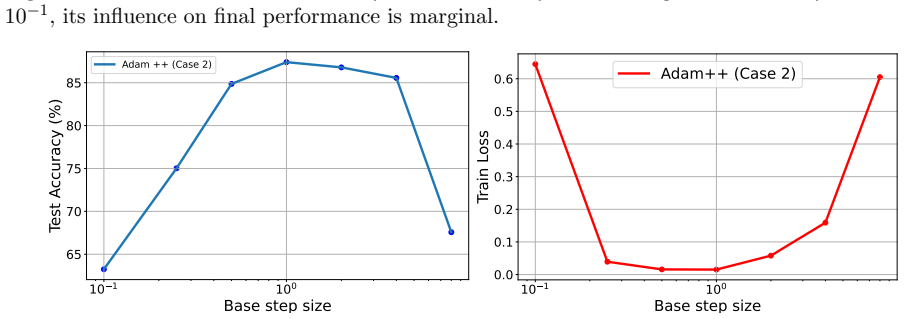
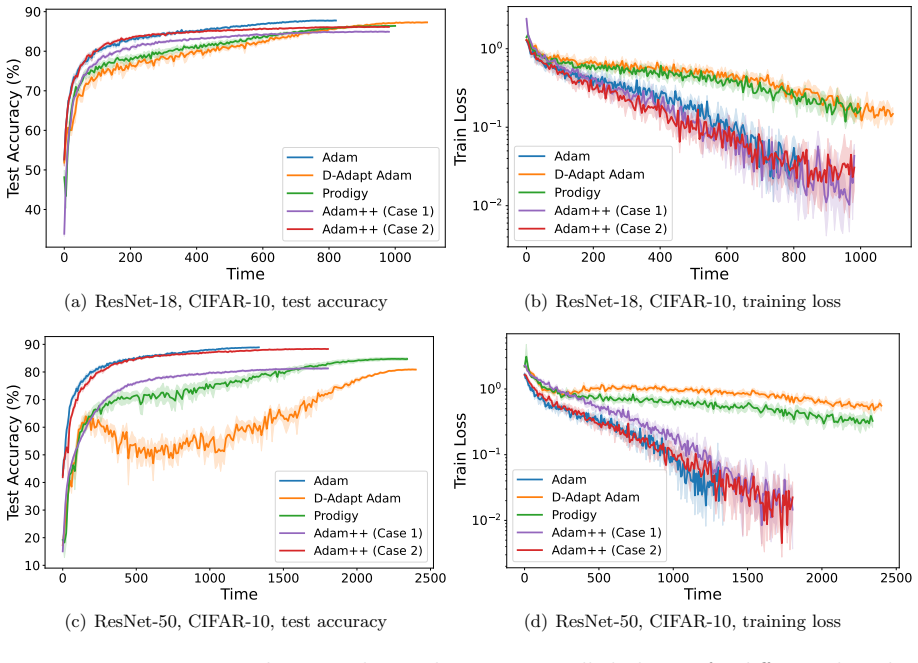
- In the reported runs, the better Adam++ variant matches or tops tuned Adam on most CIFAR-10 architectures and beats AdamW on GPT-2 small and medium by 0.02 in both train and test loss, with the base step size fixed at 1.
- Storing only $x_0$ in addition to the standard Adam or AdaGrad state makes these methods more memory-efficient than earlier parameter-free adaptive methods, which keep several parameter-sized quantities.
Reading between the lines
- The theoretical conditions and the tested configuration differ in exactly the spots the proof needs (momentum decay $\lambda<1$ or the AMSGrad max in theory, constant $\lambda=1$ in practice), which suggests the proof's technical conditions are not the operative mechanism in experiments; closing the gap by proving the rate for $\lambda=1$ would make theory and practice coincide.
- The bounds are trajectory-readable: a practitioner can record $D_\tau$ and $\|s_\tau\|_2$ on a convex problem and see which term actually controls the optimality gap, a cheap check of whether the $1/\sqrt{T}$ interpretation is the operating regime or an artifact of assuming $D_\tau$ constant.
- Because $\eta_t$ depends only on positions while the preconditioner absorbs the gradient scale, the algorithm is roughly invariant to rescaling the objective once the stabilizer $\delta$ is negligible, a property the paper does not state but which would explain why one base factor of 1.0 works across tasks with very different loss scales.
- The experiments train nonconvex networks while the theorems are convex-only, so whether the displacement schedule's benefits persist for geometric rather than convexity reasons is untested; running Adam++ on a small convex benchmark would check the predicted rate directly.
Editorial analysis
A structured set of objections, weighed in public.
Referee Report
Summary. The paper proposes AdaGrad++ and Adam++, two parameter-free variants of AdaGrad and Adam in which the step size is set adaptively to the maximum distance of the iterates from initialization, normalized by sqrt(d). The main theoretical results (Theorems 4.2 and 5.1) give high-probability bounds on the function value at a weighted average iterate in terms of D_tau = max_{t<=tau} ||x_t - x*|| and the cumulative gradient norm ||s_tau||_2, under convexity and a trajectory-wise stochastic gradient norm bound. Corollaries 4.3 and 5.2 simplify these to eO(D_tau^2 G sqrt(d/T)), which the paper interprets as an O(1/sqrt(T)) rate matching AdaGrad and Adam. The paper also presents experiments on CIFAR-10 and GPT-2 comparing Adam++ with Adam, D-Adaptation, and Prodigy.
Significance. If the claimed worst-case rates held, this would be a significant contribution: the proposed update rules are strikingly simple, and the paper would provide the first convergence guarantee for a parameter-free Adam-style method, a gap in the literature. The proof structure follows the DoG template and uses a martingale concentration inequality, yielding high-probability statements rather than expectation bounds. The experiments are extensive, covering multiple architectures, datasets, and LLM pretraining, and include ablations on the initial and base learning rates. However, the advertised worst-case rate is not established, because D_tau is not bounded a priori; the results are data-dependent bounds of the DoG type, not a uniform O(1/sqrt(T)) rate. This limits the significance relative to the abstract's claim.
major comments (3)
- [§4.2, Corollaries 4.3/5.2, Eq. (A.6)] The central claim of an O(1/sqrt(T)) worst-case rate is not supported by the theorems as stated. The bounds in Theorems 4.2 and 5.1 depend on D_tau = max_{t<=tau} ||x_t - x*||, yet the algorithms run unconstrained on R^d with no projection, and the paper provides no argument that this quantity remains bounded along the trajectory. Consequently, the corollaries' simplification to eO(D_tau^2 G sqrt(d/T)) only yields O(1/sqrt(T)) under an additional, unproven boundedness assumption. Eq. (A.6) compounds this by claiming eta_t <= D_t via a triangle inequality that is false as written: ||x_k - x_0||_2 <= ||x_k - x*||_2 + ||x_0 - x*||_2 <= 2 D_t, so at best eta_t <= 2 D_t / sqrt(d) + epsilon. While this constant factor is absorbable, the lack of control on D_t is not, and it affects the interpretation of both corollaries.
- [§5.1 and Section 6] The provable version of Adam++ requires lambda in (0,1) (Theorem 5.1), but all experiments in Section 6 use lambda = 1 and, in the LLM experiments, AdamW++ rather than Adam++. As Section 7 acknowledges, AdamW++ is used without proof. Thus the experimental validation does not exercise the algorithm for which convergence guarantees are proven, weakening the paper's claim that the proposed algorithms are both simple and provably convergent in practice.
- [Appendix B, final bound for Case 2] The proof of Theorem 5.1 for Case 2 ends with a term sum_{k=0}^{tau-1} ||g_k||_2 / sqrt(k+1), but the theorem statement contains no such sum, only ||s_tau||_2. The displayed proof does not show the step (e.g., Cauchy-Schwarz) that would turn this sum into O(sqrt(log tau) ||s_tau||_2) or similar; this is a missing derivation in a load-bearing step for the stated bound.
minor comments (4)
- [Theorem 4.2 and Theorem 5.1] The notation D_tau is used for both max ||x_t - x*||_infinity and max ||x_t - x*||_2 in the theorem statements and proofs (e.g., Theorem 4.2 statement and Appendix A vs. Appendix B), making the mathematical claims ambiguous.
- [Theorem 5.1] The definition of x_tau is mistyped: it reads 'x_tau = (sum_{t=0}^{T-1} eta_t x_tau) / (sum_{t=0}^{T-1} eta_t)' in the theorem statement; it should be x_tau = (sum_{t=0}^{tau-1} eta_t x_t) / (sum_{t=0}^{tau-1} eta_t) as in Theorem 4.2.
- [Section 3, preview of Adam++] The formula for the adaptive step size in the preview, eta_t = max_{i<=t} ||x_i - x_0||_2 / sqrt(d(t+1)), is inconsistent with Algorithm 2, where eta_t = max(eta_{t-1}, ||x_t - x_0||_2 / sqrt(d)) without the (t+1) factor; the (t+1) appears only in the definition of s_t in Case 2.
- [Throughout Appendix B] There are several typos and incomplete definitions, such as 'the inqeuality holds' in the proof of the main bound, and the switch from D_t being the infinity norm at the start of Appendix B to the 2-norm in the noise term; these should be cleaned up.
Circularity Check
No significant circularity: the convergence proofs are self-contained given the external DoG lemmas, and the only author-overlapping citation is non-load-bearing; the D_tau dependence is a correctness risk, not an input-output identity.
full rationale
The derivation chain is self-contained conditional on stated trajectory-dependent quantities. The algorithms define eta_t = max_{i <= t} ||x_i - x_0||_2 / sqrt(d) (Algorithm 1, line 4; Algorithm 2, line 4), so the step size is a nondecreasing function of the running displacement from x0; this is the DoG mechanism, not a hidden identity with the conclusion. Theorems 4.2 and 5.1 are proved from standard convex-analysis inequalities and the DoG lemmas C.1-C.2 imported from Ivgi et al. (2023), an external source, with no fitted parameter being relabeled as a prediction. The author-overlapping citation Zhou et al. (2018) appears in Section 4.2 only to remark that ||s_tau||_2 is often smaller than worst case in practice and to point at a similar quantity; it is not used to establish either theorem. The paper also states its own scope limits in Section 7 ('current convergence analyses ... limited to the convex setting', 'AdamW++ ... used in our experiments without proof') and in Section 5.1 notes that the provable theory requires lambda < 1 while lambda = 1 is used empirically; these are correctness and scope caveats, not circularity. The concern that the O(1/sqrt(T)) corollaries treat D_tau = max_{t <= tau} ||x_t - x*|| as constant without proving it bounded, and the apparent triangle-inequality slip in Eq. (A.6), are correctness risks external to the circularity question: the theorems' conclusions are not equal to their assumptions by construction.
Assumptions & free parameters
free parameters (4)
- initial step size eta_0 =
CIFAR: 1e-6(1+||x0||^2); LLM: 6e-4(1+||x0||^2) / 3e-4(1+||x0||^2)
- delta (regularizer in H_t) =
not specified; conventional small constant such as 1e-8
- beta_1, beta_2, lambda =
CIFAR: (0.9, 0.999); GPT-2: (0.9, 0.95); lambda not reported, likely 1
- base learning rate factor c =
1.0
assumptions (5)
- domain assumption Assumption 4.1: there exists a continuous l(x) with ||G(x)|| <= l(x) almost surely
- domain assumption f is convex and G is an unbiased subgradient oracle with E[G(x)|x] in df(x)
- domain assumption For Adam++ Theorem 5.1: 0 < beta_1 < sqrt(beta_2) and 0 < lambda < 1
- domain assumption Corollaries assume l(x) <= G, bounded gradients
- standard math Lemmas C.1 and C.2 from Ivgi et al. 2023 are valid martingale and step-size inequalities
Cite this review
Pith. "Pith review of Towards Simple and Provable Parameter-Free Adaptive Gradient Methods." pith.science (2026). https://pith.science/paper/JHK4HZLH
@misc{pith2026241219444,
  author       = {Pith},
  title        = {Pith review of: Towards Simple and Provable Parameter-Free Adaptive Gradient Methods},
  year         = {2026},
  howpublished = {\url{https://pith.science/paper/JHK4HZLH}},
  note         = {Machine review of arXiv:2412.19444}
}
read the original abstract
Optimization algorithms such as AdaGrad and Adam have significantly advanced the training of deep models by dynamically adjusting the learning rate during the optimization process. However, ad-hoc tuning of learning rates poses a challenge and leads to inefficiencies in practice. To address this issue, recent research has focused on developing ``parameter-free'' algorithms that operate effectively without the need for learning rate tuning. Despite these efforts, existing parameter-free variants of AdaGrad and Adam tend to be overly complex and/or lack formal convergence guarantees. In this paper, we present AdaGrad++ and Adam++, novel and simple parameter-free variants of AdaGrad and Adam with convergence guarantees. We prove that AdaGrad++ achieves comparable convergence rates to AdaGrad in convex optimization without predefined learning rate assumptions. Similarly, Adam++ matches the convergence rate of Adam without relying on any conditions on the learning rates. Experimental results across various deep learning tasks validate the competitive performance of Adam++.
Figures


Figures from the paper (13 more)






Forward citations
Cited by 1 Pith paper
-
LightSAM: Parameter-Agnostic Sharpness-Aware Minimization
An adaptive SAM variant using AdaGrad and Adam steps for both perturbation and update is claimed to converge at O(ln T / T^{1/4}) without tuning, but the Adam version still needs decaying hyperparameters and the proof...
Reference graph
Works this paper leans on
-
[1]
Alacaoglu, A., Malitsky, Y., Mertikopoulos, P. and Cevher, V. (2020). A new regret analysis for adam-type algorithms. In International conference on machine learning . PMLR. Bernstein, J., V ahdat, A., Yue, Y.and Liu, M.-Y.(2020). On the distance between two neural 24 0 25 50 75 100 125 150 175 200 Epoch 0 20 40 60 80T est Accuracy (%) Adam D-Adapt Adam P...
work page 2020
-
[2]
Each curve represents the mean of 8 random runs, with the shaded area indicating the standard error
(f) SVHN, training loss Figure 9: The results of training Wide ResNet-50-2 on CIF AR-10, CIF AR-100, and SVHN with a consine learning rate schedule. Each curve represents the mean of 8 random runs, with the shaded area indicating the standard error. Adam++ achieves performance superior or comparable to Adam. networks and the stability of learning. Advance...
work page 2020
-
[3]
Each curve represents the mean of 8 random runs, with the shaded area indicating the standard error
(f) SVHN, training loss Figure 10: The results of training DenseNet-121 on CIF AR-10, CIF AR-100, and SVHN with a consine learning rate schedule. Each curve represents the mean of 8 random runs, with the shaded area indicating the standard error. Adam++ achieves performance superior or comparable to Adam. Bubeck, S. et al.(2015). Convex optimization: Algo...
work page 2015
-
[4]
Chen, J., Zhou, D., Tang, Y., Yang, Z., Cao, Y
AdaGrad AdaGrad++ (f) SVHN, training loss Figure 11: The performance comparison of various optimizers—Adam, D-Adapt Adam, Prodigy, Adam++ (Case 1), Adam++ (Case 2), AdaGrad, and AdaGrad++—conducted for training a Vision Transformer on CIF AR-10, CIF AR-100, and SVHN datasets using a cosine learning rate schedule. Chen, J., Zhou, D., Tang, Y., Yang, Z., Ca...
arXiv 2018
-
[5]
gap of adaptive gradient methods in training deep neural networks
AdaGrad AdaGrad++ (f) SVHN, training loss Figure 12: The performance comparison of various optimizers—Adam, D-Adapt Adam, Prodigy, Adam++ (Case 1), Adam++ (Case 2), AdaGrad, and AdaGrad++—conducted for training a Wide ResNet-50-2 on CIF AR-10, CIF AR-100, and SVHN datasets using a cosine learning rate schedule. gap of adaptive gradient methods in training...
work page 2022
-
[6]
Zagoruyko, S.(2016). Wide residual networks. arXiv preprint arXiv:1605.07146 . Zaheer, M., Reddi, S., Sachan, D., Kale, S. and Kumar, S. (2018). Adaptive methods for nonconvex optimization. Advances in neural information processing systems
arXiv 2016
-
[7]
(b) ResNet-18, CIF AR-10, training loss 0 500 1000 1500 2000 2500 Time 10 20 30 40 50 60 70 80 90T est Accuracy (%) Adam D-Adapt Adam Prodigy Adam++ (Case
work page 2000
-
[8]
(c) ResNet-50, CIF AR-10, test accuracy 0 500 1000 1500 2000 2500 Time 10 2 10 1 100 Train Loss Adam D-Adapt Adam Prodigy Adam++ (Case
work page 2000
Show all 21 references
-
[9]
conference on machine learning
(d) ResNet-50, CIF AR-10, training loss Figure 14: Test accuracy and training loss with respect to wall-clock time for different algorithms in training ResNet-18 and ResNet-50 on CIF AR-10 dataset. conference on machine learning . PMLR. Cutkosky, A. and Orabona, F. (2019). Mom...
2019
-
[12]
Openwebtext corpus
Gokaslan, A.and Cohen, V.(2019). Openwebtext corpus. Gower, R. M., Defazio, A.and Rabbat, M.(2021). Stochastic polyak stepsize with a moving target. arXiv preprint arXiv:2106.11851 . 30 0 25 50 75 100 125 150 175 200 Epoch 10 20 30 40 50 60 70 80T est Accuracy (%) Adam D-Adapt...
2019 arXiv
-
[13]
Each curve represents the mean of 8 random runs, with the shaded area indicating the standard error
(f) VGG16, training loss Figure 15: Enlarged version of Figure 1 on the results of training ResNet-18, ResNet-50, and VGG16 on CIF AR-10 with a constant learning rate schedule. Each curve represents the mean of 8 random runs, with the shaded area indicating the standard error....
2018
-
[14]
Each curve represents the mean of 8 random runs, with the shaded area indicating the standard error
(f) VGG16, training loss Figure 16: Enlarged version of Figure 2 on the results of training ResNet-18, ResNet-50, and VGG16 on CIF AR-10 with a cosine learning rate schedule. Each curve represents the mean of 8 random runs, with the shaded area indicating the standard error. H...
2016 arXiv
-
[19]
and Yang, T
Guo, Z., Xu, Y., Yin, W., Jin, R. and Yang, T. (2021). A novel convergence analysis for algorithms of the adam family and beyond. arXiv preprint arXiv:2104.14840 . 31 0 25 50 75 100 125 150 175 200 Epoch 40 50 60 70 80 90T est Accuracy (%) Adam D-Adapt Adam Prodigy Adam++ (Case
2021 arXiv
-
[20]
Adagrad stepsizes: Sharp convergence over nonconvex landscapes
W ard, R., Wu, X.and Bottou, L.(2020). Adagrad stepsizes: Sharp convergence over nonconvex landscapes. Journal of Machine Learning Research 21 1–30. You, Y., Gitman, I.and Ginsburg, B.(2017a). Large batch training of convolutional networks. arXiv preprint arXiv:1708.03888 . Yo...
2020 arXiv
-
[21]
Zhou, D., Chen, J., Cao, Y., Tang, Y., Yang, Z.and Gu, Q. (2018). On the convergence of adaptive gradient methods for nonconvex optimization. arXiv preprint arXiv:1808.05671 . 34
2018 arXiv
-
[27]
and Tommasi, T
33 Orabona, F. and Tommasi, T. (2017). Training deep networks without learning rates through coin betting. Advances in Neural Information Processing Systems
2017
-
[30]
and Loizou, N
Orvieto, A., Lacoste-Julien, S. and Loizou, N. (2022). Dynamics of sgd with stochastic polyak stepsizes: Truly adaptive variants and convergence to exact solution. Advances in Neural Information Processing Systems 35 26943–26954. Paquette, C. and Scheinberg, K. (2018). A stoch...
2022 arXiv
-
[31]
Very deep convolutional networks for large-scale image recognition
Simonyan, K.and Zisserman, A.(2014). Very deep convolutional networks for large-scale image recognition. arXiv preprint arXiv:1409.1556 . Streeter, M.and McMahan, H. B.(2010). Less regret via online conditioning. arXiv preprint arXiv:1002.4862 . V aswani, S., Mishkin, A., Lara...
2014 arXiv
-
[32]
et al.(2024)
Defazio, A., Mehta, H., Mishchenko, K., Khaled, A., Cutkosky, A. et al.(2024). The road less scheduled. arXiv preprint arXiv:2405.15682 . Defazio, A.and Mishchenko, K.(2023). Learning-rate-free learning by d-adaptation. In Inter- national Conference on Machine Learning . PMLR....
2024 arXiv
-
[36]
and Yang, T
Chen, Z., Xu, Y., Chen, E. and Yang, T. (2018b). Sadagrad: Strongly adaptive stochastic gradient methods. In International Conference on Machine Learning . PMLR. Cutkosky, A. and Mehta, H. (2020). Momentum improves normalized sgd. In International 29 0 200 400 600 800 1000 Tim...
2018
-
[2011]
Orabona, F
Granada. Orabona, F. (2014). Simultaneous model selection and optimization through parameter-free stochastic learning. Advances in Neural Information Processing Systems
2014
Reviewed August 11, 2026 · model on record in the stance chip above.
Discussion (0). Continue with ORCID to comment.