REVIEW 4 major objections 5 minor 12 references
Machine Generated Product Advertisements: Benchmarking LLMs Against Human Performance
T0 review · 4 major / 5 minor · reviewed 2026-08-11 · deepseek-v4-flash
Pith's one-line read Comparing four AI models and human writers on 100 real Amazon product listings, this paper claims ChatGPT-4 comes closest to human-quality copy while smaller models generate incoherent, off-topic descriptions.
desk verdict A small, honest benchmark undermined by unsupported headline claims and no statistical backing; the paper's own metrics don't single out ChatGPT-4 as best. read the letter →
The pith
A machine-rendered reading of the paper's core claim, the machinery that carries it, and where it could break.
The reading
What carries the argument
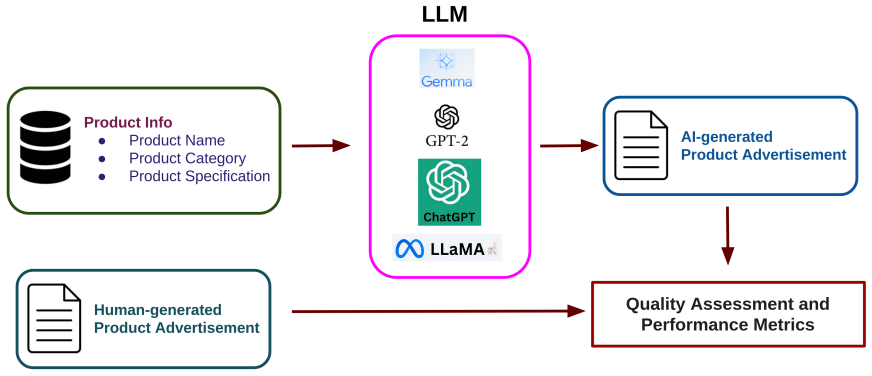
The load-bearing tool is a seven-metric scoring scheme applied to descriptions of the same 100 products: sentiment from a DistilBERT classifier, readability from the Flesch-Kincaid grade level, persuasiveness as the share of predefined persuasive words, SEO as the presence of category-related keywords, clarity as the inverse of average word length, emotional appeal as the count of emotion words, and call-to-action as the count of predefined CTA phrases. The study also varies one generation condition—whether a sample description is included in the prompt—to see if examples improve output. These metrics convert 'good advertisement copy' into a table of numbers, and the paper's ranking of models is read directly off that table.
What would settle it
A user study in which shoppers rate the same 100 descriptions for persuasiveness, trust, and purchase intent: if human ratings do not rank ChatGPT-4 and human copy above the smaller models the way the metric table does, the paper's central comparison is not measuring what it claims.
Extended reading notes
Core claim
The paper's discovery, on its own terms, is a performance ranking: human-written descriptions and the ChatGPT-4 (manual) condition significantly outperform GPT-2, Gemma 2B, and LLAMA 3.1 8B on persuasiveness, SEO optimization, and call-to-action effectiveness, and they land in or near the ideal ranges for those metrics. Human text scores highest on emotional appeal and sits inside the ideal readability band, while the smaller models drift outside it and, in the examples shown, generate content that loses focus on the product being sold. The paper reads this as evidence that advanced models are approaching human-level ability in several key copywriting dimensions, but that human expertise still matters for accessible, emotionally resonant, action-oriented descriptions.
Load-bearing premise
The ranking stands or falls on the assumption that the automated proxies—persuasive-word ratios, keyword counts, CTA phrase counts, and average word length—actually measure persuasiveness, SEO value, and clarity in real marketing copy.
Editorial extensions
If this is right
- If the paper is right, e-commerce teams can deploy ChatGPT-4 with a carefully written prompt to produce persuasive, SEO-oriented draft copy at scale, cutting production cost and time for large product catalogs.
- Smaller open-weight models such as Gemma 2B, GPT-2, and LLAMA 3.1 8B would need substantial human editing or fine-tuning before publication, because their measured copy is often incoherent or off-topic.
- Human writers retain a measurable edge in emotional appeal and in readability for a general audience, so fully automated copy risks losing the warmth and accessibility that help convert readers.
- Adding a sample description shifts some metrics—call-to-action scores for Gemma and LLAMA rise—but does not close the gap to human or ChatGPT-4 performance on the dimensions where they lead.
Reading between the lines
- Because persuasiveness, emotional appeal, and call-to-action are measured by counting words on predefined lists, the paper's ranking is really a ranking of keyword density; a human-rater study of persuasiveness could easily disagree with the table.
- The clarity metric treats shorter words as clearer by construction, so ChatGPT-4's lower clarity score may reflect richer vocabulary rather than worse writing—the paper itself warns against overreading this metric.
- The human benchmark is real Amazon marketing copy, so the comparison targets a commercial baseline; measuring against neutral, non-promotional writing would change what 'human-level' means.
Editorial analysis
A structured set of objections, weighed in public.
Referee Report
Summary. The paper benchmarks product descriptions generated by four LLMs (Gemma 2B, LLAMA, GPT-2, ChatGPT-4), each with and without sample descriptions, against human-written descriptions for 100 Amazon products. Quality is assessed with seven automated metrics: sentiment, readability, persuasiveness, SEO, clarity, emotional appeal, and call-to-action effectiveness. The abstract claims ChatGPT-4 performs best overall, while other models produce incoherent and illogical output; the body reports a single table of mean scores without statistical tests.
Significance. If its claims were supported, the paper would provide a useful, low-cost comparison of open and commercial LLMs for e-commerce copy generation. The strengths are the use of a public dataset, a clearly described generation pipeline, and the inclusion of example outputs. However, the central claims do not follow from the reported results: the metrics are unvalidated proxies, no aggregation or significance testing supports an overall 'best' model, and the 'incoherent and illogical' characterization is never measured. These issues undermine the paper's contribution in its current form; a meaningful revision would require either validated metrics with human evaluation or substantially weakened conclusions.
major comments (4)
- [§4.1, Table 1] The claim that 'ChatGPT 4 performs the best' is not supported by the numbers in Table 1 because no aggregation rule, statistical test, or effect size is reported, and different models win on different metrics. For readability, GPT2 (Sample) at 7.556 and Human at 7.286 are closest to the paper's stated ideal range of 7–9, while ChatGPT4 (manual) at 9.876 is outside it; for clarity, GPT2 (0.218) and Gemma (0.207) outscore ChatGPT4 manual (0.195).
- [§3.4, §4.2] The automated metrics are unvalidated proxies, and at least one is internally contested: clarity is defined as the inverse of average word length, but §4.2 concedes that 'longer words don't necessarily indicate complexity or reduced understandability.' This undercuts the use of that metric to rank models on clarity. Similarly, persuasiveness is measured as the ratio of predefined persuasive words to total word count, but the keyword list is not shown or validated, so the reported advantage of ChatGPT4 and humans on this metric is not established.
- [§4.2] The phrase 'significantly outperforming' is used for human-generated content and ChatGPT4 (manual) on persuasiveness, SEO, and call-to-action, but the paper reports no confidence intervals, p-values, or effect sizes. With 100 products per condition, the observed differences may be within sampling variation; the rankings are therefore not statistically grounded.
- [Abstract, §6.1] The abstract's statement that other models produce 'incoherent and illogical output that lacks logical structure and contextual relevance' is not operationalized by any metric in §3.4. Section 6.1 explicitly acknowledges that the automated metrics may miss 'contextual relevance,' and no human-annotated coherence evaluation is reported, so this strong claim is unsupported by the paper's evidence.
minor comments (5)
- [§3.3] Generation parameters are described only as 'consistent' and 'carefully adjusted' without specifying temperature, max tokens, decoding strategy, or other settings; these details should be reported for reproducibility.
- [§A.1] The example outputs contain spacing and tokenization artifacts (e.g., 'a playersnowfolkis' in the Gemma output) and some truncation marks are unexplained; cleaning the appendix would help readers verify the qualitative claims.
- [§3.4] There is a typographical error: 'It considers factor such as sentence length' should read 'factors.'
- [References] Several references are inconsistently formatted or incomplete (e.g., 'with Data, 2024', the Touvron et al. entry lists unusual author names, and the Gemma reference lacks institutional authorship); please normalize to a consistent style.
- [§3.1, §A.1] The 'with sample' condition is described only loosely; the appendix shows a single example prompt, but the number and selection of sample descriptions used across models is not specified, which matters for the study's internal validity.
Circularity Check
No circular derivation: the reported rankings are computed from externally defined metrics, not from fitted inputs or author-imported assumptions.
full rationale
The paper reports a direct, empirical comparison of generated and human-written product descriptions. Its headline result, that ChatGPT-4 performs best, is inferred from the metric scores in Table 1; that inference is under-specified because no aggregation rule, confidence interval, or significance test is given, and the underlying proxy metrics have construct-validity limits that the paper itself concedes in Section 6.1. However, unsupported or overreaching conclusions are not the same as circular reasoning. The metrics (DistilBERT sentiment, Flesch-Kincaid readability, persuasive-word ratio, keyword-based SEO, inverse word-length clarity, emotion-word counts, and CTA-phrase counts) are computed from the generated texts rather than being fitted to those texts to force the outcome. No parameter is fitted and then renamed as a prediction. No load-bearing self-citation appears: the cited external works (Herbold et al., 2023; Sanh et al., 2019; Schmid, 2024) provide context, tools, or data, and the paper does not invoke a uniqueness theorem or ansatz from the author's prior work. The hand-chosen 'ideal ranges' for readability (7-9) and persuasiveness (0.06-0.10) are interpretive thresholds, not fitted parameters derived from the data; they raise questions about metric validity and post-hoc interpretation, but they do not make the claimed results equivalent to the paper's inputs by construction. There is therefore no circular step of the kind defined in the task.
Assumptions & free parameters
free parameters (3)
- Ideal readability range 7-9 =
7-9 grade levels
- Ideal persuasiveness range 0.06-0.10 =
0.06-0.10
- Keyword lists for persuasiveness, emotional appeal, and CTA =
Not disclosed
assumptions (4)
- domain assumption Flesch-Kincaid grade level measures accessibility of product descriptions
- domain assumption Ratio of predefined persuasive words to total words measures persuasiveness
- domain assumption Inverse of average word length measures clarity
- domain assumption distilbert sentiment score reflects the emotional tone appropriately
Cite this review
Pith. "Pith review of Machine Generated Product Advertisements: Benchmarking LLMs Against Human Performance." pith.science (2026). https://pith.science/paper/ENTQSLGX
@misc{pith2026241219610,
  author       = {Pith},
  title        = {Pith review of: Machine Generated Product Advertisements: Benchmarking LLMs Against Human Performance},
  year         = {2026},
  howpublished = {\url{https://pith.science/paper/ENTQSLGX}},
  note         = {Machine review of arXiv:2412.19610}
}
read the original abstract
This study compares the performance of AI-generated and human-written product descriptions using a multifaceted evaluation model. We analyze descriptions for 100 products generated by four AI models (Gemma 2B, LLAMA, GPT2, and ChatGPT 4) with and without sample descriptions, against human-written descriptions. Our evaluation metrics include sentiment, readability, persuasiveness, Search Engine Optimization(SEO), clarity, emotional appeal, and call-to-action effectiveness. The results indicate that ChatGPT 4 performs the best. In contrast, other models demonstrate significant shortcomings, producing incoherent and illogical output that lacks logical structure and contextual relevance. These models struggle to maintain focus on the product being described, resulting in disjointed sentences that do not convey meaningful information. This research provides insights into the current capabilities and limitations of AI in the creation of content for e-Commerce.
Figures
Reference graph
Works this paper leans on
-
[2]
Speech Technology Mag- azine, February
2024 state of ai in the speech technology industry: Ai’s impact on nat- ural language processing. Speech Technology Mag- azine, February
work page 2024
-
[4]
Beyond Generative Artificial Intelligence: Roadmap for Natural Language Generation
Beyond generative artificial intelligence: Roadmap for natural language generation. arXiv preprint arXiv:2407.10554, July
-
[6]
Exploring ai text generation, retrieval-augmented generation, and detection technologies: a comprehensive overview. arXiv preprint arXiv:2412.03933, December
-
[7]
How does product in- formation impact your customer experience? [Radford et al.2018] Alec Radford, Karthik Narasimhan, Tim Salimans, and Ilya Sutskever
work page 2018
-
[9]
Martin, Borja Navarro-Colorado, Antonio Ferr ´andez, Armando Su´arez Cueto, and Elena Lloret
[Mir´o Maestre et al.2024] Mar ´ıa Mir ´o Maestre, Iv´an Mart ´ınez-Murillo, Tania J. Martin, Borja Navarro-Colorado, Antonio Ferr ´andez, Armando Su´arez Cueto, and Elena Lloret
work page 2024
-
[10]
Amazon product descriptions for vision-language models. Accessed: 2024-12-27. [Thompson2024] Nathan Thompson
work page 2024
-
[11]
Auto- mated product descriptions for large e-commerce re- tailers. Accessed: 2024-12-24. [Touvron et al.2023] Hugo Touvron, Micaela Min- ervini, Alexandre Lucchi, Pierre Senechal, Kirill Gavrilyuk, Vladimir Severa, Christopher Saba, and Saleh El-Tawab
work page 2024
-
[15]
[Neha et al.2024] Fnu Neha, Deepshikha Bhati, Deepak Kumar Shukla, Angela Guercio, and Ben Ward
work page 2024
Show all 12 references
-
[2018]
OpenAI Blog
Improving language understanding by generative pre-training. OpenAI Blog. [Sanh et al.2019] Victor Sanh, Lysandre Debut, Julien Chaumond, and Thomas Wolf
2019
-
[2019]
ArXiv, abs/1910.01108
Distilbert, a distilled version of bert: smaller, faster, cheaper and lighter. ArXiv, abs/1910.01108. [Schmid2024] Philip Schmid
1910 arXiv
-
[2023]
arXiv preprint arXiv:2302.13971
Llama: Open and effi- cient foundation language models. arXiv preprint arXiv:2302.13971. [with Data2024] Start with Data
-
[2024]
Jour- nal of Artificial Intelligence Research, 59:1–25
Gemma 2b: A large- scale language model with advanced features. Jour- nal of Artificial Intelligence Research, 59:1–25. [Herbold et al.2023] Steffen Herbold, Annette Hautli- Janisz, Ute Heuer, Zlata Kikteva, and Alexan- der Trautsch
2023
Reviewed August 11, 2026 · model on record in the stance chip above.
Discussion (0). Continue with ORCID to comment.