REVIEW 3 major objections 5 minor 2 cited by
Exploring AI Text Generation, Retrieval-Augmented Generation, and Detection Technologies: a Comprehensive Overview
T0 review · 3 major / 5 minor · reviewed 2026-08-11 · deepseek-v4-flash
Pith's one-line read This survey argues that retrieval-augmented generation—not larger models—is the practical upgrade for AI text generation, and that detection tools are not yet reliable enough to police it.
desk verdict A serviceable but unverified survey that loses its 'comprehensive' badge on an uncited GPT-4 parameter count and vendor-sourced tables. read the letter →
The pith
A machine-rendered reading of the paper's core claim, the machinery that carries it, and where it could break.
The reading
What carries the argument
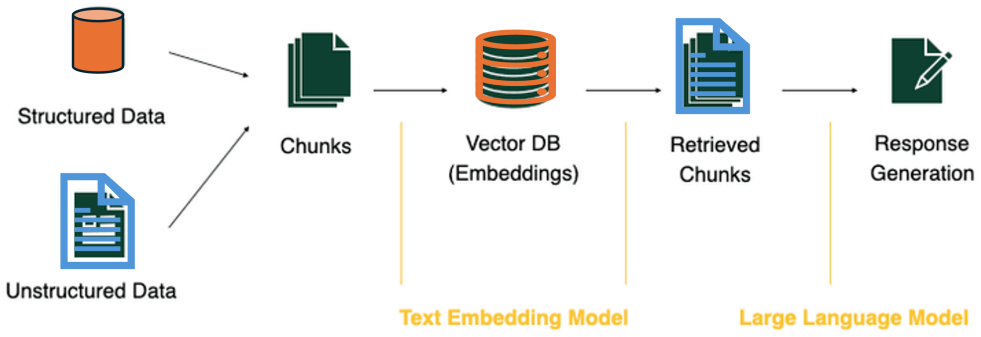
The load-bearing mechanism is the RAG pipeline, which the paper breaks into three components and five stages. The components are a retrieval model that finds relevant documents, an embedding model that turns queries and documents into vectors so matching is semantic rather than keyword-based, and a generative model (typically a pretrained transformer such as GPT or T5) that writes the final answer conditioned on the retrieved chunks. The five stages are chunking the knowledge base, embedding each chunk, storing the vectors in a vector database, retrieving the closest chunks for a query, and generating a response. This decomposition is what lets the paper argue that RAG's accuracy comes from external knowledge retrieval rather than from model scale, and it also explains why retrieval quality and data quality are the system's weak points.
What would settle it
Compile a fixed set of human and machine-written texts, run all detectors named in Table IV, and compare their reported accuracy and language support against the table; if the tools misclassify well above the implied rates or fail on claimed languages, the survey's comparative picture does not hold. For RAG, retrieve a deliberately false but well-formed document from the knowledge base and ask the generator to answer a query about it; confident repetition of the false content would confirm the paper's own caveat that RAG amplifies source errors.
Extended reading notes
Core claim
The paper's central claim is that retrieval-augmented generation is the structural improvement that addresses the main failure modes of conventional LLM text generation. Conventional models generate from parameters alone, so their knowledge is frozen at training time and they can confidently produce outdated or invented facts. RAG injects a retrieval step before generation: the query is embedded, matching chunks are pulled from a vector database, and the generator conditions on both the query and those retrieved chunks. The paper argues this makes output more accurate and contextually relevant, especially for knowledge-intensive tasks such as customer service and question answering, while conceding that RAG still depends on the quality of its external sources and can amplify their biases or errors. On the detection side, the paper's claim is that existing tools—built on perplexity, burstiness, statistical likelihood, or deep learning—can flag many AI texts but are not reliable enough to be decisive, and that the gap will widen as generators improve.
Load-bearing premise
The survey's conclusions rest on the assumption that its hand-picked sample of tools and the advantage and limitation claims drawn from vendors' own descriptions are accurate and representative enough to support a wide-angle overview.
Editorial extensions
If this is right
- If RAG works as described, systems that need current or specialized information—customer support, technical manuals, medical FAQs—can be made more accurate without retraining the underlying model.
- Detection tools that rely on statistical fingerprints such as perplexity and burstiness will keep losing accuracy as generators imitate human variability better, so detection has to be treated as an ongoing race, not a one-time fix.
- The same ethical failures (bias, misinformation, privacy, copyright) appear in generation, retrieval, and detection, which means a responsible-deployment policy has to address all three layers together.
- RAG's dependence on external sources means a single bad retrieval source can poison the output, so evaluation should separate retrieval quality from generation quality.
Reading between the lines
- The paper's reliance on vendor descriptions suggests a testable follow-up: run the named generators and detectors on a fixed, public benchmark corpus and compare actual accuracy, language support, and false-positive rates against the tables.
- If RAG's benefit is grounding, then a natural stress test is source poisoning—inserting a plausible but false document into the retrieval base and checking whether the generator repeats it; the paper's framework predicts it would.
- The survey's static snapshot (models and tools up to 2023) implies that any practical guide to this space needs a dated 'as of' label, because the tool list and capabilities change faster than peer-review cycles.
- Because the paper groups detectors by statistical versus deep-learning methods, one could test whether hybrid detectors that combine perplexity features with trained classifiers beat either family alone; the paper does not claim this, but its taxonomy makes it a natural next experiment.
Editorial analysis
A structured set of objections, weighed in public.
Referee Report
Summary. This manuscript is a survey of AI text generators (AITGs), retrieval-augmented generation (RAG), and AI text detectors (AITDs). It reviews the evolution of AITGs, describes the components and workflow of RAG, catalogs tools for RAG and detection, and discusses ethical issues and current limitations. The paper's stated contribution is a comprehensive, reliable overview that readers can use to understand the main families of generators, how RAG works, and what detection tools exist.
Significance. If brought to an acceptable standard of accuracy and sourcing, the survey could serve as a useful entry point for non-specialists, especially given its clear organization, the comparative tables of generators and detectors, and the high-level explanation of RAG. The paper does not introduce new algorithms or experiments, and its value depends entirely on the correctness and representativeness of the assembled facts. Its useful expository qualities are undermined by several unsupported and likely inaccurate claims, so the survey's reliability as a reference needs to be established before it can be accepted.
major comments (3)
- [II.B.1] The statement that GPT-4 introduced "500 billion parameters" is given without any supporting citation, and the adjacent references [15] and [16] do not contain this figure. Because this is a specific architectural claim presented as fact in a survey whose purpose is reliability, it is a load-bearing error: the reader cannot verify the number from the cited sources. The claim should be removed or replaced with a properly attributed public estimate, with the uncertainty clearly stated.
- [I (Contributions) and Tables I/IV] The paper describes itself as a "comprehensive overview" but does not describe any literature-search methodology, inclusion or exclusion criteria, or source-selection process for the tools listed in Tables I and IV. Many of the advantage/limitation rows read as vendor-reported marketing claims rather than independently verified findings, so the comprehensiveness label is unsupported. Adding a short methodology subsection and explicitly characterizing Tables I and IV as vendor-reported would make the scope and evidentiary basis transparent.
- [V] Several detector performance claims are stated without empirical support. For example, the text asserts that ZeroGPT "has lower accuracy for nuanced texts," that Turnitin "sometimes produces false positives," and that AI Writing Check is "less reliable for complex writing." These statements need either citations to independent evaluations and benchmarks or explicit softening to indicate that they are anecdotal or based on vendor descriptions.
minor comments (5)
- [II.B.1] Reference [16] is a self-citation to a preprint about ChatGPT in healthcare; it does not obviously support the GPT-4 parameter or multimodal claims, so it should be replaced or moved to a context where it is actually relevant.
- [IV.A] Standard retrieval tools and methods such as TF-IDF, BM25, FAISS, Annoy, and Elasticsearch are listed without citations; adding canonical references for these techniques would improve the survey's utility for readers seeking further information.
- [III.A] The text states that RAG has three components (retrieval, embedding, and generation) but then describes a five-stage workflow that includes chunking and a vector database; the relationship between the three components and the five stages should be clarified.
- [V and Table IV] There are minor date inconsistencies: Hive AI is described as "launched in 2023" in the text but the reference list dates it as 2024, and the table entries use inconsistent access-date formats. These should be harmonized.
- [IV.B] The expansion of BART as "Bidirectional and Auto-Regressive Transformers" should be singular: "Bidirectional and Auto-Regressive Transformer."
Circularity Check
No significant circularity: survey content is assembled from external sources, and the one self-citation is not load-bearing.
full rationale
This paper is a narrative survey, not a derivation; it makes no fitted predictions, and no first-principles result is reduced to its own inputs. The only reference to the authors' own prior work is [16] in Section II.B.1, cited together with [15] for the statement that GPT-4 introduced 500 billion parameters, multimodal capabilities, and enhanced reasoning. That self-citation is not load-bearing: the paper's central content (Tables I-IV, RAG components, detector descriptions) is assembled from external papers and vendor pages, and no equation or conclusion is constructed out of [16]. The unsupported GPT-4 parameter count is a correctness and sourcing problem, not a circularity problem, because the claim is not derived from or equivalent to the paper's own inputs. Similarly, Section VII's limitations discuss technical weaknesses of the subject technologies, not methodological circularity in the survey itself. Under the rule that self-citation only matters when it carries the argument, the score is 2 rather than 0, but there is no circular step to report.
Assumptions & free parameters
assumptions (3)
- domain assumption Vendor-provided descriptions of tools in Tables I and IV are accurate.
- domain assumption The selected tools and models are a representative sample of the field.
- domain assumption Public statements about proprietary model architectures, such as the GPT-4 parameter count, are reliable.
Cite this review
Pith. "Pith review of Exploring AI Text Generation, Retrieval-Augmented Generation, and Detection Technologies: a Comprehensive Overview." pith.science (2026). https://pith.science/paper/7JO7SUUU
@misc{pith2026241203933,
  author       = {Pith},
  title        = {Pith review of: Exploring AI Text Generation, Retrieval-Augmented Generation, and Detection Technologies: a Comprehensive Overview},
  year         = {2026},
  howpublished = {\url{https://pith.science/paper/7JO7SUUU}},
  note         = {Machine review of arXiv:2412.03933}
}
read the original abstract
The rapid development of Artificial Intelligence (AI) has led to the creation of powerful text generation models, such as large language models (LLMs), which are widely used for diverse applications. However, concerns surrounding AI-generated content, including issues of originality, bias, misinformation, and accountability, have become increasingly prominent. This paper offers a comprehensive overview of AI text generators (AITGs), focusing on their evolution, capabilities, and ethical implications. This paper also introduces Retrieval-Augmented Generation (RAG), a recent approach that improves the contextual relevance and accuracy of text generation by integrating dynamic information retrieval. RAG addresses key limitations of traditional models, including their reliance on static knowledge and potential inaccuracies in handling real-world data. Additionally, the paper reviews detection tools that help differentiate AI-generated text from human-written content and discusses the ethical challenges these technologies pose. The paper explores future directions for improving detection accuracy, supporting ethical AI development, and increasing accessibility. The paper contributes to a more responsible and reliable use of AI in content creation through these discussions.
Figures

Forward citations
Cited by 2 Pith papers
-
Feedback-Guided Extraction of Knowledge Base from Retrieval-Augmented LLM Applications
An agent-based black-box attack, CopyBreakRAG, progressively extracts over 70% of chunks from RAG knowledge bases by alternating curiosity-driven exploration with reasoning-based exploitation.
-
Machine Generated Product Advertisements: Benchmarking LLMs Against Human Performance
ChatGPT-4 outperformed Gemma, Llama, and GPT-2 on an automated 100-product description benchmark, yet the test lacks statistical grounding and the paper does not release its data or code.
Reference graph
Works this paper leans on
-
[15]
Gpt understands, too,
X. Liu, Y . Zheng, Z. Du, M. Ding, Y . Qian, Z. Yang, and J. Tang, “Gpt understands, too,” AI Open , 2023
2023
-
[16]
Chatgpt: Transforming healthcare with ai,
F. Neha, D. Bhati, D. K. Shukla, and M. Amiruzzaman, “Chatgpt: Transforming healthcare with ai,” Preprints, October 2024. [Online]. Available: https://doi.org/10.20944/preprints202410.0686.v1
-
[1]
T. Alqahtani, H. A. Badreldin, M. Alrashed, A. I. Alshaya, S. S. Alghamdi, K. bin Saleh, S. A. Alowais, O. A. Alshaya, I. Rahman, M. S. Al Yami et al., “The emergent role of artificial intelligence, natural learning processing, and large language models in higher education and research,” Research in Social and Administrative Pharmacy , vol. 19, no. 8, pp....
work page 2023
-
[2]
Data-driven materials research enabled by natural language processing and information extraction,
E. A. Olivetti, J. M. Cole, E. Kim, O. Kononova, G. Ceder, T. Y .-J. Han, and A. M. Hiszpanski, “Data-driven materials research enabled by natural language processing and information extraction,” Applied Physics Reviews, vol. 7, no. 4, 2020
work page 2020
-
[3]
Breaking language barriers: The role of ai in modern machine translation,
I. Chen and A. Lee, “Breaking language barriers: The role of ai in modern machine translation,” Eastern European Journal for Multidisci- plinary Research, vol. 1, no. 2, pp. 53–58, 2024
work page 2024
-
[4]
A comprehensive survey on answer generation methods using nlp,
P. Upadhyay, R. Agarwal, S. Dhiman, A. Sarkar, and S. Chaturvedi, “A comprehensive survey on answer generation methods using nlp,”Natural Language Processing Journal , vol. 8, p. 100088, 2024
work page 2024
-
[5]
T. Chakrabarty, V . Padmakumar, F. Brahman, and S. Muresan, “Cre- ativity support in the age of large language models: An empirical study involving emerging writers,” arXiv preprint arXiv:2309.12570 , 2023
arXiv 2023
-
[6]
V oice assistant with ai chat integration using openai,
A. Gobinath, P. Prakash, M. Anandan, A. Srinivasan et al. , “V oice assistant with ai chat integration using openai,” in 2024 Third Inter- national Conference on Intelligent Techniques in Control, Optimization and Signal Processing (INCOS) . IEEE, 2024, pp. 1–6
work page 2024
Show all 45 references
-
[7]
Language models, plagiarism, and legal writing,
M. L. Smith, “Language models, plagiarism, and legal writing,” The University of New Hampshire Law Review , vol. 22, no. 2, p. 9, 2024
2024
-
[8]
Do llms exhibit human-like response biases? a case study in survey design,
L. Tjuatja, V . Chen, T. Wu, A. Talwalkwar, and G. Neubig, “Do llms exhibit human-like response biases? a case study in survey design,” Transactions of the Association for Computational Linguistics , vol. 12, pp. 1011–1026, 2024
2024
-
[9]
Fundamental limitations of generative llms,
A. Kucharavy, “Fundamental limitations of generative llms,” in Large Language Models in Cybersecurity: Threats, Exposure and Mitigation . Springer Nature Switzerland Cham, 2024, pp. 55–64
2024
-
[10]
Pitfalls (and advantages) of sophisticated large language models,
A. Strasser, “Pitfalls (and advantages) of sophisticated large language models,” in Ethics in Online AI-based Systems . Elsevier, 2024, pp. 195–210
2024
-
[11]
Chatgpt 3.5 and 4: Its ramifications on librarianship, academia, education, publishing, and the workplace,
B. J. Holland, “Chatgpt 3.5 and 4: Its ramifications on librarianship, academia, education, publishing, and the workplace,” in Handbook of Research on Advancements of Contactless Technology and Service Innovation in Library and Information Science . IGI Global, 2023, pp. 316–340
2023
-
[12]
Recurrent neural networks,
S. Grossberg, “Recurrent neural networks,” Scholarpedia, vol. 8, no. 2, p. 1888, 2013
2013
-
[13]
Long short-term memory (lstm) networks with jet constituents for boosted top tagging at the lhc,
S. Egan, W. Fedorko, A. Lister, J. Pearkes, and C. Gay, “Long short-term memory (lstm) networks with jet constituents for boosted top tagging at the lhc,” arXiv preprint arXiv:1711.09059 , 2017
2017 arXiv
-
[14]
Attention is all you need,
A. Vaswani, “Attention is all you need,” Advances in Neural Information Processing Systems, 2017
2017
-
[17]
Bert: Pre-training of deep bidirectional transformers for language understanding,
J. Devlin, “Bert: Pre-training of deep bidirectional transformers for language understanding,” arXiv preprint arXiv:1810.04805 , 2018
2018 arXiv
-
[18]
Lamda: Language models for dialog applications,
R. Thoppilan, D. De Freitas, J. Hall, N. Shazeer, A. Kulshreshtha, H.-T. Cheng, A. Jin, T. Bos, L. Baker, Y . Duet al., “Lamda: Language models for dialog applications,” arXiv preprint arXiv:2201.08239 , 2022
2022 arXiv
-
[19]
Using deepspeed and megatron to train megatron-turing nlg 530b, a large-scale generative language model,
S. Smith, M. Patwary, B. Norick, P. LeGresley, S. Rajbhandari, J. Casper, Z. Liu, S. Prabhumoye, G. Zerveas, V . Korthikanti et al. , “Using deepspeed and megatron to train megatron-turing nlg 530b, a large-scale generative language model,” arXiv preprint arXiv:2201.11990 , 2022
2022 arXiv
-
[20]
Opt: Open pre-trained transformer language models,
S. Zhang, S. Roller, N. Goyal, M. Artetxe, M. Chen, S. Chen, C. Dewan, M. Diab, X. Li, X. V . Lin et al. , “Opt: Open pre-trained transformer language models,” arXiv preprint arXiv:2205.01068 , 2022
2022 arXiv
-
[21]
Bigscience large open-science open-access multilingual lan- guage model,
M. AI, “Bigscience large open-science open-access multilingual lan- guage model,” BigScience, 2022
2022
-
[22]
Jasper ai: Ai content platform,
Jasper, “Jasper ai: Ai content platform,” Online, available: https://www. jasper.ai/. [Accessed: Sept. 20, 2024]
2024
-
[23]
Writesonic: Ai content writer, ai seo toolkit & ai chatbots,
Writesonic, “Writesonic: Ai content writer, ai seo toolkit & ai chatbots,” Online, accessed: Sept. 21, 2024. [Online]. Available: https://writesonic.com/
2024
-
[24]
Grammarly: Free ai writing assistance,
Grammarly, “Grammarly: Free ai writing assistance,” Online, accessed: Sept. 25, 2024. [Online]. Available: https://www.grammarly.com/
2024
-
[25]
Copy.ai: Ai-powered content generation platform,
Copyai, “Copy.ai: Ai-powered content generation platform,” Online, accessed: Sept. 22, 2024. [Online]. Available: https://www.copy.ai/
2024
-
[26]
Rytr: Ai writing assistant,
Rytr, “Rytr: Ai writing assistant,” Online, accessed: Sept. 23, 2024. [Online]. Available: https://rytr.me/
2024
-
[27]
Scalenut: Ai-powered seo and content marketing platform,
Scalenut, “Scalenut: Ai-powered seo and content marketing platform,” Online, accessed: Sept. 26, 2024. [Online]. Available: https://www. scalenut.com/
2024
-
[28]
Hypotenuse ai: Ecommerce ai writer & ai writing assistant,
HypotenuseAI, “Hypotenuse ai: Ecommerce ai writer & ai writing assistant,” Online, accessed: Sept. 24, 2024. [Online]. Available: https://www.hypotenuse.ai/
2024
-
[29]
Anyword: Ai copywriting platform,
Anyword, “Anyword: Ai copywriting platform,” Online, accessed: Sept. 27, 2024. [Online]. Available: https://www.anyword.com/
2024
-
[30]
Writer: Ai writing assistant for teams,
Writer, “Writer: Ai writing assistant for teams,” Online, accessed: Sept. 29, 2024. [Online]. Available: https://www.writer.com/
2024
-
[31]
Claude ai: Conversational ai by anthropic,
C. AI, “Claude ai: Conversational ai by anthropic,” Online, accessed: Sept. 30, 2024. [Online]. Available: https://www.anthropic.com/claude
2024
-
[32]
Retrieval- augmented generation for knowledge-intensive nlp tasks,
P. Lewis, E. Perez, A. Piktus, F. Petroni, V . Karpukhin, N. Goyal, H. K ¨uttler, M. Lewis, W.-t. Yih, T. Rockt ¨aschel et al. , “Retrieval- augmented generation for knowledge-intensive nlp tasks,” Advances in Neural Information Processing Systems , vol. 33, pp. 9459–9474, 2020
2020
-
[33]
Detecting ai-generated text: Factors influencing detectability with current methods,
K. C. Fraser, H. Dawkins, and S. Kiritchenko, “Detecting ai-generated text: Factors influencing detectability with current methods,” arXiv preprint arXiv:2406.15583, 2024
2024 arXiv
-
[34]
Gptzero: Ai detector for chatgpt and more,
GPTZero, “Gptzero: Ai detector for chatgpt and more,” Online, accessed: Oct. 1, 2024. [Online]. Available: https://gptzero.me/
2024
-
[35]
Turnitin: Plagiarism prevention and detection,
Turnitin, “Turnitin: Plagiarism prevention and detection,” Online, accessed: Oct. 2, 2024. [Online]. Available: https://www.turnitin.com/
2024
-
[36]
Zerogpt: Trusted ai checker for chatgpt, gpt4 & gemini,
ZeroGPT, “Zerogpt: Trusted ai checker for chatgpt, gpt4 & gemini,” Online, accessed: Oct. 3, 2024. [Online]. Available: https://www.zerogpt.com/
2024
-
[37]
Gltr: Giant language model test room for detecting machine-generated text,
G. L. M. T. R. (GLTR), “Gltr: Giant language model test room for detecting machine-generated text,” Online, accessed: Oct. 7, 2024. [Online]. Available: https://gltr.io/
2024
-
[38]
Copyleaks: Ai-based plagiarism & ai content detection,
Copyleaks, “Copyleaks: Ai-based plagiarism & ai content detection,” Online, accessed: Oct. 8, 2024. [Online]. Available: https://copyleaks. com/
2024
-
[39]
Crossplag: Plagiarism detection and ai content verification tool,
Crossplag, “Crossplag: Plagiarism detection and ai content verification tool,” Online, accessed: Oct. 15, 2024. [Online]. Available: https: //www.crossplag.com/
2024
-
[40]
Hive ai: Ai-generated text and multimedia detection platform,
H. AI, “Hive ai: Ai-generated text and multimedia detection platform,”
-
[41]
Scribbr ai checker: Ai-powered plagiarism detection tool,
Scribbr, “Scribbr ai checker: Ai-powered plagiarism detection tool,”
-
[42]
I writing check: Tool for detecting ai-generated text,
I. W. Check, “I writing check: Tool for detecting ai-generated text,”
-
[45]
Available: https://www.aiwritingcheck.com
[Online]. Available: https://www.aiwritingcheck.com
-
[2023]
Available: https://www.scribbr.com
[Online]. Available: https://www.scribbr.com
-
[2024]
Available: https://www.hive.ai
[Online]. Available: https://www.hive.ai
Reviewed August 11, 2026 · model on record in the stance chip above.
Discussion (0). Continue with ORCID to comment.