REVIEW 2 major objections 5 minor 91 references
An Addressable and Tunable Module for Donor-based Scalable Silicon Quantum Computing
T0 review · 2 major / 5 minor · reviewed 2026-08-10 · deepseek-v4-flash
Pith's one-line read A single off-center ancilla donor in silicon provides both addressable single-qubit gates and tunable two-qubit coupling, with simulated fidelities above 99%.
desk verdict A genuinely new asymmetric ancilla-donor module resolves a known donor-qubit tension, but the 'surface-code-compatible' fidelities rest on unmodeled nuclear spin polarization that needs to be addressed before the claim fully lands. read the letter →
The pith
A machine-rendered reading of the paper's core claim, the machinery that carries it, and where it could break.
The reading
What carries the argument
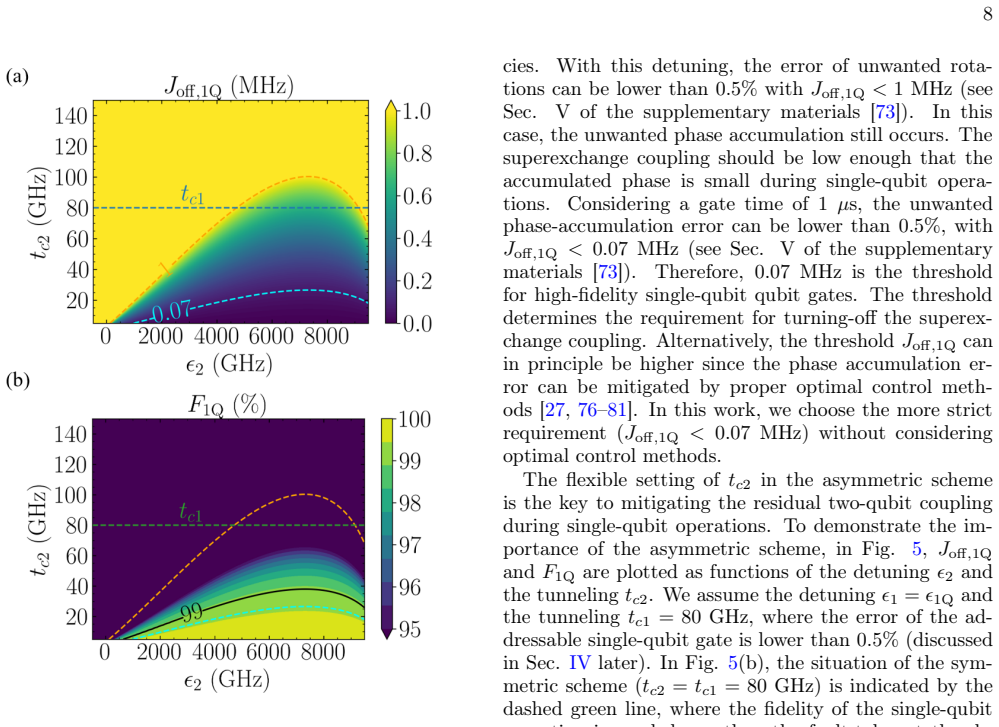
The machinery is a three-site generalized Fermi-Hubbard Hamiltonian for two electrons on two computing donors (CDL, CDR) and one ancilla donor (ADM), with tunnel couplings $t_{c1}=t_{L,M}$ and $t_{c2}=t_{M,R}$ and detunings $\epsilon_1,\epsilon_2$. The addressability mechanism is the hyperfine ZZ coupling of Eq. (3): with the ancilla nuclear spin in $\left|\Uparrow\right\rangle$ and the computing-donor nuclei in $\left|\Downarrow\right\rangle$, shifting the electron wavefunction toward the ancilla changes its Larmor frequency by up to about $A\approx117$ MHz, enough for a $\sim14$ MHz frequency separation that suppresses crosstalk. The two-qubit mechanism is superexchange through the ancilla, an effective coupling mediated by virtual tunneling through the intermediate donor, obtained by a fourth-order Schrieffer-Wolff transformation (a perturbative elimination of the excited charge states), with $J_{\mathrm{SE}}\propto t_{c1}^2 t_{c2}^2 \beta(\epsilon_1,\epsilon_2)$, tunable by detunings and switchable by choosing $\epsilon_2$ in the off region. The resonance condition $(\epsilon_1-\epsilon_0)/(\epsilon_2-\epsilon_0)=t_{c1}/t_{c2}$ locates the high-fidelity SWAP window, while the CZ gate is best at detunings away from resonance where the superexchange is stronger than the qubit frequency detuning.
What would settle it
An experiment would measure the residual superexchange $J_{\mathrm{off}}$ between the two qubits while one qubit is being driven; if $J_{\mathrm{off}}$ cannot be reduced below about 0.07 MHz with $t_{c1}\approx80$ GHz and a reasonable $t_{c2}$, the predicted single-qubit fidelity above 99% would fail. A second direct check is to monitor the ancilla donor's nuclear spin polarization after many gate operations, since the addressability mechanism disappears if it flips.
Extended reading notes
Core claim
The paper's central discovery is that addressability and tunability can coexist in one donor module if the ancilla donor is placed asymmetrically between the two computing donors. With the computing-donor nuclear spins polarized down and the ancilla nuclear spin up, the electron qubit frequency is shifted by the hyperfine interaction when the electron is detuned toward the ancilla; this frequency shift is used to address one qubit without locally generated microwaves. The same ancilla mediates a fourth-order superexchange $J_{\mathrm{SE}} = t_{c1}^2 t_{c2}^2 \beta(\epsilon_1,\epsilon_2)$ between the two qubits, tunable through detunings $\epsilon_1$ and $\epsilon_2$. The asymmetry ($t_{c1} > t_{c2}$) is what lets the coupling be turned off, with residual $J_{\mathrm{off}} \lesssim 0.07$ MHz, while the addressed qubit still sees the large tunneling it needs for charge-noise resilience. The result is fault-tolerant single-qubit and two-qubit gates in the plotted operating windows and, because valley-induced tunneling oscillation is weaker along the [110] direction, a relaxed fabrication tolerance of roughly 5 nm.
Load-bearing premise
The load-bearing premise is that the ancilla donor's nuclear spin remains polarized upward and both computing donors' nuclear spins remain downward for the whole computation; if the ancilla's nucleus flips during repeated ESR pulses or over an error-correction cycle, the hyperfine frequency shift that provides addressability disappears and the crosstalk and fidelity estimates no longer hold.
Editorial extensions
If this is right
- A single added ancilla donor per pair supplies both addressable single-qubit gates and tunable two-qubit gates, so the module avoids micromagnets, local field gradients, or two extra donors.
- Single-qubit gate fidelities exceed 99.5% and SWAP/CZ fidelities exceed 99% in the modeled operating windows, meeting the roughly 99% surface-code fault-tolerance threshold.
- The residual superexchange during single-qubit operations can be suppressed below $J_{\mathrm{off}}<0.07$ MHz without optimal control, and the allowed range of $t_{c2}$ is wide enough that donor placement precision relaxes to about 5 nm.
- Tiling the modules into a two-dimensional array with global ESR/NMR pulses yields a surface-code-compatible processor in which the ancilla donor needs no readout.
- With lower charge noise ($\sigma_\epsilon \approx 0.2$ $\mu$eV) and a hyperfine dephasing rate of 0.5 kHz, the paper projects single-qubit fidelities above 99.9%.
Reading between the lines
- A natural next test, not reported in the paper, would be to fabricate a three-donor device with $t_{c1}\approx80$ GHz and $t_{c2}\approx20$ GHz and measure whether the residual coupling $J_{\mathrm{off}}$ during single-qubit operation drops below the 0.07 MHz threshold; that measurement would also probe the assumed nuclear-spin polarization lifetime.
- The same frequency-modulator role of the ancilla could in principle be reused for selective readout or qubit reset, since the ancilla shifts the electron spin frequency without requiring a local magnetic field.
- If the nuclear-spin polarization assumption holds, the module generalizes to different donor spacings and donor species, because the superexchange strength depends only on the two tunnel couplings and detunings rather than on identical donor placements.
Editorial analysis
A structured set of objections, weighed in public.
Referee Report
Summary. The paper proposes an asymmetric three-donor module for silicon-based electron spin qubits, in which a single ancilla donor (AD) is strongly tunnel-coupled to one computing donor (CDL) and weakly coupled to the other (CDR). The AD serves both as a frequency-modulating element that enables addressable single-qubit ESR control of CDL and as a mediator of a tunable superexchange interaction for two-qubit gates. Using a generalized Fermi-Hubbard model, a fourth-order Schrieffer-Wolff treatment for the superexchange, and numerical diagonalization, the authors map out operating regions in detuning and tunneling parameter space where single-qubit fidelities exceed 99.5% and SWAP/CZ fidelities exceed 99%. They further argue that the asymmetric tunnel couplings relax donor-placement precision to about 5 nm and propose a 2D surface-code-compatible processor layout.
Significance. If the underlying assumptions hold, the scheme is a genuinely useful design idea: it resolves a real tension between the large tunnel coupling needed for addressability and the small residual coupling needed for turning off two-qubit interactions. The paper is careful to compare analytical and numerical results for the superexchange, to identify high-fidelity operating windows, and to provide concrete parameter sets (tc1 = 80 GHz, tc2 = 20 GHz, B0 = 0.3 T, 1 microsecond gate time). The proposed asymmetry also has practical appeal for mitigating valley oscillations. The main risk is that the fidelity estimates depend on static nuclear spin polarization and on a simplified hyperfine Hamiltonian, and the paper does not quantify the lifetime of that polarization resource under operation. The claim of surface-code compatibility is therefore stronger than what the module-level simulations establish.
major comments (2)
- [Sec. II, Eq. (3) and Sec. III.A] The addressability protocol assumes that the CD nuclear spins remain |down> and the AD nuclear spin remains |up> for the duration of operation. The Hamiltonian in Eq. (3) drops the transverse hyperfine terms, with the justification that flip-flop transitions are off-resonant and that nuclear coherence is long. The paper does not quantify the nuclear spin-flip probability under the proposed 1 microsecond ESR pulses, over a full error-correction cycle, or in the presence of finite drive amplitude and nuclear-spin noise. A single flip of the ancilla nuclear spin changes the electron spin resonance frequency by about A = 117 MHz and removes the frequency discrimination on which the entire scheme relies. This is a load-bearing resource, not a parameter tweak; the authors should estimate the flip rate quantitatively (including drive-induced flip-flop contributions) or provide a repolarization protocol, and state what nuclear polarization lifetime is required for the quoted fidelities.
- [Sec. III.A, Sec. III.C, and Figs. 5-6] The single-qubit gate analysis is performed only for the left computing donor CDL, which is strongly coupled to the AD. The text states that the AD provides addressability only for CDL, so the mechanism by which CDR is addressed within a module is not established by the presented simulations. If CDR is meant to be addressed by an AD from an adjacent module, the paper should say so explicitly and estimate the resulting inter-module crosstalk and its effect on the CDL-CDR two-qubit gate, since the processor layout in Fig. 7 is part of the surface-code-compatibility claim. As written, the module-level claim that each pair of donors supports addressable single-qubit gates on both qubits is incomplete.
minor comments (5)
- [Sec. II, basis states] The example state |(up,0,down)> is described as 'one electron with spin-up at CDL and one electron with spin-down at CDL'; the second site should be CDR, not CDL.
- [Sec. III.A] The sentence 'the AD provides addressability only to the its nearest qubit' contains a grammatical error, and the surrounding text should clarify whether CDR is addressed by the same AD or by a different AD.
- [Sec. III and Abstract] The threshold terminology is inconsistent: the introduction quotes the surface-code threshold as 99%, Section III sets an error threshold of 0.5%, and the abstract highlights single-qubit fidelities above 99.5%. Please state explicitly which threshold is used for single-qubit gates and which for two-qubit gates.
- [Sec. III.A/B] The statement that the 'sweet line' (epsilon1 = epsilon2) can still be used for the CZ gate should be reconciled with Fig. 4(c), where the high-fidelity CZ region appears away from the qubit resonance condition; a brief explanation of the asymmetric sweet-line condition would help.
- [Fig. 4(a)] The color scale is labeled log10(J) without units; please state the units of J (e.g., MHz) in the caption.
Circularity Check
No significant circularity: the gate fidelities are computed outputs of an explicit Fermi-Hubbard model with literature noise parameters, and the few self-citations are supporting rather than load-bearing.
full rationale
The central derivation is self-contained. The authors start from an explicit Fermi-Hubbard Hamiltonian (Eq. 2) with literature values for U, V, gamma_e, gamma_n, A, and noise parameters, then numerically diagonalize and use fourth-order Schrieffer-Wolff perturbation theory to obtain the superexchange coupling JSE (Eq. 4) and gate fidelities. The claimed fidelities are outputs of this model, not inputs: the operating points (tc1=80 GHz, tc2=20 GHz, detunings near resonance/sweet line, 14 MHz frequency discrimination) are chosen by scanning the parameter space and checking where the computed fidelity exceeds the 0.5% threshold. This is engineering design/optimization, not circular derivation. The few self-citations (e.g., Refs. [41] and [56] by co-authors) are used only as supporting references alongside independent sources (Refs. [46], [48], [60]) for established concepts such as superexchange scaling and hyperfine-frequency addressability; the key equations are derived in the paper and supplementary material rather than imported by citation. The nuclear-spin-polarization assumption (CD |down>, AD |up>) is a stated physical assumption, not a result derived from the target fidelities; whether it holds dynamically is a correctness/robustness question, not circularity. No 'prediction' in the paper is fixed by construction, and no load-bearing claim is a renamed fit.
Assumptions & free parameters
free parameters (6)
- tc1 (CDL-ADM tunneling) =
80 GHz nominal; threshold tc1 > 80 GHz for >99.5% single-qubit fidelity
- tc2 (CDR-ADM tunneling) =
20 GHz nominal; upper bound ~30-40 GHz depending on tc1
- B0 static magnetic field =
0.3 T
- Single-qubit gate time =
1 micro-second
- Error budget for gates =
0.5%
- Qubit frequency detuning for addressability =
10*sqrt(2) = approx 14 MHz
assumptions (6)
- domain assumption The three-site Fermi-Hubbard model with on-site U, nearest-neighbor V, and nearest-neighbor tunneling captures the relevant physics of two electrons in three phosphorus donors.
- domain assumption The hyperfine interaction can be truncated to ZZ coupling, with electron-nuclear flip-flop terms neglected.
- domain assumption Nuclear spin polarizations are initialized to CD down, AD up and remain stable during operations.
- domain assumption Charge noise acts as a Gaussian quasi-static fluctuation of detunings with sigma_epsilon = 2 micro-eV, and hyperfine-induced dephasing is 1 kHz.
- domain assumption Surface-code compatibility can be assessed from per-gate fidelities above the assumed 0.5% error threshold without full error-correction simulation.
- domain assumption Tunneling magnitudes and valley-oscillation envelopes from effective-mass and tight-binding calculations in Refs. [36,37,82] apply to the proposed donor spacings.
Cite this review
Pith. "Pith review of An Addressable and Tunable Module for Donor-based Scalable Silicon Quantum Computing." pith.science (2026). https://pith.science/paper/J3HFEUJY
@misc{pith2026241220055,
  author       = {Pith},
  title        = {Pith review of: An Addressable and Tunable Module for Donor-based Scalable Silicon Quantum Computing},
  year         = {2026},
  howpublished = {\url{https://pith.science/paper/J3HFEUJY}},
  note         = {Machine review of arXiv:2412.20055}
}
read the original abstract
Donor-based spin qubit offers a promising silicon quantum computing route for building large-scale qubit arrays, attributed to its long coherence time and advancements in nanoscale donor placement. However, the state-of-the-art device designs face scalability challenges, notably in achieving tunable two-qubit coupling and ensuring qubit addressability. Here, we propose a surface-code-compatible architecture, where each module has both tunable two-qubit gates and addressable single-qubit gates by introducing only a single extra donor in a pair of donors. We found that to compromise between the requirement of tunability and that of addressability, an asymmetric scheme is necessary. In this scheme, the introduced extra donor is strongly tunnel-coupled to one of the donor spin qubits for addressable single-qubit operation, while being more weakly coupled to the other to ensure the turning on and off of the two-qubit operation. The fidelity of single-qubit and two-qubit gates can exceed the fault-tolerant threshold in our design. Additionally, the asymmetric scheme effectively mitigates valley oscillations, allowing for engineering precision tolerances up to a few nanometers. Thus, our proposed scheme presents a promising prototype for large-scale, fault-tolerant, donor-based spin quantum processors.
Figures


Figures from the paper (4 more)



Reference graph
Works this paper leans on
-
[1]
B. E. Kane, Nature393, 133 (1998)
1998
-
[2]
J. J. L. Morton, A. M. Tyryshkin, R. M. Brown, S. Shankar, B. W. Lovett, A. Ardavan, T. Schenkel, E. E. Haller, J. W. Ager, and S. A. Lyon, Nature455, 1085 (2008)
2008
-
[3]
Fuechsle, S
M. Fuechsle, S. Mahapatra, F. A. Zwanenburg, M. Friesen, M. A. Eriksson, and M. Y. Simmons, Nat. Nanotechnol. 5, 502 (2010)
2010
-
[4]
A. M. Tyryshkin, S. Tojo, J. J. Morton, H. Riemann, N. V. Abrosimov, P. Becker, H. J. Pohl, T. Schenkel, M. L. Thewalt, K. M. Itoh, and S. A. Lyon, Nat. Mater. 11, 143 (2011)
2011
-
[5]
Fuechsle, J
M. Fuechsle, J. A. Miwa, S. Mahapatra, H. Ryu, S. Lee, O. Warschkow, L. C. L. Hollenberg, G. Klimeck, and M. Y. Simmons, Nat. Nanotechnol.7, 242 (2012)
2012
-
[6]
J. J. Pla, K. Y. Tan, J. P. Dehollain, W. H. Lim, J. J. Morton, D. N. Jamieson, A. S. Dzurak, and A. Morello, Nature 489, 541 (2012)
2012
-
[7]
Saeedi, S
K. Saeedi, S. Simmons, J. Z. Salvail, P. Dluhy, H. Rie- mann, N. V. Abrosimov, P. Becker, H.-J. Pohl, J. J. L. Morton, and M. L. W. Thewalt, Science342, 830 (2013)
2013
-
[8]
J. T. Muhonen, J. P. Dehollain, A. Laucht, F. E. Hud- son, R. Kalra, T. Sekiguchi, K. M. Itoh, D. N. Jamieson, J. C. McCallum, A. S. Dzurak, and A. Morello, Nat. Nan- otechnol. 9, 986 (2014)
2014
Show all 91 references
-
[9]
Harvey-Collard, N
P. Harvey-Collard, N. T. Jacobson, M. Rudolph, J. Dominguez, G. A. Ten Eyck, J. R. Wendt, T. Pluym, J. K. Gamble, M. P. Lilly, M. Pioro-Ladrière, and M. S. Carroll, Nat. Commun.8, 1029 (2017)
2017
-
[10]
Y. He, S. K. Gorman, D. Keith, L. Kranz, J. G. Keizer, and M. Y. Simmons, Nature571, 371 (2019)
2019
-
[11]
M. T. M¸ adzik, S. Asaad, A. Youssry, B. Joecker, K. M. Rudinger, E. Nielsen, K. C. Young, T. J. Proctor, A. D. Baczewski, A. Laucht, V. Schmitt, F. E. Hudson, K. M. Itoh, A. M. Jakob, B. C. Johnson, D. N. Jamieson, A. S. Dzurak, C. Ferrie, R. Blume-Kohout, and A. Morello, Nat...
2022
-
[12]
J. L. Pacheco, M. Singh, D. L. Perry, J. R. Wendt, G. Ten Eyck, R. P. Manginell, T. Pluym, D. R. Luh- man, M. P. Lilly, M. S. Carroll, and E. Bielejec, Rev. Sci. Instrum. 88, 123301 (2017)
2017
-
[13]
D.N.Jamieson, W.I.Lawrie, S.G.Robson, A.M.Jakob, B. C. Johnson, and J. C. McCallum, Mater. Sci. Semi- cond. Process.62, 23 (2017)
2017
-
[14]
Holmes, W
D. Holmes, W. I. L. Lawrie, B. C. Johnson, A. Asadpo- ordarvish, J. C. McCallum, D. R. McCamey, and D. N. Jamieson, Phys. Rev. Mater.3, 083403 (2019)
2019
-
[15]
A. M. Jakob, S. G. Robson, V. Schmitt, V. Mourik, M. Posselt, D. Spemann, B. C. Johnson, H. R. Fir- gau, E. Mayes, J. C. McCallum, A. Morello, and D. N. Jamieson, Adv. Mater.34, 2103235 (2022)
2022
-
[16]
Holmes, B
D. Holmes, B. Wilhelm, A. M. Jakob, X. Yu, F. E. Hud- son, K. M. Itoh, A. S. Dzurak, D. N. Jamieson, and A. Morello, Adv. Quantum Technol.7, 2300316 (2024)
2024
-
[17]
D. R. Ward, M. T. Marshall, D. M. Campbell, T. M. Lu, J. C. Koepke, D. A. Scrymgeour, E. Bussmann, and S. Misra, Appl. Phys. Lett.111, 193101 (2017)
2017
-
[18]
X. Wang, J. Wyrick, R. V. Kashid, P. Namboodiri, S. W. Schmucker, A. Murphy, M. D. Stewart, and R. M. Silver, Commun. Phys.3, 82 (2020)
2020
-
[19]
Bussmann, R
E. Bussmann, R. Butera, J. Owen, J. Randall, S. Rinaldi, A. Baczewski, and S. Misra, MRS Bull.46, 607 (2021)
2021
-
[20]
Kiczynski, S
M. Kiczynski, S. K. Gorman, H. Geng, M. B. Donnelly, Y. Chung, Y. He, J. G. Keizer, and M. Y. Simmons, Nature 606, 694 (2022)
2022
-
[21]
While referring to the theoretical results of tunneling magnitude based on tight-bind modeling, the distance can be around 7-12 (13-20) nm [39, 82]
nm [37]. While referring to the theoretical results of tunneling magnitude based on tight-bind modeling, the distance can be around 7-12 (13-20) nm [39, 82]. Within these ranges of distances, the oscillation on tunneling is within one order of magnitude [36]. Consequently, the...
-
[22]
H. G. Stemp, S. Asaad, M. R. v. Blankenstein, A. Vaart- jes, M. A. I. Johnson, M. T. Mądzik, A. J. A. Heskes, H. R. Firgau, R. Y. Su, C. H. Yang, A. Laucht, C. I. Ostrove, K. M. Rudinger, K. Young, R. Blume-Kohout, F. E. Hudson, A. S. Dzurak, K. M. Itoh, A. M. Jakob, B. C. Joh...
2024
-
[23]
Thorvaldson, D
I. Thorvaldson, D. Poulos, C. M. Moehle, S. H. Misha, H. Edlbauer, J. Reiner, H. Geng, B. Voisin, M. T. Jones, M. B. Donnelly, L. F. Pena, C. D. Hill, C. R. Myers, J. G. Keizer, Y. Chung, S. K. Gorman, L. Kranz, and M. Y. Simmons, arXiv preprint arXiv:2404.08741 (2024)
2024 arXiv
-
[24]
Loss and D
D. Loss and D. P. DiVincenzo, Phys. Rev. A57, 120 (1998)
1998
-
[25]
D. P. DiVincenzo, Fortschritte der Physik48, 771 (2000)
2000
-
[26]
D. S. Wang, A. G. Fowler, and L. C. L. Hollenberg, Phys. Rev. A83, 020302 (2011)
2011
-
[27]
A. G. Fowler, M. Mariantoni, J. M. Martinis, and A. N. Cleland, Phys. Rev. A86, 032324 (2012)
2012
-
[28]
X. Xue, M. Russ, N. Samkharadze, B. Undseth, A. Sam- mak, G. Scappucci, and L. M. K. Vandersypen, Nature 601, 343 (2022)
2022
-
[29]
Scappucci, and S
A.Noiri, K.Takeda, T.Nakajima, T.Kobayashi, A.Sam- mak, G. Scappucci, and S. Tarucha, Nature 601, 338 (2022)
2022
-
[30]
A. R. Mills, C. R. Guinn, M. J. Gullans, A. J. Sigillito, M. M. Feldman, E. Nielsen, and J. R. Petta, Sci. Adv.8, eabn5130 (2022)
2022
-
[31]
J. Y. Huang, R. Y. Su, W. H. Lim, M. Feng, B. van Straaten, B. Severin, W. Gilbert, N. Dumoulin Stuyck, T. Tanttu, S. Serrano, J. D. Cifuentes, I. Hansen, A. E. Seedhouse, E. Vahapoglu, R. C. C. Leon, N. V. Abrosi- mov, H.-J. Pohl, M. L. W. Thewalt, F. E. Hudson, C. C. Escott,...
2024
-
[32]
C.-A. Wang, V. John, H. Tidjani, C. X. Yu, A. S. 13 Ivlev, C.Déprez, F.vanRiggelen-Doelman, B.D.Woods, N. W. Hendrickx, W. I. L. Lawrie, L. E. A. Stehouwer, S. D. Oosterhout, A. Sammak, M. Friesen, G. Scappucci, S. L. de Snoo, M. Rimbach-Russ, F. Borsoi, and M. Veld- horst, Sc...
2024
-
[33]
Kalra, A
R. Kalra, A. Laucht, C. D. Hill, and A. Morello, Phys. Rev. X4, 021044 (2014)
2014
-
[34]
Koiller, X
B. Koiller, X. Hu, and S. Das Sarma, Phys. Rev. Lett. 88, 027903 (2001)
2001
-
[35]
J. K. Gamble, N. T. Jacobson, E. Nielsen, A. D. Baczewski, J. E. Moussa, I. Montaño, and R. P. Muller, Phys. Rev. B91, 235318 (2015)
2015
-
[36]
Salfi, B
J. Salfi, B. Voisin, A. Tankasala, J. Bocquel, M. Usman, M. Y. Simmons, L. C. L. Hollenberg, R. Rahman, and S. Rogge, Phys. Rev. X8, 031049 (2018)
2018
-
[37]
Voisin, J
B. Voisin, J. Bocquel, A. Tankasala, M. Usman, J. Salfi, R. Rahman, M. Y. Simmons, L. C. L. Hollenberg, and S. Rogge, Nat. Commun.11, 6124 (2020)
2020
-
[38]
Joecker, A
B. Joecker, A. D. Baczewski, J. K. Gamble, J. J. Pla, A. Saraiva, and A. Morello, New J. Phys. 23, 073007 (2021)
2021
-
[39]
Hsueh, H
Y.-L. Hsueh, H. Büch, Y. Tan, Y. Wang, L. C. L. Hol- lenberg, G. Klimeck, M. Y. Simmons, and R. Rahman, Phys. Rev. Lett.113, 246406 (2014)
2014
-
[40]
Y. Wang, A. Tankasala, L. C. L. Hollenberg, G. Klimeck, M. Y. Simmons, and R. Rahman, npj Quantum Inf.2, 16008 (2016)
2016
-
[41]
H. Buch, S. Mahapatra, R. Rahman, A. Morello, and M. Y. Simmons, Nat. Commun.4, 2017 (2013)
2013
-
[42]
F. N. Krauth, S. K. Gorman, Y. He, M. T. Jones, P. Macha, S. Kocsis, C. Chua, B. Voisin, S. Rogge, R. Rahman, Y. Chung, and M. Y. Simmons, Phys. Rev. Appl. 17, 054006 (2022)
2022
-
[43]
Sarkar, J
A. Sarkar, J. Hochstetter, A. Kha, X. Hu, M. Y. Sim- mons, R. Rahman, and D. Culcer, npj Quantum Inf.8, 127 (2022)
2022
-
[44]
Kranz, S
L. Kranz, S. Roche, S. K. Gorman, J. G. Keizer, and M. Y. Simmons, Phys. Rev. Appl.19, 024068 (2023)
2023
-
[45]
M. T. Jones, M. S. Monir, F. N. Krauth, P. Macha, Y.-L. Hsueh, A. Worrall, J. G. Keizer, L. Kranz, S. K. Gorman, Y. Chung, R. Rahman, and M. Y. Simmons, ACS Nano 17, 22601 (2023)
2023
-
[46]
S. Mehl, H. Bluhm, and D. P. DiVincenzo, Phys. Rev. B 90, 045404 (2014)
2014
-
[47]
Srinivasa, H
V. Srinivasa, H. Xu, and J. M. Taylor, Phys. Rev. Lett. 114, 226803 (2015)
2015
-
[48]
T. A. Baart, T. Fujita, C. Reichl, W. Wegscheider, and L. M. Vandersypen, Nat. Nanotechnol.12, 26 (2017)
2017
-
[49]
M. J. Rančić and G. Burkard, Phys. Rev. B96, 201304 (2017)
2017
-
[50]
Martins, F
F. Martins, F. K. Malinowski, P. D. Nissen, S. Fal- lahi, G. C. Gardner, M. J. Manfra, C. M. Marcus, and F. Kuemmeth, Phys. Rev. Lett.119, 227701 (2017)
2017
-
[51]
Croot, S
X. Croot, S. Pauka, J. Watson, G. Gardner, S. Fallahi, M. Manfra, and D. Reilly, Phys. Rev. Appl.10, 044058 (2018)
2018
-
[52]
F. K. Malinowski, F. Martins, T. B. Smith, S. D. Bartlett, A. C. Doherty, P. D. Nissen, S. Fallahi, G. C. Gardner, M. J. Manfra, C. M. Marcus, and F. Kuem- meth, Phys. Rev. X8, 011045 (2018)
2018
-
[53]
F. K. Malinowski, F. Martins, T. B. Smith, S. D. Bartlett, A. C. Doherty, P. D. Nissen, S. Fallahi, G. C. Gardner, M. J. Manfra, C. M. Marcus, and F. Kuem- meth, Nat. Commun.10, 1196 (2019)
2019
-
[54]
H. Qiao, Y. P. Kandel, S. Fallahi, G. C. Gardner, M. J. Manfra, X. Hu, and J. M. Nichol, Phys. Rev. Lett.126, 017701 (2021)
2021
-
[55]
K.DengandE.Barnes,Phys.Rev.B 102,035427(2020)
2020
-
[56]
G. X. Chan and X. Wang, Phys. Rev. A106, 022420 (2022)
2022
-
[57]
G. X. Chan, P. Huang, and X. Wang, Phys. Rev. B108, 035402 (2023)
2023
-
[58]
M. M. Munia, S. Monir, E. N. Osika, M. Y. Simmons, and R. Rahman, Phys. Rev. Appl.21, 014038 (2024)
2024
-
[59]
V. N. Golovach, M. Borhani, and D. Loss, Phys. Rev. B 74, 165319 (2006)
2006
-
[60]
Tokura, W
Y. Tokura, W. G. van der Wiel, T. Obata, and S. Tarucha, Phys. Rev. Lett.96, 047202 (2006)
2006
-
[61]
G. Tosi, F. A. Mohiyaddin, V. Schmitt, S. Tenberg, R. Rahman, G. Klimeck, and A. Morello, Nat. Commun. 8, 450 (2017)
2017
-
[62]
Yoneda, K
J. Yoneda, K. Takeda, T. Otsuka, T. Nakajima, M. R. Delbecq, G. Allison, T. Honda, T. Kodera, S. Oda, Y. Hoshi, N. Usami, K. M. Itoh, and S. Tarucha, Nat. Nanotechnol. 13, 102 (2018)
2018
-
[63]
Struck, A
T. Struck, A. Hollmann, F. Schauer, O. Fedorets, A. Schmidbauer, K. Sawano, H. Riemann, N. V. Abrosi- mov, L. Cywiński, D. Bougeard, and L. R. Schreiber, npj Quantum Inf.6, 40 (2020)
2020
-
[64]
Takeda, A
K. Takeda, A. Noiri, T. Nakajima, J. Yoneda, T. Kobayashi, and S. Tarucha, Nat. Nanotechnol. 16, 965 (2021)
2021
-
[65]
Reiner, Y
J. Reiner, Y. Chung, S. H. Misha, C. Lehner, C. Moehle, D. Poulos, S. Monir, K. J. Charde, P. Macha, L. Kranz, I. Thorvaldson, B. Thorgrimsson, D. Keith, Y. L. Hsueh, R. Rahman, S. K. Gorman, J. G. Keizer, and M. Y. Sim- mons, Nat. Nanotechnol.19, 605 (2024)
2024
-
[66]
Savytskyy, T
R. Savytskyy, T. Botzem, I. F. de Fuentes, B. Joecker, J. J. Pla, F. E. Hudson, K. M. Itoh, A. M. Jakob, B. C. Johnson, D. N. Jamieson, A. S. Dzurak, and A. Morello, Sci. Adv.9, eadd9408 (2023)
2023
-
[67]
C. D. Hill, E. Peretz, S. J. Hile, M. G. House, M. Fuech- sle, S. Rogge, M. Y. Simmons, and L. C. L. Hollenberg, Sci. Adv.1, e1500707 (2015)
2015
-
[68]
Veldhorst, H
M. Veldhorst, H. G. J. Eenink, C. H. Yang, and A. S. Dzurak, Nat. Commun.8, 1766 (2017)
2017
-
[69]
Hansen, A
I. Hansen, A. E. Seedhouse, K. W. Chan, F. E. Hudson, K. M. Itoh, A. Laucht, A. Saraiva, C. H. Yang, and A. S. Dzurak, Appl. Phys. Rev.9, 031409 (2022)
2022
-
[70]
S. J. Hile, L. Fricke, M. G. House, E. Peretz, C. Y. Chen, Y. Wang, M. Broome, S. K. Gorman, J. G. Keizer, R. Rahman, and M. Y. Simmons, Sci. Adv.4, eaaq1459 (2018)
2018
-
[71]
Fricke, S
L. Fricke, S. J. Hile, L. Kranz, Y. Chung, Y. He, P. Pakkiam, M. G. House, J. G. Keizer, and M. Y. Sim- mons, Nat. Commun.12, 3323 (2021)
2021
-
[72]
C. D. Hill, M. Usman, and L. C. L. Hollenberg, arXiv preprint arXiv:2107.11981 (2021)
2021 arXiv
-
[73]
Morello, J
A. Morello, J. J. Pla, P. Bertet, and D. N. Jamieson, Adv. Quantum Technol.3, 2000005 (2020)
2020
-
[74]
The resonance condition for qubit frequency is also discussed
See the supplemental material at [url will be inserted by publisher], which provides descriptions of the hyper- fine interaction between the electron spin and nuclear spin, superexchange-based two-qubit gate, and address- able single-qubit gate. The resonance condition for qub...
-
[75]
R. M. Jock, N. T. Jacobson, P. Harvey-Collard, A. M. Mounce, V. Srinivasa, D. R. Ward, J. Anderson, R. Manginell, J. R. Wendt, M. Rudolph, T. Pluym, J. K. Gamble, A. D. Baczewski, W. M. Witzel, and M. S. Car- roll, Nat. Commun.9, 1768 (2018)
2018
-
[76]
Kranz, S
L. Kranz, S. K. Gorman, B. Thorgrimsson, Y. He, D. Keith, J. G. Keizer, and M. Y. Simmons, Adv. Mater. 32, 2003361 (2020)
2020
-
[77]
L. M. K. Vandersypen and I. L. Chuang, Rev. Mod. Phys. 76, 1037 (2005)
2005
-
[78]
Khaneja, T
N. Khaneja, T. Reiss, C. Kehlet, T. Schulte-Herbrüggen, and S. J. Glaser, J. Magn. Reson.172, 296 (2005)
2005
-
[79]
X. Wang, F. A. Calderon-Vargas, M. S. Rana, J. P. Kest- ner, E. Barnes, and S. Das Sarma, Phys. Rev. B 90, 155306 (2014)
2014
-
[80]
J. Zeng, C. H. Yang, A. S. Dzurak, and E. Barnes, Phys. Rev. A99, 052321 (2019)
2019
-
[81]
C. H. Yang, K. W. Chan, R. Harper, W. Huang, T. Evans, J. C. C. Hwang, B. Hensen, A. Laucht, T. Tanttu, F. E. Hudson, S. T. Flammia, K. M. Itoh, A. Morello, S. D. Bartlett, and A. S. Dzurak, Nat. Elec- tron. 2, 151 (2019)
2019
-
[82]
Heinz, A
I. Heinz, A. R. Mills, J. R. Petta, and G. Burkard, Phys. Rev. Res.6, 013153 (2024)
2024
-
[83]
Tankasala, B
A. Tankasala, B. Voisin, Z. Kembrey, J. Salfi, Y.-L. Hsueh, E. N. Osika, S. Rogge, and R. Rahman, Phys. Rev. B105, 155158 (2022)
2022
-
[84]
L. C. L. Hollenberg, A. D. Greentree, A. G. Fowler, and C. J. Wellard, Phys. Rev. B74, 045311 (2006)
2006
-
[85]
Schenkel, C
T. Schenkel, C. C. Lo, C. D. Weis, J. Bokor, A. M. Tyryshkin, and S. A. Lyon, arXiv preprint arXiv:1110.2228 (2011)
2011 arXiv
-
[86]
O’Gorman, N
J. O’Gorman, N. H. Nickerson, P. Ross, J. J. L. Morton, and S. C. Benjamin, npj Quantum Inf.2, 15019 (2016)
2016
-
[87]
R. Li, L. Petit, D. P. Franke, J. P. Dehollain, J. Helsen, M. Steudtner, N. K. Thomas, Z. R. Yoscovits, K. J. Singh, S. Wehner, L. M. K. Vandersypen, J. S. Clarke, and M. Veldhorst, Sci. Adv.4, eaar3960 (2018)
2018
-
[88]
J. M. Boter, J. P. Dehollain, J. P. van Dijk, Y. Xu, T. Hensgens, R. Versluis, H. W. Naus, J. S. Clarke, M. Veldhorst, F. Sebastiano, and L. M. Vandersypen, Phys. Rev. Appl.18, 024053 (2022)
2022
-
[89]
F. K. Unseld, M. Meyer, M. T. Mądzik, F. Borsoi, S. L. de Snoo, S. V. Amitonov, A. Sammak, G. Scappucci, M. Veldhorst, and L. M. K. Vandersypen, Appl. Phys. Lett. 123, 084002 (2023)
2023
-
[90]
Yoneda, T
J. Yoneda, T. Otsuka, T. Takakura, M. Pioro-Ladrière, R. Brunner, H. Lu, T. Nakajima, T. Obata, A. Noiri, C. J. Palmstrøm, A. C. Gossard, and S. Tarucha, Appl. Phys. Express8, 084401 (2015)
2015
-
[91]
S. G. J. Philips, M. T. Mądzik, S. V. Amitonov, S. L. de Snoo, M. Russ, N. Kalhor, C. Volk, W. I. L. Lawrie, D. Brousse, L. Tryputen, B. P. Wuetz, A. Sammak, M. Veldhorst, G. Scappucci, and L. M. K. Vandersypen, Nature 609, 919 (2022)
2022
Reviewed August 10, 2026 · model on record in the stance chip above.
Discussion (0). Continue with ORCID to comment.