REVIEW 4 major objections 4 minor 41 references
Two Heads Are Better Than One: Averaging along Fine-Tuning to Improve Targeted Transferability
T0 review · 4 major / 4 minor · reviewed 2026-08-10 · deepseek-v4-flash
Pith's one-line read Targeted adversarial attacks transfer better when the final image is an average of the fine-tuning trajectory, not just its endpoint.
desk verdict A plausible and broadly evaluated incremental attack that needs a cleaner iteration-accounting before the headline gains are fully trustworthy. read the letter →
The pith
A machine-rendered reading of the paper's core claim, the machinery that carries it, and where it could break.
The reading
What carries the argument
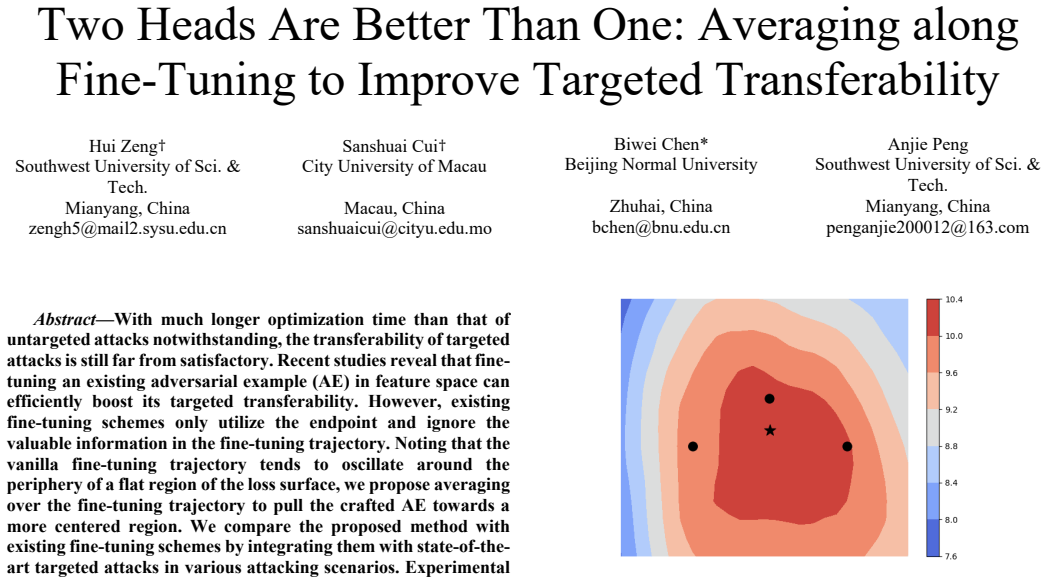
The load-bearing object is the exponential-decay trajectory average, Eq. (5), implemented online as $I'_{aaf,i} = \gamma I'_{aaf,i-1} + I'_{ft,i}$, after only $N_{wu}=5$ warm-up iterations. Averaging is applied to the same feature-space fine-tuning loop as FFT: an aggregate gradient combines target-class feature importance (with random patch masking and Gaussian smoothing) and source-class suppression, and each fine-tuning step maximizes the dot product between this combined gradient and the feature map. The mechanism proposed to explain the gain is that vanilla fine-tuning oscillates around the periphery of a flat region of the loss surface, while the weighted average of snapshots lands closer to the center of that region, which is more transferable.
What would settle it
Compute a quantitative flatness or centrality measure — for example, the average loss increase under random pixel perturbations, or the curvature of the logit surface — for the FFT endpoint and the AaF endpoint across many images and source models. If AaF endpoints are not systematically flatter or more central than FFT endpoints on that measure, the proposed mechanism is not supported even if transferability numbers improve.
Extended reading notes
Core claim
The paper's central claim is that the exponential moving average of adversarial images collected along the fine-tuning trajectory, computed as $I'_{aaf} = \gamma^{N_{ft}-1} I'_{ft,0} + \gamma^{N_{ft}-2} I'_{ft,1} + \cdots + I'_{ft,N_{ft}-1}$ with $\gamma=0.8$, yields an adversarial image located in a more centered region of the loss surface than the endpoint-only fine-tuning of FFT. In this centered region the image exhibits stronger transferability to held-out models. The claim is supported by consistent improvements in targeted success rate over five baseline attacks (CE, Logit, Margin, SupHigh, SU) when AaF is applied, with the largest gains on the weakest baselines; for example, transferring CE-based attacks from Dense121 to VGG16 rises from 11.3% to 50.3%.
Load-bearing premise
The method assumes that after only five warm-up fine-tuning iterations, every snapshot is a high-quality adversarial image, and that a fixed decay factor of 0.8 over their average reliably shifts the attack to a flatter, more central region of the loss surface; the only direct evidence offered is a handful of two-dimensional contour plots.
Editorial extensions
If this is right
- Any iterative targeted attack (CE, Logit, Margin, SupHigh, SU) can be upgraded to AaF by keeping a running average of fine-tuned snapshots, adding negligible computation.
- The weaker the baseline attack, the larger the transferability gain from AaF; the hardest transfer scenarios benefit most.
- Fine-tuned iterative attacks with AaF match or beat generative methods like TTP and C-GSP at low perturbation budgets ($\epsilon=8$).
- AaF also improves transferability when the surrogate is an adversarially trained model.
- The improvement holds across CNN architectures and extends to transformer-based victim models, though overall success rates remain low.
Reading between the lines
- Trajectory averaging here plays a role analogous to stochastic weight averaging in model training; the same trick could plausibly be applied to the fine-tuning stage of other intermediate-level attacks, such as ILA, to see whether centrality gains generalize.
- The flatness/centrality explanation is currently supported only by contour plots; a quantitative test would be to compare Hessian-based curvature or the loss increase under random perturbations for AaF versus FFT endpoints.
- A natural testable extension is to replace the fixed decay factor with an adaptive schedule based on validation transferability, or to use geometric averaging in the perturbation space rather than the image space.
Signed reviews
Editorial analysis
A structured set of objections, weighed in public.
Referee Report
Summary. The paper proposes AaF (Averaging along Fine-Tuning), a fine-tuning strategy for targeted adversarial attacks that averages the adversarial example (AE) over the fine-tuning trajectory rather than using only the endpoint as in FFT. The method is integrated with five baseline attacks (CE, Logit, Margin, SH, SU) and evaluated on CNN and transformer victim models, reporting consistent improvements over ILA and FFT and competitive performance with generative attacks such as TTP and C-GSP. The authors attribute the improvement to the averaged AE being located in a 'more centered region' of the loss surface, supported by 2D logit contour plots. The code is released.
Significance. If the reported gains are valid, AaF is a simple, low-overhead method that could improve targeted transferability across a broad range of attacks and architectures, with a plausible connection to flatness/centrality of the loss landscape. The paper includes a wide empirical comparison: five baselines, four surrogate architectures, multiple CNN and transformer victims, and a robust-surrogate setting. However, two load-bearing issues currently undermine the central comparison: an inconsistency in the fine-tuning iteration budget between AaF and FFT, and an unenforced L-infinity constraint on the averaged AE. These issues must be resolved before the empirical claims can be accepted.
major comments (4)
- [Sec. IV-A, Algorithm 1, Supplementary Sec. B] The fine-tuning iteration budget is inconsistent between AaF and the FFT baseline, potentially confounding the central comparison. Main text (Sec. IV-A) sets Nft=10 and states N_wu=5 warm-up iterations, but Algorithm 1 in the supplementary has no warm-up loop. The supplementary ablation (Sec. B) says that γ=0 'reduces to the vanilla FFT method with Nft=15', implying the ablation uses 15 fine-tuning iterations, not 10. If the AaF results in Tables I and II effectively use 5 warm-up + 10 averaged = 15 total fine-tuning iterations while the FFT baseline uses only 10, then the reported gains (e.g., CE+AaF 50.3% vs CE+FFT 34.8% for Dense121→VGG16) may be attributable to extra optimization steps rather than trajectory averaging. Please clarify exactly how many fine-tuning iterations each method uses, and provide a matched-budget comparison (e.g., FFT with 15 iterations, or AaF with only 10 total iterations).
- [Eq. (5), Algorithm 1] The proposed AaF average does not appear to be projected back into the L-infinity ball, violating the stated threat model. The weights in Eq. (5) sum to (1 - γ^{Nft})/(1 - γ), which for Nft=10 and γ=0.8 is approximately 4.6. If each snapshot I'_ft,i lies within the allowed ε-ball, the weighted sum can be several times larger than ε. Algorithm 1's recurrence (line 7) has no clipping or projection step, and the paper does not state that the final output is clipped. If the constraint is not enforced, AaF may produce perturbations that exceed the reported budget, giving it an unfair advantage over FFT and ILA. Please add an explicit projection step (or normalize the weights so the sum equals 1) and confirm that the reported experiments respect ||I'_aaf - I||_∞ ≤ ε.
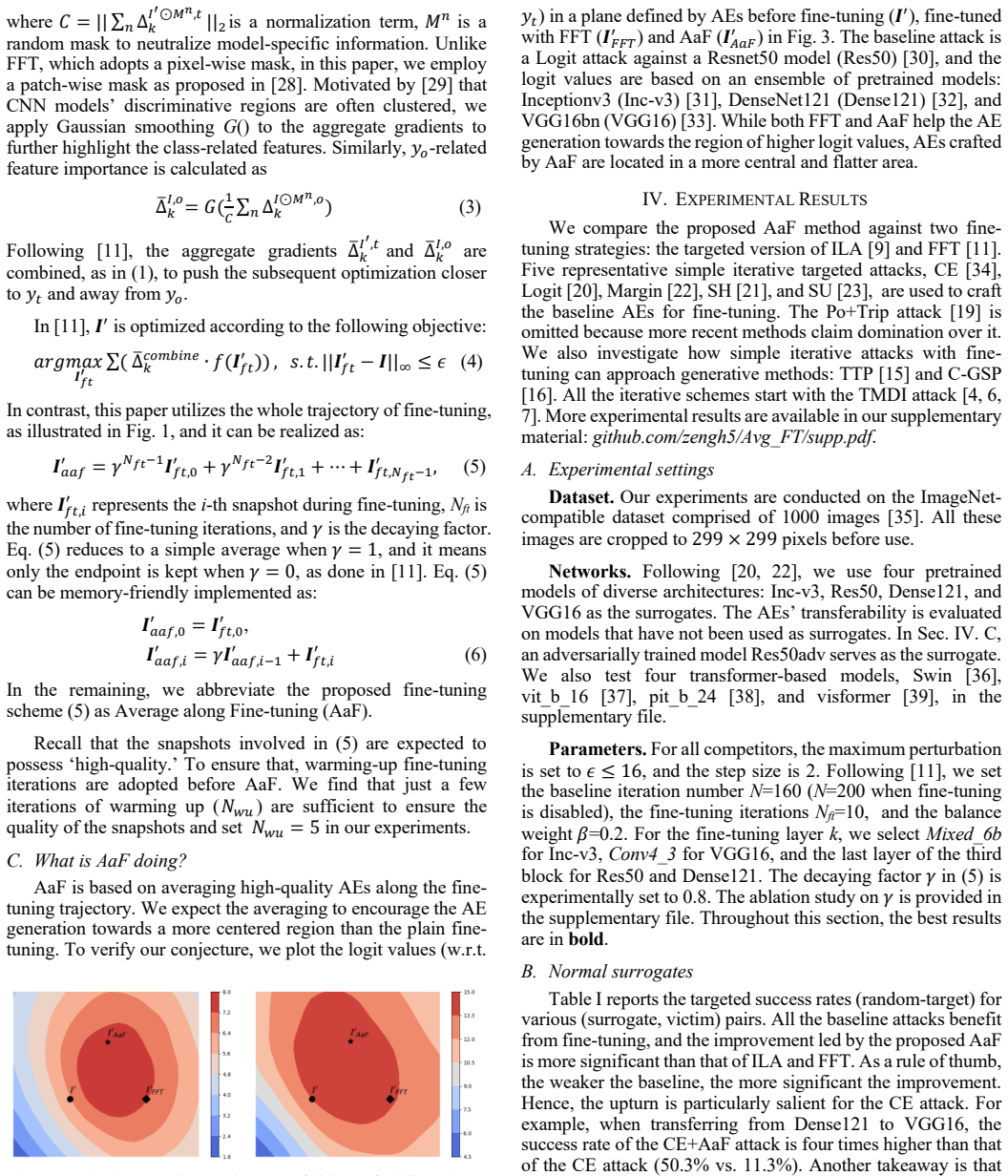
- [Fig. 3, Supplementary Sec. C] The mechanistic claim that AaF locates AEs in a 'more centered region' is supported only by qualitative 2D logit contour plots. The paper does not provide any quantitative measure of centrality, flatness, or the claimed trajectory behavior. To substantiate the explanation, please report quantitative metrics averaged over the test set, such as the trace of the Hessian of the logit loss, the variance of the logits in a local neighborhood, or the distance to the decision boundary, comparing FFT and AaF.
- [Sec. IV-A, Supplementary Fig. 1] The decaying factor γ is selected using the same victim models that appear in the main evaluation. The supplementary ablation computes transferability averaged over 'three hold-out models' and Swin, but Table I and the transformer results use those same victim models. This constitutes tuning on the evaluation set and can inflate the reported performance. Please perform the γ selection on a separate validation set of victim models, or show that the chosen γ=0.8 performs well across a range of unseen models without being selected on them.
minor comments (4)
- [Eq. (5) and Algorithm 1] In Algorithm 1, line 6 says 'Fine-tune I_aaf,t-1 with the optimization objective defined in (4) and obtain I'_ft,t', but the notation I'_ft,t is not explicitly defined in the loop. It would be clearer to state that I'_ft,t is the snapshot produced by one step of the fine-tuning optimization, and to specify whether it is clipped to the ε-ball.
- [Sec. IV-A] The sentence 'the baseline iteration number N=160 (N=200 when fine-tuning is disabled)' is ambiguous: it is not clear whether N refers to the total number of attack iterations including fine-tuning, or only to the baseline attack. Please state the total number of optimization steps for each configuration.
- [Supplementary Tables 1 and 2] The supplementary tables do not state which fine-tuning hyperparameters (Nft, N_wu, γ) were used for the transformer and most-difficult-target experiments. Please include these settings or refer to the main-text parameters.
- [Fig. 3 and Supplementary Fig. 2] The contour plots would benefit from a color scale or numeric labels on the logit contours, and from marking the original image and the target-class direction, so that the 'central region' claim is visually verifiable.
Circularity Check
No significant circularity: the AaF improvement is tested against external baselines and does not reduce to the FFT endpoint by construction, though gamma is tuned on the evaluation victims and the fine-tuning budget wording is inconsistent.
full rationale
The core AaF update, Eq. (5), is an exponentially weighted average of FFT snapshots; with gamma=0 it intentionally reduces to the endpoint-only FFT of the authors' prior work [11], which is a published baseline rather than an unverified premise. The central comparison is external: AaF is evaluated against ILA, FFT, TTP, and C-GSP on hold-out victim models (Tables I-III and supplementary Tables 1-2), and the reported improvements do not follow from Eq. (5) by construction. Two non-circularity caveats are noted. First, gamma=0.8 is selected from the supplementary ablation (Fig. 1) using the same hold-out models that appear in the main tables, which is a selection-on-the-test-set risk but not a definitional reduction; the gains persist across gamma in [0.4,0.8]. Second, the supplementary statement that gamma=0 reduces to vanilla FFT with Nft=15 conflicts with the main-text setting Nft=10, and Algorithm 1 omits the N_wu=5 warm-up. If AaF effectively uses 15 fine-tuning steps while the FFT baseline uses 10, part of the reported margin could be an optimization-budget artifact rather than evidence for trajectory averaging. That is an experimental confound, not a circularity. The self-citation to [11] supplies the base fine-tuning scheme but is not load-bearing for the averaging claim, which stands on external comparisons.
Assumptions & free parameters
free parameters (6)
- gamma (decaying factor) =
0.8
- N_wu (warm-up iterations) =
5
- Nft (fine-tuning iterations) =
10
- beta (balance weight) =
0.2
- fine-tuning layer k =
Mixed_6b / Conv4_3 / third block
- mask and smoothing hyperparameters =
not specified
assumptions (5)
- domain assumption AE optimization in pixel space is analogous to DNN weight optimization, so averaging tricks from weight space transfer to adversarial examples.
- domain assumption The fine-tuning trajectory snapshots after N_wu warm-up iterations are high-quality and their average lies in a flatter, more central region of the loss surface that transfers better.
- domain assumption Aggregate gradients computed with patch-wise random masks and Gaussian smoothing capture class-related feature importance that transfers across architectures.
- domain assumption Targeted success rate on the chosen ImageNet-compatible 1000 images and hold-out models is the correct and sufficient measure of transferability.
- domain assumption The loss-surface flatness/centrality visualized in 2D subspaces is what causes the observed transferability improvement.
Cite this review
Pith. "Pith review of Two Heads Are Better Than One: Averaging along Fine-Tuning to Improve Targeted Transferability." pith.science (2026). https://pith.science/paper/FVLISK2I
@misc{pith2026241220807,
  author       = {Pith},
  title        = {Pith review of: Two Heads Are Better Than One: Averaging along Fine-Tuning to Improve Targeted Transferability},
  year         = {2026},
  howpublished = {\url{https://pith.science/paper/FVLISK2I}},
  note         = {Machine review of arXiv:2412.20807}
}
read the original abstract
With much longer optimization time than that of untargeted attacks notwithstanding, the transferability of targeted attacks is still far from satisfactory. Recent studies reveal that fine-tuning an existing adversarial example (AE) in feature space can efficiently boost its targeted transferability. However, existing fine-tuning schemes only utilize the endpoint and ignore the valuable information in the fine-tuning trajectory. Noting that the vanilla fine-tuning trajectory tends to oscillate around the periphery of a flat region of the loss surface, we propose averaging over the fine-tuning trajectory to pull the crafted AE towards a more centered region. We compare the proposed method with existing fine-tuning schemes by integrating them with state-of-the-art targeted attacks in various attacking scenarios. Experimental results uphold the superiority of the proposed method in boosting targeted transferability. The code is available at github.com/zengh5/Avg_FT.
Figures

Reference graph
Works this paper leans on
-
[1]
Intriguing properties of neural networks,
C. Szegedy, W. Zaremba, I. Sutskever, et al., “Intriguing properties of neural networks,” Int. Conf. on Learning Representations, 2014
work page 2014
-
[2]
Towards deep learning models resistant to adversarial attacks,
A. Madr y, A. Makelov, L. Schmidt, et al., “Towards deep learning models resistant to adversarial attacks,” Int. Conf. on Learning Representations, 2018
work page 2018
-
[3]
Some methods of speeding up the convergence of iteration methods,
B. T. Polyak. “Some methods of speeding up the convergence of iteration methods,” USSR Computational Mathemat ics & Mathematical Physics, 1964, 4(5):1–17
work page 1964
-
[4]
Boosting adversarial attacks with momentum,
Y. Dong, F. Liao, T. Pang, et al., “Boosting adversarial attacks with momentum,” IEEE/CVF conf. Computer Vision and Pattern Recognition, 2018, pp. 9185–9193
work page 2018
-
[5]
Nesterov accelerated gradient and scale invariance for adversarial attacks,
J. Lin, C. Song, K. He, et al., “Nesterov accelerated gradient and scale invariance for adversarial attacks,” Int. Conf. on Learning Representations, 2020, arXiv: 1908.06281
arXiv 2020
-
[6]
Improving transferability of adversarial examples with input diversity,
C. Xie, Z. Zhang, Y. Zhou, et al., “Improving transferability of adversarial examples with input diversity,” IEEE/CVF Conf. Computer Vision and Pattern Recognition, 2019, pp. 2725–2734
work page 2019
-
[7]
Evading defenses to transferable adversarial examples by translation -invariant attacks,
Y. Dong, T. Pang, H. Su, et al., “Evading defenses to transferable adversarial examples by translation -invariant attacks,” IEEE/CVF Conf. Computer Vision and Pattern Recognition, 2019, pp. 4307–4316
work page 2019
-
[8]
Learning with pseudo- ensembles,
P. Bachman, O. Alsharif, and D. Precup. “Learning with pseudo- ensembles,” Advances in Neural Inf. Processing Systems, 2014, pp. 3365–3373
work page 2014
Show all 41 references
-
[9]
Enhancing adversarial example transferability with an intermediate level attack,
Q. Huang, I. Katsman, Z. Gu, et al., “Enhancing adversarial example transferability with an intermediate level attack,” IEEE Int. Conf. on Computer Vision, 2019, pp. 4732–4741
2019
-
[10]
Yet another intermediate -level attack,
Q. Li, Y. Guo, and H. Chen, “Yet another intermediate -level attack,” European Conf. on Computer Vision, 2020, pp. 241–257
2020
-
[11]
Enhancing targeted transferability via feature spa ce fine -tuning,
H. Zeng, B. Chen, A. Peng, “Enhancing targeted transferability via feature spa ce fine -tuning,” IEEE Int. Conf. on Acoustics, Speech and Signal Processing, 2024, pp. 4475–4479
2024
-
[12]
Averaging weights leads to wider optima and better generalization,
P. Izmailov, D. Podoprikhin, T. Garipov, et al., “Averaging weights leads to wider optima and better generalization,” Uncertainty in Artificial Intelligence, 2018, arXiv:1803.05407
2018 arXiv
-
[13]
There are many consistent explanations of unlabeled data: why you should average,
B. Athiwaratkun M. Finzi, and P. Izmailov, et al., “There are many consistent explanations of unlabeled data: why you should average,” Int. Conf. on Learning Representations, 2019
2019
-
[14]
Transferable perturbations of deep feature distributions,
N. Inkawhich, K. J. Liang, L. Carin, and Y. Chen, “Transferable perturbations of deep feature distributions,” Int. Conf. on Learning Representations, 2020
2020
-
[15]
On generating transferable targeted perturbations,
M. Naseer, S. Khan, M. Hayat, et al., “On generating transferable targeted perturbations,” IEEE Int. Conf. on Computer Vision , 2021, pp. 7688–7697
2021
-
[16]
Boosting transferability of targeted adversarial examples via hierarchical generative network,
X. Yang, Y. Dong, T. Pang, et al., “Boosting transferability of targeted adversarial examples via hierarchical generative network,” Euro. Conf. on Computer Vision, 2022, pp. 725–742
2022
-
[17]
LFAA: crafting transferable targeted adversarial examples with low-frequency perturbations,
K. Wang J. Shi, and W. Wang, “LFAA: crafting transferable targeted adversarial examples with low-frequency perturbations,” the 26th Euro. Conf. on Artificial Intelligence . 2023, pp. 2483 – 2490
2023
-
[18]
Towards evaluating the robustness of neural networks,
N. Carlini and David Wagner, “Towards evaluating the robustness of neural networks,” IEEE Symposium on Security and Privacy, 2017, pp. 39–57
2017
-
[19]
Towards transferable targeted attack,
M. Li, C. Deng, T. Li, et al., “Towards transferable targeted attack,” IEEE/CVF Conf. on Computer Vision and Pattern Recognition, 2020, pp. 638–646
2020
-
[20]
On success and simplicity: a second look at transferable targeted attacks,
Z. Zhao, Z. Liu, and M. Larson, “On success and simplicity: a second look at transferable targeted attacks,” Advances in Neural Information Processing Systems, 2021, 34: 6115–6128
2021
-
[21]
Enhancing targeted transferability via suppressing high-confidence labels,
H. Zeng, T. Zhang, B. Chen, et al., “Enhancing targeted transferability via suppressing high-confidence labels,” Int. Conf. on Image Processing, 2023, pp. 3309–3313
2023
-
[22]
Logit margin matters: Improving transferable targeted adversarial attack by logit calibration,
J. Weng, Z. Luo, Z. Zhong, et al. , “Logit margin matters: Improving transferable targeted adversarial attack by logit calibration,” IEEE Trans. Inf. For. and Sec, 2023, 18: 3561–3574
2023
-
[23]
Enhancing the self -universality for transferable t argeted attacks,
Z. Wei, J. Chen, Z. Wu, et al., “Enhancing the self -universality for transferable t argeted attacks,” IEEE/CVF Conf. Computer Vision and Pattern Recognition, 2023, pp. 12281–12290
2023
-
[24]
Feature space perturbations yield more transferable adversarial examples
N. Inkawhich, W. Wen, H. Li, et al., “Feature space perturbations yield more transferable adversarial examples” IEEE/CVF Conf. Computer Vision and Pattern Recognition, 2019, pp. 7059–7067
2019
-
[25]
Introducing competition to boost the transferability of targeted adversarial examples through clean feature mixup,
J. Byun, M. Kwon, S. Cho, et al., “Introducing competition to boost the transferability of targeted adversarial examples through clean feature mixup,” IEEE/CVF Conf. on Computer Vision and Pattern Recognition, 2023, pp. 24648–24657
2023
-
[26]
Conditional generative adversarial nets
M. Mirza and S. Osindero, “Conditional generative adversarial nets” arXiv: 1411.1784, 2014
2014 arXiv
-
[27]
Delving into transferable adversarial examples and black -box attacks,
Y. Liu, X. Chen, C. Liu, and D. Song, “Delving into transferable adversarial examples and black -box attacks,” Int. Conf. on Learning Representations, 2017
2017
-
[28]
Enhancing the transferability of adversarial examples with random patch,
Y. Zhang, Y. Tan, T. Chen, et al., “Enhancing the transferability of adversarial examples with random patch,” Int. Joint Conf. on Artificial Intelligence, 2022, pp. 1672–1678
2022
-
[29]
Patch -wise attack for fooling deep neural network,
L. Gao, Q. Zhang, J. Song, et al., “Patch -wise attack for fooling deep neural network,” Euro. Conf. on Computer Vision, 2020, pp. 307–322
2020
-
[30]
Deep residual learning for image recognition,
K. He, X. Zhang, S. Ren, et al., “Deep residual learning for image recognition,” IEEE/CVF Conf. Computer Vision and Pattern Recognition, 2016, pp. 770–778
2016
-
[31]
Rethinking the inception architecture for computer vision,
C. Szegedy, V. Vanhoucke, S. Ioffe, et al ., “Rethinking the inception architecture for computer vision,” IEEE/CVF Conf. Computer Vision and Pattern Recognition, 2016, pp. 2818–2826
2016
-
[32]
Densely connected convolutional networks,
G. Huang, Z. Liu, V. Laurens, and K. Q. Weinberger, “Densely connected convolutional networks,” IEEE/CVF Conf. Computer Vision and Pattern Recognition, 2017, pp. 2261–2269
2017
-
[33]
Very deep convolutional networks for large -scale image recognition,
K. Simonyan, A. Zisserman, “Very deep convolutional networks for large -scale image recognition,” Int. Conf. on Learning Representations, 2015
2015
-
[34]
Adversarial exam ples in the physical world,
A. Kurakin, I. Goodfellow, S. Bengio, “Adversarial exam ples in the physical world,” Int. Conf. on Learning Representations ,
-
[35]
https://github.com/cleverhans-lab/cleverhans/tree/master/clever hans_v3.1.0/examples/nips17_adversarial_competition/dataset
-
[36]
Swin transformer: Hierarchical vision transformer using shifted windows,
Z. Liu, Y. Lin, Y. Gao, et al., “Swin transformer: Hierarchical vision transformer using shifted windows,” IEEE Int. Conf. on Computer Vision, 2021, pp.10012–10022
2021
-
[37]
An image is worth 16x16 words: Transformers for image recognition at scale,
A. Dosovitskiy, L. Beyer, A. Kolesnikov, et al ., “An image is worth 16x16 words: Transformers for image recognition at scale,” Int. Conf. on Learning Representations, 2021
2021
-
[38]
Rethinking spatial dimensions of vision transformers,
B. Heo, S. Yun, D. Han, et al., “Rethinking spatial dimensions of vision transformers,” IEEE Int. Conf. on Computer Vision, 2021, pp. 11916–11925
2021
-
[39]
Visformer: The vision-friendly transformer,
Z. Chen, L. Xie, J. Niu, et al., “Visformer: The vision-friendly transformer,” IEEE Int. Conf. on Computer Vision , 2021, pp. 569–578
2021
-
[40]
A little robustness goes a long way: Leveraging robust features for targeted transfer attacks,
J. M. Springer, M. Mitchell, G. T. Kenyon, “A little robustness goes a long way: Leveraging robust features for targeted transfer attacks,” the 35th Conf. on Neural Inform ation Processing Systems, 2021. pp. 9759–9773. The supplementary document consists of six parts of cont...
2021
-
[41]
The target label for all samples is ‘hippopotamus.’ The perturbations introduced by TTP are more suspicious under human inspection , while th ose introduced by the iterative methods resemble noise. Fig. 2. The logit plane of AEs with different fine-tuning schemes.The baseline ...
Reviewed August 10, 2026 · model on record in the stance chip above.
Discussion (0). Continue with ORCID to comment.