Superconductivity and non-Fermi liquid metals in a charge-1/3 anyon fluid
Pith reviewed 2026-06-26 15:24 UTC · model grok-4.3
The pith
Doping the 2/3 Jain fractional Chern insulator yields an SC* state with charge-2e condensation coexisting with residual Z2 topological order.
A machine-rendered reading of the paper's core claim, the machinery that carries it, and where it could break.
Core claim
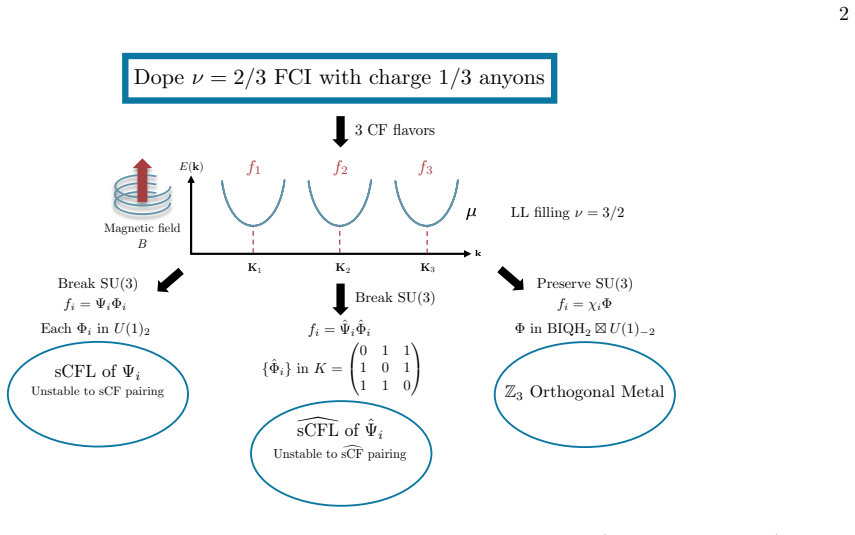
We revisit the charge-1/3 anyon fluid obtained by doping the nu = 2/3 Jain fractional Chern insulator. In the standard composite fermion description the doped anyons fractionalize into three translation-related flavors of secondary composite fermions whose gauge-mediated interactions drive a robust inter-flavor pairing instability. We consider an alternative flavor-symmetric paired state and show that it is an SC* state: a charge-2e condensate that coexists with residual Z2 topological order. The weak and strong pairing regimes share the same intrinsic topological order but differ in chiral central charge, giving c_- = 7/2 and c_- = 2. We further show how other proposed effective field theor
What carries the argument
Flavor-symmetric inter-flavor pairing instability among three translation-related flavors of secondary composite fermions, driven by gauge-mediated interactions.
If this is right
- Across the doping-driven FCI-to-superconductor transition localized anyons evolve into Bogoliubov quasiparticles rather than vortices.
- The SC* state maintains the same intrinsic topological order in both weak and strong pairing limits while the chiral central charge changes from 7/2 to 2.
- Other proposed effective field theories for the doped system can be incorporated into the same composite fermion framework.
- An approximate SU(3)-symmetric non-Fermi liquid Z3 Orthogonal Metal with three charge-1/3 pockets appears at low doping.
Where Pith is reading between the lines
- Transport or thermodynamic measurements in moire materials could search for the coexistence of superconductivity and residual Z2 order as a signature of the SC* phase.
- The absence of sharp electron quasiparticles in the low-doping orthogonal metal offers a concrete way to distinguish it from conventional Fermi liquids.
- The composite-fermion organization may allow quantitative comparison of the energetics of the SC* state against competing charge-ordered or flavor-asymmetric phases.
Load-bearing premise
The gauge-mediated interactions between the three flavors of secondary composite fermions drive a robust inter-flavor pairing instability that selects the flavor-symmetric channel.
What would settle it
Observation of sharp electron quasiparticles persisting into the low-doping regime would rule out the Z3 Orthogonal Metal description.
Figures
read the original abstract
We revisit the charge-1/3 anyon fluid obtained by doping the $\nu = 2/3$ Jain fractional Chern insulator (FCI). In the standard composite fermion description, the doped anyons fractionalize into three translation-related flavors of secondary composite fermions, whose gauge-mediated interactions drive a robust inter-flavor pairing instability. In our previous work, we analyzed a flavor-asymmetric paired state and obtained a charge-ordered Fermi liquid. Inspired by a recent paper, we consider an alternative flavor-symmetric paired state and show that it is an SC* state: a charge-$2e$ condensate that coexists with residual $\mathbb{Z}_2$ topological order. The weak and strong pairing regimes share the same intrinsic topological order but differ in chiral central charge, giving $c_- = 7/2$ and $c_- = 2$. We further show how other proposed effective field theories fit within the same composite fermion description, and argue that across the doping driven FCI-to-superconductor transition, localized anyons evolve into Bogoliubov quasiparticles rather than vortices. At low doping, we identify an approximate SU(3)-symmetric regime in which the system instead realizes a non-Fermi liquid $\mathbb{Z}_3$ Orthogonal Metal with three charge-1/3 fermion pockets and no sharp electron quasiparticle. Finally, we comment on the energetics of various possible ground states and discuss implications for experiments in moire materials.
Editorial analysis
A structured set of objections, weighed in public.
Referee Report
Summary. The paper claims that doping the ν=2/3 Jain FCI produces a charge-1/3 anyon fluid in which three flavors of secondary composite fermions undergo gauge-mediated inter-flavor pairing. The flavor-symmetric channel yields an SC* state (charge-2e condensate coexisting with residual Z₂ topological order). Weak- and strong-pairing regimes share the same intrinsic topological order but differ in chiral central charge (c₋=7/2 and c₋=2). Localized anyons evolve into Bogoliubov quasiparticles across the FCI-to-superconductor transition. At low doping an approximate SU(3)-symmetric regime realizes a non-Fermi-liquid Z₃ Orthogonal Metal with three charge-1/3 fermion pockets. The work also embeds other proposed EFTs in the same CF framework and comments on energetics and moiré-material implications.
Significance. If the pairing-channel selection and topological identifications hold, the manuscript supplies a unified composite-fermion route from doped FCIs to SC* states and NFL metals, extending the authors’ prior flavor-asymmetric analysis and incorporating alternative EFTs. The explicit statements on anyon-to-quasiparticle evolution and the two values of c₋ constitute concrete, falsifiable content relevant to moiré experiments.
major comments (2)
- [Abstract and introductory discussion of pairing instability] Abstract and the paragraph introducing the three flavors of secondary composite fermions: the claim that gauge-mediated interactions 'drive a robust inter-flavor pairing instability' that selects the flavor-symmetric channel is asserted without an explicit pairing kernel, RG flow, or eigenvalue comparison against asymmetric channels. This selection is load-bearing for the subsequent identification of the SC* state, the shared intrinsic topological order, the two values of c₋, and the Z₃ Orthogonal Metal.
- [SC* state and topological order derivation] The section deriving the SC* state: the statement that weak- and strong-pairing regimes share the same intrinsic topological order while differing only in c₋ requires an explicit accounting of how the residual Z₂ order is preserved under the flavor-symmetric pairing and how the central charges are obtained from the composite-fermion spectrum.
minor comments (2)
- [Throughout] Notation for topological orders (Z₂ versus ℤ_{2}) and newly introduced terms (SC*, Z₃ Orthogonal Metal) should be defined at first use and used consistently.
- [Energetics and experimental implications] The final comments on energetics would be strengthened by at least qualitative comparison of energy scales between the proposed states and the flavor-asymmetric Fermi liquid of the authors’ prior work.
Simulated Author's Rebuttal
We thank the referee for the careful reading and for highlighting the significance of the work. We address the two major comments below and indicate the revisions that will be made.
read point-by-point responses
-
Referee: [Abstract and introductory discussion of pairing instability] Abstract and the paragraph introducing the three flavors of secondary composite fermions: the claim that gauge-mediated interactions 'drive a robust inter-flavor pairing instability' that selects the flavor-symmetric channel is asserted without an explicit pairing kernel, RG flow, or eigenvalue comparison against asymmetric channels. This selection is load-bearing for the subsequent identification of the SC* state, the shared intrinsic topological order, the two values of c₋, and the Z₃ Orthogonal Metal.
Authors: We agree that the manuscript asserts the selection of the flavor-symmetric channel without a new explicit pairing kernel or RG eigenvalue analysis. This choice is motivated by the flavor-blind nature of the gauge-mediated interactions in the composite-fermion framework together with the topological requirements of the SC* state (as inspired by the referenced recent paper). We will revise the introductory discussion to state explicitly that a full microscopic channel comparison lies outside the present scope, while clarifying the symmetry-based rationale for focusing on the symmetric channel and its consequences for the subsequent constructions. revision: partial
-
Referee: [SC* state and topological order derivation] The section deriving the SC* state: the statement that weak- and strong-pairing regimes share the same intrinsic topological order while differing only in c₋ requires an explicit accounting of how the residual Z₂ order is preserved under the flavor-symmetric pairing and how the central charges are obtained from the composite-fermion spectrum.
Authors: We will expand the SC* derivation section to supply the requested step-by-step accounting. The residual Z₂ order follows from the fact that the flavor-symmetric pairing condenses charge-2e pairs while the underlying anyonic braiding phases of the charge-1/3 particles remain unbroken; the two values of c₋ are obtained by counting the chiral edge modes contributed by the three flavors of composite fermions in the weak-pairing (c₋=7/2) versus strong-pairing (c₋=2) regimes. The revised text will make this counting and the preservation of Z₂ explicit. revision: yes
Circularity Check
No significant circularity; derivation chain remains self-contained.
full rationale
The paper presents the flavor-symmetric paired state as a new construction analyzed within the standard composite-fermion framework, distinct from the authors' prior flavor-asymmetric analysis. Assertions regarding gauge-mediated pairing instability and resulting SC* topological order follow from the setup without reducing to self-definition, fitted inputs renamed as predictions, or load-bearing self-citations that substitute for independent content. No equations or steps exhibit the specific reductions required for circularity flags under the enumerated patterns.
Axiom & Free-Parameter Ledger
axioms (2)
- domain assumption The composite fermion description applies to the doped anyon fluid obtained from the ν=2/3 Jain FCI.
- domain assumption Gauge-mediated interactions between flavors produce a robust inter-flavor pairing instability.
invented entities (2)
-
SC* state
no independent evidence
-
Z3 Orthogonal Metal
no independent evidence
Reference graph
Works this paper leans on
-
[1]
Comments on energetics In both tMoTe 2 and the multilayer rhombohedral graphene platform, several Jain states as well as the Com- posite Fermi Liquid are seen. This experimental input suggests 7 that upon doping from 2/3 filling toward 1/2, the standard CF formalism is likely an excellent starting point in describing the energetics of existing experimen- ...
-
[2]
In the adiabatic limit of the skyrmion crystal model for twisted MoTe2, Refs
Numerics Existing numerical works [64–66] mostly focus on a bandwidth-tuned transition at fixed filling from theν= 2/3 Jain FCI to a chiral topological superconductor with c− =−1/2. In the adiabatic limit of the skyrmion crystal model for twisted MoTe2, Refs. [64, 66] provide evidence that this transition is strongly first order, and assert that it has no...
-
[3]
[38], as well as in Ref
Experiments Experimentally, superconductivity has been re- ported [63] near the 2/3 FQAH state in tMoTe2, and has been interpreted by us in Ref. [38], as well as in Ref. [37], in terms of anyon-driven superconductivity. Accepting thatsomeanyonic mechanism is at play, we can ask which of the various SCs summarized in Table I is actually re- alized. Unfortu...
-
[4]
Beyond superconductivity Going beyond superconductivity, it will also be interesting to look for the SU(3)-symmetric Z3OM in the vicinity of the 2/3 or 1/3 FCI. This non-Fermi liquid metal has roughly the same Hall conductivity as the parent FCI but has a metallicρ xx, despite the absence of sharp peaks in the momentum-resolved electron spectral function....
-
[5]
J. Cai, E. Anderson, C. Wang, X. Zhang, X. Liu, W. Holtzmann, Y. Zhang, F. Fan, T. Taniguchi, K. Watanabe, Y. Ran, T. Cao, L. Fu, D. Xiao, W. Yao, and X. Xu, Signatures of fractional quantum anomalous Hall states in twisted MoTe 2, Nature (London)622, 63 (2023), arXiv:2304.08470 [cond-mat.mes-hall]
arXiv 2023
-
[6]
H. Park, J. Cai, E. Anderson, Y. Zhang, J. Zhu, X. Liu, C. Wang, W. Holtzmann, C. Hu, Z. Liu, T. Taniguchi, 8 K. Watanabe, J.-H. Chu, T. Cao, L. Fu, W. Yao, C.- Z. Chang, D. Cobden, D. Xiao, and X. Xu, Observa- tion of fractionally quantized anomalous Hall effect, Na- ture (London)622, 74 (2023), arXiv:2308.02657 [cond- mat.mes-hall]
arXiv 2023
-
[7]
F. Xu, Z. Sun, T. Jia, C. Liu, C. Xu, C. Li, Y. Gu, K. Watanabe, T. Taniguchi, B. Tong, J. Jia, Z. Shi, S. Jiang, Y. Zhang, X. Liu, and T. Li, Observation of Integer and Fractional Quantum Anomalous Hall Effects in Twisted Bilayer MoTe2, Physical Review X13, 031037 (2023), arXiv:2308.06177 [cond-mat.mes-hall]
arXiv 2023
-
[8]
Y. Zeng, Z. Xia, K. Kang, J. Zhu, P. Kn¨ uppel, C. Vaswani, K. Watanabe, T. Taniguchi, K. F. Mak, and J. Shan, Thermodynamic evidence of fractional chern in- sulator in moir´ emote2, Nature622, 69 (2023)
2023
-
[9]
Z. Lu, T. Han, Y. Yao, A. P. Reddy, J. Yang, J. Seo, K. Watanabe, T. Taniguchi, L. Fu, and L. Ju, Fractional quantum anomalous Hall effect in multilayer graphene, Nature (London)626, 759 (2024), arXiv:2309.17436 [cond-mat.mes-hall]
arXiv 2024
-
[10]
Z. Lu, T. Han, Y. Yao, Z. Hadjri, J. Yang, J. Seo, L. Shi, S. Ye, K. Watanabe, T. Taniguchi, and L. Ju, Ex- tended quantum anomalous Hall states in graphene/hBN moir´ e superlattices, Nature (London)637, 1090 (2025), arXiv:2408.10203 [cond-mat.mes-hall]
arXiv 2025
-
[11]
K. Sun, Z. Gu, H. Katsura, and S. Das Sarma, Nearly flatbands with nontrivial topology, Phys. Rev. Lett.106, 236803 (2011)
2011
-
[12]
D. N. Sheng, Z.-C. Gu, K. Sun, and L. Sheng, Fractional quantum Hall effect in the absence of Landau levels, Nature Communications2, 389 (2011), arXiv:1102.2658 [cond-mat.str-el]
Pith/arXiv arXiv 2011
-
[13]
N. Regnault and B. A. Bernevig, Fractional Chern Insula- tor, Physical Review X1, 021014 (2011), arXiv:1105.4867 [cond-mat.str-el]
Pith/arXiv arXiv 2011
-
[14]
E. Tang, J.-W. Mei, and X.-G. Wen, High-Temperature Fractional Quantum Hall States, Phys. Rev. Lett.106, 236802 (2011), arXiv:1012.2930 [cond-mat.str-el]
Pith/arXiv arXiv 2011
-
[15]
Y.-F. Wang, Z.-C. Gu, C.-D. Gong, and D. N. Sheng, Fractional Quantum Hall Effect of Hard-Core Bosons in Topological Flat Bands, Phys. Rev. Lett.107, 146803 (2011), arXiv:1103.1686 [cond-mat.str-el]
Pith/arXiv arXiv 2011
-
[16]
T. Neupert, L. Santos, C. Chamon, and C. Mudry, Frac- tional Quantum Hall States at Zero Magnetic Field, Phys. Rev. Lett.106, 236804 (2011), arXiv:1012.4723 [cond-mat.str-el]
Pith/arXiv arXiv 2011
-
[17]
E. J. Bergholtz and Z. Liu, Topological Flat Band Models and Fractional Chern Insulators, International Journal of Modern Physics B27, 1330017 (2013), arXiv:1308.0343 [cond-mat.str-el]
Pith/arXiv arXiv 2013
-
[18]
S. A. Parameswaran, R. Roy, and S. L. Sondhi, Fractional quantum Hall physics in topological flat bands, Comptes Rendus Physique14, 816 (2013), arXiv:1302.6606 [cond- mat.str-el]
Pith/arXiv arXiv 2013
-
[19]
E. M. Spanton, A. A. Zibrov, H. Zhou, T. Taniguchi, K. Watanabe, M. P. Zaletel, and A. F. Young, Observa- tion of fractional Chern insulators in a van der Waals het- erostructure, Science360, 62 (2018), arXiv:1706.06116 [cond-mat.str-el]
Pith/arXiv arXiv 2018
-
[20]
Y. Xie, A. T. Pierce, J. M. Park, D. E. Parker, E. Khalaf, P. Ledwith, Y. Cao, S. H. Lee, S. Chen, P. R. Forrester, K. Watanabe, T. Taniguchi, A. Vishwanath, P. Jarillo- Herrero, and A. Yacoby, Fractional Chern insulators in magic-angle twisted bilayer graphene, Nature (London) 600, 439 (2021), arXiv:2107.10854 [cond-mat.mes-hall]
arXiv 2021
-
[21]
S. H. Aronson, T. Han, Z. Lu, Y. Yao, K. Watan- abe, T. Taniguchi, L. Ju, and R. C. Ashoori, Dis- placement field-controlled fractional Chern insulators and charge density waves in a graphene/hBN moir´ e superlattice, arXiv e-prints , arXiv:2408.11220 (2024), arXiv:2408.11220 [cond-mat.mes-hall]
arXiv 2024
-
[22]
S. H. Aronson, T. Han, Z. Lu, Y. Yao, J. P. Butler, K. Watanabe, T. Taniguchi, L. Ju, and R. C. Ashoori, Displacement field-controlled fractional chern insulators and charge density waves in a graphene/hbn moir´ e su- perlattice, Phys. Rev. X15, 031026 (2025)
2025
-
[23]
J. P. Butler, T. Han, A. DiFabbio, Z. Hadjri, E. Aitken, K. Watanabe, T. Taniguchi, L. Ju, and R. C. Ashoori, 1/3 Fractional and Gapless Integer Quantum Anoma- lous Hall States in Rhombohedral Graphene, arXiv e-prints , arXiv:2606.06450 (2026), arXiv:2606.06450 [cond-mat.mes-hall]
Pith/arXiv arXiv 2026
-
[24]
Z. D. Shi and T. Senthil, Doping a Fractional Quantum Anomalous Hall Insulator, Physical Review X15, 031069 (2025), arXiv:2409.20567 [cond-mat.str-el]
arXiv 2025
-
[25]
M.-L. Schleith, T. Soejima, and E. Khalaf, Anyon dispersion from non-uniform magnetic field on the sphere, arXiv e-prints , arXiv:2506.11211 (2025), arXiv:2506.11211 [cond-mat.str-el]
arXiv 2025
-
[26]
M. Gon¸ calves, J. F. Mendez-Valderrama, J. Herzog- Arbeitman, J. Yu, X. Xu, D. Xiao, B. A. Bernevig, and N. Regnault, Spinless and spinful charge exci- tations in moir´ e Fractional Chern Insulators, arXiv e-prints , arXiv:2506.05330 (2025), arXiv:2506.05330 [cond-mat.str-el]
Pith/arXiv arXiv 2025
-
[27]
Z. Yan, Q. Li, T. Soejima, and E. Khalaf, Anyon Dis- persion in Aharonov-Casher Bands and Implications for Twisted MoTe 2, arXiv e-prints , arXiv:2512.15863 (2025), arXiv:2512.15863 [cond-mat.str-el]
arXiv 2025
-
[28]
K. Iyer, A. Feuerpfeil, V. Cr´ epel, N. Regnault, and C. Mora, Dispersion of Anyon Bloch Bands, arXiv e-prints , arXiv:2604.24859 (2026), arXiv:2604.24859 [cond-mat.mes-hall]
Pith/arXiv arXiv 2026
-
[29]
T. Wang and T. Senthil, Measuring anyon dispersion with tunneling probes, arXiv preprint arXiv:2605.29017 (2026)
Pith/arXiv arXiv 2026
-
[30]
R. B. Laughlin, Superconducting ground state of non- interacting particles obeying fractional statistics, Phys. Rev. Lett.60, 2677 (1988)
1988
-
[31]
Lee and M
D.-H. Lee and M. P. A. Fisher, Anyon superconductivity and the fractional quantum hall effect, Phys. Rev. Lett. 63, 903 (1989)
1989
-
[32]
A. L. Fetter, C. B. Hanna, and R. B. Laughlin, Random- phase approximation in the fractional-statistics gas, Phys. Rev. B39, 9679 (1989)
1989
-
[33]
Y.-H. Chen, F. Wilczek, E. Witten, and B. I. Halperin, On Anyon Superconductivity, International Journal of Modern Physics A4, 3983 (1989)
1989
-
[34]
X. G. Wen and A. Zee, Compressibility and superfluidity in the fractional-statistics liquid, Phys. Rev. B41, 240 (1990)
1990
-
[35]
E. Tang and X.-G. Wen, Superconductivity with intrinsic topological order induced by pure Coulomb interaction and time-reversal symmetry breaking, Phys. Rev. B88, 195117 (2013), arXiv:1306.1528 [cond-mat.str-el]
Pith/arXiv arXiv 2013
-
[36]
S. Divic, V. Cr´ epel, T. Soejima, X.-Y. Song, A. J. Mil- lis, M. P. Zaletel, and A. Vishwanath, Anyon super- conductivity from topological criticality in a Hofstadter- 9 Hubbard model, Proceedings of the National Academy of Science122, e2426680122 (2025), arXiv:2410.18175 [cond-mat.str-el]
arXiv 2025
-
[37]
M. Kim, A. Timmel, L. Ju, and X.-G. Wen, Topological chiral superconductivity beyond pairing in a Fermi liq- uid, Phys. Rev. B111, 014508 (2025), arXiv:2409.18067 [cond-mat.str-el]
arXiv 2025
-
[38]
Y.-H. Zhang, Holon metal, charge-density-wave and chi- ral superconductor from doping fractional Chern in- sulator and SU(3) 1 chiral spin liquid, arXiv e-prints , arXiv:2506.00110 (2025), arXiv:2506.00110 [cond- mat.str-el]
arXiv 2025
-
[39]
F. Pichler, C. Kuhlenkamp, M. Knap, and A. Vish- wanath, Microscopic Mechanism of Anyon Superconduc- tivity Emerging from Fractional Chern Insulators, arXiv e-prints , arXiv:2506.08000 (2025), arXiv:2506.08000 [cond-mat.str-el]
arXiv 2025
-
[40]
Z. Darius Shi, C. Zhang, and T. Senthil, Doping lat- tice non-abelian quantum Hall states, arXiv e-prints , arXiv:2505.02893 (2025), arXiv:2505.02893 [cond- mat.str-el]
arXiv 2025
-
[41]
P. A. Nosov, Z. Han, and E. Khalaf, Anyon super- conductivity and plateau transitions in doped frac- tional quantum anomalous Hall insulators, arXiv e-prints , arXiv:2506.02108 (2025), arXiv:2506.02108 [cond- mat.str-el]
Pith/arXiv arXiv 2025
-
[42]
Z. Darius Shi and T. Senthil, Anyon delocalization transitions out of a disordered FQAH insulator, arXiv e-prints , arXiv:2506.02128 (2025), arXiv:2506.02128 [cond-mat.str-el]
arXiv 2025
-
[43]
Z. Han, T. Wang, Z. Dong, M. P. Zaletel, and A. Vish- wanath, Anyon superfluidity of excitons in quantum Hall bilayers, arXiv e-prints , arXiv:2508.14894 (2025), arXiv:2508.14894 [cond-mat.str-el]
Pith/arXiv arXiv 2025
-
[44]
Y. Nakajima, U. Mehta, and H. Goldman, Ther- modynamics of dilute anyon gases from fusion con- straints, arXiv e-prints , arXiv:2508.14961 (2025), arXiv:2508.14961 [cond-mat.str-el]
arXiv 2025
-
[45]
C. Kuhlenkamp, S. Divic, M. P. Zaletel, T. Soejima, and A. Vishwanath, Robust superconductivity upon doping chiral spin liquid and Chern insulators in a Hubbard- Hofstadter model, arXiv e-prints , arXiv:2509.02675 (2025), arXiv:2509.02675 [cond-mat.str-el]
arXiv 2025
-
[46]
Z. Darius Shi and T. Senthil, Non-Abelian topological su- perconductivity from melting Abelian fractional Chern insulators, arXiv e-prints , arXiv:2512.17996 (2025), arXiv:2512.17996 [cond-mat.str-el]
Pith/arXiv arXiv 2025
-
[47]
T. Lotricand S. H. Simon, Phases of itinerant anyons in Laughlin’s quantum Hall states on a lattice, arXiv e-prints , arXiv:2603.22389 (2026), arXiv:2603.22389 [cond-mat.str-el]
arXiv 2026
-
[48]
Z.-D. Fan, A. Vishwanath, and Z. Wang, Hidden weak- pairing superconductivity of non-interacting anyons obeying 1 3 statistics, arXiv e-prints , arXiv:2605.19036 (2026), arXiv:2605.19036 [cond-mat.str-el]
Pith/arXiv arXiv 2026
-
[49]
T. Wang, Topological superconductivity from Abelian fractional Chern insulators, arXiv e-prints , arXiv:2605.29034 (2026), arXiv:2605.29034 [cond- mat.str-el]
Pith/arXiv arXiv 2026
-
[50]
J. K. Jain, Composite-fermion approach for the fractional quantum hall effect, Phys. Rev. Lett.63, 199 (1989)
1989
-
[51]
Lopez and E
A. Lopez and E. Fradkin, Fractional quantum hall effect and chern-simons gauge theories, Phys. Rev. B44, 5246 (1991)
1991
-
[52]
Kol and N
A. Kol and N. Read, Fractional quantum hall effect in a periodic potential, Phys. Rev. B48, 8890 (1993)
1993
-
[53]
B. I. Halperin, P. A. Lee, and N. Read, Theory of the half-filled landau level, Phys. Rev. B47, 7312 (1993)
1993
-
[54]
Senthil and M
T. Senthil and M. P. A. Fisher,Z 2 gauge theory of electron fractionalization in strongly correlated systems, Phys. Rev. B62, 7850 (2000)
2000
-
[55]
R. Nandkishore, M. A. Metlitski, and T. Senthil, Orthog- onal metals: The simplest non-Fermi liquids, Phys. Rev. B86, 045128 (2012), arXiv:1201.5998 [cond-mat.str-el]
Pith/arXiv arXiv 2012
-
[56]
Z. Darius Shi, Z. Han, S. Raghu, and A. Vish- wanath, Charge-4esuperconductor with parafermionic vortices: A path to universal topological quantum computation, arXiv e-prints , arXiv:2602.06963 (2026), arXiv:2602.06963 [cond-mat.str-el]
arXiv 2026
-
[57]
M. V. Milovanovi´ c and Z. Papi´ c, Nonperturbative ap- proach to the quantum Hall bilayer, Phys. Rev. B79, 115319 (2009), arXiv:0710.0478 [cond-mat.mes-hall]
Pith/arXiv arXiv 2009
-
[58]
G. M¨ oller, S. H. Simon, and E. H. Rezayi, Paired Composite Fermion Phase of Quantum Hall Bilayers at ν=(1)/(2)+(1)/(2), Phys. Rev. Lett.101, 176803 (2008), arXiv:0804.1286 [cond-mat.mes-hall]
Pith/arXiv arXiv 2008
-
[59]
G. M¨ oller, S. H. Simon, and E. H. Rezayi, Trial wave functions forν=(1)/(2)+(1)/(2) quantum Hall bilayers, Phys. Rev. B79, 125106 (2009), arXiv:0811.4116 [cond- mat.mes-hall]
Pith/arXiv arXiv 2009
-
[60]
M. V. Milovanovi´ c, E. Dobardzi´ c, and Z. Papi´ c, Meron deconfinement in the quantum Hall bilayer at inter- mediate distances, Phys. Rev. B92, 195311 (2015), arXiv:1509.01921 [cond-mat.str-el]
Pith/arXiv arXiv 2015
-
[61]
R. Ma and Y.-C. He, Emergent QCD 3 quantum phase transitions of fractional Chern insulators, Physical Re- view Research2, 033348 (2020), arXiv:2003.05954 [cond- mat.str-el]
arXiv 2020
-
[62]
F. Gaggioli, D. Guerci, and L. Fu, Spontaneous Vortex- Antivortex Lattice and Majorana Fermions in Rhombo- hedral Graphene, Phys. Rev. Lett.135, 116001 (2025), arXiv:2503.16384 [cond-mat.supr-con]
arXiv 2025
-
[63]
M. P. A. Fisher, Vortex-glass superconductivity: A pos- sible new phase in bulk high-t c oxides, Phys. Rev. Lett. 62, 1415 (1989)
1989
-
[64]
D. S. Fisher, M. P. A. Fisher, and D. A. Huse, Thermal fluctuations, quenched disorder, phase transitions, and transport in type-ii superconductors, Phys. Rev. B43, 130 (1991)
1991
-
[65]
M. P. A. Fisher, T. A. Tokuyasu, and A. P. Young, Vor- tex variable-range-hopping resistivity in superconducting films, Phys. Rev. Lett.66, 2931 (1991)
1991
-
[66]
Han and E
Z. Han and E. Khalaf, Private communication (2026)
2026
-
[67]
F. Xu, Z. Sun, J. Li, C. Zheng, C. Xu, J. Gao, T. Jia, K. Watanabe, T. Taniguchi, B. Tong, L. Lu, J. Jia, Z. Shi, S. Jiang, Y. Zhang, Y. Zhang, S. Lei, X. Liu, and T. Li, Signatures of unconventional superconduc- tivity near reentrant and fractional quantum anomalous Hall insulators, arXiv e-prints , arXiv:2504.06972 (2025), arXiv:2504.06972 [cond-mat.mes-hall]
Pith/arXiv arXiv 2025
- [68]
-
[69]
T. Wang and M. P. Zaletel, Chiral superconductiv- ity near a fractional Chern insulator, arXiv e-prints , arXiv:2507.07921 (2025), arXiv:2507.07921 [cond- mat.str-el]. 10
arXiv 2025
- [70]
-
[71]
M. Cheng, S. Musser, A. Raz, N. Seiberg, and T. Senthil, Ordering the topological order in the fractional quan- tum Hall effect, arXiv e-prints , arXiv:2505.14767 (2025), arXiv:2505.14767 [cond-mat.str-el]. 11 Appendix A: Connecting with the effective field theory in Ref. [44] In this Appendix, we explain how the standard CF construction used in this pape...
arXiv 2025
-
[72]
In this regime, the pair fields prefer to preserve theZ 3 flavor symmetry
Forv <2u, the repulsion between different pair fields is weak. In this regime, the pair fields prefer to preserve theZ 3 flavor symmetry
-
[73]
This fully polarized limit is the maximally flavor-symmetry breaking state
Forv >2u, the repulsion between pair fields is so strong that once one of them onsets, the other two prefer to vanish. This fully polarized limit is the maximally flavor-symmetry breaking state. From this analysis, we see that up to quartic order, there is no parameter regime in which the pair fields partially polarize. Partial polarization can arise when...
discussion (0)
Sign in with ORCID, Apple, or X to comment. Anyone can read and Pith papers without signing in.