REVIEW 3 major objections 6 minor 94 references
TrajLearn: Trajectory Prediction Learning using Deep Generative Models
T0 review · 3 major / 6 minor · reviewed 2026-08-10 · deepseek-v4-flash
Pith's one-line read TrajLearn claims up to ~40% better trajectory prediction by treating paths as hexagon token sequences.
desk verdict TrajLearn is a solid empirical contribution with a real evaluation gap: the OSRM map-matching step may make GeoLife labels routing artifacts rather than true paths, and the paper never validates that step. read the letter →
The pith
A machine-rendered reading of the paper's core claim, the machinery that carries it, and where it could break.
The reading
What carries the argument
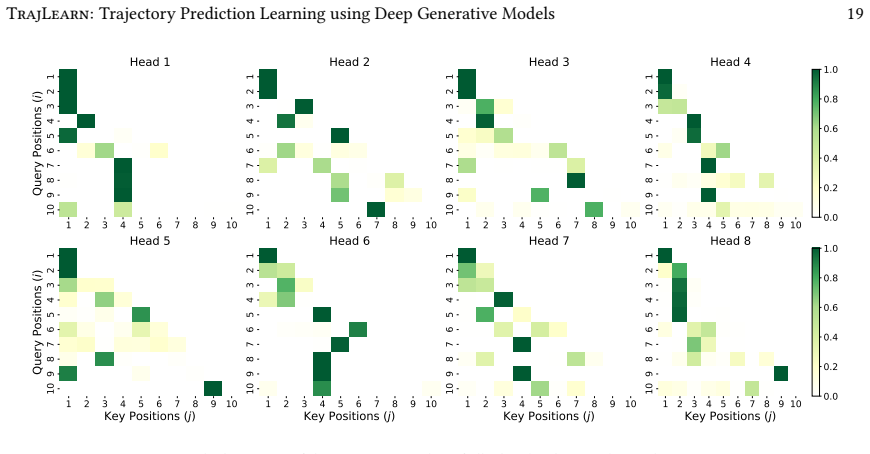
The load-bearing mechanism is the hexagon token. GPS points are map-matched to road-network paths and intersected with an H3 hexagonal tessellation, turning each trajectory into a sequence of hexagon IDs. A decoder-only Transformer with causal self-attention, learned position embeddings, and an end-of-trajectory token is trained with teacher forcing to predict the next hexagon. At inference, a constrained beam search expands candidates only to the six adjacent hexagons of the current cell, ensuring spatial continuity while exploring multiple plausible paths. A hierarchical map variant subdivides high-activity hexagons into finer resolutions to concentrate detail where movement is dense.
What would settle it
Recompute the hexagon ground truth from raw GeoLife GPS points without road routing, using straight-line cell transitions or a mode-aware map matcher, then retrain TrajLearn and the strongest baseline under identical settings; if Accuracy@1 drops by more than the reported margins on walking and cycling trajectories, the central claim is tied to the OSRM-derived labels.
Extended reading notes
Core claim
The central claim is that a decoder-only Transformer trained from scratch on higher-order mobility flows—GPS tracks converted first to road-network paths and then to H3 hexagon ID sequences—predicts the next k hexagons more accurately than Markov chains, LSTMs, GRUs, DeepMove, and Flashback++, with improvements up to about 40% on Ho-Porto, Ho-Rome, and Ho-GeoLife at H3 resolutions 7, 8, and 9. The paper attributes the gains to three components working together: the transformer's causal self-attention for long-range dependencies, hexagon tessellation for uniform spatial neighborhoods, and a constrained beam search that only allows expansions to adjacent hexagons. The paper further claims that the model consistently ranks first or second across all metric-resolution-dataset combinations and that ablations show beam search contributes a few percent of accuracy.
Load-bearing premise
The paper assumes that routing each pair of consecutive GPS points along the road network with OSRM reconstructs the true traveled path, so the resulting hexagon sequences are correct training targets and test labels; if that reconstruction is wrong, especially for GeoLife's walking and cycling trips, the reported accuracy is accuracy at predicting routing artifacts rather than real movement.
Editorial extensions
If this is right
- If the claims are correct, RNN-based trajectory models can be replaced by a token-generation pipeline that naturally handles sparse GPS by discretizing space.
- The adjacency constraint means every predicted path is spatially connected, which matters for navigation and routing applications where impossible jumps are unacceptable.
- Mixed-resolution maps offer a storage-versus-accuracy trade-off: fine hexagons only where data density demands them, coarser elsewhere, reducing memory without uniform loss.
- The sensitivity results indicate that longer input history helps, shorter prediction horizons help, and beam width shows diminishing returns beyond w=5, guiding practical deployment choices.
Reading between the lines
- Beyond the paper's claims, we infer that the reported accuracy may partly measure how well the model reproduces the routing engine's choices rather than actual traveled paths, because the paper does not validate the routed hexagon sequences against the original GPS tracks.
- The hexagon-token framing opens a direct bridge to large language model tooling: the vocabulary is the cell set, so subword tokenization or pretraining objectives could be imported with minimal changes.
- A testable extension is to retrain TrajLearn on centroid-to-centroid straight-line cell sequences without road routing; the accuracy gap would isolate how much performance comes from road-network priors baked into the training labels.
- The adjacency constraint could be relaxed to a learned transition kernel, allowing the model to choose its own topology when true movement is off-road.
Signed reviews
Editorial analysis
A structured set of objections, weighed in public.
Referee Report
Summary. The paper proposes TrajLearn, a decoder-only Transformer that predicts the next k steps of a trajectory by treating H3 hexagonal cells as tokens and using an adjacency-constrained beam search at inference. Trajectories are first converted to higher-order mobility flow sequences by map-matching GPS points with OSRM, intersecting the resulting routes with H3 hexagons, and then predicting the next k hexagons. The model is evaluated against MC, LSTM, LSTM-ATTN, GRU, DeepMove, and Flashback++ on Ho-Porto, Ho-Rome, and Ho-GeoLife at H3 resolutions 7, 8, and 9, with Accuracy@1/3/5 and BLEU. The paper claims improvements of up to ~40% and reports a secondary contribution on hierarchical mixed-resolution maps. Code and data are said to be publicly available.
Significance. If the empirical claims are sustained, the paper is a useful contribution: it shows that a relatively simple transformer over a hexagonal grid, combined with a spatially constrained beam search, can outperform strong trajectory prediction baselines across several real-world datasets and resolutions. The paper also has practical strengths: the authors release code and data, use a time-ordered train/validation/test split that avoids random data leakage, evaluate across multiple resolutions and prediction horizons, and provide an ablation of the beam-search component. The main risk is that the ground-truth sequences are generated by OSRM car routing, which may be inappropriate for GeoLife, and that the statistical evidence is reported without variance or repeated runs. The hierarchical-map section is a useful idea but is not compared quantitatively against fixed-resolution maps in terms of storage or compute.
major comments (3)
- [Section 3 (Map-Matching) and Section 5.2] The central empirical claim depends on the ground-truth hexagon sequences constructed in Section 3. The Map-Matching paragraph states that OSRM is used to find the shortest paths between consecutive points and concatenate them, and the routed linestrings are then intersected with H3 hexagons to form the training targets and test labels of Problem 2. For the taxi datasets Ho-Porto and Ho-Rome this is a reasonable model of movement, but Ho-GeoLife (Section 5.2) contains trajectories of individuals and is well known to include walking, cycling, and driving segments. Unless a mode-specific routing profile is used and validated, OSRM car routing can replace actual movement by shortest road paths, so the token sequences may encode routing artifacts rather than the paths actually traveled. The paper does not state the OSRM profile, does not report quantitative validation of the routed hexagon sequences against the original GPS traces (route length vs. GPS-derived distance, mode segmentation, or visual inspection), and the later hexagon-to-GPS mapping in Section 5.7 does not retroactively validate the training targets. Because the headline improvement of up to ~40% is driven by the 42.6% Ho-GeoLife Accuracy@1 gain in Table 4, this issue is load-bearing for the central claim. I ask the authors to validate the map-matching pipeline on GeoLife, e.g., by segmenting trajectories by transport mode, using appropriate routing profiles, and comparing routed paths to raw GPS, or to restrict the claims to datasets and transport modes for which the routing assumption is sound.
- [Section 5.2 and Table 4] No measure of uncertainty is reported. The statement in Section 5.2 that the time-ordered split eliminates the need to train and test over different random splits and report variance addresses only variance due to random data partitioning; it does not account for stochasticity in neural network training, hyperparameter search, or initialization. Table 4 reports a single value per configuration, with several margins that are small, e.g., Ho-Porto res=7: TrajLearn Accuracy@1 0.4507 vs. Flashback++ 0.4439 (1.53% relative improvement) and BLEU 0.5108 vs. 0.4929 (3.63%). Without repeated runs, confidence intervals, or significance tests, the claim that TrajLearn consistently secures one of the top two spots and outperforms all competitors by a large margin is not fully supported. Please report standard deviations over multiple seeds and, for the close configurations, a paired significance test.
- [Table 4 footnote and Section 5.5 (Q1)] The baseline comparison is not entirely apples-to-apples. The footnote to Table 4 states that DeepMove on Ho-Porto and Flashback++ on Ho-Porto res=9 were conducted on 30,000 randomly sampled trajectories due to limited efficiency and scalability, while TrajLearn is trained on the full datasets (45,186 and 1,151,544 trajectories respectively in Table 3). Training a baseline on a much smaller sample handicaps it and inflates the reported improvement. In addition, DeepMove reports OOM for Ho-Rome res=9 and Ho-GeoLife res=9, so the phrase 'in all instances outperforms all competitors' is not supported for those configurations. Please train the baselines on the same data as TrajLearn, or provide an explicit scalability study showing that the comparison is unaffected, and state the exact number of trajectories used for each baseline.
minor comments (6)
- [Section 5.4, Eq. (9)] The Accuracy@N definition should clarify that true(s) is the full k-step sequence of hexagons, not a single next block; as written, 'the actual label of s' is ambiguous.
- [Section 5.5] The sentence 'in all instances outperforming all competitors by a large margin' should be qualified, since several Table 4 margins are small (e.g., Ho-Porto res=7 Accuracy@1 is a 1.53% relative improvement over Flashback++).
- [Section 6.4 and Table 7] The hierarchical-map results should be compared directly with the fixed-resolution results of Table 4, and the claimed storage and computational savings should be quantified; currently the efficiency motivation of Section 6.1 is not supported by any reported measurement.
- [Section 5.6 and Section 5.7.2] There are minor presentation issues: 'hetmaps' should be 'heatmaps' in Section 5.6, and the label 'True Trajectory' in Section 5.7.2 is ambiguous because it could be confused with the input trajectory; 'Ground-Truth Future Trajectory' would be clearer.
- [Section 4.1] The statement that 'any advancements in language models are applicable and can benefit our approach with minimal effort' is too broad; it would be more accurate to say that architectural components such as attention variants and decoding strategies can be transferred.
- [Abstract and Section 5.2] The paper says 'complete code, data' are available, but the GitHub link appears to point to the code only; please specify precisely which preprocessed higher-order datasets are released and where, and include the OSRM profile and version in the preprocessing description.
Circularity Check
The paper's derivation is self-contained: its central claim is an empirical comparison against external baselines on shared preprocessed data, and no fitted parameter or self-citation is relabeled as a first-principles prediction.
full rationale
TrajLearn's central contribution is a decoder-only Transformer trained to predict the next H3 hexagon token from a history of hexagon tokens, followed by an adjacency-constrained beam search. The training objective (Equation 7) and the beam-search expansion rule (Equation 8) define a standard next-token prediction setup. The reported performance gains are measured against external baselines (MC, LSTM, LSTM-ATTN, GRU, DeepMove, Flashback++) on the same preprocessed higher-order trajectory data, as shown in Table 4. No equation in the paper reduces to its own input: the model parameters are learned from data, the beam search uses the model's learned probabilities plus a geometric adjacency constraint, and the evaluation metrics (Accuracy@N, BLEU) compare predicted token sequences to held-out ground-truth token sequences. The only self-citation of note is [27], Point2Hex, which supplies the higher-order mobility flow data representation; however, the paper fully describes the preprocessing pipeline in Section 3 (map-matching, linestring-hexagon intersection, block-sequence construction), so the citation is not load-bearing and the data representation is an input, not the paper's conclusion. The map-matching concern raised about OSRM shortest-path routing on GeoLife is a potential data-validity or robustness issue, not a circularity: the same artifact, if present, affects all models and does not make TrajLearn's predictions equivalent to a fitted parameter or to a self-citation. There is no evidence that any performance number is forced by construction, and no fitted value is renamed as a prediction. The score is therefore 0.
Assumptions & free parameters
free parameters (4)
- Beam width w =
5
- Model architecture hyperparameters =
not fully specified in text
- Hierarchical map thresholds delta, phi, theta =
not reported
- Minimum trajectory length filter =
15 hexagons
assumptions (5)
- domain assumption OSRM shortest-path routing between consecutive GPS points reconstructs the true traveled path
- domain assumption Hexagon-level prediction is a faithful proxy for continuous GPS trajectory prediction
- standard math Cross-entropy training of a causal transformer captures the conditional distribution over next hexagons
- standard math Cumulative probability multiplication in beam search ranks candidate paths correctly
- domain assumption Time-ordered split by trajectory start times yields a non-leaky train/validation/test partition
Cite this review
Pith. "Pith review of TrajLearn: Trajectory Prediction Learning using Deep Generative Models." pith.science (2026). https://pith.science/paper/L7CJ73TX
@misc{pith2026250100184,
  author       = {Pith},
  title        = {Pith review of: TrajLearn: Trajectory Prediction Learning using Deep Generative Models},
  year         = {2026},
  howpublished = {\url{https://pith.science/paper/L7CJ73TX}},
  note         = {Machine review of arXiv:2501.00184}
}
abstract
Trajectory prediction aims to estimate an entity's future path using its current position and historical movement data, benefiting fields like autonomous navigation, robotics, and human movement analytics. Deep learning approaches have become key in this area, utilizing large-scale trajectory datasets to model movement patterns, but face challenges in managing complex spatial dependencies and adapting to dynamic environments. To address these challenges, we introduce TrajLearn, a novel model for trajectory prediction that leverages generative modeling of higher-order mobility flows based on hexagonal spatial representation. TrajLearn predicts the next $k$ steps by integrating a customized beam search for exploring multiple potential paths while maintaining spatial continuity. We conducted a rigorous evaluation of TrajLearn, benchmarking it against leading state-of-the-art approaches and meaningful baselines. The results indicate that TrajLearn achieves significant performance gains, with improvements of up to ~40% across multiple real-world trajectory datasets. In addition, we evaluated different prediction horizons (i.e., various values of $k$), conducted resolution sensitivity analysis, and performed ablation studies to assess the impact of key model components. Furthermore, we developed a novel algorithm to generate mixed-resolution maps by hierarchically subdividing hexagonal regions into finer segments within a specified observation area. This approach supports selective detailing, applying finer resolution to areas of interest or high activity (e.g., urban centers) while using coarser resolution for less significant regions (e.g., rural areas), effectively reducing data storage requirements and computational overhead. We promote reproducibility and adaptability by offering complete code, data, and detailed documentation with flexible configuration options for various applications.
Figures


Figures from the paper (12 more)




Reference graph
Works this paper leans on
-
[1]
Gian Alix, Nina Yanin, Tilemachos Pechlivanoglou, Jing Li, Farzaneh Heidari, and Manos Papagelis. 2022. A Mobility-based Recommendation System for Mitigating the Risk of Infection during Epidemics. In 2022 23rd IEEE International Conference on Mobile Data Management (MDM) . IEEE, 292–295
2022
-
[2]
Mahmoud Alsaeed, Ameeta Agrawal, and Manos Papagelis. 2023. Trajectory-User Linking using Higher-order Mobility Flow Representations. In 2023 24th IEEE International Conference on Mobile Data Management (MDM) . IEEE, 158–167
2023
-
[3]
Licia Amichi, Aline Carneiro Viana, Mark Crovella, and Antonio AF Loureiro. 2021. From movement purpose to perceptive spatial mobility prediction. In Proceedings of the 29th International Conference on Advances in Geographic Information Systems . 500–511
2021
-
[4]
Anonymous. 2024. Trajectory-LLM: A Language-based Data Generator for Trajectory Prediction in Autonomous Driving. In Submitted to The Thirteenth International Conference on Learning Representations . https://openreview.net/forum?id=UapxTvxB3N under review
2024
-
[5]
Gowtham Atluri, Anuj Karpatne, and Vipin Kumar. 2018. Spatio-Temporal Data Mining: A Survey of Problems and Methods. ACM Comp. Surveys 51, 4 (2018)
2018
-
[6]
K. Benidis, S. S. Rangapuram, V. Flunkert, Y. Wang, D. C. Maddix, C. Türkmen, J. Gasthaus, M. Schneider, D. Salinas, L. Stella, F. Aubet, L. Callot, and T. Januschowski. 2022. Deep learning for time series forecasting: tutorial and literature survey. Comput. Surveys 55 (2022), 1–36. Issue 6. https://doi.org/10.1145/3533382
doi:10.1145/3533382 2022
-
[7]
Birch, Sander P
Colin P.D. Birch, Sander P. Oom, and Jonathan A. Beecham. 2007. Rectangular and hexagonal grids used for observation, experiment and simulation in ecology. Ecological Modelling 206, 3 (2007), 347–359
2007
-
[8]
Bond-Taylor, A
S. Bond-Taylor, A. Leach, Y. Long, and C. G. Willcocks. 2022. Deep Generative Modelling: A Comparative Review of VAEs, GANs, Normalizing Flows, Energy-Based and Autoregressive Models. IEEE Transactions on Pattern Analysis & Machine Intelligence 44, 11 (2022), 7327–7347
2022
Show all 94 references
-
[9]
Lorenzo Bracciale, Marco Bonola, Pierpaolo Loreti, Giuseppe Bianchi, Raul Amici, and Antonello Rabuffi. 2022. CRAWDAD roma/taxi
2022
-
[10]
Tom Brown, Benjamin Mann, Nick Ryder, Melanie Subbiah, Jared D Kaplan, Prafulla Dhariwal, Arvind Neelakantan, Pranav Shyam, Girish Sastry, Amanda Askell, et al. 2020. Language models are few-shot learners. Advances in neural information processing systems 33 (2020), 1877–1901
2020
-
[11]
Caroline Buckee, Abdisalan Noor, and Lisa Sattenspiel. 2021. Thinking clearly about social aspects of infectious disease transmission. Nature 595, 7866 (2021), 205–213. https://doi.org/10.1038/s41586-021-03694-x
2021 doi
-
[12]
Defu Cao, Jiachen Li, Hengbo Ma, and Masayoshi Tomizuka. 2021. Spectral Temporal Graph Neural Network for Trajectory Prediction. In 2021 IEEE International Conference on Robotics and Automation (ICRA) . 1839–1845. https://doi.org/10.1109/ICRA48506.2021.9561461
2021
-
[13]
Serina Chang, Emma Pierson, Pang Wei Koh, Jaline Gerardin, Beth Redbird, David Grusky, and Jure Leskovec. 2021. Mobility network models of COVID-19 explain inequities and inform reopening. Nature 589, 7840 (2021), 82–87
2021
-
[14]
Pingfu Chao, Yehong Xu, Wen Hua, and Xiaofang Zhou. 2020. A survey on map-matching algorithms. In Databases Theory and Applications: 31st Australasian Database Conference, ADC 2020, Melbourne, VIC, Australia, February 3–7, 2020, Proceedings 31 . Springer, 121–133
2020
-
[15]
Chen Cheng, Haiqin Yang, Irwin King, and Michael Lyu. 2012. Fused matrix factorization with geographical and social influence in location-based social networks. In Proc. of the AAAI conference on artificial intelligence , Vol. 26. 17–23
2012
-
[16]
Chen Cheng, Haiqin Yang, Michael R Lyu, and Irwin King. 2013. Where you like to go next: Successive point-of-interest recommendation. In Twenty-Third international joint conference on Artificial Intelligence
2013
-
[17]
Pranav Singh Chib and Pravendra Singh. 2024. LG-Traj: LLM Guided Pedestrian Trajectory Prediction. arXiv preprint arXiv:2403.08032 (2024)
2024 arXiv
-
[18]
Kyunghyun Cho, Bart van Merriënboer, Caglar Gulcehre, Dzmitry Bahdanau, Fethi Bougares, Holger Schwenk, and Yoshua Bengio. 2014. Learning Phrase Representations using RNN Encoder–Decoder for Statistical Machine Translation. In Proceedings of the 2014 Conference on Empirical Me...
2014
-
[19]
Eva Chondrodima, Petros Mandalis, Nikos Pelekis, and Yannis Theodoridis. 2022. Machine learning models for vessel route forecasting: An experimental comparison. In 2022 23rd IEEE International Conference on Mobile Data Management (MDM) . IEEE, 262–269
2022
-
[20]
Aakanksha Chowdhery, Sharan Narang, Jacob Devlin, Maarten Bosma, Gaurav Mishra, Adam Roberts, Paul Barham, Hyung Won Chung, Charles Sutton, Sebastian Gehrmann, et al. 2022. Palm: Scaling language modeling with pathways. arXiv preprint arXiv:2204.02311 (2022)
2022 arXiv
-
[21]
Peishan Cong, Xinge Zhu, Feng Qiao, Yiming Ren, Xidong Peng, Yuenan Hou, Lan Xu, Ruigang Yang, Dinesh Manocha, and Yuexin Ma. 2022. Stcrowd: A multimodal dataset for pedestrian perception in crowded scenes. In Proc. of the IEEE/CVF Conference on Computer Vision and Pattern Rec...
2022
-
[22]
Bruno Ferreira de Brito, Hai Zhu, Wei Pan, and Javier Alonso-Mora. 2021. Social-vrnn: One-shot multi-modal trajectory prediction for interacting pedestrians. In Conference on Robot Learning . PMLR, 862–872
2021
-
[23]
Bangchao Deng, Dingqi Yang, Bingqing Qu, Benjamin Fankhauser, and Philippe Cudre-Mauroux. 2023. Robust Location Prediction over Sparse Spatiotemporal Trajectory Data: Flashback to the Right Moment! ACM Trans. Intell. Syst. Technol. 14, 5, Article 90 (sep 2023), 24 pages. https...
2023 doi
-
[24]
Jinghai Duan, Le Wang, Chengjiang Long, Sanping Zhou, Fang Zheng, Liushuai Shi, and Gang Hua. 2022. Complementary attention gated network for pedestrian trajectory prediction. In Proceedings of the AAAI Conference on Artificial Intelligence , Vol. 36. 542–550
2022
-
[25]
Patrick Ebel, Ibrahim Emre Göl, Christoph Lingenfelder, and Andreas Vogelsang. 2020. Destination Prediction Based on Partial Trajectory Data. In 2020 IEEE Intelligent Vehicles Symposium (IV) . 1149–1155. Manuscript submitted to ACM TrajLearn: Trajectory Prediction Learning usi...
2020
-
[26]
Zipei Fan, Xuan Song, Tianqi Xia, Renhe Jiang, Ryosuke Shibasaki, and Ritsu Sakuramachi. 2018. Online deep ensemble learning for predicting citywide human mobility. Proceedings of the ACM on Interactive, Mobile, Wearable and Ubiquitous Technologies 2, 3 (2018), 1–21
2018
-
[27]
Ali Faraji, Jing Li, Gian Alix, Mahmoud Alsaeed, Nina Yanin, Amirhossein Nadiri, and Manos Papagelis. 2023. Point2Hex: Higher-order Mobility Flow Data and Resources. In Proceedings of the 31st ACM International Conference on Advances in Geographic Information Systems (Hamburg,...
2023
-
[28]
Jie Feng, Yong Li, Chao Zhang, Funing Sun, Fanchao Meng, Ang Guo, and Depeng Jin. 2018. Deepmove: Predicting human mobility with attentional recurrent networks. In Proceedings of the 2018 world wide web conference . 1459–1468
2018
-
[29]
Sébastien Gambs, Marc-Olivier Killijian, and Miguel Núñez del Prado Cortez. 2012. Next Place Prediction Using Mobility Markov Chains. In Proceedings of the First Workshop on Measurement, Privacy, and Mobility (MPM ’12) . Article 3
2012
-
[30]
Ian Goodfellow, Jean Pouget-Abadie, Mehdi Mirza, Bing Xu, David Warde-Farley, Sherjil Ozair, Aaron Courville, and Yoshua Bengio. 2020. Generative adversarial networks. Commun. ACM 63, 11 (2020), 139–144
2020
-
[31]
Karol Gregor, Ivo Danihelka, Andriy Mnih, Charles Blundell, and Daan Wierstra. 2014. Deep autoregressive networks. In International Conference on Machine Learning. PMLR, 1242–1250
2014
-
[32]
Ali Hamdi, Khaled Shaban, Abdelkarim Erradi, Amr Mohamed, Shakila Khan Rumi, and Flora D. Salim. 2022. Spatiotemporal data mining: a survey on challenges and open problems. AIR 55, 2 (2022), 1441–1488
2022
-
[33]
Dan Hendrycks and Kevin Gimpel. 2016. Bridging nonlinearities and stochastic regularizers with gaussian error linear units. CoRR, abs/1606.08415 3 (2016)
2016 arXiv
-
[34]
Yingfan Huang, Huikun Bi, Zhaoxin Li, Tianlu Mao, and Zhaoqi Wang. 2019. Stgat: Modeling spatial-temporal interactions for human trajectory prediction. In Proc. of the IEEE/CVF international conference on computer vision . 6272–6281
2019
-
[35]
Yanjun Huang, Jiatong Du, Ziru Yang, Zewei Zhou, Lin Zhang, and Hong Chen. 2022. A survey on trajectory-prediction methods for autonomous driving. IEEE Transactions on Intelligent Vehicles 7, 3 (2022), 652–674
2022
-
[36]
Keivin Isufaj, Mohamed Mokhtar Elshrif, Sofiane Abbar, and Mohamed Mokbel. 2023. GTI: A Scalable Graph-based Trajectory Imputation. In Proceedings of the 31st ACM International Conference on Advances in Geographic Information Systems . 1–10
2023
-
[37]
Renhe Jiang, Xuan Song, Zipei Fan, Tianqi Xia, Quanjun Chen, Satoshi Miyazawa, and Ryosuke Shibasaki. 2018. Deepurbanmomentum: An online deep-learning system for short-term urban mobility prediction. In Proceedings of the AAAI Conference on Artificial Intelligence , Vol. 32
2018
-
[38]
Diederik P Kingma and Max Welling. 2013. Auto-encoding variational bayes. arXiv preprint arXiv:1312.6114 (2013)
2013 arXiv
-
[39]
Ivan Kobyzev, Simon JD Prince, and Marcus A Brubaker. 2020. Normalizing flows: An introduction and review of current methods. IEEE transactions on pattern analysis and machine intelligence 43, 11 (2020), 3964–3979
2020
-
[40]
Dejiang Kong and Fei Wu. 2018. HST-LSTM: A hierarchical spatial-temporal long-short term memory network for location prediction.. In IJCAI, Vol. 18. 2341–2347
2018
-
[41]
Olga Kovaleva, Alexey Romanov, Anna Rogers, and Anna Rumshisky. 2019. Revealing the Dark Secrets of BERT. In Proceedings of the 2019 Conference on Empirical Methods in Natural Language Processing and the 9th International Joint Conference on Natural Language Processing (EMNLP-...
2019 doi
-
[42]
Hoang Thanh Lam, Ernesto Diaz-Aviles, Alessandra Pascale, Yiannis Gkoufas, and Bei Chen. 2015. (Blue) Taxi Destination and Trip Time Prediction from Partial Trajectories. In Proceedings of the 2015th International Conference on ECML PKDD Discovery Challenge . 63–74
2015
-
[43]
Zhengxing Lan, Lingshan Liu, Bo Fan, Yisheng Lv, Yilong Ren, and Zhiyong Cui. 2024. Traj-LLM: A New Exploration for Empowering Trajectory Prediction With Pre-Trained Large Language Models. IEEE Transactions on Intelligent Vehicles (2024), 1–14. https://doi.org/10.1109/TIV.2024.3418522
2024
-
[44]
Lihuan Li, Maurice Pagnucco, and Yang Song. 2022. Graph-based spatial transformer with memory replay for multi-future pedestrian trajectory prediction. In Proc. of the IEEE/CVF Conf. on Comp. Vision and Pattern Recognition . 2231–2241
2022
-
[45]
Xutao Li, Gao Cong, Xiao-Li Li, Tuan-Anh Nguyen Pham, and Shonali Krishnaswamy. 2015. Rank-geofm: A ranking based geographical factorization method for point of interest recommendation. InProceedings of the 38th international ACM SIGIR conference on research and development in...
2015
-
[46]
Defu Lian, Yongji Wu, Yong Ge, Xing Xie, and Enhong Chen. 2020. Geography-aware sequential location recommendation. InProceedings of the 26th ACM SIGKDD international conference on knowledge discovery & data mining . 2009–2019
2020
-
[47]
Defu Lian, Cong Zhao, Xing Xie, Guangzhong Sun, Enhong Chen, and Yong Rui. 2014. GeoMF: joint geographical modeling and matrix factorization for point-of-interest recommendation. In Proceedings of the 20th ACM SIGKDD international conference on Knowledge discovery and data min...
2014
-
[48]
Chengwu Liao, Chao Chen, Chaocan Xiang, Hongyu Huang, Hong Xie, and Songtao Guo. 2022. Taxi-Passenger’s Destination Prediction via GPS Embedding and Attention-Based BiLSTM Model. IEEE Transactions on Intelligent Transportation Systems 23, 5 (2022), 4460–4473
2022
-
[49]
Ziqian Lin, Jie Feng, Ziyang Lu, Yong Li, and Depeng Jin. 2019. Deepstn+: Context-aware spatial-temporal neural network for crowd flow prediction in metropolis. In Proc. of the AAAI conference on artificial intelligence , Vol. 33. 1020–1027
2019
-
[50]
Qiang Liu, Shu Wu, Liang Wang, and Tieniu Tan. 2016. Predicting the next location: A recurrent model with spatial and temporal contexts. In Proceedings of the AAAI conference on artificial intelligence , Vol. 30
2016
-
[51]
Ilya Loshchilov and Frank Hutter. 2017. Fixing weight decay regularization in adam. (2017). Manuscript submitted to ACM 32 Nadiri et al
2017
-
[52]
Yingtao Luo, Qiang Liu, and Zhaocheng Liu. 2021. Stan: Spatio-temporal attention network for next location recommendation. In Proceedings of the web conference 2021. 2177–2185
2021
-
[53]
Minh-Thang Luong, Hieu Pham, and Christopher D Manning. 2015. Effective approaches to attention-based neural machine translation. arXiv preprint arXiv:1508.04025 (2015)
2015 arXiv
-
[54]
Dennis Luxen and Christian Vetter. 2011. Real-time routing with OpenStreetMap data. In Proc. of the 19th ACM SIGSPATIAL. 513–516
2011
-
[55]
Yisheng Lv, Yanjie Duan, Wenwen Kang, Zhengxi Li, and Fei-Yue Wang. 2014. Traffic flow prediction with big data: A deep learning approach. IEEE Transactions on Intelligent Transportation Systems 16, 2 (2014), 865–873
2014
-
[56]
Wesley Mathew, Ruben Raposo, and Bruno Martins. 2012. Predicting future locations with hidden Markov models. In Proceedings of the 2012 ACM conference on ubiquitous computing . 911–918
2012
-
[57]
Miller, Mohammed Aldosari, Farah Saeed, Nasid Habib Barna, Subas Rana, I
John A. Miller, Mohammed Aldosari, Farah Saeed, Nasid Habib Barna, Subas Rana, I. Budak Arpinar, and Ninghao Liu. 2024. A Survey of Deep Learning and Foundation Models for Time Series Forecasting. arXiv:2401.13912 [cs.LG] https://arxiv.org/abs/2401.13912
2024 arXiv
-
[58]
Luis Moreira-Matias, João Gama, Michel Ferreira, João Mendes-Moreira, and Luis Damas. 2015. ECML/PKDD 15: Taxi Trajectory Prediction Porto Dataset
2015
-
[59]
Paul Newson and John Krumm. 2009. Hidden Markov Map Matching through Noise and Sparseness. In Proc. of the 17th ACM SIGSPATIAL. 336–343
2009
-
[60]
Tilemachos Pechlivanoglou, Gian Alix, Nina Yanin, Jing Li, Farzaneh Heidari, and Manos Papagelis. 2022. Microscopic modeling of spatiotemporal epidemic dynamics. In Proceedings of the 3rd ACM SIGSPATIAL International Workshop on Spatial Computing for Epidemiology . 11–21
2022
-
[61]
Tilemachos Pechlivanoglou, Jing Li, Jialin Sun, Farzaneh Heidari, and Manos Papagelis. 2022. Epidemic spreading in trajectory networks. Big Data Research 27 (2022), 100275
2022
-
[62]
Alec Radford, Jeffrey Wu, Rewon Child, David Luan, Dario Amodei, Ilya Sutskever, et al. 2019. Language models are unsupervised multitask learners. OpenAI blog 1, 8 (2019)
2019
-
[63]
Xuan Rao, Lisi Chen, Yong Liu, Shuo Shang, Bin Yao, and Peng Han. 2022. Graph-flashback network for next location recommendation. InProceedings of the 28th ACM SIGKDD Conference on Knowledge Discovery and Data Mining . 1463–1471
2022
-
[64]
Xuanchi Ren, Tao Yang, Li Erran Li, Alexandre Alahi, and Qifeng Chen. 2021. Safety-aware motion prediction with unseen vehicles for autonomous driving. In Proc. of the IEEE/CVF International Conference on Computer Vision . 15731–15740
2021
-
[65]
Alberto Rossi, Gianni Barlacchi, Monica Bianchini, and Bruno Lepri. 2020. Modelling Taxi Drivers’ Behaviour for the Next Destination Prediction. IEEE Transactions on Intelligent Transportation Systems 21, 7 (2020), 2980–2989
2020
-
[66]
David E Rumelhart, Geoffrey E Hinton, and Ronald J Williams. 1986. Learning representations by back-propagating errors. nature 323, 6088 (1986), 533–536
1986
-
[67]
Amin Sadri, Flora D Salim, Yongli Ren, Wei Shao, John C Krumm, and Cecilia Mascolo. 2018. What will you do for the rest of the day? An approach to continuous trajectory prediction. Proceedings of the ACM on interactive, mobile, wearable and ubiquitous technologies 2, 4 (2018), 1–26
2018
-
[68]
Mahmoud Sakr, Cyril Ray, and Chiara Renso. 2022. Big mobility data analytics: recent adv. & open problems. GeoInformatica 26, 4 (2022), 541–549
2022
-
[69]
Abdullah Sawas, Abdullah Abuolaim, Mahmoud Afifi, and Manos Papagelis. 2018. Tensor methods for group pattern discovery of pedestrian trajectories. In 2018 19th IEEE International Conference on Mobile Data Management (MDM) . IEEE, 76–85
2018
-
[70]
Abdullah Sawas, Abdullah Abuolaim, Mahmoud Afifi, and Manos Papagelis. 2018. Trajectolizer: Interactive analysis and exploration of trajectory group dynamics. In 2018 19th IEEE International Conference on Mobile Data Management (MDM) . IEEE, 286–287
2018
-
[71]
Abdullah Sawas, Abdullah Abuolaim, Mahmoud Afifi, and Manos Papagelis. 2019. A versatile computational framework for group pattern mining of pedestrian trajectories. GeoInformatica 23, 4 (2019), 501–531
2019
-
[72]
Schuster and K.K
M. Schuster and K.K. Paliwal. 1997. Bidirectional recurrent neural networks. IEEE Transactions on Signal Processing 45, 11 (1997), 2673–2681
1997
-
[73]
Hongzhi Shi, Yong Li, Hancheng Cao, Xiangxin Zhou, Chao Zhang, and Vassilis Kostakos. 2019. Semantics-aware hidden Markov model for human mobility. IEEE Transactions on Knowledge and Data Engineering 33, 3 (2019), 1183–1194
2019
-
[74]
Haoran Song, Wenchao Ding, Yuxuan Chen, Shaojie Shen, Michael Yu Wang, and Qifeng Chen. 2020. Pip: Planning-informed trajectory prediction for autonomous driving. In Computer Vision–ECCV 2020: 16th European Conference, Glasgow, UK, August 23–28, 2020, Proceedings, Part XXI 16 ...
2020
-
[75]
Xuan Song, Hiroshi Kanasugi, and Ryosuke Shibasaki. 2016. Deeptransport: Prediction and simulation of human mobility and transportation mode at a citywide level. In Proc. of the 25th int. joint conf. on artificial intell. 2618–2624
2016
-
[76]
Jianhua Sun, Yuxuan Li, Liang Chai, Hao-Shu Fang, Yong-Lu Li, and Cewu Lu. 2022. Human trajectory prediction with momentary observation. In Proc. of the IEEE/CVF Conference on Computer Vision and Pattern Recognition . 6467–6476
2022
-
[77]
Mingtian Tan, Mike A Merrill, Vinayak Gupta, Tim Althoff, and Thomas Hartvigsen. 2024. Are Language Models Actually Useful for Time Series Forecasting?. In The Thirty-eighth Annual Conference on Neural Information Processing Systems . https://openreview.net/forum?id=DV15UbHCY1
2024
-
[78]
Hugo Touvron, Thibaut Lavril, Gautier Izacard, Xavier Martinet, Marie-Anne Lachaux, Timothée Lacroix, Baptiste Rozière, Naman Goyal, Eric Hambro, Faisal Azhar, et al. 2023. Llama: Open and efficient foundation language models. arXiv preprint arXiv:2302.13971 (2023)
2023 arXiv
-
[79]
Uber Technologies
Inc. Uber Technologies. [n. d.]. Conversion from latitude/longitude to containing H3 cell index . https://h3geo.org/docs/core-library/latLngToCellDesc/
-
[80]
Ashish Vaswani, Noam Shazeer, Niki Parmar, Jakob Uszkoreit, Llion Jones, Aidan N Gomez, Łukasz Kaiser, and Illia Polosukhin. 2017. Attention is all you need. Advances in neural information processing systems 30 (2017)
2017
-
[81]
Jingyuan Wang, Jiawei Jiang, Wenjun Jiang, Chao Li, and Wayne Xin Zhao. 2021. LibCity: An Open Library for Traffic Prediction. In Proceedings of the 29th International Conference on Advances in Geographic Information Systems (Beijing, China) (SIGSPATIAL ’21). Association for C...
2021
-
[82]
Sheng Wang, Zhifeng Bao, J Shane Culpepper, and Gao Cong. 2021. A survey on trajectory data management, analytics, and learning. ACM Computing Surveys (CSUR) 54, 2 (2021), 1–36
2021
-
[83]
Shane Culpepper, and Gao Cong
Sheng Wang, Zhifeng Bao, J. Shane Culpepper, and Gao Cong. 2021. A Survey on Trajectory Data Mgt., Analytics, & Learning. ACM Comp. Surv. 54, 2, Article 39 (2021), 36 pages
2021
-
[84]
Zhe Xiao, Loganathan Ponnambalam, Xiuju Fu, and Wanbing Zhang. 2017. Maritime traffic probabilistic forecasting based on vessels’ waterway patterns and motion behaviors. IEEE Transactions on Intelligent Transportation Systems 18, 11 (2017), 3122–3134
2017
-
[85]
Hao Xue, Flora Salim, Yongli Ren, and Nuria Oliver. 2021. MobTCast: Leveraging auxiliary trajectory forecasting for human mobility prediction. Advances in Neural Information Processing Systems 34 (2021), 30380–30391
2021
-
[86]
Bingqi Yan, Geng Zhao, Lexue Song, Yanwei Yu, and Junyu Dong. 2023. PreCLN: Pretrained-based contrastive learning network for vehicle trajectory prediction. World Wide Web 26, 4 (2023), 1853–1875
2023
-
[87]
Dingqi Yang, Benjamin Fankhauser, Paolo Rosso, and Philippe Cudre-Mauroux. 2020. Location prediction over sparse user mobility traces using rnns. In Proceedings of the Twenty-Ninth International Joint Conference on Artificial Intelligence . 2184–2190
2020
-
[88]
Nina Yanin and Manos Papagelis. 2023. Optimal Risk-aware POI Recommendations during Epidemics. In Proceedings of the 4th ACM SIGSPATIAL International Workshop on Spatial Computing for Epidemiology . 1–12
2023
-
[89]
Huaxiu Yao, Fei Wu, Jintao Ke, Xianfeng Tang, Yitian Jia, Siyu Lu, Pinghua Gong, Jieping Ye, and Zhenhui Li. 2018. Deep multi-view spatial-temporal network for taxi demand prediction. In Proc. of the AAAI conf. on artif. intelligence , Vol. 32
2018
-
[90]
Jing Yuan, Yu Zheng, Chengyang Zhang, Xing Xie, and Guang-Zhong Sun. 2010. An Interactive-Voting Based Map Matching Algorithm. In11th IEEE MDM. 43–52
2010
-
[91]
Yu Zheng. 2015. Trajectory Data Mining: An Overview. ACM TIST 6, 3 (2015)
2015
-
[92]
Yu Zheng, Quannan Li, Yukun Chen, Xing Xie, and Wei-Ying Ma. 2008. Understanding Mobility Based on GPS Data. InProc. of the 10th UbiComp ’08 . 312–321
2008
-
[93]
Yu Zheng, Xing Xie, and Wei-Ying Ma. 2010. GeoLife: A Collaborative Social Networking Service among User, location and trajectory. IEEE Data(base) Engineering Bulletin (June 2010)
2010
-
[94]
Yu Zheng, Lizhu Zhang, Xing Xie, and Wei-Ying Ma. 2009. Mining Interesting Locations and Travel Sequences from GPS Trajectories. In Proc. 18th ACM world wide web. 791–800. Received 27 December 2024; revised 29 March 2025; accepted 2 April 2025 Manuscript submitted to ACM
2009
Reviewed August 10, 2026 · model on record in the stance chip above.
Discussion (0). Continue with ORCID to comment.