REVIEW 2 major objections 5 minor 3 cited by
Detection of H2O and CO2 in the Atmosphere of the Hot Super-Neptune WASP-166b with JWST
T0 review · 2 major / 5 minor · reviewed 2026-08-10 · deepseek-v4-flash
Pith's one-line read This paper claims JWST transmission spectroscopy detects H2O at 15.2σ and CO2 at 14.7σ in WASP-166b's atmosphere, with CO2 seen there for the first time.
desk verdict H2O and CO2 detections hold up; the metallicity and C/O results are code-dependent and need reframing before this can be published. read the letter →
The pith
A machine-rendered reading of the paper's core claim, the machinery that carries it, and where it could break.
The reading
What carries the argument
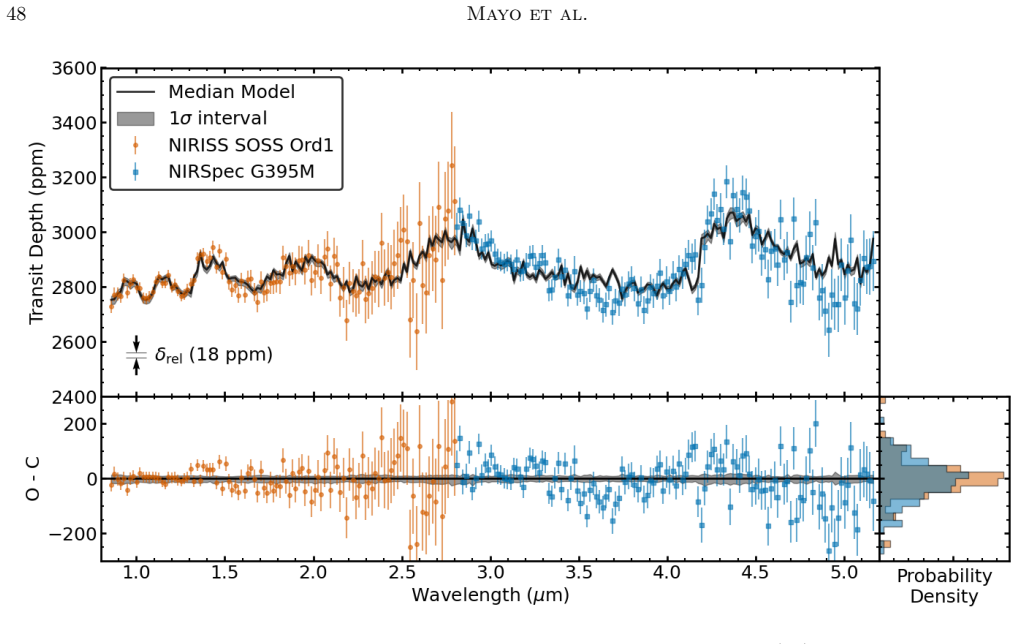
The load-bearing object is the combined 0.85–5.17 µm transit spectrum from two JWST instruments. NIRISS SOSS constrains the H2O bands and the cloud deck, which NIRSpec samples poorly, while NIRSpec G395M captures the strong 4.4 µm CO2 band and the 2.3–3.9 µm NH3 features, which NIRISS misses. Detection significances come from Bayesian model comparison: each candidate molecule is removed from a reference retrieval and the drop in Bayesian evidence is converted to an equivalent sigma. The equilibrium-chemistry step then maps the retrieved molecular mix to metallicity and C/O through a chemical-equilibrium network.
What would settle it
Re-reduce the same raw JWST data with an independent pipeline and retrieve with the reference radius fixed to the alternative branch of the radius–cloud–metallicity degeneracy; if the 4.4 µm CO2 band then yields a Bayes factor below 12, the CO2 detection depends on the reduction or the degeneracy rather than on real atmospheric CO2.
Extended reading notes
Core claim
On the paper's own terms: combined analysis of NIRISS SOSS and NIRSpec G395M data yields a transmission spectrum in which H2O and CO2 dominate the molecular absorption. A free-chemistry retrieval that lets each molecule's abundance float independently recovers log10 volume mixing ratios of −1.42 (+0.20/−0.24) for H2O and −2.13 (+0.27/−0.39) for CO2; removing either molecule from the model lowers the Bayesian evidence by an amount the authors convert to 15.2σ and 14.7σ significance respectively. The same retrieval gives only weak support for NH3 and a cloud deck, and non-detections of CH4, C2H2, HCN, H2S, and K. An equilibrium-chemistry retrieval is then used to convert the observed abundances into an atmospheric metallicity of 37 (+18/−13) times solar and C/O = 0.282 (+0.078/−0.053), consistent with the stellar C/O but significantly more metal-rich than the star.
Load-bearing premise
The reported metallicity and C/O ratio depend on assuming a single uniform atmosphere in chemical equilibrium with a simple cloud layer, and another allowed fit to the same data gives a much higher metallicity even though the water and CO2 detections survive either way.
Editorial extensions
If this is right
- If the CO2 detection holds, WASP-166b becomes one of only a few hot Neptunes with measured carbon dioxide, letting observers compare carbon chemistry across the Hot Neptune Desert boundary.
- The 15σ H2O detection demonstrates that combining NIRISS and NIRSpec on a single bright target breaks the water–cloud degeneracy that single-instrument JWST spectra often leave unresolved.
- A superstellar metallicity near 37× solar with a substellar C/O of 0.28 would favor formation via planetesimal accretion followed by core erosion or photoevaporation over in-situ gas-dominated assembly.
- Weak NH3 and cloud-deck signals at 2.3σ and 2.6σ predict specific spectral structure at 2.3, 3.9, and 0.85–1.8 µm that a follow-up observation can look for directly.
Reading between the lines
- The CO2 and H2O detections are robust to the radius–metallicity degeneracy that divides the two equilibrium-chemistry retrieval branches, but the exact metallicity is not: if the higher-metallicity branch is right, the planet is roughly eight times more metal-rich than the quoted value while remaining super-solar.
- A targeted search for NH3 at 2.3 µm in the existing NIRISS data at full spectral resolution could sharpen the 2.3σ hint, because the baseline retrieval used fixed 0.01797 µm bins that may dilute a narrow feature.
- A population-level JWST survey of planets at the Hot Neptune Desert boundary could use the same two-instrument design to test whether supersolar metallicity and substellar C/O are universal signatures of desert-edge planets.
- If the 4.4 µm CO2 band is confirmed by emission spectroscopy, the day-night thermal structure and carbon inventory could constrain the efficiency of photoevaporation on this inflated planet.
Editorial analysis
A structured set of objections, weighed in public.
Referee Report
Summary. The paper presents JWST NIRISS and NIRSpec transmission spectroscopy of the hot super-Neptune WASP-166b over 0.85–5.17 μm, and analyzes the combined spectrum with the POSEIDON, PLATON, and TauREx retrieval frameworks. The authors report detections of H2O at 15.2σ and CO2 at 14.7σ, a tentative NH3 signal at 2.3σ, and weak evidence for an intermediate-pressure cloud deck at 2.6σ. From a POSEIDON equilibrium-chemistry retrieval they derive a superstellar atmospheric metallicity of Z = 37+18−13 times solar and C/O = 0.282+0.078−0.053, and use these values to argue for formation pathways involving planetesimal accretion, core erosion, or photoevaporation, placing the planet near the edge of the Hot Neptune Desert.
Significance. If the molecular detections hold, this is a valuable observational contribution: CO2 is detected in the atmosphere of WASP-166b for the first time, and the combination of NIRISS and NIRSpec demonstrates the gains of joint wavelength coverage. The paper is methodologically strong in several respects: it provides a detailed NIRSpec G395M reduction, tests alternative binning and single-instrument retrievals, validates free-chemistry results with TauREx, and makes reduced data and retrieval inputs publicly available on Zenodo. The H2O and CO2 detections are robust to the main cross-checks. However, the quantitative equilibrium-chemistry claims are not as secure: the POSEIDON and PLATON equilibrium retrievals disagree on metallicity and reference radius at 4.6σ and 5.1σ, respectively, and the paper does not resolve this degeneracy. The abstract, Section 5.4, and the conclusions present the Z = 37x solar value as a firm measurement without adequate qualification, and the formation discussion rests on this branch.
major comments (2)
- [Abstract / Sec. 4.3 / Sec. 5.4 / Appendix D.1 (Table 9)] The paper reports Z = 37x solar (log Z = 1.57) as an equilibrium-chemistry measurement, but the independent PLATON retrieval E2 yields log Z = 2.475 and a reference radius Rp,ref = 0.608 RJ, discrepant with POSEIDON E1 at 4.6σ and 5.1σ, respectively. The control retrieval E6, which fixes PLATON's metallicity to the E1 value, returns Rp,ref = 0.598 ± 0.002 RJ, still several sigma above E1's 0.572 ± 0.004 RJ; the discrepancy is therefore not explained by metallicity alone. The paper itself states in Appendix D.1 that 'We encourage further investigation of this issue,' but the abstract and conclusion present the E1 metallicity as a firm result without flagging the competing solution. Since Section 5.4 uses the E1 branch to quote '~25x more metal-rich than the host' and to connect the composition to specific formation pathways, the quantitative metallicity claim is code-dependent. The authors should either resolve the degeneracy with additional tests, present both branches as viable in the abstract and conclusions, or explicitly state that the metallicity magnitude is not uniquely determined by the present data.
- [Sec. 5.4 / Sec. 6] The conclusion and the formation discussion describe the planetary C/O ratio as 'substellar' and 'slightly substellar,' but the paper's own comparison to the host star in Section 4.3 gives a 1.15σ difference (C/O = 0.282 vs. C/O* = 0.41 ± 0.08). A 1.15σ offset is not a significant substellar measurement, and the abstract more correctly states that the planetary C/O is 'consistent with' the stellar value. Because Section 5.4 uses a substellar C/O as an ingredient in the planetesimal-accretion and core-erosion scenario, the formation discussion should be explicitly framed as being consistent with a stellar or slightly substellar C/O ratio, not as a detected substellar abundance.
minor comments (5)
- [Abstract / Sec. 1] The phrase 'detect CO2 for the first time' should specify 'in WASP-166b,' since Table 10 lists earlier CO2 detections in other hot Neptunes such as GJ 3470b and WASP-107b.
- [Sec. 1] The claim that this is 'the first publication providing a thorough description of the NIRSpec G395M transmission spectroscopy data reduction process' is likely an overstatement; earlier G395M analyses exist in the JWST exoplanet literature. Recommend softening to 'a detailed description'.
- [Table 8] In Table 8, the B2 row lists Thigh and Tdeep under the columns labeled XH2O, XCO2, and XNH3 without separate subheaders, which makes the row difficult to interpret. Please restructure the table or add explicit subheadings for the two temperature parameters.
- [Figure 22 caption] The caption states that in the NIRISS-only retrieval 'CO2 abundance is understated, and NH3 is missed altogether'; the posteriors in Table 8 show CO2 lower but within uncertainties and NH3 poorly constrained rather than absent. Recommend rewording to 'less well constrained and lower' for CO2 and 'unconstrained' for NH3.
- [Throughout] The text repeatedly contains 'W ASP-166b' with an extra space (e.g., in the abstract and Section 1); a global search-and-replace would fix these typographical inconsistencies.
Circularity Check
No significant circularity: the molecular detections, abundances, and equilibrium-chemistry C/O and metallicity are standard retrieval outputs with legitimate Bayesian model comparisons and independent cross-checks.
full rationale
The paper's central claims are obtained by fitting retrieval models to JWST transmission spectra and then testing constituents by Bayesian model comparison. The H2O (15.2σ) and CO2 (14.7σ) significances come from comparing the evidence of a reference retrieval (R1) to otherwise identical retrievals with one molecule removed (R1a, R1b; Table 6). This is a model-selection statistic on the same dataset, not a prediction derived from a fitted parameter, so it does not reduce by construction to an input. The reported abundances (log H2O = -1.42, log CO2 = -2.13) are fitted posterior medians, and the paper does not dress them as independent predictions. The equilibrium-chemistry metallicity and C/O (E1) are likewise fitted parameters of a POSEIDON equilibrium retrieval, and the paper explicitly discloses an independent PLATON retrieval (E2) that disagrees in radius and metallicity (Appendix D.1); that disagreement is an acknowledged degeneracy/robustness issue, not a circular step. Self-citations to POSEIDON, TauREx, PLATON, and Ahsoka are ordinary software citations, and no load-bearing argument depends on an unpublished or author-owned uniqueness theorem. The NIRISS reduction uses the Ahsoka pipeline coauthored by an author, but the pipeline is described in detail in appendices and is not equivalent to the atmospheric results. No renamed known result or ansatz-smuggling-via-citation was identified. The only caveat worth noting is that the formation-pathway interpretation rests on the POSEIDON equilibrium branch, but this is a correctness/robustness concern and not circularity.
Assumptions & free parameters
free parameters (10)
- H2O volume mixing ratio =
log10 VMR = -1.42 (+0.20/-0.24)
- CO2 volume mixing ratio =
log10 VMR = -2.13 (+0.27/-0.39)
- NH3 volume mixing ratio =
log10 VMR = -4.02 (+0.28/-0.35)
- Cloud top pressure =
log10 Pcloud = -1.88 (+0.70/-0.64) bar
- Isothermal temperature =
T = 697 (+101/-59) K
- Instrument offset =
delta_rel = 8.4 (+7.8/-7.6) ppm
- Metallicity (equilibrium) =
log Z = 1.57 (+0.17/-0.18)
- C/O ratio (equilibrium) =
C/O = 0.282 (+0.078/-0.053)
- Reference planet radius =
Rp_ref = 0.607 (+0.004/-0.007) RJ (B1)
- Planet mass =
Mp = 0.1013 (+0.0049/-0.0049) MJ
assumptions (7)
- domain assumption 1D plane-parallel atmosphere
- domain assumption Isothermal P-T profile
- domain assumption H2/He fill gas at solar ratio XHe/XH2 = 0.17
- domain assumption Opaque cloud deck (MacMad17)
- domain assumption Equilibrium chemistry via FastChem
- standard math Opacity line lists are accurate
- domain assumption Stellar parameters from Hellier et al. 2019 and Doyle et al. 2022
Cite this review
Pith. "Pith review of Detection of H2O and CO2 in the Atmosphere of the Hot Super-Neptune WASP-166b with JWST." pith.science (2026). https://pith.science/paper/MUQQHFVV
@misc{pith2026250100609,
  author       = {Pith},
  title        = {Pith review of: Detection of H2O and CO2 in the Atmosphere of the Hot Super-Neptune WASP-166b with JWST},
  year         = {2026},
  howpublished = {\url{https://pith.science/paper/MUQQHFVV}},
  note         = {Machine review of arXiv:2501.00609}
}
abstract
We characterize the atmosphere of the hot super-Neptune WASP-166b ($P = 5.44$ d, $R_p = 6.9 \pm 0.3$ R$_\oplus$, $M_p = 32.1 \pm 1.6$ M$_\oplus$, $T_\mathrm{eq} = 1270 \pm 30$ K) orbiting an F9V star using JWST transmission spectroscopy with NIRISS and NIRSpec ($0.85-5.17$ $\mu$m). With this broad wavelength range, NIRISS provides strong constraints on H$_2$O and clouds (where NIRSpec performs poorly) while NIRSpec captures CO$_2$ and NH$_3$ (where NIRISS performs poorly). Our POSEIDON free chemistry retrievals confirm the detection of H$_2$O ($15.2\sigma$ significance) and detect CO$_2$ ($14.7\sigma$) for the first time. We also find a possible hint of NH$_3$ ($2.3\sigma$) and an intermediate pressure cloud deck ($2.6\sigma$). Finally, we report inconclusive support for the presence of SO$_2$, CO, and Na, as well as non-detections of CH$_4$, C$_2$H$_2$, HCN, H$_2$S, and K. We verify our results using a TauREx free chemistry retrieval. We also measure with POSEIDON equilibrium chemistry retrievals a superstellar planetary atmospheric metallicity ($\log(Z) = 1.57^{+0.17}_{-0.18}$, $Z = 37^{+18}_{-13}$) and planetary C/O ratio ($C/O = 0.282^{+0.078}_{-0.053}$) consistent with the stellar C/O ratio ($C/O_* = 0.41 \pm 0.08$). These results are compatible with various planetary formation pathways, especially those that include planetesimal accretion followed by core erosion or photoevaporation. WASP-166b also resides near the edge of the Hot Neptune Desert, a scarcity of intermediate-sized planets at high insolation fluxes; thus, these results and further atmospheric observations of Hot Neptunes will help determine the driving processes in the formation of the Hot Neptune Desert.
Figures


Figures from the paper (23 more)





Forward citations
Cited by 3 Pith papers
-
Pyrat Bay 2.0: an Upgraded Framework for Exoplanet Atmosphere Modeling in the JWST Era
Pyrat Bay 2.0 adds equilibrium chemistry, radiative equilibrium, and vertically varying abundance retrieval, and simulations indicate JWST-quality spectra can recover such variations.
-
Overcast mornings and clear evenings in hot Jupiter exoplanet atmospheres
Three hot Jupiters (WASP-39 b, WASP-94 Ab, WASP-17 b) show >5 sigma morning-evening limb differences in water absorption, with mornings muted by high-altitude aerosols.
-
The KELT-7b atmospheric thermal-inversion conundrum revisited with CHEOPS, TESS, and additional data
For KELT-7b, assuming thermochemical equilibrium yields a non-inverted atmospheric temperature profile, while free chemistry yields an inverted profile with likely unphysical TiO and VO abundances.
Reference graph
Works this paper leans on
-
[1]
Ahrer, E.-M., Stevenson, K. B., Mansfield, M., et al. 2023, Nature, 614, 653, doi: 10.1038/s41586-022-05590-4
-
[2]
Al-Refaie, A. F., Changeat, Q., Waldmann, I. P., & Tinetti, G. 2021, ApJ, 917, 37, doi: 10.3847/1538-4357/ac0252
-
[3]
Yurchenko, S. N. 2015, MNRAS, 448, 1704, doi: 10.1093/mnras/stv091
-
[4]
2023, PASP, 135, 075001, doi: 10.1088/1538-3873/acd7a3
Albert, L., Lafreni` ere, D., Ren´ e, D., et al. 2023, PASP, 135, 075001, doi: 10.1088/1538-3873/acd7a3
-
[5]
Alderson, L., Wakeford, H. R., Alam, M. K., et al. 2023, Nature, 614, 664, doi: 10.1038/s41586-022-05591-3
-
[6]
Asplund, M., Grevesse, N., Sauval, A. J., & Scott, P. 2009, ARA&A, 47, 481, doi: 10.1146/annurev.astro.46.060407.145222
arXiv 2009
-
[7]
Naumenko, O. V. 2016, MNRAS, 460, 4063, doi: 10.1093/mnras/stw1133
-
[8]
2023a, arXiv e-prints, arXiv:2311.07769, doi: 10.48550/arXiv.2311.07769 —
Baines, T., Espinoza, N., Filippazzo, J., & Volk, K. 2023a, arXiv e-prints, arXiv:2311.07769, doi: 10.48550/arXiv.2311.07769 —. 2023b, Characterization of the visit-to-visit Stability of the GR700XD Wavelength Calibration for NIRISS/SOSS
Show all 159 references
-
[9]
J., Strange, J
Barber, R. J., Strange, J. K., Hill, C., et al. 2014, MNRAS, 437, 1828, doi: 10.1093/mnras/stt2011
2014 doi
-
[10]
J., Hill, C., Yurchenko, S
Barton, E. J., Hill, C., Yurchenko, S. N., et al. 2017, JQSRT, 187, 453, doi: 10.1016/j.jqsrt.2016.10.024
2017 doi
-
[11]
J., Yurchenko, S
Barton, E. J., Yurchenko, S. N., & Tennyson, J. 2013, MNRAS, 434, 1469, doi: 10.1093/mnras/stt1105
2013 doi
-
[12]
S., et al
Basilicata, M., Giacobbe, P., Bonomo, A. S., et al. 2024, A&A, 686, A127, doi: 10.1051/0004-6361/202347659
2024 doi
-
[13]
E., Mandell, A., Pontoppidan, K., et al
Batalha, N. E., Mandell, A., Pontoppidan, K., et al. 2017, PASP, 129, 064501, doi: 10.1088/1538-3873/aa65b0
2017 doi
-
[14]
H., & Laughlin, G
Batygin, K., Bodenheimer, P. H., & Laughlin, G. P. 2016, ApJ, 829, 114, doi: 10.3847/0004-637X/829/2/114 W ASP-166b 51
2016 doi
-
[15]
G., Welbanks, L., Schlawin, E., et al
Beatty, T. G., Welbanks, L., Schlawin, E., et al. 2024, ApJL, 970, L10, doi: 10.3847/2041-8213/ad55e9
2024 doi
-
[16]
J., Ahrer, E.-M., Brande, J., et al
Bell, T. J., Ahrer, E.-M., Brande, J., et al. 2022, Journal of Open Source Software, 7, 4503, doi: 10.21105/joss.04503
2022 doi
-
[17]
2013, ApJ, 778, 153, doi: 10.1088/0004-637X/778/2/153
Benneke, B., & Seager, S. 2013, ApJ, 778, 153, doi: 10.1088/0004-637X/778/2/153
2013 doi
-
[18]
A., Lothringer, J., et al
Benneke, B., Knutson, H. A., Lothringer, J., et al. 2019, Nature Astronomy, 3, 813, doi: 10.1038/s41550-019-0800-5
2019 doi
-
[19]
Bernath, P. F. 2020, JQSRT, 240, 106687, doi: 10.1016/j.jqsrt.2019.106687
2020
-
[20]
M., Ferruit, P., Giardino, G., et al
Birkmann, S. M., Ferruit, P., Giardino, G., et al. 2022, A&A, 661, A83, doi: 10.1051/0004-6361/202142592 B¨ oker, T., Beck, T. L., Birkmann, S. M., et al. 2023, PASP, 135, 038001, doi: 10.1088/1538-3873/acb846
2022 doi
-
[21]
P., Yurchenko, S
Brady, R. P., Yurchenko, S. N., Tennyson, J., & Kim, G.-S. 2024, MNRAS, 527, 6675, doi: 10.1093/mnras/stad3508
2024 doi
-
[22]
Brande, J., Crossfield, I. J. M., Kreidberg, L., et al. 2022, AJ, 164, 197, doi: 10.3847/1538-3881/ac8b7e
2022 doi
-
[23]
Brooke, J. S. A., Bernath, P. F., Western, C. M., et al. 2016, JQSRT, 168, 142, doi: 10.1016/j.jqsrt.2015.07.021
2016 doi
-
[24]
M., Bayliss, D., McCormac, J., et al
Bryant, E. M., Bayliss, D., McCormac, J., et al. 2020, MNRAS, 494, 5872, doi: 10.1093/mnras/staa1075
2020 doi
-
[25]
2016, PyMultiNest: Python interface for
Buchner, J. 2016, PyMultiNest: Python interface for
2016
-
[26]
2023, JWST Calibration Pipeline, 1.12.0, Zenodo, Zenodo, doi: 10.5281/zenodo.6984365
Bushouse, H., Eisenhamer, J., Dencheva, N., et al. 2023, JWST Calibration Pipeline, 1.12.0, Zenodo, Zenodo, doi: 10.5281/zenodo.6984365
2023 doi
-
[27]
Cabot, S. H. C., Madhusudhan, N., Welbanks, L., Piette, A., & Gandhi, S. 2020, MNRAS, 494, 363, doi: 10.1093/mnras/staa748
2020 doi
-
[28]
2017, A&A, 608, A135, doi: 10.1051/0004-6361/201731956
Casasayas-Barris, N., Palle, E., Nowak, G., et al. 2017, A&A, 608, A135, doi: 10.1051/0004-6361/201731956
2017 doi
-
[29]
2019, A&A, 628, A9, doi: 10.1051/0004-6361/201935623
Casasayas-Barris, N., Pall´ e, E., Yan, F., et al. 2019, A&A, 628, A9, doi: 10.1051/0004-6361/201935623
2019 doi
-
[30]
M., Lovis, C., Bourrier, V., et al
Cegla, H. M., Lovis, C., Bourrier, V., et al. 2016, A&A, 588, A127, doi: 10.1051/0004-6361/201527794
2016 doi
-
[31]
M., Noyes, R
Charbonneau, D., Brown, T. M., Noyes, R. W., & Gilliland, R. L. 2002, ApJ, 568, 377, doi: 10.1086/338770
2002 doi
-
[32]
2020, A&A, 642, A54, doi: 10.1051/0004-6361/202038661
Chen, G., Casasayas-Barris, N., Pall´ e, E., et al. 2020, A&A, 642, A54, doi: 10.1051/0004-6361/202038661
2020 doi
-
[33]
2018, A&A, 616, A145, doi: 10.1051/0004-6361/201833033
Chen, G., Pall´ e, E., Welbanks, L., et al. 2018, A&A, 616, A145, doi: 10.1051/0004-6361/201833033
2018 doi
-
[34]
L., Tennyson, J., & Yurchenko, S
Chubb, K. L., Tennyson, J., & Yurchenko, S. N. 2020, MNRAS, 493, 1531, doi: 10.1093/mnras/staa229
2020 doi
-
[35]
A., Yurchenko, S
Coles, P. A., Yurchenko, S. N., & Tennyson, J. 2019, MNRAS, 490, 4638, doi: 10.1093/mnras/stz2778
2019 doi
-
[36]
2023, Nature, 620, 292, doi: 10.1038/s41586-023-06230-1 D’Angelo, G., Durisen, R
Coulombe, L.-P., Benneke, B., Challener, R., et al. 2023, Nature, 620, 292, doi: 10.1038/s41586-023-06230-1 D’Angelo, G., Durisen, R. H., & Lissauer, J. J. 2010, in Exoplanets, ed. S. Seager, 319–346, doi: 10.48550/arXiv.1006.5486 D’Angelo, G., & Lissauer, J. J. 2018, in Handb...
-
[37]
K., de Mooij, E
Deibert, E. K., de Mooij, E. J. W., Jayawardhana, R., et al. 2019, AJ, 157, 58, doi: 10.3847/1538-3881/aaf56b
2019 doi
-
[38]
M., Bryant, E., et al
Doyle, L., Cegla, H. M., Bryant, E., et al. 2022, MNRAS, 516, 298, doi: 10.1093/mnras/stac2178
2022 doi
-
[39]
J., Hutchings, J
Doyon, R., Willott, C. J., Hutchings, J. B., et al. 2023, PASP, 135, 098001, doi: 10.1088/1538-3873/acd41b
2023 doi
-
[40]
2024, Nature, 625, 51, doi: 10.1038/s41586-023-06849-0
Dyrek, A., Min, M., Decin, L., et al. 2024, Nature, 625, 51, doi: 10.1038/s41586-023-06849-0
2024 doi
-
[41]
2022, TransitSpectroscopy, 0.3.11, Zenodo, doi: 10.5281/zenodo.6960924
Espinoza, N. 2022, TransitSpectroscopy, 0.3.11, Zenodo, doi: 10.5281/zenodo.6960924
2022 doi
-
[42]
2015, MNRAS, 450, 1879, doi: 10.1093/mnras/stv744 —
Espinoza, N., & Jord´ an, A. 2015, MNRAS, 450, 1879, doi: 10.1093/mnras/stv744 —. 2016, MNRAS, 457, 3573, doi: 10.1093/mnras/stw224
2015 doi
-
[43]
M., et al
Espinoza, N., ´Ubeda, L., Birkmann, S. M., et al. 2023, PASP, 135, 018002, doi: 10.1088/1538-3873/aca3d3
2023 doi
-
[44]
D., Radica, M., Welbanks, L., et al
Feinstein, A. D., Radica, M., Welbanks, L., et al. 2023, Nature, 614, 670, doi: 10.1038/s41586-022-05674-1
2023 doi
-
[45]
P., & Bridges, M
Feroz, F., Hobson, M. P., & Bridges, M. 2009, MNRAS, 398, 1601, doi: 10.1111/j.1365-2966.2009.14548.x
2009
-
[46]
P., Cameron, E., & Pettitt, A
Feroz, F., Hobson, M. P., Cameron, E., & Pettitt, A. N. 2013, ArXiv e-prints. https://arxiv.org/abs/1306.2144
2013 arXiv
-
[47]
W., Lang, D., & Goodman, J
Foreman-Mackey, D., Hogg, D. W., Lang, D., & Goodman, J. 2013, PASP, 125, 306, doi: 10.1086/670067
2013 doi
-
[48]
Fortney, J. J. 2005, MNRAS, 364, 649, doi: 10.1111/j.1365-2966.2005.09587.x
2005
-
[49]
2014, Natur, 513, 526, doi: 10.1038/nature13785
Fraine, J., Deming, D., Benneke, B., et al. 2014, Natur, 513, 526, doi: 10.1038/nature13785
2014 doi
-
[50]
GharibNezhad, E., Shayesteh, A., & Bernath, P. F. 2013, MNRAS, 432, 2043, doi: 10.1093/mnras/stt510
2013 doi
-
[51]
2010, Communications in Applied Mathematics and Computational Science, 5, 65, doi: 10.2140/camcos.2010.5.65
Goodman, J., & Weare, J. 2010, Communications in Applied Mathematics and Computational Science, 5, 65, doi: 10.2140/camcos.2010.5.65
2010 doi
-
[52]
2007, MNRAS, 382, 1859, doi: 10.1111/j.1365-2966.2007.12707.x
Gordon, C., & Trotta, R. 2007, MNRAS, 382, 1859, doi: 10.1111/j.1365-2966.2007.12707.x
2007
-
[53]
E., Rothman, L
Gordon, I. E., Rothman, L. S., Hill, C., et al. 2017, JQSRT, 203, 3, doi: 10.1016/j.jqsrt.2017.06.038
2017 doi
-
[54]
E., Rothman, L
Gordon, I. E., Rothman, L. S., Hargreaves, R. J., et al. 2022, JQSRT, 277, 107949, doi: 10.1016/j.jqsrt.2021.107949
2022
-
[55]
N., Yurchenko, S
Gorman, M. N., Yurchenko, S. N., & Tennyson, J. 2019, MNRAS, 490, 1652, doi: 10.1093/mnras/stz2517
2019 doi
-
[56]
Grant, D., & Wakeford, H. R. 2022, Exo-TiC/ExoTiC-LD: ExoTiC-LD v3.0.0, v3.0.0, Zenodo, doi: 10.5281/zenodo.7437681 52 Mayo et al
2022 doi
-
[57]
P., Line, M
Greene, T. P., Line, M. R., Montero, C., et al. 2016, ApJ, 817, 17, doi: 10.3847/0004-637X/817/1/17
2016 doi
-
[58]
J., Espinoza, N., et al
Gressier, A., MacDonald, R. J., Espinoza, N., et al. 2025, AJ, 169, 57, doi: 10.3847/1538-3881/ad97bf
2025 doi
-
[59]
2021, AJ, 161, 19, doi: 10.3847/1538-3881/abc3c8
Guilluy, G., Gressier, A., Wright, S., et al. 2021, AJ, 161, 19, doi: 10.3847/1538-3881/abc3c8
2021 doi
-
[60]
2023, A&A, 676, A130, doi: 10.1051/0004-6361/202346419 Guzm´ an-Mesa, A., Kitzmann, D., Fisher, C., et al
Guilluy, G., Bourrier, V., Jaziri, Y., et al. 2023, A&A, 676, A130, doi: 10.1051/0004-6361/202346419 Guzm´ an-Mesa, A., Kitzmann, D., Fisher, C., et al. 2020, AJ, 160, 15, doi: 10.3847/1538-3881/ab9176
2023 doi
-
[61]
J., Gordon, I
Hargreaves, R. J., Gordon, I. E., Rothman, L. S., et al. 2019, JQSRT, 232, 35, doi: 10.1016/j.jqsrt.2019.04.040
2019 doi
-
[62]
2016, MNRAS, 455, L96, doi: 10.1093/mnrasl/slv158
Helled, R., Lozovsky, M., & Zucker, S. 2016, MNRAS, 455, L96, doi: 10.1093/mnrasl/slv158
2016 doi
-
[63]
R., Triaud, A
Hellier, C., Anderson, D. R., Triaud, A. H. M. J., et al. 2019, MNRAS, 488, 3067, doi: 10.1093/mnras/stz1903
2019 doi
-
[64]
2017, Exoplanetary Atmospheres: Theoretical Concepts and Foundations
Heng, K. 2017, Exoplanetary Atmospheres: Theoretical Concepts and Foundations
2017
-
[65]
J., Ehrenreich, D., Kitzmann, D., et al
Hoeijmakers, H. J., Ehrenreich, D., Kitzmann, D., et al. 2019, A&A, 627, A165, doi: 10.1051/0004-6361/201935089
2019 doi
-
[66]
1986, PASP, 98, 609, doi: 10.1086/131801
Horne, K. 1986, PASP, 98, 609, doi: 10.1086/131801
1986 doi
-
[67]
R., Burrows, A., & Deming, D
Howe, A. R., Burrows, A., & Deming, D. 2017, ApJ, 835, 96, doi: 10.3847/1538-4357/835/1/96
2017 doi
-
[68]
2022, A&A, 661, A80, doi: 10.1051/0004-6361/202142663
Jakobsen, P., Ferruit, P., Alves de Oliveira, C., et al. 2022, A&A, 661, A80, doi: 10.1051/0004-6361/202142663
2022 doi
-
[69]
S., D ´ ıaz, M
Jenkins, J. S., D ´ ıaz, M. R., Kurtovic, N. T., et al. 2020, Nature Astronomy, 4, 1148, doi: 10.1038/s41550-020-1142-z
2020 doi
-
[70]
G., Cauley, P
Jensen, A. G., Cauley, P. W., Redfield, S., Cochran, W. D., & Endl, M. 2018, AJ, 156, 154, doi: 10.3847/1538-3881/aadca7 JWST Transiting Exoplanet Community Early Release Science Team, Ahrer, E.-M., Alderson, L., et al. 2023, Nature, 614, 649, doi: 10.1038/s41586-022-05269-w
2018 doi
-
[71]
Kempton, E. M. R., Lupu, R., Owusu-Asare, A., Slough, P., & Cale, B. 2017, PASP, 129, 044402, doi: 10.1088/1538-3873/aa61ef
2017 doi
-
[72]
Kempton, E. M. R., Perna, R., & Heng, K. 2014, ApJ, 795, 24, doi: 10.1088/0004-637X/795/1/24
2014 doi
-
[73]
B., Fu, G., et al
Kirk, J., Stevenson, K. B., Fu, G., et al. 2024, AJ, 167, 90, doi: 10.3847/1538-3881/ad19df
2024 doi
-
[74]
2018, FastChem: An ultra-fast equilibrium chemistry, Astrophysics Source Code Library, record ascl:1804.025
Kitzmann, D., & Stock, J. 2018, FastChem: An ultra-fast equilibrium chemistry, Astrophysics Source Code Library, record ascl:1804.025
2018
-
[75]
Koll, D. D. B. 2022, ApJ, 924, 134, doi: 10.3847/1538-4357/ac3b48
2022 doi
-
[76]
1950, Harvard College Observatory Circular, 454, 1
Kopal, Z. 1950, Harvard College Observatory Circular, 454, 1
1950
-
[77]
2013, Atomic Spectra Database
Kramida, A., Ralchenko, Y., & Reader, J. 2013, Atomic Spectra Database. http://www.nist.gov/pml/data/asd.cfm
2013
-
[78]
2015, PASP, 127, 1161, doi: 10.1086/683602
Kreidberg, L. 2015, PASP, 127, 1161, doi: 10.1086/683602
2015 doi
-
[79]
Kreidberg, L., Molli` ere, P., Crossfield, I. J. M., et al. 2022, AJ, 164, 124, doi: 10.3847/1538-3881/ac85be
2022 doi
-
[80]
2023, MNRAS, 521, 1233, doi: 10.1093/mnras/stad480
Lafarga, M., Brogi, M., Gandhi, S., et al. 2023, MNRAS, 521, 1233, doi: 10.1093/mnras/stad480
2023 doi
-
[81]
J., & Chiang, E
Lee, E. J., & Chiang, E. 2016, ApJ, 817, 90, doi: 10.3847/0004-637X/817/2/90
2016 doi
-
[82]
E., Le Roy, R
Li, G., Gordon, I. E., Le Roy, R. J., et al. 2013, JQSRT, 121, 78, doi: 10.1016/j.jqsrt.2013.02.005
2013 doi
-
[83]
E., Rothman, L
Li, G., Gordon, I. E., Rothman, L. S., et al. 2015, ApJS, 216, 15, doi: 10.1088/0067-0049/216/1/15
2015 doi
-
[84]
R., Mullens, E., Alderson, L., et al
Louie, D. R., Mullens, E., Alderson, L., et al. 2025, AJ, 169, 86, doi: 10.3847/1538-3881/ad9688
2025 doi
-
[85]
M., et al
Lustig-Yaeger, J., Fu, G., May, E. M., et al. 2023, Nature Astronomy, 7, 1317, doi: 10.1038/s41550-023-02064-z
2023 doi
-
[86]
MacDonald, R. J. 2023, The Journal of Open Source Software, 8, 4873, doi: 10.21105/joss.04873
2023 doi
-
[87]
J., Goyal, J
MacDonald, R. J., Goyal, J. M., & Lewis, N. K. 2020, ApJL, 893, L43, doi: 10.3847/2041-8213/ab8238
2020 doi
-
[88]
J., & Lewis, N
MacDonald, R. J., & Lewis, N. K. 2022, ApJ, 929, 20, doi: 10.3847/1538-4357/ac47fe
2022 doi
-
[89]
J., & Madhusudhan, N
MacDonald, R. J., & Madhusudhan, N. 2017, MNRAS, 469, 1979, doi: 10.1093/mnras/stx804 —. 2019, MNRAS, 486, 1292, doi: 10.1093/mnras/stz789
2017 doi
-
[90]
2019, ARA&A, 57, 617, doi: 10.1146/annurev-astro-081817-051846
Madhusudhan, N. 2019, ARA&A, 57, 617, doi: 10.1146/annurev-astro-081817-051846
2019 doi
-
[91]
I., & Hu, Y
Madhusudhan, N., Ag´ undez, M., Moses, J. I., & Hu, Y. 2016, SSRv, 205, 285, doi: 10.1007/s11214-016-0254-3
2016 doi
-
[92]
2017, MNRAS, 469, 4102, doi: 10.1093/mnras/stx1139
Madhusudhan, N., Bitsch, B., Johansen, A., & Eriksson, L. 2017, MNRAS, 469, 4102, doi: 10.1093/mnras/stx1139
2017 doi
-
[93]
2015, Astronomy & Astrophysics, 573, A90
Magic, Z., Chiavassa, A., Collet, R., & Asplund, M. 2015, Astronomy & Astrophysics, 573, A90
2015
-
[94]
P., Yachmenev, A., Tennyson, J., & Yurchenko, S
Mant, B. P., Yachmenev, A., Tennyson, J., & Yurchenko, S. N. 2018, MNRAS, 478, 3220, doi: 10.1093/mnras/sty1239
2018 doi
-
[95]
2016, ApJL, 820, L8, doi: 10.3847/2041-8205/820/1/L8
Matsakos, T., & K¨ onigl, A. 2016, ApJL, 820, L8, doi: 10.3847/2041-8205/820/1/L8
2016 doi
-
[96]
M., MacDonald, R
May, E. M., MacDonald, R. J., Bennett, K. A., et al. 2023, ApJL, 959, L9, doi: 10.3847/2041-8213/ad054f
2023 doi
-
[97]
2016, A&A, 589, A75, doi: 10.1051/0004-6361/201528065
Mazeh, T., Holczer, T., & Faigler, S. 2016, A&A, 589, A75, doi: 10.1051/0004-6361/201528065
2016 doi
-
[98]
K., Masseron, T., Hoeijmakers, H
McKemmish, L. K., Masseron, T., Hoeijmakers, H. J., et al. 2019, MNRAS, 488, 2836, doi: 10.1093/mnras/stz1818
2019 doi
-
[99]
K., Yurchenko, S
McKemmish, L. K., Yurchenko, S. N., & Tennyson, J. 2016, MNRAS, 463, 771, doi: 10.1093/mnras/stw1969
2016 doi
-
[100]
E., Stevenson, K
Moran, S. E., Stevenson, K. B., Sing, D. K., et al. 2023, ApJL, 948, L11, doi: 10.3847/2041-8213/accb9c W ASP-166b 53
2023 doi
-
[101]
I., Visscher, C., Fortney, J
Moses, J. I., Visscher, C., Fortney, J. J., et al. 2011, ApJ, 737, 15, doi: 10.1088/0004-637X/737/1/15
2011 doi
-
[102]
K., & MacDonald, R
Mullens, E., Lewis, N. K., & MacDonald, R. J. 2024, ApJ, 977, 105, doi: 10.3847/1538-4357/ad8575
2024 doi
-
[103]
K., Gibson, N
Nikolov, N., Sing, D. K., Gibson, N. P., et al. 2016, ApJ, 832, 191, doi: 10.3847/0004-637X/832/2/191 ¨Oberg, K. I., Murray-Clay, R., & Bergin, E. A. 2011, ApJL, 743, L16, doi: 10.1088/2041-8205/743/1/L16
2016 doi
-
[104]
2022, MNRAS, 511, 5448, doi: 10.1093/mnras/stac371
Owens, A., Dooley, S., McLaughlin, L., et al. 2022, MNRAS, 511, 5448, doi: 10.1093/mnras/stac371
2022 doi
-
[105]
N., & Tennyson, J
Owens, A., Yurchenko, S. N., & Tennyson, J. 2024, MNRAS, 530, 4004, doi: 10.1093/mnras/stae1110
2024 doi
-
[106]
2022, Research Notes of the American Astronomical Society, 6, 155, doi: 10.3847/2515-5172/ac8676
Isaacson, H., & Rice, M. 2022, Research Notes of the American Astronomical Society, 6, 155, doi: 10.3847/2515-5172/ac8676
2022 doi
-
[107]
L., Kyuberis, A
Polyansky, O. L., Kyuberis, A. A., Zobov, N. F., et al. 2018, MNRAS, 480, 2597, doi: 10.1093/mnras/sty1877
2018 doi
-
[108]
N., & Tennyson, J
Qu, Q., Yurchenko, S. N., & Tennyson, J. 2021, MNRAS, 504, 5768, doi: 10.1093/mnras/stab1154
2021 doi
-
[109]
V., Apai, D., & Giampapa, M
Rackham, B. V., Apai, D., & Giampapa, M. S. 2018, ApJ, 853, 122, doi: 10.3847/1538-4357/aaa08c —. 2019, AJ, 157, 96, doi: 10.3847/1538-3881/aaf892
2018 doi
-
[110]
2024, The Journal of Open Source Software, 9, 6898, doi: 10.21105/joss.06898
Radica, M. 2024, The Journal of Open Source Software, 9, 6898, doi: 10.21105/joss.06898
2024 doi
-
[111]
R., et al
Radica, M., Taylor, J., Wakeford, H. R., et al. 2025, MNRAS, 538, 1853, doi: 10.1093/mnras/staf402
2025 doi
-
[112]
2023, MNRAS, 524, 835, doi: 10.1093/mnras/stad1762
Radica, M., Welbanks, L., Espinoza, N., et al. 2023, MNRAS, 524, 835, doi: 10.1093/mnras/stad1762
2023 doi
-
[113]
2024, ApJL, 962, L20, doi: 10.3847/2041-8213/ad20e4
Radica, M., Coulombe, L.-P., Taylor, J., et al. 2024, ApJL, 962, L20, doi: 10.3847/2041-8213/ad20e4
2024 doi
-
[114]
J., Boehm, N., Cagiano, S., et al
Rauscher, B. J., Boehm, N., Cagiano, S., et al. 2014, PASP, 126, 739, doi: 10.1086/677681
2014 doi
-
[115]
D., & Koesterke, L
Redfield, S., Endl, M., Cochran, W. D., & Koesterke, L. 2008, ApJL, 673, L87, doi: 10.1086/527475
2008 doi
-
[116]
V., & Tyuterev, V
Rey, M., Nikitin, A. V., & Tyuterev, V. G. 2017, ApJ, 847, 105, doi: 10.3847/1538-4357/aa8909
2017 doi
-
[117]
A., Bodenheimer, P., Lissauer, J
Rogers, L. A., Bodenheimer, P., Lissauer, J. J., & Seager, S. 2011, ApJ, 738, 59, doi: 10.1088/0004-637X/738/1/59
2011 doi
-
[118]
S., Gordon, I
Rothman, L. S., Gordon, I. E., Barber, R. J., et al. 2010, JQSRT, 111, 2139, doi: 10.1016/j.jqsrt.2010.05.001
2010 doi
-
[119]
K., Mukherjee, S., et al
Rustamkulov, Z., Sing, D. K., Mukherjee, S., et al. 2023, Nature, 614, 659, doi: 10.1038/s41586-022-05677-y
2023 doi
-
[120]
L., et al
Ryabchikova, T., Piskunov, N., Kurucz, R. L., et al. 2015, PhyS, 90, 054005, doi: 10.1088/0031-8949/90/5/054005
2015 doi
-
[121]
2024, MNRAS, 531, 2731, doi: 10.1093/mnras/stae1230
Holmberg, M. 2024, MNRAS, 531, 2731, doi: 10.1093/mnras/stae1230
2024 doi
-
[122]
2020, AJ, 160, 231, doi: 10.3847/1538-3881/abb811
Schlawin, E., Leisenring, J., Misselt, K., et al. 2020, AJ, 160, 231, doi: 10.3847/1538-3881/abb811
2020 doi
-
[123]
J., et al
Schlawin, E., Ohno, K., Bell, T. J., et al. 2024, ApJL, 974, L33, doi: 10.3847/2041-8213/ad7fef
2024 doi
-
[124]
V., Ehrenreich, D., Wyttenbach, A., et al
Seidel, J. V., Ehrenreich, D., Wyttenbach, A., et al. 2019, A&A, 623, A166, doi: 10.1051/0004-6361/201834776
2019 doi
-
[125]
V., Ehrenreich, D., Bourrier, V., et al
Seidel, J. V., Ehrenreich, D., Bourrier, V., et al. 2020, A&A, 641, L7, doi: 10.1051/0004-6361/202038497
2020 doi
-
[126]
V., Cegla, H
Seidel, J. V., Cegla, H. M., Doyle, L., et al. 2022, MNRAS, 513, L15, doi: 10.1093/mnrasl/slac027
2022 doi
-
[127]
Serdyuchenko, A., Gorshelev, V., Weber, M., Chehade, W., & Burrows, J. P. 2014, Atmospheric Measurement Techniques, 7, 625, doi: 10.5194/amt-7-625-201410.5194/amtd-6-6613-2013
2014 arXiv
-
[128]
K., Fortney, J
Sing, D. K., Fortney, J. J., Nikolov, N., et al. 2016, Nature, 529, 59, doi: 10.1038/nature16068
2016 doi
-
[129]
K., Rustamkulov, Z., Thorngren, D
Sing, D. K., Rustamkulov, Z., Thorngren, D. P., et al. 2024, Nature, 630, 831, doi: 10.1038/s41586-024-07395-z
2024 doi
-
[130]
Yurchenko, S. N. 2015, MNRAS, 446, 2337, doi: 10.1093/mnras/stu2246
2015 doi
-
[131]
2014, JQSRT, 142, 66, doi: 10.1016/j.jqsrt.2014.03.012
Tennyson, J. 2014, JQSRT, 142, 66, doi: 10.1016/j.jqsrt.2014.03.012
2014 doi
-
[132]
Speagle, J. S. 2020, MNRAS, 493, 3132, doi: 10.1093/mnras/staa278
2020 doi
-
[133]
W., Kitzmann, D., & Patzer, A
Stock, J. W., Kitzmann, D., & Patzer, A. B. C. 2022, MNRAS, 517, 4070, doi: 10.1093/mnras/stac2623
2022 doi
-
[134]
A., & Perevalov, V
Tashkun, S. A., & Perevalov, V. I. 2011, JQSRT, 112, 1403, doi: 10.1016/j.jqsrt.2011.03.005
2011 doi
-
[135]
C., Mann, A
Thao, P. C., Mann, A. W., Feinstein, A. D., et al. 2024, AJ, 168, 297, doi: 10.3847/1538-3881/ad81d7
2024 doi
-
[136]
2015, A&A, 574, A138, doi: 10.1051/0004-6361/201424868
Mezger, K. 2015, A&A, 574, A138, doi: 10.1051/0004-6361/201424868
2015 doi
-
[137]
R., Grosheintz, L., et al
Tsai, S.-M., Lyons, J. R., Grosheintz, L., et al. 2017, ApJS, 228, 20, doi: 10.3847/1538-4365/228/2/20
2017 doi
-
[138]
2021, ApJ, 923, 264, doi: 10.3847/1538-4357/ac29bc
Tsai, S.-M., Malik, M., Kitzmann, D., et al. 2021, ApJ, 923, 264, doi: 10.3847/1538-4357/ac29bc
2021 doi
-
[139]
Tsai, S.-M., Lee, E. K. H., Powell, D., et al. 2023, Nature, 617, 483, doi: 10.1038/s41586-023-05902-2
2023 doi
-
[140]
S., Tennyson, J., Yurchenko, S
Underwood, D. S., Tennyson, J., Yurchenko, S. N., et al. 2016, MNRAS, 459, 3890, doi: 10.1093/mnras/stw849
2016 doi
-
[141]
2022, Hubble Ultraviolet-optical Survey of Transiting Legacy Exoplanets (HUSTLE) treasury program, HST Proposal
Wakeford, H., Alderson, L., Batalha, N., et al. 2022, Hubble Ultraviolet-optical Survey of Transiting Legacy Exoplanets (HUSTLE) treasury program, HST Proposal. Cycle 30, ID. #17183
2022
-
[142]
R., Sing, D
Wakeford, H. R., Sing, D. K., Kataria, T., et al. 2017, Science, 356, 628, doi: 10.1126/science.aah4668
2017 doi
-
[143]
2019, AJ, 157, 206, doi: 10.3847/1538-3881/ab14de 54 Mayo et al
Welbanks, L., & Madhusudhan, N. 2019, AJ, 157, 206, doi: 10.3847/1538-3881/ab14de 54 Mayo et al
2019 doi
-
[144]
F., et al
Welbanks, L., Madhusudhan, N., Allard, N. F., et al. 2019, ApJL, 887, L20, doi: 10.3847/2041-8213/ab5a89
2019 doi
-
[145]
J., Beatty, T
Welbanks, L., Bell, T. J., Beatty, T. G., et al. 2024, Nature, 630, 836, doi: 10.1038/s41586-024-07514-w
2024 doi
-
[146]
2021, GGchem: Fast thermo-chemical equilibrium code, Astrophysics Source Code Library, record ascl:2104.018
Woitke, P., & Helling, C. 2021, GGchem: Fast thermo-chemical equilibrium code, Astrophysics Source Code Library, record ascl:2104.018
2021
-
[147]
H., et al
Woitke, P., Helling, C., Hunter, G. H., et al. 2018, A&A, 614, A1, doi: 10.1051/0004-6361/201732193
2018 doi
-
[148]
N., Bernath, P., et al
Wong, A., Yurchenko, S. N., Bernath, P., et al. 2017, MNRAS, 470, 882, doi: 10.1093/mnras/stx1211
2017 doi
-
[149]
2015, ApJ, 806, 180, doi: 10.1088/0004-637X/806/2/180
Wordsworth, R. 2015, ApJ, 806, 180, doi: 10.1088/0004-637X/806/2/180
2015 doi
-
[150]
2017, A&A, 602, A36, doi: 10.1051/0004-6361/201630063
Wyttenbach, A., Lovis, C., Ehrenreich, D., et al. 2017, A&A, 602, A36, doi: 10.1051/0004-6361/201630063
2017 doi
-
[151]
N., Barber, R
Yurchenko, S. N., Barber, R. J., & Tennyson, J. 2011, MNRAS, 413, 1828, doi: 10.1111/j.1365-2966.2011.18261.x
2011
-
[152]
N., Bond, W., Gorman, M
Yurchenko, S. N., Bond, W., Gorman, M. N., et al. 2018a, MNRAS, 478, 270, doi: 10.1093/mnras/sty939
-
[153]
2020, MNRAS, 496, 5282, doi: 10.1093/mnras/staa1874
Tennyson, J. 2020, MNRAS, 496, 5282, doi: 10.1093/mnras/staa1874
2020 doi
-
[154]
N., Owens, A., Kefala, K., & Tennyson, J
Yurchenko, S. N., Owens, A., Kefala, K., & Tennyson, J. 2024, MNRAS, 528, 3719, doi: 10.1093/mnras/stae148
2024 doi
-
[155]
N., Sinden, F., Lodi, L., et al
Yurchenko, S. N., Sinden, F., Lodi, L., et al. 2018b, MNRAS, 473, 5324, doi: 10.1093/mnras/stx2738
-
[156]
N., Szab´ o, I., Pyatenko, E., & Tennyson, J
Yurchenko, S. N., Szab´ o, I., Pyatenko, E., & Tennyson, J. 2018c, MNRAS, 480, 3397, doi: 10.1093/mnras/sty2050
-
[157]
N., Tennyson, J., Syme, A.-M., et al
Yurchenko, S. N., Tennyson, J., Syme, A.-M., et al. 2022, MNRAS, 510, 903, doi: 10.1093/mnras/stab3267
2022 doi
-
[158]
Zhang, M., Chachan, Y., Kempton, E. M. R., & Knutson, H. A. 2019, PASP, 131, 034501, doi: 10.1088/1538-3873/aaf5ad
2019 doi
-
[159]
Zhang, M., Chachan, Y., Kempton, E. M. R., Knutson, H. A., & Chang, W. H. 2020, ApJ, 899, 27, doi: 10.3847/1538-4357/aba1e6
2020 doi
Reviewed August 10, 2026 · model on record in the stance chip above.
Discussion (0). Continue with ORCID to comment.