REVIEW 3 major objections 6 minor 205 references
Pyrat Bay 2.0: an Upgraded Framework for Exoplanet Atmosphere Modeling in the JWST Era
T0 review · 3 major / 6 minor · reviewed 2026-08-10 · deepseek-v4-flash
Pith's one-line read Simulated JWST observations show that vertical abundance variations in exoplanet atmospheres can be recovered, while constant-abundance retrievals bias H2O and CO by about 3.5 sigma and infer a metallicity of roughly 18 times solar…
desk verdict A genuinely useful, well-benchmarked code upgrade whose headline JWST recoverability claim is demonstrated only in an idealized closed loop; worth refereeing, with the abstract needing to carry the caveat. read the letter →
The pith
A machine-rendered reading of the paper's core claim, the machinery that carries it, and where it could break.
The reading
What carries the argument
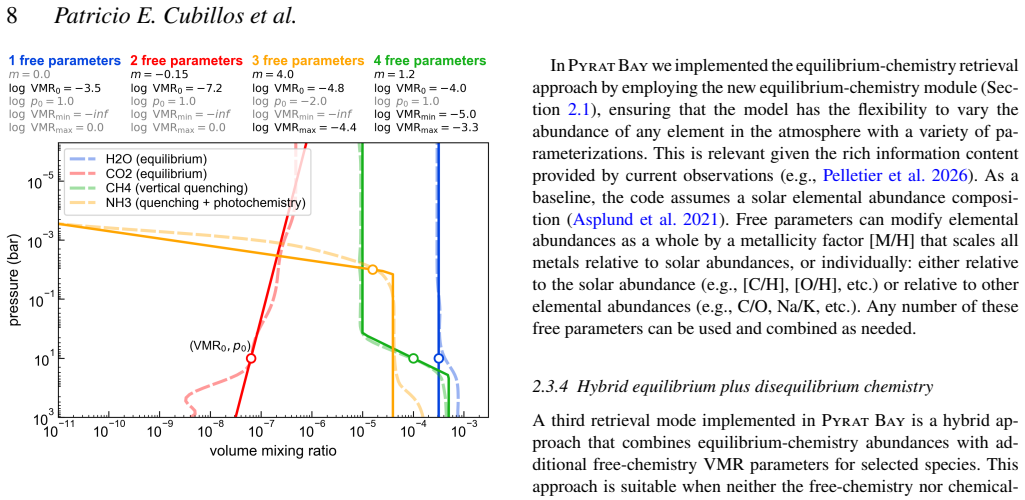
The load-bearing tool is the non-isobaric VMR parameterization: a slanted log VMR versus log pressure line, capped between minimum and maximum abundance values, with one to four free parameters depending on how much structure the data support. With a single free parameter it reduces to the standard constant-abundance model, which enables nested-sampling model comparison between the two. The other machinery carrying the argument is chemcat, a Gibbs free-energy minimizer with a Newton-Raphson and Lagrange-multiplier solver that computes equilibrium abundances fast enough for retrievals, coupled to a two-stream radiative-equilibrium iteration that self-consistently updates temperature and chemistry. The WASP-69b demonstration uses the slanted CH4 profile to show what the constant model misses.
What would settle it
Run the same constant-VMR versus non-isobaric CH4 retrieval comparison on synthetic spectra that include a gray cloud deck near 10 mbar or a three-dimensional circulation-consistent temperature structure; if the non-isobaric model then fails to recover the input abundances within 1 sigma, or if real WASP-69b spectra do not prefer the vertical model, the claim that JWST can recover vertical abundance variations would be undercut.
Extended reading notes
Core claim
The central claim is that vertical abundance variations in a gas-giant atmosphere are detectable and accurately recoverable with data of JWST quality, and that retrievals that neglect these variations can be substantially biased. In the WASP-69b demonstration, CH4 is the most abundant trace gas with a strongly pressure-dependent VMR; its absorption bands at 3.3 and 3.9 \textmu m probe different pressure levels, so a constant CH4 profile cannot fit both simultaneously. That mismatch propagates through abundance correlations, inflating H2O and CO by about 3.5 $\sigma$ and producing a metallicity estimate of about 18 times solar rather than the true 3 times solar. Replacing constant CH4 with the slanted non-isobaric model recovers the true abundances within 1 $\sigma$ and improves reduced $\chi^2$ from 1.56/1.61 to 1.09/1.14, with Bayes factors (\ln B) of 35.7 and 89.1 favoring the vertical model. The authors also validate chemcat and the radiative-equilibrium module against GGchem, FastChem, and HELIOS, and present cross-section tables, isotopic-ratio fitting, transit light source corrections, and data-offset and noise-scaling models as part of the framework.
Load-bearing premise
The whole demonstration assumes that the simulated JWST spectra are generated by the same idealized, cloud-free, one-dimensional radiative-thermochemical model that the retrievals test, so real atmospheres with clouds, three-dimensional structure, or opacity errors could behave differently.
Editorial extensions
If this is right
- JWST retrievals that assume constant volume mixing ratios for species with vertical gradients will systematically overestimate H2O and CO abundances and inferred metallicity.
- Non-isobaric VMR or equilibrium-chemistry parameterizations should be preferred for gas giants with JWST-quality data, and Bayes-factor model comparison can identify when vertical structure is statistically required.
- Combining NIRISS/SOSS with NIRSpec and MIRI extends the pressure range probed by transmission spectra and tightens constraints on vertical abundance profiles.
- Species whose abundances increase with altitude, like CO2 in this model, are less prone to altitude-induced bias in transmission geometry, so biases are species-specific rather than global.
Reading between the lines
- If this result transfers to real JWST spectra, published gas-giant retrievals that used constant-VMR free chemistry may need reanalysis; inferred metallicities could shift once vertical gradients are allowed.
- Recovered vertical abundance slopes could serve as diagnostics of quench pressures, photochemical destruction, or vertical mixing, linking retrieval outputs to atmospheric dynamics.
- Because the simulated dataset is cloud-free and one-dimensional, real observations with clouds, hazes, or terminator inhomogeneities may require joint cloud-plus-vertical-abundance retrieval before the claimed 1-sigma recovery is seen.
- A direct test would be to run the same constant-versus-non-isobaric CH4 comparison on actual WASP-69b JWST data and check whether the vertical model is preferred and whether the resulting H2O and CO abundances agree with independent constraints.
Editorial analysis
A structured set of objections, weighed in public.
Referee Report
Summary. This paper presents version 2.0 of the open-source Pyrat Bay exoplanet-atmosphere modeling framework. New capabilities include the standalone thermochemical-equilibrium package chemcat; a 1D radiative-equilibrium solver with mixing-length convection; MultiNest nested sampling; depth-offset and error-scaling parameters for multi-epoch observations; isotopic-ratio fitting; H- opacity; a transit-light-source correction; and a free-chemistry parameterization that allows non-isobaric (sloped and capped) VMR profiles. The chemistry and radiative-equilibrium modules are benchmarked against GGchem, FastChem, and HELIOS, with abundance agreement of about 0.05-0.1 dex, temperature-profile differences of 10-50 K, and NIR emission spectra agreeing within 1-10%. The paper then presents a retrieval case study on simulated JWST-quality transmission spectra of WASP-69b (NIRISS/SOSS, NIRSpec/G395H, MIRI/LRS) generated from a 3x-solar radiative-thermochemical-equilibrium forward model with enhanced NH3 and SO2. Retrievals with a constant CH4 VMR cannot simultaneously fit the CH4 features probing different pressure levels, and produce H2O and CO abundances about 3.5 sigma above the input values (inferred metallicity about 18x solar instead of 3x solar), whereas a non-isobaric CH4 parameterization recovers the input profile, improves the reduced chi-squared from 1.56/1.61 to 1.09/1.14, and is strongly favored by the evidence (ln B = 35.7 and 89.1).
Significance. The framework validation is the paper's strongest asset: chemcat and the radiative-equilibrium solver are checked against independent external codes (GGchem, FastChem, HELIOS) rather than against the framework itself, with quantified agreement, and the code, pre-computed cross sections for 38 species, and the reproducibility compendium (Zenodo records cited in Sections 2.4.2 and the Data Availability statement) are openly available. The non-isobaric VMR parameterization is a genuinely useful bridge between constant free-chemistry and full equilibrium-chemistry assumptions, and the WASP-69b closed-loop experiment is a clear, explicit control study with quantitative diagnostics (reduced chi-squared and Bayes factors) demonstrating how vertical CH4 structure can bias constant-VMR retrievals. If the claims hold, Pyrat Bay 2.0 should be a widely used community tool for JWST-era analysis. The main limitation is scope: the headline recoverability result is demonstrated for one species, one idealized cloud-free forward model, and one closed loop sharing the retrieval's opacity inputs, so the abstract's generalization to actual JWST observations is stronger than the evidence presented.
major comments (3)
- [Abstract; §3.2] The abstract's central finding — 'vertical abundance variations in planetary atmospheres can be accurately recovered using data of JWST quality' — is broader than what the paper demonstrates. Section 3 is a single closed-loop simulation for one species (CH4) under 'somewhat idealized, cloud-free conditions' (Section 3.2), using a WASP-69b forward model that omits the non-gray haze that Section 3.1 itself cites as characteristic of this target's observed optical and near-infrared spectrum. The conclusions ('with simulated transit observations') are properly qualified, but the abstract drops those qualifiers and asserts a general result about JWST data. Because a real cloud or haze inside the probed pressure window (10^-2 to 10^-5 bar) would reduce the pressure contrast between the CH4 features and could weaken or remove the vertical constraint and the quoted 3.5-sigma biases, I recommend either carrying the 'idealized, cloud-free, simulated' qualifiers into the abstract, or adding a robustness test (e.g., a gray-cloud or Mie-haze forward model, or a perturbed CH4 opacity treatment) that demonstrates the result still holds.
- [§3.2; §2.4.2] The forward model and the retrieval share the same CH4 line list (Yurchenko et al. 2024a, Table 2), the same R = 25,000 cross-section sampling (Section 2.4.2), and the same continuum, alkali, and collision-induced absorption opacities. Any common-mode opacity error is therefore invisible to the closed loop, so the non-isobaric retrieval's 'accurate recovery' is a self-consistency check of the new VMR parameterization given the adopted opacity set, not an external validation of the recovered vertical profile. I do not regard this as a flaw of the experimental design — an injection test is the correct way to validate a new parameterization — and the retrieval's parametric Madhusudhan-Seager temperature profile (Section 3.2) differs from the forward model's self-consistent radiative-equilibrium profile, which partly mitigates the shared-input concern. However, the manuscript should state explicitly that the recoverability result is conditional on the adopted opacities, and, if feasible, test sensitivity by perturbing the CH4 line-wing or sampling treatment in the forward model.
- [§3.2; Table A1] The quantitative headline numbers — H2O and CO retrieved about 3.5 sigma above the true values, and a metallicity of about 18x solar instead of 3x solar — require a scalar definition of the 'true' abundance for species whose input VMR varies with pressure (Fig. 7 middle panel; black dashed curves in Fig. 8). Table A1 reports posterior medians and 68% intervals but no comparison metric (e.g., transit-geometry-weighted mean, pressure-averaged VMR, or value at a reference pressure within the 10^-2 to 10^-5 bar window). Please state the metric used for each quoted deviation so that the 'within 1 sigma' and '3.5 sigma' claims are checkable; without it, the central bias claim cannot be precisely evaluated.
minor comments (6)
- [§2.3.3] The sentence 'The ‘equilibrium-chemistry’ parameterization is a second approach commonly used used for exoplanet atmospheric retrievals' contains a duplicated 'used', which should be removed.
- [§2.1.2] The text 'we will explore the posibility to incorporate additional thermodynamic databases' contains the typo 'posibility'; it should be 'possibility'.
- [Table 1 caption] The caption 'Equilibrium tempertatures were derived from the system parameters' contains the typo 'tempertatures'; it should be 'temperatures'.
- [§3.2] The non-isobaric retrievals end at reduced chi-squared values of 1.09 and 1.14, still somewhat above unity; a sentence explaining the residual tension (e.g., the parametric Madhusudhan-Seager temperature profile or the constant-VMR treatment of species such as CO2 or H2S) would help readers interpret the model comparison.
- [§2.3.2-§2.3.5] The equilibrium-chemistry, hybrid, and isotopic-ratio retrieval modes are implemented and described but not exercised or validated in Section 3; a sentence stating which features are externally benchmarked, which are demonstrated by the closed-loop test, and which remain untested would set accurate expectations for users of the new framework.
- [Figure 8 caption] The caption's clause 'The panels for CH4 shows the abundance profile as a function of pressure' should read 'show the abundance profiles', since multiple retrieved profiles are displayed.
Circularity Check
No significant circularity: the framework is benchmarked against independent external codes, and the WASP-69b retrieval demonstration is an explicit closed-loop control experiment rather than a prediction derived from a fitted input.
full rationale
The paper's central new-claims chain is self-contained rather than circular. The chemistry and radiative-equilibrium modules are validated against external, independent codes: chemcat is compared with GGchem and FastChem, and the radiative-equilibrium scheme is compared with HELIOS using shared inputs but separate implementations. These benchmarks provide independent support and are not cases of a result being assumed through self-citation. The retrieval application is a controlled closed-loop experiment: synthetic JWST-quality spectra are generated from a specified forward model with known input abundances and temperature profile, and then retrieved with a different, deliberately simplified parameterization (constant-VMR free chemistry, optionally with a non-isobaric CH4 profile). The constant-VMR retrieval fails and produces biased abundances; the non-isobaric CH4 retrieval recovers the inputs within 1 sigma. This is not circular because the retrieval is not guaranteed to succeed—the constant-VMR model demonstrably does not—and the recovered quantities are not equal to the fitted inputs by construction. The paper's own caveat that the simulations assume 'somewhat idealized, cloud-free conditions' (Section 3.2) limits external generalization to real JWST observations, but that is a correctness or robustness concern, not a circularity of the derivation. Self-citations to previous Pyrat Bay work establish lineage and implementation details, but no load-bearing conclusion about JWST recoverability or about biases in constant-VMR retrievals rests on a self-citation. No fitted parameter is renamed as a prediction, no uniqueness theorem is imported from the authors' prior work, and no known result is merely relabeled. Therefore there is no specific circular step that reduces an output to an input.
Assumptions & free parameters
free parameters (8)
- Non-isobaric CH4 VMR parameters =
m=1.22/2.6, logX0=-4.45/-3.93, logXmax=-3.94/-4.43 for NIRSpec+MIRI and full-instrument fits
- JWST noise inflation factor =
1.5
- Effective day-night redistribution beta_irr =
assumed efficient redistribution, exact value not stated
- Mixing-length parameters alpha and beta =
alpha about 1.5, beta unspecified in (0,1)
- Internal heat flux T_int =
0 K in baseline scenarios, 350 K in one WASP-107 scenario
- Metallicity [M/H] of WASP-69b model =
3x solar
- C/O ratio of WASP-69b model =
0.59 (solar)
- NH3 and SO2 abundance enhancements =
manual increases
assumptions (8)
- domain assumption Two-stream radiative transfer with hemispheric isotropy, pure absorption, LTE, and piecewise linear Planck function is accurate for these atmospheres.
- standard math Gibbs free-energy minimization via Newton-Raphson with mass-balance constraints converges to the equilibrium composition.
- domain assumption The atmosphere is net-neutral, allowing the charge-balance constraint for ionic species.
- domain assumption NIST-JANAF and NASA Glenn thermodynamic data are complete and accurate for all included species.
- domain assumption Solar elemental abundances (Asplund et al. 2009, 2021) are a valid baseline composition.
- domain assumption Line-list opacities, continuum opacities, and PHOENIX stellar SEDs used in benchmarks and retrievals are accurate.
- domain assumption MultiNest nested sampling with 1000 live points converges for the 18-20 parameter retrieval spaces.
- domain assumption The Madhusudhan and Seager (2009) parametric temperature profile and gray cloud-deck model are adequate for the WASP-69b retrievals.
Cite this review
Pith. "Pith review of Pyrat Bay 2.0: an Upgraded Framework for Exoplanet Atmosphere Modeling in the JWST Era." pith.science (2026). https://pith.science/paper/GMGBQ6Y6
@misc{pith2026260807128,
  author       = {Pith},
  title        = {Pith review of: Pyrat Bay 2.0: an Upgraded Framework for Exoplanet Atmosphere Modeling in the JWST Era},
  year         = {2026},
  howpublished = {\url{https://pith.science/paper/GMGBQ6Y6}},
  note         = {Machine review of arXiv:2608.07128}
}
read the original abstract
This article presents a major update to the open-source \textsc{Pyrat Bay} modeling framework (version 2.0), tailored for the characterization of exoplanet atmospheres with the observational capabilities of current facilities, such as the James Webb Space Telescope (JWST), and future missions. The upgraded framework introduces a standalone chemistry package, \textsc{chemcat}, enabling the modeling of exoplanet atmospheres via thermochemical-equilibrium calculations with custom compositions, self-consistent radiative-equilibrium thermal profiles, and equilibrium-chemistry retrievals. Other key implementations include nested sampling via MultiNest, isotopic-ratio fitting, transit light source modeling, and free-chemistry parameterization allowing vertical variations in volume mixing ratios. We validated the thermochemical- and radiative-equilibrium modules via comparisons with the \textsc{GGchem}, \textsc{FastChem}, and \textsc{HELIOS} codes. We present an application of the new modeling framework by conducting an atmospheric characterization study using simulated transmission spectra of high signal-to-noise observations for a gas-giant exoplanet. We found that vertical abundance variations in planetary atmospheres can be accurately recovered using data of JWST quality. In such cases, retrievals that neglect these variations may result in biased abundance constraints, e.g., when employing the commonly used free-chemistry approach assuming constant abundance profiles. The results highlight the potential of JWST to study the multi-dimensional nature of exoplanetary atmospheres and their underlying physical processes.
Figures


Figures from the paper (5 more)



Reference graph
Works this paper leans on
-
[1]
JWST COMPASS: A NIRSpec G395H Transmission Spectrum of the Super-Earth GJ 357 b. , keywords =. doi:10.3847/1538-3881/adee92 , archivePrefix =. 2507.07165 , primaryClass =
-
[2]
The impact of atmospheric circulation on the chemistry of the hot Jupiter HD 209458b. , keywords =. doi:10.1051/0004-6361/201220365 , archivePrefix =. 1210.6627 , primaryClass =
-
[3]
Early Release Science of the exoplanet WASP-39b with JWST NIRCam. , keywords =. doi:10.1038/s41586-022-05590-4 , archivePrefix =. 2211.10489 , primaryClass =
-
[4]
Escaping Helium and a Highly Muted Spectrum Suggest a Metal-enriched Atmosphere on Sub-Neptune GJ 3090 b from JWST Transit Spectroscopy. , keywords =. doi:10.3847/2041-8213/add010 , archivePrefix =. 2504.20428 , primaryClass =
-
[5]
Tracing the formation and migration history: molecular signatures in the atmosphere of misaligned hot Jupiter WASP-94 A b using JWST NIRSpec/G395H. , keywords =. doi:10.1093/mnras/staf819 , archivePrefix =. 2505.11224 , primaryClass =
-
[6]
The tidal deformation and atmosphere of WASP-12 b from its phase curve★. , keywords =. doi:10.1051/0004-6361/202348502 , archivePrefix =. 2402.10486 , primaryClass =
-
[7]
TauREx 3: A Fast, Dynamic, and Extendable Framework for Retrievals. , keywords =. doi:10.3847/1538-4357/ac0252 , archivePrefix =. 1912.07759 , primaryClass =
arXiv 1912
-
[8]
JWST COMPASS: The First Near- to Mid-infrared Transmission Spectrum of the Hot Super-Earth L 168-9 b. , keywords =. doi:10.3847/1538-3881/ad8eb5 , archivePrefix =. 2411.03154 , primaryClass =
Show all 205 references
-
[9]
, keywords =
Early Release Science of the exoplanet WASP-39b with JWST NIRSpec G395H. , keywords =. doi:10.1038/s41586-022-05591-3 , archivePrefix =. 2211.10488 , primaryClass =
-
[10]
, keywords =
JWST COMPASS: NIRSpec/G395H Transmission Observations of the Super-Earth TOI-836b. , keywords =. doi:10.3847/1538-3881/ad32c9 , archivePrefix =. 2404.00093 , primaryClass =
-
[11]
, keywords =
New study of the line profiles of sodium perturbed by H _ 2. , keywords =. doi:10.1051/0004-6361/201935593 , archivePrefix =. 1908.01989 , primaryClass =
1908 arXiv
-
[12]
, keywords =
Three newly discovered sub-Jupiter-mass planets: WASP-69b and WASP-84b transit active K dwarfs and WASP-70Ab transits the evolved primary of a G4+K3 binary. , keywords =. doi:10.1093/mnras/stu1737 , archivePrefix =. 1310.5654 , primaryClass =
- [13]
-
[14]
, keywords =
H ^ - Opacity and Water Dissociation in the Dayside Atmosphere of the Very Hot Gas Giant WASP-18b. , keywords =. doi:10.3847/2041-8213/aab272 , archivePrefix =. 1801.02489 , primaryClass =
-
[15]
Nature Reviews Methods Primers , keywords =
Nested sampling for physical scientists. Nature Reviews Methods Primers , keywords =. doi:10.1038/s43586-022-00121-x , archivePrefix =. 2205.15570 , primaryClass =
-
[16]
, keywords =
The Chemical Composition of the Sun. , keywords =. doi:10.1146/annurev.astro.46.060407.145222 , archivePrefix =. 0909.0948 , primaryClass =
-
[17]
, keywords =
The chemical make-up of the Sun: A 2020 vision. , keywords =. doi:10.1051/0004-6361/202140445 , archivePrefix =. 2105.01661 , primaryClass =
2020 arXiv
-
[18]
The rotation-vibration spectrum of hot H _ 2 S
ExoMol molecular line lists - XVI. The rotation-vibration spectrum of hot H _ 2 S. , keywords =. doi:10.1093/mnras/stw1133 , archivePrefix =. 1607.00499 , primaryClass =
-
[19]
The role of vertical and horizontal mixing
Grid of pseudo-2D chemistry models for tidally locked exoplanets - I. The role of vertical and horizontal mixing. , keywords =. doi:10.1093/mnras/stab1310 , archivePrefix =. 2105.02245 , primaryClass =
-
[20]
The role of photochemistry
Grid of pseudo-2D chemistry models for tidally locked exoplanets - II. The role of photochemistry. , keywords =. doi:10.1093/mnras/stac809 , archivePrefix =. 2203.11233 , primaryClass =
-
[21]
, keywords =
Kinetic and Photochemical Disequilibrium in the Potentially Carbon-rich Atmosphere of the Warm Jupiter WASP-69 b. , keywords =. doi:10.3847/1538-4357/adaa7d , archivePrefix =. 2501.08463 , primaryClass =
-
[22]
, keywords =
A Metal-poor Atmosphere with a Hot Interior for a Young Sub-Neptune Progenitor: JWST/NIRSpec Transmission Spectrum of V1298 Tau b. , keywords =. doi:10.3847/1538-3881/adec89 , archivePrefix =. 2507.08837 , primaryClass =
-
[23]
An improved hot rotation-vibration line list for HCN and HNC
ExoMol line lists - III. An improved hot rotation-vibration line list for HCN and HNC. , keywords =. doi:10.1093/mnras/stt2011 , archivePrefix =. 1311.1328 , primaryClass =
-
[24]
, keywords =
ExoMol molecular line lists V: the ro-vibrational spectra of NaCl and KCl. , keywords =. doi:10.1093/mnras/stu944 , archivePrefix =. 1403.7952 , primaryClass =
-
[25]
The GAPS Programme at TNG. LV. Multiple molecular species in the atmosphere of HAT-P-11 b and review of the HAT-P-11 planetary system. , keywords =. doi:10.1051/0004-6361/202347659 , archivePrefix =. 2403.01527 , primaryClass =
-
[26]
Nature Astronomy , keywords =
Nightside clouds and disequilibrium chemistry on the hot Jupiter WASP-43b. Nature Astronomy , keywords =. doi:10.1038/s41550-024-02230-x , archivePrefix =. 2401.13027 , primaryClass =
-
[27]
, keywords =
Evidence for a Volcanic Atmosphere on the Sub-Earth L 98-59 b. , keywords =. doi:10.3847/2041-8213/adaf22 , archivePrefix =. 2501.18680 , primaryClass =
- [28]
-
[29]
, keywords =
MoLLIST: Molecular Line Lists, Intensities and Spectra. , keywords =. doi:10.1016/j.jqsrt.2019.106687 , adsurl =
2019
-
[30]
, keywords =
TEA: A Code Calculating Thermochemical Equilibrium Abundances. , keywords =. doi:10.3847/0067-0049/225/1/4 , archivePrefix =. 1505.06392 , primaryClass =
-
[31]
, keywords =
Radii, masses, and transit-timing variations of the three-planet system orbiting the naked-eye star TOI-396. , keywords =. doi:10.1051/0004-6361/202451300 , archivePrefix =. 2411.14911 , primaryClass =
-
[32]
The GAPS Programme with HARPS-N at TNG . XIV. Investigating giant planet migration history via improved eccentricity and mass determination for 231 transiting planets. , keywords =. doi:10.1051/0004-6361/201629882 , archivePrefix =. 1704.00373 , primaryClass =
-
[33]
Reports on Progress in Physics , year = 2016, month = mar, volume =
KEPLER Mission: development and overview. Reports on Progress in Physics , year = 2016, month = mar, volume =. doi:10.1088/0034-4885/79/3/036901 , adsurl =
2016 doi
-
[34]
, keywords =
Collision-induced absorption coefficients of H _ 2 pairs at temperatures from 60 K to 1000 K. , keywords =. doi:10.1051/0004-6361:20020555 , adsurl =
-
[35]
, keywords =
Collision-induced Rototranslational Absorption Spectra of H 2-He Pairs at Temperatures from 40 to 3000 K. , keywords =. doi:10.1086/166112 , adsurl =
-
[36]
, keywords =
Collision-induced Infrared Spectra of H 2-He Pairs Involving 0 1 Vibrational Transitions and Temperatures from 18 to 7000 K. , keywords =. doi:10.1086/167027 , adsurl =
-
[37]
, keywords =
High-temperature (1000-7000 K) collision-induced absorption of H''2 pairs computed from the first principles, with application to cool and dense stellar atmospheres. , keywords =. doi:10.1016/S0022-4073(00)00023-6 , adsurl =
-
[38]
Collision-induced Infrared Spectra of H 2-He Pairs at Temperatures from 18 to 7000 K. II. Overtone and Hot Bands. , keywords =. doi:10.1086/167515 , adsurl =
-
[39]
, keywords =
ExoMol line lists - LV: hyperfine-resolved molecular line list for vanadium monoxide ( ^ 51 V ^ 16 O). , keywords =. doi:10.1093/mnras/stae542 , adsurl =
-
[40]
The SO line list, MARVEL analysis of experimental transition data and refinement of the spectroscopic model
ExoMol line lists - LVI. The SO line list, MARVEL analysis of experimental transition data and refinement of the spectroscopic model. , keywords =. doi:10.1093/mnras/stad3508 , archivePrefix =. 2312.09732 , primaryClass =
-
[41]
, keywords =
X-ray spectral modelling of the AGN obscuring region in the CDFS: Bayesian model selection and catalogue. , keywords =. doi:10.1051/0004-6361/201322971 , archivePrefix =. 1402.0004 , primaryClass =
-
[42]
2005 , month =
Burcat, A and Ruscic, B , title =. 2005 , month =. doi:10.2172/925269 , url =
2005 doi
-
[43]
, keywords =
The Near-Infrared and Optical Spectra of Methane Dwarfs and Brown Dwarfs. , keywords =. doi:10.1086/308462 , archivePrefix =. astro-ph/9908078 , primaryClass =
-
[44]
, keywords =
Theoretical Spectra and Light Curves of Close-in Extrasolar Giant Planets and Comparison with Data. , keywords =. doi:10.1086/533518 , archivePrefix =. 0709.4080 , primaryClass =
-
[45]
Multiple Molecular Species in the Atmosphere of the Warm Giant Planet WASP-80 b Unveiled at High Resolution with GIANO-B
The GAPS Programme at TNG XXXIX. Multiple Molecular Species in the Atmosphere of the Warm Giant Planet WASP-80 b Unveiled at High Resolution with GIANO-B. , keywords =. doi:10.3847/1538-3881/ac80bf , archivePrefix =. 2207.09761 , primaryClass =
-
[46]
An Introduction to Modern Astrophysics
-
[47]
Nature Astronomy , keywords =
A benchmark JWST near-infrared spectrum for the exoplanet WASP-39 b. Nature Astronomy , keywords =. doi:10.1038/s41550-024-02292-x , archivePrefix =. 2407.13893 , primaryClass =
-
[48]
Nature Astronomy , keywords =
Horizontal and vertical exoplanet thermal structure from a JWST spectroscopic eclipse map. Nature Astronomy , keywords =. doi:10.1038/s41550-025-02666-9 , archivePrefix =. 2510.24708 , primaryClass =
-
[49]
, keywords =
Toward a More Complex Description of Chemical Profiles in Exoplanet Retrievals: A Two-layer Parameterization. , keywords =. doi:10.3847/1538-4357/ab4a14 , archivePrefix =. 1903.11180 , primaryClass =
1903 arXiv
-
[50]
, keywords =
Detection of Planetary Transits Across a Sun-like Star. , keywords =. doi:10.1086/312457 , archivePrefix =. astro-ph/9911436 , primaryClass =
-
[51]
JANAF thermochemical tables
-
[52]
, keywords =
MARVEL analysis of the measured high-resolution rovibrational spectra of H _ 2 ^ 32 S. , keywords =. doi:10.1016/j.jqsrt.2018.07.012 , archivePrefix =. 1812.10503 , primaryClass =
2018 arXiv
-
[53]
Spectra of acetylene
ExoMol molecular line lists - XXXVII. Spectra of acetylene. , keywords =. doi:10.1093/mnras/staa229 , archivePrefix =. 2001.04550 , primaryClass =
2001 arXiv
-
[54]
A rotation-vibration line list for hot ammonia
ExoMol molecular line lists - XXXV. A rotation-vibration line list for hot ammonia. , keywords =. doi:10.1093/mnras/stz2778 , archivePrefix =. 1911.10369 , primaryClass =
1911 arXiv
-
[55]
, keywords =
A broadband thermal emission spectrum of the ultra-hot Jupiter WASP-18b. , keywords =. doi:10.1038/s41586-023-06230-1 , archivePrefix =. 2301.08192 , primaryClass =
-
[56]
Principles of stellar structure
-
[57]
, keywords =
Improved direct potential fit analyses for the ground electronic states of the hydrogen halides: HF/DF/TF, HCl/DCl/TCl, HBr/DBr/TBr and HI/DI/TI. , keywords =. doi:10.1016/j.jqsrt.2014.08.028 , adsurl =
2014 doi
-
[58]
, keywords =
An Algorithm to Compress Line-transition Data for Radiative-transfer Calculations. , keywords =. doi:10.3847/1538-4357/aa9228 , archivePrefix =. 1710.02556 , primaryClass =
-
[59]
doi:10.5281/zenodo.2547042 , publisher =
bibmanager: A BibTeX manager for LaTeX projects, Zenodo, doi:10.5281/zenodo.2547042 https://zenodo.org/record/2547042. doi:10.5281/zenodo.2547042 , publisher =
-
[60]
, keywords =
Gen TSO: A General JWST Simulator for Exoplanet Times-series Observations. , keywords =. doi:10.1088/1538-3873/ad8fd4 , archivePrefix =. 2410.04856 , primaryClass =
-
[61]
, keywords =
The PYRAT BAY framework for exoplanet atmospheric modelling: a population study of Hubble/WFC3 transmission spectra. , keywords =. doi:10.1093/mnras/stab1405 , archivePrefix =. 2105.05598 , primaryClass =
-
[62]
, keywords =
On Correlated-noise Analyses Applied to Exoplanet Light Curves. , keywords =. doi:10.3847/1538-3881/153/1/3 , archivePrefix =. 1610.01336 , primaryClass =
-
[63]
, keywords =
Toward More Reliable Analytic Thermochemical-equilibrium Abundances. , keywords =. doi:10.3847/1538-4357/aafda2 , archivePrefix =. 1901.03764 , primaryClass =
1901 arXiv
-
[64]
, keywords =
TOI-837 b: Characterisation, formation, and evolutionary history of an infant warm Saturn-mass planet. , keywords =. doi:10.1051/0004-6361/202450679 , archivePrefix =. 2406.08949 , primaryClass =
-
[65]
, keywords =
A Next-generation Exoplanet Atmospheric Retrieval Framework NEXOTRANS for Emission Spectroscopy: New Constraints and Atmospheric Characterization of WASP-69 b Using JWST NIRCam and MIRI Observations. , keywords =. doi:10.3847/1538-4357/ae1cc5 , archivePrefix =. 2510.27223 , pr...
-
[66]
, keywords =
Dark skies of the slightly eccentric WASP-18 b from its optical-to-infrared dayside emission. , keywords =. doi:10.1051/0004-6361/202450939 , archivePrefix =. 2505.01544 , primaryClass =
-
[67]
, keywords =
Asymmetry in the atmosphere of the ultra-hot Jupiter WASP-76 b. , keywords =. doi:10.1051/0004-6361/202348270 , adsurl =
-
[68]
, keywords =
The effects of consistent chemical kinetics calculations on the pressure-temperature profiles and emission spectra of hot Jupiters. , keywords =. doi:10.1051/0004-6361/201628799 , archivePrefix =. 1607.04062 , primaryClass =
-
[69]
, keywords =
Line Intensities and Molecular Opacities of the FeH F ^ 4 _ i -X ^ 4 _ i Transition. , keywords =. doi:10.1086/376791 , archivePrefix =. astro-ph/0305162 , primaryClass =
-
[70]
, keywords =
Identification of carbon dioxide in an exoplanet atmosphere. , keywords =. doi:10.1038/s41586-022-05269-w , archivePrefix =. 2208.11692 , primaryClass =
-
[71]
, keywords =
Spectroscopic Time-series Performance of JWST/NIRSpec from Commissioning Observations. , keywords =. doi:10.1088/1538-3873/aca3d3 , archivePrefix =. 2211.01459 , primaryClass =
-
[72]
, keywords =
Inhomogeneous terminators on the exoplanet WASP-39 b. , keywords =. doi:10.1038/s41586-024-07768-4 , archivePrefix =. 2407.10294 , primaryClass =
-
[73]
, keywords =
Atmospheric Chemistry of the Brown Dwarf Gliese 229B: Thermochemical Equilibrium Predictions. , keywords =. doi:10.1086/310356 , adsurl =
-
[74]
, keywords =
Early Release Science of the exoplanet WASP-39b with JWST NIRISS. , keywords =. doi:10.1038/s41586-022-05674-1 , archivePrefix =. 2211.10493 , primaryClass =
-
[75]
, keywords =
MULTINEST: an efficient and robust Bayesian inference tool for cosmology and particle physics. , keywords =. doi:10.1111/j.1365-2966.2009.14548.x , archivePrefix =. 0809.3437 , primaryClass =
2009
-
[76]
, keywords =
Retrieval analysis of 38 WFC3 transmission spectra and resolution of the normalization degeneracy. , keywords =. doi:10.1093/mnras/sty2550 , archivePrefix =. 1809.06894 , primaryClass =
-
[77]
, keywords =
emcee: The MCMC Hammer. , keywords =. doi:10.1086/670067 , archivePrefix =. 1202.3665 , primaryClass =
-
[78]
, keywords =
Beyond Equilibrium Temperature: How the Atmosphere/Interior Connection Affects the Onset of Methane, Ammonia, and Clouds in Warm Transiting Giant Planets. , keywords =. doi:10.3847/1538-3881/abc5bd , archivePrefix =. 2010.00146 , primaryClass =
2010 arXiv
-
[79]
, keywords =
Non-local thermodynamic equilibrium effects determine the upper atmospheric temperature structure of the ultra-hot Jupiter KELT-9b. , keywords =. doi:10.1051/0004-6361/202140813 , archivePrefix =. 2106.11263 , primaryClass =
-
[80]
The GAPS programme at TNG. XLV. HI Balmer lines transmission spectroscopy and NLTE atmospheric modelling of the ultra-hot Jupiter KELT-20b/MASCARA-2b. , keywords =. doi:10.1051/0004-6361/202346787 , archivePrefix =. 2306.15776 , primaryClass =
-
[81]
, keywords =
Non-local thermodynamical equilibrium atmospheric modelling of the ultra-hot Jupiter WASP-178b and comparison with UV and optical observations. , keywords =. doi:10.1051/0004-6361/202554240 , archivePrefix =. 2506.01132 , primaryClass =
-
[82]
, keywords =
Transmission spectroscopy of WASP-52 b with JWST NIRISS: water and helium atmospheric absorption, alongside prominent star-spot crossings. , keywords =. doi:10.1093/mnras/staf489 , archivePrefix =. 2412.17072 , primaryClass =
-
[83]
, keywords =
Hydrogen sulfide and metal-enriched atmosphere for a Jupiter-mass exoplanet. , keywords =. doi:10.1038/s41586-024-07760-y , archivePrefix =. 2407.06163 , primaryClass =
-
[84]
The California-Kepler Survey. VII. Precise Planet Radii Leveraging Gaia DR2 Reveal the Stellar Mass Dependence of the Planet Radius Gap. , keywords =. doi:10.3847/1538-3881/aae828 , archivePrefix =. 1805.01453 , primaryClass =
-
[85]
, keywords =
JWST Measurements of ^ 13 C, ^ 18 O, and ^ 17 O in the Atmosphere of Super-Jupiter VHS 1256 b. , keywords =. doi:10.3847/2041-8213/ad07e2 , archivePrefix =. 2311.05349 , primaryClass =
-
[86]
, keywords =
The ESO SupJup Survey V: exploring atmospheric variability and orbit of the super-Jupiter AB Pictoris b with CRIRES+. , keywords =. doi:10.1093/mnras/staf004 , archivePrefix =. 2501.05114 , primaryClass =
-
[87]
, keywords =
The KELT-7b atmospheric thermal-inversion conundrum revisited with CHEOPS, TESS, and additional data. , keywords =. doi:10.1051/0004-6361/202452560 , archivePrefix =. 2506.20432 , primaryClass =
-
[88]
, keywords =
Five carbon- and nitrogen-bearing species in a hot giant planet's atmosphere. , keywords =. doi:10.1038/s41586-021-03381-x , archivePrefix =. 2104.03352 , primaryClass =
-
[89]
Atmospheric Radiation: Theoretical Basis
-
[90]
, keywords =
The HITRAN2020 molecular spectroscopic database. , keywords =. doi:10.1016/j.jqsrt.2021.107949 , adsurl =
2021
-
[91]
, keywords =
The HITRAN2024 molecular spectroscopic database. , keywords =. doi:10.1016/j.jqsrt.2026.109807 , adsurl =
2026
-
[92]
1994 , url=
Computer Program for Calculation of Complex Chemical Equilibrium Compositions and Applications I, NASA Reference Publication RP-1311 , author=. 1994 , url=
1994
-
[93]
, keywords =
ExoMol molecular line lists XXXVI: X ^ 2 - X ^ 2 and A ^ 2 ^ + - X ^ 2 transitions of SH. , keywords =. doi:10.1093/mnras/stz2517 , archivePrefix =. 1909.02646 , primaryClass =
1909 arXiv
-
[94]
The observation and analysis of stellar photospheres
-
[95]
, keywords =
Hints of a Sulfur-rich Atmosphere around the 1.6 R _ Super-Earth L98-59 d from JWST NIRspec G395H Transmission Spectroscopy. , keywords =. doi:10.3847/2041-8213/ad73d1 , archivePrefix =. 2408.15855 , primaryClass =
-
[96]
, keywords =
HELIOS-K: An Ultrafast, Open-source Opacity Calculator for Radiative Transfer. , keywords =. doi:10.1088/0004-637X/808/2/182 , archivePrefix =. 1503.03806 , primaryClass =
-
[97]
, keywords =
On the radiative equilibrium of irradiated planetary atmospheres. , keywords =. doi:10.1051/0004-6361/200913396 , archivePrefix =. 1006.4702 , primaryClass =
-
[98]
The GAPS Programme at TNG. XXXVIII. Five molecules in the atmosphere of the warm giant planet WASP-69b detected at high spectral resolution. , keywords =. doi:10.1051/0004-6361/202243854 , archivePrefix =. 2207.09760 , primaryClass =
-
[99]
A grid of MARCS model atmospheres for late-type stars. I. Methods and general properties. , keywords =. doi:10.1051/0004-6361:200809724 , archivePrefix =. 0805.0554 , primaryClass =
-
[100]
, keywords =
Improved HCN/HNC linelist, model atmospheres and synthetic spectra for WZ Cas. , keywords =. doi:10.1111/j.1365-2966.2005.09960.x , archivePrefix =. astro-ph/0512363 , primaryClass =
2005
-
[101]
, keywords =
A H ^ 13 CN/HN ^ 13 C linelist, model atmospheres and synthetic spectra for carbon stars. , keywords =. doi:10.1111/j.1365-2966.2008.13642.x , archivePrefix =. 0807.0717 , primaryClass =
2008
-
[102]
, keywords =
Array programming with NumPy. , keywords =. doi:10.1038/s41586-020-2649-2 , archivePrefix =. 2006.10256 , primaryClass =
2006 arXiv
-
[103]
, keywords =
The NewEra model grid. , keywords =. doi:10.1051/0004-6361/202554171 , archivePrefix =. 2504.17597 , primaryClass =
-
[104]
Analytical Models of Exoplanetary Atmospheres. II. Radiative Transfer via the Two-stream Approximation. , keywords =. doi:10.1088/0067-0049/215/1/4 , archivePrefix =. 1405.0026 , primaryClass =
-
[105]
Studies in Stellar Evolution. III. The Calculation of Model Envelopes. , year = 1965, month = oct, volume =. doi:10.1086/148357 , adsurl =
1965 doi
-
[106]
, keywords =
Possible Hycean conditions in the sub-Neptune TOI-270 d. , keywords =. doi:10.1051/0004-6361/202348238 , archivePrefix =. 2403.03244 , primaryClass =
-
[107]
Journal of Molecular Spectroscopy , keywords =
AI-3000K Infrared Line List for Hot CO2. Journal of Molecular Spectroscopy , keywords =. doi:10.1016/j.jms.2023.111748 , adsurl =
2023
-
[108]
Matplotlib: A 2D graphics environment , Journal =
-
[109]
, keywords =
A new extensive library of PHOENIX stellar atmospheres and synthetic spectra. , keywords =. doi:10.1051/0004-6361/201219058 , archivePrefix =. 1303.5632 , primaryClass =
-
[110]
, keywords =
Continuous absorption by the negative hydrogen ion reconsidered. , keywords =
-
[111]
, keywords =
A Framework for Prioritizing the TESS Planetary Candidates Most Amenable to Atmospheric Characterization. , keywords =. doi:10.1088/1538-3873/aadf6f , archivePrefix =. 1805.03671 , primaryClass =
-
[112]
, keywords =
Probing the atmosphere of WASP-69 b with low- and high-resolution transmission spectroscopy. , keywords =. doi:10.1051/0004-6361/202141191 , archivePrefix =. 2109.06335 , primaryClass =
-
[113]
, keywords =
BOWIE-ALIGN: JWST reveals hints of planetesimal accretion and complex sulphur chemistry in the atmosphere of the misaligned hot Jupiter WASP-15b. , keywords =. doi:10.1093/mnras/staf208 , archivePrefix =. 2410.08116 , primaryClass =
-
[114]
, keywords =
Close-in Sub-Neptunes Reveal the Past Rotation History of Their Host Stars: Atmospheric Evolution of Planets in the HD 3167 and K2-32 Planetary Systems. , keywords =. doi:10.3847/1538-4357/ab1e42 , archivePrefix =. 1906.12153 , primaryClass =
1906 arXiv
-
[115]
SAO Special Report , year = 1970, month = feb, volume =
Atlas: a Computer Program for Calculating Model Stellar Atmospheres. SAO Special Report , year = 1970, month = feb, volume =
1970
-
[116]
Workshop on Astrophysical Opacities , year = 2018, series =
Including All the Lines: Data Releases for Spectra and Opacities through 2017. Workshop on Astrophysical Opacities , year = 2018, series =
2017
-
[117]
, keywords =
Atmospheric Loss of Exoplanets Resulting from Stellar X-Ray and Extreme-Ultraviolet Heating. , keywords =. doi:10.1086/380815 , adsurl =
-
[118]
A rovibrational line list for phosphinidene (PH) in its X \ \ \^3 \^- and a \ \ \^1 electronic states
ExoMol line list - XXXIV. A rovibrational line list for phosphinidene (PH) in its X \ \ \^3 \^- and a \ \ \^1 electronic states. , keywords =. doi:10.1093/mnras/stz1856 , archivePrefix =. 1907.03367 , primaryClass =
1907 arXiv
-
[119]
, keywords =
Spectral binning of precomputed correlated-k coefficients. , keywords =. doi:10.1051/0004-6361/202039040 , archivePrefix =. 2012.01428 , primaryClass =
2012 arXiv
-
[120]
, keywords =
Rovibrational Line Lists for Nine Isotopologues of the CO Molecule in the X ^ 1 ^ + Ground Electronic State. , keywords =. doi:10.1088/0067-0049/216/1/15 , adsurl =
-
[121]
Uniform Atmospheric Retrieval Analysis of Ultracool Dwarfs. I. Characterizing Benchmarks, Gl 570D and HD 3651B. , keywords =. doi:10.1088/0004-637X/807/2/183 , archivePrefix =. 1504.06670 , primaryClass =
-
[122]
, keywords =
Refractory and Volatile Species in the UV-to-IR Transmission Spectrum of Ultra-hot Jupiter WASP-178b with HST and JWST. , keywords =. doi:10.3847/1538-3881/adc117 , archivePrefix =. 2503.15472 , primaryClass =
-
[123]
, keywords =
Metallicity and Spectral Evolution of WASP 39b: The Limited Role of Hydrodynamic Escape. , keywords =. doi:10.3847/2041-8213/acfaec , archivePrefix =. 2309.09605 , primaryClass =
-
[124]
, keywords =
JWST-TST DREAMS: A Precise Water Abundance for Hot Jupiter WASP-17b from the NIRISS SOSS Transmission Spectrum. , keywords =. doi:10.3847/1538-3881/ad9688 , archivePrefix =. 2412.03675 , primaryClass =
-
[125]
The Journal of Open Source Software , keywords =
POSEIDON: A Multidimensional Atmospheric Retrieval Code for Exoplanet Spectra. The Journal of Open Source Software , keywords =. doi:10.21105/joss.04873 , archivePrefix =. 2410.18181 , primaryClass =
-
[126]
2024 , MONTH = Jun, DOI =
Mackamul, Eva and Casiez, G. 2024 , MONTH = Jun, DOI =
2024
-
[127]
, keywords =
Carbon-bearing Molecules in a Possible Hycean Atmosphere. , keywords =. doi:10.3847/2041-8213/acf577 , archivePrefix =. 2309.05566 , primaryClass =
-
[128]
, keywords =
A Temperature and Abundance Retrieval Method for Exoplanet Atmospheres. , keywords =. doi:10.1088/0004-637X/707/1/24 , archivePrefix =. 0910.1347 , primaryClass =
-
[129]
, keywords =
HELIOS: An Open-source, GPU-accelerated Radiative Transfer Code for Self-consistent Exoplanetary Atmospheres. , keywords =. doi:10.3847/1538-3881/153/2/56 , archivePrefix =. 1606.05474 , primaryClass =
-
[130]
, keywords =
Self-luminous and Irradiated Exoplanetary Atmospheres Explored with HELIOS. , keywords =. doi:10.3847/1538-3881/ab1084 , archivePrefix =. 1903.06794 , primaryClass =
1903 arXiv
-
[131]
, keywords =
The Metallicity and Carbon-to-oxygen Ratio of the Ultrahot Jupiter WASP-76b from Gemini-S/IGRINS. , keywords =. doi:10.3847/1538-3881/ad4a5f , archivePrefix =. 2405.09769 , primaryClass =
-
[132]
Science , keywords =
Atmospheric, Evolutionary, and Spectral Models of the Brown Dwarf Gliese 229 B. Science , keywords =. doi:10.1126/science.272.5270.1919 , archivePrefix =. astro-ph/9606036 , primaryClass =
1919
-
[133]
, keywords =
Detection of H _ 2 O and CO _ 2 in the Atmosphere of the Hot Super-Neptune WASP-166b with JWST. , keywords =. doi:10.3847/1538-3881/adda2e , archivePrefix =. 2501.00609 , primaryClass =
-
[134]
2002 , url=
NASA Glenn Coefficients for Calculating Thermodynamic Properties of Individual Species, NASA Technical Publication TP-2002-211556 , author=. 2002 , url=
2002
-
[135]
Water Vapor in the Spectrum of the Extrasolar Planet HD 189733b. I. The Transit. , keywords =. doi:10.1088/0004-637X/791/1/55 , archivePrefix =. 1407.2462 , primaryClass =
-
[136]
The high-temperature spectrum of VO
ExoMol line lists - XVIII. The high-temperature spectrum of VO. , keywords =. doi:10.1093/mnras/stw1969 , archivePrefix =. 1609.06120 , primaryClass =
-
[137]
The spectrum of Titanium Oxide
ExoMol molecular line lists - XXXIII. The spectrum of Titanium Oxide. , keywords =. doi:10.1093/mnras/stz1818 , archivePrefix =. 1905.04587 , primaryClass =
1905 arXiv
-
[138]
Modelling philosophy and retrieval
The ARCiS framework for exoplanet atmospheres. Modelling philosophy and retrieval. , keywords =. doi:10.1051/0004-6361/201937377 , archivePrefix =. 2006.12821 , primaryClass =
2006 arXiv
-
[139]
, keywords =
Model Atmospheres of Irradiated Exoplanets: The Influence of Stellar Parameters, Metallicity, and the C/O Ratio. , keywords =. doi:10.1088/0004-637X/813/1/47 , archivePrefix =. 1509.07523 , primaryClass =
-
[140]
A Python radiative transfer package for exoplanet characterization and retrieval
petitRADTRANS. A Python radiative transfer package for exoplanet characterization and retrieval. , keywords =. doi:10.1051/0004-6361/201935470 , archivePrefix =. 1904.11504 , primaryClass =
1904 arXiv
-
[141]
, keywords =
Detecting isotopologues in exoplanet atmospheres using ground-based high-dispersion spectroscopy. , keywords =. doi:10.1051/0004-6361/201834169 , archivePrefix =. 1809.01156 , primaryClass =
-
[142]
, keywords =
High Tide or Riptide on the Cosmic Shoreline? A Water-rich Atmosphere or Stellar Contamination for the Warm Super-Earth GJ 486b from JWST Observations. , keywords =. doi:10.3847/2041-8213/accb9c , archivePrefix =. 2305.00868 , primaryClass =
-
[143]
, keywords =
The Imprint of Exoplanet Formation History on Observable Present-day Spectra of Hot Jupiters. , keywords =. doi:10.3847/0004-637X/832/1/41 , archivePrefix =. 1609.03019 , primaryClass =
-
[144]
, keywords =
Thermal Emission and Reflected Light Spectra of Super Earths with Flat Transmission Spectra. , keywords =. doi:10.1088/0004-637X/815/2/110 , archivePrefix =. 1511.01492 , primaryClass =
-
[145]
Philosophical Transactions of the Royal Society of London Series A , keywords =
Chemical kinetics on extrasolar planets. Philosophical Transactions of the Royal Society of London Series A , keywords =. doi:10.1098/rsta.2013.0073 , archivePrefix =. 1307.5450 , primaryClass =
2013
-
[146]
, keywords =
Disequilibrium Carbon, Oxygen, and Nitrogen Chemistry in the Atmospheres of HD 189733b and HD 209458b. , keywords =. doi:10.1088/0004-637X/737/1/15 , archivePrefix =. 1102.0063 , primaryClass =
-
[147]
, keywords =
PICASO 3.0: A One-dimensional Climate Model for Giant Planets and Brown Dwarfs. , keywords =. doi:10.3847/1538-4357/ac9f48 , archivePrefix =. 2208.07836 , primaryClass =
-
[148]
The GTC exoplanet transit spectroscopy survey. XI. Possible detection of Rayleigh scattering in the atmosphere of the Saturn-mass planet WASP-69b. , keywords =. doi:10.1051/0004-6361/202038161 , archivePrefix =. 2007.02741 , primaryClass =
2007 arXiv
-
[149]
Nature Astronomy , keywords =
Evidence for morning-to-evening limb asymmetry on the cool low-density exoplanet WASP-107 b. Nature Astronomy , keywords =. doi:10.1038/s41550-024-02367-9 , archivePrefix =. 2406.09863 , primaryClass =
-
[150]
, keywords =
KRONOS I: The 1─2.8 m JWST Transmission Spectrum of the 23 Myr V1298 Tau c. , keywords =. doi:10.3847/1538-3881/ae7a32 , archivePrefix =. 2606.03740 , primaryClass =
-
[151]
, keywords =
The Effects of Snowlines on C/O in Planetary Atmospheres. , keywords =. doi:10.1088/2041-8205/743/1/L16 , archivePrefix =. 1110.5567 , primaryClass =
-
[152]
The rotation-vibration spectrum of silane up to 1200 K
ExoMol line lists - XXII. The rotation-vibration spectrum of silane up to 1200 K. , keywords =. doi:10.1093/mnras/stx1952 , archivePrefix =. 1712.09354 , primaryClass =
-
[153]
High-temperature molecular line lists for the alkali metal hydroxides KOH and NaOH
ExoMol line lists - XLI. High-temperature molecular line lists for the alkali metal hydroxides KOH and NaOH. , keywords =. doi:10.1093/mnras/staa4041 , archivePrefix =. 2103.01601 , primaryClass =
-
[154]
Rovibronic molecular line lists of calcium monohydride (CaH) and magnesium monohydride (MgH)
ExoMol line lists - XLV. Rovibronic molecular line lists of calcium monohydride (CaH) and magnesium monohydride (MgH). , keywords =. doi:10.1093/mnras/stac371 , archivePrefix =. 2210.12474 , primaryClass =
-
[155]
High-temperature molecular line list of carbonyl sulphide (OCS)
ExoMol line lists - LVIII. High-temperature molecular line list of carbonyl sulphide (OCS). , year = 2024, month = jun, volume =. doi:10.1093/mnras/stae1110 , adsurl =
2024 doi
-
[156]
, keywords =
Chemical Diversity in Protoplanetary Disks and Its Impact on the Formation History of Giant Planets. , keywords =. doi:10.3847/1538-4357/ac8b11 , archivePrefix =. 2206.14685 , primaryClass =
-
[157]
Line lists for eight isotopologues of CS
ExoMol molecular line lists - XII. Line lists for eight isotopologues of CS. , keywords =. doi:10.1093/mnras/stv1543 , archivePrefix =. 1507.01275 , primaryClass =
-
[158]
, keywords =
Enriched volatiles and refractories but deficient titanium on the day-side atmosphere of WASP-121b revealed by JWST/NIRISS. , keywords =. doi:10.1051/0004-6361/202556985 , archivePrefix =. 2508.18341 , primaryClass =
-
[159]
doi:10.1109/MCSE.2007.53 , publisher =
Computing in Science and Engineering , Volume =. doi:10.1109/MCSE.2007.53 , publisher =
2007 doi
-
[160]
, keywords =
VALD: The Vienna Atomic Line Data Base. , keywords =
-
[161]
, keywords =
ExoMol molecular line lists XXX: a complete high-accuracy line list for water. , keywords =. doi:10.1093/mnras/sty1877 , archivePrefix =. 1807.04529 , primaryClass =
-
[162]
Spectra of PO and PS
ExoMol molecular line lists - XXIII. Spectra of PO and PS. , keywords =. doi:10.1093/mnras/stx2229 , archivePrefix =. 1709.03001 , primaryClass =
-
[163]
Numerical Recipes 3rd Edition: The Art of Scientific Computing , year =
-
[164]
, keywords =
The Transit Light Source Effect: False Spectral Features and Incorrect Densities for M-dwarf Transiting Planets. , keywords =. doi:10.3847/1538-4357/aaa08c , archivePrefix =. 1711.05691 , primaryClass =
-
[165]
Sociological Methodology , year = 1995, volume = 25, pages =
Bayesian Model Selection in Social Research. Sociological Methodology , year = 1995, volume = 25, pages =
1995
-
[166]
The spectrum of sodium hydride
ExoMol molecular line lists - X. The spectrum of sodium hydride. , keywords =. doi:10.1093/mnras/stv979 , archivePrefix =. 1506.00174 , primaryClass =
-
[167]
, keywords =
Hydrogen-model atmospheres for white dwarf stars. , keywords =. doi:10.1046/j.1365-8711.2001.04298.x , archivePrefix =. astro-ph/0102182 , primaryClass =
2001
-
[168]
, keywords =
Early Release Science of the exoplanet WASP-39b with JWST NIRSpec PRISM. , keywords =. doi:10.1038/s41586-022-05677-y , archivePrefix =. 2211.10487 , primaryClass =
-
[169]
, keywords =
JWST COMPASS: The 3─5 m Transmission Spectrum of the Super-Earth L 98-59 c. , keywords =. doi:10.3847/1538-3881/ad73cf , archivePrefix =. 2409.07552 , primaryClass =
-
[170]
Empirical rovibronic spectra of phosphorous mononitride (PN) covering the IR and UV regions
ExoMol line lists - LXIV. Empirical rovibronic spectra of phosphorous mononitride (PN) covering the IR and UV regions. , keywords =. doi:10.1093/mnras/stae2610 , archivePrefix =. 2410.18292 , primaryClass =
-
[171]
, keywords =
Atmospheric Circulation of Hot Jupiters: Coupled Radiative-Dynamical General Circulation Model Simulations of HD 189733b and HD 209458b. , keywords =. doi:10.1088/0004-637X/699/1/564 , archivePrefix =. 0809.2089 , primaryClass =
-
[172]
, keywords =
Seasonal Changes in the Atmosphere of HD 80606 b Observed with JWST's NIRSpec/G395H. , keywords =. doi:10.3847/1538-3881/addfda , archivePrefix =. 2407.12456 , primaryClass =
-
[173]
, keywords =
A continuum from clear to cloudy hot-Jupiter exoplanets without primordial water depletion. , keywords =. doi:10.1038/nature16068 , archivePrefix =. 1512.04341 , primaryClass =
-
[174]
, keywords =
CHEOPS observations of KELT-20 b/MASCARA-2 b: An aligned orbit and signs of variability from a reflective day side. , keywords =. doi:10.1051/0004-6361/202347533 , archivePrefix =. 2311.03264 , primaryClass =
-
[175]
Bayesian Inference and Maximum Entropy Methods in Science and Engineering , year = 2004, editor =
Nested Sampling. Bayesian Inference and Maximum Entropy Methods in Science and Engineering , year = 2004, editor =. doi:10.1063/1.1835238 , adsurl =
2004 doi
-
[176]
Bayesian Analysis , number =
John Skilling , title =. Bayesian Analysis , number =. 2006 , doi =
2006
-
[177]
The rotation-vibration spectrum of phosphine up to 1500 K
ExoMol line lists - VII. The rotation-vibration spectrum of phosphine up to 1500 K. , keywords =. doi:10.1093/mnras/stu2246 , archivePrefix =. 1410.2917 , primaryClass =
-
[178]
, year = 2024, month = nov, volume =
K2-370 b: a strongly irradiated sub-Neptune transiting a very active solar-type star. , year = 2024, month = nov, volume =. doi:10.1093/mnras/stae2323 , adsurl =
2024 doi
-
[179]
, keywords =
Atmosphere and Spectral Models of the Kepler-field Planets HAT-P-7b and TrES-2. , keywords =. doi:10.1088/0004-637X/722/1/871 , archivePrefix =. 1006.1660 , primaryClass =
-
[180]
, keywords =
FastChem: A computer program for efficient complex chemical equilibrium calculations in the neutral/ionized gas phase with applications to stellar and planetary atmospheres. , keywords =. doi:10.1093/mnras/sty1531 , archivePrefix =. 1804.05010 , primaryClass =
-
[181]
, keywords =
Correcting Exoplanet Transmission Spectra for Stellar Activity with an Optimized Retrieval Framework. , keywords =. doi:10.3847/1538-4357/ad0369 , archivePrefix =. 2302.04574 , primaryClass =
-
[182]
, keywords =
Bayesian Model Comparison and Significance: Widespread Errors and How to Correct Them. , keywords =. doi:10.3847/1538-4365/ae0e71 , archivePrefix =. 2510.00169 , primaryClass =
-
[183]
, keywords =
Applications of Bayesian model selection to cosmological parameters. , keywords =. doi:10.1111/j.1365-2966.2007.11738.x , archivePrefix =. astro-ph/0504022 , primaryClass =
2007
-
[184]
, keywords =
Photochemically produced SO _ 2 in the atmosphere of WASP-39b. , keywords =. doi:10.1038/s41586-023-05902-2 , archivePrefix =. 2211.10490 , primaryClass =
-
[185]
, keywords =
A Population Study of Gaseous Exoplanets. , keywords =. doi:10.3847/1538-3881/aaaf75 , archivePrefix =. 1704.05413 , primaryClass =
-
[186]
The rotation-vibration spectrum of hot SO _ 2
ExoMol molecular line lists - XIV. The rotation-vibration spectrum of hot SO _ 2. , keywords =. doi:10.1093/mnras/stw849 , archivePrefix =. 1603.04065 , primaryClass =
-
[187]
, keywords =
ExoMol line lists XXV: a hot line list for silicon sulphide, SiS. , keywords =. doi:10.1093/mnras/sty998 , archivePrefix =. 1806.11177 , primaryClass =
-
[188]
, keywords =
A Detailed Investigation of HD 209458 b HST and JWST Transmission Spectra with SANSAR. , keywords =. doi:10.3847/1538-3881/addc5c , archivePrefix =. 2505.04413 , primaryClass =
-
[189]
Nature Medicine , keywords =
SciPy 1.0: fundamental algorithms for scientific computing in Python. Nature Medicine , keywords =. doi:10.1038/s41592-019-0686-2 , archivePrefix =. 1907.10121 , primaryClass =
1907 arXiv
-
[190]
Atmospheric Chemistry in Giant Planets, Brown Dwarfs, and Low-Mass Dwarf Stars. II. Sulfur and Phosphorus. , keywords =. doi:10.1086/506245 , archivePrefix =. astro-ph/0511136 , primaryClass =
-
[191]
, keywords =
JWST COMPASS: A NIRSpec/G395H Transmission Spectrum of the Sub-Neptune TOI-836c. , keywords =. doi:10.3847/1538-3881/ad3917 , archivePrefix =. 2404.01264 , primaryClass =
-
[192]
, keywords =
A high internal heat flux and large core in a warm Neptune exoplanet. , keywords =. doi:10.1038/s41586-024-07514-w , archivePrefix =. 2405.11018 , primaryClass =
-
[193]
, keywords =
Aurora: A Generalized Retrieval Framework for Exoplanetary Transmission Spectra. , keywords =. doi:10.3847/1538-4357/abee94 , archivePrefix =. 2103.08600 , primaryClass =
-
[194]
, year = 1958, month = may, volume =
Chemical Equilibrium in Complex Mixtures. , year = 1958, month = may, volume =. doi:10.1063/1.1744264 , adsurl =
1958 doi
-
[195]
Impact of silicates and phyllosilicates on the carbon to oxygen ratio
Equilibrium chemistry down to 100 K. Impact of silicates and phyllosilicates on the carbon to oxygen ratio. , keywords =. doi:10.1051/0004-6361/201732193 , archivePrefix =. 1712.01010 , primaryClass =
-
[196]
, keywords =
A theoretical room-temperature line list for ^ 15 NH _ 3. , keywords =. doi:10.1016/j.jqsrt.2014.10.023 , archivePrefix =. 1502.07975 , primaryClass =
2014 arXiv
-
[197]
, keywords =
ExoMol line lists XXIV: a new hot line list for silicon monohydride, SiH. , keywords =. doi:10.1093/mnras/stx2738 , archivePrefix =. 1710.06964 , primaryClass =
-
[198]
Ro-vibrational molecular line list for CO _ 2
ExoMol line lists - XXXIX. Ro-vibrational molecular line list for CO _ 2. , keywords =. doi:10.1093/mnras/staa1874 , archivePrefix =. 2007.02122 , primaryClass =
2007 arXiv
-
[199]
Infrared and ultraviolet line list for silicon monoxide ( ^ 28 Si ^ 16 O)
ExoMol line lists - XLIV. Infrared and ultraviolet line list for silicon monoxide ( ^ 28 Si ^ 16 O). , keywords =. doi:10.1093/mnras/stab3267 , archivePrefix =. 2111.04859 , primaryClass =
-
[200]
High accuracy ro-vibrational line list for methane (CH _ 4 )
ExoMol line lists - LVII. High accuracy ro-vibrational line list for methane (CH _ 4 ). , keywords =. doi:10.1093/mnras/stae148 , adsurl =
-
[201]
Molecular line list for the ammonia isotopologue ^ 15 NH _ 3
ExoMol line lists - LX. Molecular line list for the ammonia isotopologue ^ 15 NH _ 3. , keywords =. doi:10.1093/mnras/stae1849 , archivePrefix =. 2410.04295 , primaryClass =
-
[202]
The rotation-vibration spectrum of methane up to 1500 K
ExoMol line lists - IV. The rotation-vibration spectrum of methane up to 1500 K. , keywords =. doi:10.1093/mnras/stu326 , archivePrefix =. 1401.4852 , primaryClass =
-
[203]
, keywords =
PLATON II: New Capabilities and a Comprehensive Retrieval on HD 189733b Transit and Eclipse Data. , keywords =. doi:10.3847/1538-4357/aba1e6 , archivePrefix =. 2004.09513 , primaryClass =
2004 arXiv
-
[204]
, keywords =
The ^ 13 CO-rich atmosphere of a young accreting super-Jupiter. , keywords =. doi:10.1038/s41586-021-03616-x , archivePrefix =. 2107.06297 , primaryClass =
-
[205]
Statistics and Computing , volume =
Differential Evolution Markov Chain with snooker updater and fewer chains , year =. Statistics and Computing , volume =. doi:10.1007/s11222-008-9104-9 , url =
Reviewed August 10, 2026 · model on record in the stance chip above.
Discussion (0). Continue with ORCID to comment.