REVIEW 4 major objections 4 minor 62 references
Uncertainties in tellurium-based dark matter searches stemming from nuclear structure uncertainties
T0 review · 4 major / 4 minor · reviewed 2026-08-10 · deepseek-v4-flash
Pith's one-line read For tellurium targets like CUORE's, nuclear shell model uncertainty makes 90% upper limits on spin-dependent dark matter couplings exceed 100% in some channels, and makes annual modulation amplitude uncertainties track the time-averaged…
desk verdict A competent follow-up to the authors' xenon work, with the same key caveat: the tellurium uncertainty numbers rest on a two-Hamiltonian ensemble that is not validated, though the annual-modulation phase result is robust. read the letter →
The pith
A machine-rendered reading of the paper's core claim, the machinery that carries it, and where it could break.
The reading
What carries the argument
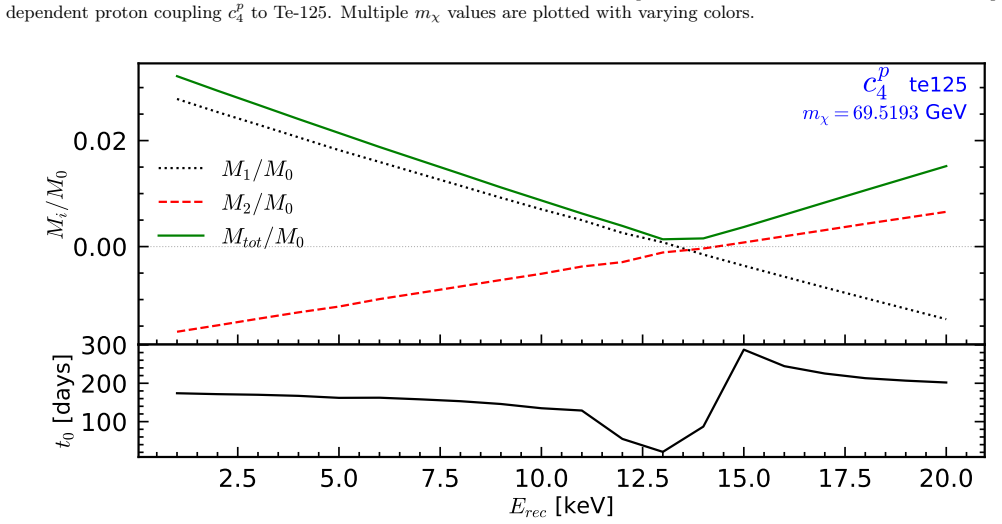
The central object is the Gaussian ensemble of one-body density matrices. The two tellurium shell-model Hamiltonians, GCN and JJ55, each produce a set of one-body density matrices; for every matrix element the two values fix the mean and width of a normal distribution, and Monte Carlo draws from these distributions are the input to the dmscatter code that computes WIMP-nucleus differential rates. A single rate calculation fixes the 90% upper limit on a coupling coefficient through the quadratic relation of Eq. (8), and the Feldman-Cousins prescription converts the ensemble spread into asymmetric 1σ uncertainties. For the annual modulation part, the same ensemble is evaluated at eight Earth velocities and the Fourier coefficients M0, M1, M2 of Eq. (10) are fit per run, so the ratio structure of the modulation signal can be inspected directly.
What would settle it
Take a third, independently fitted shell-model Hamiltonian for 123Te and 125Te, generate its one-body density matrices, and check whether they fall inside the Gaussian widths defined by the GCN and JJ55 pair; if they fall outside, the reported upper-limit uncertainties—and the claim that tellurium uncertainties are comparable to xenon's—would have to be revised.
Extended reading notes
Core claim
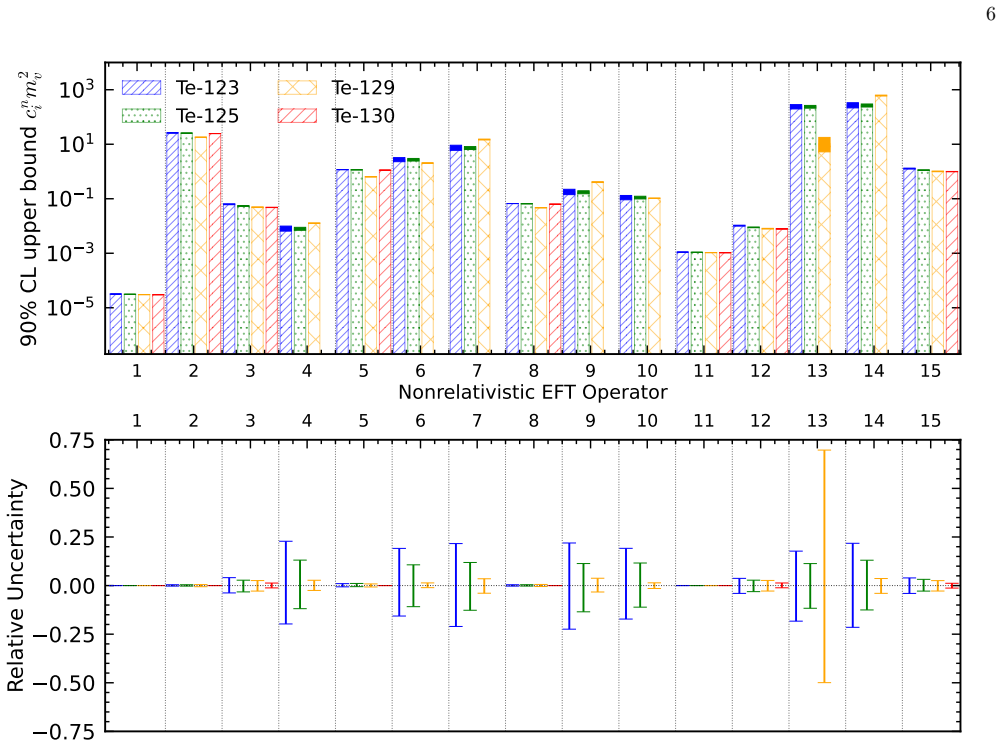
The paper's claim, on its own terms, is that in tellurium dioxide detectors the nuclear shell model is a significant source of systematic uncertainty for spin-dependent WIMP search limits. Starting from the two shell-model Hamiltonians GCN and JJ55, the authors construct a Gaussian ensemble of one-body density matrices, each Monte Carlo draw entering the dmscatter calculation of the differential event rate and thus the 90% upper limit on each of the fifteen Galilean EFT couplings via Eq. (8). The result is a clear pattern: operators that are independent of nucleon spin have negligible relative uncertainty, whereas nucleon spin-dependent operators—O6, O7, O9, O10, O13, O14 in particular—show uncertainties comparable to the xenon case and reaching above 100% in even-odd isotopes such as 123Te and 125Te. For the annual modulation, fitting the Fourier model of Eq. (10) per Monte Carlo run shows that the ratios M1/M0 and M2/M0 are ensemble-independent, which directly implies the modulation phase is unchanged and that the uncertainty in the modulation amplitude Mtot is the same fraction as the uncertainty in M0. The authors present these results as a quantification of a source of theoretical error that is often neglected in direct detection analyses.
Load-bearing premise
The whole uncertainty estimate rests on the assumption that the spread between the two shell-model Hamiltonians GCN and JJ55 brackets the true nuclear structure uncertainty; if those two models miss the real variation—because they share a common pedigree or fitting strategy—then the reported uncertainty magnitudes, including the values above 100%, are not validated.
Editorial extensions
If this is right
- For CUORE's tellurium target, the 90% upper limits on nucleon spin-dependent Galilean EFT couplings carry model-induced uncertainties of order tens of percent and up to more than 100%, while spin-independent coupling limits are essentially unchanged by the nuclear model.
- The relative size of these nuclear uncertainties is comparable to what the same method found for xenon, so comparisons between tellurium- and xenon-based detectors' limits should account for nuclear structure error on both sides.
- A tellurium annual modulation search would inherit the same fractional nuclear uncertainty in its modulation amplitude as in its non-modulating rate; the two measurements are tied together by the model, not independent.
- The modulation phase is insensitive to the nuclear model for a given isotope, so a phase difference between a tellurium experiment and other targets cannot be explained away by shell-model choice.
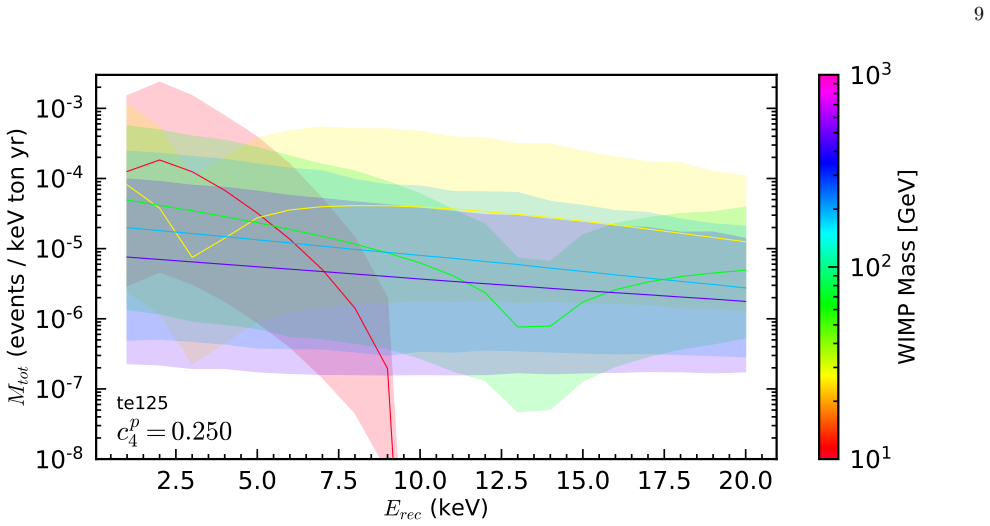
- The recoil-energy locations where the modulation amplitude dips toward zero are isotope- and WIMP-mass dependent, and pinning down those dips could be used to constrain the WIMP mass.
Reading between the lines
- A direct stress test of the uncertainty numbers would be to repeat the ensemble with a third, independently fitted shell-model Hamiltonian; if its one-body density matrices fall outside the GCN–JJ55 spread, the reported over-100% values would not be a trustworthy bound on model error.
- The Gaussian ensemble samples each one-body density matrix element independently, ignoring correlations between elements; observables like spin-dependent responses that add many elements coherently could have their uncertainty either over- or under-estimated by this procedure, so a covariance-aware sampling scheme is a natural extension.
- Because the two Hamiltonians are not independent—both descend from CD-Bonn G-matrix effective interactions and both were fit with tellurium data in mind—the ensemble width is a lower bound on the kind of spread one would get from a genuinely independent nuclear modeling approach; experiments should be cautious when quoting these uncertainties as complete.
- If a future ton-scale experiment measures both the time-averaged rate limit and the annual modulation amplitude in the same detector, the predicted proportionality of their nuclear uncertainties could be tested empirically; a violation would point to systematic effects beyond nuclear structure.
Editorial analysis
A structured set of objections, weighed in public.
Referee Report
Summary. This paper calculates the impact of nuclear shell-model uncertainties on 90% upper confidence limits for Galilean effective field theory (EFT) couplings in tellurium (CUORE detector), using a Gaussian ensemble of one-body density matrices built from two shell-model Hamiltonians (GCN and JJ55). The authors find that uncertainties are large for nucleon spin-dependent operators, reaching over 100% for some isotopes, and compare the results with previous xenon calculations. They also analyze annual modulation, finding that the modulation amplitude uncertainty is proportional to the non-modulating rate uncertainty while the modulation phase is insensitive to nuclear model changes. The central numerical results are internally consistent and the error propagation through the dmscatter code is clearly described.
Significance. The paper addresses a relevant source of systematic uncertainty in dark matter direct detection. If the uncertainty ensemble is valid, the results provide an important caution for tellurium-based searches and a useful comparison with xenon. The annual modulation phase robustness is a valuable finding. However, the uncertainty estimate rests entirely on the spread of two Hamiltonians, which has not been validated, limiting confidence in the quantitative conclusions. The manuscript does not release the density matrices or code, which would allow independent checks. The paper's strengths include a clear description of the error propagation and the explicit oxygen comparison with varying oscillator lengths.
major comments (4)
- [Sec. III A] The Gaussian ensemble is built from exactly two shell-model Hamiltonians, GCN and JJ55, with the mean and width of the Gaussian PDF for each one-body density matrix element fixed by the two values from these Hamiltonians alone. No evidence is provided that this two-point spread brackets the true nuclear structure uncertainty; a third interaction could move a spin-dependent matrix element outside the GCN/JJ55 interval, which would change the quoted >100% uncertainties. Because the abstract's central claim ('some reaching over 100%') rests on this ensemble, the authors should validate the spread with at least one independent interaction or an experimental anchor (e.g., magnetic moments or spin observables).
- [Sec. III A and Eqs. (4)-(6)] Each density matrix element is sampled independently from its Gaussian distribution. Physical one-body density matrices must satisfy sum rules (particle number, Hermiticity, and relations between proton and neutron occupations), and unconstrained independent sampling can produce unphysical matrices. Since the event rate is quadratic in the density matrices (Eqs. (4)-(6)), a spin matrix element driven through zero by the Gaussian tail can artificially inflate the upper limit uncertainty. The >100% uncertainty for O13 in 129Te (Sec. III A and Fig. 2) may arise from this artifact rather than from a physical uncertainty. The authors should enforce the sum rules or test the sensitivity of their results to such constraints.
- [Sec. V and Abstract] The comparison with xenon is weakened because the same GCN and JJ55 Hamiltonians were used for xenon in Ref. [36]. The claimed comparability between tellurium and xenon uncertainties may partly reflect the shared input spread rather than independent nuclear structure uncertainties. The authors should either use an additional Hamiltonian for at least one target or clearly state that the comparison is limited by the common input set.
- [Sec. IV] The claim that M1/M0 and M2/M0 are independent of the nuclear model (and hence that the phase is insensitive) is stated empirically but not derived. Since the Monte Carlo varies individual density matrix elements independently, the factorization of the rate into M0 times a model-independent shape is nontrivial. The authors should provide a derivation or an explicit demonstration (e.g., showing that the q-dependence of the relevant response functions is model-independent for the operators considered), as this is load-bearing for the conclusion that modulation amplitude uncertainties are proportional to non-modulating rate uncertainties.
minor comments (4)
- [Sec. III A] The use of the term 'Feldman-Cousins method' in Sec. III A is misleading; the authors are computing a central 68.23% interval of the Monte Carlo distribution, not the Feldman-Cousins confidence interval for a Poisson signal.
- [Figs. 1 and 2] The relative uncertainty panels have a y-axis labeled 'Relative Uncertainty' running from -1 to 1, but the text reports uncertainties exceeding 100%; the figures should either extend the axis or explain how values above 100% are represented, for example as truncated error bars.
- [General] The paper does not state whether the density matrices or the Monte Carlo code are publicly available; providing them would allow the decomposition of the uncertainties to be checked independently.
- [Introduction] There is a typo in the Introduction: 'an overview the the theoretical framework' should be 'an overview of the theoretical framework'.
Circularity Check
No significant circularity: the paper propagates fixed shell-model inputs through a public scattering code and derives modulation-phase insensitivity from cancellation in ratios, with no fitted quantity serving as its own prediction.
full rationale
The central calculations are forward propagation, not fitting. Section III A constructs Gaussian ensembles of one-body density matrices from exactly two shell-model Hamiltonians (GCN and JJ55) by using the two values to set each matrix element's mean and width, then feeds randomized matrices into the dmscatter code to compute differential rates via Eqs. (3)-(7). The 90% upper limits are obtained from Eq. (8) as c_{i,min} = sqrt((dR_min/dt)/(dR0/dt)) c_{i,0}, with dR_min/dt = 2.3 events/ton-yr fixed from a Poisson 90% confidence level; no CUORE event data enter, so the limits are not predictions of fitted quantities. The annual modulation phase result is not by construction: the Monte Carlo runs show that M1/M0 and M2/M0 are unchanged across the ensemble, and only then does t0 = arctan(M2/M1) become model-insensitive; similarly Mtot = M0 sqrt((M1/M0)^2 + (M2/M0)^2) makes the amplitude uncertainty proportional to M0 uncertainty after the ratio independence is established numerically. The self-citation to Ref. [36] supplies the uncertainty-quantification method and the xenon comparison, but it is methodological and the present paper re-derives the relevant quantities; it is not an unverified uniqueness theorem forcing the result. Even if the same Hamiltonian pair underlies both the tellurium and xenon ensembles, that is a modeling limitation rather than a circular reduction. The paper's own stated limitations, such as the two-Hamiltonian ensemble possibly not bracketing the true nuclear-structure uncertainty and the oxygen NCSM calculations not being fully converged, are robustness and correctness concerns, not circularity. No equation in the paper is equal to its input by construction, and no fitted parameter is renamed as a prediction.
Assumptions & free parameters
free parameters (5)
- GCN shell-model Hamiltonian parameter set =
fit to experimental data in Refs [46,47]
- JJ55 shell-model Hamiltonian parameter set =
fit to experimental data in Ref [48]
- Gaussian ensemble width for each one-body density matrix element =
half-difference of GCN and JJ55 values, not independently fitted
- Harmonic oscillator length b for oxygen wave functions =
1.315, 1.540, 1.663, 1.709, 1.764 fm depending on model
- Recoil energy integration window =
1 to 100 keV
assumptions (8)
- domain assumption Configuration-interaction shell model with a truncated valence space approximates tellurium nuclear states
- domain assumption The 15 Galilean EFT operators form a complete basis for nonrelativistic elastic WIMP-nucleus scattering
- domain assumption Only elastic ground-state to ground-state scattering with one-body currents is considered
- domain assumption Isospin is conserved so the WIMP couples separately to protons and neutrons with no cross response
- domain assumption Zero-background Poisson statistics with 90% CL detection threshold of 2.3 events/tonyr
- domain assumption Standard halo model and Fourier decomposition of the annual modulation signal
- ad hoc to paper The Gaussian ensemble of one-body density matrices is an adequate error model for nuclear structure uncertainty
- ad hoc to paper O16 no-core shell-model results at Nmax=6 without three-body forces are sufficient for the oxygen comparison
Cite this review
Pith. "Pith review of Uncertainties in tellurium-based dark matter searches stemming from nuclear structure uncertainties." pith.science (2026). https://pith.science/paper/ZQIDTQWB
@misc{pith2026250100621,
  author       = {Pith},
  title        = {Pith review of: Uncertainties in tellurium-based dark matter searches stemming from nuclear structure uncertainties},
  year         = {2026},
  howpublished = {\url{https://pith.science/paper/ZQIDTQWB}},
  note         = {Machine review of arXiv:2501.00621}
}
read the original abstract
Using tellurium dioxide as a target, we calculate uncertainties on 90% upper confidence limits of Galilean effective field theory (Galilean EFT) couplings to a weakly-interacting massive particle (WIMP) dark matter candidate due to uncertainties in nuclear shell models. We find that these uncertainties in naturally-occurring tellurium isotopes are comparable across the different Galilean EFT couplings to uncertainties in xenon, with some reaching over 100%. We also consider the effect these nuclear uncertainties have on estimates of the annual modulation of dark matter from these searches, finding that the uncertainties in the modulation amplitude are proportional to the non-modulating upper confidence limit uncertainties. We also show that the determination of the modulation phase is insensitive to changes in the nuclear model for a given isotope.
Figures


Figures from the paper (3 more)

Reference graph
Works this paper leans on
-
[36]
Daniel J. Heimsoth, Brandon Lem, Anna M. Suliga, Calvin W. Johnson, A. Baha Balantekin, and Susan N. Coppersmith, “Uncertainties on the eft coupling limits for direct dark matter detection experiments stemming from uncertainties of target properties,” Phys. Rev. D 108, 103031 (2023)
work page 2023
-
[1]
Die Rotverschiebung von extragalaktischen Nebeln,
F. Zwicky, “Die Rotverschiebung von extragalaktischen Nebeln,” Helvetica Physica Acta6, 110–127 (1933)
work page 1933
-
[2]
Rotation of the Andromeda Nebula from a Spectroscopic Survey of Emis- sion Regions,
Vera C. Rubin and Jr. Ford, W. Kent, “Rotation of the Andromeda Nebula from a Spectroscopic Survey of Emis- sion Regions,” Astrophys. J.159, 379 (1970)
work page 1970
-
[3]
On the Disks of Spiral and S0 Galaxies,
K. C. Freeman, “On the Disks of Spiral and S0 Galaxies,” Astrophys. J.160, 811 (1970)
work page 1970
-
[4]
COSINE-100 Full Dataset Challenges the Annual Modulation Signal of DAMA/LIBRA
N. Carlin et al. (COSINE-100 Collaboration), “Cosine- 100 full dataset challenges the annual modulation signal of dama/libra,” (2024), arXiv:2409.13226 [hep-ex]
work page Pith review arXiv 2024
-
[5]
Three- year annual modulation search with cosine-100,
G. Adhikariet al.(COSINE-100 Collaboration), “Three- year annual modulation search with cosine-100,” Phys. Rev. D106, 052005 (2022)
work page 2022
-
[6]
Search for dark matter annual modulation with DarkSide-50
P. Agnes et al. (DarkSide-50 Collaboration), “Search for dark matter annual modulation with darkside-50,” (2023), arXiv:2307.07249 [hep-ex]
work page Pith review arXiv 2023
-
[7]
Probing the scalar wimp-pion coupling with the first lux-zeplin data,
J. Aalbers et al. (LZ Collaboration), “Probing the scalar wimp-pion coupling with the first lux-zeplin data,” Communications Physics7 (2024), 10.1038/s42005-024- 01774-8
Show all 62 references
-
[8]
First search for light dark matter in the neutrino fog with xenonnt,
E. Aprileet al.(XENONnT Collaboration), “First search for light dark matter in the neutrino fog with xenonnt,” (2024), arXiv:2409.17868 [hep-ex]
2024 arXiv
-
[9]
Dark matter search results from the pandax-4t commissioning run,
PandaX-4T Collaboration, “Dark matter search results from the pandax-4t commissioning run,” Physical Review Letters 127, 261802 (2021)
2021
-
[10]
Results on light dark matter particles with a low-threshold cresst-ii detector,
G. Angloheret al., “Results on light dark matter particles with a low-threshold cresst-ii detector,” The European Physical Journal C76, 25 (2016)
2016
-
[11]
Search for low-mass dark matter with cdmslite using a profile likelihood fit,
R. Agnese et al. (SuperCDMS Collaboration), “Search for low-mass dark matter with cdmslite using a profile likelihood fit,” Phys. Rev. D99, 062001 (2019)
2019
-
[12]
Dark matter search results from the complete exposure of the pico-60 c3f8 bubble chamber,
C. Amole et al. (PICO Collaboration), “Dark matter search results from the complete exposure of the pico-60 c3f8 bubble chamber,” Phys. Rev. D100, 022001 (2019)
2019
-
[13]
"indirect dark matter searches in gamma and cosmic rays
Jan Conrad and Olaf Reimer, “"indirect dark matter searches in gamma and cosmic rays",” Nature Physics 13, 224–231 (2017)
2017
-
[14]
Status, challenges and di- rections in indirect dark matter searches,
Carlos Perez de los Heros, “Status, challenges and di- rections in indirect dark matter searches,” Symmetry12 (2020)
2020
-
[15]
Dark matter searches at accelerators,
Albert De Roeck, “Dark matter searches at accelerators,” Nuclear Physics B , 116480 (2024)
2024
-
[16]
WIMP dark matter candidates and searches—current status and future prospects,
Leszek Roszkowski, Enrico Maria Sessolo, and Sebas- tian Trojanowski, “WIMP dark matter candidates and searches—current status and future prospects,” Rept. Prog. Phys. 81, 066201 (2018), arXiv:1707.06277 [hep- ph]
2018 arXiv
-
[17]
Light weakly interacting massive particles,
Graciela B. Gelmini, “Light weakly interacting massive particles,” Reports on Progress in Physics80 (2017)
2017
-
[18]
Cross sections for dark mat- ter particles and implications for allowed masses, inter- actions, and detection,
G.L Kane and Iraj Kani, “Cross sections for dark mat- ter particles and implications for allowed masses, inter- actions, and detection,” Nuclear Physics B , 525–546 (1986)
1986
-
[19]
Light fermionic wimp dark matter with light scalar mediator,
Shigeki Matsumoto, Yue-Lin Sming Tsai, and Po-Yan Tseng, “Light fermionic wimp dark matter with light scalar mediator,” J. High Energ. Phys50 (2019)
2019
-
[20]
Complementarity of direct detec- tion experiments in search of light dark matter,
J.R. Angevaare, G. Bertone, A.P. Colijn, M.P. Decowski, and B.J. Kavanagh, “Complementarity of direct detec- tion experiments in search of light dark matter,” Journal of Cosmology and Astroparticle Physics (2022)
2022
-
[21]
Direct detection of sub-gev dark matter,
Rouven Essig, Jeremy Mardon, and Tomer Volansky, “Direct detection of sub-gev dark matter,” Phys. Rev. D 85, 076007 (2012). 12
2012
-
[22]
Search for light dark matter in low-energy ionization signals from xenonnt,
E. Aprileet al. (XENONnT Collaboration), “Search for light dark matter in low-energy ionization signals from xenonnt,” (2024), arXiv:2411.15289 [hep-ex]
2024 arXiv
-
[23]
Search for light dark matter with news-g at the lsm using a methane target,
M. M. Aroraet al.(NEWS-G Collaboration), “Search for light dark matter with news-g at the lsm using a methane target,” (2024), arXiv:2407.12769 [hep-ex]
2024 arXiv
-
[24]
First direct search for light dark matter using the neon experiment at a nuclear reactor,
J. J. Choi et al. (NEON Collaboration), “First direct search for light dark matter using the neon experiment at a nuclear reactor,” (2024), arXiv:2407.16194 [hep-ex]
2024 arXiv
-
[25]
The effective field theory of dark matter direct detection,
A. Liam Fitzpatrick, Wick Haxton, Emanuel Katz, Nicholas Lubbers, and Yiming Xu, “The effective field theory of dark matter direct detection,” Journal of Cos- mology and Astroparticle Physics2013, 004 (2013)
2013
-
[26]
Effective field theory and inelastic dark matter results from xenon1t,
E. Aprileet al.(XENON Collaboration), “Effective field theory and inelastic dark matter results from xenon1t,” Phys. Rev. D109, 112017 (2024)
2024
-
[27]
Chiral power counting of one-and two-body currents in direct detection of dark matter,
Martin Hoferichter, Philipp Klos, and Achim Schwenk, “Chiral power counting of one-and two-body currents in direct detection of dark matter,” Physics Letters B746, 410–416 (2015)
2015
-
[28]
Dark-matter-nucleus scattering in chi- ral effective field theory,
Martin Hoferichter, Philipp Klos, Javier Menéndez, and Achim Schwenk, “Dark-matter-nucleus scattering in chi- ral effective field theory,” (2019), arXiv:1903.11075 [hep- ph]
2019 arXiv
-
[29]
Chiral effective theory of dark matter di- rect detection,
Fady Bishara, Joachim Brod, Benjamin Grinstein, and Jure Zupan, “Chiral effective theory of dark matter di- rect detection,” Journal of Cosmology and Astroparticle Physics 2017, 009 (2017)
2017
-
[30]
WIMP-nucleus scattering in chiral effective theory,
Vincenzo Cirigliano, Michael L. Graesser, and Grigory Ovanesyan, “WIMP-nucleus scattering in chiral effective theory,” JHEP10, 025 (2012), arXiv:1205.2695 [hep-ph]
2012 arXiv
-
[31]
Effective field theory of dark matter direct de- tection with collective excitations,
Tanner Trickle, Zhengkang Zhang, and Kathryn M. Zurek, “Effective field theory of dark matter direct de- tection with collective excitations,” Phys. Rev. D105, 015001 (2022), arXiv:2009.13534 [hep-ph]
2022 arXiv
-
[32]
Nuclear structure factors for general spin-independent wimp-nucleus scattering,
Martin Hoferichter, Philipp Klos, Javier Menéndez, and Achim Schwenk, “Nuclear structure factors for general spin-independent wimp-nucleus scattering,” Phys. Rev. D 99, 055031 (2019)
2019
-
[33]
Large-Nc constraints for elastic dark-matter– light-nucleus scattering in pionless effective field theory,
Thomas R. Richardson, Xincheng Lin, and Son T. Nguyen, “Large-Nc constraints for elastic dark-matter– light-nucleus scattering in pionless effective field theory,” Phys. Rev. C106, 044003 (2022)
2022
-
[34]
Cuore-0 de- tector: design, construction and operation,
C. Alduinoet al.(CUORE Collaboration), “Cuore-0 de- tector: design, construction and operation,” Journal of Instrumentation 11, P07009 (2016)
2016
-
[35]
Jouni Suhonen,From Nucleons to Nucleus: Concepts of Microscopic Nuclear Theory(Springer Science & Busi- ness Media, 2007)
2007
-
[37]
Su- persymmetric dark matter,
Kim Griest Gerard Jungman, Marc Kamionkowski, “Su- persymmetric dark matter,” Physics Reports (1996)
1996
-
[38]
Pandax-ii constraints on spin-dependent wimp-nucleon effective interactions,
Jingkai Xia, Abdusalam Abdukerim, Wei Chen, Xun Chen, Yunhua Chen, Xiangyi Cui, Deqing Fang, Changbo Fu, Karl Giboni, Franco Giuliani, et al., “Pandax-ii constraints on spin-dependent wimp-nucleon effective interactions,” Physics Letters B 792, 193–198 (2019)
2019
-
[39]
Spin- dependent wimp scattering off nuclei,
J. Menéndez, D. Gazit, and A. Schwenk, “Spin- dependent wimp scattering off nuclei,” Phys. Rev. D86, 103511 (2012)
2012
-
[40]
Chiral two- body currents in nuclei: Gamow-teller transitions and neutrinoless double-beta decay,
J. Menéndez, D. Gazit, and A. Schwenk, “Chiral two- body currents in nuclei: Gamow-teller transitions and neutrinoless double-beta decay,” Phys. Rev. Lett.107, 062501 (2011)
2011
-
[41]
Edmonds, Angular Momentum in Quantum Me- chanics, Investigations in physics (Princeton University Press, 1957)
A.R. Edmonds, Angular Momentum in Quantum Me- chanics, Investigations in physics (Princeton University Press, 1957)
1957
-
[42]
dmscatter: A fast program forwimp-nucleusscattering,
Oliver C. Gorton, Calvin W. Johnson, Changfeng Jiao, and Jonathan Nikoleyczik, “dmscatter: A fast program forwimp-nucleusscattering,” ComputerPhysicsCommu- nications 284, 108597 (2023)
2023
-
[43]
Review of mathematics, numerical factors, and corrections for dark matter ex- periments based on elastic nuclear recoil,
J.D. Lewin and P.F. Smith, “Review of mathematics, numerical factors, and corrections for dark matter ex- periments based on elastic nuclear recoil,” Astroparticle Physics 6, 87–112 (1996)
1996
-
[44]
Low energy analysis techniques for cuore,
C. Alduinoet al.(CUORE Collaboration), “Low energy analysis techniques for cuore,” The European Physical Journal C77, 857 (2017)
2017
-
[45]
Re- view of particle physics,
P. A. Zyla et al. (Particle Data Group), “Re- view of particle physics,” Progress of Theoret- ical and Experimental Physics 2020, 083C01 (2020), https://academic.oup.com/ptep/article- pdf/2020/8/083C01/34673722/ptaa104.pdf
2020
-
[46]
The Influence of pairing on the nuclear matrix elements of the neutrinoless beta beta decays,
E. Caurier, J. Menendez, F. Nowacki, and A. Poves, “The Influence of pairing on the nuclear matrix elements of the neutrinoless beta beta decays,” Phys. Rev. Lett. 100, 052503 (2008), arXiv:0709.2137 [nucl-th]
2008 arXiv
-
[47]
Collec- tivity in the light Xenon isotopes: A shell model study,
E. Caurier, F. Nowacki, A. Poves, and K. Sieja, “Collec- tivity in the light Xenon isotopes: A shell model study,” Phys. Rev. C82, 064304 (2010), arXiv:1009.3813 [nucl- th]
2010 arXiv
-
[48]
Magnetic moments of the 2+(1) states around Sn-132,
B. Alex Brown, N. J. Stone, J. R. Stone, I. S. Towner, and M. Hjorth-Jensen, “Magnetic moments of the 2+(1) states around Sn-132,” Phys. Rev. C71, 044317 (2005), [Erratum: Phys.Rev.C 72, 029901 (2005)], arXiv:nucl- th/0411099
2005
-
[49]
Realistic effective interactions for nuclear sys- tems,
Morten Hjorth-Jensen, Thomas T.S. Kuo, and Eivind Osnes, “Realistic effective interactions for nuclear sys- tems,” Physics Reports261, 125–270 (1995)
1995
-
[50]
The High precision, charge dependent Bonn nucleon-nucleon potential (CD-Bonn),
R. Machleidt, “The High precision, charge dependent Bonn nucleon-nucleon potential (CD-Bonn),” Phys. Rev. C 63, 024001 (2001), arXiv:nucl-th/0006014
2001 arXiv
-
[51]
A Uni- fied approach to the classical statistical analysis of small signals,
Gary J. Feldman and Robert D. Cousins, “A Uni- fied approach to the classical statistical analysis of small signals,” Phys. Rev. D 57, 3873–3889 (1998), arXiv:physics/9711021
1998 arXiv
-
[52]
Ab initio no core shell model,
Bruce R Barrett, Petr Navrátil, and James P Vary, “Ab initio no core shell model,” Progress in Particle and Nu- clear Physics69, 131–181 (2013)
2013
-
[53]
N3lo nn interaction adjusted to light nu- clei in ab exitu approach,
AM Shirokov, IJ Shin, Y Kim, M Sosonkina, P Maris, and JP Vary, “N3lo nn interaction adjusted to light nu- clei in ab exitu approach,” Physics Letters B761, 87–91 (2016)
2016
-
[54]
Accurate charge- dependent nucleon-nucleon potential at fourth order of chiral perturbation theory,
D. R. Entem and R. Machleidt, “Accurate charge- dependent nucleon-nucleon potential at fourth order of chiral perturbation theory,” Phys. Rev. C 68, 041001 (2003)
2003
-
[55]
Simi- larity renormalization group for nucleon-nucleon interac- tions,
S. K. Bogner, R. J. Furnstahl, and R. J. Perry, “Simi- larity renormalization group for nucleon-nucleon interac- tions,” Phys. Rev. C75, 061001 (2007). 13
2007
-
[56]
Radii and binding energies in oxygen isotopes: A challenge for nuclear forces,
V. Lapoux, V. Somà, C. Barbieri, H. Hergert, J. D. Holt, and S. R. Stroberg, “Radii and binding energies in oxygen isotopes: A challenge for nuclear forces,” Phys. Rev. Lett. 117, 052501 (2016)
2016
-
[57]
Convergence in the no-core shell model with low-momentum two-nucleon interactions,
SKBogner, RJFurnstahl, PMaris, RJPerry, ASchwenk, and JP Vary, “Convergence in the no-core shell model with low-momentum two-nucleon interactions,” Nuclear Physics A801, 21–42 (2008)
2008
-
[58]
Robust ab initio prediction of nuclear electric quadrupole observables by scaling to the charge radius,
Mark A. Caprio, Patrick J. Fasano, and Pieter Maris, “Robust ab initio prediction of nuclear electric quadrupole observables by scaling to the charge radius,” Phys. Rev. C105, L061302 (2022)
2022
-
[59]
Collective 0- vibrations in even spherical nuclei with tensor forces,
J Blomqvist and A Molinari, “Collective 0- vibrations in even spherical nuclei with tensor forces,” Nuclear Physics A 106, 545–569 (1968)
1968
-
[60]
Colloquium: Annual modulation of dark mat- ter,
Katherine Freese, Mariangela Lisanti, and Christopher Savage, “Colloquium: Annual modulation of dark mat- ter,” Rev. Mod. Phys.85, 1561–1581 (2013)
2013
-
[61]
Dark matter: Dama/libra and its perspectives,
R. Bernabei, P. Belli, F. Cappella, V. Caracciolo, R. Cerulli, C. J. Dai, A. d’Angelo, A. Incicchitti, A. Leoncini, X. H. Ma, V. Merlo, F. Montecchia, X. D. Sheng, and Z. P. Ye, “Dark matter: Dama/libra and its perspectives,” (2022), arXiv:2209.00882 [hep-ex]
2022 arXiv
-
[62]
Phase of the annual modulation as a tool for determining the mass of the weakly interacting massive particle,
Matthew J. Lewis and Katherine Freese, “Phase of the annual modulation as a tool for determining the mass of the weakly interacting massive particle,” Phys. Rev. D 70, 043501 (2004)
2004
Reviewed August 10, 2026 · model on record in the stance chip above.
Discussion (0). Continue with ORCID to comment.