REVIEW 5 major objections 6 minor 67 references
Prediction of Geoeffective CMEs Using SOHO Images and Deep Learning
T0 review · 5 major / 6 minor · reviewed 2026-08-10 · deepseek-v4-flash
Pith's one-line read A deep-learning ensemble trained on SOHO images predicts which Earth-arriving coronal mass ejections will trigger geomagnetic storms, with a Matthews correlation coefficient of 0.807 and a true skill statistic of 0.714 on a held-out test…
desk verdict Useful question and clean architecture, but a random temporal split and an unfinished draft make the headline metrics unreliable for future CMEs. read the letter →
The pith
A machine-rendered reading of the paper's core claim, the machinery that carries it, and where it could break.
The reading
What carries the argument
The load-bearing mechanism is ensemble transfer learning over a multimodal image set. Each SOHO instrument is assigned two parallel ImageNet-pretrained convolutional networks, ResNet152 and InceptionResNetV2, that convert raw images into feature vectors; concatenation plus three 3×3 convolutional blocks with 64, 128, and 256 filters, batch normalization, and LeakyReLU activation, a 1024-neuron dense layer, and a single sigmoid neuron turn those features into an event-level probability. Two averaging ensembles, first over multiple images per instrument and then over the three instruments, combine 3,107 images into one prediction per CME event, while a weighted binary cross-entropy loss emphasizing the 35-event minority class is used for training. The ensemble identity is what lets a small labelled set of 136 events exploit ImageNet features rather than training a deep network from scratch.
What would settle it
Re-run the experiment with a strict temporal split, training on 1997-2003 and testing on 2004-2006; if the chronological MCC drops far below 0.807 or the model's false-negative rate rises, the random-split result was inflated by within-cycle pattern similarity rather than a stable image-to-storm relationship.
Extended reading notes
Core claim
The paper's central claim is that the visual content of SOHO images carries enough information to judge whether an Earth-arriving halo or partial halo CME will produce a geomagnetic storm. GeoCME is built as three instrument-specific pipelines that share a design: for a given event, LASCO C2 base-difference images, EIT 195 Å images, and MDI magnetograms are each passed through a ResNet152 and an InceptionResNetV2 pretrained on ImageNet; the two output vectors are concatenated, refined by three convolutional blocks and two dense layers, and averaged first over images of the same instrument and then over instruments. The final sigmoid output is the predicted probability of geoeffectiveness, converted to a deterministic label with threshold 0.6. On the 28-event held-out test set the paper reports 21 true positives, 5 true negatives, 2 false positives, and no false negatives, hence MCC 0.807 and TSS 0.714; in probabilistic mode it reports Brier 0.094 and Brier skill 0.493. It concludes that the model learns a usable mapping from solar images to CME geoeffectiveness, and that combining all three instruments is better than using any subset.
Load-bearing premise
The evaluation splits events randomly rather than by time, so it assumes that a CME's image appearance and its storm-causing potential do not change systematically over the 1997-2006 observing window; if they do, the reported scores may not hold for future events.
Editorial extensions
If this is right
- An operational two-step forecast becomes possible: existing arrival-time models identify which CMEs will hit Earth, and GeoCME then labels those events as storm-producing or not from images alone.
- Because the model never misses a storm on the held-out test set but issues two false alarms, its deterministic mode behaves as a sensitive storm alarm for this test distribution.
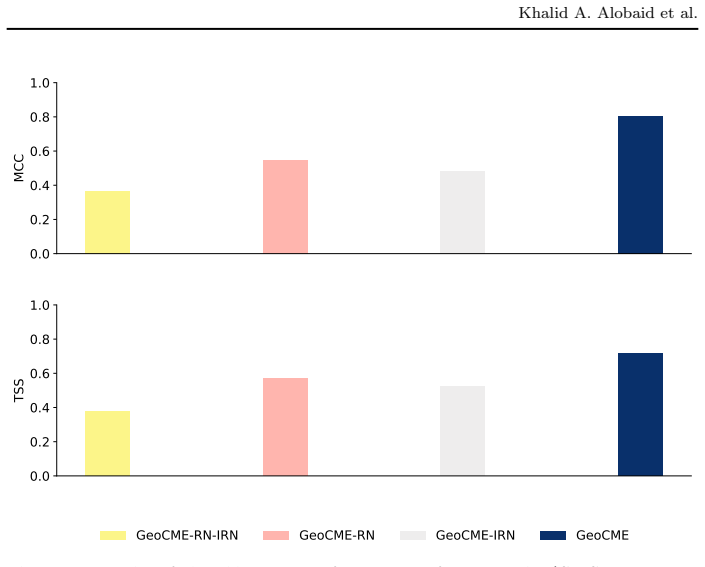
- Removing both pretrained base models drops MCC from 0.807 to 0.365, so the paper's result depends on the feature representations transferred from ImageNet rather than on the small amount of solar data by itself.
- Using all three instruments beats any single instrument or pair, and among single instruments EIT is the best, suggesting the different image modalities contribute complementary visual information.
- The five-fold cross-validation averages are close to the 80:20 split results, indicating the reported performance is not an artifact of one particular split under the paper's random-split protocol.
Reading between the lines
- The paper's 80:20 split is random rather than chronological, so the reported skill should be read as within-cycle pattern recognition; a temporal split would be the natural test of whether GeoCME would perform operationally on future, unseen solar-cycle conditions.
- The model labels events only against the $Dst < -50$ nT storm threshold; the same architecture could be retrained at $Dst < -100$ nT or on continuous Dst regression, and the class imbalance of 101 geoeffective versus 35 non-geoeffective events makes the choice of threshold particularly consequential.
- Saliency or attribution maps over the LASCO, EIT, and MDI inputs could reveal which visual signatures drive the prediction, potentially connecting the deep features to physical CME properties such as width, brightness, source-region complexity, or magnetic field orientation.
- A direct extension to Solar Cycle 24 or to SDO/AIA and HMI imagery would test whether the transferred features and the learned solar representations generalize to newer instruments and different cycle conditions.
Editorial analysis
A structured set of objections, weighed in public.
Referee Report
Summary. The paper proposes GeoCME, an ensemble deep-learning model that combines ResNet152 and InceptionResNetV2 features extracted from SOHO LASCO C2, EIT 195 Å, and MDI images to predict whether an Earth-arriving CME will cause a geomagnetic storm (Dst < -50 nT). The dataset contains 136 halo/partial halo CMEs from Solar Cycle 23 (101 geoeffective, 35 non-geoeffective). Using an 80:20 random split, the authors report test-set MCC 0.807 and TSS 0.714 for deterministic prediction and BS 0.094 / BSS 0.493 for probabilistic forecasting, along with ablation studies and a five-fold cross-validation. The manuscript is currently incomplete, with several sections marked '(To be completed)'. The evaluation rests on a small, randomly split test set with no confidence intervals or baseline comparisons, so the headline skill estimates are not yet firmly established.
Significance. If the reported performance survives a rigorous temporal and uncertainty-aware evaluation, GeoCME would be a valuable image-based tool for operational geoeffectiveness forecasting, and the use of multi-instrument SOHO imagery with transfer learning is a sensible direction given the small dataset. The paper's strengths include the use of publicly available data, a clearly stated two-step arrival-then-geoeffectiveness framing, ablation tests separating base models and instrument contributions, and both deterministic and probabilistic evaluation. However, the current evidence is conditional: the test set is small, the split is not temporal, no baselines are given, and the manuscript is unfinished. The central claim of genuine held-out predictive skill is plausible but not yet demonstrated.
major comments (5)
- [Sections 3.1, 3.2, 4.1, 4.2, 5] The manuscript is incomplete: Sections 3.1, 3.2, 4.1, 4.2, and 5 contain the literal placeholder '(To be completed)' in place of the transfer-learning details, the GeoCME model description, the evaluation-metrics discussion, the evaluation results, and the conclusions, and the text retains a fragment from another article template ('A&A proofs' in the figure block after Figure 3). These placeholders must be filled in before the technical content can be assessed.
- [Section 4.1 and Section 5] The evaluation uses random splits rather than temporal splits. The 80:20 scheme in Section 4.1 and the five-fold cross-validation in Section 5 both partition events without respect to time, although the events span 1997-2006. Because solar-cycle phase, CME properties, and SOHO instrument behavior change over this interval, random splitting allows training and test events from the same phase to be near-duplicates in covariates, which can inflate the reported MCC and TSS for future CMEs. A temporally blocked evaluation (e.g., train on earlier years, test on later years) is needed to support the forecasting claim.
- [Section 4.2, Figure 10] The test set has only 28 events, with 7 non-geoeffective cases, and the reported MCC of 0.807 and TSS of 0.714 are point estimates without confidence intervals. The TSS value is determined by exactly two false positives (FP=2 in Figure 10), so even a small amount of temporal leakage or threshold variation can materially change the headline metrics. Please report bootstrap or exact confidence intervals, per-class error rates, and the variance of the five-fold cross-validation results in Section 5.
- [Section 4.2 and Section 4.3] No baseline comparison is provided. The Brier skill score in Eq. (5) uses the climatological mean as a reference, but the deterministic MCC and TSS are not benchmarked against trivial predictors (e.g., always predicting the majority class) or against existing CME-parameter-based classifiers such as those cited in the Introduction. Without such baselines, the claim that GeoCME achieves 'good performance' is not fully substantiated.
- [Equation (1)] The class-weight notation in the WBCE loss is inconsistent: the text states that w0 is the weight for the negative class and w1 for the positive class, but the formula assigns w0 to the yi log(ŷi) term (positive) and w1 to the (1-yi) log(1-ŷi) term (negative). Please correct the formula or the description, and clarify which weighting was actually used in training, since this affects reproducibility of the imbalance handling.
minor comments (6)
- [Section 4.2] The sentence 'GeoCME-RN performs better than GeoCME-IRN, emphasizing the importance of InceptionResNet' is self-contradictory: if GeoCME-RN (which removes InceptionResNet) performs better, the result emphasizes ResNet rather than InceptionResNet. Please correct.
- [Section 4.1] The list of evaluation metrics in Section 4.1 includes Accuracy, F1-Score, Recall, Precision, Hamming Loss, and AUC, but the experiments report only MCC and TSS (and later BS/BSS). Please either report the listed metrics or remove them from the list.
- [Sections 4.1, 4.2, 5] The threshold of 0.6 and the hyperparameters were selected using the validation set (Figure 8, Table 3), but the manuscript does not state how many validation evaluations were used. Please clarify, and consider a nested cross-validation to avoid optimistic selection bias.
- [Section 4.2] For the seven instrument-ablation cases in Figures 11 and 13, it is unclear whether the hyperparameters and the decision threshold were re-tuned for each case. Please specify the training protocol for each ablation.
- [Figures 9, 11, 12, 13] The bar charts report single metric values without error bars or point labels. Adding numerical values and uncertainty estimates would make the comparisons among variants and instrument combinations more informative.
- [Data Availability] No code, trained model weights, or image-preprocessing pipeline are provided. Given the paper's reliance on a custom ensemble and transfer-learning setup, these artifacts would substantially improve reproducibility.
Circularity Check
No significant circularity: GeoCME is an empirical classifier whose held-out test evaluation does not reduce to its training inputs.
full rationale
GeoCME's central claim is an empirical predictive-skill claim: a supervised classifier is trained on SOHO images (LASCO C2, EIT, MDI) with geoeffectiveness labels derived from external Dst measurements in the RC list, and then evaluated on a randomly held-out 20% test set. There is no equation in the paper that defines the predicted probability in terms of the Dst label, nor any fitted parameter that is renamed as a prediction. The 0.6 decision threshold is selected using the validation set and the hyperparameters by grid search; this is standard model selection on data that is disjoint from the test set, so the reported MCC 0.807, TSS 0.714, BS 0.094, and BSS 0.493 remain held-out estimates rather than fits to the test outcome. The self-citations, e.g., to Alobaid et al. (2022, 2023) for base-difference imagery and CME arrival prediction, supply methodological context and external tools; they are not used to justify the geoeffectiveness-prediction result itself. The more serious concern with this paper is the random, non-temporal split in Section 4.1 and the five-fold CV in Section 5, which may overstate generalization because nearby solar-cycle/instrument states can appear in both training and test folds. That is a correctness/validation risk (covariate shift), not a circularity of derivation, because the train/test separation is still real. Accordingly, the circularity score is low.
Assumptions & free parameters
free parameters (4)
- classification threshold =
0.6
- WBCE class weights =
not explicitly stated (inverse class-frequency ratio)
- network hyperparameters (batch size, epochs, dropout, layer sizes) =
batch 32, epochs 100, dropout 0.3, dense 1024, conv filters 64/128/256
- image collection windows =
C2: -10 min to +4 h; EIT: -4 h to 0; MDI: last 3 images
assumptions (4)
- domain assumption A geomagnetic storm is defined as minimum Dst < -50 nT.
- domain assumption The 136 halo/partial halo CMEs from the RC list with Dst values are a representative sample of Earth-arriving CMEs.
- domain assumption ImageNet-pretrained features transfer to grayscale solar imagery.
- domain assumption Random 80:20 splitting of events across 10 years yields an unbiased performance estimate.
Cite this review
Pith. "Pith review of Prediction of Geoeffective CMEs Using SOHO Images and Deep Learning." pith.science (2026). https://pith.science/paper/K5W5HMRD
@misc{pith2026250101011,
  author       = {Pith},
  title        = {Pith review of: Prediction of Geoeffective CMEs Using SOHO Images and Deep Learning},
  year         = {2026},
  howpublished = {\url{https://pith.science/paper/K5W5HMRD}},
  note         = {Machine review of arXiv:2501.01011}
}
read the original abstract
The application of machine learning to the study of coronal mass ejections (CMEs) and their impacts on Earth has seen significant growth recently. Understanding and forecasting CME geoeffectiveness is crucial for protecting infrastructure in space and ensuring the resilience of technological systems on Earth. Here we present GeoCME, a deep-learning framework designed to predict, deterministically or probabilistically, whether a CME event that arrives at Earth will cause a geomagnetic storm. A geomagnetic storm is defined as a disturbance of the Earth's magnetosphere during which the minimum Dst index value is less than -50 nT. GeoCME is trained on observations from the instruments including LASCO C2, EIT and MDI on board the Solar and Heliospheric Observatory (SOHO), focusing on a dataset that includes 136 halo/partial halo CMEs in Solar Cycle 23. Using ensemble and transfer learning techniques, GeoCME is capable of extracting features hidden in the SOHO observations and making predictions based on the learned features. Our experimental results demonstrate the good performance of GeoCME, achieving a Matthew's correlation coefficient of 0.807 and a true skill statistics score of 0.714 when the tool is used as a deterministic prediction model. When the tool is used as a probabilistic forecasting model, it achieves a Brier score of 0.094 and a Brier skill score of 0.493. These results are promising, showing that the proposed GeoCME can help enhance our understanding of CME-triggered solar-terrestrial interactions.
Figures


Figures from the paper (10 more)




Reference graph
Works this paper leans on
-
[1]
barticle Abduallah , Y. , Jordanova , V.K. , Liu , H. , Li , Q. , Wang , J.T.L. , Wang , H. : 2022 , Predicting solar energetic particles using SDO/HMI vector magnetic data products and a bidirectional LSTM network . 260 , 16 . https://doi.org/10.3847/1538-4365/ac5f56 . barticle
-
[2]
barticle Abunin , A.A. , Abunina , M.A. , Belov , A.V. , Chertok , I.M. : 2020 , Peculiar solar sources and geospace disturbances on 20-26 August 2018 . 295 , 7 . https://doi.org/10.1007/s11207-019-1574-8 . barticle
-
[3]
barticle Alobaid , K.A. , Abduallah , Y. , Wang , J.T.L. , Wang , H. , Jiang , H. , Xu , Y. , Yurchyshyn , V. , Zhang , H. , Cavus , H. , Jing , J. : 2022 , Predicting CME arrival time through data integration and ensemble learning . blue Front. Astron. Space Sci. 9 , 1013345 . https://doi.org/10.3389/fspas.2022.1013345 . barticle
arXiv 2022
-
[4]
barticle Alobaid , K.A. , Abduallah , Y. , Wang , J.T.L. , Wang , H. , Fan , S. , Li , J. , Cavus , H. , Yurchyshyn , V. : 2023 , Estimating coronal mass ejection mass and kinetic energy by fusion of multiple deep-learning models . 958 , L34 . https://doi.org/10.3847/2041-8213/ad0c4a . barticle
-
[5]
barticle Amerstorfer , T. , Hinterreiter , J. , Reiss , M.A. , M \"o stl , C. , Davies , J.A. , Bailey , R.L. , Weiss , A.J. , Dumbovi \'c , M. , Bauer , M. , Amerstorfer , U.V. , Harrison , R.A. : 2021 , Evaluation of CME arrival prediction using ensemble modeling based on heliospheric imaging observations . Space Weather 19 , e02553 . https://doi.org/10...
-
[6]
barticle Augusto , C.R.A. , Navia , C.E. , de Oliveira , M.N. , Nepomuceno , A.A. , Raulin , J.P. , Tueros , E. , de Mendon c a , R.R.S. , Fauth , A.C. , Vieira de Souza , H. , Kopenkin , V. , Sinzi , T. : 2018 , The 2015 summer solstice storm: One of the major geomagnetic storms of solar cycle 24 observed at ground level . 293 , 84 . https://doi.org/10.1...
-
[7]
barticle Baker , D.N. , Li , X. , Pulkkinen , A. , Ngwira , C.M. , Mays , M.L. , Galvin , A.B. , Simunac , K.D.C. : 2013 , A major solar eruptive event in July 2012: Defining extreme space weather scenarios . Space Weather 11 , 585 . https://doi.org/10.1002/swe.20097 . barticle
-
[8]
barticle Baratashvili , T. , Verbeke , C. , Wijsen , N. , Poedts , S. : 2022 , Improving CME evolution and arrival predictions with AMR and grid stretching in Icarus . 667 , A133 . https://doi.org/10.1051/0004-6361/202244111 . barticle
Show all 67 references
-
[9]
, Maris Muntean , G
barticle Besliu-Ionescu , D. , Maris Muntean , G. , Dobrica , V. : 2022 , Complex catalogue of high speed streams associated with geomagnetic storms during solar cycle 24 . 297 , 65 . https://doi.org/10.1007/s11207-022-01998-3 . barticle
2022 doi
-
[10]
, Talpeanu , D.-C
barticle Besliu-Ionescu , D. , Talpeanu , D.-C. , Mierla , M. , Maris Muntean , G. : 2019 , On the prediction of geoeffectiveness of CMEs during the ascending phase of SC24 using a logistic regression method . blue J. Atmos. Solar-Terr. Phys. 193 , 105036 . https://doi.org/10....
2019 doi
-
[11]
: 1950 , Verification of forecasts expressed in terms of probability
barticle Brier , G.W. : 1950 , Verification of forecasts expressed in terms of probability . Monthly Weather Review 78 , 1 . https://doi.org/10.1175/1520-0493(1950)078<0001:VOFEIT>2.0.CO;2 . barticle
1950 doi
-
[12]
, Howard , R.A
barticle Brueckner , G.E. , Howard , R.A. , Koomen , M.J. , Korendyke , C.M. , Michels , D.J. , Moses , J.D. , Socker , D.G. , Dere , K.P. , Lamy , P.L. , Llebaria , A. , Bout , M.V. , Schwenn , R. , Simnett , G.M. , Bedford , D.K. , Eyles , C.J. : 1995 , The Large Angle Spect...
1995 doi
-
[13]
, Delaboudiniere , J.-P
barticle Brueckner , G.E. , Delaboudiniere , J.-P. , Howard , R.A. , Paswaters , S.E. , St. Cyr , O.C. , Schwenn , R. , Lamy , P. , Simnett , G.M. , Thompson , B. , Wang , D. : 1998 , Geomagnetic storms caused by coronal mass ejections (CMEs): March 1996 through June 1997 . 25...
1998 doi
-
[14]
: 2020 , On the relationship between the transit time of ICMEs and strength of the initiated geomagnetic storms
barticle Chertok , I.M. : 2020 , On the relationship between the transit time of ICMEs and strength of the initiated geomagnetic storms . 295 , 74 . https://doi.org/10.1007/s11207-020-01640-0 . barticle
2020 doi
-
[15]
, Liu , J
barticle Chierichini , S. , Liu , J. , Kors \'o s , M.B. , Del Moro , D. , Erd \'e lyi , R. : 2024 , CME arrival modeling with machine learning . 963 , 121 . https://doi.org/10.3847/1538-4357/ad1cee . barticle
2024 doi
-
[16]
: 2017 , Xception: Deep learning with depthwise separable convolutions
bchapter Chollet , F. : 2017 , Xception: Deep learning with depthwise separable convolutions . In: 2017 IEEE Conference on Computer Vision and Pattern Recognition , 1800 . https://doi.org/10.1109/CVPR.2017.195 . bchapter
2017 doi
-
[17]
, Dong , W
bchapter Deng , J. , Dong , W. , Socher , R. , Li , L. , Li , K. , Fei - Fei , L. : 2009 , ImageNet: A large-scale hierarchical image database . In: 2009 IEEE Conference on Computer Vision and Pattern Recognition , 248 . https://doi.org/10.1109/CVPR.2009.5206848 . bchapter
2009
-
[18]
, C alogovi \'c , J
barticle Dumbovi \'c , M. , C alogovi \'c , J. , Martini \'c , K. , Vr s nak , B. , Sudar , D. , Temmer , M. , Veronig , A. : 2021 , Drag-based model (DBM) tools for forecast of coronal mass ejection arrival time and speed . blue Front. Astron. Space Sci. 8 , 58 . https://doi....
2021
-
[19]
, Sun , W
barticle Fry , C.D. , Sun , W. , Deehr , C.S. , Dryer , M. , Smith , Z. , Akasofu , S.-I. , Tokumaru , M. , Kojima , M. : 2001 , Improvements to the HAF solar wind model for space weather predictions . 106 , 20985 . https://doi.org/10.1029/2000JA000220 . barticle
2001 doi
-
[20]
, Zheng , Y
barticle Fu , H. , Zheng , Y. , Ye , Y. , Feng , X. , Liu , C. , Ma , H. : 2021 , Joint geoeffectiveness and arrival time prediction of CMEs by a unified deep learning framework . blue Remote Sens. 13 , 1738 . https://doi.org/10.3390/rs13091738 . barticle
2021 doi
-
[21]
, Joselyn , J.A
barticle Gonzalez , W.D. , Joselyn , J.A. , Kamide , Y. , Kroehl , H.W. , Rostoker , G. , Tsurutani , B.T. , Vasyliunas , V.M. : 1994 , What is a geomagnetic storm? 99 , 5771 . https://doi.org/10.1029/93JA02867 . barticle
1994 doi
-
[22]
, Bengio , Y
bbook Goodfellow , I. , Bengio , Y. , Courville , A. : 2016 , Deep Learning , MIT Press . http://www.deeplearningbook.org . bbook
2016
-
[23]
: 2009 , Halo coronal mass ejections and geomagnetic storms
barticle Gopalswamy , N. : 2009 , Halo coronal mass ejections and geomagnetic storms . Earth, Planets and Space 61 , 595 . https://doi.org/10.1186/BF03352930 . barticle
2009 doi
-
[24]
, Yashiro , S
barticle Gopalswamy , N. , Yashiro , S. , Akiyama , S. : 2007 , Geoeffectiveness of halo coronal mass ejections . blue J. Geophys. Res. (Space Physics) 112 , A06112 . https://doi.org/10.1029/2006JA012149 . barticle
2007 doi
-
[25]
, Lara , A
barticle Gopalswamy , N. , Lara , A. , Manoharan , P.K. , Howard , R.A. : 2005 , An empirical model to predict the 1-AU arrival of interplanetary shocks . blue Adv. Space Res. 36 , 2289 . https://doi.org/10.1016/j.asr.2004.07.014 . barticle
2005 doi
-
[26]
, Candiani , V
barticle Guastavino , S. , Candiani , V. , Bemporad , A. , Marchetti , F. , Benvenuto , F. , Massone , A.M. , Mancuso , S. , Susino , R. , Telloni , D. , Fineschi , S. , Piana , M. : 2023 , Physics-driven machine learning for the prediction of coronal mass ejections' travel ti...
2023 doi
-
[27]
, Owens , M.J
barticle Haines , C. , Owens , M.J. , Barnard , L. , Lockwood , M. , Ruffenach , A. : 2019 , The variation of geomagnetic storm duration with intensity . 294 , 154 . https://doi.org/10.1007/s11207-019-1546-z . barticle
2019 doi
-
[28]
, Ebihara , Y
barticle Hayakawa , H. , Ebihara , Y. , Pevtsov , A.A. : 2024 , Analyses of equatorward auroral extensions during the extreme geomagnetic storm on 15 July 1959 . 527 , 7298 . https://doi.org/10.1093/mnras/stad3556 . barticle
2024 doi
-
[29]
, Zhang , X
bchapter He , K. , Zhang , X. , Ren , S. , Sun , J. : 2016 , Deep residual learning for image recognition . In: 2016 IEEE Conference on Computer Vision and Pattern Recognition , 770 . https://doi.org/10.1109/CVPR.2016.90 . bchapter
2016 doi
-
[30]
, Liu , Z
bchapter Huang , G. , Liu , Z. , van der Maaten , L. , Weinberger , K.Q. : 2017 , Densely connected convolutional networks . In: 2017 IEEE Conference on Computer Vision and Pattern Recognition , 2261 . https://doi.org/10.1109/CVPR.2017.243 . bchapter
2017 doi
-
[31]
, Ibrahim , M.S
barticle Joshi , B. , Ibrahim , M.S. , Shanmugaraju , A. , Chakrabarty , D. : 2018 , A major geoeffective CME from NOAA 12371: Initiation, CME-CME interactions, and interplanetary consequences . 293 , 107 . https://doi.org/10.1007/s11207-018-1325-2 . barticle
2018 doi
-
[32]
, Shugay , Y.S
barticle Kaportseva , K.B. , Shugay , Y.S. : 2021 , Use of the DBM model to the predict of arrival of coronal mass ejections to the Earth . blue Cosmic Res. 59 , 268 . https://doi.org/10.1134/S001095252104002X . barticle
2021 doi
-
[33]
, Liu , C
barticle Liu , H. , Liu , C. , Wang , J.T.L. , Wang , H. : 2019 , Predicting solar flares using a long short-term memory network . 877 , 121 . https://doi.org/10.3847/1538-4357/ab1b3c . barticle
2019 doi
-
[34]
, Liu , C
barticle Liu , H. , Liu , C. , Wang , J.T.L. , Wang , H. : 2020 , Predicting coronal mass ejections using SDO/HMI vector magnetic data products and recurrent neural networks . 890 , 12 . https://doi.org/10.3847/1538-4357/ab6850 . barticle
2020 doi
-
[35]
, Ye , Y
barticle Liu , J. , Ye , Y. , Shen , C. , Wang , Y. , Erd \'e lyi , R. : 2018 , A new tool for CME arrival time prediction using machine learning algorithms: CAT-PUMA . 855 , 109 . https://doi.org/10.3847/1538-4357/aaae69 . barticle
2018 doi
-
[36]
, Gopalswamy , N
barticle Manoharan , P.K. , Gopalswamy , N. , Yashiro , S. , Lara , A. , Michalek , G. , Howard , R.A. : 2004 , Influence of coronal mass ejection interaction on propagation of interplanetary shocks . blue J. Geophys. Res. (Space Physics) 109 , A06109 . https://doi.org/10.1029...
2004 doi
-
[37]
, Dumbovi \'c , M
barticle Martini \'c , K. , Dumbovi \'c , M. , C alogovi \'c , J. , Vr s nak , B. , Al-Haddad , N. , Temmer , M. : 2023 , Effects of coronal mass ejection orientation on its propagation in the heliosphere . 679 , A97 . https://doi.org/10.1051/0004-6361/202346858 . barticle
2023 doi
-
[38]
: 1980 , 2
bchapter Mayaud , P.N. : 1980 , 2 . What is a geomagnetic index? , American Geophysical Union (AGU) , 2 . 9781118663837 . https://doi.org/10.1002/9781118663837.ch2 . bchapter
1980 doi
-
[39]
, Belov , A.V
barticle Melkumyan , A.A. , Belov , A.V. , Shlyk , N.S. , Abunina , M.A. , Abunin , A.A. , Oleneva , V.A. , Yanke , V.G. : 2024 , Forbush decreases and associated geomagnetic storms: Statistical comparison in solar cycles 23 and 24 . 299 , 40 . https://doi.org/10.1007/s11207-0...
2024 doi
-
[40]
, Gopalswamy , N
barticle Michalek , G. , Gopalswamy , N. , Lara , A. , Yashiro , S. : 2006 , Properties and geoeffectiveness of halo coronal mass ejections . Space Weather 4 , S10003 . https://doi.org/10.1029/2005SW000218 . barticle
2006 doi
-
[41]
, Dave , K
barticle Mishra , W. , Dave , K. , Srivastava , N. , Teriaca , L. : 2021 , Multipoint remote and in situ observations of interplanetary coronal mass ejection structures during 2011 and associated geomagnetic storms . 506 , 1186 . https://doi.org/10.1093/mnras/stab1721 . barticle
2021 doi
-
[42]
, Dryer , M
barticle Moon , Y.-J. , Dryer , M. , Smith , Z. , Park , Y.D. , Cho , K.S. : 2002 , A revised shock time of arrival (STOA) model for interplanetary shock propagation: STOA-2 . 29 , 1390 . https://doi.org/10.1029/2002GL014865 . barticle
2002 doi
-
[43]
, Sotirelis , T
barticle Newell , P.T. , Sotirelis , T. , Liou , K. , Meng , C.-I. , Rich , F.J. : 2007 , A nearly universal solar wind-magnetosphere coupling function inferred from 10 magnetospheric state variables . blue J. Geophys. Res. (Space Physics) 112 , A01206 . https://doi.org/10.102...
2007 doi
-
[44]
, Nandy , D
barticle Pal , S. , Nandy , D. , Kilpua , E.K.J. : 2022 , Magnetic cloud prediction model for forecasting space weather relevant properties of Earth-directed coronal mass ejections . 665 , A110 . https://doi.org/10.1051/0004-6361/202243513 . barticle
2022 doi
-
[45]
, Varoquaux , G
barticle Pedregosa , F. , Varoquaux , G. , Gramfort , A. , Michel , V. , Thirion , B. , Grisel , O. , Blondel , M. , Prettenhofer , P. , Weiss , R. , Dubourg , V. , VanderPlas , J. , Passos , A. , Cournapeau , D. , Brucher , M. , Perrot , M. , Duchesnay , E. : 2011 , Scikit-le...
2011
-
[46]
, Paraschiv , A.R
barticle Pricopi , A.-C. , Paraschiv , A.R. , Besliu-Ionescu , D. , Marginean , A.-N. : 2022 , Predicting the geoeffectiveness of CMEs using machine learning . 934 , 176 . https://doi.org/10.3847/1538-4357/ac7962 . barticle
2022 doi
-
[47]
, Shaikh , Z
barticle Raghav , A. , Shaikh , Z. , Vemareddy , P. , Bhaskar , A. , Dhamane , O. , Ghag , K. , Tari , P. , Dayanandan , B. , Mohammed Al Suti , B. : 2023 , The possible cause of most intense geomagnetic superstorm of the 21st century on 20 November 2003 . 298 , 64 . https://d...
2023 doi
-
[48]
, Cane , H.V
barticle Richardson , I.G. , Cane , H.V. : 2010 , Near- Earth interplanetary coronal mass ejections during solar cycle 23 (1996 - 2009): Catalog and summary of properties . 264 , 189 . https://doi.org/10.1007/s11207-010-9568-6 . barticle
2010 doi
-
[49]
, Howard , A.G
bchapter Sandler , M. , Howard , A.G. , Zhu , M. , Zhmoginov , A. , Chen , L. : 2018 , MobileNetV2: Inverted residuals and linear bottlenecks . In: 2018 IEEE Conference on Computer Vision and Pattern Recognition , 4510 . https://doi.org/10.1109/CVPR.2018.00474 . bchapter
2018
-
[50]
, Kauristie , K
barticle Schrijver , C.J. , Kauristie , K. , Aylward , A.D. , Denardini , C.M. , Gibson , S.E. , Glover , A. , Gopalswamy , N. , Grande , M. , Hapgood , M. , Heynderickx , D. , Jakowski , N. , Kalegaev , V.V. , Lapenta , G. , Linker , J.A. , Liu , S. , Mandrini , C.H. , Mann ,...
2015
-
[51]
, Zisserman , A
bchapter Simonyan , K. , Zisserman , A. : 2015 , Very deep convolutional networks for large-scale image recognition . In: 3rd International Conference on Learning Representations . http://arxiv.org/abs/1409.1556 . bchapter
2015 arXiv
-
[52]
, Benson , B
barticle Singh , T. , Benson , B. , Raza , S.A.Z. , Kim , T.K. , Pogorelov , N.V. , Smith , W.P. , Arge , C.N. : 2023 , Improving the arrival time estimates of coronal mass ejections by using magnetohydrodynamic ensemble modeling, heliospheric imager data, and machine learning...
2023 doi
-
[53]
, Vr s nak , B
barticle Sudar , D. , Vr s nak , B. , Dumbovi \'c , M. : 2016 , Predicting coronal mass ejections transit times to Earth with neural network . 456 , 1542 . https://doi.org/10.1093/mnras/stv2782 . barticle
2016 doi
-
[54]
, Vanhoucke , V
bchapter Szegedy , C. , Vanhoucke , V. , Ioffe , S. , Shlens , J. , Wojna , Z. : 2016 , Rethinking the inception architecture for computer vision . In: 2016 IEEE Conference on Computer Vision and Pattern Recognition , 2818 . https://doi.org/10.1109/CVPR.2016.308 . bchapter
2016 doi
-
[55]
, Ioffe , S
bchapter Szegedy , C. , Ioffe , S. , Vanhoucke , V. , Alemi , A.A. : 2017 , Inception-v4, Inception-ResNet and the impact of residual connections on learning . In: 31st AAAI Conference on Artificial Intelligence , 4278 . https://doi.org/10.1609/aaai.v31i1.11231 . bchapter
2017 doi
-
[56]
, Le , Q.V
bchapter Tan , M. , Le , Q.V. : 2019 , EfficientNet: Rethinking model scaling for convolutional neural networks . In: 36th International Conference on Machine Learning 97 , 6105 . http://proceedings.mlr.press/v97/tan19a.html . bchapter
2019
-
[57]
: 2022 , Statistical methods applied to space weather science
barticle Telloni , D. : 2022 , Statistical methods applied to space weather science . blue Front. Astron. Space Sci. 9 , 865880 . https://doi.org/10.3389/fspas.2022.865880 . barticle
2022
-
[58]
, Patsourakos , S
barticle Vourlidas , A. , Patsourakos , S. , Savani , N.P. : 2019 , Predicting the geoeffective properties of coronal mass ejections: Current status, open issues and path forward . blue Philos. Trans. Royal Soc. A 377 , 20180096 . https://doi.org/10.1098/rsta.2018.0096 . barticle
2019
-
[59]
, Gopalswamy , N
barticle Vr s nak , B. , Gopalswamy , N. : 2002 , Influence of the aerodynamic drag on the motion of interplanetary ejecta . blue J. Geophys. Res. (Space Physics) 107 , 1019 . https://doi.org/10.1029/2001JA000120 . barticle
2002 doi
-
[60]
, Liu , J
barticle Wang , Y. , Liu , J. , Jiang , Y. , Erd \'e lyi , R. : 2019 , CME arrival time prediction using convolutional neural network . 881 , 15 . https://doi.org/10.3847/1538-4357/ab2b3e . barticle
2019 doi
-
[61]
, Showalter , K.M
barticle Wanliss , J.A. , Showalter , K.M. : 2006 , High-resolution global storm index: Dst versus SYM-H . blue J. Geophys. Res. (Space Physics) 111 , A02202 . https://doi.org/10.1029/2005JA011034 . barticle
2006 doi
-
[62]
: 2010 , Sampling distributions of the Brier score and Brier skill score under serial dependence
barticle Wilks , D.S. : 2010 , Sampling distributions of the Brier score and Brier skill score under serial dependence . Quarterly Journal of the Royal Meteorological Society 136 , 2109 . https://doi.org/10.1002/qj.709 . barticle
2010 doi
-
[63]
, Liou , K
barticle Wu , C.-C. , Liou , K. , Lepping , R.P. , Hutting , L. : 2019 , The 04 - 10 September 2017 Sun-Earth connection events: Solar flares, coronal mass ejections/magnetic clouds, and geomagnetic storms . 294 , 110 . https://doi.org/10.1007/s11207-019-1446-2 . barticle
2019 doi
-
[64]
, Liu , J.J
barticle Yang , Y. , Liu , J.J. , Feng , X.S. , Chen , P.F. , Zhang , B. : 2023 , Prediction of the transit time of coronal mass ejections with an ensemble machine-learning method . 268 , 69 . https://doi.org/10.3847/1538-4365/acf218 . barticle
2023 doi
-
[65]
, Gopalswamy , N
barticle Yashiro , S. , Gopalswamy , N. , Michalek , G. , St. Cyr , O.C. , Plunkett , S.P. , Rich , N.B. , Howard , R.A. : 2004 , A catalog of white light coronal mass ejections observed by the SOHO spacecraft . blue J. Geophys. Res. (Space Physics) 109 , A07105 . https://doi....
2004 doi
-
[66]
, Shen , C
barticle Zhang , Z. , Shen , C. , Chi , Y. , Mao , D. , Liu , J. , Xu , M. , Zhong , Z. , Wang , C. , Wang , Y. : 2023 , Comparison of I-ICME and M-ICME fittings and in situ observation parameters for solar cycles 23 and 24 and their influence on geoeffectiveness . 298 , 138 ....
2023 doi
-
[67]
, Dryer , M
barticle Zhao , X. , Dryer , M. : 2014 , Current status of CME/shock arrival time prediction . Space Weather 12 , 448 . https://doi.org/10.1002/2014SW001060 . barticle
2014 doi
Reviewed August 10, 2026 · model on record in the stance chip above.
Discussion (0). Continue with ORCID to comment.