REVIEW 5 major objections 6 minor 67 references
MDSF: Context-Aware Multi-Dimensional Data Storytelling Framework based on Large language Model
T0 review · 5 major / 6 minor · reviewed 2026-08-10 · deepseek-v4-flash
Pith's one-line read The paper proposes MDSF, a framework that automates multidimensional data storytelling by combining algorithmic insight discovery with a fine-tuned LLM ranker and a context-aware agent, reporting description accuracy close to human…
desk verdict The paper's central claim is contradicted by its own tables: GPT-4 beats MDSF on ranking and most story-generation metrics, so the abstract overstates the results. read the letter →
The pith
A machine-rendered reading of the paper's core claim, the machinery that carries it, and where it could break.
The reading
What carries the argument
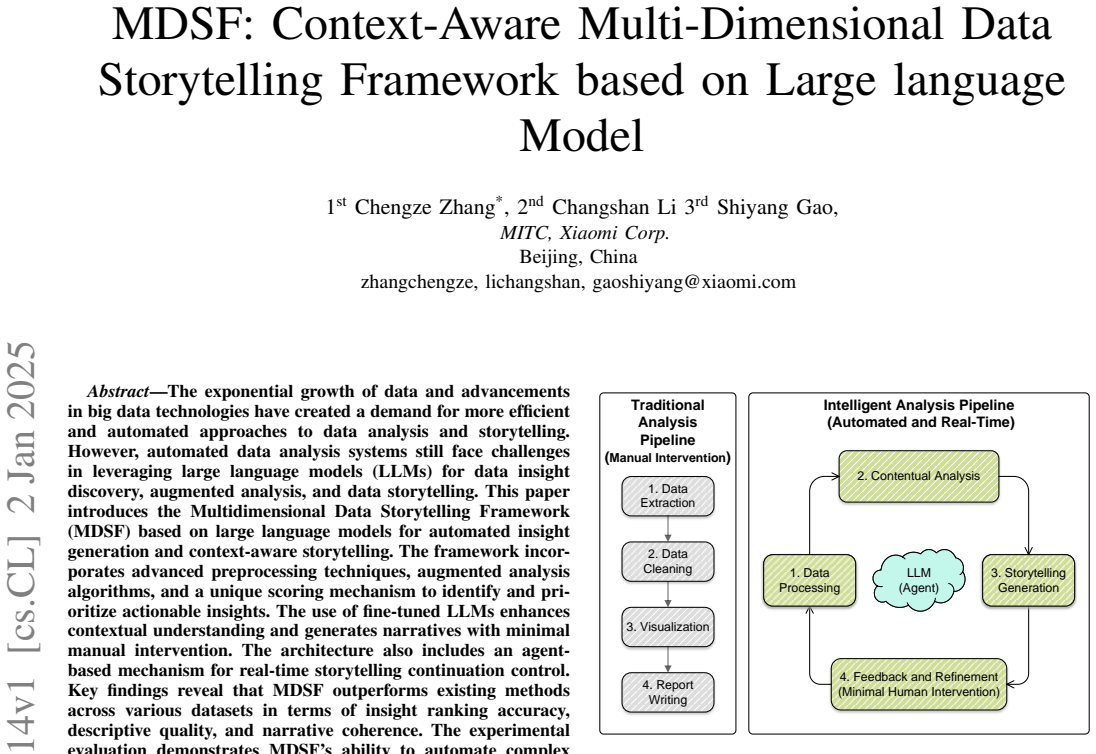
The load-bearing object is the MDSF pipeline itself, whose central move separates insight discovery from narration. Candidate findings are extracted by augmented-analysis algorithms for time-series and non-time-series data, and each is represented as an Insight tuple carrying a scalar score. That score is the mechanism: it combines importance (weighting head versus tail subspaces), significance (fit to the insight type), surprise (Jensen-Shannon divergence between sibling and native subspaces), fatigue (suppression of repeated patterns), and interpretability (justifiability of the finding). A fine-tuned LLM ranker, trained on human-ranked examples, re-ranks these scored insights against the user's editing context, and a context agent uses the resulting order to compose and continue the story. The scoring tuple plus fine-tuned ranking is what carries the claim that MDSF knows which insights matter.
What would settle it
Re-run the InsightBench ranking experiment with GPT-4 given the exact same precomputed insight candidates and cleaned inputs that MDSF's discovery stage provides. If GPT-4's Spearman-footrule distance matches or beats MDSF's 7.25, then the claimed ranking advantage does not come from MDSF's scoring and fine-tuning mechanism.
Extended reading notes
Core claim
On the paper's own terms, the central discovery is that inserting a scoring-and-ranking stage between insight discovery and narrative generation makes LLMs markedly more reliable for data storytelling. MDSF encodes each candidate finding as a tuple of breakdown dimensions, indicators, insight type, data model, details, and a scalar score, where the score aggregates five signals: subspace importance, statistical significance, surprise relative to sibling subspaces, fatigue from repeated similar suggestions, and interpretability. A fine-tuned LLM rank model re-ranks these scored insights against the user's edit history and profile, and a context agent then generates and continues the narrative. In experiments on a private business dataset, InsightBench, Kaggle data, and Text2Analysis, MDSF achieves the lowest Spearman-footrule ranking distance among automated systems (6.82 and 7.25 on the two ranking sets) and the highest automated description accuracy (0.858), while producing stories with Rouge and BLEU scores close to, though not above, GPT-4 and Gemini 1.5. The authors take this as evidence that algorithmic discovery plus fine-tuned ranking yields accurate, context-aware narratives with minimal manual intervention.
Load-bearing premise
The comparison assumes the baseline models received the same cleaned data and precomputed candidate insights as MDSF; if they were run without the pipeline's preprocessing and discovery stage, the reported gains could reflect the pipeline rather than the model capability.
Editorial extensions
If this is right
- Insight ranking and description improve when the LLM selects among precomputed scored candidates rather than exploring raw tables directly.
- Fine-tuning a 7-billion-parameter LLM on human-ranked insights is enough to approach manual-quality description accuracy and to beat general-purpose models on ranking distance.
- A context agent that reads edit history and user profile can continue a data story in real time, making the framework usable inside an existing reporting workflow.
- The same pipeline transfers across private business data, InsightBench, Kaggle datasets, and Text2Analysis, suggesting the scoring rules generalize beyond a single domain.
- Using the framework reduces manual intervention and interpretive bias in turning multidimensional data into structured, conclusion-bearing reports.
Reading between the lines
- If the comparison setup is fair, even stronger results should appear when MDSF's scoring and ranking stage is mounted on a GPT-4- or Gemini-class base model; the paper's tables imply the ranker, rather than the base model, accounts for much of the gain.
- The surprise formula based on Jensen-Shannon divergence could be lifted out and reused as a generic interestingness measure for exploratory data analysis tools beyond storytelling.
- An ablation that removes the fine-tuned ranker and substitutes a zero-shot LLM would reveal exactly how much of the gain comes from the scoring mechanism; this is testable on the paper's own InsightBench setup.
- The fatigue and interpretability scoring components make the framework a plausible starting point for personalized recommendation systems, where repeated suggestions must be suppressed and outputs must be explainable.
Editorial analysis
A structured set of objections, weighed in public.
Referee Report
Summary. The paper proposes MDSF, a framework for automated multidimensional data storytelling that combines data preprocessing, insight discovery, multi-criteria insight scoring, fine-tuned LLM ranking, and context-aware storytelling with an agent-based continuation mechanism. The evaluation compares MDSF with several LLM baselines on a private dataset and on Text2Analysis, InsightBench, and Kaggle data, using Spearman Footrule Distance, accuracy, ROUGE/BLEU, and a user study. The central claim is that MDSF outperforms existing methods in insight ranking accuracy, descriptive quality, and narrative coherence.
Significance. If its claims were supported, MDSF would be a practically useful integrated framework for automated multidimensional data storytelling. The paper includes some sound design choices: temporal train/test splits, use of public benchmarks, and a user study. The insight description accuracy result (MDSF 0.858 vs. GPT-4 0.785) is a concrete positive finding. However, the reported experiments do not support the headline claims, the scoring mechanism is underspecified, and key evaluation details such as baseline prompts and fine-tuning data size are absent. No code or data is provided, limiting independent verification.
major comments (5)
- [V-B1, Table II] The abstract claims MDSF outperforms existing methods in insight ranking accuracy, but Table II reports Spearman Footrule Distance (explicitly defined as lower-is-better) and shows GPT-4 at 5.83 on the private dataset and 7.00 on InsightBench, versus MDSF at 6.82 and 7.25. GPT-4 is therefore more accurate on both ranking tasks. The text's statement that MDSF 'showed significant improvement over other automated models' is contradicted by this same table, since GPT-4 is an automated model with a smaller SFD.
- [V-B3, Table III] The abstract and conclusion claim superior descriptive quality and narrative coherence, but Table III shows GPT-4 exceeding MDSF on ROUGE/BLEU in seven of eight dataset-metric cells; MDSF only wins Text2Analysis BLEU (0.813 vs. 0.745). The article itself acknowledges 'it did not surpass GPT-4 and Gemini 1.5' in the Story Generation task, so the narrative quality claim is unsupported by the reported evidence.
- [IV-A3, V-A] The composite insight score is not fully specified: Section IV-A3 describes five scoring aspects, gives equations only for importance and surprise, and does not state how the aspects are combined or weighted. The fine-tuning setup omits the training-set size, annotation counts, and number of annotators, and Table II does not state which base model or configuration MDSF uses. These omissions prevent replication and make it impossible to verify the ranking results.
- [V-B4, Table IV, Figure 4] The user study lacks essential methodological details: no number of participants, no recruitment description, no inter-annotator reliability, and no statistical test. The rubric in Table IV is internally inconsistent (Structure is scored 0-2 while Richness uses 0-5), and Figure 4 does not clearly label its axes. The conclusion's claim of 'user satisfaction compared to existing methods' therefore goes beyond what the reported study can support.
- [II, V-A] The experimental comparison includes only general-purpose LLM baselines. None of the related automated storytelling systems discussed in Section II (e.g., DS-Agent, InsightPilot, Calliope) is evaluated. Since the abstract speaks of 'existing methods,' the claimed advantage over existing data storytelling frameworks is not demonstrated.
minor comments (6)
- [V-A] The setup lists 'GPT-3-turbo' while Table II reports 'GPT-3.5 turbo'; please unify the model names.
- [Eq. (4)] Equation (4) defines the Spearman Footrule, but the reported values (e.g., 5.83) are not clearly normalized; specify the ranking length and whether scores are scaled.
- [Figure 3] The y-axis is labeled 'Accuracy' but the plotted distribution style is unclear; provide error bars or confidence intervals for the accuracy values.
- [IV-B2] Typo: 'Insigth Discovery' should be 'Insight Discovery'; also 'Mannul' in Figure 3 and 'LLMS' in Section IV-B1 should be corrected.
- [Table IV] Several cells in Table IV are blank where a score level is undefined; consider marking these as 'N/A' for clarity.
- [IV-A2] The augmented analysis methods (Prophet, SR-CNN, 3-sigma, iForest) are named but not described; include parameter choices or specific references.
Circularity Check
No circularity found: MDSF's insight scoring, fine-tuning, and evaluation form a self-contained supervised pipeline with held-out test splits.
full rationale
The paper's derivation chain is not circular. Insights are discovered by external algorithms (Prophet, SR-CNN, 3-sigma, iForest), scored by explicit formulas such as Eq. (2) importance and Eq. (3) surprise, then ranked by a fine-tuned LLM trained on expert-annotated rankings. The evaluation compares the resulting rankings and narratives against held-out human labels and public benchmarks using SFD, ACC, BLEU, and ROUGE. Critically, the paper states: 'The oldest data instances were used to build the retrieval set, the newest instances formed the test set, and the intermediate instances were used for training,' which means the ranking and generation results are measured on data not used in fine-tuning. No equation defines the evaluation metric in terms of a fitted parameter, and no load-bearing claim is justified only by a self-citation. The scoring weights for the multi-angle mechanism are under-specified, which is a reproducibility limitation rather than circularity. Separately, the abstract's claim that MDSF 'outperforms existing methods' is contradicted by the paper's own Tables II and III, where GPT-4 achieves lower SFD on both ranking datasets and higher ROUGE/BLEU on most story-generation cells; however, that is an internal-evidence consistency problem, not a circular-derivation problem. Under the stated criteria, no circular step can be exhibited with a specific reduction, so the appropriate finding is no significant circularity.
Assumptions & free parameters
free parameters (4)
- Composite insight score weights =
Not specified
- Anomaly detection thresholds and model settings =
Not specified
- Fine-tuning dataset size and annotation counts =
Not stated
- User study participant count =
Not stated
assumptions (5)
- domain assumption Long-tail distributions make head data more valuable than tail data
- domain assumption Expert manual rankings are a reliable ground truth for insight quality
- domain assumption BLEU and ROUGE capture narrative quality in data stories
- domain assumption Temporal split prevents leakage between training and test data
- domain assumption A model fine-tuned on private business data transfers to public benchmarks
Cite this review
Pith. "Pith review of MDSF: Context-Aware Multi-Dimensional Data Storytelling Framework based on Large language Model." pith.science (2026). https://pith.science/paper/ERW7XJJT
@misc{pith2026250101014,
  author       = {Pith},
  title        = {Pith review of: MDSF: Context-Aware Multi-Dimensional Data Storytelling Framework based on Large language Model},
  year         = {2026},
  howpublished = {\url{https://pith.science/paper/ERW7XJJT}},
  note         = {Machine review of arXiv:2501.01014}
}
read the original abstract
The exponential growth of data and advancements in big data technologies have created a demand for more efficient and automated approaches to data analysis and storytelling. However, automated data analysis systems still face challenges in leveraging large language models (LLMs) for data insight discovery, augmented analysis, and data storytelling. This paper introduces the Multidimensional Data Storytelling Framework (MDSF) based on large language models for automated insight generation and context-aware storytelling. The framework incorporates advanced preprocessing techniques, augmented analysis algorithms, and a unique scoring mechanism to identify and prioritize actionable insights. The use of fine-tuned LLMs enhances contextual understanding and generates narratives with minimal manual intervention. The architecture also includes an agent-based mechanism for real-time storytelling continuation control. Key findings reveal that MDSF outperforms existing methods across various datasets in terms of insight ranking accuracy, descriptive quality, and narrative coherence. The experimental evaluation demonstrates MDSF's ability to automate complex analytical tasks, reduce interpretive biases, and improve user satisfaction. User studies further underscore its practical utility in enhancing content structure, conclusion extraction, and richness of detail.
Figures


Figures from the paper (1 more)

Reference graph
Works this paper leans on
-
[1]
M. S. Islam, M. T. R. Laskar, M. R. Parvez, E. Hoque, and S. Joty, DataNarrative: Automated Data-Driven Storytelling with Visualizations and Texts, Aug. 09, 2024. Accessed: Aug. 27, 2024. [Online]. Available: https://arxiv.org/abs/2408.05346v2
arXiv 2024
-
[2]
G. Sahu et al., InsightBench: Evaluating Business Analytics Agents Through Multi-Step Insight Generation, Jul. 08, 2024, arXiv: arXiv:2407.06423. Accessed: Jul. 18, 2024. [Online]. Available: http://arxiv.org/abs/2407.06423
arXiv 2024
-
[3]
Magic Quadrant for Analytics and Business Intelligence Platforms, Jun. 2024. Accessed: Jul. 10, 2024. [On- line]. Available: https://www.gartner.com/doc/reprints?id=1- 2HWZ69DK&ct=240624&st
work page 2024
-
[4]
Y . Xie, Y . Luo, G. Li, and N. Tang, HAIChart: Human and AI Paired Vi- sualization System, Jun. 16, 2024, arXiv: arXiv:2406.11033. Accessed: Jul. 24, 2024. [Online]. Available: http://arxiv.org/abs/2406.11033
arXiv 2024
-
[5]
Y . Zhu, S. Du, B. Li, Y . Luo, and N. Tang, Are Large Language Models Good Statisticians?, Jun. 11, 2024, arXiv: arXiv:2406.07815. Accessed: Jul. 24, 2024. [Online]. Available: http://arxiv.org/abs/2406.07815
arXiv 2024
-
[6]
G. Li, R. Li, Y . Feng, Y . Zhang, Y . Luo, and C. H. Liu, CoInsight: Visual Storytelling for Hierarchical Tables With Connected Insights, IEEE Trans. Vis. Comput. Graphics, vol. 30, no. 6, pp. 3049–3061, Jun. 2024, doi: 10.1109/TVCG.2024.3388553
arXiv 2024
-
[7]
S. Guo, C. Deng, Y . Wen, H. Chen, Y . Chang, and J. Wang, DS-Agent: Automated Data Science by Empowering Large Lan- guage Models with Case-Based Reasoning, May 28, 2024, arXiv: arXiv:2402.17453. Accessed: Jun. 05, 2024. [Online]. Available: http://arxiv.org/abs/2402.17453
arXiv 2024
-
[8]
H. Shao, R. Martinez-Maldonado, V . Echeverria, L. Yan, and D. Gasevic, Data Storytelling in Data Visualisation: Does it Enhance the Efficiency and Effectiveness of Information Retrieval and Insights Comprehen- sion?, in Proceedings of the CHI Conference on Human Factors in Com- puting Systems, May 2024, pp. 1–21. doi: 10.1145/3613904.3643022
arXiv 2024
Show all 67 references
-
[9]
Singha, B
A. Singha, B. Chopra, A. Khatry, S. Gulwani, and A. Z. Henley, Semantically Aligned Question and Code Generation for Automated Insight Generation, Apr. 2024
2024
-
[10]
X. Lan, L. Yang, Z. Wang, Y . Wang, D. Shi, and S. Carpendale, Gen4DS: Workshop on Data Storytelling in an Era of Generative AI, Apr. 05, 2024, arXiv: arXiv:2404.01622. Accessed: Jul. 11, 2024. [Online]. Available: http://arxiv.org/abs/2404.01622
2024 arXiv
-
[11]
Y . Sui, M. Zhou, M. Zhou, S. Han, and D. Zhang, Table Meets LLM: Can Large Language Models Understand Structured Table Data? A Benchmark and Empirical Study, in Proceedings of the 17th ACM International Conference on Web Search and Data Mining, Merida Mexico: ACM, Mar. 2024, ...
2024
-
[12]
Y . He, S. Cao, Y . Shi, Q. Chen, K. Xu, and N. Cao, Leveraging Large Models for Crafting Narrative Visualization: A Survey, Jan. 25, 2024, arXiv: arXiv:2401.14010. Accessed: Apr. 28, 2024. [Online]. Available: http://arxiv.org/abs/2401.14010
2024 arXiv
- [13]
-
[14]
He et al., Text2Analysis: A Benchmark of Table Question Answering with Advanced Data Analysis and Unclear Queries, Dec
X. He et al., Text2Analysis: A Benchmark of Table Question Answering with Advanced Data Analysis and Unclear Queries, Dec. 21, 2023, arXiv: arXiv:2312.13671. Accessed: Feb. 27, 2024. [Online]. Available: http://arxiv.org/abs/2312.13671
2023 arXiv
-
[15]
R. Ding, S. Han, and D. Zhang, InsightPilot: An LLM-Empowered Automated Data Exploration System, in EMNLP 2023, ACL special interest group on linguistic data (SIGDAT), Dec. 2023. [Online]. Avail- able: https://www.microsoft.com/en-us/research/publication/insightpilot- an-llm-e...
2023
-
[16]
Y . Zhao, H. Zhang, S. Si, L. Nan, X. Tang, and A. Co- han, Investigating Table-to-Text Generation Capabilities of LLMs in Real-World Information Seeking Scenarios, Oct. 30, 2023, arXiv: arXiv:2305.14987. Accessed: Jun. 05, 2024. [Online]. Available: http://arxiv.org/abs/2305.14987
2023 arXiv
- [17]
-
[18]
Stalph and B
F. Stalph and B. Heravi, Exploring Data Visualisations: An Analytical Framework Based on Dimensional Components of Data Artefacts in Journalism, Digital Journalism, vol. 11, no. 9, pp. 1641–1663, Oct. 2023, doi: 10.1080/21670811.2021.1957965
2023 arXiv
-
[19]
Li et al., Table-GPT: Table-tuned GPT for Diverse Table Tasks, Oct
P. Li et al., Table-GPT: Table-tuned GPT for Diverse Table Tasks, Oct. 13, 2023, arXiv: arXiv:2310.09263. Accessed: Jun. 04, 2024. [Online]. Available: http://arxiv.org/abs/2310.09263
2023 arXiv
-
[20]
L. Wang, S. Zhang, Y . Wang, E.-P. Lim, and Y . Wang, LLM4Vis: Explainable Visualization Recommendation using ChatGPT, Oct. 2023, Accessed: May 07, 2024. [Online]. Available: https://www.microsoft.com/en-us/research/publication/llm4vis- explainable-visualization-recommendation...
2023
-
[21]
H. Li, Y . Wang, and H. Qu, Where Are We So Far? Understanding Data Storytelling Tools from the Perspective of Human-AI Collabo- ration, Sep. 27, 2023. Accessed: Aug. 27, 2024. [Online]. Available: https://arxiv.org/abs/2309.15723v2
2023 arXiv
-
[22]
C. Wang, J. Thompson, and B. Lee, Data Formulator: AI-powered Concept-driven Visualization Authoring, Sep. 18, 2023. Accessed: Nov. 22, 2023. [Online]. Available: https://arxiv.org/abs/2309.10094v2
2023 arXiv
-
[23]
Renda, M
G. Renda, M. Daquino, and V . Presutti, Melody: A Platform for Linked Open Data Visualisation and Curated Storytelling, 34TH ACM CONFERENCE ON HYPERTEXT AND SOCIAL MEDIA, HT 2023. ASSOC COMPUTING MACHINERY , 1601 Broadway, 10th Floor, NEW YORK, NY , UNITED STATES, pp. 1–8, Sep...
2023
-
[24]
Wang et al., Large Language Models are not Fair Evaluators, Aug
P. Wang et al., Large Language Models are not Fair Evaluators, Aug. 30, 2023, arXiv: arXiv:2305.17926. Accessed: Jul. 17, 2024. [Online]. Available: http://arxiv.org/abs/2305.17926
2023 arXiv
-
[25]
Zheng, N
L. Zheng, N. Li, X. Chen, Q. Gan, and W. Zhang, Dense Representation Learning and Retrieval for Tabular Data Prediction, in Proceedings of the 29th ACM SIGKDD Conference on Knowledge Discovery and Data Mining, Long Beach CA USA: ACM, Aug. 2023, pp. 3559–3569. doi: 10.1145/3580...
2023
-
[26]
Mysore, A
S. Mysore, A. McCallum, and H. Zamani, Large Language Model Augmented Narrative Driven Recommendations, Jul. 21, 2023, arXiv: arXiv:2306.02250. Accessed: Dec. 06, 2023. [Online]. Available: http://arxiv.org/abs/2306.02250
2023 arXiv
-
[27]
Zhao and N
Z. Zhao and N. Elmqvist, The Stories We Tell About Data: Sur- veying Data-Driven Storytelling Using Visualization, IEEE Com- put. Graph. Appl., vol. 43, no. 4, pp. 97–110, Jul. 2023, doi: 10.1109/MCG.2023.3269850
2023
-
[28]
P. Yin et al., Natural Language to Code Generation in Interactive Data Science Notebooks, in Proceedings of the 61st Annual Meeting of the Association for Computational Linguistics (V olume 1: Long Papers), A. Rogers, J. Boyd-Graber, and N. Okazaki, Eds., Toronto, Canada: Asso...
2023 doi
-
[29]
V . Dibia, LIDA: A Tool for Automatic Generation of Grammar-Agnostic Visualizations and Infographics using Large Language Models, in Pro- ceedings of the 61st Annual Meeting of the Association for Computa- tional Linguistics (V olume 3: System Demonstrations), D. Bollegala, R....
2023 doi
- [30]
- [31]
-
[32]
C. Chai, N. Tang, J. Fan, and Y . Luo, Demystifying Artificial Intelligence for Data Preparation, in Companion of the 2023 International Conference on Management of Data, Seattle W A USA: ACM, Jun. 2023, pp. 13–20. doi: 10.1145/3555041.3589406
2023
-
[33]
Shen et al., Towards Natural Language Interfaces for Data Visualiza- tion: A Survey, IEEE Trans
L. Shen et al., Towards Natural Language Interfaces for Data Visualiza- tion: A Survey, IEEE Trans. Visual. Comput. Graphics, vol. 29, no. 6, pp. 3121–3144, Jun. 2023, doi: 10.1109/TVCG.2022.3148007
2023
-
[34]
P. Ma, R. Ding, S. Wang, S. Han, and D. Zhang, XInsight: eXplain- able Data Analysis Through The Lens of Causality, May 30, 2023, arXiv: arXiv:2207.12718. Accessed: Jun. 19, 2023. [Online]. Available: http://arxiv.org/abs/2207.12718
2023 arXiv
-
[35]
Maddigan and T
P. Maddigan and T. Susnjak, Chat2VIS: Generating Data Visualizations via Natural Language Using ChatGPT, Codex and GPT-3 Large Lan- guage Models, IEEE Access, vol. 11, pp. 45181–45193, May 2023, doi: 10.1109/ACCESS.2023.3274199
2023
-
[36]
Harris et al., SpotLight: Visual Insight Recommendation, in Compan- ion Proceedings of the ACM Web Conference 2023, Austin TX USA: ACM, Apr
C. Harris et al., SpotLight: Visual Insight Recommendation, in Compan- ion Proceedings of the ACM Web Conference 2023, Austin TX USA: ACM, Apr. 2023, pp. 19–23. doi: 10.1145/3543873.3587302
2023
-
[37]
Li et al., NetworkNarratives: Data Tours for Visual Network Ex- ploration and Analysis, in Proceedings of the 2023 CHI Conference on Human Factors in Computing Systems, Apr
W. Li et al., NetworkNarratives: Data Tours for Visual Network Ex- ploration and Analysis, in Proceedings of the 2023 CHI Conference on Human Factors in Computing Systems, Apr. 2023, pp. 1–15. doi: 10.1145/3544548.3581452
2023
-
[38]
Zhao et al., ChartStory: Automated Partitioning, Layout, and Cap- tioning of Charts into Comic-Style Narratives, IEEE Trans
J. Zhao et al., ChartStory: Automated Partitioning, Layout, and Cap- tioning of Charts into Comic-Style Narratives, IEEE Trans. Visual. Comput. Graphics, vol. 29, no. 2, pp. 1384–1399, Feb. 2023, doi: 10.1109/TVCG.2021.3114211
2023
-
[39]
P. S. Bobkowski and C. E. Etheridge, Spreadsheets, Software, Story- telling, Visualization, Lifelong Learning: Essential Data Skills for Jour- nalism and Strategic Communication Students, Science Communication, vol. 45, no. 1, pp. 95–116, Feb. 2023, doi: 10.1177/10755470221147887
2023 doi
-
[40]
S. Xu, E. Koh, F. Du, T. Y . Lee, S. M. Lee, and R. Rossi, Generating visual data stories, Jan. 24, 2023
2023
-
[41]
Gkitsakis, S
D. Gkitsakis, S. Kaloudis, E. Mouselli, V . Peralta, P. Marcel, and P. Vassiliadis, Assessment Methods for the Interestingness of Cube Queries, 2023
2023
-
[42]
H. W. Chung et al., Scaling Instruction-Finetuned Language Models, Dec. 06, 2022, arXiv: arXiv:2210.11416. Accessed: Jul. 17, 2024. [Online]. Available: http://arxiv.org/abs/2210.11416
2022 arXiv
-
[43]
Q. Wang, Z. Chen, Y . Wang, and H. Qu, A Survey on ML4VIS: Applying Machine Learning Advances to Data Visualization, IEEE Trans Vis Comput Graph, vol. 28, no. 12, pp. 5134–5153, Dec. 2022, doi: 10.1109/TVCG.2021.3106142
2022
-
[44]
L. Shen, E. Shen, Z. Tai, Y . Xu, and J. Wang, Visual Data Analysis with Task-based Recommendations, Data Sci. Eng., vol. 7, no. 4, pp. 354–369, Dec. 2022, doi: 10.1007/s41019-022-00195-3
2022 doi
-
[45]
Zhang, M
Y . Zhang, M. Reynolds, A. Lugmayr, K. Damjanov, and G. M. Hassan, A Visual Data Storytelling Framework, Informatics, vol. 9, no. 4, p. 73, Sep. 2022, doi: 10.3390/informatics9040073
2022 doi
- [46]
-
[47]
V . Porwal et al., Efficient Insights Discovery through Conditional Generative Model based Query Approximation, in Proceedings of the 2022 International Conference on Management of Data, Philadelphia PA USA: ACM, Jun. 2022, pp. 2397–2400. doi: 10.1145/3514221.3520161
2022
-
[48]
Hosseini-Asl, W
E. Hosseini-Asl, W. Liu, and C. Xiong, A Generative Language Model for Few-shot Aspect-Based Sentiment Analysis, Apr. 11, 2022, arXiv: arXiv:2204.05356. Accessed: Nov. 22, 2023. [Online]. Available: http://arxiv.org/abs/2204.05356
2022 arXiv
-
[49]
Zdanovic, T
D. Zdanovic, T. J. Lembcke, and T. Bogers, The Influence of Data Storytelling on the Ability to Recall Information, in Proceedings of the 2022 Conference on Human Information Interaction and Retrieval, in CHIIR ’22. New York, NY , USA: Association for Computing Machinery, Mar....
2022
-
[50]
Y . Zhou, X. Meng, Y . Wu, T. Tang, Y . Wang, and Y . Wu, An intelli- gent approach to automatically discovering visual insights, Journal of Visualization, pp. 1–18, 2022
2022
-
[51]
S. A. Matei and L. Hunter, Data storytelling is not storytelling with data: A framework for storytelling in science communication and data journalism, The Information Society, vol. 37, no. 5, pp. 312–322, Oct. 2021, doi: 10.1080/01972243.2021.1951415
2021
-
[52]
Hsu, Y .-W
C. Hsu, Y .-W. Chu, T.-H. Huang, and L.-W. Ku, Plot and Rework: Modeling Storylines for Visual Storytelling, in Findings of the Asso- ciation for Computational Linguistics: ACL-IJCNLP 2021, C. Zong, F. Xia, W. Li, and R. Navigli, Eds., Online: Association for Computational Lin...
2021 doi
-
[53]
Wu et al., MultiVision: Designing Analytical Dashboards with Deep Learning Based Recommendation, Jul
A. Wu et al., MultiVision: Designing Analytical Dashboards with Deep Learning Based Recommendation, Jul. 16, 2021, arXiv: arXiv:2107.07823. Accessed: Apr. 22, 2024. [Online]. Available: http://arxiv.org/abs/2107.07823
2021 arXiv
-
[54]
Personnaz, S
A. Personnaz, S. Amer-Yahia, L. Berti-Equille, M. Fabricius, and S. Subramanian, Balancing Familiarity and Curiosity in Data Exploration with Deep Reinforcement Learning, in Fourth Workshop in Exploiting AI Techniques for Data Management, in aiDM ’21. New York, NY , USA: Assoc...
2021
-
[55]
P. Ma, R. Ding, S. Han, and D. Zhang, MetaInsight: Automatic Discovery of Structured Knowledge for Exploratory Data Analysis, in Proceedings of the 2021 International Conference on Management of Data, Virtual Event China: ACM, Jun. 2021, pp. 1262–1274. doi: 10.1145/3448016.3457267
2021
-
[56]
Sultanum, F
N. Sultanum, F. Chevalier, Z. Bylinskii, and Z. Liu, Leveraging Text- Chart Links to Support Authoring of Data-Driven Articles with VizFlow, in Proceedings of the 2021 CHI Conference on Human Factors in Com- puting Systems, in CHI ’21. New York, NY , USA: Association for Com- ...
2021
-
[57]
Srinivasan, N
A. Srinivasan, N. Nyapathy, B. Lee, S. M. Drucker, and J. Stasko, Col- lecting and Characterizing Natural Language Utterances for Specifying Data Visualizations, in Proceedings of the 2021 CHI Conference on Human Factors in Computing Systems, in CHI ’21. New York, NY , USA: As...
2021
-
[58]
D. Shi, X. Xu, F. Sun, Y . Shi, and N. Cao, Calliope: Automatic Visual Data Story Generation from a Spreadsheet, Ieee T Vis Comput Gr, vol. 27, no. 2, pp. 453–463, Feb. 2021, doi: 10.1109/TVCG.2020.3030403
2021
-
[59]
Wu et al., Ai4vis: Survey on artificial intelligence approaches for data visualization, IEEE Transactions on Visualization and Computer Graphics, 2021
A. Wu et al., Ai4vis: Survey on artificial intelligence approaches for data visualization, IEEE Transactions on Visualization and Computer Graphics, 2021
2021
-
[60]
Li et al., Exploring the” Double-Edged Sword” Effect of Auto-Insight Recommendation in Exploratory Data Analysis., in IUI Workshops, 2021
Q. Li et al., Exploring the” Double-Edged Sword” Effect of Auto-Insight Recommendation in Exploratory Data Analysis., in IUI Workshops, 2021
2021
- [61]
-
[62]
T. B. Brown et al., Language Models are Few-Shot Learners, Jul. 22, 2020, arXiv: arXiv:2005.14165. Accessed: Dec. 27, 2022. [Online]. Available: http://arxiv.org/abs/2005.14165
2020 arXiv
-
[63]
W. Chen, J. Chen, Y . Su, Z. Chen, and W. Y . Wang, Logical Natural Language Generation from Open-Domain Tables, in Proceedings of the 58th Annual Meeting of the Association for Computational Linguistics, D. Jurafsky, J. Chai, N. Schluter, and J. Tetreault, Eds., Online: Asso-...
2020 doi
-
[64]
Milo and A
T. Milo and A. Somech, Automating Exploratory Data Analysis via Machine Learning: An Overview, in Proceedings of the 2020 ACM SIG- MOD International Conference on Management of Data, Portland OR USA: ACM, Jun. 2020, pp. 2617–2622. doi: 10.1145/3318464.3383126
2020
-
[65]
Wang et al., DataShot: Automatic Generation of Fact Sheets from Tabular Data, IEEE Transactions on Visualization and Com- puter Graphics, vol
Y . Wang et al., DataShot: Automatic Generation of Fact Sheets from Tabular Data, IEEE Transactions on Visualization and Com- puter Graphics, vol. 26, no. 1, pp. 895–905, Jan. 2020, doi: 10.1109/TVCG.2019.2934398
2020
-
[66]
X. Qin, Y . Luo, N. Tang, and G. Li, Making data visualization more efficient and effective: a survey, The VLDB Journal, vol. 29, no. 1, pp. 93–117, Jan. 2020, doi: 10.1007/s00778-019-00588-3
2020 doi
-
[67]
R. Ding, S. Han, Y . Xu, H. Zhang, and D. Zhang, QuickInsights: Quick and Automatic Discovery of Insights from Multi-Dimensional Data, in Proceedings of the 2019 International Conference on Management of Data, Amsterdam Netherlands: ACM, Jun. 2019, pp. 317–332. doi: 10.1145/32...
2019
Reviewed August 10, 2026 · model on record in the stance chip above.
Discussion (0). Continue with ORCID to comment.