REVIEW 4 major objections 4 minor 54 references
GDSR: Global-Detail Integration through Dual-Branch Network with Wavelet Losses for Remote Sensing Image Super-Resolution
T0 review · 4 major / 4 minor · reviewed 2026-08-10 · deepseek-v4-flash
Pith's one-line read GDSR beats HAT with 63% of its parameters
desk verdict GDSR is a genuinely new RWKV-CNN dual-branch SR design with an internally consistent efficiency story, but the 0.09 dB SOTA claim over HAT rests on single-run numbers with no variance estimates or released artifacts. read the letter →
The pith
A machine-rendered reading of the paper's core claim, the machinery that carries it, and where it could break.
The reading
What carries the argument
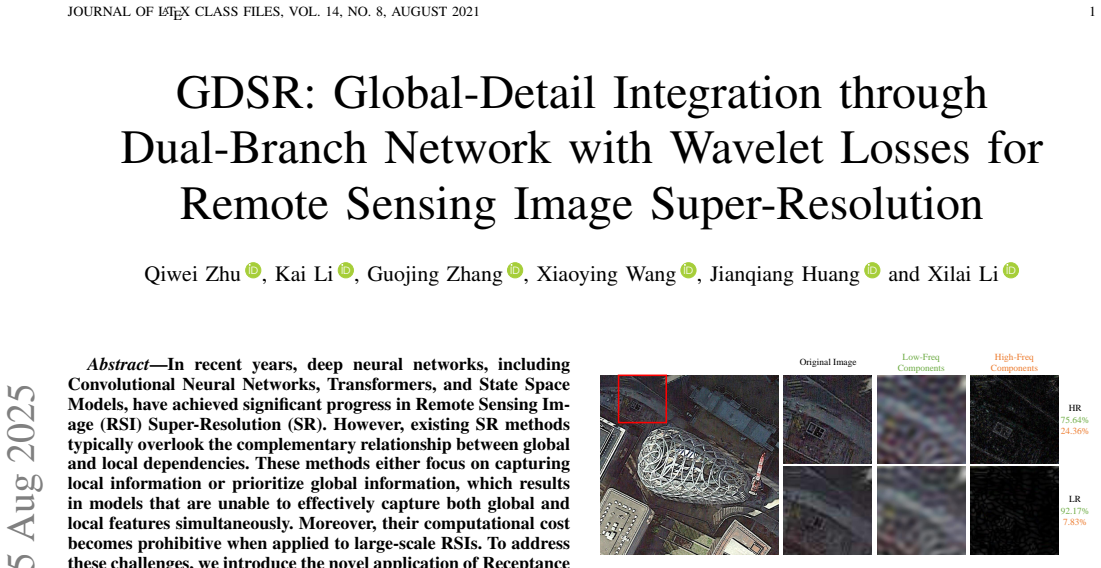
The mechanism that carries the argument is the Global-Detail dual-branch architecture. One branch, the Residual Global Extraction Group, applies RWKV (Receptance Weighted Key Value, a linear-complexity attention-style sequence model adapted to images) to model long-range dependencies, while the other, the Residual Details Extraction Group, applies residual convolutions for local texture. Between them sits the Global-Detail Reconstruction Module, whose Permuted Spatial Attention aligns both feature maps and an adaptive gating layer fuses them, with the fused output fed only into the detail branch to avoid frequency interference. The training objective adds a Dual-Group Multi-Scale Wavelet Loss that compares stationary-wavelet subbands of the SR and HR images separately for low-frequency structure and aggregated high-frequency detail at three scales, so the network is pushed to recover high-frequency information rather than only minimizing pixel error.
What would settle it
Train GDSR, HAT, SwinIR, MambaIR, and FreMamba from the same data splits with three or more seeds and identical degradations, then compare the mean and standard deviation of PSNR and SSIM; the central claim fails if the mean GDSR-HAT gap falls within one standard deviation of the repeated runs, or if HAT wins on any dataset and scale, and the 3.2x speed claim fails if both models are timed on the same GPU with identical input sizes and batch sizes.
Extended reading notes
Core claim
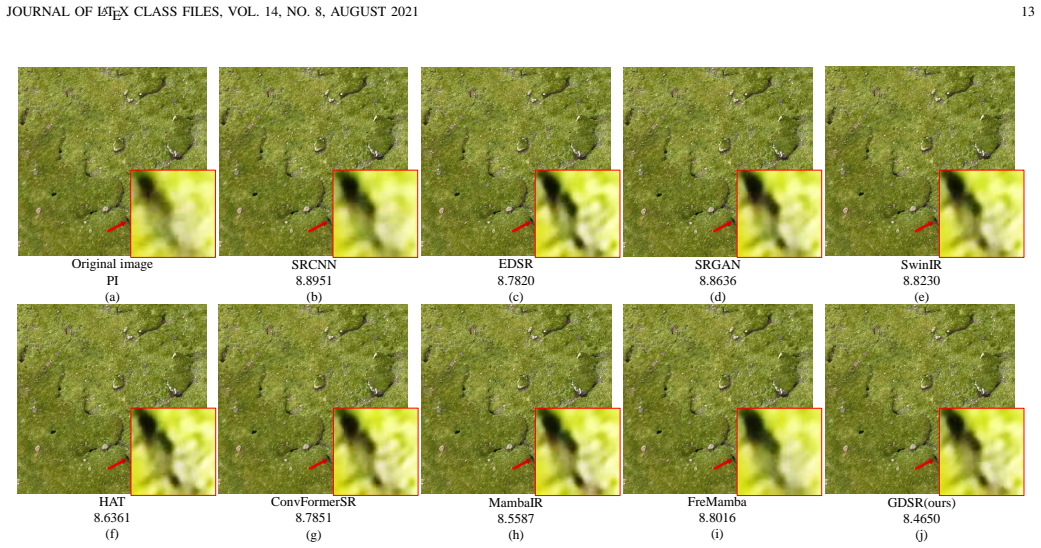
On its own terms, the paper's discovery is that global and local feature extraction are complementary low-pass and high-pass operations, and that explicitly decoupling them into a dual-branch architecture yields better reconstruction than any single-paradigm network. The global branch uses RWKV's recurrent weighted key-value attention with omnidirectional token shifting to capture long-range dependencies, while the detail branch stacks residual convolutional blocks to recover fine textures. The Global-Detail Reconstruction Module aligns and adaptively fuses the two feature streams, and the Dual-Group Multi-Scale Wavelet Loss constrains low-frequency structure and aggregated high-frequency subbands across three resolutions. Across the AID, UCMerced, and RSSRD-QH benchmarks under both bicubic and comprehensive degradation, the authors report that GDSR beats the state-of-the-art Transformer HAT by 0.04 to 0.11 dB in PSNR, with the average gain at 0.09 dB, while consuming 63% of the parameters and 51% of the FLOPs and running 3.2 times faster.
Load-bearing premise
The accuracy advantage over HAT and the other baselines assumes that all compared models were trained with the same data splits, the same degradation pipeline, and comparable tuning effort, and that differences of 0.04 to 0.11 dB are larger than run-to-run variation; the paper reports no repeated seeds, error bars, or released checkpoints to confirm that equivalence.
Editorial extensions
If this is right
- RWKV becomes a viable backbone for large-scale image restoration, not just language modeling, because its linear complexity sidesteps the quadratic cost of self-attention on high-resolution remote sensing inputs.
- The reported 0.04 to 0.11 dB PSNR gains over HAT, SwinIR, and MambaIR suggest that decoupling global and local processing helps across scales (x2, x3, x4) and across two degradation types, including a real-world UAV dataset.
- Because the model has 13.17M parameters, 338.73G FLOPs, and 14.8 FPS at 160x160 input, it fits deployment settings where Transformer and Mamba baselines are too slow or memory-heavy.
- The wavelet loss improves PSNR and SSIM over pixel-loss training while slightly worsening LPIPS, and the ablation shows the multi-scale dual-group design mitigates that tradeoff among wavelet-based losses.
- Retraining with stripe noise added to the degradation model removes sensor stripes, indicating the framework can absorb remote-sensing-specific degradations beyond the standard CDM.
Reading between the lines
- The dual-branch low-pass/high-pass decoupling is not specific to super-resolution; the same RWKV-global/CNN-detail split with attention fusion could be tested on denoising, deblurring, or pan-sharpening of remote sensing images, but the paper does not make that claim.
- Because RWKV has linear complexity in sequence length while windowed Transformers have growing costs, the 3.2x speed advantage at 160x160 inputs may widen at larger operational satellite-image patches; this is extrapolation, since the paper only reports one input size.
- The reported margins over HAT are small enough that repeated-seed training with released checkpoints is needed to know whether the average 0.09 dB advantage is systematic; the paper reports single runs, so the stability of the ranking is an open question.
- If the wavelet loss's LPIPS regression is considered a cost, combining it with a perceptual or adversarial term might preserve fidelity gains while closing the perceptual gap; the paper only evaluates it with L1 reconstruction.
Editorial analysis
A structured set of objections, weighed in public.
Referee Report
Summary. The paper proposes GDSR, a dual-branch network for remote sensing image super-resolution that combines an RWKV-based global branch with a convolutional detail branch, fused by a Global-Detail Reconstruction Module, and trained with an additional dual-group multi-scale wavelet loss. Experiments on AID, UCMerced, and a custom drone-based RSSRD-QH dataset under bicubic and comprehensive degradation report PSNR/SSIM/LPIPS comparisons against CNN, GAN, Transformer, Mamba, and hybrid baselines, plus ablations of branches, RWKV alternatives, depth, and wavelet-loss variants. The abstract's headline claim is that GDSR outperforms HAT by on average 0.09 dB PSNR while using 63% of its parameters, 51% of its FLOPs, and running 3.2 times faster.
Significance. If the headline accuracy claim is accepted, the contribution is a useful efficiency-oriented architecture: the RWKV-CNN dual-branch design is a plausible way to obtain linear-complexity global modeling with local detail refinement, and the efficiency arithmetic in Table X is internally consistent (13.17M/20.81M parameters, 338.73G/652.17G FLOPs, 14.8/4.6 FPS). The 30-category AID breakdown in Table IX is a genuinely informative generalization analysis, and the authors are candid about LPIPS trade-offs and about their model's limitations. However, the paper does not ship code, checkpoints, or the RSSRD-QH dataset, and all headline numbers are single runs, so the quantitative superiority over HAT is not yet verified; the significance of the empirical claim is therefore conditional on added statistical and reproducibility evidence.
major comments (4)
- [Section IV-D, Tables VII and VIII] The headline 'average 0.09 dB over HAT' is not supported as stated. The 18 per-setting PSNR differences range from 0.00 dB (RSSRD-QH CDM x2, where GDSR is also worse in SSIM and LPIPS) to 0.23 dB, with no error bars, no repeated seeds, and no released checkpoints. These gaps are the same order as ablation differences in Table IV, where replacing RWKV with Transformer or Mamba shifts PSNR by 0.14 dB and 0.06 dB on AID x3. Without run-to-run variance estimates or released trained models, the reported 0.09 dB advantage cannot be distinguished from training noise. Please report mean and standard deviation over at least three seeds for GDSR and the closest baselines, or release checkpoints so the comparison can be reproduced.
- [Section IV-B] The comparison protocol is underspecified for baselines. The text states that training used 64x64 patches, batch size 16, Adam, and 200 epochs, but it does not state whether HAT, SwinIR, MambaIR, FreMamba, and the other baselines were retrained under exactly the same patch sampling, degradation generation, learning-rate schedule, and hyperparameter budgets, or whether published checkpoints/final models were used. If the baselines were not trained under the identical protocol, the accuracy and efficiency comparison is not controlled. Please document per-baseline training budgets, data splits, and degradation code, and preferably release training scripts.
- [Section IV-C, Table VI] The wavelet-loss contribution is too small to be considered established. The proposed Dual-Group Multi-Scale loss adds 0.0185 dB PSNR and 0.0008 SSIM over the L1 baseline while increasing LPIPS from 0.3476 to 0.3519; the text calls this a 'significant' improvement. With a single run, this delta is indistinguishable from training noise, and the LPIPS regression runs against the abstract's 'enhanced reconstruction fidelity' claim if perceptual quality is included. Please provide seeded trials or temper the claim to a small PSNR/SSIM improvement with a known perceptual cost.
- [Section IV-A, Table VIII] The custom RSSRD-QH dataset is central to the evaluation, including six of the eighteen settings averaged in the headline claim, but no dataset URL, download link, or release plan is provided; only the geographic distribution of the counties is listed in Table I. Independent verification of the SOTA claim is therefore impossible. Please release the dataset under a clear availability statement or, if it cannot be released, re-state the headline claim based only on public benchmarks.
minor comments (4)
- [Abstract] The abstract contains the typo 'GSDR' instead of 'GDSR'; please correct it throughout.
- [Figures 1, 6, and 7] Several figure captions are duplicated and mismatched: the ERF figure is labeled both 'Figure 1' and 'Fig. 2', the wavelet-loss overview appears as both 'Figure 2' and 'Fig. 6', and the feature-visualization figure appears as both 'Figure 5' and 'Fig. 7'. Please renumber the figures consistently.
- [Section IV-D, paragraph after Table IX] The text refers to experiments on 'F2B and F2C', but the ablation study in Section IV-C only defines F2B and F2D; F2C is never introduced. Please correct the reference or add the missing definition.
- [Table IV and Table IX] There are small formatting errors: the Table IV header reads 'Effect of RWKV .' with an extra space, and Table IX has 'Categoties' instead of 'Categories'.
Circularity Check
No significant circularity: the SOTA claim is an external benchmark comparison, and the only self-citations are contextual, not load-bearing.
full rationale
The paper does not derive its central result from its own assumptions; it benchmarks a trained model against external baselines. The claimed 0.09 dB average PSNR advantage over HAT is a measured comparison in Tables VII and VIII on public datasets (AID, UCMerced) and the custom RSSRD-QH dataset under two degradation models, and the efficiency ratios (63% parameters, 51% FLOPs, 3.2x speed) are arithmetic consequences of the reported values in Table X. No parameter is fitted to a subset of the benchmark data and then renamed as a prediction, and no uniqueness theorem or internal definition forces the outcome. The RWKV components are adopted from external prior work (Restore-RWKV [20], Vision-RWKV [33]) and the wavelet loss is compared against external baselines from [41]; these are building blocks, not circular justification. The only self-references are the authors' own survey [4] and earlier SR paper [5] in the introduction, and they are contextual rather than load-bearing for the quantitative claims. The conclusion's stated limitations (parameter count, RGB-only evaluation, lack of hyperspectral tests) are honesty about scope, not evidence of circularity. The absence of error bars, repeated seeds, or released checkpoints is a correctness and reproducibility concern about whether the 0.09 dB gap exceeds training variance, but it is not a circular-reasoning defect under the criteria used here. Overall, the paper is self-contained against external benchmarks, so circularity is minimal.
Assumptions & free parameters
free parameters (2)
- Wavelet loss weights (lambda_L, lambda_H, alpha_s) =
lambda_L=0.05, lambda_H=0.01, alpha={0.6,0.3,0.1} for s=1,1/2,1/4
- Architecture configuration (N_RCB=12, N_RWKVB=6, depth=4, channels=96) =
12 RCBs, 6 R-RWKVBs, 4 RGEG/RDEG/GDRM stages, c=96
assumptions (4)
- domain assumption Re-WKV attention with Omni-Shift captures global spatial dependencies on 2D images at linear complexity.
- domain assumption Global attention acts as low-pass filtering and convolution as high-pass filtering.
- domain assumption The CDM degradation (Gaussian blur, motion blur, scaling, noise, JPEG) approximates real remote sensing degradation.
- domain assumption Compared models were trained and evaluated under equivalent protocols.
Cite this review
Pith. "Pith review of GDSR: Global-Detail Integration through Dual-Branch Network with Wavelet Losses for Remote Sensing Image Super-Resolution." pith.science (2026). https://pith.science/paper/S457JYO4
@misc{pith2026250101460,
  author       = {Pith},
  title        = {Pith review of: GDSR: Global-Detail Integration through Dual-Branch Network with Wavelet Losses for Remote Sensing Image Super-Resolution},
  year         = {2026},
  howpublished = {\url{https://pith.science/paper/S457JYO4}},
  note         = {Machine review of arXiv:2501.01460}
}
read the original abstract
In recent years, deep neural networks, including Convolutional Neural Networks, Transformers, and State Space Models, have achieved significant progress in Remote Sensing Image (RSI) Super-Resolution (SR). However, existing SR methods typically overlook the complementary relationship between global and local dependencies. These methods either focus on capturing local information or prioritize global information, which results in models that are unable to effectively capture both global and local features simultaneously. Moreover, their computational cost becomes prohibitive when applied to large-scale RSIs. To address these challenges, we introduce the novel application of Receptance Weighted Key Value (RWKV) to RSI-SR, which captures long-range dependencies with linear complexity. To simultaneously model global and local features, we propose the Global-Detail dual-branch structure, GDSR, which performs SR by paralleling RWKV and convolutional operations to handle large-scale RSIs. Furthermore, we introduce the Global-Detail Reconstruction Module (GDRM) as an intermediary between the two branches to bridge their complementary roles. In addition, we propose the Dual-Group Multi-Scale Wavelet Loss, a wavelet-domain constraint mechanism via dual-group subband strategy and cross-resolution frequency alignment for enhanced reconstruction fidelity in RSI-SR. Extensive experiments under two degradation methods on several benchmarks, including AID, UCMerced, and RSSRD-QH, demonstrate that GSDR outperforms the state-of-the-art Transformer-based method HAT by an average of 0.09 dB in PSNR, while using only 63% of its parameters and 51% of its FLOPs, achieving an inference speed 3.2 times faster.
Figures


Figures from the paper (11 more)



Reference graph
Works this paper leans on
-
[1]
T. Sung, Y . Kang, and J. Im, “Enhancing satellite-based wildfire mon- itoring: Advanced contextual model using environmental and structural information,” IEEE Transactions on Geoscience and Remote Sensing , vol. 62, pp. 1–16, 2024
work page 2024
-
[2]
F. Li, T. Yigitcanlar, M. Nepal, K. Nguyen, and F. Dur, “Machine learn- ing and remote sensing integration for leveraging urban sustainability: A review and framework,” Sustainable Cities and Society , vol. 96, p. 104653, 2023
work page 2023
-
[3]
A uav-assisted edge framework for real-time disaster management,
H. Ijaz, R. Ahmad, R. Ahmed, W. Ahmed, Y . Kai, and W. Jun, “A uav-assisted edge framework for real-time disaster management,” IEEE Transactions on Geoscience and Remote Sensing , vol. 61, pp. 1–13, 2023
work page 2023
-
[4]
Survey of single image super-resolution reconstruction,
K. Li, S. Yang, R. Dong, X. Wang, and J. Huang, “Survey of single image super-resolution reconstruction,” IET Image Processing , vol. 14, no. 11, pp. 2273–2290, 2020
work page 2020
-
[5]
Single image super-resolution reconstruction of enhanced loss function with multi-gpu train- ing,
J. Huang, K. Li, and X. Wang, “Single image super-resolution reconstruction of enhanced loss function with multi-gpu train- ing,” in 2019 IEEE Intl Conf on Parallel & Distributed Process- ing with Applications, Big Data & Cloud Computing, Sustainable Computing & Communications, Social Computing & Networking (ISPA/BDCloud/SocialCom/SustainCom). IEEE, 2019,...
work page 2019
-
[6]
Image super-resolution using deep convolutional networks,
C. Dong, C. C. Loy, K. He, and X. Tang, “Image super-resolution using deep convolutional networks,” IEEE transactions on pattern analysis and machine intelligence , vol. 38, no. 2, pp. 295–307, 2015
2015
-
[7]
Accurate image super-resolution using very deep convolutional networks,
J. Kim, J. K. Lee, and K. M. Lee, “Accurate image super-resolution using very deep convolutional networks,” in Proceedings of the IEEE conference on computer vision and pattern recognition, 2016, pp. 1646– 1654
work page 2016
-
[8]
Photo-realistic single image super-resolution using a generative adversarial network,
C. Ledig, L. Theis, F. Husz ´ar, J. Caballero, A. Cunningham, A. Acosta, A. Aitken, A. Tejani, J. Totz, Z. Wang et al. , “Photo-realistic single image super-resolution using a generative adversarial network,” in Proceedings of the IEEE conference on computer vision and pattern recognition, 2017, pp. 4681–4690
2017
Show all 54 references
-
[9]
Enhanced deep residual networks for single image super-resolution,
B. Lim, S. Son, H. Kim, S. Nah, and K. Mu Lee, “Enhanced deep residual networks for single image super-resolution,” in Proceedings of the IEEE conference on computer vision and pattern recognition workshops, 2017, pp. 136–144
2017
-
[10]
Understanding the effective receptive field in deep convolutional neural networks,
W. Luo, Y . Li, R. Urtasun, and R. Zemel, “Understanding the effective receptive field in deep convolutional neural networks,” Advances in neural information processing systems , vol. 29, 2016
2016
-
[11]
Transformer-based multistage enhancement for remote sensing image super-resolution,
S. Lei, Z. Shi, and W. Mo, “Transformer-based multistage enhancement for remote sensing image super-resolution,” IEEE Transactions on Geoscience and Remote Sensing , vol. 60, pp. 1–11, 2022
2022
-
[12]
Swinir: Image restoration using swin transformer,
J. Liang, J. Cao, G. Sun, K. Zhang, L. Van Gool, and R. Timofte, “Swinir: Image restoration using swin transformer,” in Proceedings of the IEEE/CVF international conference on computer vision , 2021, pp. 1833–1844. JOURNAL OF LATEX CLASS FILES, VOL. 14, NO. 8, AUGUST 2021 15
2021
-
[13]
Activating more pixels in image super-resolution transformer,
X. Chen, X. Wang, J. Zhou, Y . Qiao, and C. Dong, “Activating more pixels in image super-resolution transformer,” in Proceedings of the IEEE/CVF Conference on Computer Vision and Pattern Recognition (CVPR), June 2023, pp. 22 367–22 377
2023
-
[14]
Stransfuse: Fusing swin transformer and convolutional neural network for remote sensing image semantic segmentation,
L. Gao, H. Liu, M. Yang, L. Chen, Y . Wan, Z. Xiao, and Y . Qian, “Stransfuse: Fusing swin transformer and convolutional neural network for remote sensing image semantic segmentation,” IEEE journal of selected topics in applied earth observations and remote sensing, vol. 14, p...
2021
-
[15]
Mambair: A simple baseline for image restoration with state-space model,
H. Guo, J. Li, T. Dai, Z. Ouyang, X. Ren, and S.-T. Xia, “Mambair: A simple baseline for image restoration with state-space model,” in European Conference on Computer Vision . Springer, 2025, pp. 222– 241
2025
-
[16]
Frequency-assisted mamba for remote sensing image super-resolution,
Y . Xiao, Q. Yuan, K. Jiang, Y . Chen, Q. Zhang, and C.-W. Lin, “Frequency-assisted mamba for remote sensing image super-resolution,” IEEE Transactions on Multimedia , vol. 26, pp. 1–14, 2024
2024
-
[17]
Mamba: Linear-time sequence modeling with selective state spaces,
A. Gu and T. Dao, “Mamba: Linear-time sequence modeling with selective state spaces,” arXiv preprint arXiv:2312.00752 , 2023
2023 arXiv
-
[18]
Eagle and finch: Rwkv with matrix-valued states and dynamic recurrence,
B. Peng, D. Goldstein, Q. Anthony, A. Albalak, E. Alcaide, S. Biderman, E. Cheah, X. Du, T. Ferdinan, H. Hou et al. , “Eagle and finch: Rwkv with matrix-valued states and dynamic recurrence,” arXiv preprint arXiv:2404.05892, 2024
2024 arXiv
-
[19]
Mamba or rwkv: Exploring high-quality and high-efficiency segment anything model,
H. Yuan, X. Li, L. Qi, T. Zhang, M.-H. Yang, S. Yan, and C. C. Loy, “Mamba or rwkv: Exploring high-quality and high-efficiency segment anything model,” arXiv preprint arXiv:2406.19369 , 2024
2024 arXiv
-
[20]
Restore-rwkv: Efficient and effective medical image restoration with rwkv,
Z. Yang, H. Zhang, D. Zhao, B. Wei, and Y . Xu, “Restore-rwkv: Efficient and effective medical image restoration with rwkv,” arXiv preprint arXiv:2407.11087, 2024
2024 arXiv
-
[21]
How do vision transformers work?
N. Park and S. Kim, “How do vision transformers work?” in Interna- tional Conference on Learning Representations , 2022
2022
-
[22]
Super-resolution of single remote sensing image based on residual dense backprojection networks,
Z. Pan, W. Ma, J. Guo, and B. Lei, “Super-resolution of single remote sensing image based on residual dense backprojection networks,” IEEE Transactions on Geoscience and Remote Sensing , vol. 57, no. 10, pp. 7918–7933, 2019
2019
-
[23]
Remote sensing image super-resolution using novel dense-sampling networks,
X. Dong, X. Sun, X. Jia, Z. Xi, L. Gao, and B. Zhang, “Remote sensing image super-resolution using novel dense-sampling networks,” IEEE Transactions on Geoscience and Remote Sensing , vol. 59, no. 2, pp. 1618–1633, 2020
2020
-
[24]
Hybrid-scale self-similarity exploitation for remote sensing image super-resolution,
S. Lei and Z. Shi, “Hybrid-scale self-similarity exploitation for remote sensing image super-resolution,” IEEE Transactions on Geoscience and Remote Sensing, vol. 60, pp. 1–10, 2021
2021
-
[25]
Hybrid attention- based u-shaped network for remote sensing image super-resolution,
J. Wang, B. Wang, X. Wang, Y . Zhao, and T. Long, “Hybrid attention- based u-shaped network for remote sensing image super-resolution,” IEEE Transactions on Geoscience and Remote Sensing , vol. 61, pp. 1–15, 2023
2023
-
[26]
Dual self- attention swin transformer for hyperspectral image super-resolution,
Y . Long, X. Wang, M. Xu, S. Zhang, S. Jiang, and S. Jia, “Dual self- attention swin transformer for hyperspectral image super-resolution,” IEEE Transactions on Geoscience and Remote Sensing , vol. 61, pp. 1–12, 2023
2023
-
[27]
Scale- aware backprojection transformer for single remote sensing image super- resolution,
J. Hao, W. Li, Y . Lu, Y . Jin, Y . Zhao, S. Wang, and B. Wang, “Scale- aware backprojection transformer for single remote sensing image super- resolution,” IEEE Transactions on Geoscience and Remote Sensing , vol. 62, pp. 1–13, 2024
2024
-
[28]
Convformersr: Fusing transformers and convolutional neural networks for cross-sensor remote sensing imagery super-resolution,
J. Li, Y . Meng, C. Tao, Z. Zhang, X. Yang, Z. Wang, X. Wang, L. Li, and W. Zhang, “Convformersr: Fusing transformers and convolutional neural networks for cross-sensor remote sensing imagery super-resolution,” IEEE Transactions on Geoscience and Remote Sensing , vol. 62, pp. ...
2024
-
[29]
A dual-path feature reuse multi- scale network for remote sensing image super-resolution,
H. Xiao, X. Chen, L. Luo, and C. Lin, “A dual-path feature reuse multi- scale network for remote sensing image super-resolution,” The Journal of Supercomputing, vol. 81, no. 1, pp. 1–28, 2025
2025
-
[30]
Aeru-net: Adaptive edge recovery and attention u-shaped network for remote sensing image super-resolution,
A. Hajian and S. Aramvith, “Aeru-net: Adaptive edge recovery and attention u-shaped network for remote sensing image super-resolution,” IEEE Access, vol. 13, pp. 59 177–59 197, 2025
2025
-
[31]
Scat: Shift channel attention transformer for remote sensing image super-resolution,
Y . Kang, X. Zhang, S. Wang, and G. Jin, “Scat: Shift channel attention transformer for remote sensing image super-resolution,” IEEE Journal of Selected Topics in Applied Earth Observations and Remote Sensing , vol. 18, pp. 10 337–10 347, 2025
2025
-
[32]
Rwkv: Reinventing rnns for the transformer era,
B. Peng, E. Alcaide, Q. Anthony, A. Albalak, S. Arcadinho, S. Bider- man, H. Cao, X. Cheng, M. Chung, M. Grella et al., “Rwkv: Reinventing rnns for the transformer era,” arXiv preprint arXiv:2305.13048 , 2023
2023 arXiv
-
[33]
Vision-RWKV: Efficient and scalable visual per- ception with RWKV-like architectures,
Y . Duan, W. Wang, Z. Chen, X. Zhu, L. Lu, T. Lu, Y . Qiao, H. Li, J. Dai, and W. Wang, “Vision-RWKV: Efficient and scalable visual per- ception with RWKV-like architectures,” in The Thirteenth International Conference on Learning Representations , 2025
2025
-
[34]
Diffusion-rwkv: Scaling rwkv-like architectures for diffusion models,
Z. Fei, M. Fan, C. Yu, D. Li, and J. Huang, “Diffusion-rwkv: Scaling rwkv-like architectures for diffusion models,” arXiv preprint arXiv:2404.04478, 2024
2024 arXiv
-
[35]
Ten lectures on wavelets,
I. Daubechies, “Ten lectures on wavelets,” Society for industrial and applied mathematics, 1992
1992
-
[36]
Wavelet-srnet: A wavelet-based cnn for multi-scale face super resolution,
H. Huang, R. He, Z. Sun, and T. Tan, “Wavelet-srnet: A wavelet-based cnn for multi-scale face super resolution,” in Proceedings of the IEEE international conference on computer vision , 2017, pp. 1689–1697
2017
-
[37]
Wavelet domain style transfer for an effective perception-distortion tradeoff in single image super-resolution,
X. Deng, R. Yang, M. Xu, and P. L. Dragotti, “Wavelet domain style transfer for an effective perception-distortion tradeoff in single image super-resolution,” in Proceedings of the IEEE/CVF international conference on computer vision , 2019, pp. 3076–3085
2019
-
[38]
Wavelet-based dual recursive network for image super-resolution,
J. Xin, J. Li, X. Jiang, N. Wang, H. Huang, and X. Gao, “Wavelet-based dual recursive network for image super-resolution,” IEEE Transactions on Neural Networks and Learning Systems , vol. 33, no. 2, pp. 707–720, 2022
2022
-
[39]
Wavelet convo- lutions for large receptive fields,
S. E. Finder, R. Amoyal, E. Treister, and O. Freifeld, “Wavelet convo- lutions for large receptive fields,” in European Conference on Computer Vision. Springer, 2025, pp. 363–380
2025
-
[40]
Training generative image super-resolution models by wavelet-domain losses enables better control of artifacts,
C. Korkmaz, A. M. Tekalp, and Z. Dogan, “Training generative image super-resolution models by wavelet-domain losses enables better control of artifacts,” in Proceedings of the IEEE/CVF Conference on Computer Vision and Pattern Recognition , 2024, pp. 5926–5936
2024
-
[41]
Training transformer models by wavelet losses improves quantitative and visual performance in single image super-resolution,
C. Korkmaz and A. M. Tekalp, “Training transformer models by wavelet losses improves quantitative and visual performance in single image super-resolution,” in Proceedings of the IEEE/CVF Conference on Computer Vision and Pattern Recognition , 2024, pp. 6661–6670
2024
-
[42]
Real-time single image and video super- resolution using an efficient sub-pixel convolutional neural network,
W. Shi, J. Caballero, F. Husz ´ar, J. Totz, A. P. Aitken, R. Bishop, D. Rueckert, and Z. Wang, “Real-time single image and video super- resolution using an efficient sub-pixel convolutional neural network,” in Proceedings of the IEEE conference on computer vision and pattern r...
2016
-
[43]
Cbam: Convolutional block attention module,
S. Woo, J. Park, J.-Y . Lee, and I. S. Kweon, “Cbam: Convolutional block attention module,” in Proceedings of the European conference on computer vision (ECCV) , 2018, pp. 3–19
2018
-
[44]
Aid: A benchmark data set for performance evaluation of aerial scene classification,
G.-S. Xia, J. Hu, F. Hu, B. Shi, X. Bai, Y . Zhong, L. Zhang, and X. Lu, “Aid: A benchmark data set for performance evaluation of aerial scene classification,” IEEE Transactions on Geoscience and Remote Sensing , vol. 55, no. 7, pp. 3965–3981, 2017
2017
-
[45]
Bag-of-visual-words and spatial extensions for land-use classification,
Y . Yang and S. Newsam, “Bag-of-visual-words and spatial extensions for land-use classification,” in Proceedings of the 18th SIGSPATIAL in- ternational conference on advances in geographic information systems , 2010, pp. 270–279
2010
-
[46]
Image quality assess- ment: from error visibility to structural similarity,
Z. Wang, A. Bovik, H. Sheikh, and E. Simoncelli, “Image quality assess- ment: from error visibility to structural similarity,” IEEE Transactions on Image Processing , vol. 13, no. 4, pp. 600–612, 2004
2004
-
[47]
The unreasonable effectiveness of deep features as a perceptual metric,
R. Zhang, P. Isola, A. A. Efros, E. Shechtman, and O. Wang, “The unreasonable effectiveness of deep features as a perceptual metric,” in Proceedings of the IEEE conference on computer vision and pattern recognition, 2018, pp. 586–595
2018
-
[48]
Imagenet classification with deep convolutional neural networks,
A. Krizhevsky, I. Sutskever, and G. E. Hinton, “Imagenet classification with deep convolutional neural networks,” Advances in neural informa- tion processing systems , vol. 25, 2012
2012
-
[49]
Blind super-resolution with iterative kernel correction,
J. Gu, H. Lu, W. Zuo, and C. Dong, “Blind super-resolution with iterative kernel correction,” in Proceedings of the IEEE/CVF conference on computer vision and pattern recognition , 2019, pp. 1604–1613
2019
-
[50]
Real-esrgan: Training real- world blind super-resolution with pure synthetic data,
X. Wang, L. Xie, C. Dong, and Y . Shan, “Real-esrgan: Training real- world blind super-resolution with pure synthetic data,” in Proceedings of the IEEE/CVF international conference on computer vision , 2021, pp. 1905–1914
2021
-
[51]
Real-world remote sensing image super-resolution via a practical degradation model and a kernel-aware network,
R. Dong, L. Mou, L. Zhang, H. Fu, and X. X. Zhu, “Real-world remote sensing image super-resolution via a practical degradation model and a kernel-aware network,” ISPRS Journal of Photogrammetry and Remote Sensing, vol. 191, pp. 155–170, 2022
2022
-
[52]
Building bridges across spatial and temporal resolutions: Reference-based super-resolution via change priors and con- ditional diffusion model,
R. Dong, S. Yuan, B. Luo, M. Chen, J. Zhang, L. Zhang, W. Li, J. Zheng, and H. Fu, “Building bridges across spatial and temporal resolutions: Reference-based super-resolution via change priors and con- ditional diffusion model,” in Proceedings of the IEEE/CVF Conference on Com...
2024
-
[53]
Interpreting super-resolution networks with local attribution maps,
J. Gu and C. Dong, “Interpreting super-resolution networks with local attribution maps,” in Proceedings of the IEEE/CVF Conference on Computer Vision and Pattern Recognition , 2021, pp. 9199–9208
2021
-
[54]
The 2018 pirm challenge on perceptual image super-resolution,
Y . Blau, R. Mechrez, R. Timofte, T. Michaeli, and L. Zelnik-Manor, “The 2018 pirm challenge on perceptual image super-resolution,” in Proceedings of the European conference on computer vision (ECCV) workshops, 2018, pp. 0–0
2018
Reviewed August 10, 2026 · model on record in the stance chip above.
Discussion (0). Continue with ORCID to comment.