REVIEW 4 major objections 7 minor 42 references
Skillful High-Resolution Ensemble Precipitation Forecasting with an Integrated Deep Learning Framework
T0 review · 4 major / 7 minor · reviewed 2026-08-10 · deepseek-v4-flash
Pith's one-line read This paper claims that a hybrid 3D SwinTransformer plus conditional latent diffusion framework produces reliable 0.05° precipitation ensembles over China that match observed precipitation better than ERA5.
desk verdict Credible hybrid deterministic+diffusion precipitation ensemble with a real operational pipeline, but the reliability claim outruns the evidence. read the letter →
The pith
A machine-rendered reading of the paper's core claim, the machinery that carries it, and where it could break.
The reading
What carries the argument
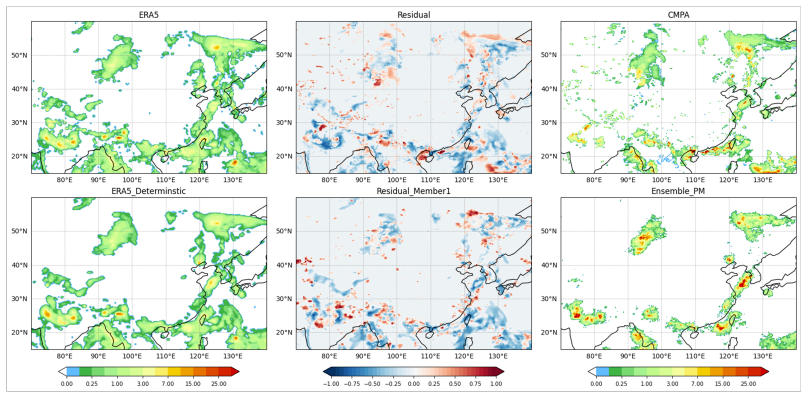
The load-bearing idea is the additive decomposition $X_t = \bar{X}_t + X'_t$, where $\bar{X}_t$ is the mesoscale mean precipitation produced by the deterministic 3D SwinTransformer — a vision transformer that processes spatial and temporal patches — and $X'_t$ is the residual precipitation generated by a conditional latent diffusion model. The residual is computed as the difference between scaled CMPA and ERA5 precipitation, so the diffusion model effectively learns the conditional distribution of the discrepancy between a coarse reanalysis and a high-resolution merged analysis. A VAE compresses the residual to a $16\times 90\times 140$ latent space; the DiT-based denoiser — a transformer-based diffusion backbone — is conditioned on the atmospheric state and mean precipitation; DDIM sampling with 300 steps generates 11 members; probability matching combines them into an ensemble mean.
What would settle it
Extend the evaluation from the single month of August 2021 to a full twelve months spanning all seasons and compare the rank histogram and cumulative distribution functions against CMPA over that entire period. If the near-uniform rank histogram and the closer-to-CMPA-than-ERA5 distribution only appear in the summer month, the claim of an unbiased, well-calibrated ensemble system fails.
Extended reading notes
Core claim
The paper's central claim is that the physically motivated decomposition of precipitation into a grid-resolved mean plus a sub-grid stochastic perturbation can be learned from reanalysis data, and that the learned stochastic part carries genuine forecast skill. Concretely, the deterministic model predicts mesoscale mean precipitation from consecutive atmospheric states, and a conditional diffusion model in latent space generates residual precipitation, conditioned on the same atmospheric state plus the mean prediction. At inference, repeatedly sampling Gaussian noise in the latent space yields an 11-member ensemble. Evaluation on August 2021 over China shows a nearly uniform rank histogram — with only slightly elevated tails — and cumulative distribution functions of the 11 members that track the CMPA observations more closely than ERA5 does, especially for heavy precipitation. The authors also report that a real-time system forced by open operational forecast data maintains CSI scores of roughly 0.15–0.3 at the 0.1 mm/h threshold out to five days.
Load-bearing premise
The load-bearing premise is that the real-time operational forecast data used at inference resemble the ERA5 reanalysis used in training closely enough that the model transfers without fine-tuning; the paper only rescales the precipitation variable, and the authors themselves flag fine-tuning as needed as more data accumulate.
Editorial extensions
If this is right
- A model trained once on reanalysis can produce 120-hour, 0.05-degree ensemble forecasts from 0.25-degree inputs, which removes the usual computational barrier to high-resolution ensemble precipitation forecasting.
- The two-component design means the deterministic backbone can be swapped (for example, for a different NWP or data-driven model) without retraining the diffusion part, since the diffusion only models the residual between the mean prediction and the high-resolution truth.
- Repeated latent-space sampling yields 11 ensemble members whose spatial patterns agree at synoptic scales but differ in convective details, giving operational users a probabilistic rather than a single deterministic output.
- Probability-matching over the members produces an ensemble mean that represents heavy precipitation better than the raw ERA5 field, which matters for flood and disaster response.
Reading between the lines
- A natural next test is to fine-tune the diffusion model on residual statistics computed from real-time forecast inputs rather than ERA5; closing that gap is the paper's own stated future work and would likely raise the real-time CSI scores.
- The decomposition into mean-plus-residual is a general post-processing template: any coarse deterministic precipitation forecast could be 'sharpened' by adding a calibrated stochastic residual learned against a high-resolution merged analysis, provided such an analysis exists for the region.
- Because the residual is defined as the difference between CMPA and ERA5, part of what the diffusion learns may be systematic bias correction rather than pure physical stochasticity; splitting the residual into a deterministic correction term and a truly random component would sharpen the physical interpretation.
Editorial analysis
A structured set of objections, weighed in public.
Referee Report
Summary. This paper proposes a deep learning framework for hourly 0.05-degree ensemble precipitation forecasting over China. It combines a deterministic 3D SwinTransformer that predicts mesoscale precipitation from ERA5 atmospheric fields with a latent conditional diffusion model that generates residual precipitation (defined as CMPA minus ERA5) to represent sub-grid variability; 11 ensemble members are produced by repeated DDIM sampling. The authors report an ablation study of deterministic design choices, a case study, a rank histogram claimed to show unbiasedness, CDF comparisons against CMPA and ERA5 for a heavy-rain period, and a real-time 5-day forecasting experiment using ECMWF open data. The central claims are that the ensemble is nearly unbiased, that its precipitation distribution is closer to CMPA than ERA5, and that it captures extreme precipitation events better than ERA5.
Significance. The practical motivation is strong: high-resolution precipitation ensembles are important for flood and disaster response, and the hybrid deterministic-plus-diffusion architecture is a plausible way to address the common blurring problem in deep-learning precipitation forecasts. The paper includes an ablation study and a real-time implementation, which are concrete strengths. However, the headline claims of unbiasedness and distributional fidelity currently rest on a single-month, single-region evaluation, a rank histogram whose construction is under-specified, and a verification target that is also used to define the training target. If these issues are addressed with additional analysis and broader evaluation, the framework could be a useful applied contribution; at present the evidence is not yet at the level claimed in the abstract and key points.
major comments (4)
- [§4.2.2 / Figure 7] The rank histogram is the only quantitative support for the 'nearly unbiased' claim, but the manuscript does not state how zero precipitation values were handled, whether ties were randomized, over which grid cells and time steps the histogram was computed, or what the sampling uncertainty is. Precipitation is a mixed discrete-continuous variable with a large point mass at exactly 0 mm/h, especially at 0.05-degree resolution; without explicit randomized tie-breaking or separate treatment of dry and wet cases, the rank histogram can appear artificially flat. Please report the exact construction, including any randomized rank procedure, the spatiotemporal sample (e.g., all of August 2021 over the full domain), and confidence bands or a statistical test for uniformity.
- [§3.1, §4.2.2] Because the residual precipitation TP' is defined as scaled CMPA minus scaled ERA5, and the ensemble is generated as TP + TP', verifying the ensemble against CMPA is partly a test of reconstruction of the training target rather than an independent forecast evaluation. This does not invalidate the architecture, but it weakens the claim that the output distribution is inherently 'closer to CMPA than ERA5.' Please add a comparison against a baseline that does not use CMPA in its construction, such as deterministic-only forecasts, a simple bias-corrected ERA5 ensemble, or a diffusion model trained on a different target, or at least explicitly quantify how much of the CDF improvement follows from the additive construction.
- [§4.2–4.3] The quantitative evaluation is limited to August 2021 over a single region: the rank histogram and CDF use one month, the case study is one event, and the real-time CSI evaluation covers August 2021 only. There is no multi-season or multi-year verification, no confidence intervals on the scores, and no comparison against an operational NWP ensemble or a probabilistic baseline. Given the title and key points claim 'skillful' forecasting and 'unbiased' ensembles, this single-month evaluation is not sufficient support; please broaden the evaluation or temper the claims.
- [§4.3 / Conclusion] The real-time forecasting experiment uses ECMWF open data after only 'adjusting the precipitation data scale' (Conclusion), without quantifying the distribution shift between ERA5 and real-time IFS forecasts. Moreover, the 3-hour ECMWF fields are converted to hourly forecasts using Pangu-Weather extrapolations, and the error introduced by this intermediate step is not evaluated separately. Without a comparison of ERA5-driven and ECMWF-driven ensemble performance on the same dates, the reported CSI results cannot be attributed to the framework rather than to the specific input stream or the extrapolation procedure.
minor comments (7)
- [§3.2.3 / Eq. (5)] The text says the loss 'balances L1 and SSIM,' but Eq. (5) uses a squared L2 term; please correct the inconsistency.
- [§3.2.3] The acronym 'SIMM' appears in the text; it should be 'SSIM.'
- [Figure 7 caption] The caption contains a duplicated phrase: 'The black dashed line The black dashed line represents...' Please fix.
- [Data Availability] The text has a typo, 'ECWWF open real-time forecast'; it should be 'ECMWF.' Also, the Code Availability section is empty; please state whether code will be released.
- [Table 1] The heading 'Determinstic model' is misspelled; it should be 'Deterministic.'
- [§2.4] Reducing CMPA from 0.01 degrees to 0.05 degrees by average pooling may smooth extreme precipitation values; please justify this choice or discuss its effect on the reported extremes.
- [§3.4 / §4.2.1] The manuscript does not explain why 11 ensemble members and 300 DDIM sampling steps were chosen, nor how probability matching is applied to combine the members; please provide the rationale and a precise description.
Circularity Check
No significant circularity: the model is trained on CMPA-derived residuals but evaluated on a held-out 2021 test period, so the CMPA comparison is a legitimate out-of-sample forecast assessment.
full rationale
The paper defines the residual precipitation as the difference between scaled CMPA and scaled ERA5 precipitation (Section 3.1) and trains the probabilistic model to generate this residual conditioned on atmospheric state. It then evaluates the resulting ensemble against CMPA on August 2021 data that was not used in training (training spans 2018-2019, validation 2020, testing 2021). Therefore, the claim that the ensemble distribution is closer to CMPA than ERA5 is not an algebraic identity or a fitted-input prediction: the model must generalize to a held-out period, and the stochastic diffusion sampler does not guarantee exact reproduction of CMPA. The rank histogram and CDF evaluations use CMPA as the reference, which is standard practice even when CMPA is also the training target, because the test period is independent. Potential concerns about rank-histogram handling of zero-precipitation ties are evaluation-methodology issues rather than circularity. No load-bearing self-citation or imported uniqueness argument appears. The framework's decomposition into a deterministic mean plus residual is a modeling choice, not a circular derivation of the paper's central claims.
Assumptions & free parameters
free parameters (4)
- loss weights lambda1, lambda2 =
0.5, 1.5
- dBZ normalization scale =
temporal mean of spatial maxima over training years
- VAE latent dimension =
16 channels (16 x 90 x 140)
- ensemble size and DDIM sampling steps =
11 members, 300 steps
assumptions (4)
- domain assumption High-resolution precipitation can be decomposed into a mesoscale mean plus a subgrid residual (Eq. 3).
- domain assumption CMPA is an accurate ground truth for precipitation over China.
- domain assumption Coarse 0.25 degree ERA5 atmospheric fields carry enough information to condition stochastic generation of 0.05 degree precipitation.
- domain assumption ECMWF IFS forecasts and ERA5 reanalysis are sufficiently homogeneous for direct transfer without fine-tuning.
Cite this review
Pith. "Pith review of Skillful High-Resolution Ensemble Precipitation Forecasting with an Integrated Deep Learning Framework." pith.science (2026). https://pith.science/paper/LVSNSW2B
@misc{pith2026250102905,
  author       = {Pith},
  title        = {Pith review of: Skillful High-Resolution Ensemble Precipitation Forecasting with an Integrated Deep Learning Framework},
  year         = {2026},
  howpublished = {\url{https://pith.science/paper/LVSNSW2B}},
  note         = {Machine review of arXiv:2501.02905}
}
abstract
High-resolution precipitation forecasts are crucial for providing accurate weather prediction and supporting effective responses to extreme weather events. Traditional numerical models struggle with stochastic subgrid-scale processes, while recent deep learning models often produce blurry results. To address these challenges, we propose a physics-inspired deep learning framework for high-resolution (0.05\textdegree{} $\times$ 0.05\textdegree{}) ensemble precipitation forecasting. Trained on ERA5 and CMPA high-resolution precipitation datasets, the framework integrates deterministic and probabilistic components. The deterministic model, based on a 3D SwinTransformer, captures average precipitation at mesoscale resolution and incorporates strategies to enhance performance, particularly for moderate to heavy rainfall. The probabilistic model employs conditional diffusion in latent space to account for uncertainties in residual precipitation at convective scales. During inference, ensemble members are generated by repeatedly sampling latent variables, enabling the model to represent precipitation uncertainty. Our model significantly enhances spatial resolution and forecast accuracy. Rank histogram shows that the ensemble system is reliable and unbiased. In a case study of heavy precipitation in southern China, the model outputs align more closely with observed precipitation distributions than ERA5, demonstrating superior capability in capturing extreme precipitation events. Additionally, 5-day real-time forecasts show good performance in terms of CSI scores.
Figures


Figures from the paper (6 more)



Reference graph
Works this paper leans on
-
[1]
allen2022model APACrefauthors Allen, M R. , Kettleborough, J A. \ Stainforth, D A. APACrefauthors \ 2022 . Model error in weather and climate forecasting Model error in weather and climate forecasting . ECMWF Predictability of Weather and Climate Seminar ECMWF predictability of weather and climate seminar \ ( \ 279--304). APACrefURL http://www.ecmwf.int/p...
work page 2022
-
[2]
aspertiPrecipitationNowcastingGenerative2023 APACrefauthors Asperti, A. , Merizzi, F. , Paparella, A. , Pedrazzi, G. , Angelinelli, M. \ Colamonaco, S. APACrefauthors \ 2023 . Precipitation Nowcasting with Generative Diffusion Models Precipitation nowcasting with generative diffusion models \ ( \ arXiv:2308.06733). arXiv
arXiv 2023
-
[3]
bauerQuietRevolutionNumerical2015 APACrefauthors Bauer, P. , Thorpe, A. \ Brunet, G. APACrefauthors \ 2015 . The Quiet Revolution of Numerical Weather Prediction The quiet revolution of numerical weather prediction . Nature 525 7567 47--55
work page 2015
-
[4]
biAccurateMediumrangeGlobal2023 APACrefauthors Bi, K. , Xie, L. , Zhang, H. , Chen, X. , Gu, X. \ Tian, Q. APACrefauthors \ 2023 . Accurate Medium-Range Global Weather Forecasting with 3D Neural Networks Accurate medium-range global weather forecasting with 3D neural networks . Nature 619 7970 533--538
work page 2023
-
[5]
bodnarFoundationModelEarth2024 APACrefauthors Bodnar, C. , Bruinsma, W P. , Lucic, A. , Stanley, M. , Vaughan, A. , Brandstetter, J. Perdikaris, P. APACrefauthors \ 2024 . A Foundation Model for the Earth System A Foundation Model for the Earth System \ ( \ arXiv:2405.13063). arXiv
arXiv 2024
-
[6]
charlton-perez2024 APACrefauthors Charlton-Perez , A J. , Dacre, H F. , Driscoll, S. , Gray, S L. , Harvey, B. , Harvey, N J. Volont \'e , A. APACrefauthors \ 2024 . Do AI Models Produce Better Weather Forecasts than Physics-Based Models? A Quantitative Evaluation Case Study of Storm Ciar \'a n Do AI models produce better weather forecasts than physics-ba...
work page 2024
-
[7]
chenFuXiCascadeMachine2023 APACrefauthors Chen, L. , Zhong, X. , Zhang, F. , Cheng, Y. , Xu, Y. , Qi, Y. \ Li, H. APACrefauthors \ 2023 . FuXi : A Cascade Machine Learning Forecasting System for 15-Day Global Weather Forecast FuXi : A cascade machine learning forecasting system for 15-day global weather forecast . npj Climate and Atmospheric Science 6 1 190
work page 2023
-
[8]
ebert2001 APACrefauthors Ebert, E E. APACrefauthors \ 2001 . Ability of a Poor Man's Ensemble to Predict the Probability and Distribution of Precipitation Ability of a poor man's ensemble to predict the probability and distribution of precipitation . Monthly Weather Review 129 2461--2480
work page 2001
Show all 42 references
-
[9]
APACrefauthors \ 2023
ECMWF2023 APACrefauthors ECMWF . APACrefauthors \ 2023 . IFS Documentation – CY49R1 Operational Implementation Ifs documentation – cy49r1 operational implementation \ [ ]. Available at: https://www.ecmwf.int/en/publications/ifs-documentation
2023
-
[10]
, Shi, X
gaoPreDiffPrecipitationNowcasting2023 APACrefauthors Gao, Z. , Shi, X. , Han, B. , Wang, H. , Jin, X. , Maddix, D. Wang, Y. APACrefauthors \ 2023 . PreDiff : Precipitation Nowcasting with Latent Diffusion Models PreDiff : Precipitation Nowcasting with Latent Diffusion Models \...
2023 arXiv
-
[11]
, Bai, L
gongCasCastSkillfulHighresolution2024 APACrefauthors Gong, J. , Bai, L. , Ye, P. , Xu, W. , Liu, N. , Dai, J. Ouyang, W. APACrefauthors \ 2024 . CasCast : Skillful High-resolution Precipitation Nowcasting via Cascaded Modelling CasCast : Skillful High-resolution Precipitation ...
2024 arXiv
-
[12]
APACrefauthors \ 2001
hamill2001 APACrefauthors Hamill, T M. APACrefauthors \ 2001 . Interpretation of rank histograms for verifying ensemble forecasts Interpretation of rank histograms for verifying ensemble forecasts . Monthly Weather Review 129 3 550--560 . APACrefDOI doi:10.1175/1520-0493(2001)...
2001 doi
-
[13]
, Bell, B
hersbach2020era5 APACrefauthors Hersbach, H. , Bell, B. , Berrisford, P. , Hirahara, S. , Hor \'a nyi, A. , Mu \ n oz-Sabater, J. others APACrefauthors \ 2020 . The ERA5 global reanalysis The era5 global reanalysis . Quarterly Journal of the Royal Meteorological Society 146 73...
2020
-
[14]
, Jain, A
hoDenoisingDiffusionProbabilistic2020 APACrefauthors Ho, J. , Jain, A. \ Abbeel, P. APACrefauthors \ 2020 . Denoising Diffusion Probabilistic Models Denoising Diffusion Probabilistic Models \ ( \ arXiv:2006.11239). arXiv
2020 arXiv
-
[15]
, Duffy, P
iorio2004effects APACrefauthors Iorio, J. , Duffy, P. , Govindasamy, B. , Thompson, S. , Khairoutdinov, M. \ Randall, D. APACrefauthors \ 2004 . Effects of model resolution and subgrid-scale physics on the simulation of precipitation in the continental United States Effects of...
2004
-
[16]
\ Fritsch, J M
kain1993convective APACrefauthors Kain, J S. \ Fritsch, J M. APACrefauthors \ 1993 . Convective parameterization for mesoscale models: The Kain--Fritsch scheme Convective parameterization for mesoscale models: The kain--fritsch scheme . The representation of cumulus convection...
1993
-
[17]
\ Welling, M
kingma2022 APACrefauthors Kingma, D P. \ Welling, M. APACrefauthors \ 2022 . Auto- Encoding Variational Bayes Auto- Encoding Variational Bayes \ ( \ arXiv:1312.6114). arXiv
2022 arXiv
-
[18]
, Sanchez-Gonzalez, A
lam2023learning APACrefauthors Lam, R. , Sanchez-Gonzalez, A. , Willson, M. , Wirnsberger, P. , Fortunato, M. , Alet, F. others APACrefauthors \ 2023 . Learning skillful medium-range global weather forecasting Learning skillful medium-range global weather forecasting . Science...
2023
-
[19]
, Cao, J
liang2021 APACrefauthors Liang, J. , Cao, J. , Sun, G. , Zhang, K. , Gool, L V. \ Timofte, R. APACrefauthors \ 2021 . SwinIR : Image Restoration Using Swin Transformer SwinIR : Image Restoration Using Swin Transformer \ ( \ arXiv:2108.10257). arXiv
2021 arXiv
-
[20]
, Hsu, K
liu2024 APACrefauthors Liu, C C. , Hsu, K. , Peng, M S. , Chen, D S. , Chang, P L. , Hsiao, L F. Kuo, H C. APACrefauthors \ 2024 . Evaluation of Five Global AI Models for Predicting Weather in Eastern Asia and Western Pacific Evaluation of five global AI models for predicting ...
2024
-
[21]
, Fung, J C H
liuEnhancingQuantitativePrecipitation2024 APACrefauthors Liu, H. , Fung, J C H. , Lau, A K H. \ Li, Z. APACrefauthors \ 2024 . Enhancing Quantitative Precipitation Estimation of NWP Model With Fundamental Meteorological Variables and Transformer Based Deep Learning Model Enhan...
2024
-
[22]
, Lin, Y
liu2021 APACrefauthors Liu, Z. , Lin, Y. , Cao, Y. , Hu, H. , Wei, Y. , Zhang, Z. Guo, B. APACrefauthors \ 2021 . Swin Transformer : Hierarchical Vision Transformer Using Shifted Windows Swin Transformer : Hierarchical Vision Transformer using Shifted Windows \ ( \ arXiv:2103....
2021 arXiv
-
[23]
\ Palmer, W
marshall1948distribution APACrefauthors Marshall, J. \ Palmer, W. APACrefauthors \ 1948 . The distribution of raindrops with size The distribution of raindrops with size . Journal of Meteorology 5 4 165--166
1948
-
[24]
\ Dudek, M
Molinari1992Review APACrefauthors Molinari, J. \ Dudek, M. APACrefauthors \ 1992 . Parameterization of Convective Precipitation in Mesoscale Numerical Models: A Critical Review Parameterization of convective precipitation in mesoscale numerical models: A critical review . Mont...
1992
-
[25]
, Buizza, R
molteni1996ecmwf APACrefauthors Molteni, F. , Buizza, R. , Palmer, T N. \ Petroliagis, T. APACrefauthors \ 1996 . The ECMWF ensemble prediction system: Methodology and validation The ECMWF ensemble prediction system: Methodology and validation . Quarterly Journal of the Royal ...
1996
-
[26]
, Shutts, G J
palmer2005representing APACrefauthors Palmer, T N. , Shutts, G J. , Hagedorn, R. , Doblas-Reyes, F J. , Jung, T. \ Leutbecher, M. APACrefauthors \ 2005 . Representing model uncertainty in weather and climate prediction Representing model uncertainty in weather and climate pred...
2005
-
[27]
, Subramanian, S
pathak2022 APACrefauthors Pathak, J. , Subramanian, S. , Harrington, P. , Raja, S. , Chattopadhyay, A. , Mardani, M. Anandkumar, A. APACrefauthors \ 2022 . FourCastNet : A Global Data-driven High-resolution Weather Model Using Adaptive Fourier Neural Operators FourCastNet : A ...
2022 arXiv
-
[28]
\ Xie, S
peeblesScalableDiffusionModels2023 APACrefauthors Peebles, W. \ Xie, S. APACrefauthors \ 2023 . Scalable Diffusion Models with Transformers Scalable Diffusion Models with Transformers \ ( \ arXiv:2212.09748). arXiv
2023 arXiv
-
[29]
\ Thuerey, N
rasp2021data APACrefauthors Rasp, S. \ Thuerey, N. APACrefauthors \ 2021 . Data-driven medium-range weather prediction with a resnet pretrained on climate simulations: A new model for weatherbench Data-driven medium-range weather prediction with a resnet pretrained on climate ...
2021
-
[30]
, Temperton, C
ritchie1995implementation APACrefauthors Ritchie, H. , Temperton, C. , Simmons, A J. , Hortal, M. , Davies, T. , Dent, D. \ Hamrud, M. APACrefauthors \ 1995 . Implementation of the semi-Lagrangian method in a high-resolution version of the ECMWF forecast model Implementation o...
1995
-
[31]
, Blattmann, A
rombachHighResolutionImageSynthesis2022 APACrefauthors Rombach, R. , Blattmann, A. , Lorenz, D. , Esser, P. \ Ommer, B. APACrefauthors \ 2022 . High- Resolution Image Synthesis with Latent Diffusion Models High- Resolution Image Synthesis with Latent Diffusion Models \ ( \ arX...
2022 arXiv
-
[32]
, Klemp, J B
skamarock2005description APACrefauthors Skamarock, W C. , Klemp, J B. , Dudhia, J. , Gill, D O. , Barker, D M. , Duda, M G. Powers, J G. APACrefauthors \ 2005 . A description of the advanced research WRF version 2 A description of the advanced research wrf version 2 \ . Nation...
2005
-
[33]
, Meng, C
songDenoisingDiffusionImplicit2022 APACrefauthors Song, J. , Meng, C. \ Ermon, S. APACrefauthors \ 2022 . Denoising Diffusion Implicit Models Denoising Diffusion Implicit Models \ ( \ arXiv:2010.02502). arXiv
2022 arXiv
-
[34]
APACrefauthors \ 1999
talagrand1999 APACrefauthors Talagrand, O. APACrefauthors \ 1999 . Evaluation of probabilistic prediction systems Evaluation of probabilistic prediction systems . Proceedings of the ECMWF Workshop on Predictability
1999
-
[35]
, Lean, H W
tang2013benefits APACrefauthors Tang, Y. , Lean, H W. \ Bornemann, J. APACrefauthors \ 2013 . The benefits of the Met Office variable resolution NWP model for forecasting convection The benefits of the Met Office variable resolution nwp model for forecasting convection . Meteo...
2013
-
[36]
APACrefauthors \ 1989
tiedtke1989comprehensive APACrefauthors Tiedtke, M. APACrefauthors \ 1989 . A comprehensive mass flux scheme for cumulus parameterization in large-scale models A comprehensive mass flux scheme for cumulus parameterization in large-scale models . Monthly Weather Review 117 8 1779--1800
1989
-
[37]
, Fasullo, J T
trenberth2011 APACrefauthors Trenberth, K E. , Fasullo, J T. \ Mackaro, J. APACrefauthors \ 2011 . Atmospheric moisture transports from ocean to land and global energy flows in reanalyses Atmospheric moisture transports from ocean to land and global energy flows in reanalyses ...
2011
-
[38]
, Bovik, A
ssim APACrefauthors Wang, Z. , Bovik, A. , Sheikh, H. \ Simoncelli, E. APACrefauthors \ 2004 . Image quality assessment: from error visibility to structural similarity Image quality assessment: from error visibility to structural similarity . IEEE Transactions on Image Process...
2004
-
[39]
APACrefauthors \ 2011
wilks2011rank APACrefauthors Wilks, D. APACrefauthors \ 2011 . On the reliability of the rank histogram On the reliability of the rank histogram . Monthly Weather Review 139 1 311--316
2011
-
[40]
\ Xiong, A Y
xie2011 APACrefauthors Xie, P. \ Xiong, A Y. APACrefauthors \ 2011 . A Conceptual Model for Constructing High-Resolution Gauge-Satellite Merged Precipitation Analyses: GAUGE-SATELLITE MERGED PRECIP ANALYSIS A conceptual model for constructing high-resolution gauge-satellite me...
2011
-
[41]
, Wang, Q J
zhao2021which APACrefauthors Zhao, P. , Wang, Q J. , Wu, W. \ Yang, Q. APACrefauthors \ 2021 . Which precipitation forecasts to use? Deterministic versus coarser-resolution ensemble NWP models Which precipitation forecasts to use? deterministic versus coarser-resolution ensemb...
2021
-
[42]
, Sun, J
zhou2022 APACrefauthors Zhou, K. , Sun, J. , Zheng, Y. \ Zhang, Y. APACrefauthors \ 2022 . Quantitative Precipitation Forecast Experiment Based on Basic NWP Variables Using Deep Learning Quantitative Precipitation Forecast Experiment Based on Basic NWP Variables Using Deep Lea...
2022
Reviewed August 10, 2026 · model on record in the stance chip above.
Discussion (0). Continue with ORCID to comment.