REVIEW 3 major objections 7 minor 45 references
CONTINUUM: Detecting APT Attacks through Spatial-Temporal Graph Neural Networks
T0 review · 3 major / 7 minor · reviewed 2026-08-10 · deepseek-v4-flash
Pith's one-line read A spatio-temporal graph autoencoder trained on benign provenance snapshots can detect multi-stage APT attacks with false-positive rates at or near zero on most benchmark datasets, according to this paper's evaluation.
desk verdict Plausible incremental architecture with good detection scores on most benchmarks, but the resource-usage and low-FPR claims outrun the evidence; deserves a serious referee with expectations of major revision. read the letter →
The pith
A machine-rendered reading of the paper's core claim, the machinery that carries it, and where it could break.
The reading
What carries the argument
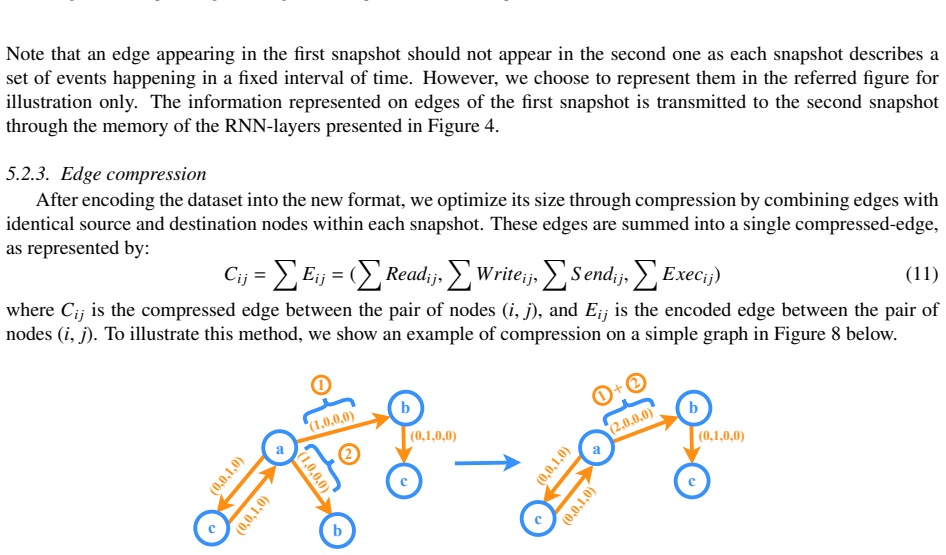
The load-bearing object is the Spatial-Temporal Graph Autoencoder, an encoder-decoder whose encoder stacks Graph Attention Network layers (with edge-feature-aware attention) and Gated Recurrent Unit cells, and whose decoder reconstructs node features snapshot by snapshot. Snapshots are produced by timestamp-based division of provenance logs, and edge compression sums parallel edges of the same type so that multi-gigabyte datasets shrink by an average of 70.8%. Detection uses K-Nearest Neighbors on the learned embeddings: a node or snapshot far from the benign cluster is flagged as an anomaly.
What would settle it
Measure the federated pipeline end-to-end over real network links with the FedML-HE encryption and decryption phases included; if the total time with FL and homomorphic encryption exceeds the centralized GPU baseline, the optimized-resource claim fails. Alternatively, build a provenance dataset where attack edges are interspersed with benign patterns in the same snapshots (mimicry); if K-NN distances do not separate the classes, the detection claim fails.
Extended reading notes
Core claim
The central claim is that treating APT detection as a spatio-temporal anomaly-detection problem, rather than a static graph classification task, is what makes multi-stage attacks visible. By converting provenance graphs into snapshots, compressing repeated edges, encoding node and edge types with one-hot vectors, and feeding the snapshot sequence through a GAT-based autoencoder with GRU memory, the model captures both the local entity interactions and their evolution across attack stages; at inference, a K-NN classifier over benign embeddings separates normal activity from attack activity. The authors further claim that federated training with homomorphic encryption preserves most of this accuracy while cutting training time and keeping raw data on-premise.
Load-bearing premise
The resource-usage comparison assumes that splitting a single dataset across simulated federated clients is a valid proxy for real distributed deployment, and that the reported time savings do not need to include homomorphic encryption and communication costs.
Editorial extensions
If this is right
- A privacy-preserving federated IDS can be assembled from on-premise host data with near-centralized accuracy, making cross-organization APT defense alliances feasible.
- The snapshot-and-compress preprocessing pipeline turns existing provenance log datasets into temporal graph benchmarks without manual labeling of attack stages.
- The reported five-to-tenfold training-time reduction with FL suggests that splitting model training across hosts is a practical route to resource-constrained IDS deployment, provided the timing holds in real networks.
- The near-perfect scores on clear-stage datasets imply that staged temporal modeling matters most where attack phases are separated in time; datasets without such separation would be the harder test.
Reading between the lines
- The paper's own tables show FL sometimes lowers precision (SC-2, Cadets-E3) because the same dataset is split across simulated clients; in a real deployment with diverse clients, the accuracy gap could be larger or smaller, and the resource comparison would need to include homomorphic encryption and communication costs, which the timing table omits.
- The near-perfect scores on most benchmarks likely come from the benchmark structure (attack graphs are clearly separable), so the strongest untested scenario is mimicry: an attacker who imitates benign interaction patterns within a single snapshot.
- The preprocessing innovation (timestamp snapshots plus edge compression) is reusable independently of the GNN, so other graph-based detectors could adopt it to add temporal structure to static provenance datasets.
Editorial analysis
A structured set of objections, weighed in public.
Referee Report
Summary. The manuscript presents CONTINUUM, an APT detection system based on a spatial-temporal graph autoencoder. It converts provenance-graph logs into snapshots, applies one-hot encoding to nodes and edges, compresses edges, and uses a GAT-based autoencoder with RNN layers for graph-level and node-level anomaly detection. The paper also proposes a federated learning deployment with homomorphic encryption for privacy-preserving weight aggregation. Experiments are conducted on DARPA Transparent Computing and related public datasets, and results are compared with GNN-based IDSs such as MAGIC, KAIROS, Threatrace, GHunter, GCA, and XFedGraph. The abstract claims that the system detects APTs with lower false positive rates and optimized resource usage compared to existing methods.
Significance. If the stated claims are fully supported, CONTINUUM would be a useful contribution to GNN-based APT detection, especially for combining temporal modeling of provenance graphs with federated learning and homomorphic encryption. The paper's strengths include a concrete architecture, use of standard benchmarks, comparison with several recent baselines, a publicly referenced code repository, and explicit descriptions of the preprocessing pipeline. However, the headline claims are not substantiated by the reported evidence: the false-positive-rate claim is contradicted by the SC-2 results in Table 6, and the resource-usage claim is based on an internal comparison that omits encryption and communication costs. The core model may still be valuable, but the current evaluation does not support the strong conclusions stated in the abstract and Section 6.5.
major comments (3)
- [Section 6.5, Table 6] The abstract's claim of 'lower false positive rates compared to existing methods' is contradicted by the manuscript's own numbers in the SC-2 row: Threatrace reports FP 4.0, while the proposed method reports FP 8.0 without FL and FP 14.0 with FL. The text acknowledges a 'slight reduction in performance' for SC-2, but the unqualified claim in the abstract is not supported. Even in Table 7, the FL variant's FPR is not consistently lower than existing baselines (e.g., Theia-E3: Ours-FL 0.17 vs. Threatrace 0.1). The claims in the abstract and in Section 6.5 ('superior performance in Graph-level detection across almost all datasets') must be revised or substantiated with additional configurations where FPR is consistently lower.
- [Section 6.5, Table 5 and Section 5.3.2] The 'optimized resource usage compared to existing methods' claim is not supported by Table 5, which compares CONTINUUM without FL to CONTINUUM with FL but does not compare against any existing method. Moreover, the FL timing comparison is not a fair efficiency proxy because the text states that 'we are splitting the same dataset over multiple clients, which reduces its quality'; the measured speedup may simply reflect smaller per-client training partitions. No number of clients, aggregation rounds, communication volume, or homomorphic encryption overhead is reported, despite Section 5.3.2 describing FedML-HE with threshold key management and Section 6.1 listing TenSEAL. Without accounting for these costs, the resource-usage claim is unsupported.
- [Sections 6.4 and 6.5] No error bars, standard deviations, or significance tests are reported for any result, even though training is stochastic and several entries are perfect scores (1.0) for both the proposed method and baselines. The absence of variance information makes it difficult to judge whether differences are meaningful, particularly on datasets where all methods saturate. Reporting multiple independent runs with variance is necessary to support the strong comparative claims made in the paper.
minor comments (7)
- [Section 3 and Section 2.1] There are multiple typos, including 'Advances Persis-tent Threats', 'stealthiness od', 'ect..', and 'di fferent'; these should be corrected throughout.
- [Equations (12) and (13)] The term 'Droupout' should be 'Dropout' in both equations.
- [Equations (1) and (2)] The notation for GNN layers is inconsistent: Eq. (1) uses superscripts (l), while Eq. (2) uses (k) for the same concept; the notation should be unified.
- [Equation (7) and Section 5.1.3] Equation (7) defines the reconstruction loss as an unspecified 'loss function', but the text later mentions symmetric binary cross-entropy; the loss should be stated explicitly in the equation or its surrounding text.
- [Section 5.3] The text refers to 'the third hypothesis' without having introduced numbered hypotheses earlier; either introduce the hypotheses explicitly or remove the reference.
- [Table 2] The '-' entries for node-level datasets under 'Avg. #Graphs' are ambiguous; please state whether these datasets are not split into graphs or the statistic is not applicable.
- [Figures 4 and 5] The captions of Figures 4 and 5 do not explain the meaning of the repeated blocks and arrows, which makes the architecture difficult to follow; more descriptive captions are needed.
Circularity Check
No significant circularity: CONTINUUM's detection and efficiency claims rest on held-out evaluation and direct experiments; self-citations are motivational, not load-bearing.
full rationale
The central detection claim is not circular: CONTINUUM trains a spatio-temporal GNN autoencoder only on benign snapshots, sets the K-NN threshold using validation metrics, and reports detection on held-out attack graphs (Sections 6.3-6.5), so no target quantity is used to define the model or to fit a parameter that is then called a prediction. The federated-learning resource claim is supported by a direct within-paper A/B timing comparison (Table 5) rather than by a parameter fitted to the headline outcome; the fact that this comparison omits homomorphic-encryption overhead and does not compare to external methods is an evidentiary limitation, not a circular reduction. Reusing MAGIC's GAT layer and loss implementation (Section 6.3) is code reuse with external baselines, and the self-citations to FedHE-Graph appear only in motivation and related work, where the current experiments independently support the FL efficiency claim. Even the SC-2 FP% inconsistency with the abstract's lower-FPR claim is an empirical contradiction, not a circular derivation. No self-definitional equations, fitted-input predictions, author-imported uniqueness theorems, or ansatz-smuggling citations were found.
Assumptions & free parameters
free parameters (5)
- Number of snapshots per graph =
not reported
- KNN number of neighbors k =
not reported
- Distance threshold =
not reported
- Number of training epochs =
50 (entity-level), 6 (graph-level)
- GNN hidden dimensions and layer counts =
not reported
assumptions (5)
- domain assumption Provenance graphs in the datasets faithfully represent system activity and attack stages
- domain assumption Benign training snapshots are representative of normal behavior, and attacks are statistically different in reconstruction error or embedding distance
- ad hoc to paper The FL simulation, where the same dataset is split across clients, approximates real federated deployment
- standard math FedML-HE with threshold key management provides the claimed security guarantees
- domain assumption The compared baseline numbers from prior papers were obtained under comparable data splits
Cite this review
Pith. "Pith review of CONTINUUM: Detecting APT Attacks through Spatial-Temporal Graph Neural Networks." pith.science (2026). https://pith.science/paper/KJ7XTHBI
@misc{pith2026250102981,
  author       = {Pith},
  title        = {Pith review of: CONTINUUM: Detecting APT Attacks through Spatial-Temporal Graph Neural Networks},
  year         = {2026},
  howpublished = {\url{https://pith.science/paper/KJ7XTHBI}},
  note         = {Machine review of arXiv:2501.02981}
}
read the original abstract
Advanced Persistent Threats (APTs) represent a significant challenge in cybersecurity due to their sophisticated and stealthy nature. Traditional Intrusion Detection Systems (IDS) often fall short in detecting these multi-stage attacks. Recently, Graph Neural Networks (GNNs) have been employed to enhance IDS capabilities by analyzing the complex relationships within networked data. However, existing GNN-based solutions are hampered by high false positive rates and substantial resource consumption. In this paper, we present a novel IDS designed to detect APTs using a Spatio-Temporal Graph Neural Network Autoencoder. Our approach leverages spatial information to understand the interactions between entities within a graph and temporal information to capture the evolution of the graph over time. This dual perspective is crucial for identifying the sequential stages of APTs. Furthermore, to address privacy and scalability concerns, we deploy our architecture in a federated learning environment. This setup ensures that local data remains on-premise while encrypted model-weights are shared and aggregated using homomorphic encryption, maintaining data privacy and security. Our evaluation shows that this system effectively detects APTs with lower false positive rates and optimized resource usage compared to existing methods, highlighting the potential of spatio-temporal analysis and federated learning in enhancing cybersecurity defenses.
Figures


Figures from the paper (7 more)





Reference graph
Works this paper leans on
-
[4]
https://mbernste.github.io/posts/gcn/
Graph convolutional neural networks — mbernste.github.io. https://mbernste.github.io/posts/gcn/. [Accessed 06-04-2024]. Bianchi, F., Livi, L., Øyvind Mikalsen, K., Kamp ffmeyer, M.C., Jenssen, R.,
work page 2024
-
[6]
arXiv preprint arXiv:2111.13597
Graph-based solutions with residuals for intrusion detection: The modified e-graphsage and e-resgat algorithms. arXiv preprint arXiv:2111.13597 . Chen, H., Chillotti, I., Song, Y .,
-
[8]
IEEE Communications Letters 25, 1564–1567
Discovering attack scenarios via intrusion alert correlation using graph convolutional networks. IEEE Communications Letters 25, 1564–1567. Cheng, Z., Dai, R., Wang, L., Yu, Z., Lv, Q., Wang, Y ., Sun, D., 2023a. Ghunter: A fast subgraph matching method for threat hunting, in: 2023 26th International Conference on Computer Supported Cooperative Work in De...
arXiv 2023
-
[11]
Hidden markov models and alert correlations for the prediction of advanced persistent threats. IEEE Access 7, 99508–99520. doi: 10.1109/ACCESS.2019.2930200. Gilmer, J., Schoenholz, S.S., Riley, P.F., Vinyals, O., Dahl, G.E.,
arXiv 2019
-
[14]
Tactical provenance analysis for endpoint detection and response systems. 2020 IEEE Symposium on Security and Privacy (SP) , 1172–1189URL: https://api.semanticscholar.org/CorpusID:216263050. He, C., Balasubramanian, K., Ceyani, E., Yang, C., Xie, H., Sun, L., He, L., Yang, L., Yu, P.S., Rong, Y ., et al.,
work page 2020
-
[15]
arXiv preprint arXiv:2104.07145
Fedgraphnn: A federated learning system and benchmark for graph neural networks. arXiv preprint arXiv:2104.07145 . Hochreiter, S.,
-
[16]
arXiv preprint arXiv:2310.09831
Magic: Detecting advanced persistent threats via masked graph representation learning. arXiv preprint arXiv:2310.09831 . Jin, W., Yao, Y ., Han, S., Joe-Wong, C., Ravi, S., Avestimehr, S., He, C.,
-
[17]
arXiv preprint arXiv:2303.10837
Fedml-he: An e fficient homomorphic-encryption-based privacy- preserving federated learning system. arXiv preprint arXiv:2303.10837 . Kazemi, S.M., Goel, R., Jain, K., Kobyzev, I., Sethi, A., Forsyth, P., Poupart, P.,
Show all 45 references
-
[22]
E-graphsage: A graph neural network based intrusion detection system for iot, in: NOMS 2022-2022 IEEE/IFIP Network Operations and Management Symposium, IEEE. pp. 1–9. Lu, J., Chen, K., Zhuo, Z., Zhang, X.,
2022
-
[23]
Cluster Computing 22, 7347–7358
A temporal correlation and tra ffic analysis approach for apt attacks detection. Cluster Computing 22, 7347–7358. doi: 10.1007/s10586-017-1256-y . Lv, Y ., Qin, S., Zhu, Z., Yu, Z., Li, S., Han, W.,
-
[24]
2022 7th IEEE International Conference on Data Science in Cyberspace (DSC) , 498–505doi:10.1109/dsc55868.2022.00075
A review of provenance graph based apt attack detection:applications and developments. 2022 7th IEEE International Conference on Data Science in Cyberspace (DSC) , 498–505doi:10.1109/dsc55868.2022.00075. Mansour Bahar, A.A., Ferrahi, K.S., Messai, M.L., Seba, H., Amrouche, K.,
2022
-
[25]
arXiv preprint arXiv:2006.10637
Temporal graph networks for deep learning on dynamic graphs. arXiv preprint arXiv:2006.10637 . Rumelhart, D.E., Hinton, G.E., Williams, R.J.,
2006 arXiv
-
[26]
arXiv preprint arXiv:2301.10569
Spatio-temporal graph neural networks: A survey. arXiv preprint arXiv:2301.10569 . Savazzi, S., Nicoli, M., Rampa, V .,
-
[27]
IEEE Internet of Things Journal 7, 4641–4654
Federated learning with cooperating devices: A consensus approach for massive iot networks. IEEE Internet of Things Journal 7, 4641–4654. doi: 10.1109/JIOT.2020.2964162. Scarselli, F., Gori, M., Tsoi, A.C., Hagenbuchner, M., Monfardini, G.,
2020
-
[28]
Structured sequence modeling with graph convolutional recurrent networks, in: Neural Information Processing: 25th International Conference, ICONIP 2018, Siem Reap, Cambodia, December 13-16, 2018, Proceedings, Part I 25, Springer. pp. 362–373. Sexton, J., Storlie, C., Neil, J.,
2018
-
[29]
2016 Picture Coding Symposium (PCS) , 1–5doi: 10.1109/PCS.2016.7906393
Lossless compression of curated erythrocyte images using deep autoencoders for malaria infection diagnosis. 2016 Picture Coding Symposium (PCS) , 1–5doi: 10.1109/PCS.2016.7906393. Son, N.D.H., Thi, H.T., Duy, P.T., Pham, V .H.,
2016
-
[30]
Wget Dataset
Han, X., 2018a. Wget Dataset. URL: https://doi.org/10.7910/DVN/IA8UOS, doi:10.7910/DVN/IA8UOS. Han, X., 2018b. Wget Hour-Long Dataset. URL: https://doi.org/10.7910/DVN/8GKEON, doi:10.7910/DVN/8GKEON. Han, X., 2020a. Wget-Trojan APT Attack Dataset. URL: https://doi.org/10.7910/...
-
[31]
Advanced persistent threats: Behind the scenes, in: 2016 Annual Conference on Information Science and Systems (CISS), IEEE. pp. 181–186. Veliˇckovi´c, P., Cucurull, G., Casanova, A., Romero, A., Lio, P., Bengio, Y .,
2016
-
[32]
arXiv preprint arXiv:1710.10903
Graph attention networks. arXiv preprint arXiv:1710.10903 . Velickovic, P., Fedus, W., Hamilton, W.L., Li`o, P., Bengio, Y ., Hjelm, R.D.,
-
[33]
Advanced persistent threats-detection and defense, in: 2015 38Th international convention on information and communication technology, electronics and microelectronics (MIPRO), IEEE. pp. 1324–1330. Wang, D., Cui, P., Zhu, W.,
2015
-
[34]
1894–1903
Learning how to propagate messages in graph neural networks, in: Proceedings of the 27th ACM SIGKDD Conference on Knowledge Discovery & Data Mining, pp. 1894–1903. Xu, K., Hu, W., Leskovec, J., Jegelka, S.,
1903
-
[35]
Xu, M., Dai, W., Liu, C., Gao, X., Lin, W., Qi, G.J., Xiong, H.,
How powerful are graph neural networks? arXiv preprint arXiv:1810.00826 . Xu, M., Dai, W., Liu, C., Gao, X., Lin, W., Qi, G.J., Xiong, H.,
-
[36]
arXiv preprint arXiv:2001.02908
Spatial-temporal transformer networks for tra ffic flow forecasting. arXiv preprint arXiv:2001.02908 . Yan, N., Wen, Y ., Chen, L., Wu, Y ., Zhang, B., Wang, Z., Meng, D.,
2001 arXiv
-
[37]
Deepro: Provenance-based apt campaigns detection via gnn, in: 2022 IEEE International Conference on Trust, Security and Privacy in Computing and Communications (TrustCom), IEEE. pp. 747–758. 30 Yan, S., Xiong, Y ., Lin, D.,
2022
-
[38]
arXiv preprint arXiv:1703.01340
Generative poisoning attack method against neural networks. arXiv preprint arXiv:1703.01340 . Yasar, K., Rosenrance, L.,
-
[39]
Detect advanced persistent threat in graph-level using competitive autoencoder, in: Proceedings of the 2023 2nd International Conference on Networks, Communications and Information Technology, pp. 28–34. Yi, X., Paulet, R., Bertino, E., Yi, X., Paulet, R., Bertino, E.,
2023
-
[40]
Gcn-tc: combining trace graph with statistical features for network tra ffic classification, in: ICC 2019-2019 IEEE International Conference on Communications (ICC), IEEE. pp. 1–6. Zhong, L., Zhang, L., Xu, L., Wang, L.,
2019
-
[41]
2022 3rd International Conference on Big Data, Artificial Intelligence and Internet of Things Engineering (ICBAIE) , 493–497doi:10.1109/ICBAIE56435.2022.9985933
Mpc-based privacy-preserving serverless federated learning. 2022 3rd International Conference on Big Data, Artificial Intelligence and Internet of Things Engineering (ICBAIE) , 493–497doi:10.1109/ICBAIE56435.2022.9985933. Zhong, M., Lin, M., Zhang, C., Xu, Z.,
2022
-
[42]
Graph-based intrusion detection system using general behavior learning, in: GLOBECOM 2022-2022 IEEE Global Com- munications Conference, IEEE. pp. 2621–2626. Zhu, T., Wang, J., Ruan, L., Xiong, C., Yu, J., Li, Y ., Chen, Y ., Lv, M., Chen, T.,
2022
-
[43]
IEEE Transactions on Information Forensics and Security 16, 3312–3325
General, efficient, and real-time data compaction strategy for apt forensic analysis. IEEE Transactions on Information Forensics and Security 16, 3312–3325. doi: 10.1109/TIFS.2021.3076288. Zhuang, C., Ma, Q.,
2021
-
[44]
Dual graph convolutional networks for graph-based semi-supervised classification, in: Proceedings of the 2018 world wide web conference, pp. 499–508. Zimba, A., Chen, H., Wang, Z., Chishimba, M.,
2018
-
[45]
Future Gener
Modeling and detection of the multi-stages of advanced persistent threats attacks based on semi-supervised learning and complex networks characteristics. Future Gener. Comput. Syst. 106, 501–517. doi: 10.1016/j.future.2020. 01.032. 31
2020 doi
-
[96]
Bilot, T., El Madhoun, N., Al Agha, K., Zouaoui, A.,
doi: 10.1016/J.PATCOG.2019.106973. Bilot, T., El Madhoun, N., Al Agha, K., Zouaoui, A.,
2019
-
[2007]
Inference attacks on location tracks, in: Pervasive Computing: 5th International Conference, PERV ASIVE 2007, Toronto, Canada, May 13-16,
2007
-
[2010]
Graph echo state networks, in: The 2010 international joint conference on neural networks (IJCNN), IEEE. pp. 1–8. Ghafir, I., Kyriakopoulos, K., Lambotharan, S., Aparicio-Navarro, F.J., AsSadhan, B., Binsalleeh, H., Diab, D.M.,
2010
-
[2014]
arXiv preprint arXiv:1406.1078
Learning phrase representations using rnn encoder-decoder for statistical machine translation. arXiv preprint arXiv:1406.1078 . Dai, H., Kozareva, Z., Dai, B., Smola, A., Song, L.,
-
[2015]
arXiv preprint arXiv:1511.05493
Gated graph sequence neural networks. arXiv preprint arXiv:1511.05493 . Liu, H., Jiang, R.,
-
[2016]
https://tkipf.github.io/ graph-convolutional-networks/
How powerful are Graph Convolutional Networks? — tkipf.github.io. https://tkipf.github.io/ graph-convolutional-networks/ . [Accessed 06-04-2024]. Kipf, T.N., Welling, M., 2016a. Semi-supervised classification with graph convolutional networks. arXiv preprint arXiv:1609.02907 ....
2024 arXiv
-
[2017]
International Journal of Hybrid Information Technology 10, 1–10
Apt detection with concolic execution. International Journal of Hybrid Information Technology 10, 1–10. doi:10.14257/IJHIT.2017.10.7.01. Thein, K.M.M.,
2017 doi
-
[2018]
IEEE Transactions on Signal Processing 67, 97–109
Cayleynets: Graph convolutional neural networks with complex rational spectral filters. IEEE Transactions on Signal Processing 67, 97–109. Li, G., Zhao, Y ., Wei, W., Liu, Y ., 2023a. Few-shot multi-domain knowledge rearming for context-aware defence against advanced persisten...
2023
-
[2019]
Multi-key homomorphic encryption from tfhe, in: Advances in Cryptology–ASIACRYPT 2019: 25th Inter- national Conference on the Theory and Application of Cryptology and Information Security, Kobe, Japan, December 8–12, 2019, Proceedings, Part II 25, Springer. pp. 446–472. Chen, ...
2019
-
[2020]
arXiv preprint arXiv:2001.01525
Unicorn: Runtime provenance-based detector for advanced persistent threats. arXiv preprint arXiv:2001.01525 . 28 Hassan, W.U., Bates, A., Marino, D.,
2001 arXiv
-
[2021]
ArXiv abs/2104.03152
Tenseal: A library for encrypted tensor operations using homomorphic encryption. ArXiv abs/2104.03152. URL: https://api.semanticscholar.org/CorpusID:233169040. Bernstein, M.N.,
-
[2022]
2022 IEEE 18th International Conference on e-Science (e-Science) , 433–434doi:10.1109/eScience55777.2022.00074
Exploring tradeo ffs in federated learning on serverless computing architectures. 2022 IEEE 18th International Conference on e-Science (e-Science) , 433–434doi:10.1109/eScience55777.2022.00074. Bebis, G., Georgiopoulos, M.,
2022
-
[2023]
European Journal of Science and Technology doi:10.31590/ejosat.1265586
Forensic analysis of apt attacks based on unsupervised machine learning. European Journal of Science and Technology doi:10.31590/ejosat.1265586. Alsaheel, A., Nan, Y ., Ma, S., Yu, L., Walkup, G., Celik, Z.B., Zhang, X., Xu, D., 2021.{ATLAS}: A sequence-based learning approach...
Reviewed August 10, 2026 · model on record in the stance chip above.
Discussion (0). Continue with ORCID to comment.