REVIEW 4 major objections 5 minor 58 references
Hyperbolic Binary Neural Network
T0 review · 4 major / 5 minor · reviewed 2026-08-10 · deepseek-v4-flash
Pith's one-line read Hyperbolic geometry lifts binary neural nets past state-of-the-art accuracy.
desk verdict Plausible BNN reparameterization with consistent ~0.5–1 pt gains, but the forward pass is underspecified — the central results are not reproducible from the manuscript. read the letter →
The pith
A machine-rendered reading of the paper's core claim, the machinery that carries it, and where it could break.
The reading
What carries the argument
The Exponential Parametrization Cluster (EPC) is the central object: a differentiable map from the Euclidean tangent space to a cluster of points in the Poincaré ball, defined through gyrovector addition and a scaled tangent vector. The EPC generalizes the Riemannian exponential map from a single endpoint to $t$ candidate endpoints, and the paper shows its segment domain $\mathrm{seg}^*_p$ is contained in the segment domain of the ordinary exponential map. This contraction is what supposedly drives higher weight-flip probability, while the diffeomorphism property of the map preserves the loss landscape's local-minima structure.
What would settle it
Run the published training recipe (CIFAR10 VGGsmall for 600 epochs, cosine LR, $r=0.05$) with an explicit selection rule such as choosing the candidate with smallest binarization error or lowest training loss; if no rule reproduces the reported 93.4% top-1 accuracy within a small margin, the EPC mechanism as described is not sufficient for the claimed gain.
Extended reading notes
Core claim
HBNN reparameterizes the binarization constraint by embedding full-precision latent weights into a Poincaré ball $\mathbb{D}^n_r$ and applying an exponential parametrization cluster $\phi_{\mathcal{F}}(\tilde{w})$, where $\mathcal{F} = \{F_1, \dots, F_t\}$ is a learnable cluster of candidate points in hyperbolic space. Each candidate is computed as $F_i \oplus \left(\tanh\left(\frac{\sqrt{r}\lambda_p\|\tilde{w}\|}{2}\right) \cdot \frac{\tilde{w}}{\sqrt{r}\|\tilde{w}\|}\right)$, so the same tangent vector $\tilde{w}$ maps to a cluster of points rather than a single exponential-map point. The paper claims that this cluster, by shrinking the segment domain needed to cover the ball, increases the probability that binarization flips a weight's sign; experiments report roughly 50% weight flips per layer, which prior work ties to maximal information gain. Training alternates between updating the cluster $\mathcal{F}$ with hyperbolic gradient descent and updating the latent weight $\tilde{w}$ through the chosen optimal exponential parametrization, and inference binarizes $\mathrm{sign}(\phi_{F_i}(\tilde{w}))$ exactly like a standard BNN.
Load-bearing premise
The load-bearing assumption is that an 'optimal exponential parametrization' $\phi_{F_i}$ can be chosen from the mapped cluster in a well-defined way, but the paper never states the selection rule, so the exact network evaluated in the experiments cannot be reconstructed from the text.
Editorial extensions
If this is right
- If HBNN is correct, binary networks can gain roughly 0.5 to 1 percentage point of top-1 accuracy on CIFAR and ImageNet without changing the deployed bit width or inference operations.
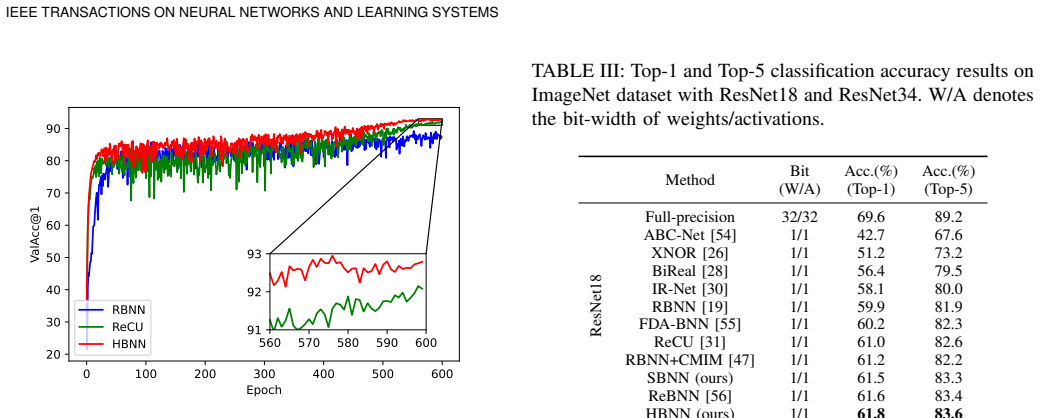
- The EPC acts as a plug-and-play module: grafting HBNN onto IR-Net and ReCU improves their reported accuracy (e.g., IR-Net+HBNN from 58.1 to 60.9 top-1 on ImageNet ResNet18), suggesting the geometric reparameterization is complementary to existing binarization tricks.
- Training maintains a diffeomorphic mapping, so the paper predicts flatter loss surfaces than sign-based binarization; its 2D loss-surface visualization shows HBNN intermediates between full-precision and XNOR++ sharpness.
- The roughly 50% per-layer weight-flip rate observed across ResNet18 layers is consistent with the paper's claim that the EPC maximizes information gain during optimization.
- Because inference uses only $\mathrm{sign}(\phi_{F_i}(\tilde{w}))$, the method keeps the same parameter size, OPs, and latency as a standard BNN, making the accuracy gain essentially free at deployment.
Reading between the lines
- The paper never specifies how the 'optimal exponential parametrization' $\phi_{F_i}$ is selected from the mapped cluster; a natural reading is that $i$ is chosen to minimize the training loss or the binarization error among the $t$ candidates. If that selection rule is the true source of gain, HBNN is effectively a differentiable form of learned binarization-direction search, and the hyperbolic fr
- The same EPC construction could be applied to other constrained neural-network problems, such as orthogonal or low-rank weight constraints, where a learnable cluster of geodesic endpoints might improve exploration over a single exponential map.
- A testable extension is to ablate cluster size $t$: if EPC's benefit comes from increasing flip probability, accuracy should rise with $t$ and then saturate; the paper does not report this ablation.
Signed reviews
Editorial analysis
A structured set of objections, weighed in public.
Referee Report
Summary. This paper proposes Hyperbolic Binary Neural Network (HBNN), which reparameterizes binary-network weights through an Exponential Parametrization Cluster (EPC) in the Poincaré ball: latent Euclidean weights are mapped to hyperbolic-space candidate points via multiple exponential maps, then binarized with sign. The authors claim that EPC shrinks the segment domain and increases weight-flip probability, thereby maximizing information gain as in RBNN, and report top-1 accuracy improvements over published BNN baselines on CIFAR10/CIFAR100/ImageNet with VGGsmall/ResNet18/ResNet34 at no additional inference cost.
Significance. If the reported accuracy numbers are reproducible, the contribution is a modest but consistent improvement over strong 1-bit baselines (e.g., 61.8% vs 61.6% on ImageNet ResNet18) at identical inference cost, with a plug-and-play compatibility that helps IR-Net and ReCU. The paper also carefully reports means over multiple runs and includes latency and parameter-size comparisons. However, the geometric mechanism is not derived rigorously, and the forward-pass selection of the exponential parametrization is left undefined, which currently prevents independent verification of the central empirical claim. No reproducibility artifacts (code) are provided.
major comments (4)
- [Section IV-B, Eq. (8), and Algorithm 1 (lines 3, 13-14)] The forward pass selects "an optimal exponential parametrization" phi_{F_i} but no selection rule is specified. Eq. (8) optimizes the loss over the entire cluster, whereas Eq. (11) and Algorithm 1 assume a single i. Without a defined criterion for choosing i, the mapping from latent weights to binarized weights is not a function, and the network evaluated in Tables II and III cannot be reconstructed from the manuscript. Please specify the selection rule, state whether it is deterministic or differentiable, and describe how gradients flow through it if it involves an argmax or argmin.
- [Section V-A, Definition 2 and segment-domain argument] The claim that EPC shrinks the segment domain is not substantiated. The paper writes D_r^n = union_i phi_{F_i}(seg*_p) and then concludes seg*_p ⊆ seg_p, but seg*_p is never defined independently of this covering equation. To be meaningful, define seg*_p as the maximal subset of T_p D_r^n such that the union covers D_r^n, and prove the inclusion; otherwise the "shrinkage" is merely a reindexing. Moreover, the connection between a smaller segment domain and a higher probability of weight flips is asserted, not derived; provide a quantitative statement or a controlled experiment that isolates the segment-domain effect.
- [Eq. (6) and surrounding text] The base point of the exponential map is ambiguous. The formula uses lambda_p in the tangent vector expression but then Möbius-adds the result to F_i; if the map is the Riemannian exponential at F_i, it should use lambda_{F_i}. Also, the statement that the geodesic distance from the mapped cluster phi_F(v) to the original cluster is ||v||_g is only true for exp_{F_i}, not for the written formula if p ≠ F_i. Please clarify the notation and verify the isometry property, because this directly affects the correctness of the reparametrization and the gradient update in Eq. (12).
- [Section VI-A, Figure 3, and Conclusion] The 50% flip-rate result is presented as confirmation of the mechanism, but it is partly circular: the design goal of EPC (stated in Sections I and V) is to increase flip rates toward 50%, so observing approximately 50% flips does not independently support the claim that flips are the cause of the accuracy gains. The accuracy tables provide independent evidence, but the causal link from flip rate to accuracy is not established. Please include an ablation that varies flip rate separately from the EPC parameterization (e.g., a regularization that targets 50% flips without EPC, and an EPC variant that does not target 50%).
minor comments (5)
- [Section VI-B, Tables II and III] The abbreviation "SBNN" appears as "ours" without prior definition; please define it as the sphere-boundary variant in the main text and clarify its relation to Eq. (6).
- [Author line] The author line contains "Y ong Liu" with an extra space; please fix the author name formatting.
- [Section VI, Experimental Setup] The text contains the typo "settting"; it should read "settings".
- [Figure 5] The contour labels in the loss-surface visualizations are too small to read at normal print size; please enlarge them or provide a higher-resolution figure.
- [Section III-B, Eq. (3)] The notation in Eq. (3) writes the straight-through estimator as a derivative of the binarized weight with respect to the full-precision weight; please clarify that this is an approximation and align the notation with the variables defined in the text.
Circularity Check
No circular derivation: HBNN's accuracy and flip-rate results are independent measured outcomes; the 50%-flip premise is imported from external RBNN, not from the paper's own fit.
full rationale
The derivation chain is: formulate binarization as a constrained problem in hyperbolic space, transform it into an unconstrained problem via the Riemannian exponential map, and then generalize the map to a trainable exponential parametrization cluster. The unconstrained objective in Eq. (8) directly optimizes the loss with respect to the latent weights and the cluster F; no target accuracy or flip-rate quantity is fed back as an input to the optimization. The paper's claim that approximately 50% weight flips maximize information gain is explicitly attributed to RBNN [19], an independent prior work not authored by the present authors, so HBNN is not using its own output as its own justification. Figure 3 reports measured flip rates, which is an empirical outcome rather than a fitted constraint, and the main accuracy claims are benchmark comparisons against external baselines. The paper contains self-citations, notably ReCU [31], which includes one of the present authors, but ReCU is used only as a baseline and as a compatibility testbed, not as the logical support for the central derivation. The main genuine weakness is reproducibility: Algorithm 1 refers to an 'optimal exponential parametrization' phi_Fi without specifying the selection criterion, so the forward pass is not fully defined from the manuscript alone. That is a specification and correctness risk, not a circularity, because the missing rule is not a quantity defined in terms of the predicted accuracy. No equation reduces to its own input, no fitted parameter is renamed as a prediction, and no load-bearing premise depends on a self-citation chain.
Assumptions & free parameters
free parameters (2)
- radius r =
r=0.05 for Poincaré ball D_r^n; r=1 for sphere S_r^n
- cluster size t =
not reported
assumptions (4)
- standard math The Riemannian exponential map in the Poincaré ball is a diffeomorphism that does not create or destroy local minima.
- domain assumption Binarized weights in a layer lie on a ball of constant radius, and that set can be treated as hyperbolic space.
- domain assumption A weight-flip rate near 50% maximizes information gain in BNN training.
- ad hoc to paper The mapped cluster phi_F(v) is well-defined and each phi_Fi is a valid Riemannian exponential map.
Cite this review
Pith. "Pith review of Hyperbolic Binary Neural Network." pith.science (2026). https://pith.science/paper/FYWQLQ55
@misc{pith2026250103471,
  author       = {Pith},
  title        = {Pith review of: Hyperbolic Binary Neural Network},
  year         = {2026},
  howpublished = {\url{https://pith.science/paper/FYWQLQ55}},
  note         = {Machine review of arXiv:2501.03471}
}
read the original abstract
Binary Neural Network (BNN) converts full-precision weights and activations into their extreme 1-bit counterparts, making it particularly suitable for deployment on lightweight mobile devices. While binary neural networks are typically formulated as a constrained optimization problem and optimized in the binarized space, general neural networks are formulated as an unconstrained optimization problem and optimized in the continuous space. This paper introduces the Hyperbolic Binary Neural Network (HBNN) by leveraging the framework of hyperbolic geometry to optimize the constrained problem. Specifically, we transform the constrained problem in hyperbolic space into an unconstrained one in Euclidean space using the Riemannian exponential map. On the other hand, we also propose the Exponential Parametrization Cluster (EPC) method, which, compared to the Riemannian exponential map, shrinks the segment domain based on a diffeomorphism. This approach increases the probability of weight flips, thereby maximizing the information gain in BNNs. Experimental results on CIFAR10, CIFAR100, and ImageNet classification datasets with VGGsmall, ResNet18, and ResNet34 models illustrate the superior performance of our HBNN over state-of-the-art methods.
Figures


Figures from the paper (3 more)


Reference graph
Works this paper leans on
-
[1]
Imagenet classification with deep convolutional neural networks,
A. Krizhevsky, I. Sutskever, and G. E. Hinton, “Imagenet classification with deep convolutional neural networks,” Advances in neural informa- tion processing systems , vol. 25, 2012
2012
-
[2]
Deep residual learning for image recognition,
K. He, X. Zhang, S. Ren, and J. Sun, “Deep residual learning for image recognition,” in Proceedings of the IEEE conference on computer vision and pattern recognition , pp. 770–778, 2016
2016
-
[3]
You only look once: Unified, real-time object detection,
J. Redmon, S. Divvala, R. Girshick, and A. Farhadi, “You only look once: Unified, real-time object detection,” in Proceedings of the IEEE conference on computer vision and pattern recognition , pp. 779–788, 2016
2016
-
[4]
Mask r-cnn,
K. He, G. Gkioxari, P. Doll ´ar, and R. Girshick, “Mask r-cnn,” in Proceedings of the IEEE international conference on computer vision , pp. 2961–2969, 2017
2017
-
[5]
Fully convolutional networks for semantic segmentation,
J. Long, E. Shelhamer, and T. Darrell, “Fully convolutional networks for semantic segmentation,” in Proceedings of the IEEE conference on computer vision and pattern recognition , pp. 3431–3440, 2015
2015
-
[6]
Learning deconvolution network for semantic segmentation,
H. Noh, S. Hong, and B. Han, “Learning deconvolution network for semantic segmentation,” in Proceedings of the IEEE international conference on computer vision , pp. 1520–1528, 2015
work page 2015
-
[7]
Global sparse momentum sgd for pruning very deep neural networks,
X. Ding, X. Zhou, Y . Guo, J. Han, J. Liu et al. , “Global sparse momentum sgd for pruning very deep neural networks,” Advances in Neural Information Processing Systems , vol. 32, 2019
work page 2019
-
[8]
Hrank: Filter pruning using high-rank feature map,
M. Lin, R. Ji, Y . Wang, Y . Zhang, B. Zhang, Y . Tian, and L. Shao, “Hrank: Filter pruning using high-rank feature map,” in Proceedings of the IEEE/CVF conference on computer vision and pattern recognition , pp. 1529–1538, 2020
work page 2020
Show all 58 references
-
[9]
Unified data-free com- pression: Pruning and quantization without fine-tuning,
S. Bai, J. Chen, X. Shen, Y . Qian, and Y . Liu, “Unified data-free com- pression: Pruning and quantization without fine-tuning,” in Proceedings of the IEEE/CVF International Conference on Computer Vision , pp. 5876–5885, 2023
2023
-
[10]
Scalable methods for 8-bit training of neural networks,
R. Banner, I. Hubara, E. Hoffer, and D. Soudry, “Scalable methods for 8-bit training of neural networks,” Advances in neural information processing systems, vol. 31, 2018
2018
-
[11]
Latent weights do not exist: Rethinking binarized neu- ral network optimization,
K. Helwegen, J. Widdicombe, L. Geiger, Z. Liu, K.-T. Cheng, and R. Nusselder, “Latent weights do not exist: Rethinking binarized neu- ral network optimization,” Advances in neural information processing systems, vol. 32, 2019
2019
-
[12]
Propagating asymptotic- estimated gradients for low bitwidth quantized neural networks,
J. Chen, Y . Liu, H. Zhang, S. Hou, and J. Yang, “Propagating asymptotic- estimated gradients for low bitwidth quantized neural networks,” IEEE Journal of Selected Topics in Signal Processing, vol. 14, no. 4, pp. 848– 859, 2020
2020
-
[13]
Learning discretized neural networks under ricci flow,
J. Chen, H. Chen, M. Wang, G. Dai, I. W. Tsang, and Y . Liu, “Learning discretized neural networks under ricci flow,” arXiv preprint arXiv:2302.03390, 2023
2023 arXiv
-
[14]
Data- free quantization via mixed-precision compensation without fine-tuning,
J. Chen, S. Bai, T. Huang, M. Wang, G. Tian, and Y . Liu, “Data- free quantization via mixed-precision compensation without fine-tuning,” Pattern Recognition, p. 109780, 2023
2023
-
[15]
Dccd: Reducing neural network redundancy via distillation,
Y . Liu, J. Chen, and Y . Liu, “Dccd: Reducing neural network redundancy via distillation,” IEEE Transactions on Neural Networks and Learning Systems, 2023
2023
-
[16]
A learning framework for n-bit quantized neural networks toward fpgas,
J. Chen, L. Liu, Y . Liu, and X. Zeng, “A learning framework for n-bit quantized neural networks toward fpgas,” IEEE Transactions on Neural Networks and Learning Systems , vol. 32, no. 3, pp. 1067–1081, 2021. IEEE TRANSACTIONS ON NEURAL NETWORKS AND LEARNING SYSTEMS
2021
-
[17]
Convex optimization: Algorithms and complexity,
S. Bubeck et al. , “Convex optimization: Algorithms and complexity,” Foundations and Trends® in Machine Learning , vol. 8, no. 3-4, pp. 231–357, 2015
2015
-
[18]
Mirror de- scent view for neural network quantization,
T. Ajanthan, K. Gupta, P. Torr, R. Hartley, and P. Dokania, “Mirror de- scent view for neural network quantization,” in International Conference on Artificial Intelligence and Statistics , pp. 2809–2817. PMLR, 2021
2021
-
[19]
Rotated binary neural network,
M. Lin, R. Ji, Z. Xu, B. Zhang, Y . Wang, Y . Wu, F. Huang, and C.-W. Lin, “Rotated binary neural network,” Advances in neural information processing systems, vol. 33, pp. 7474–7485, 2020
2020
-
[20]
H. W. Guggenheimer, Differential geometry. Courier Corporation, 2012
2012
-
[21]
Optimization algorithms on matrix manifolds,
P.-A. Absil, R. Mahony, and R. Sepulchre, “Optimization algorithms on matrix manifolds,” in Optimization Algorithms on Matrix Manifolds . Princeton University Press, 2009
2009
-
[22]
Decentralized riemannian conjugate gradient method on the stiefel manifold,
J. Chen, H. Ye, M. Wang, T. Huang, G. Dai, I. Tsang, and Y . Liu, “Decentralized riemannian conjugate gradient method on the stiefel manifold,” in The Twelfth International Conference on Learning Representations , 2024. [Online]. Available: https: //openreview.net/forum?id=PQbFUMKLFp
2024
-
[23]
Orthogonal recurrent neural networks with scaled cayley transform,
K. Helfrich, D. Willmott, and Q. Ye, “Orthogonal recurrent neural networks with scaled cayley transform,” in International Conference on Machine Learning, pp. 1969–1978. PMLR, 2018
1969
-
[24]
Cheap orthogonal con- straints in neural networks: A simple parametrization of the orthogonal and unitary group,
M. Lezcano-Casado and D. Martınez-Rubio, “Cheap orthogonal con- straints in neural networks: A simple parametrization of the orthogonal and unitary group,” in International Conference on Machine Learning , pp. 3794–3803. PMLR, 2019
2019
-
[25]
Trivializations for gradient-based optimization on manifolds,
M. Lezcano Casado, “Trivializations for gradient-based optimization on manifolds,” Advances in Neural Information Processing Systems, vol. 32, 2019
2019
-
[26]
Xnor-net: Imagenet classification using binary convolutional neural networks,
M. Rastegari, V . Ordonez, J. Redmon, and A. Farhadi, “Xnor-net: Imagenet classification using binary convolutional neural networks,” in European conference on computer vision, pp. 525–542. Springer, 2016
2016
-
[27]
Xnor-net++: Improved binary neural networks,
A. Bulat and G. Tzimiropoulos, “Xnor-net++: Improved binary neural networks,” arXiv preprint arXiv:1909.13863 , 2019
1909 arXiv
-
[28]
Bi- real net: Binarizing deep network towards real-network performance,
Z. Liu, W. Luo, B. Wu, X. Yang, W. Liu, and K.-T. Cheng, “Bi- real net: Binarizing deep network towards real-network performance,” International Journal of Computer Vision , vol. 128, no. 1, pp. 202–219, 2020
2020
-
[29]
Proxybnn: Learning binarized neural networks via proxy matrices,
X. He, Z. Mo, K. Cheng, W. Xu, Q. Hu, P. Wang, Q. Liu, and J. Cheng, “Proxybnn: Learning binarized neural networks via proxy matrices,” in European Conference on Computer Vision , pp. 223–241. Springer, 2020
2020
-
[30]
Forward and backward information retention for accurate binary neural networks,
H. Qin, R. Gong, X. Liu, M. Shen, Z. Wei, F. Yu, and J. Song, “Forward and backward information retention for accurate binary neural networks,” in Proceedings of the IEEE/CVF conference on computer vision and pattern recognition , pp. 2250–2259, 2020
2020
-
[31]
Recu: Reviving the dead weights in binary neural networks,
Z. Xu, M. Lin, J. Liu, J. Chen, L. Shao, Y . Gao, Y . Tian, and R. Ji, “Recu: Reviving the dead weights in binary neural networks,” in Proceedings of the IEEE/CVF international conference on computer vision , pp. 5198– 5208, 2021
2021
-
[32]
Weight normalization: A simple repa- rameterization to accelerate training of deep neural networks,
T. Salimans and D. P. Kingma, “Weight normalization: A simple repa- rameterization to accelerate training of deep neural networks,” Advances in neural information processing systems , vol. 29, 2016
2016
-
[33]
Centered weight normalization in accelerating training of deep neural networks,
L. Huang, X. Liu, Y . Liu, B. Lang, and D. Tao, “Centered weight normalization in accelerating training of deep neural networks,” in Proceedings of the IEEE International Conference on Computer Vision , pp. 2803–2811, 2017
2017
-
[34]
Petersen, Riemannian geometry, vol
P. Petersen, Riemannian geometry, vol. 171. Springer, 2006
2006
-
[35]
Binarized neural networks: Training deep neural networks with weights and activations constrained to+ 1 or-1,
M. Courbariaux, I. Hubara, D. Soudry, R. El-Yaniv, and Y . Ben- gio, “Binarized neural networks: Training deep neural networks with weights and activations constrained to+ 1 or-1,” arXiv preprint arXiv:1602.02830, 2016
2016 arXiv
-
[36]
Neural networks for machine learning,
G. Hinton, N. Srivastava, and K. Swersky, “Neural networks for machine learning,” Coursera, video lectures , vol. 264, no. 1, pp. 2146–2153, 2012
2012
-
[37]
Estimating or propagating gradients through stochastic neurons for conditional computation,
Y . Bengio, N. L ´eonard, and A. Courville, “Estimating or propagating gradients through stochastic neurons for conditional computation,” arXiv preprint arXiv:1308.3432, 2013
2013 arXiv
-
[38]
J. W. Anderson, Hyperbolic geometry . Springer Science & Business Media, 2006
2006
-
[39]
Hyperbolic neural networks,
O. Ganea, G. B ´ecigneul, and T. Hofmann, “Hyperbolic neural networks,” Advances in neural information processing systems , vol. 31, 2018
2018
-
[40]
Poincar ´e embeddings for learning hierarchical representations,
M. Nickel and D. Kiela, “Poincar ´e embeddings for learning hierarchical representations,” Advances in neural information processing systems , vol. 30, 2017
2017
-
[41]
Hyperbolic entailment cones for learning hierarchical embeddings,
O. Ganea, G. B ´ecigneul, and T. Hofmann, “Hyperbolic entailment cones for learning hierarchical embeddings,” in International Conference on Machine Learning, pp. 1646–1655. PMLR, 2018
2018
-
[42]
Hyperbolic trigonometry and its application in the poincar´e ball model of hyperbolic geometry,
A. A. Ungar, “Hyperbolic trigonometry and its application in the poincar´e ball model of hyperbolic geometry,”Computers & Mathematics with Applications, vol. 41, no. 1-2, pp. 135–147, 2001
2001
-
[43]
A gyrovector space approach to hyperbolic geometry,
A. A. Ungar, “A gyrovector space approach to hyperbolic geometry,” Synthesis Lectures on Mathematics and Statistics , vol. 1, no. 1, pp. 1– 194, 2008
2008
-
[44]
Riemannian metrics,
P. Petersen, “Riemannian metrics,” in Riemannian Geometry, pp. 1–39. Springer, 2016
2016
-
[45]
Learning multiple layers of features from tiny images,
A. Krizhevsky, G. Hinton et al. , “Learning multiple layers of features from tiny images,” 2009
2009
-
[46]
Accelerate cnns from three dimensions: a comprehensive pruning framework,
W. Wang, M. Chen, S. Zhao, L. Chen, J. Hu, H. Liu, D. Cai, X. He, and W. Liu, “Accelerate cnns from three dimensions: a comprehensive pruning framework,” in International Conference on Machine Learning , pp. 10 717–10 726. PMLR, 2021
2021
-
[47]
Network binarization via contrastive learning,
Y . Shang, D. Xu, Z. Zong, and Y . Yan, “Network binarization via contrastive learning,” arXiv preprint arXiv:2207.02970 , 2022
2022 arXiv
-
[48]
Estimator meets equilibrium perspective: A rectified straight through estimator for binary neural networks training,
X.-M. Wu, D. Zheng, Z. Liu, and W.-S. Zheng, “Estimator meets equilibrium perspective: A rectified straight through estimator for binary neural networks training,” in Proceedings of the IEEE/CVF International Conference on Computer Vision , pp. 17 055–17 064, 2023
2023
-
[49]
Binaryconnect: Training deep neural networks with binary weights during propagations,
M. Courbariaux, Y . Bengio, and J.-P. David, “Binaryconnect: Training deep neural networks with binary weights during propagations,” Ad- vances in neural information processing systems , vol. 28, 2015
2015
-
[50]
Dorefa-net: Training low bitwidth convolutional neural networks with low bitwidth gradients,
S. Zhou, Y . Wu, Z. Ni, X. Zhou, H. Wen, and Y . Zou, “Dorefa-net: Training low bitwidth convolutional neural networks with low bitwidth gradients,” arXiv preprint arXiv:1606.06160 , 2016
2016 arXiv
-
[51]
Regularizing activation distribution for training binarized deep networks,
R. Ding, T.-W. Chin, Z. Liu, and D. Marculescu, “Regularizing activation distribution for training binarized deep networks,” in Proceedings of the IEEE/CVF Conference on Computer Vision and Pattern Recognition, pp. 11 408–11 417, 2019
2019
-
[52]
Dif- ferentiable soft quantization: Bridging full-precision and low-bit neural networks,
R. Gong, X. Liu, S. Jiang, T. Li, P. Hu, J. Lin, F. Yu, and J. Yan, “Dif- ferentiable soft quantization: Bridging full-precision and low-bit neural networks,” in Proceedings of the IEEE/CVF International Conference on Computer Vision , pp. 4852–4861, 2019
2019
-
[53]
Searching for low-bit weights in quantized neural networks,
Z. Yang, Y . Wang, K. Han, C. Xu, C. Xu, D. Tao, and C. Xu, “Searching for low-bit weights in quantized neural networks,” Advances in neural information processing systems , vol. 33, pp. 4091–4102, 2020
2020
-
[54]
Towards accurate binary convolutional neural network,
X. Lin, C. Zhao, and W. Pan, “Towards accurate binary convolutional neural network,” Advances in neural information processing systems , vol. 30, 2017
2017
-
[55]
Learning frequency domain approximation for binary neural networks,
Y . Xu, K. Han, C. Xu, Y . Tang, C. Xu, and Y . Wang, “Learning frequency domain approximation for binary neural networks,” Advances in Neural Information Processing Systems , vol. 34, pp. 25 553–25 565, 2021
2021
-
[56]
Resilient binary neural network,
S. Xu, Y . Li, T. Ma, M. Lin, H. Dong, B. Zhang, P. Gao, and J. Lu, “Resilient binary neural network,” in Proceedings of the AAAI Conference on Artificial Intelligence , vol. 37, no. 9, pp. 10 620–10 628, 2023
2023
-
[57]
Training binary neural networks through learning with noisy supervision,
K. Han, Y . Wang, Y . Xu, C. Xu, E. Wu, and C. Xu, “Training binary neural networks through learning with noisy supervision,” in International Conference on Machine Learning, pp. 4017–4026. PMLR, 2020
2020
-
[58]
Visualizing the loss landscape of neural nets,
H. Li, Z. Xu, G. Taylor, C. Studer, and T. Goldstein, “Visualizing the loss landscape of neural nets,” Advances in neural information processing systems, vol. 31, 2018. Jun Chen received the B.S. degree in the de- partment of Mechanical and Electrical Engineer- ing from China ...
2018
Reviewed August 10, 2026 · model on record in the stance chip above.
Discussion (0). Continue with ORCID to comment.