REVIEW 2 major objections 6 minor 93 references
Light Transport-aware Diffusion Posterior Sampling for Single-View Reconstruction of 3D Volumes
T0 review · 2 major / 6 minor · reviewed 2026-08-10 · deepseek-v4-flash
Pith's one-line read A diffusion prior guided by light-transport gradients reconstructs volumetric clouds from a single view at a quality earlier methods did not reach.
desk verdict The idea is good and the monoplanar representation is neat, but the main evaluation likely lets the diffusion prior see the test clouds, so the headline quality claim is unsupported. read the letter →
The pith
A machine-rendered reading of the paper's core claim, the machinery that carries it, and where it could break.
The reading
What carries the argument
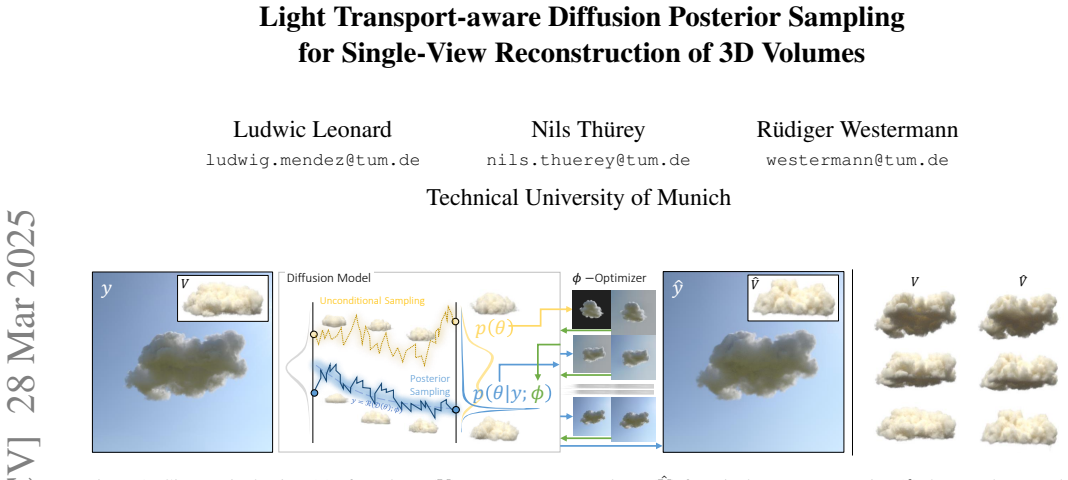
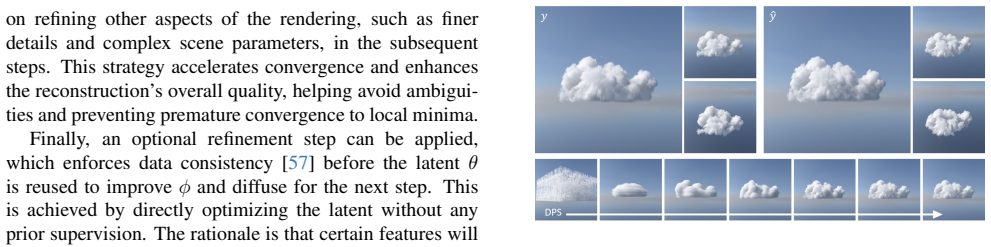
The central object is a parametric diffusion posterior sampling loop (PDPS, Algorithm 2) running in the latent space of an unconditional diffusion model, with a monoplanar representation as the compression layer. Monoplanar means a single 2D feature grid on the xy-plane whose feature vectors are sampled along z and decoded by a shared MLP; it compresses each cloud volume from roughly 100 MB to a 2 MB latent code. The load-bearing mechanism is that gradients of the image loss are computed through a physically-based differentiable volume renderer, so the update direction $\nabla_{\theta_t}\|y - R(D(\hat\theta_0), \phi)\|_2^2$ carries real light-transport information, while the diffusion prior keeps the density distribution cloud-like. The outer loop (Algorithm 1) alternates SGD on physical parameters $\phi$ with posterior samples $\theta$, starts denoising from a partially noisy latent, and scales the guidance weight $\zeta$ from 0.1 to 1.
What would settle it
Check the released dataset and training scripts for overlap between the 16 test clouds and the training set; if any overlap exists, retrain the diffuser on only the non-test clouds and re-run the Table 2 comparison to see whether the N-LPIPS advantage over DRT and SPS survives.
Extended reading notes
Core claim
On its own terms, the paper's central claim is that an unconditional diffusion prior over compressed cloud densities, coupled to a differentiable path-tracing volume renderer, turns single-view reconstruction of highly scattering volumes from a severely underdetermined optimization into a workable posterior sampling problem. The authors compress each roughly 100 MB density field into a roughly 2 MB monoplanar latent code, train a latent diffusion model on 1,000 simulated cumulus clouds augmented to 112,000 instances, and then alternate SGD on physical scene parameters with diffusion posterior samples in the latent space. In their Table 2 comparison, the single-view and three-view variants outperform the gradient-only baselines DRT and SPS on the perceptual metric N-LPIPS for novel views, produce cloud-like interiors, and the same loop recovers unknown background or environment lighting in Section 5.6.
Load-bearing premise
The reported quality gains assume the 16 test clouds were never among the 1,000 clouds or their 111,000 augmented copies used to train the diffusion model, and the paper does not describe such a holdout split.
Editorial extensions
If this is right
- A single cloud photograph can yield a full 3D density field suitable for novel-view rendering and relighting, not just a 2D appearance match.
- The same posterior-sampling machinery transfers to other observation models, such as transmittance images, coarse-grid super-resolution, and inpainting, because the forward model is swapped without retraining the diffuser.
- Unknown scene parameters such as background radiance and environment lighting are recoverable alongside the density field, reducing the need to calibrate lighting before reconstruction.
- Three-view input with three diffusion restarts (DPS3x3) gives the best reported quality, so the method scales gracefully as views are added.
- Reconstructions take minutes instead of the roughly half-hour runs of the DRT and SPS baselines, making iterative volume reconstruction more practical.
Reading between the lines
- The paper does not describe a train/test split between the 1,000 simulated clouds and the 16 'unseen' test clouds, so the headline comparison should be re-run after confirming that the tested clouds are outside the diffusion model's training set.
- Because the prior is trained only on simulated cumulus clouds, its ability to generalize to smoke, fire, or non-cumulus morphology is an open question; a natural stress test is reconstruction from an independently simulated or analytic volume.
- The $\zeta$ schedule, with weak prior guidance early and stronger guidance later, is a tunable knob; adapting it to observation noise or view count could extend the method to noisier or more ambiguous inputs without changing the algorithm.
Editorial analysis
A structured set of objections, weighed in public.
Referee Report
Summary. The paper proposes a method for reconstructing 3D volumetric density fields (specifically cumulus clouds) from one or a few images by combining an unconditional latent diffusion model with a physically-based differentiable volume renderer. The authors introduce a new dataset (Cloudy) of 1,000 synthetic cloud volumes, a novel 'monoplanar' implicit representation that compresses each volume into a 128x128x32 latent grid, and a parametric diffusion posterior sampling (PDPS) scheme (Algorithms 1 and 2) that alternates DPS-style guidance with optimization of unknown physical parameters such as background radiance. The method is evaluated on single-view and three-view reconstruction against DRT and SPS (Table 2), on super-resolution, inpainting, transmittance-based reconstruction, and joint lighting recovery. The central quantitative claim is that PDPS yields novel-view LPIPS substantially better than the prior-free baselines, supporting the abstract's assertion of 'previously unattainable quality.'
Significance. If the experimental results are valid, this is a strong contribution: it demonstrates a practical way to inject a learned shape prior into a physically-accurate differentiable renderer, a known hard problem due to the ill-posedness of inverse volume rendering. The dataset release, the compact monoplanar representation, and the public code are valuable assets for the community. The paper is also transparent about important limitations, such as the ambiguity between the latent volume θ and the physical parameters ϕ, and the high computational cost. However, the significance hinges on the evaluation being conducted on clouds that are truly unseen by the diffusion prior; currently that is not established, and the headline claim of 'previously unattainable quality' is therefore not supported as written.
major comments (2)
- [Section 4.3 vs. Table 2] The diffusion model is trained on latent codes derived from all 1,000 Cloudy volumes (Section 4.3), while Table 2's caption states that the 32 test cases are constructed from 16 'unseen clouds' from the same dataset. The paper never states that these 16 clouds are excluded from the 1,000 used to generate the training latent codes, and no split protocol (e.g., cloud identifiers or an explicit 'held-out' statement) is provided anywhere in the main text or supplement. If the test clouds are a subset of the training set, the prior can encode the exact ground-truth volumes, and the reported N-LPIPS improvements over DRT and SPS would reflect memorization rather than reconstruction ability. This is load-bearing for every quantitative claim in Section 5.5 and for the abstract. Please specify the exact split, provide the cloud IDs or a reproducible protocol, and re-evaluate on clouds that are provably held out from the diffusion training set; alternatively, report the overlap statistics to demonstrate disjointness.
- [Section 5.5 and Abstract] The abstract claims single-view reconstruction at 'previously unattainable quality,' but the only quantitative comparison in Table 2 is against DRT and SPS, which are prior-free differentiable optimization baselines. There is no comparison with recent learning-based single-view reconstruction methods (e.g., pixelNeRF, Zero-1-to-3, or latent-diffusion NeRF pipelines), and no ablation that isolates the contribution of the diffusion prior from the differentiable renderer. As a result, the strength of the headline claim is not fully supported by the evidence presented. A comparison with at least one learning-based baseline, or a careful rephrasing of the claim to 'previously unattainable with optimization-only differentiable rendering,' would make the contribution statement proportionate.
minor comments (6)
- [Section 2] The sentence 'Karras et al. [49] and Po et al. [49] provide thorough overviews' appears to cite the same reference twice; [49] is Po et al., and the Karras et al. entry is missing from the reference list.
- [Table 2] The metrics T-LPIPS and N-LPIPS are not defined in the main text or the table caption; please define them (e.g., test-view LPIPS and novel-view LPIPS) and state the exact computation procedure.
- [Section 4.3] The augmentation operations are described only as '14 such operations' and '8 equivariant transformations (flips and transposes)'; please enumerate the exact operations for reproducibility.
- [Section 5.4] The transmittance-based reconstruction is presented with qualitative figures only; adding a quantitative metric (e.g., PSNR or LPIPS on the reconstructed volume or rendered views) would strengthen the claim.
- [Section 5.6] The lighting recovery experiment states that the optimization 'closely matches' the ground-truth lighting, but no quantitative error is reported for the recovered background or environment map; please add a numerical measure.
- [References] Several reference entries contain incorrect author attributions (e.g., 'Yong Jae Wang' appears in papers that should be attributed to different authors); please proofread the reference list against the original sources.
Circularity Check
No significant circularity: the reconstruction derivation is self-contained; the train/test overlap concern is an evaluation-hygiene issue, not a definitional reduction.
full rationale
The paper's derivation chain is self-contained. The diffusion prior is trained on latent codes of the Cloudy dataset (Section 4.3), and reconstruction is formulated as posterior sampling with a differentiable renderer (Eq. 2, Algorithm 1, Algorithm 2). The DPS guidance step is cited to the external work of Chung et al. [9], and the differentiable volume rendering follows the published SPS/DRT literature [27, 45, 46]. The monoplanar representation is introduced and directly compared against triplanar and dense-grid baselines (Table 1). The only potentially load-bearing concern is the evaluation split: Section 4.3 trains on 'all 1,000 clouds from the Cloudy dataset' augmented to 1,000x14x8 instances, while Table 2 reports averages 'sampled from 16 unseen clouds' from the same dataset, with no explicit holdout protocol. If the test clouds were actually in the training set, the reported LPIPS improvements over DRT and SPS would reflect memorization rather than reconstruction. However, that would be an empirical evaluation flaw, not a circular derivation: the paper's equations and algorithms do not define the test clouds in terms of the training data, and the word 'unseen' asserts disjointness rather than entailing it. No self-citation chain forces the central result, and no parameter is fitted and then renamed as a prediction. Accordingly, under the specified circularity definitions, the correct finding is no significant circularity.
Assumptions & free parameters
free parameters (4)
- DPS guidance scale zeta =
0.1 to 1.0 (scheduled)
- Number of diffusion steps and stride =
100 steps with stride 10
- Latent refinement schedule S_refine =
not specified precisely ("a few steps around the middle")
- Monoplanar latent grid dimensions =
128x128x32 features, upsampled to 256x256x64
assumptions (6)
- domain assumption The DPS approximation p(y|xt) is well approximated by p(y|x0_hat(xt)) with a Gaussian likelihood when the decoder and renderer are nonlinear.
- domain assumption The monoplanar latent representation is equivariant to flips, transposes, rotations, and xy-scaling, so transformations applied directly to latent codes yield valid volumes.
- domain assumption A decoder trained on only 64 clouds produces accurate latent codes for all 1,000 clouds in the dataset.
- domain assumption Synthetic clouds generated with the JangaFX EmberGen simulator are representative of the cloud distribution relevant to the intended application.
- domain assumption The differentiable volume renderer provides unbiased and sufficiently low-variance gradients for the inverse problem with 64 samples per pixel.
- ad hoc to paper The 16 unseen clouds used for testing are disjoint from the 1,000 clouds used to train the diffusion model.
Cite this review
Pith. "Pith review of Light Transport-aware Diffusion Posterior Sampling for Single-View Reconstruction of 3D Volumes." pith.science (2026). https://pith.science/paper/6M3PADBE
@misc{pith2026250105226,
  author       = {Pith},
  title        = {Pith review of: Light Transport-aware Diffusion Posterior Sampling for Single-View Reconstruction of 3D Volumes},
  year         = {2026},
  howpublished = {\url{https://pith.science/paper/6M3PADBE}},
  note         = {Machine review of arXiv:2501.05226}
}
read the original abstract
We introduce a single-view reconstruction technique of volumetric fields in which multiple light scattering effects are omnipresent, such as in clouds. We model the unknown distribution of volumetric fields using an unconditional diffusion model trained on a novel benchmark dataset comprising 1,000 synthetically simulated volumetric density fields. The neural diffusion model is trained on the latent codes of a novel, diffusion-friendly, monoplanar representation. The generative model is used to incorporate a tailored parametric diffusion posterior sampling technique into different reconstruction tasks. A physically-based differentiable volume renderer is employed to provide gradients with respect to light transport in the latent space. This stands in contrast to classic NeRF approaches and makes the reconstructions better aligned with observed data. Through various experiments, we demonstrate single-view reconstruction of volumetric clouds at a previously unattainable quality.
Figures


Figures from the paper (11 more)



Reference graph
Works this paper leans on
-
[1]
Mitra, and Paul Guerrero
Titas Anciukevicius, Zexiang Xu, Matthew Fisher, Paul Hen- derson, Hakan Bilen, Niloy J. Mitra, and Paul Guerrero. Ren- derdiffusion: Image diffusion for 3d reconstruction, inpaint- ing and generation. In Proceedings of the IEEE/CVF Confer- ence on Computer Vision and Pattern Recognition (CVPR) , pages 12608–12618, 2023. 2
2023
-
[2]
Gaudi: A neural architect for immersive 3d scene generation
Miguel Angel Bautista, Pengsheng Guo, Samira Abnar, Wal- ter Talbott, Alexander Toshev, Zhuoyuan Chen, Laurent Dinh, Shuangfei Zhai, Hanlin Goh, Daniel Ulbricht, Afshin Dehghan, and Joshua Susskind. Gaudi: A neural architect for immersive 3d scene generation. In Advances in Neural Information Processing Systems (NeurIPS), 2022. 2
2022
-
[3]
Adabins: Depth estimation using adaptive bins
Shariq Farooq Bhat, Ibraheem Alhashim, and Peter Wonka. Adabins: Depth estimation using adaptive bins. In Proceed- ings of the IEEE/CVF Conference on Computer Vision and Pattern Recognition (CVPR), pages 4009–4018, 2021. 1
2021
-
[4]
Chan, Marco Monteiro, Petr Kellnhofer, Jiajun Wu, and Gordon Wetzstein
Eric R. Chan, Marco Monteiro, Petr Kellnhofer, Jiajun Wu, and Gordon Wetzstein. Pi-GAN: Periodic implicit generative adversarial networks for 3d-aware image synthesis. In Pro- ceedings of the IEEE/CVF Conference on Computer Vision and Pattern Recognition (CVPR), pages 5799–5809, 2021. 2
2021
-
[5]
TensoRF: Tensorial radiance fields
Anpei Chen, Zexiang Xu, Andreas Geiger, Jingyi Yu, and Hao Su. TensoRF: Tensorial radiance fields. In Proceedings of the European Conference on Computer Vision (ECCV) , pages 333–350. Springer, 2022. 2
2022
-
[6]
Single-stage diffusion nerf: A unified approach to 3d generation and reconstruction
Hansheng Chen, Jiatao Gu, Anpei Chen, Wei Tian, Zhuowen Tu, Lingjie Liu, and Hao Su. Single-stage diffusion nerf: A unified approach to 3d generation and reconstruction. In Proceedings of the IEEE/CVF International Conference on Computer Vision (ICCV), pages 2416–2425, 2023. 2, 4
2023
-
[7]
Sdfusion: Multimodal 3d shape completion, reconstruction, and generation
Yen-Chi Cheng, Hsin-Ying Lee, Sergey Tulyakov, Alexan- der G Schwing, and Liang-Yan Gui. Sdfusion: Multimodal 3d shape completion, reconstruction, and generation. InPro- ceedings of the IEEE/CVF Conference on Computer Vision and Pattern Recognition, pages 4456–4465, 2023. 2
2023
-
[8]
Diffusion-sdf: Conditional generative modeling of signed distance func- tions
Gene Chou, Yuval Bahat, and Felix Heide. Diffusion-sdf: Conditional generative modeling of signed distance func- tions. In Proceedings of the IEEE/CVF international con- ference on computer vision, pages 2262–2272, 2023. 2
2023
Show all 93 references
-
[9]
Diffusion posterior sam- pling for general noisy inverse problems
Hyungjin Chung, Jeongsol Kim, Michael T Mccann, Marc L Klasky, and Jong Chul Ye. Diffusion posterior sam- pling for general noisy inverse problems. arXiv preprint arXiv:2209.14687, 2022. 3
2022 arXiv
-
[10]
Tore: Token reduction for efficient human mesh re- covery with transformer
Zhiyang Dou, Qingxuan Wu, Cheng Lin, Zeyu Cao, Qiangqiang Wu, Weilin Wan, Taku Komura, and Wenping Wang. Tore: Token reduction for efficient human mesh re- covery with transformer. In Proceedings of the IEEE/CVF International Conference on Computer Vision (ICCV), pages 15143–1...
2023
-
[11]
Distwar: Fast differentiable rendering on raster-based ren- dering pipelines
Sankeerth Durvasula, Adrian Zhao, Fan Chen, Ruofan Liang, Pawan Kumar Sanjaya, and Nandita Vijaykumar. Distwar: Fast differentiable rendering on raster-based ren- dering pipelines. arXiv preprint arXiv:2401.05345, 2023. 1
2023 arXiv
-
[12]
Global Transport for Fluid Reconstruction with Learned Self- Supervision
Erik Franz, Barbara Solenthaler, and Nils Thuerey. Global Transport for Fluid Reconstruction with Learned Self- Supervision. In 2021 IEEE/CVF Conference on Computer Vision and Pattern Recognition (CVPR) , pages 1632–1642, Nashville, TN, USA, 2021. IEEE. 3
2021
-
[13]
Plenox- els: Radiance Fields without Neural Networks
Sara Fridovich-Keil, Alex Yu, Matthew Tancik, Qinhong Chen, Benjamin Recht, and Angjoo Kanazawa. Plenox- els: Radiance Fields without Neural Networks. In 2022 IEEE/CVF Conference on Computer Vision and Pattern Recognition (CVPR), pages 5491–5500, New Orleans, LA, USA, 2022. IEEE. 2
2022
-
[14]
3DGen: Triplane la- tent diffusion for textured mesh generation
Hongrui Fu, Zhaoxi Zhang, Jian Zhang, Ziyu Zhang, Jian- feng Zhang, and Yong Jae Wang. 3DGen: Triplane la- tent diffusion for textured mesh generation. arXiv preprint arXiv:2304.00707, 2023. 2, 4
2023 arXiv
-
[15]
GET3D: A generative model of high quality 3d tex- tured shapes learned from images
Jun Gao, Tianchang Shen, Zian Wang, Wenzheng Chen, Kangxue Yin, Daiqing Li, Or Litany, Zan Gojcic, and Sanja Fidler. GET3D: A generative model of high quality 3d tex- tured shapes learned from images. In Advances in Neural Information Processing Systems (NeurIPS), 2022. 2
2022
-
[16]
StyleNeRF: A style-based 3d-aware genera- tor for high-resolution image synthesis
Jiatao Gu, Lingjie Liu, Peng Wang, and Christian Theobalt. StyleNeRF: A style-based 3d-aware genera- tor for high-resolution image synthesis. arXiv preprint arXiv:2110.08985, 2021. 2
2021 arXiv
-
[17]
Tenenbaum, and Chuang Gan
Animesh Gupta, Zekun Li, Joshua B. Tenenbaum, and Chuang Gan. HyperDiffusion: Generating implicit neu- ral fields with weight-space diffusion. arXiv preprint arXiv:2303.00828, 2023. 2
2023 arXiv
-
[18]
Henyey and Jesse L
Louis G. Henyey and Jesse L. Greenstein. Diffuse radiation in the galaxy. The Astrophysical Journal, 93:70–83, 1941. 6
1941
-
[19]
Denoising dif- fusion probabilistic models
Jonathan Ho, Ajay Jain, and Pieter Abbeel. Denoising dif- fusion probabilistic models. In Advances in Neural Informa- tion Processing Systems (NeurIPS), pages 6840–6851, 2020. 2
2020
-
[20]
Genvs: Gen- erative novel view synthesis with 3d-aware diffusion models
Ajay Jain, Matthew Tancik, and Pieter Abbeel. Genvs: Gen- erative novel view synthesis with 3d-aware diffusion models. arXiv preprint arXiv:2303.07308, 2023. 2
2023 arXiv
-
[21]
Embergen: Real-time fluid simulation software,
JangaFX. Embergen: Real-time fluid simulation software,
-
[23]
Shap-e: Generat- ing conditional 3d implicit functions
Heewoo Jun and Alex Nichol. Shap-e: Generat- ing conditional 3d implicit functions. arXiv preprint arXiv:2305.02463, 2023. 2
2023 arXiv
-
[24]
Holodiffusion: Training a 3d diffusion model using 2d images
Animesh Karnewar, Andrea Vedaldi, David Novotny, and Niloy J Mitra. Holodiffusion: Training a 3d diffusion model using 2d images. In Proceedings of the IEEE/CVF con- ference on computer vision and pattern recognition , pages 18423–18433, 2023. 2
2023
-
[25]
Differentiable rendering: A survey
Hiroharu Kato, Deniz Beker, Mihai Morariu, Takahiro Ando, Toru Matsuoka, Wadim Kehl, and Adrien Gaidon. Differentiable rendering: A survey. arXiv preprint arXiv:2006.12057, 2020. 1
2006 arXiv
-
[26]
Neuralfield-ldm: Scene genera- tion with hierarchical latent diffusion models
Seung Wook Kim, Bradley Brown, Kangxue Yin, Karsten Kreis, Katja Schwarz, Daiqing Li, Robin Rombach, Antonio Torralba, and Sanja Fidler. Neuralfield-ldm: Scene genera- tion with hierarchical latent diffusion models. In Proceed- ings of the IEEE/CVF Conference on Computer Visio...
2023
-
[27]
Image-based re- construction of heterogeneous media in the presence of mul- tiple light-scattering
Ludwic Leonard and R ¨udiger Westermann. Image-based re- construction of heterogeneous media in the presence of mul- tiple light-scattering. Computers & Graphics, 119:103877,
-
[28]
3ddesigner: Towards pho- torealistic 3d object generation and editing with text-guided diffusion models
Gang Li, Heliang Zheng, Chaoyue Wang, Chang Li, Chang- wen Zheng, and Dacheng Tao. 3ddesigner: Towards pho- torealistic 3d object generation and editing with text-guided diffusion models. arXiv preprint arXiv:2211.14108, 2022. 2
2022 arXiv
-
[29]
Vision transformer for nerf-based view synthesis from a single input image
Kai-En Lin, Yen-Chen Lin, Wei-Sheng Lai, Tsung-Yi Lin, Yi-Chang Shih, and Ravi Ramamoorthi. Vision transformer for nerf-based view synthesis from a single input image. In Proceedings of the IEEE/CVF Winter Conference on Appli- cations of Computer Vision (WACV), pages 806–815, 2023. 2
2023
-
[30]
Zero-1-to-3: Zero-shot one image to 3d object
Bowen Liu, Ziyu Zhang, Jianfeng Zhang, Chunyuan Zhang, Yong Jae Wang, and Jian Zhang. Zero-1-to-3: Zero-shot one image to 3d object. arXiv preprint arXiv:2303.11328, 2023. 1, 2
2023 arXiv
-
[31]
Black, Derek Nowrouzezahrai, Liam Paull, and Weiyang Liu
Zhen Liu, Yao Feng, Michael J. Black, Derek Nowrouzezahrai, Liam Paull, and Weiyang Liu. MeshD- iffusion: Score-based generative 3d mesh modeling. In International Conference on Learning Representations (ICLR), 2023. 2
2023
-
[32]
Wonder3d: Single image to 3d using cross-domain diffusion
Xiaoxiao Long, Yuan-Chen Guo, Cheng Lin, Yuan Liu, Zhiyang Dou, Lingjie Liu, Yuexin Ma, Song-Hai Zhang, Marc Habermann, Christian Theobalt, and Wenping Wang. Wonder3d: Single image to 3d using cross-domain diffusion. arXiv preprint arXiv:2310.15008, 2023. 2
-
[33]
Compressive neural representations of volumetric scalar fields
Yuzhe Lu, Kairong Jiang, Joshua A Levine, and Matthew Berger. Compressive neural representations of volumetric scalar fields. Eurographics Conference on Visualization (Eu- roVis), 2021. 2
2021
-
[34]
Diffusion probabilistic models for 3d point cloud generation
Shitong Luo and Wei Hu. Diffusion probabilistic models for 3d point cloud generation. In Proceedings of the IEEE/CVF Conference on Computer Vision and Pattern Recognition (CVPR), pages 2837–2845, 2021. 2
2021
-
[35]
Realfusion: 360° reconstruction of any ob- ject from a single image
Luke Melas-Kyriazi, Iro Laina, Christian Rupprecht, and Andrea Vedaldi. Realfusion: 360° reconstruction of any ob- ject from a single image. In Proceedings of the IEEE/CVF Conference on Computer Vision and Pattern Recognition (CVPR), pages 8446–8455, 2023. 1
2023
-
[36]
Learning controllable 3d diffusion models from single-view images
Luke Melas-Kyriazi, Christian Rupprecht, Iro Laina, and Andrea Vedaldi. Learning controllable 3d diffusion models from single-view images. arXiv preprint arXiv:2304.03820,
-
[37]
Gendr: A general- ized differentiable renderer
Lars Mescheder, Michael Oechsle, Michael Niemeyer, Se- bastian Nowozin, and Andreas Geiger. Gendr: A general- ized differentiable renderer. InProceedings of the IEEE/CVF Conference on Computer Vision and Pattern Recognition (CVPR), pages 15143–15155, 2022. 1
2022
-
[38]
Nerf: Representing scenes as neural radiance fields for view syn- thesis
Ben Mildenhall, Pratul P Srinivasan, Matthew Tancik, Jonathan T Barron, Ravi Ramamoorthi, and Ren Ng. Nerf: Representing scenes as neural radiance fields for view syn- thesis. Communications of the ACM , 65(1):99–106, 2021. 2
2021
-
[39]
Au- toRF: Learning 3d object radiance fields from single view observations
Norman M ¨uller, Andrea Simonelli, Lorenzo Porzi, Samuel Rota Bul `o, Matthias Nießner, and Peter Kontschieder. Au- toRF: Learning 3d object radiance fields from single view observations. In Proceedings of the IEEE/CVF Conference on Computer Vision and Pattern Recognition (CVP...
2022
-
[40]
Diffrf: Rendering-guided 3d radiance field diffusion
Norman M ¨uller, Yawar Siddiqui, Lorenzo Porzi, Samuel Rota Bul`o, Peter Kontschieder, and Matthias Nießner. Diffrf: Rendering-guided 3d radiance field diffusion. In Proceed- ings of the IEEE/CVF Conference on Computer Vision and Pattern Recognition (CVPR), pages 18473–18483, 2023. 2
2023
-
[41]
Instant neural graphics primitives with a mul- tiresolution hash encoding
Thomas M ¨uller, Alex Evans, Christoph Schied, and Alexan- der Keller. Instant neural graphics primitives with a mul- tiresolution hash encoding. ACM Transactions on Graphics (TOG), 41(4):102:1–102:15, 2022. 2
2022
-
[42]
Point-e: A sys- tem for generating 3d point clouds from complex prompts
Alex Nichol, Prafulla Dhariwal, Aditya Ramesh, Pranav Shyam, Pamela Mishkin, and Bob McGrew. Point-e: A sys- tem for generating 3d point clouds from complex prompts. arXiv preprint arXiv:2212.08751, 2022. 2
2022 arXiv
-
[43]
GIRAFFE: Rep- resenting scenes as compositional generative neural feature fields
Michael Niemeyer and Andreas Geiger. GIRAFFE: Rep- resenting scenes as compositional generative neural feature fields. In Proceedings of the IEEE/CVF Conference on Com- puter Vision and Pattern Recognition (CVPR), pages 11453– 11464, 2021. 2
2021
-
[44]
Mitsuba 2: A retargetable forward and inverse renderer
Merlin Nimier-David, Delio Vicini, Tizian Zeltner, and Wen- zel Jakob. Mitsuba 2: A retargetable forward and inverse renderer. ACM Transactions on Graphics (TOG) , 38(6):1– 17, 2019. 1, 3
2019
-
[45]
Radiative backpropagation: an adjoint method for lightning-fast differentiable rendering
Merlin Nimier-David, S ´ebastien Speierer, Benoˆıt Ruiz, and Wenzel Jakob. Radiative backpropagation: an adjoint method for lightning-fast differentiable rendering. ACM Transactions on Graphics (TOG), 39(4):146–1, 2020. 1, 3, 2
2020
-
[46]
Unbiased inverse volume rendering with differential trackers
Merlin Nimier-David, Thomas M ¨uller, Alexander Keller, and Wenzel Jakob. Unbiased inverse volume rendering with differential trackers. ACM Transactions on Graphics (TOG), 41(4):1–20, 2022. 3, 7, 2
2022
-
[47]
Autodecoding latent 3d diffusion models
Evangelos Ntavelis, Aliaksandr Siarohin, Kyle Olszewski, Chaoyang Wang, Luc Van Gool, and Sergey Tulyakov. Autodecoding latent 3d diffusion models. arXiv preprint arXiv:2307.05445, 2023. 2
2023 arXiv
-
[48]
Pytorch: An im- perative style, high-performance deep learning library
Adam Paszke, Sam Gross, Francisco Massa, Adam Lerer, James Bradbury, Gregory Chanan, Trevor Killeen, Zeming Lin, Natalia Gimelshein, Luca Antiga, et al. Pytorch: An im- perative style, high-performance deep learning library. Ad- vances in Neural Information Processing Systems,...
2019
-
[49]
Barron, Amit H
Ryan Po, Wang Yifan, Vladislav Golyanik, Kfir Aberman, Jonathan T. Barron, Amit H. Bermano, Eric Ryan Chan, Tali Dekel, Aleksander Holynski, Angjoo Kanazawa, C. Karen Liu, Lingjie Liu, Ben Mildenhall, Matthias Nießner, Bj ¨orn Ommer, Christian Theobalt, Peter Wonka, and Gordon...
-
[50]
Sdxl: Improving latent diffusion mod- els for high-resolution image synthesis
Dustin Podell, Zion English, Kyle Lacey, Andreas Blattmann, Tim Dockhorn, Jonas M ¨uller, Joe Penna, and Robin Rombach. Sdxl: Improving latent diffusion mod- els for high-resolution image synthesis. arXiv preprint arXiv:2307.01952, 2023. 2
2023 arXiv
-
[51]
Barron, and Ben Milden- hall
Ben Poole, Ajay Jain, Jonathan T. Barron, and Ben Milden- hall. Dreamfusion: Text-to-3d using 2d diffusion. arXiv preprint arXiv:2209.14988, 2022. 2 10
2022 arXiv
-
[52]
High-resolution image synthesis with latent diffusion models
Robin Rombach, Andreas Blattmann, Dominik Lorenz, Patrick Esser, and Bj ¨orn Ommer. High-resolution image synthesis with latent diffusion models. In Proceedings of the IEEE/CVF conference on computer vision and pattern recognition, pages 10684–10695, 2022. 2
2022
-
[53]
GRAF: Generative radiance fields for 3d-aware im- age synthesis
Katja Schwarz, Yiyi Liao, Michael Niemeyer, and Andreas Geiger. GRAF: Generative radiance fields for 3d-aware im- age synthesis. In Advances in Neural Information Processing Systems (NeurIPS), pages 20154–20166, 2020. 2
2020
-
[54]
3d neural field generation using triplane diffusion
J Ryan Shue, Eric Ryan Chan, Ryan Po, Zachary Ankner, Jiajun Wu, and Gordon Wetzstein. 3d neural field generation using triplane diffusion. In Proceedings of the IEEE/CVF Conference on Computer Vision and Pattern Recognition , pages 20875–20886, 2023. 2, 4
2023
-
[55]
Scene Representation Networks: Continuous 3D- Structure-Aware Neural Scene Representations
Vincent Sitzmann, Michael Zollhoefer, and Gordon Wet- zstein. Scene Representation Networks: Continuous 3D- Structure-Aware Neural Scene Representations. InAdvances in Neural Information Processing Systems . Curran Asso- ciates, Inc., 2019. 2
2019
-
[56]
Deep unsupervised learning using nonequilibrium thermodynamics
Jascha Sohl-Dickstein, Eric A Weiss, Niru Mah- eswaranathan, and Surya Ganguli. Deep unsupervised learning using nonequilibrium thermodynamics. Proceed- ings of the 32nd International Conference on Machine Learning (ICML), pages 2256–2265, 2015. 2
2015
-
[57]
Solving inverse problems with latent diffusion models via hard data consistency
Bowen Song, Soo Min Kwon, Zecheng Zhang, Xinyu Hu, Qing Qu, and Liyue Shen. Solving inverse problems with latent diffusion models via hard data consistency. arXiv preprint arXiv:2307.08123, 2023. 6
2023 arXiv
-
[58]
Denois- ing diffusion implicit models
Jiaming Song, Chenlin Meng, and Stefano Ermon. Denois- ing diffusion implicit models. In International Conference on Learning Representations (ICLR), 2021. 2
2021
-
[59]
Generative modeling by esti- mating gradients of the data distribution.Advances in Neural Information Processing Systems (NeurIPS), 32, 2019
Yang Song and Stefano Ermon. Generative modeling by esti- mating gradients of the data distribution.Advances in Neural Information Processing Systems (NeurIPS), 32, 2019
2019
-
[60]
Score-based generative modeling through stochastic differential equations
Yang Song and Stefano Ermon. Score-based generative modeling through stochastic differential equations. arXiv preprint arXiv:2011.13456, 2021
2011 arXiv
-
[61]
Improved techniques for training score-based generative models
Yang Song, Jascha Sohl-Dickstein, Diederik P Kingma, Ab- hishek Kumar, Stefano Ermon, and Ben Poole. Improved techniques for training score-based generative models. Ad- vances in Neural Information Processing Systems (NeurIPS), 33:12438–12448, 2020. 2
2020
-
[62]
Viewset diffusion: (0-)image-conditioned 3d gener- ative models from 2d data
Stanislaw Szymanowicz, Christian Rupprecht, and Andrea Vedaldi. Viewset diffusion: (0-)image-conditioned 3d gener- ative models from 2d data. In Proceedings of the IEEE/CVF International Conference on Computer Vision (ICCV), 2023. 2
2023
-
[63]
Srinivasan, Jonathan T
Matthew Tancik, Vincent Casser, Xinchen Yan, Sabeek Pradhan, Ben Mildenhall, Pratul P. Srinivasan, Jonathan T. Barron, and Henrik Kretzschmar. Block-nerf: Scalable large scene neural view synthesis. In Proceedings of the IEEE/CVF Conference on Computer Vision and Pattern Recog...
2022
-
[64]
Advances in neural rendering
Ayush Tewari, Justus Thies, Ben Mildenhall, Pratul Srini- vasan, Edgar Tretschk, Wang Yifan, Christoph Lassner, Vin- cent Sitzmann, Ricardo Martin-Brualla, Stephen Lombardi, et al. Advances in neural rendering. In Computer Graphics Forum, pages 703–735. Wiley Online Library, 2022. 2
2022
-
[65]
Tenenbaum, Fr´edo Durand, William T
Ayush Tewari, Tianwei Yin, George Cazenavette, Semon Rezchikov, Joshua B. Tenenbaum, Fr´edo Durand, William T. Freeman, and Vincent Sitzmann. Diffusion with forward models: Solving stochastic inverse problems without direct supervision. arXiv preprint arXiv:2306.11719, 2023. 2
2023 arXiv
-
[66]
Mega-nerf: Scalable construction of large- scale nerfs for virtual fly-throughs
Haithem Turki, Deva Ramanan, and Mahadev Satya- narayanan. Mega-nerf: Scalable construction of large- scale nerfs for virtual fly-throughs. In Proceedings of the IEEE/CVF Conference on Computer Vision and Pattern Recognition (CVPR), pages 12922–12931, 2022. 2
2022
-
[67]
Path re- play backpropagation: differentiating light paths using con- stant memory and linear time
Delio Vicini, S ´ebastien Speierer, and Wenzel Jakob. Path re- play backpropagation: differentiating light paths using con- stant memory and linear time. ACM Transactions on Graph- ics (TOG), 40(4):1–14, 2021. 3, 2
2021
-
[68]
Rodin: A generative model for sculpt- ing 3d digital avatars using diffusion
Chaoyang Wang, Ziyu Zhang, Jian Zhang, Jianfeng Zhang, and Yong Jae Wang. Rodin: A generative model for sculpt- ing 3d digital avatars using diffusion. In Proceedings of the IEEE/CVF Conference on Computer Vision and Pattern Recognition (CVPR), pages 14699–14709, 2023. 2
2023
-
[69]
Barron, Ricardo Martin- Brualla, Noah Snavely, and Thomas Funkhouser
Qianqian Wang, Zhicheng Wang, Kyle Genova, Pratul Srini- vasan, Howard Zhou, Jonathan T. Barron, Ricardo Martin- Brualla, Noah Snavely, and Thomas Funkhouser. IBRNet: Learning multi-view image-based rendering. In Proceedings of the IEEE/CVF Conference on Computer Vision and Pa...
2021
-
[70]
From traditional rendering to differentiable rendering: The- ories and applications
Yufei Wang, Yuhan Dong, Yuxin Wang, and Yizhou Yu. From traditional rendering to differentiable rendering: The- ories and applications. Science China Information Sciences, 64(1):1–22, 2021. 1
2021
-
[71]
Image quality assessment: from error visibility to structural similarity
Zhou Wang, Alan C Bovik, Hamid R Sheikh, and Eero P Si- moncelli. Image quality assessment: from error visibility to structural similarity. IEEE transactions on image processing, 13(4):600–612, 2004. 7
2004
-
[72]
Novel view synthesis with diffusion models
Daniel Watson, William Chan, Ricardo Martin-Brualla, Jonathan Ho, Andrea Tagliasacchi, and Mohammad Norouzi. Novel view synthesis with diffusion models. arXiv preprint arXiv:2210.04628, 2022. 2
2022 arXiv
-
[73]
Differentiable di- rect volume rendering
Sebastian Weiss and R ¨udiger Westermann. Differentiable di- rect volume rendering. IEEE Transactions on Visualization and Computer Graphics, 28(1):562–572, 2021. 3
2021
-
[74]
Fast neural representations for direct volume render- ing
Sebastian Weiss, Philipp Herm ¨uller, and R ¨udiger Wester- mann. Fast neural representations for direct volume render- ing. In Computer Graphics Forum, pages 196–211. Wiley Online Library, 2022. 2
2022
-
[75]
PlenOctrees for Real-time Rendering of Neural Radiance Fields
Alex Yu, Ruilong Li, Matthew Tancik, Hao Li, Ren Ng, and Angjoo Kanazawa. PlenOctrees for Real-time Rendering of Neural Radiance Fields. In 2021 IEEE/CVF International Conference on Computer Vision (ICCV), pages 5732–5741, Montreal, QC, Canada, 2021. IEEE. 2
2021
-
[76]
pixelNeRF: Neural radiance fields from one or few images
Alex Yu, Vickie Ye, Matthew Tancik, and Angjoo Kanazawa. pixelNeRF: Neural radiance fields from one or few images. In Proceedings of the IEEE/CVF Conference on Computer Vision and Pattern Recognition (CVPR) , pages 4578–4587,
-
[77]
Monte carlo estimators for differential light transport
Tizian Zeltner, S ´ebastien Speierer, Iliyan Georgiev, and Wenzel Jakob. Monte carlo estimators for differential light transport. ACM Transactions on Graphics (TOG), 40(4):1– 16, 2021. 3 11
2021
-
[78]
Lion: Latent point diffusion models for 3d shape generation
Xiaohui Zeng, Arash Vahdat, Francis Williams, Zan Gojcic, Or Litany, Sanja Fidler, and Karsten Kreis. Lion: Latent point diffusion models for 3d shape generation. In Advances in Neural Information Processing Systems (NeurIPS), 2022. 2
2022
-
[79]
3dshape2vecset: A 3d shape representation for neu- ral fields and generative diffusion models
Biao Zhang, Jiapeng Tang, Matthias Niessner, and Peter Wonka. 3dshape2vecset: A 3d shape representation for neu- ral fields and generative diffusion models. arXiv preprint arXiv:2301.11445, 2023. 2
2023 arXiv
-
[80]
A dif- ferential theory of radiative transfer
Cheng Zhang, Lifan Wu, Changxi Zheng, Ioannis Gkioulekas, Ravi Ramamoorthi, and Shuang Zhao. A dif- ferential theory of radiative transfer. ACM Transactions on Graphics (TOG), 38(6):1–16, 2019. 3
2019
-
[81]
Path-space dif- ferentiable rendering of participating media
Cheng Zhang, Zihan Yu, and Shuang Zhao. Path-space dif- ferentiable rendering of participating media. ACM Transac- tions on Graphics (TOG), 40(4):1–15, 2021. 3
2021
-
[82]
The unreasonable effectiveness of deep features as a perceptual metric
Richard Zhang, Phillip Isola, Alexei A Efros, Eli Shecht- man, and Oliver Wang. The unreasonable effectiveness of deep features as a perceptual metric. In Proceedings of the IEEE conference on computer vision and pattern recogni- tion, pages 586–595, 2018. 8
2018
-
[83]
HoloFusion: Towards photo-realistic 3d generative modeling
Yifan Zhang, Zhaoxi Zhang, Jian Zhang, Ziyu Zhang, Jian- feng Zhang, and Yong Jae Wang. HoloFusion: Towards photo-realistic 3d generative modeling. arXiv preprint arXiv:2305.16214, 2023. 2
2023 arXiv
-
[84]
3d shape generation and completion through point-voxel diffusion
Linqi Zhou, Yilun Du, and Jiajun Wu. 3d shape generation and completion through point-voxel diffusion. In Proceed- ings of the IEEE/CVF international conference on computer vision, pages 5826–5835, 2021. 2
2021
-
[85]
DMV3D: Dif- fusion model for voxelized 3d data
Linqi Zhou, Yilun Du, and Jiajun Wu. DMV3D: Dif- fusion model for voxelized 3d data. arXiv preprint arXiv:2103.01458, 2021. 2
2021 arXiv
-
[86]
3d shape generation and completion through point-voxel diffusion
Linqi Zhou, Yilun Du, and Jiajun Wu. 3d shape generation and completion through point-voxel diffusion. In Proceed- ings of the IEEE/CVF International Conference on Com- puter Vision (ICCV), pages 5826–5835, 2021. 2
2021
-
[87]
CIPS-3D: A 3d-aware generator of gans based on conditionally-independent pixel synthesis
Peng Zhou, Lingxi Xie, Bingbing Ni, and Qi Tian. CIPS-3D: A 3d-aware generator of gans based on conditionally-independent pixel synthesis. arXiv preprint arXiv:2110.09788, 2021. 2
2021 arXiv
-
[88]
SDFusion: Multimodal 3d shape completion, reconstruction, and generation
Zhipeng Zhou, Zhaoxi Zhang, Jian Zhang, Ziyu Zhang, Jian- feng Zhang, and Yong Jae Wang. SDFusion: Multimodal 3d shape completion, reconstruction, and generation. arXiv preprint arXiv:2303.07120, 2023. 2
2023 arXiv
-
[89]
Make-a-volume: Leveraging latent diffusion models for cross-modality 3d brain mri syn- thesis
Lingting Zhu, Zeyue Xue, Zhenchao Jin, Xian Liu, Jingzhen He, Ziwei Liu, and Lequan Yu. Make-a-volume: Leveraging latent diffusion models for cross-modality 3d brain mri syn- thesis. In International Conference on Medical Image Com- puting and Computer-Assisted Intervention, p...
2023
-
[90]
Enhancing Latent Space Augmenting the original 1, 000 instances in the Cloudy dataset with additional volumes obtained via transforma- tions requires increasing the encoding time significantly. For example, if encoding 1, 000 clouds requires 2 days on an NVIDIA GeForce RTX 309...
-
[91]
radiative environment shell
Differentiable Volume Rendering Module The rendering equation assumes that light travels un- changed between visible surface positions, i.e., the incom- ing radiance at a point xa from xb remains unchanged; Li(xa, ω) = Lo(xb, −ω). However, incorporating partic- ipating media l...
-
[92]
Here, αt denotes the noise scheduling parameter at time step t
Parameterized Diffusion Posterior Sampling Algorithm 2 outlines the adapted DPS method tailored for our parameterized posterior sampling approach. Here, αt denotes the noise scheduling parameter at time step t. In practice, we sample only 100 time steps with a stride of 10, ra...
-
[93]
These applications highlight the versatility and power of our approach in addressing dif- ferent challenges within the domain of volumetric scene re- construction and rendering
Common diffusion-base tasks In this section, we present several applications of our pro- posed generative model and the parameterized diffusion posterior sampling technique, demonstrating their effective- ness across a variety of tasks. These applications highlight the versati...
-
[94]
16 shows visual examples from the 32 test cases
Extended comparisons Fig. 16 shows visual examples from the 32 test cases. 4 T arget+ T arget+ T arget T est View DRT1 0.0367 30 min 13 s 0.2337 DRT3 0.0149 36 min 53 s 0.0649 SPS1 0.0137 30 min 55 s 0.2108 SPS3 0.0060 33 min 13 s 0.0420 DPS1 0.0203 3 min 21 s 0.0671 DPS3 0.02...
Reviewed August 10, 2026 · model on record in the stance chip above.
Discussion (0). Continue with ORCID to comment.