REVIEW 4 major objections 6 minor 23 references
Off-Policy Evaluation and Counterfactual Methods in Dynamic Auction Environments
T0 review · 4 major / 6 minor · reviewed 2026-08-10 · deepseek-v4-flash
Pith's one-line read Given logged data from two A/B tests that share a control policy, the paper argues that off-policy estimators can compare two treatment policies directly and recover the same directional lifts later observed in a real test.
desk verdict A useful industrial case study whose central counterfactual result is not reproducible from the paper as written because the key adjustment step is undefined. read the letter →
The pith
A machine-rendered reading of the paper's core claim, the machinery that carries it, and where it could break.
The reading
What carries the argument
The load-bearing mechanism is the continuous kernel-density off-policy estimator, which turns logged context-payment pairs into importance weights: $\hat{v}_{\tau}=\frac{1}{nh}\sum_{i}K\!\left(\frac{\tau(x_i)-t_i}{h}\right)\frac{y_i}{Q_i}$, with bandwidth $h$, kernel $K$, proxy policy action $\tau(x_i)$, and logged density $Q_i$. Random-forest classifiers and regressors supply the proxy policies $X'$, $Y'$, $Z'$ used to compute those ratios, and the continuous version makes the estimator differentiable so an MLP named OptPaL can be trained by gradient descent on a profit-based loss. The same pipeline supports discrete estimators, whose coarser binning is the comparison baseline.
What would settle it
Run a new A/B test comparing $Y$ and $Z$ in a market segment not used for training the proxies and check the sign of each metric's lift against the OPE prediction; if the predicted and observed directions disagree on even one headline metric, the claim that OPE can rank policies from logged data fails in that setting.
Extended reading notes
Core claim
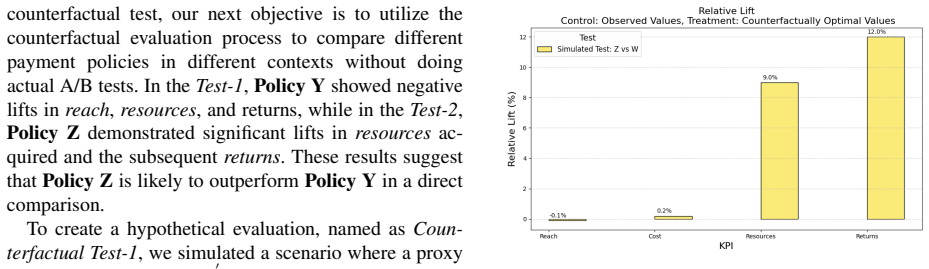
On its own terms, the paper's central discovery is that continuous off-policy estimators recover the sign of treatment effects between two auction payment policies from past A/B-test logs. Using the data from Test-1 ($X$ versus $Y$) and Test-2 ($X$ versus $Z$), the authors build proxy policies $X'$, $Y'$, $Z'$ and a counterfactual Test-2 in which Proxy $Y$ replaces $X$; the resulting lifts for cost, reach, resources, and returns tracked the lifts later measured in a real Test-3 ($Y$ versus $Z$). They also report that continuous OPE reduces mean absolute percentage error by roughly 20 percent relative to discretized OPE, that the self-normalized doubly robust estimator performs best among the continuous evaluators, and that a differentiable continuous estimator can train an MLP policy (OptPaL) whose simulated allocation matches Policy $X$'s cost and reach while increasing resources and returns.
Load-bearing premise
The proxy policies learned with random forests are faithful substitutes for the true payment policies; if a proxy's action distribution is biased, every importance weight, OPE estimate, and the Y-versus-Z ranking inherits that bias.
Editorial extensions
If this is right
- Payment policies can be ranked offline before committing to a live test, reducing the number of A/B tests needed.
- Continuous OPE gives roughly 20 percent lower mean absolute percentage error than discretized OPE across the metrics considered.
- The self-normalized doubly robust estimator with a tuned kernel and bandwidth is the most reliable of the continuous evaluators tested.
- A counterfactually optimized policy (OptPaL) found by gradient descent can match an existing policy's cost and reach while increasing simulated resources and returns.
Reading between the lines
- The paper leaves implicit a validation step the ranking depends on: checking each proxy policy against the actual logged actions before trusting any OPE estimate; without that check, proxy bias is invisible in the comparison.
- The same compare-two-treatments-through-a-common-control trick should generalize to ranking many policies from pairwise historical tests, provided the proxy models stay calibrated across contexts.
- The reported success is stated in terms of directional lift; if a decision-maker needs the magnitude of lift rather than just its sign, the estimators would need separate validation on level accuracy.
Signed reviews
Editorial analysis
A structured set of objections, weighed in public.
Referee Report
Summary. The paper applies off-policy evaluation (OPE) estimators to logged data from three real A/B tests in a dynamic auction marketplace, with policies X, Y, and Z. The authors learn random-forest proxy policies for the logged policies, compare discrete and continuous OPE variants by mean absolute percentage error, and use OPE to construct a counterfactual Y-vs-Z comparison whose directional lifts are checked against an actual Y-vs-Z test. They also propose an off-policy learning procedure, OptPaL, that optimizes an OPE-based profit objective and is then evaluated against Policy X in a simulated test. The central claims are that continuous estimators reduce MAPE by about 20% relative to discrete ones, that SNDR performs best among the continuous estimators, that OPE recovers the directional lifts of a real A/B test, and that a policy optimized on OPE estimates improves resources and returns at comparable cost.
Significance. If the empirical claims were supported, the paper would provide a valuable industrial case study showing that OPE can rank payment policies in a dynamic auction environment before committing to a live experiment. The availability of three real A/B tests, including a ground-truth Y-vs-Z test, is a genuine strength, and the comparison of discrete versus continuous OPE estimators on real logged data addresses a practically important question. The paper also names several concrete components of a future analytics platform, which is useful framing. However, the current evidence does not establish the central claims: the only direct validation of OPE against a real test is produced by an unspecified 'reward calculator' that is absent from the estimator definitions, the proxy policies are never validated, and the OptPaL result is circular because the learned policy is evaluated with the same OPE objective used to train it. These gaps are load-bearing, so the paper in its present form is not yet a reliable basis for the stated conclusions.
major comments (4)
- [Section II.C.1 and Figure 6] The central Y-vs-Z validation rests on a 'reward calculator' that adjusts observed outcomes to counterfactual outcomes using an undefined function f(P_AX, P_AY'), but no equation in the paper or in Appendix A defines this function, and none of the estimators in Eqs. (1)-(6) contains such an adjustment. Since Figure 6 is the only direct evidence that OPE recovers the sign of a real A/B test, the paper must specify f, explain how it relates to the OPE estimators, and show the result separately for each estimator; otherwise the directional-lift match cannot be attributed to the OPE methods being compared.
- [Section II.C.2] The proxy policies X', Y', and Z' are random-forest regressors/classifiers, yet the paper never states how a random-forest model is converted into the densities needed for importance weights (π_e(a|x)/π_b(a|x) in Eqs. (1)-(5) and Q_i in Eq. (6)). Moreover, the proxies are never validated against the actual actions taken in the logged data, so any bias or miscalibration in a proxy propagates into every OPE estimate and into the Y-vs-Z ranking. The authors should describe the density conversion explicitly and report held-out action-prediction accuracy for each proxy.
- [Section III.D and Figure 8] The OptPaL policy is trained by minimizing f = -(Returns_OPE(p) - Cost_OPE(p)), and its superiority over Policy X in Figure 8 is then reported using the same OPE estimates. This is circular: the comparison shows that a policy fitted to the estimator attains a high value of that estimator, which is not evidence of a genuinely better policy. An independent evaluation, for example on a held-out portion of logged data or against the actual Test-3 outcomes, is required before the claim that 'counterfactual policy learning helps us discover new optimal policies' can be supported.
- [Section III.A, III.B, Figures 4 and 5] The MAPE comparisons in Figures 4 and 5 are reported without confidence intervals, and the text indicates that hyperparameters such as the kernel K, bandwidth h, discretization bin count, and the random-forest/MLP hyperparameters are tuned with Optuna, apparently on the same evaluation data. This in-sample tuning makes the reported 20% MAPE improvement and the 'SNDR works best' conclusion difficult to assess. The authors should provide error bars or bootstrapped intervals and use a nested or held-out tuning procedure.
minor comments (6)
- [Abstract and Introduction] The abstract repeatedly refers to 'resource allocation strategies', but the controllable units are payment policies; aligning the terminology with the problem formulation in Section II.A would improve readability.
- [Figure 2] The flowchart introduces the function f and the notation O_AX, O_AY', P_AX, and P_AY' but the caption does not explain the symbols; please add a legend or a detailed caption.
- [Appendix A, Eq. (6)] In Eq. (6), the notation Q_i = P(t_i ∥ x_i) uses a double bar; this should be the conditional probability P(t_i | x_i), and the text should clarify whether τ(x_i) is a deterministic action or a distribution over actions in the continuous case.
- [Section III.B] The statement that 'SNDR works the best' is made without any statistical comparison or effect-size information; please qualify it or provide uncertainty estimates.
- [Figure 6 and Figure 8] The figures report lifts without confidence intervals or sample sizes, even though the text notes that a T-test is used for the actual tests; adding the intervals would make the directional-lift claim more interpretable.
- [Conclusion] The conclusion states that the study 'demonstrated the effectiveness of off-policy evaluation', which overstates what is shown given the gaps in Sections II.C.1 and III.D; please temper the claim to match the evidence.
Circularity Check
One circular step: OptPaL's reported improvement over Policy X is the optimized OPE objective itself; the Y-vs-Z direction-match against Test-3 is not circular, though it depends on an undefined reward-adjustment function.
-
fitted input called prediction
[Section III.D ('New Policy Learning through OPE Optimization'), with Algorithm 1.]
"we selected profit maximization as the objective function. As a standard practice in machine learning, the negative of the profit maximization is used as the loss function, defined as: min_p f = − (ReturnsOPE(p) − CostOPE(p)), where p = OptPaL(C) ... Here, the returns and cost are estimated using the OPE models. ... To compare the relative performance of the new optimal policy (Policy W: OptPaL(C)) with the existing Policy X, we utilized the Test-2. The results of the simulated test are shown in Figure 8."
Policy W = OptPaL(C) is obtained by minimizing f = −(Returns_OPE(p) − Cost_OPE(p)) over p, and then the paper reports W as better than X using the same OPE models on the same Test-2 data ('utilized the Test-2'; 'returns and cost are estimated using the OPE models'). Maximizing Returns_OPE − Cost_OPE is exactly the criterion on which W is judged to have increased Resource count and total Return. Thus the claimed improvement is the training objective relabeled as a measured outcome; unless W is evaluated on held-out data or in a real A/B test, the superiority over X is built into the loss function by construction.
full rationale
The only defensible circular reduction is the OptPaL policy-learning result in Section III.D. Algorithm 1 minimizes f = −(Returns_OPE(p) − Cost_OPE(p)), and the paper then reports that the resulting Policy W beats Policy X on the same Test-2 data using the same OPE models. That superiority is a restatement of the training objective, so it is a fitted value presented as a demonstrated improvement. This is partial circularity, not total: the paper's headline counterfactual comparison (Y vs Z) has an external ground truth in Test-3, and the MAPE comparisons in Figures 4 and 5 are checked against observed A/B outcomes. I therefore do not count those as circular. The figure-6 direction-match, however, depends on a 'reward calculator' adjustment f(P_AX, P_AY') described only in the flowchart of Figure 2 and never given an equation, and on random-forest proxies whose conversion to densities is unspecified; those are missing-support and reproducibility gaps rather than circular reductions, so they do not raise the score beyond 6 but they do weaken the paper's central claim. The sole self-citation ([14], for MAPE) is definitional and not load-bearing.
Assumptions & free parameters
free parameters (3)
- kernel function K and bandwidth h =
not reported
- discretization bin count for discrete OPEs =
not reported
- random forest and MLP hyperparameters =
not reported
assumptions (4)
- domain assumption Unconfoundedness: the logged action is independent of potential outcomes given the context x.
- domain assumption Overlap/support: the evaluation policy's action distribution is within the support of the behavior policy.
- domain assumption Stationarity: the market environment is stable across Test-1, Test-2, and Test-3.
- ad hoc to paper The random forest proxy policies accurately approximate the true policies.
Cite this review
Pith. "Pith review of Off-Policy Evaluation and Counterfactual Methods in Dynamic Auction Environments." pith.science (2026). https://pith.science/paper/VLKKD2JZ
@misc{pith2026250105278,
  author       = {Pith},
  title        = {Pith review of: Off-Policy Evaluation and Counterfactual Methods in Dynamic Auction Environments},
  year         = {2026},
  howpublished = {\url{https://pith.science/paper/VLKKD2JZ}},
  note         = {Machine review of arXiv:2501.05278}
}
read the original abstract
Counterfactual estimators are critical for learning and refining policies using logged data, a process known as Off-Policy Evaluation (OPE). OPE allows researchers to assess new policies without costly experiments, speeding up the evaluation process. Online experimental methods, such as A/B tests, are effective but often slow, thus delaying the policy selection and optimization process. In this work, we explore the application of OPE methods in the context of resource allocation in dynamic auction environments. Given the competitive nature of environments where rapid decision-making is crucial for gaining a competitive edge, the ability to quickly and accurately assess algorithmic performance is essential. By utilizing counterfactual estimators as a preliminary step before conducting A/B tests, we aim to streamline the evaluation process, reduce the time and resources required for experimentation, and enhance confidence in the chosen policies. Our investigation focuses on the feasibility and effectiveness of using these estimators to predict the outcomes of potential resource allocation strategies, evaluate their performance, and facilitate more informed decision-making in policy selection. Motivated by the outcomes of our initial study, we envision an advanced analytics system designed to seamlessly and dynamically assess new resource allocation strategies and policies.
Figures


Figures from the paper (5 more)




Reference graph
Works this paper leans on
-
[1]
Auction research evolving: Theorems and market designs
Paul Milgrom. Auction research evolving: Theorems and market designs. American Economic Review , 111(5):1383–1405, 2021
work page 2021
-
[2]
Market design: auctions and matching
Guillaume Haeringer. Market design: auctions and matching . MIT Press, 2018
work page 2018
-
[3]
Learning to bid with auctiongym
Olivier Jeunen, Sean Murphy, and Ben Allison. Learning to bid with auctiongym. AdKDD, 2022
work page 2022
-
[4]
Open bandit dataset and pipeline: Towards realis- tic and reproducible off-policy evaluation
Yuta Saito, Shunsuke Aihara, Megumi Matsutani, and Yusuke Narita. Open bandit dataset and pipeline: Towards realis- tic and reproducible off-policy evaluation. arXiv preprint arXiv:2008.07146, 2020
arXiv 2008
-
[5]
Learning from logged implicit exploration data
Alex Strehl, John Langford, Lihong Li, and Sham M Kakade. Learning from logged implicit exploration data. Advances in neural information processing systems , 23, 2010
work page 2010
-
[6]
Doubly robust policy evaluation and optimization
Miroslav Dudık, Dumitru Erhan, John Langford, and Lihong Li. Doubly robust policy evaluation and optimization. Statistical Science, 29(4):485–511, 2014
work page 2014
-
[7]
Doubly robust off-policy evaluation with shrink- age
Yi Su, Maria Dimakopoulou, Akshay Krishnamurthy, and Miroslav Dud´ık. Doubly robust off-policy evaluation with shrink- age. In International Conference on Machine Learning , pages 9167–9176. PMLR, 2020
work page 2020
-
[8]
The self-normalized estimator for counterfactual learning
Adith Swaminathan and Thorsten Joachims. The self-normalized estimator for counterfactual learning. advances in neural infor- mation processing systems , 28, 2015
work page 2015
Show all 23 references
-
[9]
Intrinsically efficient, stable, and bounded off-policy evaluation for reinforcement learn- ing
Nathan Kallus and Masatoshi Uehara. Intrinsically efficient, stable, and bounded off-policy evaluation for reinforcement learn- ing. Advances in neural information processing systems , 32, 2019
2019
-
[10]
The offset tree for learning with partial labels
Alina Beygelzimer and John Langford. The offset tree for learning with partial labels. In Proceedings of the 15th ACM SIGKDD international conference on Knowledge discovery and data mining, pages 129–138, 2009
2009
-
[11]
More robust doubly robust off-policy evaluation
Mehrdad Farajtabar, Yinlam Chow, and Mohammad Ghavamzadeh. More robust doubly robust off-policy evaluation. In International Conference on Machine Learning , pages 1447–1456. PMLR, 2018
2018
-
[12]
Cab: Continuous adaptive blending for policy eval- uation and learning
Yi Su, Lequn Wang, Michele Santacatterina, and Thorsten Joachims. Cab: Continuous adaptive blending for policy eval- uation and learning. In International Conference on Machine Learning, pages 6005–6014. PMLR, 2019
2019
-
[13]
Policy evaluation and optimiza- tion with continuous treatments
Nathan Kallus and Angela Zhou. Policy evaluation and optimiza- tion with continuous treatments. In International conference on artificial intelligence and statistics , pages 1243–1251. PMLR, 2018
2018
-
[14]
Virtual metrology in long batch processes using machine learning
Ritam Guha, Anirudh Suresh, Jared DeFrain, and Kalyanmoy Deb. Virtual metrology in long batch processes using machine learning. Materials and Manufacturing Processes , 38(15):1997– 2008, 2023
1997
-
[15]
Probabilistic evaluation of counterfactual queries
Alexander Balke and Judea Pearl. Probabilistic evaluation of counterfactual queries. Probabilistic and Causal Inference: The Works of Judea Pearl, page 237, 2011
2011
-
[16]
Off-policy evaluation for large action spaces via embeddings
Yuta Saito and Thorsten Joachims. Off-policy evaluation for large action spaces via embeddings. In International Conference on Machine Learning (ICML) , 2022
2022
-
[17]
Optuna: A next-generation hyperparameter optimization framework
Takuya Akiba, Shotaro Sano, Toshihiko Yanase, Takeru Ohta, and Masanori Koyama. Optuna: A next-generation hyperparameter optimization framework. In Proceedings of the 25th ACM SIGKDD International Conference on Knowledge Discovery and Data Mining, 2019. 7 APPENDIX A. Evaluator...
2019
-
[18]
En[·] is the empirical average over n observations in D
Inverse Probability Weighting (IPW): IPW esti- mates the policy value of evaluation policy( πe) [5], [6], [7]: ˆVIPW(πe; D) :=En[w(xi, ai) · ri] (1) where D = {(xi, ai, ri)}n i=1 is logged bandit data with n observations collected by behavior policy πb; w(x, a) := πe(a|x)/πb(a...
-
[19]
This estimator is not unbiased even when the behavior policy is known
Self-Normalized Inverse Probability Weighting (SNIPW): SNIPW estimates the policy value of eval- uation policy ( πe) [8], [9] as ˆVSNIPW(πe; D) := En[w(xi, ai) · ri] En[w(xi, ai)] (2) SNIPW normalizes the observed rewards by the self- normalized importance weight. This estimat...
-
[20]
It then uses the estimated rewards to estimate the policy value as follows
Direct Method (DM): DM [6], [10] first trains a supervised ML model, such as ridge regression and gra- dient boosting, to estimate the reward function q(x, a) = E[r|x, a]. It then uses the estimated rewards to estimate the policy value as follows. ˆVDM(πe; D, ˆq) :=En "X a∈A ˆ...
-
[21]
It then uses the estimated rewards to estimate the policy value as follows
Doubly Robust (DR): Similar to DM, DR [6], [11], [12], [7], estimates the reward function ( q(x, a) = E[r|x, a] ). It then uses the estimated rewards to estimate the policy value as follows. ˆVDR(πe; D, ˆq) :=En[ˆq(xi, πe) +w(xi, ai)(ri − ˆq(xi, ai)] (4) When the clipping is a...
-
[22]
The SNDR estimator computes the policy value of the evaluation policy πe as ˆVSNDR(πe; D, ˆq) :=En ˆq(xi, πe) +w(xi, ai)(ri − ˆq(xi, ai)) En[w(xi, ai)] (5)
Self-Normalized Doubly Robust (SNDR): Simi- lar to SNIPW, the SNDR estimator applies the self- normalized importance weighting technique to gain some stability. The SNDR estimator computes the policy value of the evaluation policy πe as ˆVSNDR(πe; D, ˆq) :=En ˆq(xi, πe) +w(xi,...
-
[23]
This binning process can obscure subtle differences within the data, making it challenging to evaluate small changes, as these nuances are often lost within the bins
Continuous Evaluators: In traditional discretized off-policy evaluators, significant drawbacks arise due to the loss of information when continuous values are binned together. This binning process can obscure subtle differences within the data, making it challenging to evaluat...
Reviewed August 10, 2026 · model on record in the stance chip above.
Discussion (0). Continue with ORCID to comment.