REVIEW 4 major objections 5 minor 12 references
Introduction to the Usage of Open Data from the Large Hadron Collider for Computer Scientists in the Context of Machine Learning
T0 review · 4 major / 5 minor · reviewed 2026-08-10 · deepseek-v4-flash
Pith's one-line read CMS open data from the LHC is converted into documented pandas DataFrames for computer scientists.
desk verdict A genuinely useful resource paper: six CMS open datasets converted to documented per-event pandas DataFrames, but the validation and provenance details need tightening before it should be widely promoted. read the letter →
The pith
A machine-rendered reading of the paper's core claim, the machinery that carries it, and where it could break.
The reading
What carries the argument
The load-bearing mechanism is the conversion pipeline described in the appendix: a CMS analysis module filters the desired objects and roughly 100 variables per event out of each 2 GB ROOT file, writes them to a temporary ROOT tree, and a Python script converts the tree into pandas DataFrames, transposing the storage from per-variable to per-event orientation and saving the result as compressed feather files. The second half of the machinery is the paper's variable dictionary: a set of tables that maps every DataFrame column, such as vecMuon PT or nVertex, to its physical meaning, so the data can be used without a physics background.
What would settle it
Choose one of the published 10000-event DataFrames and re-extract the same events from the original ROOT files with a fresh reader, then compare the full set of retained variables element by element; any mismatch outside floating-point tolerance would show the conversion is not faithful. A less direct falsifier is to compute the dimuon invariant-mass peak from vecMuon PT, Eta, Phi in the Z-boson sample and check that it reproduces the known Z mass.
Extended reading notes
Core claim
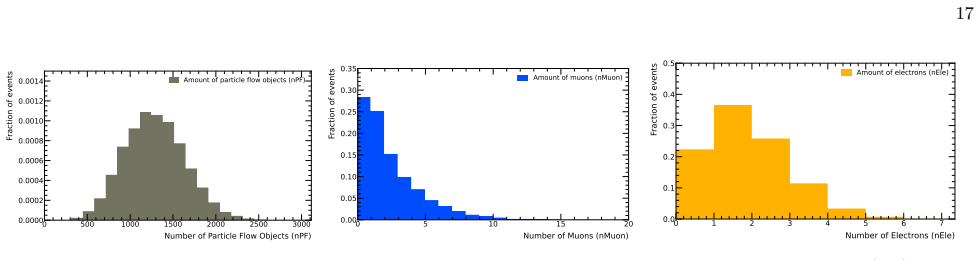
The central claim is that a large, useful portion of CMS open data from the 2011-2012 LHC run can be served to computer scientists as pandas DataFrames rather than ROOT trees. The authors implemented a pipeline in which a CMS analysis module filters roughly 100 of 121 event variables out of each 2 GB ROOT file, converts the values without alteration into a per-event tabular layout, and saves the result as compressed feather files that can be read directly with pandas. The released datasets cover simulated and real proton-proton collisions at 8 TeV, including a top-quark pair sample, W and Z boson samples, and muon-trigger data, each with 10000-event files. The paper presents the full variable dictionary, histograms of key distributions, and a step-by-step analysis estimating W-boson signal events to demonstrate that the DataFrames behave like the original physics data.
Load-bearing premise
The load-bearing premise is that the single-pass filtering step keeps every variable a machine-learning model could need and introduces no silent corruption of the values, so users can trust the released DataFrames without re-checking them against the original ROOT files.
Editorial extensions
If this is right
- Machine-learning researchers can load and explore real LHC collision data with standard pandas tooling, without installing ROOT or learning its object model.
- The per-event storage layout matches the way deep-learning data loaders typically consume tabular inputs, so the DataFrames can feed neural-network pipelines almost directly.
- The documented variable tables give non-physicists enough vocabulary to design features and understand what each observable means physically.
- The worked W-boson analysis shows the DataFrames support a conventional physics measurement, not just machine-learning toy tasks.
- The pipeline is reusable: the same single-container recipe can be pointed at other ROOT-based CMS open data.
Reading between the lines
- The same conversion approach could be applied to other ROOT-based open datasets beyond CMS, including ATLAS data, which would extend the bridge between high-energy-physics open data and the Python machine-learning ecosystem.
- Because the DataFrames keep only about 100 of 121 variables, the dropped variables may matter for some analyses; a faithful machine-learning benchmark built on these files should state that the filtering step is part of the dataset definition.
- The paper's variable tables could serve as the starting schema for a standardized interchange format for tabular high-energy-physics data, reducing the need for each new collaboration to re-derive the mapping.
- The histogram comparisons in the paper could be turned into automated data-quality regression tests: any future change to the conversion pipeline should leave these distributions statistically unchanged.
Signed reviews
Editorial analysis
A structured set of objections, weighed in public.
Referee Report
Summary. This paper presents a conversion of a subset of CMS LHC open data from ROOT TTrees to pandas DataFrames, released through the University of Bonn bonndata repository. The manuscript has three main parts: a pedagogical primer on Standard Model particles, LHC detectors, and kinematic variables; a detailed catalogue of the roughly 100 DataFrame variables organized by object type; and a description of the conversion pipeline (a CMSSW EDAnalyzer followed by uproot3/pandas transposition) together with file-format benchmarks. As a use case, the authors perform a simple W-boson selection and show data/Monte Carlo agreement. The central claim is that the released DataFrames are a faithful, usable entry point for machine-learning researchers without a particle-physics background.
Significance. If the DataFrames are faithful to the original CMS open data, this is a genuinely useful community resource: it lowers the entry barrier for computer scientists, provides a documented variable catalogue, and ships a reproducible pipeline skeleton on GitHub. The paper is honest about being a tutorial and data descriptor rather than a methods contribution, and the data/MC comparison in Section 5 is a reasonable first sanity check. The main value hinges on trust in the conversion, and that trust is not yet established by the evidence in the manuscript.
major comments (4)
- [Appendix A.2, Figures 15-22] The central claim of a trustworthy conversion is not yet supported by the published validation. The pipeline in Appendix A.2 filters roughly 100 of 121 variables and transposes the data with uproot3/pandas, but the only validation consists of one-dimensional histograms (Figures 15-22). Such histograms are invariant under permutations of objects within an event and under swaps between variables of the same object (for example, exchanging the i-th entries of vecMuon_PT and vecMuon_Eta changes no histogram in Figures 16 and 21). I ask for an event-by-event comparison of the released DataFrames against the source ROOT files (or a documented subset), checksums for the released feather files, and a commit hash or version tag for the GitHub repository in reference [12] so that the exact pipeline that produced the data can be identified and re-run.
- [Section 4.1, Tables 3, 15, and 16] The tau-lepton counts appear to be corrupted. In Table 3, the values of nTau are identical to nJets in all three example events (64/64, 98/98, 96/96), and in Tables 15 and 16 the mean "Tauon" value exactly equals the mean "Jets" value (78.2536 and 71.1567, respectively). Since roughly 78 reconstructed tau leptons per event is physically implausible, this strongly suggests that the tau variables were filled from the jet branch (or vice versa). The paper must clarify this and, if the released nTau/vecTau columns are wrong, regenerate and re-validate the affected datasets before the resource can be used.
- [Section 2.4] The invariant-mass formula is stated incorrectly. The text defines the scalar product p1.p2 = E1*E2 - p_x1*p_x2 - p_y1*p_y2 - p_z1*p_z2 and equates it directly to (m12)^2, but the invariant mass of a two-particle system is obtained from the square of the summed four-vector, (p1+p2)^2 = m12^2, not from p1.p2. The subsequent discussion of adding the two muon four-vectors to obtain the Z-boson mass is conceptually correct, so the equation and the sentence "By taking the scalar product of this four-vector" need to be corrected to avoid teaching a wrong definition to the target audience.
- [Table 14, Section 4.3] The dataset catalogue contains a duplicate entry: the DYToMuMu M-20 CT10 TuneZ2star v2 8TeV sample is listed twice with the same DOI (10.7483/OPENDATA.CMS.QGC3.PTZ9), so Table 14 lists six rows but only five distinct samples. Since the paper's deliverable is a documented set of public datasets, the catalogue must be corrected and each dataset should carry a stable record identifier or DOI so that users can cite and retrieve the exact version they used.
minor comments (5)
- [Throughout] There are many typographical and formatting errors, including "T able" in several table captions, "Panda Data Frames" in the Appendix title, and "We are hope" in the Conclusion; please run a careful proofreading pass.
- [Table 12] The caption of Table 12 says "Description of the variables associated to Monte Carlo Truth" but the table actually describes jet variables; the caption should be corrected.
- [Section 4.1, Table 4] The first paragraph of Section 4.1 describes a Top-AntiTop semi-leptonic decay, but the caption of Table 4 refers to a "ZZ to 4mu decay"; the example and the caption should be aligned.
- [Section A.2] The statement that the python step transforms the file "without altering or discarding any of the contained values" should be clarified to apply only to the ROOT-to-DataFrame step, because the EDAnalyzer already filters out roughly 20 of the 121 variables; as written, the two sentences can be read as claiming losslessness of the full pipeline.
- [Section 2.1, Table 1] The text says "one GeV corresponds to 1.783 * 10^27 kg"; the exponent is missing a minus sign and should be 10^-27 kg.
Circularity Check
No significant circularity: the paper reports a data conversion with no fitted parameters or derived predictions, and the validation histograms do not function as inputs to the conversion.
full rationale
The paper's central deliverable is a set of pandas DataFrames converted from CMS Open Data ROOT files; the only 'derivation' is the pipeline in Appendix A.2, which filters about 100 variables through a CMSSW EDAnalyzer, writes a TTree, and transposes it with uproot3 and pandas. Nothing in the pipeline is fit to the validation histograms in Figures 15–22: those histograms are drawn from the converted DataFrames and serve as sanity checks, not as fitted inputs, so the conversion cannot reduce to them by construction. The benchmarking section A.3 chooses the feather/zstd file format based on measured read/write speed and disk usage; this is an engineering choice, not a prediction from first principles, and the benchmark data are the authors' own converted DataFrames, which is appropriate for format selection and does not assume the target result. References [1] and [12] are self-citations that point to the released data and pipeline code, but the paper's substantive claim—that the ROOT-to-DataFrame conversion was performed and documented—does not rest on an unverified theorem or on a fitted parameter. Concerns raised by the skeptical reviewer about per-object array alignment, missing event-by-event validation, duplicate rows in Table 14, and physically implausible means in Tables 15–16 are correctness and reproducibility risks, not circularity: the histograms could be wrong while the reasoning remains non-circular. There is no equation equated to its own input and no fitted quantity renamed as a prediction, so the appropriate circularity score is 0.
Assumptions & free parameters
assumptions (4)
- domain assumption The Standard Model of particle physics correctly describes the collisions.
- domain assumption The CMS detector simulation and reconstruction chain accurately model the recorded events.
- ad hoc to paper The EDAnalyzer selection of roughly 100 variables retains all information needed for the intended ML tasks.
- ad hoc to paper The trigger flags and event weighting in the sample are correctly copied from the original CMS data.
Cite this review
Pith. "Pith review of Introduction to the Usage of Open Data from the Large Hadron Collider for Computer Scientists in the Context of Machine Learning." pith.science (2026). https://pith.science/paper/OEKTIXT7
@misc{pith2026250106896,
  author       = {Pith},
  title        = {Pith review of: Introduction to the Usage of Open Data from the Large Hadron Collider for Computer Scientists in the Context of Machine Learning},
  year         = {2026},
  howpublished = {\url{https://pith.science/paper/OEKTIXT7}},
  note         = {Machine review of arXiv:2501.06896}
}
read the original abstract
Deep learning techniques have evolved rapidly in recent years, significantly impacting various scientific fields, including experimental particle physics. To effectively leverage the latest developments in computer science for particle physics, a strengthened collaboration between computer scientists and physicists is essential. As all machine learning techniques depend on the availability and comprehensibility of extensive data, clear data descriptions and commonly used data formats are prerequisites for successful collaboration. In this study, we converted open data from the Large Hadron Collider, recorded in the ROOT data format commonly used in high-energy physics, to pandas DataFrames, a well-known format in computer science. Additionally, we provide a brief introduction to the data's content and interpretation. This paper aims to serve as a starting point for future interdisciplinary collaborations between computer scientists and physicists, fostering closer ties and facilitating efficient knowledge exchange.
Figures


Figures from the paper (16 more)




Reference graph
Works this paper leans on
-
[12]
Saala, OpenDataToDataFrame (2025)
T. Saala, OpenDataToDataFrame (2025). URL https://github.com/TSaala/OpenDataToDataFrame A Transformation of CMS Open Data to Panda Data Frames A.1 Pandas Library The python library pandas [8, 9] was designed with the goal in mind to bridge the gap between python and more domain-specific statistical and data analytical languages such as R. pandas is built ...
-
[1]
URL https://bonndata.uni-bonn.de/dataverse/lhc_open_df
University of Bonn, LHC Open DataFrames (2024). URL https://bonndata.uni-bonn.de/dataverse/lhc_open_df
work page 2024
-
[2]
Aad, et al., The ATLAS Experiment at the CERN Large Hadron Collider, JINST 3 (2008) S08003
G. Aad, et al., The ATLAS Experiment at the CERN Large Hadron Collider, JINST 3 (2008) S08003. doi: 10.1088/1748-0221/3/08/S08003
-
[3]
Chatrchyan, et al., The CMS Experiment at the CERN LHC, JINST 3 (2008) S08004
S. Chatrchyan, et al., The CMS Experiment at the CERN LHC, JINST 3 (2008) S08004. doi:10.1088/ 1748-0221/3/08/S08004
work page 2008
-
[4]
URL https://atlas.cern/Discover/Detector
CERN ATLAS Experiment, Detector & technology (2024). URL https://atlas.cern/Discover/Detector
work page 2024
-
[5]
CERN CMS Experiment, Detector (2024). URL https://cms.cern/detector
work page 2024
-
[6]
URL https://cms.cern/news/search-microscopic-black-hole-signatures-large-hadron-collider
CMS Collaboration, Search for microscopic black hole signatures at the Large Hadron Collider (2025). URL https://cms.cern/news/search-microscopic-black-hole-signatures-large-hadron-collider
work page 2025
-
[7]
URL https://cds.cern.ch/record/2916299
ATLAS Collaboration, ATLAS Event Displays: Top Quark Pairs with Missing Energy, general Photo (2024). URL https://cds.cern.ch/record/2916299
Show all 12 references
-
[8]
The pandas development team, pandas-dev/pandas: Pandas (Feb. 2020). doi:10.5281/zenodo.3509134. URL https://doi.org/10.5281/zenodo.3509134
2020 doi
-
[9]
Wes McKinney, Data Structures for Statistical Computing in Python, in: St´ efan van der Walt, Jarrod Millman (Eds.), Proceedings of the 9th Python in Science Conference, 2010, pp. 56 – 61. doi:10.25080/ Majora-92bf1922-00a
2010
-
[10]
URL https://opendata.cern.ch/
CERN, CERN Open Data Portal (2025). URL https://opendata.cern.ch/
2025
-
[11]
Lassila-Perini, C
K. Lassila-Perini, C. Lange, E. Carrera Jarrin, M. Bellis, Using CMS Open Data in research – challenges and directions, EPJ Web of Conferences 251 (2021) 01004. doi:10.1051/epjconf/202125101004. URL http://dx.doi.org/10.1051/epjconf/202125101004
2021
Reviewed August 10, 2026 · model on record in the stance chip above.
Discussion (0). Continue with ORCID to comment.