REVIEW 4 major objections 5 minor 1 cited by
Skeleton and Font Generation Network for Zero-shot Chinese Character Generation
T0 review · 4 major / 5 minor · reviewed 2026-08-10 · deepseek-v4-flash
Pith's one-line read A two-stage network generates unseen and misspelled Chinese characters from captions, avoiding the bias that makes older models "correct" them into familiar forms.
desk verdict The caption-driven skeleton builder and misspelled-character augmentation results are the real contributions; the SOTA claims in the abstract overreach, but the paper deserves a serious referee. read the letter →
The pith
A machine-rendered reading of the paper's core claim, the machinery that carries it, and where it could break.
The reading
What carries the argument
The load-bearing object is the transitive-attention block $\mathrm{TA}$, whose kernel $\hat{\beta}=\prod_{i=1}^{N-1}\exp(Q_i)\exp(K_{i+1}^\top)$ multiplies pairwise attention weights along a chain from style features to captions to content features. A variance normalization formula $V_n = D^{n-1}[\sum_{i=0}^n (D-1)^i C^i_n e^{2n-i}] - e^n D^{2(n-1)}$ is used to rescale $\hat\beta$ before softmax, under the stated assumption that queries and keys are independent standard normal vectors. The skeleton builder also carries the argument: a "blank canvas" of position-embedded vectors is filled first with radical representations and then with stroke representations, letting the model generate glyphs from captions alone. Together the two modules turn font generation into a copy-and-place operation at radical scale.
What would settle it
Compute the empirical variance of the unnormalized product $\hat\beta$ over actual style-feature and caption pairs in the trained model and compare it with $V_n$; if the values diverge, retrain with the empirical normalization and measure whether generated misspelled characters still avoid being corrected, which would show that the stated formula, and the assumption behind it, is load-bearing. Equivalently, rescaling style features so they are provably not $N(0,1)$ should break the attention alignment if the assumption is essential.
Extended reading notes
Core claim
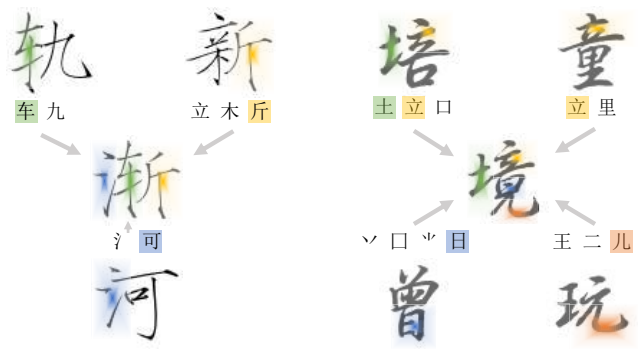
The central claim is that Chinese character font generation can be decomposed into glyph creation and font application, with both stages robust to characters that look nearly identical to training samples. The skeleton builder maps radical-level and stroke-level text captions directly to a content feature and a standard-font image, so the content channel never sees a content image and can represent unseen combinations; the font generator then aligns this content feature with style features extracted from five style images via a transitive-attention mechanism that routes attention from style image to style captions, from style captions to content captions, and from content captions back to content features. This radical-level "copying" path is what prevents the model from overwriting a misspelled character with the nearest familiar one. The paper additionally claims that images of misspelled characters generated this way improve a handwritten Chinese character error-correction model, and that the benefit is roughly comparable to using twenty-five times more rare-character data.
Load-bearing premise
The transitive-attention block assumes that query and key vectors behave as independent standard-normal variables, because its variance normalization formula is derived from that assumption and is stated without proof.
Editorial extensions
If this is right
- Characters that are not in the training dictionary, including misspelled and internet-novel characters, can be rendered in a target font without content images.
- A font style can be transferred from roughly five reference images whose radicals cover the target character, without retraining for each new font.
- Generated misspelled characters work as training data for handwritten Chinese character error correction, and a small misspelled set yields gains comparable to a much larger rare-character set.
- The three transmitted attention maps are interpretable as locating components in the style image, deciding which components are needed, and placing them in the content image.
- The method extends to at least one other compositional script, Korean, after fine-tuning on that script's training set.
Reading between the lines
- A testable extension is to apply the transitive-attention chain to other compositional writing systems or structured object generation where captions intermediate between source and target domains, since nothing in the mechanism is Chinese-specific beyond the radical captions.
- The augmentation result suggests that the difficulty distribution of training data matters more than volume: data close to the decision boundary, such as misspelled characters, buys most of the error-correction gain; isolating rare-character sets at varying sizes would make this effect explicit.
- Because the variance formula for transitive attention is asserted rather than derived, the method's robustness claim carries a hidden dependency; checking whether learned queries and keys are approximately $N(0,1)$, or replacing the theoretical normalization with an empirical estimate, would make the mechanism portable and safer to adopt.
Signed reviews
Editorial analysis
A structured set of objections, weighed in public.
Referee Report
Summary. The paper proposes SFGN (Skeleton and Font Generation Network) for zero-shot Chinese character generation, combining a skeleton builder that synthesizes standard-font glyph images from radical- and stroke-level captions with a font generator that transfers target font style through a novel transitive-attention mechanism. The method is evaluated on glyph generation (Table 1), font generation for seen and unseen styles (Tables 2–3), single-font transfer (Table 4), misspelled characters, cross-lingual Korean characters, and downstream Chinese character error correction with generated data (Tables 7–8). The authors claim that SFGN outperforms current state-of-the-art font generation methods and is particularly robust on misspelled characters.
Significance. If the results are sound, the skeleton builder's caption-to-glyph synthesis with zero-shot generalization is a genuine advance, and the transitive-attention idea of aligning content and style at the radical level is an interesting new perspective. The quantitative results for glyph generation (Table 1) are strong, and the augmentation experiments for handwritten Chinese character error correction, while modest, support the pedagogical value of generated misspelled characters. However, the central claim that SFGN outperforms state-of-the-art font generation methods is not well supported by the reported metrics, and the theoretical justification of the transitive-attention normalization is incomplete. The paper also relies heavily on qualitative visual comparison for the misspelled-character robustness claim, which weakens the contribution.
major comments (4)
- [Abstract, Section 6, Tables 2–3] The claims that SFGN 'outperforms current state-of-the-art font generation methods' and 'outperforms state-of-the-art generation models on both glyph and font generation tasks' are not supported by the reported numbers. In Table 2, the proposed Font Generator has RMSE 0.0233 versus 0.0220 for CF-Font and 0.0223 for CG-GAN; in Table 3, its FID is 23.12 versus 20.11 for CG-GAN and 22.08 for CF-Font. The only rows where SFGN is consistently best are the 'End-to-end' rows against RCN and RTN-G, which are text-to-glyph methods rather than font generation methods. The abstract and conclusion should be revised to claim 'comparable' performance for the font generator, or a controlled comparison that accounts for the harder caption-only input should be provided.
- [Section 3.2, Eq. (13)] The variance formula V_n used to normalize the product of exponentials in the transitive-attention mechanism is stated without derivation, and the supporting assumption that queries and keys follow i.i.d. N(0,1) distributions is not justified for the projected vectors X_i U^Q_i and X_{i+1} U^K_{i+1}. Because this normalization is the core of the proposed mechanism, a derivation or a reference proving Eq. (13) is required, along with a discussion of how the N(0,1) assumption is maintained or approximated during training. Without this, the normalization is not reproducible and the theoretical foundation of the mechanism remains unverified.
- [Section 3.3, Eq. (21)] The guided loss L_g supervises the transitive-attention maps with attention maps aG generated by the skeleton builder and aR generated by the recognition model. Since the skeleton builder is trained jointly on the same data, this is a form of self-supervision that could propagate errors from the skeleton builder into the font generator. The paper should explicitly state whether aG is detached and aR is frozen, and should discuss the potential for error amplification. The ablation in Table 6 shows a large drop without L_g but does not isolate whether the guidance is transferring genuinely useful structural knowledge or merely forcing the font generator to imitate an imperfect attention pattern.
- [Section 5.2, Tables 2–3] The comparison between SFGN's end-to-end row and the font generation baselines is not controlled: SFGN receives captions as input, while the baselines receive a real content image. The text acknowledges 'slight performance degradation' for SFGN, but the abstract and conclusion do not reflect this. The paper should explicitly quantify this degradation by comparing the 'Font Generator' row (which uses a content image) with the 'SFGN' end-to-end row, and should re-frame the SOTA claim so that it is restricted to the appropriate comparison setting.
minor comments (5)
- [Section 2.2] The citations for RCN and RTN-G are swapped: the text says 'RCN [8]' and 'RTN-G [9]', but the reference list identifies [8] as RTN-G and [9] as RCN. Please correct the in-text citations.
- [Section 3.2, Eq. (12)] The denominator in Eq. (12) is written as 'V2N −2' while the variance formula in Eq. (13) is defined generically as V_n. Please clarify that the argument is n = 2N−2 and define N in this context.
- [Table 4] The method name 'Strokegan' is inconsistent with the reference title 'Strokegan: Reducing mode collapse in chinese font generation via stroke encoding'; please unify the capitalization.
- [Section 5.4] The category 'novel characters' is used in Table 7 but is only vaguely described in the text; a concrete definition with examples would improve clarity.
- [Figures 8 and 10] The visual comparisons in Figures 8 and 10 are difficult to read at the current size; consider enlarging the panels and adding annotations to highlight the failure cases discussed in the text.
Circularity Check
No significant circularity: SFGN's claims are empirical benchmark results, supported by external comparisons, ablations, and downstream tasks; self-citations are normal and not load-bearing.
full rationale
The paper's central claims are empirical: the skeleton builder and font generator are evaluated against external baselines (CG-GAN, CF-Font, FsFont, EMD, DG-Font, etc.) on RMSE/SSIM/LPIPS/FID and through a downstream error-correction augmentation study. These results are not derived from the inputs by construction. The two-stage architecture (skeleton builder producing content features that feed the font generator) is a standard compositional design, not a circular dependency. The guided loss in Eq. 21 aligns the font generator's transitive-attention maps with the skeleton builder's attention maps and a recognition model's attention maps; this is auxiliary self-distillation, not a case where a predicted quantity is defined as the fitted input, and the ablations in Table 6 and attention visualizations give independent evidence that the loss affects behavior. Self-citations to RCN, RTN-G, RTN-R, and TAN are used as baselines, as a design rationale, and as an error-correction tool; they are not the sole support for the headline claims, which are benchmark comparisons against external methods and an augmentation experiment. The variance normalization formula (Eq. 13) is asserted without derivation and rests on a strong i.i.d. N(0,1) assumption; this is an omitted proof and a correctness risk, not a circular step, because the formula is a normalization assumption rather than a quantity defined in terms of the target prediction. The abstract's 'outperforms current state-of-the-art' statement is broader than the font-generator-only numbers in Tables 2-3 support, but overclaiming is a correctness issue, not circularity. Therefore no circular step can be exhibited, and the score is 0.
Assumptions & free parameters
free parameters (4)
- lambda_c =
0.1
- lambda_g =
0.1
- number_of_style_images_T =
5
- model_dimension_D =
512
assumptions (4)
- domain assumption Radical-level captions uniquely determine the structure of each Chinese character
- ad hoc to paper Queries and keys in the transitive-attention follow i.i.d. N(0,1) distributions, validating the variance formula V_n
- domain assumption A stroke-radical correspondence mask is available for all characters, including misspelled or novel ones
- domain assumption Attention maps from the skeleton builder and the RTN-R recognition model are directly comparable to the transitive-attention maps for guided loss
invented entities (2)
-
Transitive-attention mechanism
-
Blank canvas B
Cite this review
Pith. "Pith review of Skeleton and Font Generation Network for Zero-shot Chinese Character Generation." pith.science (2026). https://pith.science/paper/VY3AKBNJ
@misc{pith2026250108062,
  author       = {Pith},
  title        = {Pith review of: Skeleton and Font Generation Network for Zero-shot Chinese Character Generation},
  year         = {2026},
  howpublished = {\url{https://pith.science/paper/VY3AKBNJ}},
  note         = {Machine review of arXiv:2501.08062}
}
read the original abstract
Automatic font generation remains a challenging research issue, primarily due to the vast number of Chinese characters, each with unique and intricate structures. Our investigation of previous studies reveals inherent bias capable of causing structural changes in characters. Specifically, when generating a Chinese character similar to, but different from, those in the training samples, the bias is prone to either correcting or ignoring these subtle variations. To address this concern, we propose a novel Skeleton and Font Generation Network (SFGN) to achieve a more robust Chinese character font generation. Our approach includes a skeleton builder and font generator. The skeleton builder synthesizes content features using low-resource text input, enabling our technique to realize font generation independently of content image inputs. Unlike previous font generation methods that treat font style as a global embedding, we introduce a font generator to align content and style features on the radical level, which is a brand-new perspective for font generation. Except for common characters, we also conduct experiments on misspelled characters, a substantial portion of which slightly differs from the common ones. Our approach visually demonstrates the efficacy of generated images and outperforms current state-of-the-art font generation methods. Moreover, we believe that misspelled character generation have significant pedagogical implications and verify such supposition through experiments. We used generated misspelled characters as data augmentation in Chinese character error correction tasks, simulating the scenario where students learn handwritten Chinese characters with the help of misspelled characters. The significantly improved performance of error correction tasks demonstrates the effectiveness of our proposed approach and the value of misspelled character generation.
Figures


Figures from the paper (7 more)




Forward citations
Cited by 1 Pith paper
-
Computer-Aided Multi-Stroke Character Simplification by Stroke Removal
A neural-network recognizer is used to find stroke-removal patterns that preserve character identity, revealing that many multi-stroke characters tolerate losing about a third of their strokes.
Reference graph
Works this paper leans on
-
[1]
Y. Huang, M. He, L. Jin, Y. Wang, Rd-gan: Few/zero-shot chinese char- acter style transfer via radical decomposition and rendering, in: Com- puter Vision–ECCV 2020: 16th European Conference, Glasgow, UK, August 23–28, 2020, Proceedings, Part VI 16, Springer, 2020, pp. 156– 172
work page 2020
-
[2]
J. Cha, S. Chun, G. Lee, B. Lee, S. Kim, H. Lee, Few-shot composi- tional font generation with dual memory, in: Computer Vision–ECCV 2020: 16th European Conference, Glasgow, UK, August 23–28, 2020, Proceedings, Part XIX 16, Springer, 2020, pp. 735–751
work page 2020
-
[3]
S. Park, S. Chun, J. Cha, B. Lee, H. Shim, Few-shot font generation with localized style representations and factorization, in: Proceedings of the AAAI Conference on Artificial Intelligence, Vol. 35, 2021, pp. 2393–2402
work page 2021
-
[4]
Y. Kong, C. Luo, W. Ma, Q. Zhu, S. Zhu, N. Yuan, L. Jin, Look closer to supervise better: One-shot font generation via component-based dis- 31 criminator, in: Proceedings of the IEEE/CVF Conference on Computer Vision and Pattern Recognition, 2022, pp. 13482–13491
work page 2022
-
[5]
H. H. Shen, An investigation of chinese-character learning strategies among non-native speakers of chinese, System 33 (1) (2005) 49–68
work page 2005
-
[6]
S. S. Lam, R. K. Au, H. W. Leung, C. W. Li-Tsang, Chinese handwrit- ing performance of primary school children with dyslexia, Research in developmental disabilities 32 (5) (2011) 1745–1756
work page 2011
-
[7]
X. Li, X. Zhang, The writing order of modern chinese character com- ponents, The journal of modernization of Chinese language education 2 (1) (2013) 26–41
work page 2013
-
[8]
M. Xue, J. Du, B. Wang, B. Ren, Y. Hu, Joint optimization for attention-based generation and recognition of chinese characters using tree position embedding, Pattern Recognition 140 (2023) 109538
work page 2023
Show all 49 references
-
[9]
M. Xue, J. Du, J. Zhang, Z.-R. Wang, B. Wang, B. Ren, Radical composition network for chinese character generation, in: Document Analysis and Recognition–ICDAR 2021: 16th International Conference, Lausanne, Switzerland, September 5–10, 2021, Proceedings, Part I 16, Springer, 2...
2021
-
[10]
J. Zeng, Q. Chen, Y. Liu, M. Wang, Y. Yao, Strokegan: Reducing mode collapse in chinese font generation via stroke encoding, in: Proceedings of the AAAI Conference on Artificial Intelligence, Vol. 35, 2021, pp. 3270–3277
2021
- [11]
-
[12]
Q. Wen, S. Li, B. Han, Y. Yuan, Zigan: Fine-grained chinese calligraphy font generation via a few-shot style transfer approach, in: Proceedings of the 29th ACM International Conference on Multimedia, 2021, pp. 621–629. 32
2021
-
[13]
Chang, Y
J. Chang, Y. Gu, Y. Zhang, Y.-F. Wang, C. Innovation, Chinese hand- writing imitation with hierarchical generative adversarial network., in: BMVC, 2018, p. 290
2018
-
[14]
P. Lyu, X. Bai, C. Yao, Z. Zhu, T. Huang, W. Liu, Auto-encoder guided gan for chinese calligraphy synthesis, in: 2017 14th IAPR International Conference on Document Analysis and Recognition (ICDAR), Vol. 1, IEEE, 2017, pp. 1095–1100
2017
-
[15]
Kaonashi, zi2zi: Master chinese calligraphy with conditional adversarial networks, https://github.com/kaonashi-tyc/zi2zi (2017)
2017
-
[16]
Jiang, Z
Y. Jiang, Z. Lian, Y. Tang, J. Xiao, Dcfont: an end-to-end deep chinese font generation system, in: D. Gutierrez, H. Huang (Eds.), SIGGRAPH Asia 2017 Technical Briefs, Bangkok, Thailand, November 27 - 30, 2017, ACM, 2017, pp. 22:1–22:4. doi:10.1145/3145749.3149440. URL https:/...
2017
-
[17]
Zhang, Y
Y. Zhang, Y. Zhang, W. Cai, Separating style and content for general- ized style transfer, in: Proceedings of the IEEE conference on computer vision and pattern recognition, 2018, pp. 8447–8455
2018
-
[18]
D. Sun, T. Ren, C. Li, H. Su, J. Zhu, Learning to write stylized chi- nese characters by reading a handful of examples, in: J. Lang (Ed.), Proceedings of the Twenty-Seventh International Joint Conference on Artificial Intelligence, IJCAI 2018, July 13-19, 2018, Stockholm, Swe-...
2018 doi
-
[19]
Jiang, Z
S. Jiang, Z. Wang, A. Hertzmann, H. Jin, Y. Fu, Visual font pairing, IEEE Transactions on Multimedia 22 (8) (2019) 2086–2097
2019
-
[20]
J. Park, A. U. Hassan, J. Choi, Ccfont: Component-based chinese font generation model using generative adversarial networks (gans), Applied Sciences 12 (16) (2022) 8005
2022
-
[21]
Y. Xie, X. Chen, L. Sun, Y. Lu, Dg-font: Deformable generative networks for unsupervised font generation, in: Proceedings of the IEEE/CVF conference on computer vision and pattern recognition, 2021, pp. 5130–5140. 33
2021
-
[22]
S. Park, S. Chun, J. Cha, B. Lee, H. Shim, Multiple heads are better than one: Few-shot font generation with multiple localized experts, in: Proceedings of the IEEE/CVF International Conference on Computer Vision, 2021, pp. 13900–13909
2021
-
[23]
X. Liu, G. Meng, J. Chang, R. Hu, S. Xiang, C. Pan, Decoupled repre- sentation learning for character glyph synthesis, IEEE Transactions on Multimedia 24 (2021) 1787–1799
2021
-
[24]
L. Tang, Y. Cai, J. Liu, Z. Hong, M. Gong, M. Fan, J. Han, J. Liu, E. Ding, J. Wang, Few-shot font generation by learning fine-grained local styles, in: Proceedings of the IEEE/CVF conference on computer vision and pattern recognition, 2022, pp. 7895–7904
2022
-
[25]
Y. Li, J. Du, J. Zhang, C. Wu, A tree-structure analysis network on handwritten chinese character error correction, IEEE Transactions on Multimedia (2022)
2022
-
[26]
Kukich, Techniques for automatically correcting words in text, Acm Computing Surveys (CSUR) 24 (4) (1992) 377–439
K. Kukich, Techniques for automatically correcting words in text, Acm Computing Surveys (CSUR) 24 (4) (1992) 377–439
1992
-
[27]
Lee, L.-C
L.-H. Lee, L.-C. Yu, K.-C. Lee, Y.-H. Tseng, L.-P. Chang, H.-H. Chen, A sentence judgment system for grammatical error detection, in: Pro- ceedings of COLING 2014, the 25th International Conference on Com- putational Linguistics: System Demonstrations, 2014, pp. 67–70
2014
-
[28]
X. Wu, Q. Chen, Y. Xiao, W. Li, X. Liu, B. Hu, Lcsegnet: An efficient semantic segmentation network for large-scale complex chinese character recognition, IEEE Transactions on Multimedia 23 (2020) 3427–3440
2020
-
[29]
D. Peng, L. Jin, W. Ma, C. Xie, H. Zhang, S. Zhu, J. Li, Recognition of handwritten chinese text by segmentation: A segment-annotation-free approach, IEEE Transactions on Multimedia (2022)
2022
-
[30]
T.-Q. Wang, F. Yin, C.-L. Liu, Radical-based chinese character recogni- tion via multi-labeled learning of deep residual networks, in: 2017 14th IAPR International Conference on Document Analysis and Recognition (ICDAR), Vol. 1, IEEE, 2017, pp. 579–584
2017
-
[31]
Zhang, J
J. Zhang, J. Du, L. Dai, Radical analysis network for learning hierarchies of chinese characters, Pattern Recognition 103 (2020) 107305. 34
2020
-
[32]
Zhang, Y
J. Zhang, Y. Zhu, J. Du, L. Dai, Radical analysis network for zero- shot learning in printed chinese character recognition, in: 2018 IEEE International Conference on Multimedia and Expo (ICME), IEEE, 2018, pp. 1–6
2018
-
[33]
Z. Cao, J. Lu, S. Cui, C. Zhang, Zero-shot handwritten chinese char- acter recognition with hierarchical decomposition embedding, Pattern Recognition 107 (2020) 107488
2020
-
[34]
V. Mnih, N. Heess, A. Graves, et al., Recurrent models of visual atten- tion, Advances in neural information processing systems 27 (2014)
2014
-
[35]
Vaswani, N
A. Vaswani, N. Shazeer, N. Parmar, J. Uszkoreit, L. Jones, A. N. Gomez, L. Kaiser, I. Polosukhin, Attention is all you need, Advances in neural information processing systems 30 (2017)
2017
-
[36]
M. Seo, A. Kembhavi, A. Farhadi, H. Hajishirzi, Bidirectional atten- tion flow for machine comprehension, arXiv preprint arXiv:1611.01603 (2016)
2016 arXiv
-
[37]
Gehring, M
J. Gehring, M. Auli, D. Grangier, D. Yarats, Y. N. Dauphin, Convo- lutional sequence to sequence learning, in: International Conference on Machine Learning, PMLR, 2017, pp. 1243–1252
2017
-
[38]
Simonyan, A
K. Simonyan, A. Zisserman, Very deep convolutional networks for large- scale image recognition, arXiv preprint arXiv:1409.1556 (2014)
2014 arXiv
-
[39]
M. D. Zeiler, D. Krishnan, G. W. Taylor, R. Fergus, Deconvolutional networks, in: 2010 IEEE Computer Society Conference on computer vision and pattern recognition, IEEE, 2010, pp. 2528–2535
2010
-
[40]
Huang, Z
G. Huang, Z. Liu, L. Van Der Maaten, K. Q. Weinberger, Densely con- nected convolutional networks, in: Proceedings of the IEEE conference on computer vision and pattern recognition, 2017, pp. 4700–4708
2017
-
[41]
C. Yang, Q. Wang, J. Du, J. Zhang, C. Wu, J. Wang, A transformer- based radical analysis network for chinese character recognition, in: 2020 25th International Conference on Pattern Recognition (ICPR), IEEE, 2021, pp. 3714–3719. 35
2020
-
[42]
Y. Wang, X. Ma, Z. Chen, Y. Luo, J. Yi, J. Bailey, Symmetric cross entropy for robust learning with noisy labels, in: Proceedings of the IEEE/CVF International Conference on Computer Vision, 2019, pp. 322–330
2019
-
[43]
Z. Wang, A. C. Bovik, H. R. Sheikh, E. P. Simoncelli, Image quality assessment: from error visibility to structural similarity, IEEE transac- tions on image processing 13 (4) (2004) 600–612
2004
-
[44]
Zhang, P
R. Zhang, P. Isola, A. A. Efros, E. Shechtman, O. Wang, The unreason- able effectiveness of deep features as a perceptual metric, in: Proceed- ings of the IEEE conference on computer vision and pattern recognition, 2018, pp. 586–595
2018
-
[45]
Heusel, H
M. Heusel, H. Ramsauer, T. Unterthiner, B. Nessler, S. Hochreiter, Gans trained by a two time-scale update rule converge to a local nash equi- librium, Advances in neural information processing systems 30 (2017)
2017
-
[46]
M. D. Zeiler, Adadelta: an adaptive learning rate method, arXiv preprint arXiv:1212.5701 (2012)
2012 arXiv
-
[47]
Ioffe, C
S. Ioffe, C. Szegedy, Batch normalization: Accelerating deep network training by reducing internal covariate shift, in: International conference on machine learning, pmlr, 2015, pp. 448–456
2015
-
[48]
Glorot, A
X. Glorot, A. Bordes, Y. Bengio, Deep sparse rectifier neural networks, in: Proceedings of the fourteenth international conference on artificial intelligence and statistics, JMLR Workshop and Conference Proceed- ings, 2011, pp. 315–323
2011
-
[49]
C.-Y. Wang, M. Zhou, T. Ge, Y. Jiang, H. Bao, W. Xu, Cf-font: Con- tent fusion for few-shot font generation, 2023 IEEE/CVF Conference on Computer Vision and Pattern Recognition (CVPR) (2023) 1858–1867. URL https://api.semanticscholar.org/CorpusID:257757256 36
2023
Reviewed August 10, 2026 · model on record in the stance chip above.
Discussion (0). Continue with ORCID to comment.