Electrostatic Clutch-Based Mechanical Multiplexer with Increased Force Capability
Pith reviewed 2026-05-23 04:53 UTC · model grok-4.3
The pith
Electrostatic capstan clutches let one motor drive a four-DoF robotic hand to 212 N output forces.
A machine-rendered reading of the paper's core claim, the machinery that carries it, and where it could break.
Core claim
The paper establishes that an electrostatic capstan clutch-based transmission enables both SISO and SIMO mechanical multiplexing at high force levels, as shown by a single motor producing up to 212 N output forces, 4.09 times greater vertical grip strength, and 111.2 N horizontal carrying capacity on a four-DoF tendon-driven robotic hand.
What carries the argument
The electrostatic capstan clutch, which engages a capstan surface via electrostatic attraction to transmit tendon forces in a multiplexed transmission.
If this is right
- A single motor can control four joints either sequentially or simultaneously while still delivering peak tendon forces of 212 N.
- Vertical grip strength rises by a measured factor of 4.09 compared with non-multiplexed baselines.
- Horizontal carrying capacity reaches 111.2 N, exceeding prior five-fingered tendon-driven hands.
- The same motor can switch between SISO and SIMO modes without hardware changes.
- Actuator count for multi-DoF tendon-driven systems can be reduced while preserving high force output.
Where Pith is reading between the lines
- Fewer motors could lower overall system mass and power draw in wearable or mobile robots that use similar tendon routing.
- The multiplexing approach may extend to other cable-driven mechanisms such as exoskeletons or legged robots if clutch scaling holds.
- Reliability under thousands of cycles at peak load remains an open question beyond the reported demonstrations.
Load-bearing premise
The electrostatic clutches transmit the reported high forces reliably without slippage, wear, or added control overhead that would reduce net output.
What would settle it
Direct measurement showing clutch slippage, measurable wear, or force output dropping below 212 N under repeated SISO and SIMO cycling on the hand would falsify the performance claim.
Figures



read the original abstract
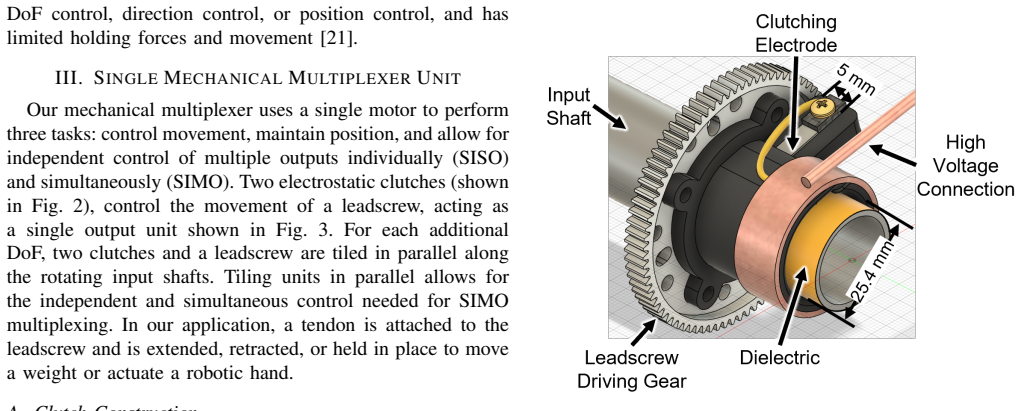
Robotic systems with many degrees of freedom (DoF) are constrained by the demands of dedicating a motor to each joint, and while mechanical multiplexing reduces actuator count, existing clutch designs are bulky, force-limited, or restricted to one output at a time. The problem addressed in this study is how to achieve high-force multiplexing that supports both simultaneous and sequential control from a single motor. Here we show an electrostatic capstan clutch-based transmission that enables both single-input-single-output (SISO) and single-input-multiple-output (SIMO) multiplexing. We demonstrated these on a four-DoF tendon-driven robotic hand where a single motor achieved output forces of up to 212 N, increased vertical grip strength by 4.09 times, and raised horizontal carrying capacity to 111.2 N, the highest currently among five-fingered tendon-driven robotic hands. These results demonstrate that electrostatic-based multiplexing provides versatile actuation, overcoming the limitations of prior systems.
Editorial analysis
A structured set of objections, weighed in public.
Referee Report
Summary. The manuscript presents an electrostatic capstan clutch-based mechanical multiplexer for reducing actuator count in multi-DoF robotic systems. It enables both SISO and SIMO control from a single motor and demonstrates the approach on a four-DoF tendon-driven robotic hand, reporting output forces up to 212 N, a 4.09-fold increase in vertical grip strength, and a horizontal carrying capacity of 111.2 N (claimed highest among five-fingered tendon-driven hands).
Significance. If the experimental results hold after verification of the transmission assumptions, the work would be significant for high-force multi-DoF actuation with reduced motor count, addressing a practical constraint in tendon-driven robotics and potentially enabling more compact high-performance manipulators.
major comments (2)
- [Abstract] Abstract: The headline results (212 N output force, 4.09× grip increase, 111.2 N carrying capacity) require the electrostatic clutches to transmit full motor torque without slippage, creep, or degradation in both SISO and SIMO modes. No clutch-level force-slip curves, voltage thresholds, engagement/disengagement timing data, or endurance cycling results at 212 N tendon tension are referenced, leaving the core force-multiplication claim dependent on an unverified transmission assumption.
- [Abstract] Abstract / Results: No measurement protocol, error bars, baseline comparisons to non-multiplexed actuation, or details on multiplexing implementation (e.g., how simultaneous vs. sequential control was achieved without control overhead) are supplied. This prevents verification of the data-to-claim link for the reported performance numbers.
Simulated Author's Rebuttal
We thank the referee for the constructive review and for highlighting the need for stronger verification of the clutch transmission and experimental details. We address each major comment below and will incorporate the requested data and clarifications in the revised manuscript.
read point-by-point responses
-
Referee: [Abstract] Abstract: The headline results (212 N output force, 4.09× grip increase, 111.2 N carrying capacity) require the electrostatic clutches to transmit full motor torque without slippage, creep, or degradation in both SISO and SIMO modes. No clutch-level force-slip curves, voltage thresholds, engagement/disengagement timing data, or endurance cycling results at 212 N tendon tension are referenced, leaving the core force-multiplication claim dependent on an unverified transmission assumption.
Authors: We agree that clutch-level characterization data are essential to substantiate the headline force claims. The current manuscript focuses on system-level results; in revision we will add force-slip curves, voltage thresholds, engagement/disengagement timing, and endurance cycling results at 212 N tendon tension for both SISO and SIMO operation. These additions will directly verify transmission without slippage, creep, or degradation. revision: yes
-
Referee: [Abstract] Abstract / Results: No measurement protocol, error bars, baseline comparisons to non-multiplexed actuation, or details on multiplexing implementation (e.g., how simultaneous vs. sequential control was achieved without control overhead) are supplied. This prevents verification of the data-to-claim link for the reported performance numbers.
Authors: We acknowledge that explicit protocols and comparisons strengthen the results. In the revision we will supply the full measurement protocol with error bars, baseline comparisons to non-multiplexed actuation, and expanded details on the multiplexing implementation, including how simultaneous versus sequential control is realized and any control overhead. These changes will clarify the link between data and claims. revision: yes
Circularity Check
No significant circularity: experimental hardware demonstration with no derivations
full rationale
The paper is a hardware demonstration of an electrostatic capstan clutch multiplexer on a tendon-driven robotic hand. It reports measured performance metrics (212 N output force, 4.09× grip increase, 111.2 N carrying capacity) from physical testing rather than any mathematical derivation, model fitting, or prediction step. No equations, fitted parameters, self-citations of uniqueness theorems, or ansatzes appear in the provided text. The central claims rest on experimental outcomes that are externally falsifiable via replication of the hardware, satisfying the criteria for a self-contained result with no reduction to inputs by construction.
Axiom & Free-Parameter Ledger
Reference graph
Works this paper leans on
-
[1]
Underactuated robotics: A review,
B. He, S. Wang, and Y . Liu, “Underactuated robotics: A review,” International Journal of Advanced Robotic Systems, vol. 16, no. 4, pp. 172 988 141 986 216–, 2019
work page 2019
-
[2]
Design of Tendon-Driven Manipulators,
L.-W. Tsai, “Design of Tendon-Driven Manipulators,”Journal of Vibration and Acoustics, vol. 117, no. B, pp. 80–86, 06 1995. [Online]. Available: https://doi.org/10.1115/1.2838680
-
[3]
Lock your robot: A review of locking devices in robotics,
M. Plooij, G. Mathijssen, P. Cherelle, D. Lefeber, and B. Vanderborght, “Lock your robot: A review of locking devices in robotics,”IEEE Robotics & Automation Magazine, vol. 22, no. 1, pp. 106–117, 2015
work page 2015
-
[4]
Trends and challenges in robot manipulation,
A. Billard and D. Kragic, “Trends and challenges in robot manipulation,” Science (American Association for the Advancement of Science), vol. 364, no. 6446, pp. 1149–, 2019
work page 2019
-
[5]
A survey on snake robot modeling and locomotion,
A. A. Transeth, K. Y . Pettersen, and P. Liljeb ¨ack, “A survey on snake robot modeling and locomotion,”Robotica, vol. 27, no. 7, pp. 999–1015, 2009
work page 2009
-
[6]
B.-Y . Sun, X. Gong, J. Liang, W.-B. Chen, Z.-L. Xie, C. Liu, and C.-H. Xiong, “Design principle of a dual-actuated robotic hand with anthropomorphic self-adaptive grasping and dexterous manipulation abilities,”IEEE Trans. on Robotics, vol. 38, no. 4, pp. 2322–2340, 2022
work page 2022
-
[7]
Johnsen-rahbek capstan clutch: A high torque electrostatic clutch,
T. E. Amish, J. T. Auletta, C. C. Kessens, J. R. Smith, and J. I. Lipton, “Johnsen-rahbek capstan clutch: A high torque electrostatic clutch,” in2024 IEEE International Conference on Robotics and Automation (ICRA), 2024, pp. 148–154
work page 2024
-
[8]
High force density textile electrostatic clutch,
R. Hinchet and H. Shea, “High force density textile electrostatic clutch,” Advanced Materials Technologies, vol. 5, no. 4, pp. 1 900 895–n/a, 2020
work page 2020
-
[9]
C. Choi, S. Gardner, S. Chatterjee, A. Kuchibhotla, G. Wan, and M. C. Hipwell, “High-performance and high bandwidth electroadhesive clutch enabled by fracture mechanics and a dielectric nanoparticle-based high-k composite,”Advanced materials technologies, vol. 9, no. 14, 2024
work page 2024
-
[10]
A mechanics-based approach to realize high-force capacity elec- troadhesives for robots,
D. J. Levine, G. M. Iyer, R. Daelan Roosa, K. T. Turner, and J. H. Pikul, “A mechanics-based approach to realize high-force capacity elec- troadhesives for robots,”Science robotics, vol. 7, no. 72, pp. eabo2179– eabo2179, 2022
work page 2022
-
[11]
High-performance electroadhesive clutches with multilayered architecture,
B. Aksoy, S. Tan, M. A. Peshkin, and J. E. Colgate, “High-performance electroadhesive clutches with multilayered architecture,”Science ad- vances, vol. 11, no. 7, pp. eads0766–, 2025
work page 2025
-
[12]
Electrostatic adhesive brakes for high spatial resolution refreshable 2.5d tactile shape displays,
K. Zhang and S. Follmer, “Electrostatic adhesive brakes for high spatial resolution refreshable 2.5d tactile shape displays,” in2018 IEEE Haptics Symposium (HAPTICS). IEEE, 2018, pp. 319–326
work page 2018
-
[13]
A physical phenomenon and its applications to telegraphy, telephony, etc,
A. Johnsen and K. Rahbek, “A physical phenomenon and its applications to telegraphy, telephony, etc,”Journal of the Institution of Electrical Engineers, pp. 713–725, 1923
work page 1923
-
[14]
Development of the electrostatic clutch,
C. J. Fitch, “Development of the electrostatic clutch,”IBM Journal of Research and Development, vol. 1, no. 1, pp. 49–56, 1957
work page 1957
-
[15]
Dextres: Wearable haptic feedback for grasping in vr via a thin form-factor electrostatic brake,
R. Hinchet, V . Vechev, H. Shea, and O. Hilliges, “Dextres: Wearable haptic feedback for grasping in vr via a thin form-factor electrostatic brake,” inProceedings of the 31st Annual ACM Symposium on User Interface Software and Technology, ser. UIST ’18. New York, NY , USA: Association for Computing Machinery, 2018, p. 901–912. [Online]. Available: https:/...
-
[16]
R. M. Strong and D. E. Troxel, “An electrotactile display,”IEEE Transactions on Man-Machine Systems, vol. 11, no. 1, pp. 72–79, 1970
work page 1970
-
[17]
All-fabric wearable electroadhesive clutch,
V . Ramachandran, J. Shintake, and D. Floreano, “All-fabric wearable electroadhesive clutch,”Advanced Materials Technologies, vol. 4, no. 2, pp. 1 800 313–n/a, 2019
work page 2019
-
[18]
N. Vanichvoranun, H. Lee, S. Kim, and S. H. Yoon, “Estatig: Wearable haptic feedback with multi-phalanx electrostatic brake for enhanced object perception in vr,”Proc. ACM Interact. Mob. Wearable Ubiquitous Technol., vol. 8, no. 3, Sep. 2024. [Online]. Available: https://doi.org/10.1145/3678567
-
[19]
Optical proximity sensing for pose estimation during in-hand manipulation,
P. Lancaster, P. Gyawali, C. Mavrogiannis, S. S. Srinivasa, and J. R. Smith, “Optical proximity sensing for pose estimation during in-hand manipulation,” 2023. [Online]. Available: https://arxiv.org/abs/2204.02371
-
[20]
Design and testing of a selectively compliant underactuated hand,
D. M. Aukes, B. Heyneman, J. Ulmen, H. Stuart, M. R. Cutkosky, S. Kim, P. Garcia, and A. Edsinger, “Design and testing of a selectively compliant underactuated hand,”The International Journal of Robotics Research, vol. 33, no. 5, pp. 721–735, 2014
work page 2014
-
[21]
D. Wei, Q. Xiong, J. Dong, H. Wang, X. Liang, S. Tang, X. Xu, H. Wang, and H. Wang, “Electrostatic adhesion clutch with superhigh force density achieved by mxene-poly(vinylidene fluoride–trifluoroethylene–chlorotrifluoroethylene) composites,”Soft Robotics, vol. 10, no. 3, pp. 482–492, 2023
work page 2023
-
[22]
Electrostatic brakes enable individual joint control of underactuated, highly articulated robots,
P. Lancaster, C. Mavrogiannis, S. Srinivasa, and J. R. Smith, “Electrostatic brakes enable individual joint control of underactuated, highly articulated robots,”The International Journal of Robotics Research, vol. 43, no. 14, pp. 2204–2220, 2024. [Online]. Available: https://doi.org/10.1177/02783649241250362
-
[23]
An earthworm-inspired multi-mode underwater locomotion robot: Design, modeling, and experiments,
H. Fang, Z. He, and J. Xu, “An earthworm-inspired multi-mode underwater locomotion robot: Design, modeling, and experiments,”
-
[24]
Available: https://arxiv.org/abs/2108.05518
[Online]. Available: https://arxiv.org/abs/2108.05518
-
[25]
Elastic energy-recycling actuators for efficient robots,
E. Krimsky and S. H. Collins, “Elastic energy-recycling actuators for efficient robots,”Science Robotics, vol. 9, no. 88, pp. eadj7246– eadj7246, 2024
work page 2024
-
[26]
A lightweight, low-power electroadhesive clutch and spring for exoskeleton actuation,
S. Diller, C. Majidi, and S. H. Collins, “A lightweight, low-power electroadhesive clutch and spring for exoskeleton actuation,” inInt’l Conf on Robotics and Automation (ICRA). IEEE, 2016, pp. 682–689
work page 2016
-
[27]
Electroadhesion technologies for robotics: A comprehensive review,
J. Guo, J. Leng, and J. Rossiter, “Electroadhesion technologies for robotics: A comprehensive review,”IEEE Transactions on Robotics, vol. 36, no. 2, pp. 313–327, 2020
work page 2020
-
[28]
The dependency of adhesion and friction on electro- static attraction,
B. N. J. Persson, “The dependency of adhesion and friction on electro- static attraction,”The Journal of Chemical Physics, vol. 148, no. 14, pp. 144 701–144 701, 2018
work page 2018
-
[29]
M. R. Sogard, A. R. Mikkelson, M. Nataraju, K. T. Turner, and R. L. Engelstad, “Analysis of coulomb and johnsen-rahbek electrostatic chuck performance for extreme ultraviolet lithography,”J of Vacuum Science & Technology. B, Microelectronics and Nanometer Structures Processing, Measurement and Phenomena, vol. 25, no. 6, pp. 2155–2161, 2007
work page 2007
-
[30]
The effects of electroadhesive clutch design parameters on performance characteristics,
S. B. Diller, S. H. Collins, and C. Majidi, “The effects of electroadhesive clutch design parameters on performance characteristics,”J. of Int. Material Systems and Structures, vol. 29, no. 19, pp. 3804–3828, 2018
work page 2018
-
[31]
J. Guo, C. Xiang, and J. Rossiter, “A soft and shape-adaptive elec- troadhesive composite gripper with proprioceptive and exteroceptive capabilities,”Materials & Design, vol. 156, pp. 586–587, 2018
work page 2018
-
[32]
Y . Zuo, G. Merritt, and X. Wang, “Design of a novel surgical robot with rigidity-adjustable joints based on time-division multiplexing actuation,” in2020 8th IEEE RAS/EMBS International Conference for Biomedical Robotics and Biomechatronics (BioRob), 2020, pp. 885–890
work page 2020
-
[33]
The switchable cable-driven mechanism to control multiple cables individually using a single motor,
Y . Kim and H.-S. Park, “The switchable cable-driven mechanism to control multiple cables individually using a single motor,”IEEE Robotics and Automation Letters, vol. 7, no. 2, pp. 4376–4383, 2022
work page 2022
-
[34]
Uni-drive modular robots with pulse width modulation control,
H. Karbasi, A. Khajepour, and J. Huissoon, “Uni-drive modular robots with pulse width modulation control,” inIEEE Int’l Conference Mecha- tronics and Automation, vol. 1. IEEE, 2005, pp. 260–267 V ol. 1
work page 2005
-
[35]
Muxhand: A cable-driven dexterous robotic hand using time-division multiplexing motors,
J. Xu, S. Li, H. Luo, H. Liu, X. Wang, W. Ding, and C. Xia, “Muxhand: A cable-driven dexterous robotic hand using time-division multiplexing motors,” 2024. [Online]. Available: https://arxiv.org/abs/2409.12455
-
[36]
N. Feizi, S. F. Atashzar, M. R. Kermani, and R. V . Patel, “Design and modeling of a smart torque-adjustable rotary electroadhesive clutch for application in human-robot interaction,”IEEE/ASME transactions on mechatronics, vol. 28, no. 5, pp. 1–11, 2023
work page 2023
-
[37]
Bidirectional clutch using wrapped spring and bidirectional braking device using wrapped spring,
M. DE SOUZA, T. LIBBY , Y . KATO, N. ASO, T. OTANI, J. ECKERLE, K. KAW AMURA, and A. KERNBAUM, “Bidirectional clutch using wrapped spring and bidirectional braking device using wrapped spring,” 2024
work page 2024
-
[38]
Dielectric-based electroadhesive clutch,
S. DILLER, B. ZEKANY , C. MAJIDI, K. WITTE, and J. W ATKINS, “Dielectric-based electroadhesive clutch,” 2022
work page 2022
-
[39]
Electroadhesive clutch for universal load directions trans- misison,
S. B. DILLER, K. A. WITTE, B. ZEKANY , J. D. W ATKINS, and C. MAJIDI, “Electroadhesive clutch for universal load directions trans- misison,” 2025
work page 2025
-
[40]
Bhandari,Design of Machine Elements
V . Bhandari,Design of Machine Elements. Tata McGraw-Hill, 2007. [Online]. Available: https://books.google.com/books?id=f5Eit2FZe cC
work page 2007
-
[41]
D. J. Smith,A dictionary of horse-drawn vehicles. London: J.A. Allen, 1988
work page 1988
-
[42]
Design and validation of a self- aligning index finger exoskeleton for post-stroke rehabilitation,
N. Sun, G. Li, and L. Cheng, “Design and validation of a self- aligning index finger exoskeleton for post-stroke rehabilitation,”IEEE transactions on neural systems and rehabilitation engineering, vol. 29, pp. 1513–1523, 2021
work page 2021
-
[43]
Worm gear mechanism with switchable backdrivability,
T. Takayama and N. Hisamatsu, “Worm gear mechanism with switchable backdrivability,”ROBOMECH journal, vol. 6, no. 1, pp. 1–10, 2019
work page 2019
discussion (0)
Sign in with ORCID, Apple, or X to comment. Anyone can read and Pith papers without signing in.