REVIEW 4 major objections 6 minor 62 references
Discovery of Spatter Constitutive Models in Additive Manufacturing Using Machine Learning
T0 review · 4 major / 6 minor · reviewed 2026-08-10 · deepseek-v4-flash
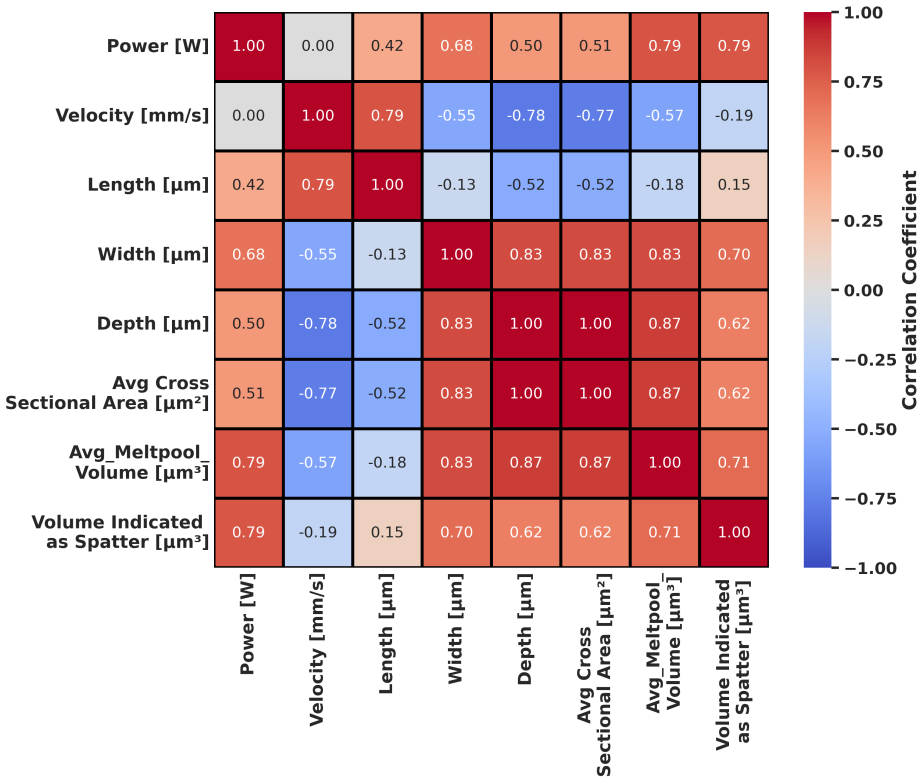
Pith's one-line read This paper reports that melt pool dimensions, area, volume, and spatter volume in laser powder bed fusion are predictable from laser power and scan velocity alone, with $R^2$ above 95% for melt pool geometry and up to 96.7% for spatter…
desk verdict The melt pool predictions are fine, but the spatter R2 claims are invalidated by an undisclosed log transformation of the target. read the letter →
The pith
A machine-rendered reading of the paper's core claim, the machinery that carries it, and where it could break.
The reading
What carries the argument
The load-bearing mechanism is a two-stage pipeline: a spatter/melt pool classifier trained on OpenFOAM simulations is transferred to FLOW-3D output, after aligning feature ranges, to label 'volume indicated as spatter' in simulations that do not resolve spatter physics; then polynomial regression of degrees 2 to 6 transforms power and velocity, or melt pool dimensions, into polynomial and interaction terms and fits a linear model, producing interpretable equations. The logarithmic transformations of inputs, such as $\log$ velocity, $\log$ length, $\log$ width, and $\log$ depth, are a deliberate part of the machinery: they improve spatter $R^2$ substantially, indicating that spatter volume responds approximately linearly to log-transformed process and geometry variables. Feature importance is read off from the absolute sizes of the polynomial coefficients, which is what turns the regressions into claims about which physical variables drive melt pool shape and spatter.
What would settle it
Run the fitted polynomial equations against experimentally measured spatter volumes from high-speed or synchrotron X-ray imaging of equivalent SS316L single tracks over the same power-velocity grid; if the equations systematically diverge, especially in regimes with deep keyholes or spatter modes absent from the training simulations, the FLOW-3D labels cannot be representing physical spatter.
Extended reading notes
Core claim
The central claim is that a low-dimensional, closed-form map connects process conditions to melt pool state and spatter: laser power and scan velocity alone fix the stable melt pool length, width, depth, cross-sectional area, and volume, and those same process conditions or the melt pool dimensions fix the volume indicated as spatter. In the paper's own terms, this is a discovery of constitutive models for spatter, namely explicit polynomial equations with $R^2$ above 95% for melt pool geometry features and 85% (training) and 82% (testing) for spatter in the polynomial fits. The best machine learning result, the ExtraTree model, reaches $R^2$ of 96.7% on training and 87.5% on testing for spatter when log-transformed melt pool dimensions are the inputs. The derived equations also rank the importance of physical inputs: power dominates the equations for length and depth, velocity dominates width, and width and depth dominate the spatter equations built from melt pool dimensions.
Load-bearing premise
The entire 'volume indicated as spatter' result rests on a single transfer: a classifier trained on OpenFOAM output is assumed to label spatter correctly in FLOW-3D simulations, even though FLOW-3D approximates recoil pressure and mass transfer and omits tangential surface tension; if that transfer is unfaithful, every reported spatter equation describes an artifact, not physical spatter.
Editorial extensions
If this is right
- With power and velocity fixed before a build, the fitted equations yield forecasts of melt pool length, width, depth, area, volume, and spatter volume without additional simulation cost.
- Because melt pool dimensions alone predict spatter volume, in-situ sensing of melt pool shape during printing can act as a surrogate spatter monitor for defect detection.
- The feature-importance rankings in the equations identify which process knob to turn: power for length and depth, velocity for width, and width plus depth for spatter volume.
- The consistent improvement from logarithmic inputs implies spatter volume scales in an approximately power-law or log-linear way with process conditions, not linearly.
Reading between the lines
- If the central claim holds, an untested consequence is that closed-loop control could regulate spatter by adjusting power and velocity from measured melt pool dimensions, without needing a direct spatter sensor.
- Because the FLOW-3D simulations omit tangential surface tension, the fitted equations describe a reduced-physics world; comparing them with full-physics OpenFOAM output or experiments would reveal which polynomial terms are artifacts of that simplification.
- A testable extension follows from the strong power-spatter correlation: the classifier's label is probably dominated by recoil-pressure ejection, so the equations should miss spatter generated by other mechanisms such as powder-bed entrainment or laser-plume interactions.
Editorial analysis
A structured set of objections, weighed in public.
Referee Report
Summary. The paper develops a machine-learning and polynomial-regression framework to predict melt pool dimensions (length, width, depth), melt pool geometry (cross-sectional area, volume), and a quantity called 'volume indicated as spatter' for laser powder bed fusion (LPBF). The dataset consists of 281 FLOW-3D simulations, with spatter labels generated by applying a classifier trained on OpenFOAM simulations to FLOW-3D output. The authors report R2 values above 95% for melt pool features and, after logarithmic transformation of model inputs, an ExtraTree model achieving R2 of 96.7% (train) and 87.5% (test) for spatter volume. They also provide polynomial equations intended as interpretable 'constitutive models' for these quantities.
Significance. If the reported accuracy were valid on the original physical scale and the spatter target were physically meaningful, the framework could provide inexpensive surrogate models for LPBF process mapping and a step toward interpretable quality-control models. The paper usefully compares five ML algorithms and reports explicit fitted equations, which is a strength. However, the central spatter accuracy claim is compromised by an internal inconsistency in the reported MAE values, and the spatter target itself is a classifier-generated quantity without experimental validation. The paper does not provide code or data, so the equations and metrics cannot be independently checked. The idea is potentially interesting, but the current manuscript does not establish the central claim.
major comments (4)
- [Section 3.2, Table 2] The reported MAE values for the spatter target are internally inconsistent. Rows for inputs [Length, Width, Depth] report Train/Test MAE on the order of 23,000–35,000 (e.g., KNN: 27,269.7 / 27,395.2), while rows for inputs [log Length, Width, Depth, logWidth, logDepth] report Train/Test MAE of roughly 0.1–0.3 (e.g., ExtraTree: 0.1112 / 0.2173). The text in Section 3.2 and the abstract state that only the model inputs were logarithmically transformed, leaving the target unchanged. For the same target in the same units, a five-orders-of-magnitude drop in MAE is not possible unless the target was also log-transformed or otherwise rescaled. This means the claimed improvement in R2 from 0.80 to 0.875, and the headline ExtraTree R2 of 96.7%, are not demonstrated for the quantity named in the paper. The authors must disclose whether the target was transformed, and report R2 and MAE on the original spatter-volume scale, or explicitly reframe all claims as applying to a transformed target.
- [Section 3.3, Table A.6] Table A.6 is captioned as the polynomial equation derived from logarithmic transformation of melt pool dimensions, but the equation is written in terms of P, V, and log(V) (process conditions), not length, width, and depth. This contradicts the caption, the text, and Table 5, and it makes the appendix unusable for reproducing the claimed 'volume indicated as spatter' model based on melt pool dimensions. The correct equation for the log-transformed melt-pool-dimension model must be provided, and the erroneous duplicate/placeholder equation removed.
- [Section 2.2, Figure 1] The spatter volume target is not a direct simulation output; it is produced by a classifier trained on OpenFOAM features and then applied to FLOW-3D data after 'aligning the range of each feature' with the OpenFOAM dataset. The manuscript does not quantify the classifier's transfer accuracy, the domain shift between OpenFOAM and FLOW-3D, or the sensitivity of the derived spatter values to the alignment procedure. Since FLOW-3D is acknowledged to lack the physics needed to produce realistic spatter (Section 2.1), the high R2 values for spatter may describe self-consistency of the simulation+classifier pipeline rather than physical spatter behavior. The authors should either provide a validation benchmark (e.g., against experimental spatter measurements or high-fidelity simulations) or clearly restrict all claims to the surrogate 'volume indicated as spatter' rather than physical spatter.
- [Section 3.3, Tables 3 and 5] The polynomial equations are presented as 'constitutive models,' but only training R2 is reported for the equations in Tables 4, 5, and A.6, while Table 3 gives both training and test R2. Without test-set performance for the displayed equations, and without any uncertainty quantification for the coefficients, the reader cannot assess whether these equations generalize or merely overfit the training data. At minimum, the test R2 should be listed next to each equation, and the term 'constitutive models' should be reconsidered, since these are empirical response surfaces rather than constitutive laws derived from physical principles.
minor comments (6)
- [Introduction] The acronym 'LBPF' appears in the introduction; it should be 'LPBF' (laser powder bed fusion).
- [Section 3.1, Figure 3 text] The text refers to 'volume indicated as splinter' and 'avalanche meltpool volume'; these appear to be typographical errors or inconsistent feature names and should be corrected to match the terminology used elsewhere in the paper.
- [Section 2.1] The equation numbering is inconsistent: the text refers to equations (3), (4), and (5), but the displayed equations are numbered (1), (2), and (3), and equation (4) is used for velocity magnitude in Section 2.2. All in-text equation references should be renumbered or re-checked.
- [Table 5] The first spatter equation begins with '-47591.2675 - 0.1273 - 0.2616P', where the '-0.1273' term has no corresponding variable; it is likely a typographical artifact or a missing term and should be corrected.
- [Figures 4 and 5] The captions for panels (F) and (G) are nearly identical and do not clearly distinguish the two input sets; the captions should be revised to state exactly which inputs (e.g., [Power, Velocity] versus [Power, Velocity, log(Velocity)]) are used in each panel.
- [General] The paper does not include a data availability or code availability statement. Given that the dataset is synthetic and the pipeline is complex, releasing the code and data (or a reproducible benchmark) would be important for the claims to be verifiable.
Circularity Check
Spatter target is generated by the authors' own prior classifier, making the central spatter prediction claim depend on a load-bearing self-citation; the regression mechanics themselves are not circular.
-
self citation load bearing
[Section 1 (Introduction), Section 2.2, Figure 1 caption, Conclusions]
"We collect the data set of the spatter count versus process conditions by augmenting OpenFOAM and FLOW-3D simulations via ML model developed for binary classification task for spatter/melt pool predictions. ... Using the model as an inference, spatter count was predicted on a FLOW-3D, which is 18 times less computationally expensive tool. ... FLOW-3D is computationally efficient but lacks the physics to produce realistic spatter phenomena."
The variable the paper claims to predict, 'volume indicated as spatter,' is not an external measurement or first-principles ground truth: it is the inference output of an ML classifier developed in the authors' prior work [5], applied to FLOW-3D simulations that the paper itself says do not model realistic spatter physics. Every spatter R2 value and every spatter polynomial equation in Tables 2, 3, 5, and A.6 is a regression fitted to this self-generated target. The derivation chain is: [5] classifier -> spatter labels -> ML/polynomial fit -> 'discovered constitutive model.' The central spatter prediction claim therefore rests on a load-bearing self-citation rather than on independent validation.
full rationale
The melt pool dimension/geometry predictions (length, width, depth, area, volume) are conventional supervised regressions on FLOW-3D outputs with train/test evaluation, so they are not circular: the equations are least-squares fits to the same dataset they describe, but 'predict' is used in the standard held-out sense. No quantity is defined in terms of another predicted quantity, and no uniqueness theorem or ansatz is imported through citation. The main circularity-adjacent issue is the spatter target's provenance: it is produced by the authors' own classifier from [5], and the paper concedes FLOW-3D cannot produce realistic spatter; this is a load-bearing self-citation for the validity of the target, though not a by-construction reduction of the fitted equations to their inputs. The paper also contains an internal reporting inconsistency: Table 2 lists 'Volume Indicated as Spatter' with test MAE around 29,000 for raw inputs but around 0.2 for log-input rows, which is impossible for the same untransformed target; Section 3.2 and the abstract state that only inputs were log-transformed. This suggests an undisclosed target rescaling, invalidating the claimed R2 improvement comparison and the headline 87.5% test R2 as stated. That is a correctness/consistency problem rather than a circular derivation, but it is material to the paper's central accuracy claim. Overall score reflects one load-bearing self-citation for the spatter target while the regression methodology itself remains self-contained against the generated dataset.
Assumptions & free parameters
free parameters (4)
- Polynomial regression coefficients (all outputs) =
reported in Tables 4, 5, A.6
- Polynomial degree per output =
2 to 6 depending on target (Table 3)
- ML hyperparameters =
e.g., n_estimators 2-100, max_depth 2-9, learning rate 0.1, k neighbors (Table 1)
- Log-scaling of target =
implied by MAE drop to ~0.2 in Table 2
assumptions (5)
- standard math Navier-Stokes and volume-of-fluid equations as implemented in OpenFOAM and FLOW-3D are accurate enough to serve as ground truth.
- domain assumption FLOW-3D's approximations (recoil pressure estimates, no tangential surface tension) do not prevent a faithful spatter proxy when combined with the OpenFOAM-trained classifier.
- domain assumption The stable-state averaging of FLOW-3D features represents the process conditions relevant to defect formation.
- domain assumption The train/test split of the 281 conditions is representative and not favorable to the reported R2 scores.
- ad hoc to paper Logarithmic transformation of inputs (and implicitly target) improves prediction in a physically meaningful way.
Cite this review
Pith. "Pith review of Discovery of Spatter Constitutive Models in Additive Manufacturing Using Machine Learning." pith.science (2026). https://pith.science/paper/XO3PU7VY
@misc{pith2026250108922,
  author       = {Pith},
  title        = {Pith review of: Discovery of Spatter Constitutive Models in Additive Manufacturing Using Machine Learning},
  year         = {2026},
  howpublished = {\url{https://pith.science/paper/XO3PU7VY}},
  note         = {Machine review of arXiv:2501.08922}
}
read the original abstract
Additive manufacturing (AM) is a rapidly evolving technology that has attracted applications across a wide range of fields due to its ability to fabricate complex geometries. However, one of the key challenges in AM is achieving consistent print quality. This inconsistency is often attributed to uncontrolled melt pool dynamics, partly caused by spatter which can lead to defects. Therefore, capturing and controlling the evolution of the melt pool is crucial for enhancing process stability and part quality. In this study, we developed a framework to support decision-making towards efficient AM process operations, capable of facilitating quality control and minimizing defects via machine learning (ML) and polynomial symbolic regression models. We implemented experimentally validated computational tools, specifically for laser powder bed fusion (LPBF) processes as a cost-effective approach to collect large datasets. For a dataset consisting of 281 varying process conditions, parameters such as melt pool dimensions (length, width, depth), melt pool geometry (area, volume), and volume indicated as spatter were extracted. Using machine learning (ML) and polynomial symbolic regression models, a high R2 of over 95 % was achieved in predicting the melt pool dimensions and geometry features on both the training and testing datasets, with either process conditions (power and velocity) or melt pool dimensions as the model inputs. In the case of volume indicated as spatter the value of the R2 improved after logarithmic transforming the model inputs, which were either the process conditions or the melt pool dimensions. Among the investigated ML models, the ExtraTree model achieved the highest R2 values of 96.7 % and 87.5 %.
Figures


Figures from the paper (4 more)


Reference graph
Works this paper leans on
-
[1]
Jingchang Li, Qi Zhou, Longchao Cao, Yanzhi Wang, and Jiexiang Hu. A convolutional neural network- based multi-sensor fusion approach for in-situ quality monitoring of selective laser melting. Journal of Manufacturing Systems, 64:429–442, 2022
work page 2022
-
[2]
Florian Wirth, Teresa Tonn, Markus Sch¨ oberl, Stefan Hermann, Hannes Birkhofer, and Vasily Ploshikhin. Implementation of the marangoni effect in an open-source software environment and the influence of surface tension modeling in the mushy region in laser powder bed fusion (lpbf). Modelling and Simulation in Materials Science and Engineering, 30(3):034001, 2022
work page 2022
-
[3]
On the use of spatter signature for in-situ monitoring of laser powder bed fusion
Giulia Repossini, Vittorio Laguzza, Marco Grasso, and Bianca Maria Colosimo. On the use of spatter signature for in-situ monitoring of laser powder bed fusion. Additive Manufacturing, 16:35–48, 2017. 27
work page 2017
-
[4]
Data-driven prediction of future melt pool from built parts during metal additive manufacturing
Yaohong Xiao, Xiantong Wang, Wenhua Yang, XinXin Yao, Zhuo Yang, Yan Lu, Zhuo Wang, and Lei Chen. Data-driven prediction of future melt pool from built parts during metal additive manufacturing. Additive Manufacturing, page 104438, 2024
work page 2024
-
[5]
Olabode T Ajenifujah, Francis Ogoke, Florian Wirth, Jack Beuth, and Amir Barati Farimani. Inte- grating multi-physics simulations and machine learning to define the spatter mechanism and process window in laser powder bed fusion. arXiv preprint arXiv:2405.07823, 2024
work page Pith review arXiv 2024
-
[6]
Building blocks for a digital twin of additive manufacturing
GL Knapp, Tuhin Mukherjee, JS Zuback, HL Wei, TA Palmer, Amitava De, and TJAM DebRoy. Building blocks for a digital twin of additive manufacturing. Acta Materialia, 135:390–399, 2017
work page 2017
-
[7]
Digital twins for additive manufacturing: a state-of-the-art review
Li Zhang, Xiaoqi Chen, Wei Zhou, Taobo Cheng, Lijia Chen, Zhen Guo, Bing Han, and Longxing Lu. Digital twins for additive manufacturing: a state-of-the-art review. Applied Sciences, 10(23):8350, 2020
work page 2020
-
[8]
Zhiqiang Wang, Xuede Wang, Xin Zhou, Guangzhao Ye, Xing Cheng, and Peiyu Zhang. Investigation into spatter particles and their effect on the formation quality during selective laser melting processes. CMES-Computer Modeling in Engineering & Sciences, 124(1), 2020
work page 2020
Show all 62 references
-
[9]
Inexpensive high fidelity melt pool models in additive manufacturing using generative deep diffusion
Francis Ogoke, Quanliang Liu, Olabode Ajenifujah, Alexander Myers, Guadalupe Quirarte, Jonathan Malen, Jack Beuth, and Amir Barati Farimani. Inexpensive high fidelity melt pool models in additive manufacturing using generative deep diffusion. Materials & Design, 245:113181, 2024
2024
-
[10]
Synchrotron-based x-ray microtomography characterization of the effect of processing variables on porosity formation in laser power-bed additive manufacturing of ti-6al-4v
Ross Cunningham, Sneha P Narra, Colt Montgomery, Jack Beuth, and AD Rollett. Synchrotron-based x-ray microtomography characterization of the effect of processing variables on porosity formation in laser power-bed additive manufacturing of ti-6al-4v. Jom, 69:479–484, 2017
2017
-
[11]
Melt pool morphology in directed energy deposition additive manufac- turing process
Yunhui Chen, Samuel Clark, ACL Leung, L Sinclair, S Marussi, Robert Atwood, T Connoley, Martyn Jones, G Baxter, and PD Lee. Melt pool morphology in directed energy deposition additive manufac- turing process. In IOP conference series: materials science and engineering, volume ...
2020
-
[12]
Laser- induced keyhole defect dynamics during metal additive manufacturing
Andrew M Kiss, Anthony Y Fong, Nicholas P Calta, Vivek Thampy, Aiden A Martin, Philip J Depond, Jenny Wang, Manyalibo J Matthews, Ryan T Ott, Christopher J Tassone, et al. Laser- induced keyhole defect dynamics during metal additive manufacturing. Advanced Engineering Materi- ...
2019
-
[13]
In-situ characterization and quantifi- cation of melt pool variation under constant input energy density in laser powder bed fusion additive 28 manufacturing process
Qilin Guo, Cang Zhao, Minglei Qu, Lianghua Xiong, Luis I Escano, S Mohammad H Hojjatzadeh, Niranjan D Parab, Kamel Fezzaa, Wes Everhart, Tao Sun, et al. In-situ characterization and quantifi- cation of melt pool variation under constant input energy density in laser powder bed...
2019
-
[14]
The role of process parameters and printing position on meltpool variations in lpbf hastelloy x: Insights into laser-plume interaction
Jian Tang, Rafal Wr´ obel, Pooriya Scheel, Willy Gaechter, Christian Leinenbach, and Ehsan Hosseini. The role of process parameters and printing position on meltpool variations in lpbf hastelloy x: Insights into laser-plume interaction. Additive Manufacturing Letters, 9:100203, 2024
2024
-
[15]
Geo- metrical metrology for metal additive manufacturing
RK Leach, David Bourell, Simone Carmignato, Alkan Donmez, Nicola Senin, and Wim Dewulf. Geo- metrical metrology for metal additive manufacturing. CIRP annals, 68(2):677–700, 2019
2019
-
[16]
Effect of laser focal point position on porosity and melt pool geometry in laser powder bed fusion additive manufacturing
Joni Reijonen, Alejandro Revuelta, Sini Mets¨ a-Kortelainen, and Antti Salminen. Effect of laser focal point position on porosity and melt pool geometry in laser powder bed fusion additive manufacturing. Additive Manufacturing, 85:104180, 2024
2024
-
[17]
Deep learning based reconstruction of transient 3d melt pool geometries in laser powder bed fusion from coaxial melt pool images
Shuheng Liao, Tianju Xue, and Jian Cao. Deep learning based reconstruction of transient 3d melt pool geometries in laser powder bed fusion from coaxial melt pool images. Manufacturing Letters, 40:50–53, 2024
2024
-
[18]
Llm-3d print: Large language models to monitor and control 3d printing
Amir Barati Farimani, Peter Pak, et al. Llm-3d print: Large language models to monitor and control 3d printing. 2024
2024
-
[19]
Melt pool geometry and morphology variability for the inconel 718 alloy in a laser powder bed fusion additive manufacturing process
Luke Scime and Jack Beuth. Melt pool geometry and morphology variability for the inconel 718 alloy in a laser powder bed fusion additive manufacturing process. Additive Manufacturing, 29:100830, 2019
2019
-
[20]
Review on thermal analysis in laser-based additive manufacturing.Optics & Laser Technology, 106:427– 441, 2018
Zhaorui Yan, Weiwei Liu, Zijue Tang, Xuyang Liu, Nan Zhang, Mingzheng Li, and Hongchao Zhang. Review on thermal analysis in laser-based additive manufacturing.Optics & Laser Technology, 106:427– 441, 2018
2018
-
[21]
High-resolution melt pool thermal imaging for metals additive manufacturing using the two-color method with a color camera
Alexander J Myers, Guadalupe Quirarte, Francis Ogoke, Brandon M Lane, Syed Zia Uddin, Amir Barati Farimani, Jack L Beuth, and Jonathan A Malen. High-resolution melt pool thermal imaging for metals additive manufacturing using the two-color method with a color camera. Additive ...
2023
-
[22]
Two-color thermal imaging of the melt pool in powder-blown laser-directed energy deposition
Alexander J Myers, Guadalupe Quirarte, Jack L Beuth, and Jonathan A Malen. Two-color thermal imaging of the melt pool in powder-blown laser-directed energy deposition. Additive Manufacturing, 78:103855, 2023
2023
-
[23]
Vision-based defect detection in laser metal deposition process
Shyam Barua, Frank Liou, Joseph Newkirk, and Todd Sparks. Vision-based defect detection in laser metal deposition process. Rapid Prototyping Journal, 20(1):77–85, 2014
2014
-
[24]
Relationship between solidifica- tion time and porosity with directed energy deposition of inconel 718
Tatsuhiko Kuriya, Ryo Koike, Takanori Mori, and Yasuhiro Kakinuma. Relationship between solidifica- tion time and porosity with directed energy deposition of inconel 718. Journal of Advanced Mechanical Design, Systems, and Manufacturing, 12(5):JAMDSM0104–JAMDSM0104, 2018. 29
2018
-
[25]
Surrogate modeling of melt pool temperature field using deep learning
AmirPouya Hemmasian, Francis Ogoke, Parand Akbari, Jonathan Malen, Jack Beuth, and Amir Barati Farimani. Surrogate modeling of melt pool temperature field using deep learning. Additive Manufac- turing Letters, 5:100123, 2023
2023
-
[26]
Dual process monitoring of metal-based additive manufacturing using tensor decomposition of thermal image streams
Mojtaba Khanzadeh, Wenmeng Tian, Aref Yadollahi, Haley R Doude, Mark A Tschopp, and Linkan Bian. Dual process monitoring of metal-based additive manufacturing using tensor decomposition of thermal image streams. Additive Manufacturing, 23:443–456, 2018
2018
-
[27]
Unveiling gas–liquid metal reactions in metal additive manufacturing: High-fidelity modeling validated with experiments
Hou Yi Chia, Yanming Zhang, Lu Wang, and Wentao Yan. Unveiling gas–liquid metal reactions in metal additive manufacturing: High-fidelity modeling validated with experiments. Acta Materialia, 275:120029, 2024
2024
-
[28]
Melt pool oxidation and reduction in powder bed fusion
Du-Rim Eo, Seong Gyu Chung, Jin Myoung Jeon, and Jung-Wook Cho. Melt pool oxidation and reduction in powder bed fusion. Additive Manufacturing, 41:101982, 2021
2021
-
[29]
Pressure dependence of the laser-metal interaction under laser powder bed fusion conditions probed by in situ x-ray imaging
Nicholas P Calta, Aiden A Martin, Joshua A Hammons, Michael H Nielsen, Tien T Roehling, Kamel Fezzaa, Manyalibo J Matthews, Jason R Jeffries, Trevor M Willey, and Jonathan RI Lee. Pressure dependence of the laser-metal interaction under laser powder bed fusion conditions probe...
2020
-
[30]
The effect of powder oxidation on defect formation in laser additive manufacturing
Chu Lun Alex Leung, Sebastian Marussi, Michael Towrie, Robert C Atwood, Philip J Withers, and Peter D Lee. The effect of powder oxidation on defect formation in laser additive manufacturing. Acta Materialia, 166:294–305, 2019
2019
-
[31]
In situ moni- toring the effects of ti6al4v powder oxidation during laser powder bed fusion additive manufacturing
Gowtham Soundarapandiyan, Chu Lun Alex Leung, Carol Johnston, Bo Chen, Raja HU Khan, Phil McNutt, Alisha Bhatt, Robert C Atwood, Peter D Lee, and Michael E Fitzpatrick. In situ moni- toring the effects of ti6al4v powder oxidation during laser powder bed fusion additive manufac...
2023
-
[32]
Meltpoolnet: Melt pool characteristic prediction in metal additive manufactur- ing using machine learning
Parand Akbari, Francis Ogoke, Ning-Yu Kao, Kazem Meidani, Chun-Yu Yeh, William Lee, and Amir Barati Farimani. Meltpoolnet: Melt pool characteristic prediction in metal additive manufactur- ing using machine learning. Additive Manufacturing, 55:102817, 2022
2022
-
[33]
Machine learning based prediction of melt pool morphology in a laser-based powder bed fusion additive manufacturing process
Zhibo Zhang, Chandan Kumar Sahu, Shubhendu Kumar Singh, Rahul Rai, Zhuo Yang, and Yan Lu. Machine learning based prediction of melt pool morphology in a laser-based powder bed fusion additive manufacturing process. International Journal of Production Research, 62(5):1803–1817, 2024
2024
-
[34]
Sub-surface thermal measurement in additive manufacturing via machine learning- enabled high-resolution fiber optic sensing
Rongxuan Wang, Ruixuan Wang, Chaoran Dou, Shuo Yang, Raghav Gnanasambandam, Anbo Wang, and Zhenyu Kong. Sub-surface thermal measurement in additive manufacturing via machine learning- enabled high-resolution fiber optic sensing. Nature Communications, 15(1):7568, 2024. 30
2024
-
[35]
Using machine learning to identify in-situ melt pool signatures indicative of flaw formation in a laser powder bed fusion additive manufacturing process
Luke Scime and Jack Beuth. Using machine learning to identify in-situ melt pool signatures indicative of flaw formation in a laser powder bed fusion additive manufacturing process. Additive Manufacturing, 25:151–165, 2019
2019
-
[36]
Spatter formation in selective laser melting process using multi-laser technology
Mohsen Taheri Andani, Reza Dehghani, Mohammad Reza Karamooz-Ravari, Reza Mirzaeifar, and Jun Ni. Spatter formation in selective laser melting process using multi-laser technology. Materials & Design, 131:460–469, 2017
2017
-
[37]
A study on the effect of energy input on spatter particles creation during selective laser melting process
Mohsen Taheri Andani, Reza Dehghani, Mohammad Reza Karamooz-Ravari, Reza Mirzaeifar, and Jun Ni. A study on the effect of energy input on spatter particles creation during selective laser melting process. Additive Manufacturing, 20:33–43, 2018
2018
-
[38]
Laser powder bed fusion of nickel alloy 625: Experimental investigations of effects of process parameters on melt pool size and shape with spatter analysis
Luis E Criales, Yi˘ git M Arısoy, Brandon Lane, Shawn Moylan, Alkan Donmez, and Tu˘ grul¨Ozel. Laser powder bed fusion of nickel alloy 625: Experimental investigations of effects of process parameters on melt pool size and shape with spatter analysis. International Journal of ...
2017
-
[39]
On the effect of spatter particles distribution on the quality of hastelloy x parts made by laser powder-bed fusion additive manufacturing
Reza Esmaeilizadeh, Usman Ali, Ali Keshavarzkermani, Yahya Mahmoodkhani, Ehsan Marzbanrad, and Ehsan Toyserkani. On the effect of spatter particles distribution on the quality of hastelloy x parts made by laser powder-bed fusion additive manufacturing. Journal of Manufacturing...
2019
-
[40]
Fatigue crack initiation from defects at weld toes in steel
JL Otegui, HW Kerr, DJ Burns, and UH Mohaupt. Fatigue crack initiation from defects at weld toes in steel. International journal of pressure vessels and piping, 38(5):385–417, 1989
1989
-
[41]
The investigation of plume and spatter signatures on melted states in selective laser melting
Dongsen Ye, Kunpeng Zhu, Jerry Ying Hsi Fuh, Yingjie Zhang, and Hong Geok Soon. The investigation of plume and spatter signatures on melted states in selective laser melting. Optics & Laser Technology, 111:395–406, 2019
2019
-
[42]
Deep learning object detection for optical monitoring of spatters in l-pbf
Gwenaelle Chebil, Dimitri Bettebghor, Yves Renollet, P Lapouge, Cecile Davoine, Marc Thomas, V Favier, and M Schneider. Deep learning object detection for optical monitoring of spatters in l-pbf. Journal of Materials Processing Technology, 319:118063, 2023
2023
-
[43]
Real-time tracking method for motion spatter in high-power laser welding of stainless steel plate based on a lightweight deep learning model
Wang Cai, LeShi Shu, ShaoNing Geng, Qi Zhou, and LongChao Cao. Real-time tracking method for motion spatter in high-power laser welding of stainless steel plate based on a lightweight deep learning model. Expert Systems with Applications, page 124386, 2024
2024
-
[44]
Online detection of powder spatters in the additive manufac- turing process
Ziqian Wu, Zhenying Xu, and Wei Fan. Online detection of powder spatters in the additive manufac- turing process. Measurement, 194:111040, 2022
2022
-
[45]
Characteristics 31 of droplet spatter behavior and process-correlated mapping model in laser powder bed fusion
Di Wang, Wenhao Dou, Yuanhui Ou, Yongqiang Yang, Chaolin Tan, and Yingjie Zhang. Characteristics 31 of droplet spatter behavior and process-correlated mapping model in laser powder bed fusion. journal of materials research and technology, 12:1051–1064, 2021
2021
-
[46]
Compu- tational analysis and experiments of spatter transport in a laser powder bed fusion machine
Nicholas O’Brien, Syed Zia Uddin, Jordan Weaver, Jake Jones, Satbir Singh, and Jack Beuth. Compu- tational analysis and experiments of spatter transport in a laser powder bed fusion machine. Additive Manufacturing, page 104133, 2024
2024
-
[47]
Controlling process instability for defect lean metal additive manufacturing
Minglei Qu, Qilin Guo, Luis I Escano, Ali Nabaa, S Mohammad H Hojjatzadeh, Zachary A Young, and Lianyi Chen. Controlling process instability for defect lean metal additive manufacturing. Nature communications, 13(1):1079, 2022
2022
-
[48]
Computational investigation of melt pool process dynamics and pore formation in laser powder bed fusion
Bo Cheng, Lukas Loeber, Hannes Willeck, Udo Hartel, and Charles Tuffile. Computational investigation of melt pool process dynamics and pore formation in laser powder bed fusion. Journal of Materials Engineering and Performance, 28:6565–6578, 2019
2019
-
[49]
Cfd simulation of fluid flow during laser metal wire deposition using openfoam: 3d printing, 2019
Jennifer Lundkvist. Cfd simulation of fluid flow during laser metal wire deposition using openfoam: 3d printing, 2019
2019
-
[50]
Openfoam documentation
OpenCFD Ltd (ESI Group). Openfoam documentation. (online) https://www.openfoam.com/documentation/overview)
-
[51]
Convolutional neural networks for melt depth prediction and visualization in laser powder bed fusion
Francis Ogoke, William Lee, Ning-Yu Kao, Alexander Myers, Jack Beuth, Jonathan Malen, and Amir Barati Farimani. Convolutional neural networks for melt depth prediction and visualization in laser powder bed fusion. The International Journal of Advanced Manufacturing Technology,...
2023
-
[52]
Simulation of melt pool behaviour during additive manufactur- ing: Underlying physics and progress
Peter S Cook and Anthony B Murphy. Simulation of melt pool behaviour during additive manufactur- ing: Underlying physics and progress. Additive Manufacturing, 31:100909, 2020
2020
-
[53]
Random forests
Leo Breiman. Random forests. Machine learning, 45(1):5–32, 2001
2001
-
[54]
The elements of statistical learning: data mining, inference, and prediction, 2009
Trevor Hastie. The elements of statistical learning: data mining, inference, and prediction, 2009
2009
-
[55]
Classification and regression by randomforest
A Liaw. Classification and regression by randomforest. R news, 2002
2002
-
[56]
Extremely randomized trees
Pierre Geurts, Damien Ernst, and Louis Wehenkel. Extremely randomized trees. Machine learning, 63(1):3–42, 2006
2006
-
[57]
Scikit-learn: Machine learning in python fabian
Fabian Pedregosa. Scikit-learn: Machine learning in python fabian. Journal of machine learning research, 12:2825, 2011
2011
-
[58]
Bagging predictors
Leo Breiman. Bagging predictors. Machine learning, 24(2):123–140, 1996
1996
-
[59]
An introduction to kernel and nearest-neighbor nonparametric regression
Naomi S Altman. An introduction to kernel and nearest-neighbor nonparametric regression. The American Statistician, 46(3):175–185, 1992. 32
1992
-
[60]
Nearest neighbor pattern classification
Thomas Cover and Peter Hart. Nearest neighbor pattern classification. IEEE transactions on infor- mation theory, 13(1):21–27, 1967
1967
-
[61]
Greedy function approximation: a gradient boosting machine
Jerome H Friedman. Greedy function approximation: a gradient boosting machine. Annals of statistics, pages 1189–1232, 2001
2001
-
[62]
Gradient boosting machines, a tutorial
Alexey Natekin and Alois Knoll. Gradient boosting machines, a tutorial. Frontiers in neurorobotics, 7:21, 2013. 33 Appendix A. OpenFOAM simulation domain Figure A.7: Schematic illustration of the computational domain with random packing of Stainless steel powder bed. Appendix ...
2013
Reviewed August 10, 2026 · model on record in the stance chip above.
Discussion (0). Continue with ORCID to comment.