REVIEW 3 major objections 6 minor 54 references
Prompt-CAM: Making Vision Transformers Interpretable for Fine-Grained Analysis
T0 review · 3 major / 6 minor · reviewed 2026-08-10 · deepseek-v4-flash
Pith's one-line read The paper claims that a pre-trained, frozen Vision Transformer can be made interpretable for fine-grained analysis by learning one class-specific prompt per class and scoring each with a single shared vector.
desk verdict Prompt-CAM is a cheap, broadly evaluated trait-localization method that mostly works, but its 'must attend' theoretical claim is overreaching and should be softened. read the letter →
The pith
A machine-rendered reading of the paper's core claim, the machinery that carries it, and where it could break.
The reading
What carries the argument
The load-bearing objects are the class-specific prompt tokens \(p^c\) and the shared scoring vector \(w\). Each prompt is injected into the frozen transformer, and after the last layer its output \(z^c_N\) is scored as \(s[c] = w^\top z^c_N\); the prompts are trained with cross-entropy while the backbone stays frozen. In the simplified analysis of Section 2.5, Equation 7—\(\hat{y} = \arg\max_c \sum_j \$\alpha$^c[j] (w^\top v_j)\)—is the identity that carries the argument: with one shared \(w\), the model cannot store class-discriminative information in the patch-value channels, so attention weights \(\$\alpha$^c\) must become class-specific and trait-focused. In the deep variant, class-agnostic prompts in earlier layers adapt the frozen features while only the last-layer prompts are class-specific.
What would settle it
A decisive test would be to compute Prompt-CAM attention on images where the class label can be predicted from background or global shape alone: if deleting or masking the highest-attended trait patches leaves the predicted class unchanged, while masked-out low-attended patches change it, the attention maps are not showing the traits that drive classification.
Extended reading notes
Core claim
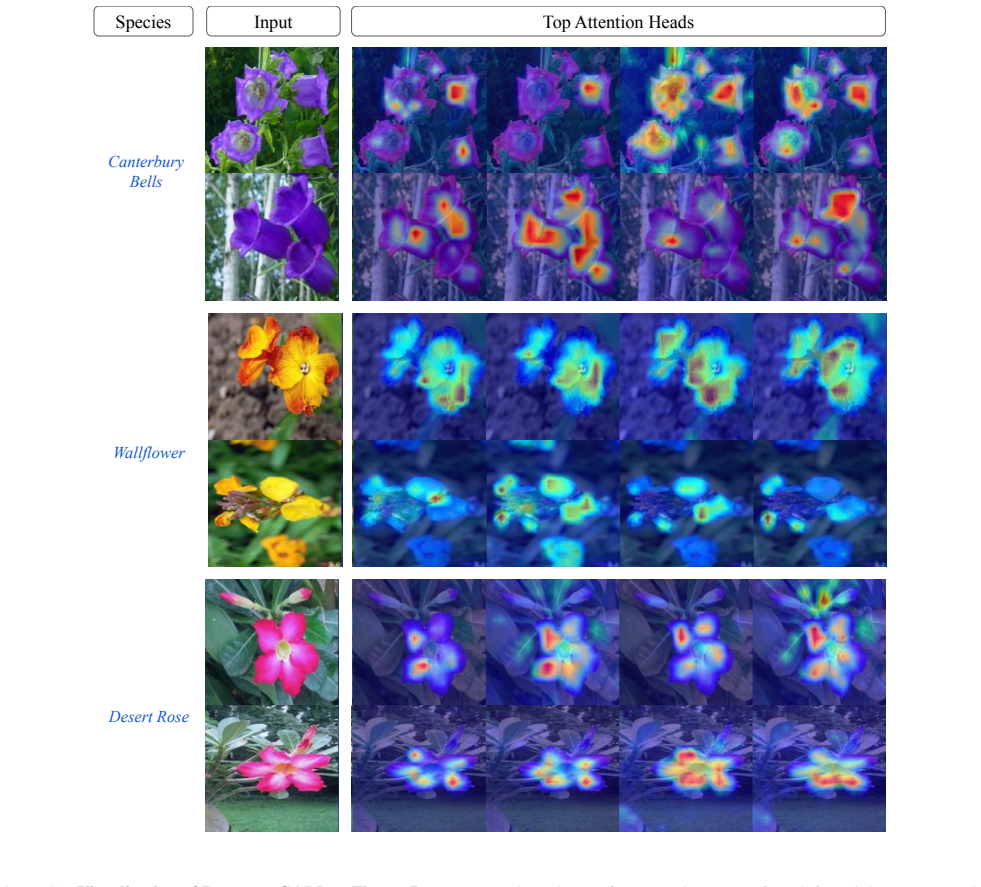
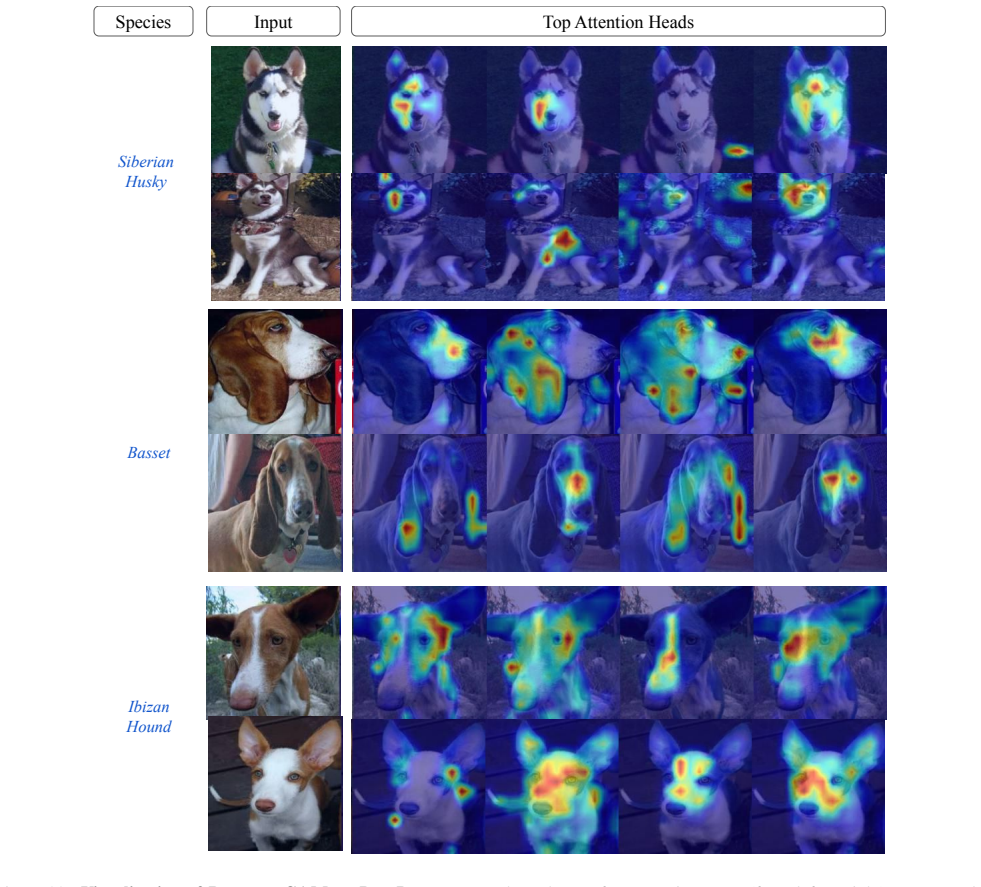
The paper claims that a pre-trained, frozen ViT can deliver interpretable fine-grained classification if classification is done by class-specific prompt tokens scored by a shared vector w. In the simplified single-head picture, replacing the per-class head \(\sum_j \$\alpha$^*[j] (w_c^\top v_j)\) with \(\sum_j \$\alpha$^c[j] (w^\top v_j)\) removes the detour that lets a conventional model store class information in patch values and attend where it likes. With no class-specific \(w_c\), the only way to separate classes is for each prompt's attention \(\$\alpha$^c\) to concentrate on patches that carry the class's traits. The paper argues that after cross-entropy training on a frozen backbone, the true class's multi-head attention maps in the last transformer layer reveal those traits and their locations, and the experiments support this through faithfulness metrics, a human study, trait-manipulation counterfactuals, and hierarchical taxonomy-key discovery.
Load-bearing premise
The load-bearing premise is that conclusions drawn from a stripped-down single-head transformer—where only attention can carry class information—still hold for the full frozen ViT, which has residual connections, MLPs, layer norms, and many heads that could hide class information in patch values or background cues.
Editorial extensions
If this is right
- The true class's multi-head attention maps can be visualized per head, so a single prediction can expose several distinct traits instead of one coarse heatmap.
- Attention maps of other classes' prompts on the same image show which traits are shared between classes, explaining confusions and enabling trait comparison.
- A greedy head-blurring procedure ranks the most discriminative traits per class; the remaining heads highlight what is sufficient for classification.
- When an image is misclassified, comparing the true-class and predicted-class attention maps explains why: traits are invisible, occluded, or the object resembles the wrong class.
- The same recipe extends to hierarchical taxonomy: prompts trained at each tree level localize coarser-to-finer group-level traits.
Reading between the lines
- If the shared-vector mechanism is truly what forces trait-focused attention, then a conventional per-class head on the same prompts should diffuse the attention maps; this is a direct ablation the paper does not report.
- The method suggests a trait-based image retrieval or similarity search: images could be matched by which attention heads fire on the same class-specific traits, not just by global embeddings.
- Applied to non-biological fine-grained domains, the same recipe may expose diagnostic features in medical or industrial imagery, but the paper's evidence is limited to natural-object datasets and human-viewable traits.
- The greedy head-blurring procedure could be turned into a quantitative trait-necessity score per patch, enabling automated trait discovery at scale.
Editorial analysis
A structured set of objections, weighed in public.
Referee Report
Summary. The paper proposes Prompt-CAM, an interpretability method for frozen Vision Transformers in fine-grained classification. It adds C learnable class-specific prompt tokens to the last (or first) transformer layer, computes logits as inner products of the prompt outputs with a single shared vector w, and trains only the prompts and w with cross-entropy. The core claim is that, because the classifier is shared and has no per-class fully connected layer, the true-class prompt must attend to image patches unique to that class ("traits"), so the resulting multi-head attention maps provide faithful trait localization. The paper validates this with insertion/deletion faithfulness scores, a human trait-recognition study, comparisons to other interpretable and explainable methods, a counterfactual trait-removal experiment, and a preliminary hierarchical taxonomy application, across 13 fine-grained datasets and multiple ViT backbones.
Significance. If the central claim holds, Prompt-CAM is a genuinely attractive method: it is simple, training-efficient, requires only frozen pre-trained encoders, and is supported by code and a demo. The empirical scope is unusually broad for an interpretability paper, and the counterfactual red-wing-patch experiment plus the human study are steps in the right direction. The method also connects to an active area of parameter-efficient transfer learning and to biological trait discovery. However, the paper's advertised guarantee that attention maps 'must' point to traits is not established by the theoretical argument in Section 2.5, and the trait-validation evidence is currently too thin to carry the full weight of the claim. With a careful revision of the theoretical claim and additional systematic trait evaluations, this could be a valuable contribution.
major comments (3)
- [2.5, Eq. (7)] The central claim in the Abstract that the true-class prompt "must attend to unique image patches ... (i.e., traits)" is proven only in a stripped-down model that, as the text itself states, omits layer normalization, residual connections, MLP blocks, and self-attention among prompts. In the actual PROMPT-CAM-DEEP forward pass (Eq. (3) plus the final layer LN), the output z_c for class c is not equal to sum_j alpha_c[j] v_j: the prompt's own token survives via the residual connection, it attends to the [CLS] token and to the other C-1 prompts, and the MLP block operates on the residual stream. Therefore w^T z_c can encode class identity through the prompt's own pathway even if every patch attention map alpha_c is uniform, and the "no spatial resolution" argument in Section 2.5 collapses. What is shown is that class-specific attention is a sufficient mechanism in a simplified model, not a necessary one in the full architecture. Please either soften the "must" claim to an "encourages" statement, or provide an empirical test (e.g., setting all patch attention weights to uniform while keeping the prompt's residual and other-token contributions intact and comparing logits) demonstrating that the trait-attention route is the one the trained model actually uses for classification.
- [2.5, Eq. (7); 3.2 human study] Even if attention were the only route to class-discriminative scores, Eq. (7) forces only that alpha_c differ across classes so that the shared inner products w^T v_j are combined class-specifically. It does not force the attended patches to be unique to the class or to correspond to semantically meaningful traits: background, pose, and other class-predictive patches can equally generate class-specific scores. The paper's definition of traits as class-unique patches is thereby made true by construction only if the optimized attention happens to choose such patches, which is not proven. The human study (Supplementary Appendix F) covers only four species and four images per method, and the counterfactual in Figure 8 is a single image, so the evidence for trait localization is anecdotal relative to the breadth of the claim. Please evaluate quantitatively against an external trait or part annotation, e.g., the CUB part attributes the paper already uses or the Fish-Vista trait annotations it cites, reporting hit rates or IoU for the top-ranked attention heads over a large set of images.
- [2.3, D. Inner Workings of Visualization] In the greedy head-blurring algorithm, replacing a head's attention vector with the uniform distribution and recomputing s[c] does not remove the trait from the image; the residual connection, the MLP, and the prompt's own token still contribute to z_c even when the patch attention is uniform. As a result, the logits may remain high even if no patch is effectively attended to, and the ranking of "least important" heads may under-estimate the number of heads that are actually necessary. Please report the relationship between the greedy head rankings and the human/annotation-based trait importance, and state how often the prediction flips when only the retained heads are left active, so the reader can judge whether the retained heads are indeed sufficient.
minor comments (6)
- [Throughout] The method name appears in multiple inconsistent forms, including "P ROMPT -CAM", "PROMPT-CAM", and "Prompt-CAM"; please standardize the typography.
- [1, Introduction] The evaluation dataset list includes "Stanford Cars" twice; please remove the duplicate entry.
- [E.1, Supplementary] The DINOv2 learning-rate description is duplicated verbatim; the second block likely refers to BioCLIP and should state the correct learning rate for that backbone.
- [2.3, Eq. (5)] The uniform-distribution notation "1/M 1" is ambiguous; please introduce a symbol such as u for the uniform vector and write alpha_c,r <- u.
- [Table 2] Accuracy is reported for only four of the thirteen datasets in the main paper; consider moving the fuller accuracy table (Supplementary Table 5) to the main text, since the Abstract emphasizes evaluation on more than a dozen datasets.
- [References] Reference [14] is cited for attention roll-out, but the original attention roll-out method is Abnar and Zuidema [1]; please reconcile the two citations so that credit is given to the original source.
Circularity Check
No significant circularity: Prompt-CAM's trait evaluations are grounded in external CUB annotations and counterfactual tests; the Eq. 7 simplification is a theoretical gap, not a circular derivation.
full rationale
The paper's central derivation (Section 2.5, Eqs. 6-7) is a simplified, self-contained argument about why a shared classifier w discourages class information in patch values. It does not fit parameters to its own outputs or rename a fitted quantity as a prediction. The claim that 'the true-class prompt must attend to unique image patches' is an over-idealization for the full ViT because Eq. 7 explicitly assumes no residual connections, no MLP, and no self-attention among prompts; however, this is a correctness/robustness concern, not a circularity. The interpretability claims are validated independently: the human study compares model heatmaps against external CUB trait annotations, and the counterfactual trait-removal test checks causal sensitivity. Self-citations to INTR and Fish-Vista are present, but they are architectural/dataset references, not load-bearing uniqueness theorems or fitted inputs. The greedy head-blurring algorithm is self-referential in that it uses the model's own predictions to rank heads, but the resulting trait identifications are subsequently checked against external trait knowledge, so the loop is not closed internally. No step in the derivation reduces by construction to its own input, and no fitted parameter is renamed as a prediction. Score 0 reflects the absence of circularity; the Eq. 7 gap should be addressed as a limitation but does not constitute a circular derivation.
Assumptions & free parameters
free parameters (3)
- Class-specific prompts pc =
not reported
- Shared classification vector w =
not reported
- Learning rates per dataset =
0.01/0.1/0.125 (DINO), 0.005/0.01 (DINOv2), 0.05/0.01 (BioCLIP)
assumptions (3)
- domain assumption Frozen pre-trained ViT patch features retain enough spatial, trait-specific information for fine-grained discrimination.
- ad hoc to paper The simplified single-head analysis of Section 2.5 extends to the full ViT with residuals, norm layers, MLPs, and multiple heads.
- domain assumption CUB expert trait annotations are a valid ground truth for trait identification.
Cite this review
Pith. "Pith review of Prompt-CAM: Making Vision Transformers Interpretable for Fine-Grained Analysis." pith.science (2026). https://pith.science/paper/C2QROUHF
@misc{pith2026250109333,
  author       = {Pith},
  title        = {Pith review of: Prompt-CAM: Making Vision Transformers Interpretable for Fine-Grained Analysis},
  year         = {2026},
  howpublished = {\url{https://pith.science/paper/C2QROUHF}},
  note         = {Machine review of arXiv:2501.09333}
}
read the original abstract
We present a simple approach to make pre-trained Vision Transformers (ViTs) interpretable for fine-grained analysis, aiming to identify and localize the traits that distinguish visually similar categories, such as bird species. Pre-trained ViTs, such as DINO, have demonstrated remarkable capabilities in extracting localized, discriminative features. However, saliency maps like Grad-CAM often fail to identify these traits, producing blurred, coarse heatmaps that highlight entire objects instead. We propose a novel approach, Prompt Class Attention Map (Prompt-CAM), to address this limitation. Prompt-CAM learns class-specific prompts for a pre-trained ViT and uses the corresponding outputs for classification. To correctly classify an image, the true-class prompt must attend to unique image patches not present in other classes' images (i.e., traits). As a result, the true class's multi-head attention maps reveal traits and their locations. Implementation-wise, Prompt-CAM is almost a ``free lunch,'' requiring only a modification to the prediction head of Visual Prompt Tuning (VPT). This makes Prompt-CAM easy to train and apply, in stark contrast to other interpretable methods that require designing specific models and training processes. Extensive empirical studies on a dozen datasets from various domains (e.g., birds, fishes, insects, fungi, flowers, food, and cars) validate the superior interpretation capability of Prompt-CAM. The source code and demo are available at https://github.com/Imageomics/Prompt_CAM.
Figures


Figures from the paper (18 more)


Reference graph
Works this paper leans on
-
[1]
Quantifying atten- tion flow in transformers
Samira Abnar and Willem Zuidema. Quantifying atten- tion flow in transformers. arXiv preprint arXiv:2005.00928,
arXiv 2005
-
[2]
Food-101–mining discriminative components with random forests
Lukas Bossard, Matthieu Guillaumin, and Luc Van Gool. Food-101–mining discriminative components with random forests. In Computer vision–ECCV 2014: 13th European conference, zurich, Switzerland, September 6-12, 2014, pro- ceedings, part VI 13, pages 446–461. Springer, 2014. 2, 6
work page 2014
-
[3]
Tom B. Brown, Benjamin Mann, Nick Ryder, Melanie Sub- biah, Jared Kaplan, Prafulla Dhariwal, Arvind Neelakan- tan, Pranav Shyam, Girish Sastry, Amanda Askell, Sand- hini Agarwal, Ariel Herbert-V oss, Gretchen Krueger, Tom Henighan, Rewon Child, Aditya Ramesh, Daniel M. Ziegler, Jeffrey Wu, Clemens Winter, Christopher Hesse, Mark Chen, Eric Sigler, Mateusz...
work page 2020
-
[4]
Emerg- ing properties in self-supervised vision transformers
Mathilde Caron, Hugo Touvron, Ishan Misra, Herv ´e J´egou, Julien Mairal, Piotr Bojanowski, and Armand Joulin. Emerg- ing properties in self-supervised vision transformers. In Pro- ceedings of the International Conference on Computer Vi- sion (ICCV), 2021. 2, 6, 1
work page 2021
-
[5]
Transformer inter- pretability beyond attention visualization
Hila Chefer, Shir Gur, and Lior Wolf. Transformer inter- pretability beyond attention visualization. In Proceedings of the IEEE/CVF conference on computer vision and pattern recognition, pages 782–791, 2021. 2
work page 2021
-
[6]
This looks like that: deep learn- ing for interpretable image recognition
Chaofan Chen, Oscar Li, Daniel Tao, Alina Barnett, Cynthia Rudin, and Jonathan K Su. This looks like that: deep learn- ing for interpretable image recognition. Advances in neural information processing systems, 32, 2019. 2, 1
work page 2019
-
[7]
Vision transformers need registers
Timoth ´ee Darcet, Maxime Oquab, Julien Mairal, and Piotr Bojanowski. Vision transformers need registers. In ICLR,
-
[8]
Robust learning with progressive data expansion against spurious correlation
Yihe Deng, Yu Yang, Baharan Mirzasoleiman, and Quan- quan Gu. Robust learning with progressive data expansion against spurious correlation. Advances in neural information processing systems, 36, 2024. 5
work page 2024
Show all 54 references
-
[9]
An image is worth 16x16 words: Transformers for image recognition at scale
Alexey Dosovitskiy, Lucas Beyer, Alexander Kolesnikov, Dirk Weissenborn, Xiaohua Zhai, Thomas Unterthiner, Mostafa Dehghani, Matthias Minderer, Georg Heigold, Syl- vain Gelly, Jakob Uszkoreit, and Neil Houlsby. An image is worth 16x16 words: Transformers for image recognition ...
2021
-
[10]
Transfg: A trans- former architecture for fine-grained recognition
Ju He, Jie-Neng Chen, Shuai Liu, Adam Kortylewski, Cheng Yang, Yutong Bai, and Changhu Wang. Transfg: A trans- former architecture for fine-grained recognition. In Proceed- ings of the AAAI conference on artificial intelligence , pages 852–860, 2022. 2
2022
-
[11]
The spectre of ‘spurious’ correlations
Darneisha A Jackson and Keith M Somers. The spectre of ‘spurious’ correlations. Oecologia, 86:147–151, 1991. 5
1991
-
[12]
Vi- sual prompt tuning
Menglin Jia, Luming Tang, Bor-Chun Chen, Claire Cardie, Serge Belongie, Bharath Hariharan, and Ser-Nam Lim. Vi- sual prompt tuning. In European Conference on Computer Vision, pages 709–727. Springer, 2022. 2, 3, 4, 1
2022
-
[13]
Layercam: Exploring hierarchical class activation maps for localization
Peng-Tao Jiang, Chang-Bin Zhang, Qibin Hou, Ming-Ming Cheng, and Yunchao Wei. Layercam: Exploring hierarchical class activation maps for localization. IEEE Transactions on Image Processing, 30:5875–5888, 2021. 2, 6
2021
-
[14]
Explainability of vision transform- ers: A comprehensive review and new perspectives
Rojina Kashefi, Leili Barekatain, Mohammad Sabokrou, and Fatemeh Aghaeipoor. Explainability of vision transform- ers: A comprehensive review and new perspectives. arXiv preprint arXiv:2311.06786, 2023. 2, 6
2023 arXiv
-
[15]
Novel dataset for fine-grained image categorization: Stanford dogs
Aditya Khosla, Nityananda Jayadevaprakash, Bangpeng Yao, and Fei-Fei Li. Novel dataset for fine-grained image categorization: Stanford dogs. In Proceedings CVPR work- shop on fine-grained visual categorization (FGVC), 2011. 2, 6
2011
-
[16]
3d object representations for fine-grained categorization
Jonathan Krause, Michael Stark, Jia Deng, and Li Fei-Fei. 3d object representations for fine-grained categorization. In Proceedings of the IEEE international conference on com- puter vision workshops, pages 554–561, 2013. 2, 6
2013
-
[17]
Transcam: Transformer attention-based cam refinement for weakly supervised semantic segmentation
Ruiwen Li, Zheda Mai, Zhibo Zhang, Jongseong Jang, and Scott Sanner. Transcam: Transformer attention-based cam refinement for weakly supervised semantic segmentation. Journal of Visual Communication and Image Representation, 92:103800, 2023. 2
2023
-
[18]
Re- moteclip: A vision language foundation model for remote sensing
Fan Liu, Delong Chen, Zhangqingyun Guan, Xiaocong Zhou, Jiale Zhu, Qiaolin Ye, Liyong Fu, and Jun Zhou. Re- moteclip: A vision language foundation model for remote sensing. IEEE Transactions on Geoscience and Remote Sensing, 2024. 1
2024
-
[19]
Visual instruction tuning
Haotian Liu, Chunyuan Li, Qingyang Wu, and Yong Jae Lee. Visual instruction tuning. In Advances in neural information processing systems, 2024. 1
2024
-
[20]
Query2label: A simple transformer way to multi-label clas- sification
Shilong Liu, Lei Zhang, Xiao Yang, Hang Su, and Jun Zhu. Query2label: A simple transformer way to multi-label clas- sification. arXiv preprint arXiv:2107.10834, 2021. 2, 3
2021 arXiv
-
[21]
This looks like those: Illuminating prototypical con- cepts using multiple visualizations
Chiyu Ma, Brandon Zhao, Chaofan Chen, and Cynthia Rudin. This looks like those: Illuminating prototypical con- cepts using multiple visualizations. Advances in Neural In- formation Processing Systems, 36, 2024. 6, 1, 8
2024
-
[22]
Fine-tuning is fine, if cal- ibrated
Zheda Mai, Arpita Chowdhury, Ping Zhang, Cheng-Hao Tu, Hong-You Chen, Vardaan Pahuja, Tanya Berger-Wolf, Song Gao, Charles Stewart, Yu Su, et al. Fine-tuning is fine, if cal- ibrated. In The Thirty-eighth Annual Conference on Neural Information Processing Systems, 2024. 1
2024
-
[23]
Lessons learned from a unifying empirical study of parameter-efficient transfer learning (petl) in visual recognition
Zheda Mai, Ping Zhang, Cheng-Hao Tu, Hong-You Chen, Li Zhang, and Wei-Lun Chao. Lessons learned from a unifying empirical study of parameter-efficient transfer learning (petl) in visual recognition. arXiv preprint arXiv:2409.16434 ,
-
[24]
Fish-vista: A multi-purpose dataset for understanding & identification of traits from images
Kazi Sajeed Mehrab, M Maruf, Arka Daw, Harish Babu Manogaran, Abhilash Neog, Mridul Khurana, Bahadir Al- tintas, Yasin Bakis, Elizabeth G Campolongo, Matthew J Thompson, et al. Fish-vista: A multi-purpose dataset for understanding & identification of traits from images. arXiv ...
2024 arXiv
-
[25]
Eigen-cam: Class activation map using principal compo- nents
Mohammed Bany Muhammad and Mohammed Yeasin. Eigen-cam: Class activation map using principal compo- nents. In 2020 international joint conference on neural net- works (IJCNN), pages 1–7. IEEE, 2020. 2, 6, 1
2020
-
[26]
Neural prototype trees for interpretable fine-grained image recogni- tion
Meike Nauta, Ron Van Bree, and Christin Seifert. Neural prototype trees for interpretable fine-grained image recogni- tion. In Proceedings of the IEEE/CVF conference on com- puter vision and pattern recognition , pages 14933–14943,
-
[27]
Dreamcreature: Crafting photorealistic virtual creatures from imagination
Kam Woh Ng, Xiatian Zhu, Yi-Zhe Song, and Tao Xi- ang. Dreamcreature: Crafting photorealistic virtual creatures from imagination. arXiv preprint arXiv:2311.15477, 2023. 2
2023 arXiv
-
[28]
Automated flower classification over a large number of classes
Maria-Elena Nilsback and Andrew Zisserman. Automated flower classification over a large number of classes. In 2008 Sixth Indian conference on computer vision, graphics & im- age processing, pages 722–729. IEEE, 2008. 2, 6
2008
-
[29]
Maxime Oquab, Timoth ´ee Darcet, Theo Moutakanni, Huy V . V o, Marc Szafraniec, Vasil Khalidov, Pierre Fernandez, Daniel Haziza, Francisco Massa, Alaaeldin El-Nouby, Rus- sell Howes, Po-Yao Huang, Hu Xu, Vasu Sharma, Shang- Wen Li, Wojciech Galuba, Mike Rabbat, Mido Assran, Ni...
2023
-
[30]
Cats and dogs
Omkar M Parkhi, Andrea Vedaldi, Andrew Zisserman, and CV Jawahar. Cats and dogs. In 2012 IEEE conference on computer vision and pattern recognition, pages 3498–3505,
2012
-
[31]
A simple interpretable transformer for fine-grained image classifica- tion and analysis
Dipanjyoti Paul, Arpita Chowdhury, Xinqi Xiong, Feng-Ju Chang, David Carlyn, Samuel Stevens, Kaiya Provost, Anuj Karpatne, Bryan Carstens, Daniel Rubenstein, Charles Stew- art, Tanya Berger-Wolf, Yu Su, and Wei-Lun Chao. A simple interpretable transformer for fine-grained imag...
2024
-
[32]
Rise: Randomized input sampling for explanation of black-box models
V Petsiuk, A Das, and K Saenko. Rise: Randomized input sampling for explanation of black-box models. arxiv 2018. arXiv preprint arXiv:1806.07421, 1806. 6
2018 arXiv
-
[33]
Birds 525 species - image classification
Gerald Piosenka. Birds 525 species - image classification
-
[34]
Attention-based interpretabil- ity with concept transformers
Mattia Rigotti, Christoph Miksovic, Ioana Giurgiu, Thomas Gschwind, and Paolo Scotton. Attention-based interpretabil- ity with concept transformers. In International conference on learning representations, 2021. 1
2021
-
[35]
High-resolution image synthesis with latent diffusion models
Robin Rombach, Andreas Blattmann, Dominik Lorenz, Patrick Esser, and Bj ¨orn Ommer. High-resolution image synthesis with latent diffusion models. In Proceedings of the IEEE/CVF conference on computer vision and pattern recognition, pages 10684–10695, 2022. 1
2022
-
[36]
Medicinal Leaf Dataset, 2020
Roopashree S and Anitha J. Medicinal Leaf Dataset, 2020. Mendeley Data, V1. 2, 6
2020
-
[37]
Grad-cam: Visual explanations from deep networks via gradient-based localization
Ramprasaath R Selvaraju, Michael Cogswell, Abhishek Das, Ramakrishna Vedantam, Devi Parikh, and Dhruv Batra. Grad-cam: Visual explanations from deep networks via gradient-based localization. In Proceedings of the IEEE in- ternational conference on computer vision , pages 618–626,
-
[38]
Bioclip: A vision foundation model for the tree of life
Samuel Stevens, Jiaman Wu, Matthew J Thompson, Eliza- beth G Campolongo, Chan Hee Song, David Edward Carlyn, Li Dong, Wasila M Dahdul, Charles Stewart, Tanya Berger- Wolf, et al. Bioclip: A vision foundation model for the tree of life. In Proceedings of the IEEE/CVF Conference...
-
[39]
Emergent correspondence from image diffusion
Luming Tang, Menglin Jia, Qianqian Wang, Cheng Perng Phoo, and Bharath Hariharan. Emergent correspondence from image diffusion. Advances in Neural Information Pro- cessing Systems, 36:1363–1389, 2023. 2
2023
-
[40]
Weakly supervised posture mining for fine-grained classi- fication
Zhenchao Tang, Hualin Yang, and Calvin Yu-Chian Chen. Weakly supervised posture mining for fine-grained classi- fication. In Proceedings of the IEEE/CVF Conference on Computer Vision and Pattern Recognition , pages 23735– 23744, 2023. 2
2023
-
[41]
Rare Species Dataset, 2023
Imageomics Team. Rare Species Dataset, 2023. Dataset with 400 classes of rare species images and descriptions sourced from the Encyclopedia of Life and the IUCN Red List. 2, 6
2023
-
[42]
Visual query tuning: Towards effective usage of intermediate representa- tions for parameter and memory efficient transfer learning
Cheng-Hao Tu, Zheda Mai, and Wei-Lun Chao. Visual query tuning: Towards effective usage of intermediate representa- tions for parameter and memory efficient transfer learning. In Proceedings of the IEEE/CVF Conference on Computer Vision and Pattern Recognition, pages 7725–7735...
2023
-
[43]
Benchmarking rep- resentation learning for natural world image collections
Grant Van Horn, Elijah Cole, Sara Beery, Kimberly Wilber, Serge Belongie, and Oisin Mac Aodha. Benchmarking rep- resentation learning for natural world image collections. In Proceedings of the IEEE/CVF conference on computer vi- sion and pattern recognition, pages 12884–12893,...
2021
-
[44]
Gomez, Łukasz Kaiser, and Illia Polosukhin
Ashish Vaswani, Noam Shazeer, Niki Parmar, Jakob Uszko- reit, Llion Jones, Aidan N. Gomez, Łukasz Kaiser, and Illia Polosukhin. Attention is all you need. In Proceedings of the 31st International Conference on Neural Information Pro- cessing Systems, page 6000–6010, 2017. 3
2017
-
[45]
The caltech-ucsd birds-200-2011 dataset
Catherine Wah, Steve Branson, Peter Welinder, Pietro Per- ona, and Serge Belongie. The caltech-ucsd birds-200-2011 dataset. 2011. 2, 6
2011
-
[46]
Score-cam: Score-weighted visual explanations for convolutional neural networks
Haofan Wang, Zifan Wang, Mengnan Du, Fan Yang, Zijian Zhang, Sirui Ding, Piotr Mardziel, and Xia Hu. Score-cam: Score-weighted visual explanations for convolutional neural networks. In Proceedings of the IEEE/CVF conference on computer vision and pattern recognition workshops ...
2020
-
[47]
Interpretable image recognition by constructing transparent embedding space
Jiaqi Wang, Huafeng Liu, Xinyue Wang, and Liping Jing. Interpretable image recognition by constructing transparent embedding space. In Proceedings of the IEEE/CVF interna- tional conference on computer vision, pages 895–904, 2021. 6, 1, 8 10
2021
-
[48]
Open-set fine-grained retrieval via prompting vision-language evaluator
Shijie Wang, Jianlong Chang, Haojie Li, Zhihui Wang, Wanli Ouyang, and Qi Tian. Open-set fine-grained retrieval via prompting vision-language evaluator. In Proceedings of the IEEE/CVF Conference on Computer Vision and Pattern Recognition, pages 19381–19391, 2023. 2
2023
-
[49]
Ip102: A large-scale benchmark dataset for insect pest recognition
Xiaoping Wu, Chi Zhan, Yu-Kun Lai, Ming-Ming Cheng, and Jufeng Yang. Ip102: A large-scale benchmark dataset for insect pest recognition. In Proceedings of the IEEE/CVF conference on computer vision and pattern recognition , pages 8787–8796, 2019. 2, 6
2019
-
[50]
Multi-class token transformer for weakly supervised semantic segmentation
Lian Xu, Wanli Ouyang, Mohammed Bennamoun, Farid Boussaid, and Dan Xu. Multi-class token transformer for weakly supervised semantic segmentation. In Proceedings of the IEEE/CVF conference on computer vision and pattern recognition, pages 4310–4319, 2022. 2, 3
2022
-
[51]
Protopformer: Concentrating on prototypical parts in vision transform- ers for interpretable image recognition
Mengqi Xue, Qihan Huang, Haofei Zhang, Lechao Cheng, Jie Song, Minghui Wu, and Mingli Song. Protopformer: Concentrating on prototypical parts in vision transform- ers for interpretable image recognition. arXiv preprint arXiv:2208.10431, 2022. 6, 1
2022
-
[52]
Learning deep features for discrimina- tive localization
Bolei Zhou, Aditya Khosla, Agata Lapedriza, Aude Oliva, and Antonio Torralba. Learning deep features for discrimina- tive localization. In Proceedings of the IEEE conference on computer vision and pattern recognition, pages 2921–2929,
-
[53]
Learning to prompt for vision-language models
Kaiyang Zhou, Jingkang Yang, Chen Change Loy, and Ziwei Liu. Learning to prompt for vision-language models. In- ternational Journal of Computer Vision, 130(9):2337–2348,
-
[54]
learnable prototypes
Haowei Zhu, Wenjing Ke, Dong Li, Ji Liu, Lu Tian, and Yi Shan. Dual cross-attention learning for fine-grained visual categorization and object re-identification. In Proceedings of the IEEE/CVF conference on computer vision and pattern recognition, pages 4692–4702, 2022. 2 11 P...
2022
Reviewed August 10, 2026 · model on record in the stance chip above.
Discussion (0). Continue with ORCID to comment.