REVIEW 6 major objections 5 minor 32 references
Metric Learning with Progressive Self-Distillation for Audio-Visual Embedding Learning
T0 review · 6 major / 5 minor · reviewed 2026-08-10 · deepseek-v4-flash
Pith's one-line read This paper claims that integrating cross-modal triplet loss with progressive self-distillation, where a model generates soft audio-visual alignment labels for the unlabeled part of each batch and then gradually relies on those labels…
desk verdict Plausible incremental idea undone by an undefined core equation; needs a major rewrite before it can be evaluated. read the letter →
The pith
A machine-rendered reading of the paper's core claim, the machinery that carries it, and where it could break.
The reading
What carries the argument
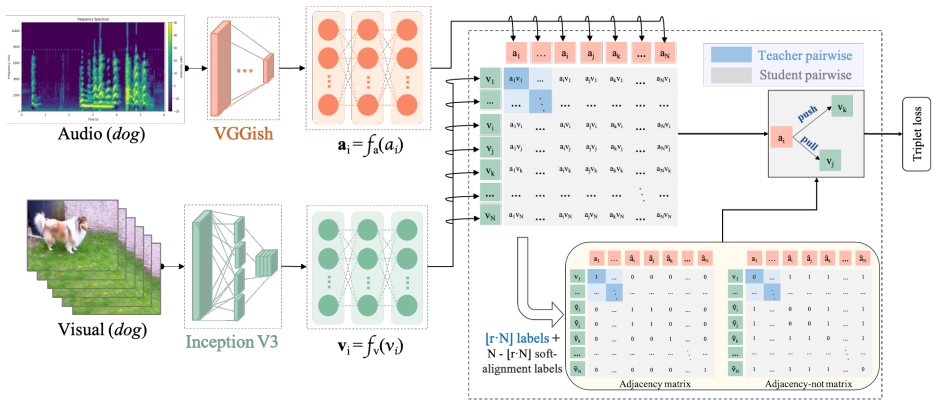
The load-bearing object is the soft-alignment label: a probability distribution over the other modality computed as the softmax of a cross-modal similarity matrix (Equations 1-2), which replaces hard positive and negative choices with probabilistic ones. The cross-modal triplet loss in Equation 3 uses these soft labels through an adjacency matrix and its complement, and it is combined with the AA anchor-aware proxy from the baseline method. The progressive schedule on the partition ratio $r$, which shrinks the labeled subset from all samples to 20% of each batch, is what converts the network into its own teacher. These pieces together turn fixed annotated categories into a continuously refined soft structure between audio and visual samples.
What would settle it
Fix a copy of the teacher every few epochs so that the student's loss on unlabeled samples never changes the network generating the soft labels. If average MAP stays at 0.908 on AVE and 0.914 on VEGAS, the progressive self-distillation story is supported; if it falls back to the previous best of 0.887 and 0.896, the reported gain comes from reusing the model's own current predictions rather than from a genuine teacher-student separation.
Extended reading notes
Core claim
The authors' central claim is that probabilistic soft alignments between audio and visual samples, generated by the model itself from a labeled subset of each batch, carry information beyond the fixed labels and improve cross-modal retrieval. The teacher network produces label distributions $L_a = \sigma(\hat{V}\hat{A}^T)$ and $L_v = \sigma(\hat{A}\hat{V}^T)$; these distributions are converted into an adjacency matrix $A$ and its complement $\bar{A}$ that decide which visual samples act as soft positives and soft negatives for each audio anchor. Those soft triplets are optimized with the AA proxy of the anchor-aware metric learning baseline, while an additional loss pulls each audio-visual pair together and a label-space loss keeps the projected features aligned with label representations. The proportion $r$ of labeled samples per batch decreases stepwise from 1.0 to 0.2, so the network gradually supervises itself on a larger fraction of each batch. On the AVE and VEGAS benchmarks the resulting MAP values are 0.908 and 0.914 on average, exceeding the previous best values of 0.887 and 0.896.
Load-bearing premise
The method assumes the same network's current predictions are reliable enough to supervise itself on the unlabeled part of each batch, and the paper does not say whether the training signal from those unlabeled samples is blocked from updating the teacher that produced the soft labels.
Editorial extensions
If this is right
- On AVE, average MAP rises from 0.887 to 0.908, an improvement of 2.13% over the previous best method.
- On VEGAS, average MAP rises from 0.896 to 0.914, an improvement of 1.82% over the previous best method.
- Ablations show that all three components matter: removing the cross-modal dependency loss, the self-distillation, or the AA proxy each lowers average MAP on AVE.
- The stepwise decay of the labeled fraction outperforms both linear and cosine-annealing schedules for the partition ratio.
Reading between the lines
- A natural extension is to apply the same progressive self-distillation to other modality pairs, such as image-text retrieval, since the soft-alignment construction does not depend on audio- or visual-specific details.
- The paper does not report a variant that stops gradients from the student loss before they reach the teacher that generates the soft labels; testing such a variant would clarify whether the gain comes from self-distillation or from using the model's current predictions as smoothed targets.
- Because the soft labels are produced by a softmax over the whole batch, the method's behavior may change with batch size; sweeping batch size could reveal whether the improvement is partly a high-batch-size effect.
Editorial analysis
A structured set of objections, weighed in public.
Referee Report
Summary. The paper proposes a metric-learning method for audio-visual embedding that combines a cross-modal triplet loss with progressive self-distillation. In each batch, a subset N1 is trained with ground-truth labels, and the resulting model generates soft-alignment labels for the remaining subset N2; these soft labels are then used to construct soft cross-modal triplets that supervise the model on N2. The partition ratio r decreases during training so that the model gradually becomes its own teacher. The final objective combines a label-embedding loss, the soft cross-modal triplet loss, and a cross-modal dependency loss. Experiments on the AVE and VEGAS datasets report improvements over prior methods in average MAP, and ablation studies examine the effect of the dependency loss, the AA proxy, and the decay schedule.
Significance. The problem addressed is relevant: audio-visual metric learning is often limited by rigid label-based sampling, and using learned soft alignments to construct triplets is a plausible way to exploit distributional structure beyond labels. If the method were fully specified and reproducible, the reported consistent gains over the strong AADML baseline and the accompanying ablations would make a useful contribution. The paper also has strengths in experimental breadth: it compares against nine methods, reports results on two datasets, and includes ablation variants that isolate the contributions of ldis, self-distillation, the AA proxy, and the decay schedule. However, as written, the central formulation is not executable from the text because Eq. (1) is dimensionally inconsistent, Eq. (2) has an indexing inconsistency, the AA proxy in Eq. (3) is not defined, and the teacher-student gradient flow is unspecified. These issues are load-bearing for the claimed state-of-the-art results, so the contribution is currently conditional on a substantial rewrite of the method section.
major comments (6)
- [Section III.B, Eq. (1)] The soft-alignment construction is undefined as written. The text states that the audio logits are A-hat in R^{N x 128} and the visual logits are V-hat in R^{N x 1024}. The first equation, La = sigma(V-hat * A-hat^T), is the product of an N x 1024 matrix with a 128 x N matrix, whose inner dimensions 1024 and 128 do not match. The analogous product Lv = sigma(A-hat * V-hat^T) is also invalid. The paper later says the projected features have dimension equal to the number of labels (c = 15 or c = 10), but Eq. (1) does not use such a projection and none is defined. Since these soft labels determine the positive and negative visual samples in the core triplet loss Eq. (3), the method cannot be implemented or evaluated from the paper as it stands.
- [Section III.B, Eq. (2)] The indexing in Eq. (2) is internally inconsistent with the surrounding text. The text says 'L^a_i refers to the i-th column of L^a and L^v_j corresponds to the j-th row of L^v', but the displayed equation uses argmax(L^a_j) and argmax(L^v_i). If L^a and L^v are N x N matrices, then the row/column convention determines which sample is the anchor and which is the candidate positive or negative; swapping the indices changes the meaning of the adjacency matrix. The notation must be made consistent, and the dimensions of L^a and L^v should be stated explicitly.
- [Section III.C] The teacher-student gradient flow is not specified. The paper says the teacher network generates soft-alignment labels for the unlabeled subset N2 and that these labels supervise the student, but it never states whether gradients from the student loss on N2 are stopped from updating the teacher, whether an EMA teacher is used, or whether the teacher and student share parameters. If the same network is updated by the student loss, the soft labels are simply the model's current predictions and the method reduces to self-training with pseudo-labels, which can reinforce errors. The authors should specify the gradient flow and, ideally, add an ablation that detaches the teacher's labels or uses a momentum teacher to demonstrate that the reported gains are not an artifact of this choice.
- [Section III.B, Eq. (3)] The AA(·) proxy is cited to reference [27] but is never defined. Since the triplet loss is computed on AA(a_i), AA(v_+_i), and AA(v_-_i), the representation used for distance computation is not specified. Without a definition of AA(·), Eq. (3) is incomplete and the reader cannot reproduce the training procedure or understand the contribution of the AA proxy beyond the citation.
- [Section III.C, Eq. (4)] The final loss includes llab = 1/n ||f_a(a_i) - Y(a_i)||_F + 1/n ||f_v(v_i) - Y(v_i)||_F, but the notation is ambiguous. It uses n instead of the batch size N used elsewhere, and it does not specify whether f_a(a_i) and f_v(v_i) are raw features, projected features, or output logits. The term Y(a_i) is called 'label representations' but is not defined; it is unclear whether this is a one-hot vector, a label embedding, or something else. Since this loss is part of the final objective that produces the reported results, the notation must be clarified.
- [Section IV.C, Table I] The empirical central claim is based on improvements of 1.9-2.4 percentage points in MAP, but the paper reports no error bars, no number of runs, and no significance tests. Given that the gains over AADML are modest in absolute terms, the authors should report the mean and standard deviation over multiple seeds, or at least provide a clear statement that the table reports a single run. Without this information, the claim of state-of-the-art performance is not statistically supported.
minor comments (5)
- [Abstract] The abstract contains the typo 'probabilistic aligns' where 'probabilistic alignments' is intended.
- [Section III.A] The notation for the dataset is typeset awkwardly as '{(a_i, v_i)}n-1_i=0'; standard set notation would be clearer, e.g., D = {(a_i, v_i)}_{i=0}^{n-1}.
- [Section IV.B] The implementation section states that the dimensionality of the projected features matches the number of labels, but it does not reconcile this with Eq. (1), where the logits are described as having dimensions 128 and 1024. This ambiguity should be resolved in the rewritten method section.
- [Section IV.D.1, Fig. 3] The caption and text refer to comparisons of loss and MAP over epochs, but the figure is not described clearly; the reader cannot tell which curves correspond to which model or what metric is plotted on each axis.
- [References] Several references are formatted inconsistently (e.g., volume and page ranges are not uniform), and reference [30] is used for the data partitioning and feature extraction details, but the paper does not summarize those details in the text; a brief description would improve self-containedness.
Circularity Check
Soft-alignment labels are produced by and then supervise the same network, making the 'distilled knowledge' the model's own current predictions.
-
self definitional
[Section III.B (Eq. (1)) and Section III.C, with Eq. (4); cf. Abstract]
"Soft-alignment labels are generated by the teacher model trained on a subset of every batch. The teacher model consists of audio and visual encoders fa(·) and fv(·), the output logits ˆA = {ˆai} ∈RN ×128 and ˆV = {ˆvi} ∈RN ×1024 used to produce soft-alignment label distributions La and Lv, which defined as: La = σ( ˆV · ˆAT ) and Lv = σ( ˆA · ˆV T ) (1) ... The teacher network then generates soft-alignment labels for the subset N2, which are used to supervise its own student model."
The soft-alignment labels in Eq. (1) are not external annotations: they are computed by applying softmax to the outputs of the same encoders fa and fv that the final loss (Eqs. (3)-(4)) optimizes. Section III.C describes no separate teacher network, no EMA teacher, and no stop-gradient for the student loss, so the 'teacher' and 'student' share parameters by construction. Thus the labels used to select v+ and v- in Eq. (3) are a function of the current model, and the student objective on the unlabeled subset fits the model to its own predictions. The method is therefore self-training/pseudo-labeling: the claimed 'self-distilled knowledge' reduces to the model's own output.
full rationale
The paper's headline SOTA claim is an empirical result on held-out AVE and VEGAS test partitions, compared against published baselines; that comparison is not equivalent to the training objective by construction, so this is not a case where the 'prediction' is the fit itself. The one genuinely circular-adjacent element is the progressive self-distillation mechanism: the teacher that generates soft-alignment labels is the same network being trained, and the paper never specifies an EMA copy or gradient stopping. Consequently the soft targets are current model outputs, and the student loss on the unlabeled subset is a self-training loop. This is a real self-referentiality in the method's derivation, but because the evaluation is external and the ablation shows the components contribute, the central empirical claim still has independent content; score 4. Separately, Eq. (1) as printed has mismatched inner dimensions (V-hat is N x 1024 and A-hat is N x 128, so V-hat * A-hat^T is undefined), and Eq. (2)'s index conventions conflict with its text; these are executability/correctness defects, not circularity, so they are noted here but not counted as circular steps. The AA proxy is taken from the authors' prior work [27] and is load-bearing in Eq. (3), but it is externally defined and ablated, so it is a normal self-citation rather than circularity.
Assumptions & free parameters
free parameters (3)
- labeled fraction schedule r =
start 1.0, end 0.2, step-wise
- triplet margin alpha =
1.2
- loss weighting =
equal weights (1.0 each) for llab, lcross, ldis
assumptions (3)
- domain assumption Audio and visual modalities share identical semantic information
- ad hoc to paper The model's own current predictions are a reliable source of training supervision
- domain assumption Softmax-normalized similarity scores represent meaningful alignment probabilities
Cite this review
Pith. "Pith review of Metric Learning with Progressive Self-Distillation for Audio-Visual Embedding Learning." pith.science (2026). https://pith.science/paper/5WQRIDBZ
@misc{pith2026250109608,
  author       = {Pith},
  title        = {Pith review of: Metric Learning with Progressive Self-Distillation for Audio-Visual Embedding Learning},
  year         = {2026},
  howpublished = {\url{https://pith.science/paper/5WQRIDBZ}},
  note         = {Machine review of arXiv:2501.09608}
}
read the original abstract
Metric learning projects samples into an embedded space, where similarities and dissimilarities are quantified based on their learned representations. However, existing methods often rely on label-guided representation learning, where representations of different modalities, such as audio and visual data, are aligned based on annotated labels. This approach tends to underutilize latent complex features and potential relationships inherent in the distributions of audio and visual data that are not directly tied to the labels, resulting in suboptimal performance in audio-visual embedding learning. To address this issue, we propose a novel architecture that integrates cross-modal triplet loss with progressive self-distillation. Our method enhances representation learning by leveraging inherent distributions and dynamically refining soft audio-visual alignments -- probabilistic alignments between audio and visual data that capture the inherent relationships beyond explicit labels. Specifically, the model distills audio-visual distribution-based knowledge from annotated labels in a subset of each batch. This self-distilled knowledge is used t
Figures


Reference graph
Works this paper leans on
-
[27]
Anchor-aware deep metric learning for audio-visual retrieval
Donghuo Zeng, Yanan Wang, Kazushi Ikeda, and Yi Yu. Anchor-aware deep metric learning for audio-visual retrieval. In Proceedings of the 2024 International Conference on Multimedia Retrieval, pages 211–219, 2024
work page 2024
-
[1]
Deep canonical correlation analysis
Galen Andrew, Raman Arora, Jeff Bilmes, and Karen Livescu. Deep canonical correlation analysis. In Proceedings of the 30th International Conference on Machine Learning , volume V ol.28 of Proceedings of Machine Learning Research , pages pp.1247–1255, Atlanta, Georgia, USA, 17–19 Jun 2013. PMLR
work page 2013
-
[2]
Canonical correlation analysis: An overview with application to learning methods
Hardoon David, R., Szedm ´ak S´andor, and Shawe-Taylor John. Canonical correlation analysis: An overview with application to learning methods. Neural Computation., V ol.16(no.12):pp.2639–2664, 2004
work page 2004
-
[3]
Tommaso Furlanello, Zachary Lipton, Michael Tschannen, Laurent Itti, and Anima Anandkumar. Born again neural networks. In International conference on machine learning , pages 1607–1616. PMLR, 2018
work page 2018
-
[4]
Knowledge distillation: A survey
Jianping Gou, Baosheng Yu, Stephen J Maybank, and Dacheng Tao. Knowledge distillation: A survey. International Journal of Computer Vision, 129(6):1789–1819, 2021
2021
-
[5]
Self-Knowledge Distillation in Natural Language Processing
Sangchul Hahn and Heeyoul Choi. Self-knowledge distillation in natural language processing. arXiv preprint arXiv:1908.01851 , 2019
work page Pith review arXiv 1908
-
[6]
In defense of the triplet loss for person re-identification
Alexander Hermans, Lucas Beyer, and Bastian Leibe. In defense of the triplet loss for person re-identification. arXiv preprint arXiv:1703.07737, 2017
arXiv 2017
-
[7]
Distilling the knowledge in a neural network
Geoffrey Hinton. Distilling the knowledge in a neural network. arXiv preprint arXiv:1503.02531, 2015
arXiv 2015
Show all 32 references
-
[8]
Deep metric learning using triplet network
Elad Hoffer and Nir Ailon. Deep metric learning using triplet network. In Similarity-Based Pattern Recognition: Third International Workshop, SIMBAD 2015, Copenhagen, Denmark, October 12-14, 2015. Proceed- ings 3, pages 84–92. Springer, 2015
2015
-
[9]
Adam: A method for stochastic optimization
Diederik P Kingma and Jimmy Ba. Adam: A method for stochastic optimization. arXiv preprint arXiv:1412.6980 , 2014
2014 arXiv
-
[10]
Metric learning: A survey
Brian Kulis et al. Metric learning: A survey. Foundations and Trends® in Machine Learning , 5(4):287–364, 2013
2013
-
[11]
Kernel and nonlinear canonical correlation analysis
Pei Ling Lai and Colin Fyfe. Kernel and nonlinear canonical correlation analysis. Int. J. Neural Syst. , V ol.10(no.5):pp.365–377, 2000
2000
-
[12]
Rank-based distance metric learning: An application to image retrieval
Jung-Eun Lee, Rong Jin, and Anil K Jain. Rank-based distance metric learning: An application to image retrieval. In 2008 IEEE Conference on Computer Vision and Pattern Recognition , pages 1–8. IEEE, 2008
2008
-
[13]
Neighborhood- adaptive structure augmented metric learning
Pandeng Li, Yan Li, Hongtao Xie, and Lei Zhang. Neighborhood- adaptive structure augmented metric learning. In Proceedings of the AAAI Conference on Artificial Intelligence , volume 36, pages 1367– 1375, 2022
2022
-
[14]
Few sample knowledge distillation for efficient network compression
Tianhong Li, Jianguo Li, Zhuang Liu, and Changshui Zhang. Few sample knowledge distillation for efficient network compression. In Proceedings of the IEEE/CVF conference on computer vision and pattern recognition, pages 14639–14647, 2020
2020
-
[15]
Similarity metric learning for a variable-kernel classifier
David G Lowe. Similarity metric learning for a variable-kernel classifier. Neural computation, 7(1):72–85, 1995
1995
-
[16]
Cluster canonical correlation analysis
Nikhil Rasiwasia, Dhruv Mahajan, Vijay Mahadevan, and Gaurav Ag- garwal. Cluster canonical correlation analysis. In Proceedings of the Seventeenth International Conference on Artificial Intelligence and Statistics, pages pp.823–831, Reykjavik, Iceland, 2014. JMLR.org
2014
-
[17]
An overview of gradient descent optimization algo- rithms
Sebastian Ruder. An overview of gradient descent optimization algo- rithms. arXiv preprint arXiv:1609.04747 , 2016
2016 arXiv
-
[18]
Audio-visual event localization in unconstrained videos
Yapeng Tian, Jing Shi, Bochen Li, Zhiyao Duan, and Chenliang Xu. Audio-visual event localization in unconstrained videos. In Computer Vision - ECCV 2018 - 15th European Conference , volume V ol.11206 of Lecture Notes in Computer Science , pages pp.252–268, Munich, Germany, 201...
2018
-
[19]
It takes two to tango: Mixup for deep metric learning
Shashanka Venkataramanan, Bill Psomas, Ewa Kijak, Laurent Amsaleg, Konstantinos Karantzalos, and Yannis Avrithis. It takes two to tango: Mixup for deep metric learning. arXiv preprint arXiv:2106.04990, 2021
2021 arXiv
-
[20]
Hyperml: A boosting metric learning approach in hyperbolic space for recommender systems
Lucas Vinh Tran, Yi Tay, Shuai Zhang, Gao Cong, and Xiaoli Li. Hyperml: A boosting metric learning approach in hyperbolic space for recommender systems. In Proceedings of the 13th international conference on web search and data mining , pages 609–617, 2020
2020
-
[21]
Videoadviser: Video knowledge distillation for multimodal transfer learning
Yanan Wang, Donghuo Zeng, Shinya Wada, and Satoshi Kurihara. Videoadviser: Video knowledge distillation for multimodal transfer learning. IEEE Access, 2023
2023
-
[22]
Distance metric learning for large margin nearest neighbor classification
Kilian Q Weinberger, John Blitzer, and Lawrence Saul. Distance metric learning for large margin nearest neighbor classification. Advances in neural information processing systems , 18, 2005
2005
-
[23]
Distance metric learning with application to clustering with side-information
Eric Xing, Michael Jordan, Stuart J Russell, and Andrew Ng. Distance metric learning with application to clustering with side-information. Advances in neural information processing systems , 15, 2002
2002
-
[24]
Category- based deep cca for fine-grained venue discovery from multimodal data
Yi Yu, Suhua Tang, Kiyoharu Aizawa, and Akiko Aizawa. Category- based deep cca for fine-grained venue discovery from multimodal data. IEEE transactions on neural networks and learning systems , V ol.30(no.4):pp.1250–1258, 2019
2019
-
[25]
Two-stage triplet loss training with curriculum augmentation for audio-visual retrieval
Donghuo Zeng and Kazushi Ikeda. Two-stage triplet loss training with curriculum augmentation for audio-visual retrieval. arXiv preprint arXiv:2310.13451, 2023
2023 arXiv
-
[26]
Learning joint embedding for cross- modal retrieval
Donghuo Zeng and Keizo Oyama. Learning joint embedding for cross- modal retrieval. In International Conference on Data Mining Workshops (ICDMW), pages pp.1070–1071, Beijing, China, 2019. IEEE
2019
-
[28]
Com- plete cross-triplet loss in label space for audio-visual cross-modal retrieval
Donghuo Zeng, Yanan Wang, Jianming Wu, and Kazushi Ikeda. Com- plete cross-triplet loss in label space for audio-visual cross-modal retrieval. In 2022 IEEE International Symposium on Multimedia (ISM) , pages 1–9. IEEE, 2022
2022
-
[29]
Learning explicit and implicit dual common subspaces for audio-visual cross-modal retrieval
Donghuo Zeng, Jianming Wu, Gen Hattori, Rong Xu, and Yi Yu. Learning explicit and implicit dual common subspaces for audio-visual cross-modal retrieval. ACM Transactions on Multimedia Computing, Communications and Applications , vol.19(no.2s):pp.1–23, 2023
2023
-
[30]
Deep triplet neural networks with cluster-cca for audio-visual cross-modal retrieval
Donghuo Zeng, Yi Yu, and Keizo Oyama. Deep triplet neural networks with cluster-cca for audio-visual cross-modal retrieval. ACM Trans- actions on Multimedia Computing, Communications and Applications , vol.16(no.3):pp.1–23, 2020
2020
-
[31]
Hardness- aware deep metric learning
Wenzhao Zheng, Zhaodong Chen, Jiwen Lu, and Jie Zhou. Hardness- aware deep metric learning. In Proceedings of the IEEE/CVF Conference on Computer Vision and Pattern Recognition , pages 72–81, 2019
2019
-
[32]
Yipin Zhou, Zhaowen Wang, Chen Fang, Trung Bui, and Tamara L. Berg. Visual to sound: Generating natural sound for videos in the wild. In 2018 IEEE Conference on Computer Vision and Pattern Recognition , pages pp.3550–3558, Salt Lake City, Utah, USA, 2018. IEEE
2018
Reviewed August 10, 2026 · model on record in the stance chip above.
Discussion (0). Continue with ORCID to comment.