REVIEW 2 major objections 6 minor 1 cited by
Belavkin-Staszewski Quantum Markov Chains
T0 review · 2 major / 6 minor · reviewed 2026-08-10 · deepseek-v4-flash
Pith's one-line read This paper proves that the states with zero Belavkin–Staszewski conditional mutual information are exactly those that become ordinary quantum Markov chains after a rescaling by the inverse square root of the middle marginal, and uses this…
desk verdict Core structural correspondence between BS-quantum Markov chains and ordinary quantum Markov chains is new and convincing; the advertised superexponential CMI decay application has a proof gap that needs a fix. read the letter →
The pith
A machine-rendered reading of the paper's core claim, the machinery that carries it, and where it could break.
The reading
What carries the argument
The load-bearing object is the rescaling map $\eta(X) = d_B^{-1} \rho_B^{-1/2} X \rho_B^{-1/2}$, applied to $\rho_{ABC}$; it converts the purely algebraic BS condition $\rho_{ABC} = \rho_{AB} \rho_B^{-1} \rho_{BC}$ into the ordinary quantum Markov chain condition with commuting marginals $\eta_{AB}$ and $\eta_{BC}$ and middle marginal $\tau_B$. Its inverse on quantum Markov chains with $\eta_B = \tau_B$ is $\omega(X_B) = d_B^2 X_B^{1/2} \eta_{AB} \eta_{BC} X_B^{1/2}$, which generates families of BS-quantum Markov chains. The recovery map $\Phi_{B\to AB}(X) = d_B \rho_B^{1/2} \eta_{AB}^{1/2} \rho_B^{-1/2} X \rho_B^{-1/2} \eta_{AB}^{1/2} \rho_B^{1/2}$, equivalently $\rho_{AB}^{1/2} W_{AB} \rho_B^{-1/2} X \rho_B^{-1/2} W_{AB}^* \rho_{AB}^{1/2}$ with $W_{AB}$ unitary, is the mechanism that makes recovery an if-and-only-if statement; the commuting-marginal identity $[\eta_{AB},\eta_{BC}]=0$ is what turns the non-Hermitian BS recovery condition into this Hermitian one.
What would settle it
Compute $\|(\rho_B)^{-1}\|_\infty$ for the Gibbs states of a fixed 1D local, finite-range, translation-invariant Hamiltonian at fixed inverse temperature as $|B|$ grows; if the growth is faster than exponential, Theorem 6.1's claimed superexponential decay of $I_\eta$ lacks its prefactor control. The displayed chain in Section 6.1 already shows the risk: after invoking [7, Corollary 4.4] the proof concludes $\|(\rho_B)^{-1}\|_\infty \le C\|(\rho_B)^{-1}\|_\infty$, which is tautological and cannot by itself establish the exponential prefactor.
Extended reading notes
Core claim
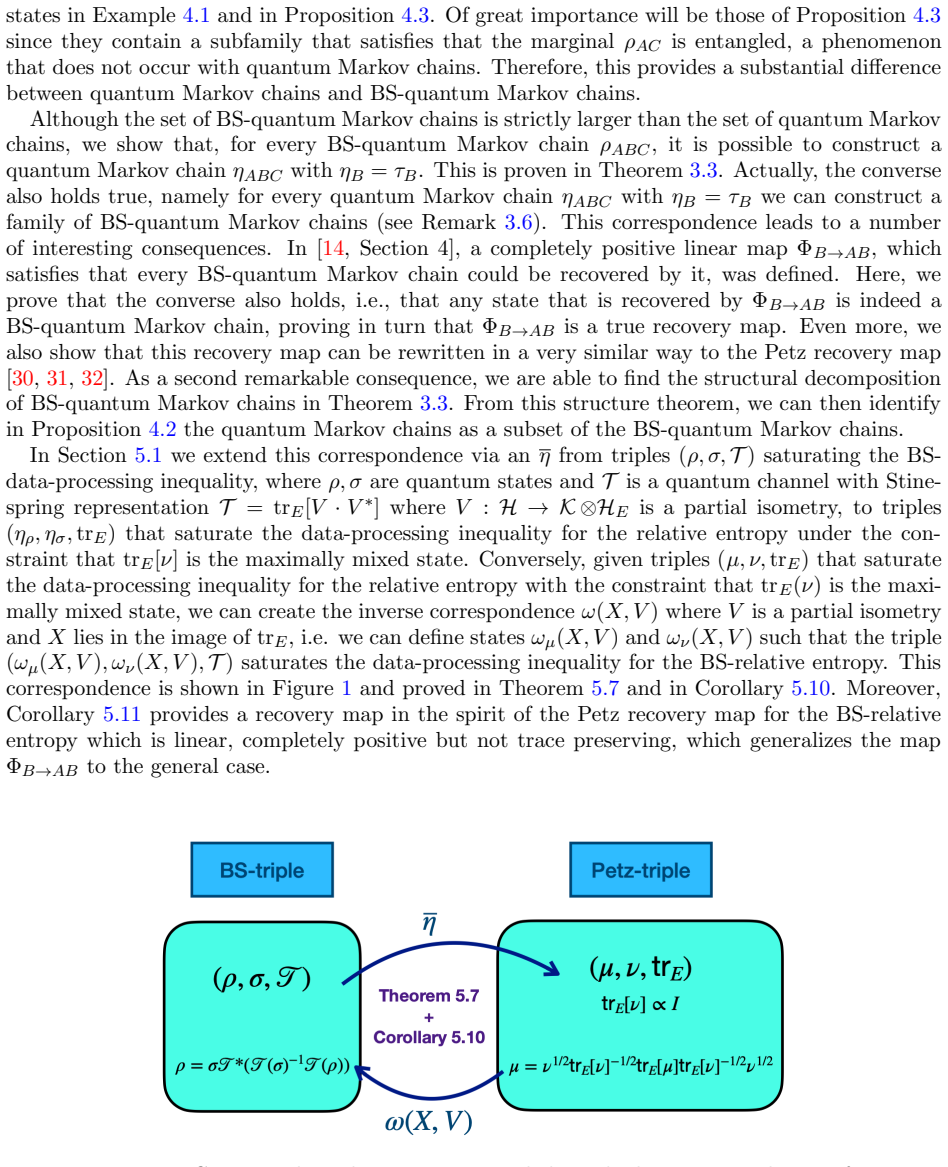
The paper establishes the equivalence stated in Theorem 3.3: for a tripartite state $\rho_{ABC}$ with invertible $\rho_B$, the rescaled state $\eta_{ABC} = d_B^{-1} \rho_B^{-1/2} \rho_{ABC} \rho_B^{-1/2}$ is a quantum Markov chain with middle marginal maximally mixed if and only if $\rho_{ABC}$ is a Belavkin–Staszewski quantum Markov chain, i.e. iff $\rho_{ABC} = \rho_{AB} \rho_B^{-1} \rho_{BC}$ and the marginals $\eta_{AB}$, $\eta_{BC}$ commute. It follows (Corollary 3.9) that $\rho_{ABC}$ is a BS-quantum Markov chain iff it is recovered from $\rho_{BC}$ by the linear completely positive map $\Phi_{B\to AB}$ with a unitary factor, closing the converse left open in an earlier work. The authors extend this correspondence to arbitrary pairs of states and channels saturating the respective data-processing inequalities, prove structural decompositions in both settings, and show that on BS-quantum Markov chains the rescaling is entanglement-breaking between $A$ and $C$, even though BS-quantum Markov chains can have entangled $AC$ marginals.
Load-bearing premise
The application to Gibbs states needs the inverse of the middle marginal, $\|\rho_B^{-1}\|_\infty$, to grow at most exponentially with $|B|$; the paper's proof of that step invokes an external bound and, as written, collapses to the tautology $\|\rho_B^{-1}\|_\infty \le C\|\rho_B^{-1}\|_\infty$.
Editorial extensions
If this is right
- Every BS-quantum Markov chain admits the block decomposition of Theorem 3.3(v), so the structural theory of ordinary quantum Markov chains applies verbatim to zero-BS-CMI states.
- The recovery map $\Phi_{B\to AB}$ is certified: a state is a BS-quantum Markov chain if and only if $(\Phi_{B\to AB}\otimes\mathrm{id}_C)(\rho_{BC})=\rho_{ABC}$, resolving the converse left open in the prior work.
- Approximate BS-quantum Markov chains are approximate quantum Markov chains: the reversed BS-CMI lower-bounds an eighth power of the CMI of $\eta_{ABC}$, and a partial upper bound holds under commuting marginals.
- Saturation of the BS data-processing inequality for general channels is equivalent to saturation of the standard relative-entropy data-processing inequality for the associated partial trace, yielding a linear completely positive recovery map.
- For Gibbs states of local finite-range translation-invariant one-dimensional Hamiltonians at any positive temperature, the associated $\eta_{ABC}$ has conditional mutual information decaying superexponentially in $|B|$, the first such example with non-vanishing CMI.
Reading between the lines
- If the exponential prefactor bound on $\|\rho_B^{-1}\|_\infty$ can be proved directly, the superexponential CMI decay of $\eta_{ABC}$ could transfer to spectral-gap statements for Davies generators through the paper's bound on $\Delta_\rho$, connecting conditional independence to open-system dynamics.
- The entanglement-breaking property of the rescaling restricted to BS-quantum Markov chains suggests quantifying the 'BS-ness' of a state by how much entanglement the rescaling removes; such a measure would separate BS-quantum Markov chains that are ordinary quantum Markov chains from those with entangled AC marginals.
- A natural testable extension is to check the paper's open rotated-recovery question, whether $(\Phi^{\mathrm{rot}}_{B\to AB}\otimes\mathrm{id}_C)(\rho_{BC})=\rho_{ABC}$ holds for exact BS-quantum Markov chains; a positive answer would give a second recovery map and sharpen the approximate bounds.
- The correspondence between saturation triples for the two relative entropies may offer an operational interpretation: BS-saturating triples are images of relative-entropy-saturating triples under a state-dependent rescaling, potentially allowing channel-capacity arguments formulated for one entropy to be ported to the other.
Signed reviews
Editorial analysis
A structured set of objections, weighed in public.
Referee Report
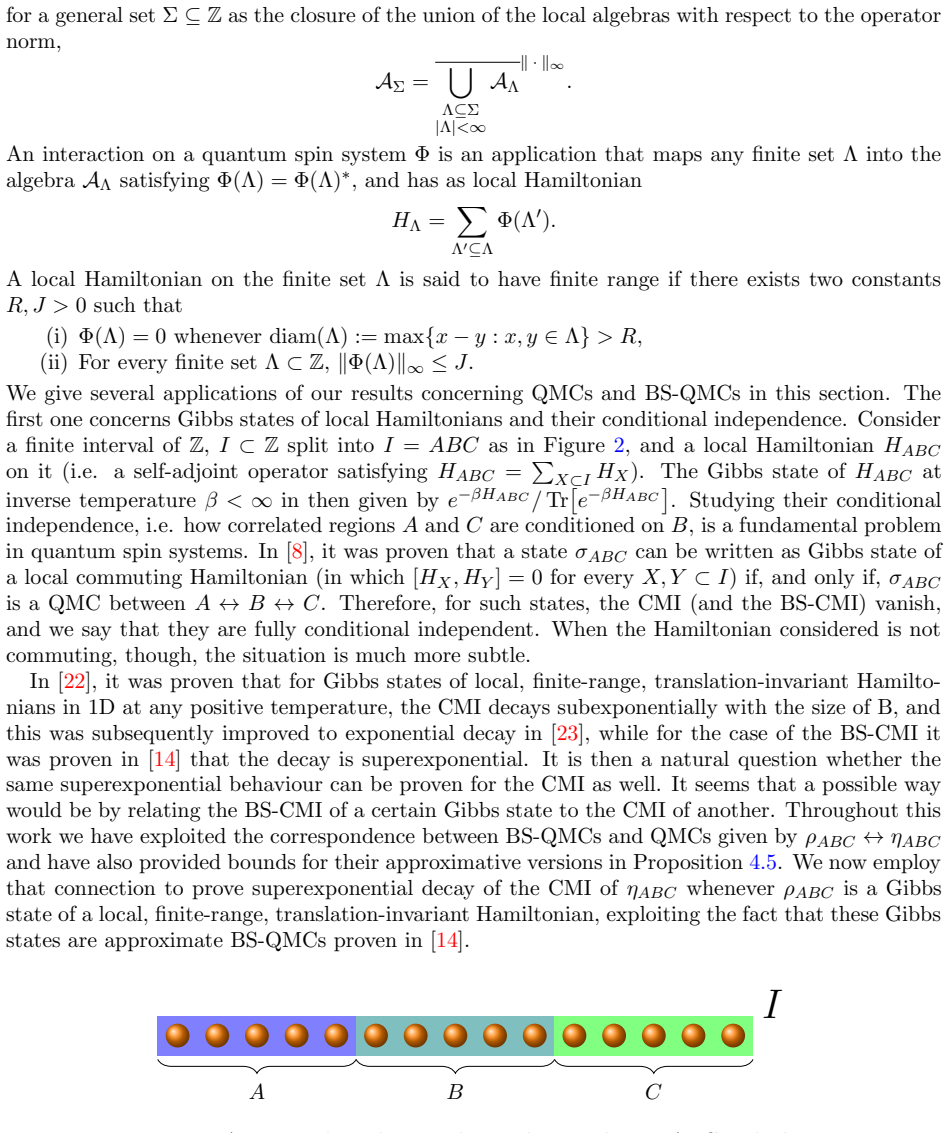
Summary. The paper introduces Belavkin-Staszewski quantum Markov chains (BS-QMCs), states with vanishing BS-conditional mutual information, and relates them to ordinary quantum Markov chains (QMCs) via the map η_ABC = d_B^{-1} ρ_B^{-1/2} ρ_ABC ρ_B^{-1/2}. The central result, Theorem 3.3, characterizes BS-QMCs as exactly those states whose associated η_ABC is a QMC with maximally mixed B marginal; it also yields a structural decomposition and a recovery map Φ_{B→AB} in Petz form with an additional unitary, including the converse direction that was left open in [14]. The paper extends the correspondence to general states and channels saturating the BS data-processing inequality (Section 5), studies approximate BS-QMCs (Propositions 4.5 and 4.6), gives examples of BS-QMCs with entangled AC marginals (Proposition 4.3), and applies the correspondence to quantum spin chains, claiming superexponential decay of the CMI of η_ABC for Gibbs states of local, finite-range, translation-invariant Hamiltonians (Theorem 6.1) and a bound on the quantity Δ_ρ relevant to spectral gaps (Proposition 6.2).
Significance. If the main results stand, this is a substantial contribution to the structural theory of quantum conditional independence. Theorem 3.3 gives a complete classification of BS-QMCs in terms of the Hayden–Jozsa–Petz–Winter QMC structure theorem, and Corollary 3.9 resolves the open recovery-map question from [14]. The recovery map Φ_{B→AB} is linear, completely positive, and resembles the Petz map, which is a notable step since the original BS recovery condition is not positive. The generalization to BS-triples and Petz-triples in Section 5, with explicit structural decompositions, is valuable and appears to be proven carefully. The paper also provides concrete constructive examples, including entangled AC marginals for BS-QMCs, which sharpen the contrast with QMCs. The advertised spin-chain application, if its prefactor bound is properly established, would provide the first family of states with non-vanishing CMI that decays superexponentially with |B|; currently that application is not fully supported by the proof as written, so the overall significance is conditional on repairing Section 6.1.
major comments (2)
- [Section 6.1, proof of Theorem 6.1] The proof does not establish the required prefactor growth. After the chain of identities for ρ_B^{-1}, the text states: 'Therefore, by [7, Corollary 4.4], we conclude ∥(ρ_B)^{-1}∥_∞ ≤ C∥(ρ_B)^{-1}∥_∞.' This displayed inequality is tautological: it provides no bound on ∥ρ_B^{-1}∥_∞ beyond itself, and the constant C is not shown to be finite or to scale in a controlled way. The final bound in Theorem 6.1 contains the factor ∥ρ_B^{-1}∥_∞^{1/2}, so to conclude superexponential decay the proof must show that this factor grows at most sub-superexponentially, typically at most exponentially in |B|. The cited [7, Corollary 4.4] is not quoted, and its hypotheses and conclusion are not checked against the present setting. This is a load-bearing gap: it affects the paper's headline application, even though it does not affect the internal coherence of Theorem 3.3.
- [Section 6.1, proof of Theorem 6.1, final paragraph] The bound on ∥ρ_{BC}^{-1/2}ρ_{ABC}ρ_{BC}^{-1/2}∥_∞ is delegated to '[4, Theorem IX.1.1]' and to '[7, Corollary 3.4(i)]' and an 'analogous proof' to '[7, Corollary 4.4]'. The latter is not carried out, and the text does not state the resulting constants. Since this term also enters the prefactor of the theorem, the proof would benefit from an explicit statement of the bounds being used, including the dependence on |B| and on the inverse-temperature, strength, and range parameters. This is a presentation gap in the same chain of reasoning as the previous comment, and it should be addressed together with it.
minor comments (6)
- [General] There are several typographical errors, including 'beging' (page 12), 'satruate' (page 24), and 'Gibss' (page 26). These should be corrected in a revision.
- [Section 4.2, Proposition 4.5] The proof of the lower bound invokes [6] for the inequality I_η(A:C|B) ≤ 2(log min{d_A,d_C}+1) ∥η_ABC - P(η_AB)∥_1^{1/2}. The cited reference is an IEEE conference paper that may not be readily available; quoting the precise inequality and its hypotheses would improve self-containedness.
- [Section 2.2, Eq. (7)] The notation bI_ρ^{os}(A;C|B), bI_ρ^{ts}(A;C|B), and bI_ρ^{rev}(A;C|B) is introduced, but the superscripts are not explained in the text; the reader must infer that 'os', 'ts', and 'rev' stand for 'operator', 'trace', and 'reversed'. A short sentence defining the labels would clarify the definition.
- [Section 4.1, Proposition 4.3] The statement of Proposition 4.3 says 'ρ_ABC is a BS-QMC and ρ_AC has negative partial transpose if and only if α ∈ [-1, 1-√3)' but the proof only shows the 'if' direction by explicit computation. The 'only if' part appears to follow from the minimum of the quadratic expression, but it would be helpful to state this explicitly.
- [Section 5.2, Theorem 5.13] In the proof of (iv) ⇒ (ii), the displayed chain of equalities uses the identity tr[T(ρ)T(σ)^{-1}T(ρ)] = tr[ρ T^*(T(σ)^{-1}T(ρ))]; this is correct, but it may not be immediately obvious to all readers that T^* is taken with respect to the Hilbert-Schmidt inner product. A brief reminder would improve readability.
- [Section 6.2, Proposition 6.2] The function f(ρ) is said to be 'explicitly defined in the proof', but the proof defines it as g(ρ) = g_1(ρ)^{-1}; the final statement would be clearer if the dependence on d_A, d_C, d_D and on the norm factors were displayed in the proposition itself.
Circularity Check
Core BS-QMC/QMC classification (Thm 3.3, Cor 3.9) is internally derived; the superexponential CMI application (Thm 6.1) contains a circular prefactor step: the proof concludes ∥ρ_B^{-1}∥∞ ≤ C∥ρ_B^{-1}∥∞, leaving the required growth bound unsupplied.
-
other
[Section 6.1, proof of Theorem 6.1, prefactor estimate for ∥ρ_B^{-1}∥∞]
"By a very similar calculation to that of [14, Lemma 3.5], we have ∥ρ^{-1}_B∥^{1/2}_∞ ≤ C1 e^{α1|B|}. ... Therefore, by [7, Corollary 4.4], we conclude ∥(ρ_B)^{-1}∥∞ ≤ C∥(ρ_B)^{-1}∥∞."
The step is meant to establish the exponential prefactor bound needed in Theorem 6.1, but the displayed conclusion has the same norm on both sides: ∥ρ_B^{-1}∥∞ ≤ C∥ρ_B^{-1}∥∞ holds trivially for any C≥1 and contains no |B| dependence. Thus the desired control over the prefactor is not derived; it is re-inserted as the right-hand side. The following remark that a 'last term' scales exponentially does not remove the same norm from the RHS. All substantive work is delegated to [7, Cor. 4.4] (authors' prior work), whose content is not quoted; if that result supplies the missing estimate, the proof is incomplete as written, and if it does not, Theorem 6.1 is unsupported. This is a self-referential step in the application, not in the central classification Theorem 3.3.
full rationale
The central correspondence (Theorem 3.3) is derived from the [5] saturation characterization and the Hayden-Jozsa-Petz-Winter structure theorem, with explicit algebra: BS-QMC iff ρABC=ρABρ_B^{-1}ρBC, and the η transform then satisfies the QMC condition because the marginals commute; the converse directions are direct trace computations. Corollary 3.9 follows from the same identity. The Petz/BS-triple correspondence (Theorems 5.4, 5.7, 5.13) is built on independently stated recovery conditions and structural theorems, not on the conclusions being proved. No definitional equivalence or fitted-input-as-prediction pattern appears in these core results. The only circular step is in the auxiliary application Theorem 6.1: the proof claims the exponential prefactor bound but derives only a tautological inequality with ∥ρ_B^{-1}∥∞ on both sides, delegating the real estimate to [7, Cor. 4.4]. Because the central classification has independent content and the circularity is confined to a prefactor estimate in an application, the score is 4 rather than 6 or higher.
Assumptions & free parameters
assumptions (5)
- domain assumption Finite-dimensional Hilbert spaces and states as density matrices; support conditions ensure relative entropies are finite.
- standard math Saturation of the BS-DPI is characterized by the recovery condition B^σ_T from [5], and saturation of the Umegaki DPI by the Petz recovery map from [30,31,32] and [17].
- standard math Hayden-Jozsa-Petz-Winter structure theorem for quantum Markov chains [16].
- domain assumption Superexponential decay of the BS-conditional mutual information for Gibbs states of local, finite-range, translation-invariant 1D Hamiltonians, and the reversed BS-CMI inequality Eq. (8), from [14].
- domain assumption Quantum spin chain formalism: local finite-range translation-invariant interactions, Gibbs states e^{-βH}/tr, and Araki expansion bounds from [7].
Cite this review
Pith. "Pith review of Belavkin-Staszewski Quantum Markov Chains." pith.science (2026). https://pith.science/paper/6TGJAWC3
@misc{pith2026250109708,
  author       = {Pith},
  title        = {Pith review of: Belavkin-Staszewski Quantum Markov Chains},
  year         = {2026},
  howpublished = {\url{https://pith.science/paper/6TGJAWC3}},
  note         = {Machine review of arXiv:2501.09708}
}
read the original abstract
It is well-known that the conditional mutual information of a quantum state is zero if, and only if, the quantum state is a quantum Markov chain. Replacing the Umegaki relative entropy in the definition of the conditional mutual information by the Belavkin-Staszewski (BS) relative entropy, we obtain the BS-conditional mutual information, and we call the states with zero BS-conditional mutual information Belavkin-Staszewski quantum Markov chains. In this article, we establish a correspondence which relates quantum Markov chains and BS-quantum Markov chains. This correspondence allows us to find a recovery map for the BS-entropy in the spirit of the Petz recovery map. Furthermore, we show that, over the set of BS-quantum Markov chains, this correspondence constitutes an entanglement-breaking map. Moreover, we prove a structural decomposition of the Belavkin-Staszewski quantum Markov chains and also study states for which the BS-conditional mutual information is only approximately zero. We subsequently extend the aforementioned correspondence, structural decomposition and recovery map to arbitrary pairs of states and conditional expectations. As an application of the correspondence, we find the first family of states with non-vanishing conditional mutual information for which it decays superexponentially fast with the size of the middle system.
Figures
Forward citations
Cited by 1 Pith paper
-
Spectral Gap Bounds for Quantum Markov Semigroups via Correlation Decay
A purified canonical Hamiltonian connects correlation decay of a quantum state to spectral gaps of Davies generators, yielding size-independent gap bounds for 1D chains and quantum double models.
Reference graph
Works this paper leans on
-
[5]
A. Bluhm and ´A. Capel. A strengthened data processing inequality for the Belavkin-Staszewski relative entropy. Rev. Math. Phys. , 32(2):2050005, 2020. 4, 5, 16, 18
work page 2020
- [7]
-
[14]
Conditional Independence of 1D Gibbs States with Applications to Efficient Learning
P. Gondolf, S. O. Scalet, A. Ruiz-de Alarcon, A. M. Alhambra, and A. Capel. Conditional independence of 1D Gibbs states with applications to efficient learning. arXiv preprint arXiv:2402.18500 , 2024. 1, 2, 3, 5, 13, 15, 16, 25, 26, 28
work page Pith review arXiv 2024
-
[1]
L. Accardi and A. Frigerio. Markovian cocycles. Proc. R. Ir. Acad., A Math. phys. sci. , 83A(2):251–263, 1983. 1
work page 1983
-
[2]
H. Araki. Gibbs states of the one-dimensional quantum spin chain. Commun. Math. Phys. , 14:120–157, 1969. 26
work page 1969
-
[3]
V. P. Belavkin and P. Staszewski. C ∗-algebraic generalization of relative entropy and entropy. Ann. Inst. Henri Poincar´ e, section A, 37(1):51–58, 1982. 3
work page 1982
-
[4]
R. Bhatia. Matrix analysis . Springer Science & Business Media, 12 2013. 17, 26
work page 2013
- [6]
Show all 36 references
-
[8]
Brown and D
W. Brown and D. Poulin. Quantum Markov networks and commuting Hamiltonians. arXiv preprint arXiv:1206.0755, 2012. 1, 7, 25, 29
2012 arXiv
-
[9]
E. A. Carlen and A. Vershynina. Recovery map stability for the data processing inequality. J. Phys. A: Math. Theor., 53(3):035204, 2020. 4, 14, 19
2020
-
[10]
M.-D. Choi. A Schwarz inequality for positive linear maps on C ∗-algebras. Illinois J. Math. , 18(4):565–574, 1974. 23
1974
-
[11]
C. Davis. A Schwarz inequality for convex operator functions. Proc. Am. Math. Soc. , 8(1):42–44, 1957. 23
1957
-
[12]
Fang and H
K. Fang and H. Fawzi. Geometric R´ enyi divergence and its applications in quantum channel capacities.Commun. Math. Phys. , 384(3):1615–1677, 2021. 1, 17
2021
-
[13]
Fawzi and R
O. Fawzi and R. Renner. Quantum conditional mutual information and approximate Markov chains. Commun. Math. Phys. , 340(2):575–611, 2015. 4
2015
-
[15]
J. M. Hammersley and P. Clifford. Markov fields on finite graphs and lattices. https://ora.ox.ac.uk/objects/ uuid:4ea849da-1511-4578-bb88-6a8d02f457a6 , 1971. 1
1971
-
[16]
Hayden, R
P. Hayden, R. Jozsa, D. Petz, and A. Winter. Structure of states which satisfy strong subadditivity of quantum entropy with equality. Commun. Math. Phys. , 246:359–374, 2004. 1, 4, 6, 9, 10, 28
2004
-
[17]
Hiai and M
F. Hiai and M. Mosonyi. Different quantum f-divergencies and the reversibility of quantum operations. Rev. Math. Phys. , 29(7):1750023, 2017. 1, 3, 7, 8, 16, 17, 22
2017
-
[18]
Hiai and D
F. Hiai and D. Petz. The proper formula for relative entropy and its asymptotics in quantum probability. Commun. Math. Phys. , 143:99–114, 1991. 3
1991
-
[19]
Jenˇ cov´ a and D
A. Jenˇ cov´ a and D. Petz. Sufficiency in quantum statistical inference.Communications in mathematical physics , 263(1):259–276, 2006. 3, 21
2006
-
[20]
Jencov´ a, D
A. Jencov´ a, D. Petz, and J. Pitrik. Markov triplets on CCR-algebras. Acta Sci. Math. , 76:27–50, 2009. 1, 8
2009
-
[21]
Junge, R
M. Junge, R. Renner, D. Sutter, M. M. Wilde, and A. Winter. Universal recovery maps and approximate sufficiency of quantum relative entropy. Ann. Henri Poincar´ e, 19(10):2955–2978, 2018. 4
2018
-
[22]
Kato and F
K. Kato and F. G. S. L. Brand˜ ao. Quantum approximate Markov chains are thermal. Commun. Math. Phys. , 370(1):117–149, 2019. doi:10.1007/s00220-019-03485-6 . arXiv:1609.06636. 25
2019 arXiv
-
[23]
Kuwahara
T. Kuwahara. Clustering of conditional mutual information and quantum Markov structure at arbitrary tem- peratures. arXiv preprint arXiv:2407.05835 , 2024. 25, 28
2024
-
[24]
E. H. Lieb and M. B. Ruskai. Proof of the strong subadditivity of quantum mechanical entropy. J. Math. Phys. , 14:1938–1941, 1973. 4
1938
-
[25]
Lucia, D
A. Lucia, D. P´ erez-Garc ´ ıa, and A. P´ erez-Hern´ andez. Spectral gap bounds for quantum Markov semigroups via correlation decay. arXiv preprint arXiv:2505.08991 , 2025. 27, 28
2025 arXiv
-
[26]
Matsumoto
K. Matsumoto. A new quantum version of f -divergence. In Reality and Measurement in Algebraic Quantum Theory, pages 229–273. Springer, 2018. 7, 16
2018
-
[27]
Mosonyi and D
M. Mosonyi and D. Petz. Structure of sufficient quantum coarse-grainings. Letters in Mathematical Physics , 68:19–30, 2004. 3, 21
2004
-
[28]
Ohya and D
M. Ohya and D. Petz. Quantum Entropy and Its Use . Theoretical and Mathematical Physics. Springer Berlin, Heidelberg, 1993. 17
1993
-
[29]
V. Paulsen. Completely bounded maps and operator algebras . Cambridge University Press, 2002. 16
2002
-
[30]
D. Petz. Sufficiency of channels over von Neumann algebras. Q. J. Math. , 39:97–108, 1978. 2, 3
1978
-
[31]
D. Petz. Sufficient subalgebras and the relative entropy of states of a von Neumann algebra. Commun. Math. Phys., 105:123–131, 1986. 2, 3
1986
-
[32]
D. Petz. Monotonicity of quantum relative entropy revisited. Rev. Math. Phys. , 15(1):79–91, 2003. 1, 2, 3, 4, 19 30
2003
-
[33]
D. Petz. Quantum Information Theory and Quantum Statistics . Springer, 2008. 10
2008
-
[34]
Sutter, M
D. Sutter, M. Berta, and M. Tomamichel. Multivariate trace inequalities. Commun. Math. Phys. , 352(1):37–58,
-
[35]
H. Umegaki. Conditional expectation in an operator algebra IV. Entropy and information. Kodai Math. Sem. Rep., 14:59–85, 1962. 3
1962
-
[36]
M. M. Wilde. Recoverability in quantum information theory. Proc. Math. Phys. Eng. Sci. , 471(2182):20150338, 9 2015. 14 Email address : andreas.bluhm@univ-grenoble-alpes.fr Univ. Grenoble Alpes, CNRS, Grenoble INP, LIG, 38000 Grenoble, France Email address : ac2722@cam.ac.uk C...
2015
Reviewed August 10, 2026 · model on record in the stance chip above.
Discussion (0). Continue with ORCID to comment.