REVIEW 3 major objections 5 minor 34 references
Higher-order effects in the dynamics of hierarchical triple systems. III. Astrophysical implications of second-order and dotriacontapole terms
T0 review · 3 major / 5 minor · reviewed 2026-08-10 · deepseek-v4-flash
Pith's one-line read Second-order terms beat first-order theory in most hierarchical triples.
desk verdict Solid applications paper showing genuine second-order secular effects, but the headline N-body agreement claim needs quantitative backing. read the letter →
The pith
A machine-rendered reading of the paper's core claim, the machinery that carries it, and where it could break.
The reading
What carries the argument
The load-bearing object is the set of 'SOD' orbit-averaged secular evolution equations for the inner and outer orbital elements, obtained in Paper II by a two-timescale expansion of the exact Lagrange planetary equations. The scheme splits every orbital element into an average part and an average-free oscillatory part; feeding the average-free parts back into the planetary equations and re-averaging produces second-order 'feedback' and 'time-conversion' terms (Table I) with amplitudes scaling as $alpha^{2}$ $epsilon^{{9/2}}$, $\alpha$ eta $epsilon^{5}$, $alpha^{2}$ $\Delta$ $epsilon^{{11/2}}$, and $alpha^{2}$ $epsilon^{6}$, where $\alpha$ = m3/m and epsilon = a/A. These terms are what generate secular semimajor-axis variations at orders $epsilon^{5}$ and $epsilon^{6}$, absent at linear order, and what modify the eccentricity and inclination evolution at high outer mass. The first-order dotriacontapole term, scaling as $\alpha$ $\Delta$ (1 - 2 eta) $epsilon^{6}$, is included in the same SOD set.
What would settle it
Run a systematic suite of stable hierarchical triples spanning the paper's parameter space, with mass ratios m3/m from $10^{-2}$ to $10^{5}$, semimajor-axis ratios epsilon from $10^{-3}$ to $10^{-1}$, and mutual inclinations from 5 to 98 degrees, and compare long-term N-body integrations (about $10^{5}$ inner orbits with REBOUND/IAS15) against both the SOD equations and first-order equations through hexadecapole order; if the first-order model is closer to the N-body data in a majority of systems, the paper's central claim fails.
Extended reading notes
Core claim
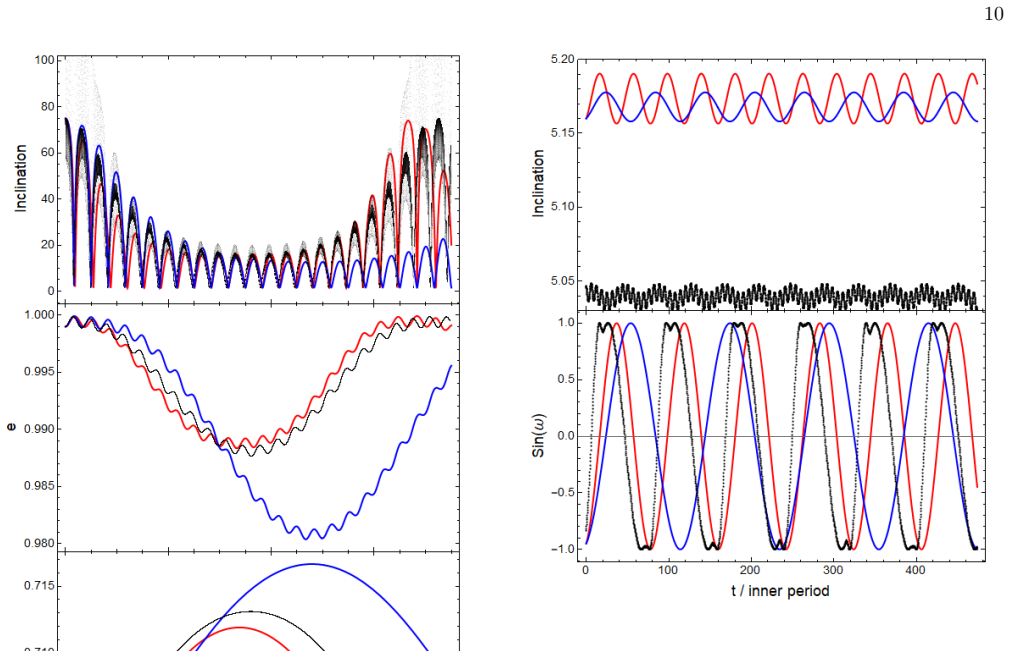
The paper shows that the second-order secular terms and the first-order dotriacontapole term, taken together as the SOD system, are not merely small corrections. For a Jupiter-like planet around a solar-mass star with a brown-dwarf companion, the SOD terms produce only modest shifts in flip timing. But in a stellar-mass binary orbiting a supermassive black hole, they cleanly suppress the orbital flips predicted by first-order octupole theory when the second-order amplitudes exceed the octupole amplitude, and the resulting no-flip evolution matches N-body integrations. For a planet orbiting a 10:1-mass-ratio binary, the SOD equations predict long-period secular oscillations of the planetary semimajor axis with an amplitude of about 0.5 AU over roughly 2 times $10^{5}$ inner orbits, an effect that is exactly zero at first order; the N-body data show the same oscillation. For a 30 plus 20 solar-mass inner binary with a 30 solar-mass outer black hole, the SOD and N-body solutions reach inner eccentricities above 0.999 much earlier than the octupole solution, shortening the implied gravitational-wave inspiral time. In the Earth-Moon-Sun system, the second-order quadrupole-squared term moves the lunar perigee advance period from 118 to 88 months, matching the N-body result.
Load-bearing premise
The results hold only if the orbit-averaged secular expansion remains valid for the whole evolution, meaning neglected resonances and yet-higher-order terms stay small enough that the SOD terms are the dominant correction, and if the averaged initial elements faithfully represent the N-body osculating elements.
Editorial extensions
If this is right
- For circumbinary planets, second-order terms drive secular semimajor-axis oscillations with amplitudes that can reach several percent of the orbital separation, so population studies that treat the planet's semimajor axis as fixed will miss this drift.
- In high-outer-mass triples, the presence or absence of orbital flips becomes a function of the ratio of octupole to second-order amplitudes, not just of first-order secular theory, so flip suppression can be diagnosed from the mass ratio and stability parameter.
- Triple black hole merger rates estimated with octupole-only secular equations may be biased because the inner binary reaches extreme eccentricity earlier when SOD terms are included, shortening the gravitational-wave-driven inspiral time.
- The SOD equations provide a computationally cheaper replacement for direct N-body integration in the stable hierarchical regime, with better fidelity than first-order secular models in most tested cases.
- The Earth-Moon-Sun test shows that even 'standard' hierarchical triples require second-order terms for accurate perigee advance, indicating that first-order-only lunar models are incomplete.
Reading between the lines
- Because the new semimajor-axis variations are periodic in the pericenter angles, which themselves precess secularly, the oscillation shown here could accumulate into a systematic migration over timescales much longer than the plots in the paper; that would matter for circumbinary planet survival, though the paper does not address it.
- The paper's comparisons rely on identifying averaged orbital elements with instantaneous osculating N-body initial conditions; a systematic method for constructing the average-free initial offset would likely remove the small vertical offsets in the semimajor-axis comparisons and sharpen the validation of the second-order terms.
- One could map the regime where second-order terms dominate octupole terms as a function of alpha, epsilon, and inclination, turning the three worked cases (A, B, C) into a phase diagram of flip suppression; the paper only samples three points.
- A clean numerical separation of the epsilon^6 first-order dotriacontapole term from the epsilon^6 second-order terms would clarify which piece drives the early eccentricity growth in the triple black hole example; the paper's combined SOD set does not isolate them.
Editorial analysis
A structured set of objections, weighed in public.
Referee Report
Summary. This paper is the third in a series on secular dynamics of hierarchical triple systems. It applies the second-order and dotriacontapole (SOD) secular equations derived in Paper II to several astrophysical systems: hot Jupiters, high-outer-mass systems around supermassive black holes, circumbinary planets, planets in binaries, triple black holes, and the Earth-Moon-Sun system. The authors compare SOD integrations, first-order secular integrations (octupole or hexadecapole), and REBOUND N-body integrations for selected cases. They report that SOD effects suppress orbital flips in high-outer-mass systems, produce secular semimajor-axis variations for circumbinary planets, generate earlier large eccentricities in triple black holes, and improve agreement with N-body integrations in most of the cases shown.
Significance. If the SOD equations are validated, the paper identifies several physically important effects that first-order secular theory misses: finite semimajor-axis drift in circumbinary systems, suppression of flips in high-outer-mass triples, and accelerated eccentricity growth in triple black holes with consequences for merger times. The authors have made the full equation set publicly available, which is a concrete strength and will allow independent checking and reuse. The lunar example provides a clean analytic sanity check of the second-order contribution to the pericenter precession rate. However, the paper's central comparative claim, that SOD equations agree with N-body integrations better than first-order equations 'in most cases,' rests on a small set of visual comparisons without quantitative error metrics, so the significance of the headline claim is not yet established at the level the abstract asserts.
major comments (3)
- [Abstract; §III A 4; §III B] The central claim 'in most cases, evolutions using our SOD equations are in better agreement with those from direct integration of the N-body equations of motion than those from first-order perturbations through hexadecapole order' is supported only by visual inspection of a handful of hand-selected examples. No quantitative error metric is given, and Case C in Fig. 7 is explicitly described as showing only 'spotty agreement.' Please provide a quantitative comparison, such as RMS deviations in e, z, a, and A over the integration window, ideally averaged over an ensemble of initial orbital phases, and state precisely how 'most cases' is defined.
- [§II C; §III B 1; §III B 2] The validation of the semimajor-axis drift, a headline SOD effect, has a load-bearing gap. Section II C states that the secular equations are initialized with osculating element values without mapping to the averaged elements (despite Paper II providing the average-free pieces), and that the N-body output is running-averaged. Figure 2 shows that the N-body semimajor-axis evolution depends strongly on the initial inner true anomaly. Consequently, the 'rough agreement' in Figs. 8 and 9 between SOD and N-body semimajor axes could be partly an artifact of the chosen phases or of comparing averaged secular variables with running-averaged osculating data. Please add phase-averaged or offset-corrected comparisons for the semimajor-axis evolutions.
- [§II B; §III A 4; §III B 4] The paper states in Section II B that the secular approximation ignores orbital resonance effects and 'will begin to fail in describing systems with high E,' and that attention is confined to systems satisfying the improved Mardling-Aarseth stability criterion. However, two systems used in the main comparisons have stability ratio Y* below unity: Case A in Fig. 7 has Y* = 0.9957 and the Earth-Moon-Sun system in Fig. 11 has Y* = 0.955. Please either justify the use of these marginally unstable cases or restrict the validation and generalization claims accordingly.
minor comments (5)
- [References] Reference [11] is mis-cited: the in-text citation 'Paper II [11]' points to Cornish and Key (2010), which is unrelated to the secular equations of Paper II; the actual Paper II (Conway and Will 2024) appears only later as [24]. Please correct the citation numbering.
- [Section I heading] The heading 'INTRODUCTION AND SUMMAR Y' contains an unwanted space in 'SUMMARY'; please fix.
- [Fig. 7 caption] The caption for Fig. 7 mentions octupole, SOD, and N-body solutions but does not identify the line colors; a legend or explicit color key would make the figure self-contained.
- [Eq. (2.8)] The notation [A±] = A+ + A− and related bracket definitions are introduced after Eq. (2.8), which makes the equations difficult to parse on first reading; consider defining the notation before presenting the equations.
- [Section IV] The final discussion suggests that SOD equations may allow population simulations 'with better fidelity' and less computational cost than N-body integrations, but this claim is not demonstrated by the paper's few case studies; either soften the wording or cite a benchmark.
Circularity Check
No significant circularity: the SOD equations are self-cited from Paper II, but the paper's headline claims are checked against independent REBOUND N-body integrations with no fitted parameters.
full rationale
Walked the derivation chain. The SOD evolution equations are imported from Paper II (Conway & Will 2024), a self-citation, but every astrophysical claim in this paper is tested against REBOUND/IAS15 N-body integrations, an external benchmark. No parameter is fitted to those integrations: the semimajor-axis drift prediction (Eq. 2.8) is compared directly to N-body running averages, and no tuning is reported. The acknowledged averaged-vs-osculating initial-condition offset and phase sensitivity in Sec. II C weaken the quantitative comparison but do not make the prediction equivalent to its input by construction. The abstract's 'in most cases' generalization is supported only by a handful of visual comparisons, which is a correctness/robustness concern, not circularity. No step was found where Eq. X = Eq. Y by definition, where a fitted parameter is renamed a prediction, or where a load-bearing conclusion rests solely on an unverified self-citation. The self-citation supplies the equations, but the paper's central evidential weight is the independent N-body agreement.
Assumptions & free parameters
free parameters (2)
- Outer semimajor axes for high-outer-mass cases A, B, C =
A = 3 a.u., 1.35 a.u., 0.5 a.u.
- Initial orbital elements for the case studies =
various per system (e.g., e = 0.8, E = 0.5, z = 65 deg for planet in binary; e = 0.999, E = 0.7, z = 75 deg for triple…
assumptions (6)
- standard math The Lagrange planetary equations are an exact change of variables equivalent to Newton's equations for the osculating elements of the inner and outer orbits.
- standard math The two-timescale perturbation method cleanly separates averaged and average-free parts and can be iterated to second order in the perturbative parameter.
- domain assumption The hierarchy is weakly perturbed: alpha epsilon^3 << 1 and epsilon << 1, where alpha = m3/m and epsilon = a/A.
- domain assumption The secular (orbit-averaged) approximation remains valid for the studied systems; resonances and high outer eccentricity do not spoil the average.
- domain assumption The REBOUND code with the IAS15 integrator provides accurate N-body ground truth for the comparisons.
- standard math Classical no-secular-drift theorems for semimajor axes permit the periodic-in-angles variations in Eq. (2.8).
Cite this review
Pith. "Pith review of Higher-order effects in the dynamics of hierarchical triple systems. III. Astrophysical implications of second-order and dotriacontapole terms." pith.science (2026). https://pith.science/paper/ITIC2KHM
@misc{pith2026250111187,
  author       = {Pith},
  title        = {Pith review of: Higher-order effects in the dynamics of hierarchical triple systems. III. Astrophysical implications of second-order and dotriacontapole terms},
  year         = {2026},
  howpublished = {\url{https://pith.science/paper/ITIC2KHM}},
  note         = {Machine review of arXiv:2501.11187}
}
abstract
We study the long-term evolution of selected hierarchical triple systems in Newtonian gravity. We employ analytic equations derived in Paper II for the evolution of orbit-averaged orbital elements for both inner and outer orbits, which include two classes of contributions. One class consists of linear-order contributions, including quadrupole, octupole, hexadecapole and dotriacontapole orders, the latter scaling as $\epsilon^6$, where $\epsilon = a/A$, the ratio of the semimajor axes of the inner and outer orbits. The second class consists of contributions at {\em second} order in the fundamental perturbation parameter; they contribute at orders $\epsilon^{9/2}$, $\epsilon^{5}$, $\epsilon^{11/2}$ and $\epsilon^{6}$. For well studied triples such as star-planet systems perturbed by a low-mass third body (``hot Jupiters''), second-order and dotriacontapole (SOD) effects induce only small corrections. For stellar-mass binaries orbiting supermassive black holes, SOD corrections can suppress orbital flips that are generated by purely first-order effects. Planets orbiting binary star systems are susceptible to significant variations in the planetary semimajor axis, an effect that does not occur at first perturbative order. SOD effects in triple black hole systems can induce migrations of the eccentricity to significantly larger values than predicted by first-order perturbations, with implications for the gravitational-wave induced inspiral of the inner binary. We also show that in most cases, evolutions using our SOD equations are in better agreement with those from direct integration of the N-body equations of motion than those from first-order perturbations through hexadecapole order.
Figures


Figures from the paper (5 more)



Reference graph
Works this paper leans on
-
[1]
Hot Jupiters The first system we consider is taken from Naoz et al. [9] who discussed the possibility of hot Jupiters in retrograde orbits as a result of secular three-body effects. They considered a system composed of an inner binary containing a solar mass star and a Jupiter mass planet (M⊙ = 1047MJ ) with a = 6 a.u. perturbed by a brown dwarf of mass 4...
-
[2]
[20] in a similar system 7 FIG
Orbital flips from nearly coplanar orbits The possibility of orbital flips from nearly coplanar or- bits was discovered by Li et al. [20] in a similar system 7 FIG. 5: Comparison of orbital flips and eccentricity excur- sions in a nearly coplanar Jupiter Sun system between linear hexadecapole effects (blue) and SODeffects (red). of masses but with a = 4 a...
-
[3]
and an outer star, with m3 = 0.6M⊙, A = 800 a.u
A triple-star hierarchical system This system, studied by Fabrycky and Tremaine [21], consists of an inner binary with m1 = M⊙, m2 = 0.25M⊙, a = 60 a.u. and an outer star, with m3 = 0.6M⊙, A = 800 a.u. The remaining initial orbital ele- ments are e = 0.01, ω= 0o, E= 0.6, ω3 = 0o, z= 98o. The stability factor Y ∗ of this system is 1.588. We evolve the syst...
-
[4]
High-outer-mass systems Because the second-order perturbative effects involve an additional factor of m3/m, then the regime of high outer mass, where m3/m ≫ 1, may display interest- ing effects. In Paper I, we studied systems such as a 1M⊙ + 100M⊙ binary system orbiting a 10 6 M⊙ black hole, and found that the dominant quadrupole squared terms (the leadin...
-
[5]
The first system consists of an inner binary with m1 = M⊙, m2 = 10M⊙, a = 1 a.u
Circumbinary planet In this section we focus on astrophysical systems, not explored in earlier work, that showcase the differences between octupole and SOD solutions. The first system consists of an inner binary with m1 = M⊙, m2 = 10M⊙, a = 1 a.u. and an outer planetary body, with m3 = M⊙/1047 and A = 10 a.u. The remaining initial orbital elements are e =...
-
[6]
and an outer body, with m3 = M⊙ and A = 14 a.u
Planet in a binary system We next consider a system composed of an inner binary with m1 = M⊙, m2 = M⊙/1047, a = 1 a.u. and an outer body, with m3 = M⊙ and A = 14 a.u. The remaining initial orbital elements are e = 0.8, ω= 0o, E= 0.5, ω3 = 0o, z= 65o. The stability factor Y ∗ for this system is 1.497. We evolve the system for 1 × 10⁴ periods of the inner o...
-
[7]
Triple black holes and merger rates Investigating the rate of binary black hole inspirals in- duced by a third black hole in an eccentric orbit, Su et al
-
[8]
C. M. Will, Phys. Rev. D 103, 063003 (2021), 2011.13286
arXiv 2021
Show all 34 references
-
[9]
ground zero
The Earth-Moon-Sun system The final system we consider is the triple formed from the Earth, Moon and Sun. This system is the “ground zero” for hierarchical triple dynamics, as Newton himself tackled it, unsuccessfully, as it turned out. The parame- ters and orbital elements de...
- [10]
-
[11]
Merritt, Dynamics and Evolution of Galactic Nuclei (Princeton University Press, Princeton, 2013)
D. Merritt, Dynamics and Evolution of Galactic Nuclei (Princeton University Press, Princeton, 2013)
2013
-
[12]
Valtonen and H
M. Valtonen and H. Karttunen, The Three-Body Problem (Cambridge University Press, Cambridge, 2005)
2005
-
[13]
R. A. Mardling, Resonance, Chaos and Stability: The Three-Body Problem in Astrophysics (Springer Dor- drecht, 2008), vol. 760 of Lecture Notes in Physics, p. 59
2008
-
[14]
C. D. Murray and S. F. Dermott, Solar System Dynamics (Cambridge University Press, Cambridge, 1999)
1999
-
[15]
Poisson and C
E. Poisson and C. M. Will, Gravity: Newtonian, Post- Newtonian, Relativistic (Cambridge University Press, Cambridge, 2014)
2014
-
[16]
C. M. Bender and S. A. Orszag, Advanced Mathematical Methods for Scientists and Engineers (McGraw-Hill, New York, 1978)
1978
-
[17]
Andoyer, Annales de l’Observatoire de Paris 23, A.1 (1902)
H. Andoyer, Annales de l’Observatoire de Paris 23, A.1 (1902)
1902
-
[18]
S. Naoz, W. M. Farr, Y. Lithwick, F. A. Rasio, and J. Teyssandier, Nature (London) 473, 187 (2011), 1011.2501
2011 arXiv
-
[19]
S. Naoz, W. M. Farr, Y. Lithwick, F. A. Rasio, and J. Teyssandier, Mon. Not. R. Astron. Soc. 431, 2155 (2013), 1107.2414
2013 arXiv
-
[20]
N. J. Cornish and J. S. Key, Phys. Rev. D 82, 044028 (2010), 1004.5322
2010 arXiv
-
[21]
C. M. Will, Phys. Rev. D 96, 023017 (2017), 1705.03962. 12
2017 arXiv
-
[22]
used octupole order secular equations of motion aug- mented with relativistic 1PN pericenter precessions and 2.5PN gravitational radiation reaction terms to evolve a population of triple black hole systems with eccentric outer orbits. The evolution of the inner orbit’s eccen- ...
-
[23]
R. A. Mardling and S. J. Aarseth, Mon. Not. R. Astron. Soc. 321, 398 (2001)
2001
-
[24]
Vynatheya, A
P. Vynatheya, A. S. Hamers, R. A. Mardling, and E. P. Bellinger, Mon. Not. R. Astron. Soc. 516, 4146 (2022), 2207.03151
2022 arXiv
-
[25]
Poincare, Bulletin Astronomique, Serie I 14, 241 (1897)
H. Poincare, Bulletin Astronomique, Serie I 14, 241 (1897)
-
[26]
Tisserand, Trait´ e de M´ ecanique C´ eleste, vol
F. Tisserand, Trait´ e de M´ ecanique C´ eleste, vol. 1 (Gauthier-Villars et Fils, 1889)
-
[27]
Duriez, Astron
L. Duriez, Astron. Astrophys. 68, 199 (1978)
1978
- [28]
-
[29]
G. Li, S. Naoz, B. Kocsis, and A. Loeb, Astrophys. J. 785, 116 (2014), 1310.6044
2014 arXiv
- [30]
-
[31]
Y. Su, B. Liu, and S. Xu, Astrophys. J. 971, 139 (2024), 2405.12270
2024 arXiv
-
[32]
E. W. Brown, An introductory treatise on the lunar the- ory (Cambridge University Press, Cambridge, 1896)
- [33]
-
[34]
Rein and D
H. Rein and D. S. Spiegel, Mon. Not. R. Astron. Soc. 446, 1424 (2015), 1409.4779
2015 arXiv
Reviewed August 10, 2026 · model on record in the stance chip above.
Discussion (0). Continue with ORCID to comment.